Genesis 16:8
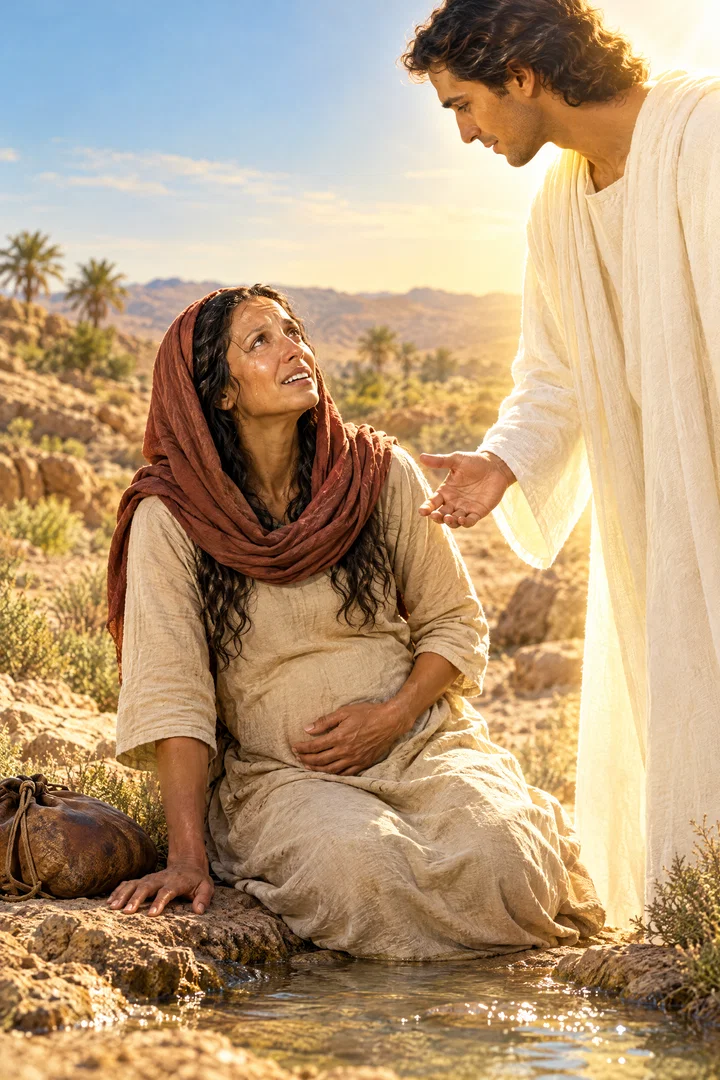
And he said, Hagar, Sarai’s maid, whence camest thou? and whither wilt thou go? And she said, I flee from the face of my mistress Sarai.
Translations
And he said, Hagar, Sarai’s maid, from where came you? and where will you go? And she said, I flee from the face of my mistress Sarai.
King James Version, KJV Cambridge Paragraph Bible
And he said, Hagar, Sarai’s maid, whence camest thou? and whither wilt thou go? And she said, I flee from the face of my mistress Sarai.
And he said, Hagar, Sarai's maid, whence camest thou? and whither wilt thou go? And she said, I flee from the face of my mistress Sarai.
And he said, Hagar, Sarai’s handmaid, whence camest thou? and whither goest thou? And she said, I flee from the face of my mistress Sarai.
And he said, Hagar, Sarai’s handmaid, whence camest thou? and whither goest thou? And she said, I am fleeing from the face of my mistress Sarai.
and he saith, 'Hagar, Sarai's handmaid, whence hast thou come, and whither dost thou go?' and she saith, 'From the presence of Sarai, my mistress, I am fleeing.'
And he said, Hagar, Sarai's maidservant, whence comest thou? and whither art thou going? And she said, I am fleeing from the face of my mistress Sarai.
So he said Hagar! handmaid of Sarai! Whence hast thou come, and whither wouldst thou go? And she said, From the face of Sarai, my lady, am, I, fleeing.
Berean Standard Bible, Majority Standard Bible
“ Hagar, servant of Sarai,” he said, “ where have you come from, and where are you going?”“ I am running away from my mistress Sarai,” she replied.
He said, “ Hagar, Sarai’s servant, where did you come from? Where are you going?”She said, “ I am fleeing from the face of my mistress Sarai.”
And he said, Hagar, Sarai's servant, where have you come from and where are you going? And she said, I am running away from Sarai, my master's wife.
And he saide, Hagar Sarais maide, whence commest thou? and whither wilt thou goe? And she said, I flie from my dame Sarai.
Douay-Rheims (Challoner revision)
He said to her: Agar, handmaid of Sarai, whence comest thou? and whither goest thou? And she answered: I flee from the face of Sarai, my mistress.
Pictures
Cross-references
- Galatians 4:22-31
For it is written, that Abraham had two sons, the one by a bondmaid, the other by a freewoman.
Hagar and Sarah figure the two covenants, bondage and freedom.
- Genesis 16:13
And she called the name of the LORD that spake unto her, Thou God seest me: for she said, Have I also here looked after him that seeth me?
Hagar names the Lord as the God who sees her in her distress.
- Genesis 21:1-12
And the LORD visited Sarah as he had said, and the LORD did unto Sarah as he had spoken.
Isaac’s birth and Ishmael’s dismissal confirm that the heir comes through Sarah.
- Genesis 15:2-5
And Abram said, Lord GOD, what wilt thou give me, seeing I go childless, and the steward of my house is this Eliezer of Damascus?
Abraham’s attempt to arrange an heir contrasts with God’s promise of descendants.
- Genesis 16:4
And he went in unto Hagar, and she conceived: and when she saw that she had conceived, her mistress was despised in her eyes.
The strife between Hagar and Sarai drove Hagar to flee.
- Genesis 21:14-21
And Abraham rose up early in the morning, and took bread, and a bottle of water, and gave it unto Hagar, putting it on her shoulder, and the child, and sent her away: and she departed, and wandered in the wilderness of Beer-sheba.
Hagar and Ishmael are sent away and receive divine help.
- Galatians 4:22
For it is written, that Abraham had two sons, the one by a bondmaid, the other by a freewoman.
contrasts sons of bondwoman and freewoman
- Romans 9:7-8
Neither, because they are the seed of Abraham, are they all children: but, In Isaac shall thy seed be called.
contrasts Ishmael with the promised heir
- Genesis 17:19-21
And God said, Sarah thy wife shall bear thee a son indeed; and thou shalt call his name Isaac: and I will establish my covenant with him for an everlasting covenant, and with his seed after him.
God declares that Sarah will bear the covenant heir, distinguishing Isaac from Hagar’s son.
- Exodus 14:25
And took off their chariot wheels, that they drave them heavily: so that the Egyptians said, Let us flee from the face of Israel; for the LORD fighteth for them against the Egyptians.
The Egyptians flee from Israel, while Hagar flees from Sarai.
- Genesis 12:1-3
Now the LORD had said unto Abram, Get thee out of thy country, and from thy kindred, and from thy father’s house, unto a land that I will shew thee:
God’s original promise frames the later attempt involving Hagar.
- Genesis 17:1-7
And when Abram was ninety years old and nine, the LORD appeared to Abram, and said unto him, I am the Almighty God; walk before me, and be thou perfect.
God renews the covenant promise after the events involving Hagar.
- Genesis 22:2
And he said, Take now thy son, thine only son Isaac, whom thou lovest, and get thee into the land of Moriah; and offer him there for a burnt offering upon one of the mountains which I will tell thee of.
contrasts Ishmael with the promised heir
Commentary
Each commentary is drawn from primary sources: the writings of Ellen G. White and Adventist pioneers and periodicals. Each commentary is separate. Its own words are not a quotation; follow the references to read the source passages.
Ellen G. White
4 sources
Abraham had taken Hagar as wife at Sarah's request, and their failure to trust God to fulfill His promise in His own way brought unhappiness and conflict into the household.ST Mar 27, 1879 Out of that conflict Hagar was fleeing from her mistress Sarah.PP 145.2–31SP 95.2–3ST Mar 27, 1879SG3 101.1–2
At that point an angel met her and comforted her.PP 145.2–31SP 95.2–3ST Mar 27, 1879SG3 101.1–2 He addressed her by her position as Sarah's servant, asking where she had come from and where she was going, which reminded her of her position and duty.PP 145.2–3 She answered that she was getting away from her mistress.SG3 101.1–2
That comfort included the assurance that God had heard her affliction.PP 145.2–3 At the same time the angel reproved her for haughty conduct.1SP 95.2–3ST Mar 27, 1879SG3 101.1–2 He directed her to return to Sarah and submit to her.PP 145.2–31SP 95.2–3ST Mar 27, 1879SG3 101.1–2
Sources
Pioneers and periodicals
28 sources
The angel of the Lord met Hagar alone in the wilderness after she fled from Sarai's harsh treatment, asking where she had come from and where she was going, and she answered that she was fleeing from her mistress.ST Mar 20, 1907ST Apr 11, 1900ST Jun 3, 1908ST Mar 1, 1905RH Aug 3, 1905 Her flight followed Abram and Sarai's unbelieving plan to gain the promised heir through Hagar, which brought jealousy and sorrow into the household when Hagar despised Sarai after conceiving and Sarai oppressed her until she drove her out.ST Apr 11, 1900ST Sep 8, 1898ST Mar 1, 1905 God had not forgotten Hagar in her distress but saw her and sent His Son with comfort and promise for her future, so that His seeing her brought assurance and hope rather than condemnation.ST Nov 8, 1899ST Jun 3, 1908ST Sep 8, 1898 He reproved her haughtiness and told her to return to Sarah and submit to her lot, showing that happiness is not found by merely fleeing hardship but by a change of heart under trial.ST Mar 27, 1879ST Mar 20, 1907ST Sep 8, 1898RH Aug 3, 1905 Hagar the bondwoman and mother of Ishmael born after the flesh stands in contrast to Sarah the freewoman and mother of Isaac the promised heir, for the two women are the two covenants, Hagar the covenant from Mount Sinai unto bondage and Sarah the covenant of freedom by God's promise (Galatians 4:21-30).RH May 29, 1900RH Jun 26, 1900ST Sep 28, 1915ST Apr 29, 1908
Story and Household Setting
Genesis 16:8 belongs to the account of God's providential dealings with Abram and with Abraham's chosen family through which the promised Seed would come, showing God's overruling providential care and interest in people.ST Dec 20, 1910ST It belongs to the story of Abraham's sojourn and trials of faith while he had not yet come to fullness of faith and had to learn the lesson of faith over and over, which raises whether readers are children of Abraham.ST Jan 2, 1912ST Dec 20, 1910 The verse comes after Abraham and Sarah, from unbelief and human weakness and temporary lack of faith, tried to secure the promised heir by their own humanly devised plan through Hagar rather than continuing to trust God to fulfill His promise in His own way and by His power.ST Apr 11, 1900ST Mar 1, 1905ST Sep 23, 1913 Hagar conceived after that attempt, as Sarah's handmaid bearing a child through a human plan rather than God's promise.ST Apr 11, 1900ST Sep 28, 1915
That arrangement brought friction and sorrow and jealousy and unhappiness into the household.ST Mar 27, 1879ST Apr 11, 1900ST Sep 8, 1898 After Hagar conceived she despised Sarai and made light of her, and Sarai treated her harshly and oppressed her until she drove her out.ST Apr 11, 1900ST Sep 8, 1898ST Mar 1, 1905 So Hagar fled from the face of her mistress Sarai into the wilderness and desert at a critical time, through no fault of her own, wounded and deprived of home and counsel.ST Mar 27, 1879ST Sep 8, 1898 The account is that of the birth of Ishmael and of Sarai's jealousy and the sending away of Hagar and her son, and it stands as an instance of the unhappiness caused by polygamy.ST Jan 29, 1894RH Mar 1, 1870 It is a patriarchal violation of the marriage institution, yet such a violation does not lessen marriage's sacred character, which was established before the fall.ST Jun 10, 1875ST May 18, 1882RH Jan 21, 1875 The episode belongs to Abram's wavering faith in God's promise after his faith was counted for righteousness and before God revealed Himself as the Almighty God calling Abram to perfection.
Covenant Allegory and Doctrine
Hagar is Sarai's maid, an Egyptian slave and bondwoman who became mother of Abraham's son after the flesh.RH May 29, 1900ST Mar 22, 1899ST Jan 24, 1900 Ishmael was Abraham's natural son, born through a human plan to fulfill God's promise rather than through God's promise fulfilled by His power.RH May 29, 1900ST Sep 28, 1915ST Apr 29, 1908 He is set in contrast to Sarah the freewoman and mother of Isaac, the free-born promised heir whose birth depended on God's power.ST Sep 28, 1915ST Jan 24, 1900 Before Ishmael's birth God had already indicated that Abraham's heir would be a free-born son, so Ishmael was not the promised heir.ST Mar 22, 1899
The two women and their two sons represent the children of the two covenants.RH May 29, 1900 Hagar represents the covenant from Mount Sinai which brings bondage, while Sarah the freewoman represents the other covenant of freedom through God's promise.RH May 29, 1900ST Sep 28, 1915ST Apr 29, 1908 Hagar's child represents bondage and human effort, while Sarah's promised child Isaac represents freedom through God's promise fulfilled by God's power.ST Sep 28, 1915ST Apr 29, 1908 For this reason the subject of the two covenants begins in the family of Abraham, and study of the two covenants must begin there with Genesis 15, 16, 17 and 21:1-21 together with Galatians 4:21-30, for Galatians 4:24 says these are the two covenants.RH May 29, 1900RH Jun 26, 1900
Paul uses Abraham's experience, including his human weakness and temporary lack of faith in trying to accomplish by his own means what God had promised, in comparing the old and new covenants.ST Sep 23, 1913 The story of the two sons and their mothers is the basis for Paul's allegory in Galatians 4 setting forth the two covenants, testaments or dispensations.ST Jan 24, 1900 It sets forth the typical and antitypical systems, and literal Israel and true Israel, or Jews and Gentiles, as representatives of the Lord and His work in two special periods of its development in the earth.ST Jan 24, 1900
Hagar and her son represent bondage and those who seek justification by the law through their own efforts. They are contrasted with Isaac, the child of promise, whose birth depended on God's power.ST Apr 29, 1908 Justification and salvation come through God's promise in Christ and not by human effort. Obedience follows receiving life and salvation by faith.
Ishmael was another son of Abraham and ancestor of the Arabs, shown in Genesis 16:1-16.RH Jan 16, 1872 Though literally descended from Abraham by flesh, he and his descendants are not reckoned as Israel entitled to the promises, just as the descendants of Keturah and the Edomites descended from Esau are not.RH Jan 16, 1872 The exclusion of these fleshly descendants proves that lineal descent alone does not decide who is an Israelite.RH Jan 16, 1872 Some other principle besides fleshly ancestry determines heirship to the promises.RH Jan 16, 1872
The verse shows the Sabbath was in existence and was kept and binding at least a month before the old covenant was made at Horeb.RH Apr 2, 1872 This proves the obligation of the Sabbath did not originate with the covenant at Horeb.RH Apr 2, 1872 It rests on its sanctification at creation where it was reserved from secular use.RH Apr 2, 1872 It remains sanctified until He who sanctified it revokes it.RH Apr 2, 1872
Angel's Care and Application
The Angel of Jehovah, who is the Son of God, found and met Hagar in the wilderness in her distress, loneliness and desperate condition when she was not seeking God.ST Jun 3, 1908ST Mar 23, 1915ST Nov 4, 1930 He asked where she had come from and where she was going, and heard that she was fleeing from the face of her mistress Sarai after being treated harshly and wronged and driven out.ST Mar 20, 1907ST Jun 3, 1908RH Oct 13, 1859ST Mar 23, 1915ST Nov 4, 1930 In that lonely place God saw her and sent the angel to her.ST Mar 23, 1915ST Nov 4, 1930
His seeing her was a message of comfort, assurance and hope for her future and not condemnation or terror, for He had not forgotten her but supplied her need.ST Nov 8, 1899ST Jun 3, 1908ST Mar 23, 1915 He sent the angel with comforting words and a divine promise that showed He was God, whom she recognized as the God who sees her.ST Jun 3, 1908ST Sep 8, 1898 Those who yield to Him are safe in His presence, and He saves Hagar and her child.ST Mar 23, 1915 The encounter was ministration by angels and not communication with the dead. Nor does the account portray the angel as a slave-catcher returning her to bondage.RH Oct 13, 1859
The angel reproved Hagar for her haughty conduct, told her to return to Sarah and submit to her and suffer whatever fell to her lot.ST Mar 27, 1879ST Mar 20, 1907ST Sep 8, 1898ST Nov 4, 1930 On his advice she smothered her grief and returned to her mistress.ST Sep 8, 1898 Her flight did not make her happier, showing that fleeing a difficult situation is not always the way to find happiness.ST Mar 20, 1907RH Aug 3, 1905 What is needed is a change of heart rather than a change of surroundings, while trials can expose faults that need to be confessed and overcome.ST Mar 20, 1907RH Aug 3, 1905
Wounded and deprived of home and counsel, she had wandered in the desert where a messenger direct from the throne of God visited her.ST Sep 8, 1898 The harsh treatment she endured left its impress on her child born soon after, who by the angel's prediction became a wild man with his hand against everyone and everyone's hand against him.ST Sep 8, 1898
Sources