Genesis 17:5
Neither shall thy name any more be called Abram, but thy name shall be Abraham; for a father of many nations have I made thee.
Translations
Neither shall your name any more be called Abram, but your name shall be Abraham; for a father of many nations have I made you.
King James Version, KJV Cambridge Paragraph Bible, Webster Bible
Neither shall thy name any more be called Abram, but thy name shall be Abraham; for a father of many nations have I made thee.
Revised Version, American Standard Version
Neither shall thy name any more be called Abram, but thy name shall be Abraham; for the father of a multitude of nations have I made thee.
and thy name is no more called Abram, but thy name hath been Abraham, for father of a multitude of nations have I made thee;
And thy name shall no more be called Abram, but thy name shall be Abraham; for a father of a multitude of nations have I made thee.
And thy name shall no more be called Abram,—but thy name shall become Abraham, for father of a multitude of nations, have I appointed thee;
Berean Standard Bible, Majority Standard Bible
No longer will you be called Abram, but your name will be Abraham, for I have made you a father of many nations.
Your name will no more be called Abram, but your name will be Abraham; for I have made you the father of a multitude of nations.
No longer will your name be Abram, but Abraham, for I have made you the father of a number of nations.
Neither shall thy name any more be called Abram, but thy name shalbe Abraham: for a father of many nations haue I made thee.
Douay-Rheims (Challoner revision)
Neither shall thy name be called any more Abram: but thou shalt be called Abraham: because I have made thee a father of many nations.
Pictures
Cross-references 20 of 57
- Romans 4:16-17
Therefore it is of faith, that it might be by grace; to the end the promise might be sure to all the seed; not to that only which is of the law, but to that also which is of the faith of Abraham; who is the father of us all,
Paul explains God’s promise to Abraham and his calling future things as present.
- Genesis 13:14-16
And the LORD said unto Abram, after that Lot was separated from him, Lift up now thine eyes, and look from the place where thou art northward, and southward, and eastward, and westward:
God promises Abram the land and innumerable descendants.
- Genesis 12:3
And I will bless them that bless thee, and curse him that curseth thee: and in thee shall all families of the earth be blessed.
God promises that all families of the earth will be blessed through Abram.
- Genesis 15:4-6
And, behold, the word of the LORD came unto him, saying, This shall not be thine heir; but he that shall come forth out of thine own bowels shall be thine heir.
The promise concerning Abraham’s seed is connected with the covenant and faith.
- Romans 4:11
And he received the sign of circumcision, a seal of the righteousness of the faith which he had yet being uncircumcised: that he might be the father of all them that believe, though they be not circumcised; that righteousness might be imputed unto them also:
Calls Abraham father of believers, circumcised and uncircumcised.
- Galatians 3:29
And if ye be Christ’s, then are ye Abraham’s seed, and heirs according to the promise.
Says those who belong to Christ share the promise as Abraham’s seed.
- Genesis 22:16-18
And said, By myself have I sworn, saith the LORD, for because thou hast done this thing, and hast not withheld thy son, thine only son:
Records God's oath confirming the promise to Abraham.
- Genesis 26:3-5
Sojourn in this land, and I will be with thee, and will bless thee; for unto thee, and unto thy seed, I will give all these countries, and I will perform the oath which I sware unto Abraham thy father;
God confirms to Isaac the covenant promises to Abraham, including blessing all nations through his seed.
- Romans 4:13
For the promise, that he should be the heir of the world, was not to Abraham, or to his seed, through the law, but through the righteousness of faith.
Connects the promise to inheriting the world.
- Genesis 21:1-12
And the LORD visited Sarah as he had said, and the LORD did unto Sarah as he had spoken.
Isaac is born according to God’s promise, and God declares that the seed will be called through him.
- Genesis 32:28
And he said, Thy name shall be called no more Jacob, but Israel: for as a prince hast thou power with God and with men, and hast prevailed.
Jacob’s God-given new name marks his changed identity.
- Genesis 16
Now Sarai Abram’s wife bare him no children: and she had an handmaid, an Egyptian, whose name was Hagar.
Hagar bears Ishmael through Abraham and Sarah’s attempt to secure an heir themselves.
- Genesis 17:15-16
And God said unto Abraham, As for Sarai thy wife, thou shalt not call her name Sarai, but Sarah shall her name be.
Sarah’s renaming accompanies Abraham’s, and she is promised as a mother of nations.
- Romans 9:7-8
Neither, because they are the seed of Abraham, are they all children: but, In Isaac shall thy seed be called.
Distinguishes Abraham’s promised seed through Isaac from descent alone.
- Galatians 4:21-31
Tell me, ye that desire to be under the law, do ye not hear the law?
Abraham’s household illustrates the contrast between children of promise and bondage.
- Genesis 15:18
In the same day the LORD made a covenant with Abram, saying, Unto thy seed have I given this land, from the river of Egypt unto the great river, the river Euphrates:
God covenants with Abram to give his seed the promised land.
- Genesis 28:13-14
And, behold, the LORD stood above it, and said, I am the LORD God of Abraham thy father, and the God of Isaac: the land whereon thou liest, to thee will I give it, and to thy seed;
God renews to Jacob the promise of land, numerous descendants, and blessing for all families.
- Hebrews 11:10
For he looked for a city which hath foundations, whose builder and maker is God.
Abraham looked for God’s founded city while awaiting the promise.
- Romans 4:16
Therefore it is of faith, that it might be by grace; to the end the promise might be sure to all the seed; not to that only which is of the law, but to that also which is of the faith of Abraham; who is the father of us all,
Abraham is father of all believers, Jew and Gentile, through faith.
- Galatians 3:16
Now to Abraham and his seed were the promises made. He saith not, And to seeds, as of many; but as of one, And to thy seed, which is Christ.
Identifies Christ as Abraham’s promised seed.
Commentary
Each commentary is drawn from primary sources: the writings of Ellen G. White and Adventist pioneers and periodicals. Each commentary is separate. Its own words are not a quotation; follow the references to read the source passages.
Ellen G. White
4 sources
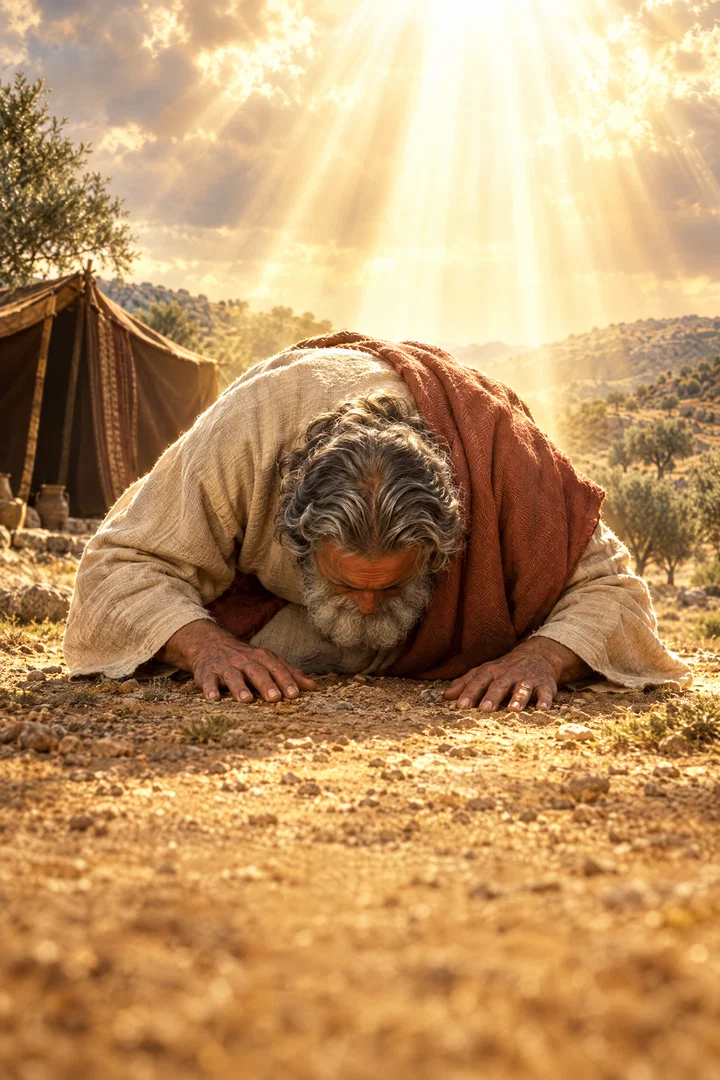
After nearly twenty-five years in Canaan God appeared as the Almighty God and commanded a life of blameless devotion before Him, and Abraham fell facedown in awe.PP 137.3–138.1 Then Abram was renamed Abraham, which means father of a great multitude, as a token that the promise to make him a father of many nations would be fulfilled.PP 137.3–138.1 The renaming belongs to God's covenant with Abraham in which He promised to multiply him, to establish an everlasting covenant with him and his descendants, and to be their God.SG3 296.2 The sign of that covenant, circumcision, marked Abraham and his descendants as set apart from other nations and pledged them to keep the covenant by living separately and obeying God.SG3 297.1–2
The covenant promise to make Abraham the father of many descendant nations was cherished by Isaac and Rebekah as their great hope and taught to Esau and Jacob as the birthright.PP 177.3–178.1 That birthright meant more than material wealth, conferring spiritual preeminence as priest of the family and continuance of the family line from which the Redeemer of the world would come.PP 177.3–178.1 It also obligated its holder to devote his life to God's service and obey God's requirements as Abraham had done, seeking God's will in marriage, family relations, and public life, since God's law was the condition of the covenant.PP 177.3–178.1 Isaac made those privileges and conditions known to his sons and declared Esau entitled as the eldest, but Esau had no love for devotion and viewed the law and spiritual requirement as a hateful bondage, desiring only freedom for self-indulgence, power, riches, and wild living, while Rebekah discerned that the promised heritage was intended for Jacob.PP 177.3–178.1
Sources
Pioneers and periodicals
75 sources
God changed Abram's name to Abraham when he was ninety-nine, giving him a name meaning father of a multitude as a continual memorial of the promise that he would be made father of many nations.ST Jun 2, 1881ST Jan 29, 1894ST Apr 6, 1888 God spoke of it as already done though Abraham had no child, because what exists in his purpose is certain to come to pass.ST Jun 30, 1881ST Mar 15, 1877RH Jun 12, 1860RH Mar 28, 1865 The promise belongs to God's everlasting covenant to multiply him exceedingly, to be a God to him and his seed, and to give circumcision as its token, calling him to walk perfectly before God through the righteousness of faith and not by works of law.ST Jan 29, 1894ST Jun 29, 1882RH Oct 25, 1853ST Jul 15, 1886ST Oct 17, 1900 He is father not of one people only but of many nations by natural descent and of all who share his faith whether Jew or Gentile, who as children of promise become Abraham's seed by belonging to Christ.ST Sep 9, 1889ST Oct 17, 1900ST Jan 29, 1894RH Jan 15, 1901ST That seed is Christ, through whom all nations are blessed, and the everlasting possession promised to Abraham and his seed reaches beyond Canaan to the whole renewed earth inherited with all who are Christ's.ST Oct 17, 1900ST Jul 28, 1914ST Jan 28, 1903
Name Change and Meaning
God himself changed Abram's name to Abraham when Abram was ninety-nine years old.ST Jan 29, 1894 The Lord appeared to Abram as God Almighty, commanded him to walk before him and be perfect, and made his covenant between them.ST Jan 29, 1894 As part of that covenant God promised to multiply Abraham exceedingly and made him the father of a multitude of nations, and the new name marks that making.ST Jan 29, 1894
The name Abraham means father of a multitude, father of a great multitude, father of many nations, a multitude of nations, or father of nations.ST Jun 2, 1881RH Nov 19, 1861 It was given to give force to the promise that he would become the father of many nations.ST Jun 2, 1881 It continually recalls God's promise that Abraham's seed would be as numerous as the dust of the earth and the stars of heaven, and that Abraham and his seed would receive the earth as an everlasting possession. It points to the promise that all nations would be blessed in Abraham and his seed, Christ, with the nations sharing that blessing through Christ. It expressed the character or calling God gave him: he would be the father of many.RH Nov 19, 1861
Abram means high or exalted father, while Abraham means father of a multitude.ST Jan 29, 1894 The change was fulfilled through literal descendants including the Israelites, Arabians, Midianites and Dedanites, and will be fulfilled more gloriously when the faithful nations inherit the new earth.ST Jan 29, 1894 The new name was a sign of the promise to make him the father of many nations, even though Abraham had no child and, by human reckoning, could have none.ST Apr 6, 1888ST Sep 8, 1898RH Sep 3, 1903 It was a continual reminder and memorial of the promise, renewed whenever the new names of Abraham and Sarah were used, marking him as made the father of a multitude of nations.ST Jan 29, 1894 The promise included the child of promise whom Sarah, though aged, would bear, and despite Abraham and Sarah's disbelief God's word proved true in Isaac, born miraculously to them in their old age.ST Sep 8, 1898 The added letter in the names of Abraham and Sarah signified that God himself was in the promise.ST Jan 29, 1894
The new name expressed the character, calling, position and role God gave him, well suited to him as father of many and father of nations.RH Nov 19, 1861ST Nov 20, 1893ST Jul 16, 1902 This illustrates the custom since Adam of giving names that carry deep meaning and mark character or changed life rather than serving as arbitrary labels.ST Nov 20, 1893ST Jul 12, 1910ST Oct 10, 1895ST Jul 16, 1902 Biblical names expressed the leading characteristics of the men who bore them, and were changed when distinction of characteristics or belief required it, as when a person's character changes.ST Jul 12, 1910RH Jun 12, 1879ST Oct 10, 1895 Yet there is nothing in a name itself to make a person better or worse.RH Jun 12, 1879 God gave the new name after Abram received the promises by faith to mark the changed relationship he sustained to the Lord and the new experience he had received.RH Dec 23, 1909 A name can in this way signify an experience known by the receiver and by God even when no one else understands it.
The change from Abram to Abraham was not word play but carried godly meaning worthy of attention.ST Jun 30, 1914 It shows that God changes a name to indicate what the person is to become under God, like the changes from Sarai to Sarah and from Oshea to Jehoshua.ST Jun 30, 1914 Joshua as savior leading his people into the promised land, which symbolizes the heavenly Canaan, points forward to Jesus, whose name means Saviour, as Saviour of the new covenant.ST Jun 30, 1914
Covenant Setting and Terms
Genesis 17:5 belongs to God's everlasting covenant with Abraham and his descendants, earlier promised and renewed over time and then formally ratified and sealed with repeated promises and an oath.RH Oct 25, 1853ST Apr 11, 1900ST Oct 10, 1900ST Jun 4, 1902 It is one of the covenants included in the everlasting covenant in Christ through the gospel for life, salvation, the kingdom, and the salvation of every soul saved.ST Feb 1, 1899ST Jun 4, 1902 The promise of the fatherhood of many nations and the salvation connected with the promised seed belongs to that covenant.ST Apr 11, 1900ST Oct 10, 1900ST Mar 1, 1905
As part of that covenant God promised to multiply Abraham exceedingly and to make him exceeding fruitful, to make nations of him with kings coming out of him, to establish an everlasting covenant to be a God to him and his seed after him, to give him and his seed the land of Canaan for an everlasting possession, and gave circumcision of every male as the token of the covenant to be kept by Abraham and his seed.ST Jan 29, 1894RH Oct 25, 1853 The Lord appeared to Abram as God Almighty when he was ninety-nine years old, commanded him to walk before him and be perfect, and made his covenant between them, marking that making by the new name.ST Jan 29, 1894
The covenant called Abraham to walk uprightly, sincerely and perfectly before God, and receiving its inheritance involved obedience to God's perfect law, already binding and later expressed in specific form at Sinai.ST Jun 29, 1882ST Sep 17, 1874ST May 11, 1915 A Gentile who keeps God's law secures a covenant interest in the blessings of the gospel promised to Abraham, his uncircumcision being counted for circumcision and making him a Jew inwardly, for the law containing righteousness is the basis of the Abrahamic covenant.RH Feb 4, 1873 The promise was conditional on Abraham walking perfectly before God, and the meek as followers of Christ who are perfect inherit the earth.
That walking perfectly is not by unaided effort but through the righteousness of faith, and the inheritance summed up as the whole earth renewed where righteousness dwells comes freely by God, not earned by works of law.ST Jul 15, 1886ST Oct 17, 1900 The promise rests on faith rather than law, for God gives life to the dead and calls into being what does not yet exist.ST Abraham is thereby father of all who believe whether in circumcision or uncircumcision, the father of us all, including all who are Christ's as Abraham's seed and heirs according to promise, blessed with faithful Abraham and made righteous and heirs by simply believing God.ST Oct 17, 1900ST Jan 29, 1894 That blessing comes on the Gentiles through Jesus Christ, who redeems from the curse of the law so believers may receive the promised Spirit through faith, and it comes by grace so it is sure to all the seed, both of the law and of Abraham's faith.RH Jul 17, 1866
The promised seed and the salvation connected with it would come by God's power, not through human schemes such as Abraham's arrangement with Hagar.ST Apr 11, 1900 The promised seed would come through Isaac, not through a human plan, showing that fulfillment depended on God's power.ST Mar 1, 1905 God would bring forth the promised Seed through Sarah, and Isaac born through God's promise represents those who receive freedom through faith in Christ and the new covenant.ST Sep 28, 1915
Circumcision originated here as God set Israel apart from other peoples and from sin, enjoining it on Abraham and his family long before Moses, with circumcision as a sign that they were separate to him and that his righteousness was upon them.ST Jul 11, 1911RH Dec 17, 1861 The sign was meant to point to the need for cleanliness of heart.ST Jul 11, 1911 Circumcision is the covenant token and assurance that God will fulfill the land promise to Abraham, and its purpose as a sign of that inheritance still holds in circumcision of the heart, the seal of the promised Spirit assuring believers of their inheritance including the redeemed earth.RH Sep 16, 1873 It is distinguished from the divine moral law contained in the Ten Commandments and is not presented as a continuing obligation for Christians.RH Nov 2, 1911
By contrast, those who held it taught that the perpetual or everlasting language attached to the circumcision covenant is no stronger than the command to a thousand generations, having expired like the Aaronic priesthood, the Passover and its feast, and the shewbread, as one of two or three covenants made with Abraham pertaining to Israel.RH Apr 15, 1873 The mention of circumcision shows the command was so firmly impressed on Moses' mind that his neglect of circumcising his son in Exodus 4:24-26 seems improbable.RH Aug 6, 1872
The promise is presented as a covenant, a divinely established arrangement of promises and conditions, giving an example where a promise is called a covenant.RH Apr 12, 1860RH Aug 13, 1872 The meaning of covenant depends on its context, and not every covenant is the same kind of agreement.RH Apr 12, 1860RH Oct 21, 1873 The verse is part of God's progressive dealing with Abraham from his call from country, kindred and home to a strange land to the time when he came fully to trust God.ST Dec 20, 1910 It belongs to Genesis 12-50 showing God's dealings with the chosen race, distinct from Genesis 1-11 showing God's dealings with the human race, and identifies Abraham as the chosen progenitor of the Seed and the father of the faithful to be kept ever in mind together with the Promised Seed.ST Dec 20, 1910STST Mar 17, 1914
Genesis 17:1-8 records the real making of the covenant by God, including the ordaining of circumcision and sacrifice, on whose historical trustworthiness Christian theology stands.ST Oct 8, 1912 The very conception of Christ as Messiah is interwoven with it, and identification of Jesus of Nazareth with that Messiah rests on Hebrew Scriptures having the historical character assigned to them.ST Oct 8, 1912 If the covenant was not made and Abraham is a mythical hero like Theseus, Messianic doctrine fails and the writers of the New Testament built the foundations of Christian dogma upon legendary quicksands by accepting flimsy fiction for solid truth.ST Oct 8, 1912
The covenant history in Genesis 15:18 and chapters 16, 17 and 21, read with Galatians 4:21-30, shows the two covenants.RH Jun 26, 1900 God chose Abraham for the special work of being father of the promised Seed, appointing him to a role in God's plan, but that choosing did not by itself secure his eternal salvation.ST Apr 10, 1907
Prophetic Certainty of Promise
God called Abraham the father of many nations before he had even one son, saying in the past tense that he had made him so when the outcome was still wholly future.ST Jun 30, 1881ST Mar 15, 1877RH Jun 12, 1860RH Mar 28, 1865RH May 12, 1874 Prophetic language can speak of a future event in the past tense, describing promised things as already accomplished facts and presenting the promised future prospectively as done.RH Jun 12, 1860ST Feb 20, 1879RH Jun 16, 1874 The past tense therefore proves nothing about when the promise was fulfilled.RH Jun 12, 1860
God speaks of what exists in his purpose as though it already exists, because it is certain to come to pass and will surely be fulfilled.ST Jun 30, 1881ST Mar 15, 1877RH Mar 28, 1865RH May 12, 1874 He sees the future as certain, gives life to the dead, and calls into being what does not yet exist.STRH Jun 16, 1874 The promised fatherhood was certain in God's purpose though not yet present.RH Mar 28, 1865
Abraham accepted and repeated what God had said, even though others could ridicule him for having no child. Though he could not see by natural means how this could happen through his barren wife, faith trusted the promise and saw that God would bring it to pass.ST Jan 16, 1896 The declaration illustrates trusting God's word as true without first being able to see how it will be fulfilled.
Abraham became by promise the father of many nations despite being old and his wife being past age, his near inability to have a child not making him any less so.RH Apr 28, 1868 His becoming father of many descendants though as good as dead stands as an example of life and power where it might seem impossible.RH Sep 2, 1902 God had changed Abram's name to Abraham as a sign of the promise that his descendants would continue and be favored, including the child of promise whom Sarah though aged would bear.ST Sep 8, 1898 Despite Abraham and Sarah's disbelief, God's word proved true in Isaac, born miraculously to them in their old age.ST Sep 8, 1898
The name change belongs to the promises and prophecies to the father of the Hebrew people that form a witness regarding Israel according to the flesh, with prediction and fulfillment so far apart in time that human collusion is impossible.ST Jul 22, 1913 That witness includes making of Abraham a great nation and making his name great, with blessing to all families of the earth in and through him.ST Jul 22, 1913 It includes an heir of his own blood and not an adopted son through whom the promised Seed would come, a numerous seed, early affliction of that seed, deliverance after four hundred years, and possession by his descendants of the land from the Euphrates to the river of Egypt by dispossessing named nations stronger than the Hebrews.ST Jul 22, 1913
Father of Many Nations
The promise was sure because God knew Abraham would obey Him and teach his household to follow the Lord, and the descendants promised were those who would serve God.ST Apr 6, 1888 God gave Abraham more than the son he asked for, promising him numerous offspring through whom all the nations of the earth would be blessed.RH Aug 31, 1869 He is the ancestor of a people whose stock endures through the ages, bound together as a nation and prepared to preserve distinctive civil order and religious teaching amid surrounding idolatrous peoples.ST Apr 14, 1887 God changed Abram's name to Abraham and made him head of a people who would become the Hebrews or Jews, set apart as God's own and prepared over many generations to preserve a written revelation and in time share its blessings with all nations.RH Jul 16, 1914
He was made not the exclusive ancestor of one people but father of many nations, related to Jew and Gentile alike by natural descent, and all who are saved must share the faith he received while still a heathen in a heathen land.ST Israel is one of those nations, yet Israel and Judah remain proper names for the believing descendants of Jacob and Judah rather than general names for all believers.RH May 29, 1855 The promise reaches beyond literal descendants to spiritual descendants who share Abraham's faith, the covenant having been made before Abraham was circumcised, showing that people of faith whether Jew or Gentile and circumcised or uncircumcised share in the promise.ST Sep 9, 1889 His fatherhood extends to all who believe whether circumcised or uncircumcised, and the covenant's promises of the renewed earth where righteousness dwells come through the righteousness of faith given freely by God, not through the law.ST Oct 17, 1900 The new name marks him as a man of faith and as father of a multitude of nations, the father of us all, including all who are Christ's as Abraham's seed and heirs according to promise, all who are of faith being blessed with faithful Abraham and made righteous and heirs not through works of law but through the righteousness of faith by simply believing God.ST Jan 29, 1894ST
Those spiritual children are children of promise, born from above by the power of God and citizens of the heavenly Jerusalem, the saved nations who inherit the new earth, distinguished from his natural descendants who constitute one nation after the flesh.RH Jan 15, 1901 The promise was made with the Gentiles in view as much as the Jews, so that blessing and imputed righteousness rest on Gentiles as well as Jews through Jesus Christ, who redeems from the curse of the law that believers may receive the promised Spirit through faith, coming not through law but through the righteousness of faith by grace so it is sure to all the seed, both those of the law and those of the faith of Abraham.RH Jul 17, 1866 An unbelieving Jew has no more claim to the promises than an unbelieving Gentile, because all are under sin, and the true Israel are all who believe and embrace the promises through faith in Jesus Christ, whether Jews or Gentiles.RH Jul 17, 1866 The promise of kingly glory and blessings came before the nation of Israel existed and therefore does not depend on the nation's continued standing, so that rejecting some or all of that nation cannot cancel it, and descendants by birth are not all heirs, for Israel is primarily a matter of character and the promise belongs to true Israel, the faithful.ST Mar 13, 1884 The Jews as the seed of Abraham were made the chosen people of God under the covenant of promise to Abraham the father of the faithful, yet wicked works disqualify from claiming those promises, so hardness of heart and final rejection of Christ as Messiah causes those of the seed of Abraham to be cast out while those not of the seed sit down with Abraham, Isaac, and Jacob.RH Jan 14, 1873
God made him father of believers of every nation and age as a public role as patriarch and representative of the church, not merely a personal promise, believers becoming his children and heirs and being blessed through that relationship, the blessing for all nations through Abraham and his seed being the same gospel promise fulfilled in the Messiah and the blessings of His kingdom.RH Oct 25, 1853 It was part of the covenant by which God formed the church, implying that church and covenant were intended to endure together.RH Oct 25, 1853 In that sense he is in effect the father of the church, and his journey and trials serve as a type of the Christian's journey toward the heavenly Canaan.RH May 14, 1867
Land and World Inheritance
The covenant gives Abraham and his seed possession of the land of Canaan as an everlasting possession, renewed afterward to Isaac and confirmed to Jacob, with circumcision given as its token and assurance that God will fulfill the land promise.ST Sep 17, 1874RH Jun 2, 1859RH Sep 16, 1873 The charge to walk uprightly and sincerely makes obedience to God's perfect law a condition for receiving that inheritance, and Abraham and his seed receive the covenant blessings and the land under the conditions God gives.ST Sep 17, 1874RH Jun 2, 1859 Circumcision of the heart, the seal of the promised Spirit, now assures believers of their inheritance, including the redeemed earth.RH Sep 16, 1873
The promise was spoken to Abraham in person, so later possession of Canaan by his descendants could not by itself fulfill it for him.RH Jun 2, 1859RH Jun 2, 1859 He did not receive even a place to set his foot in his lifetime, and Israel's entry into Canaan did not fulfill it, since Abraham, Isaac and Jacob were not alive to receive it.RH Jun 2, 1859RH Jun 2, 1859 The everlasting possession therefore points beyond a temporal possession in his lifetime to an inheritance to be received with the rest of God's people under God's conditions.RH Jun 2, 1859RH Jun 2, 1859
Although living in Canaan as a stranger not yet its heir, Abraham was promised to possess the world forever.ST Oct 17, 1900ST Jul 28, 1914ST Jan 28, 1903 The promise includes Palestine but is not limited to it, extending to the whole earth renewed where righteousness dwells and to the whole world as inheritance realized through his Seed.ST Oct 17, 1900ST Jul 28, 1914ST Jan 28, 1903 All who belong to Christ by faith become Abraham's children and heirs of that promise, and the covenant's promises come through righteousness of faith given freely by God, not through law.ST Oct 17, 1900ST Jan 28, 1903
The verse repeats the larger promise first given in Genesis 13 and differs from Genesis 15:13-21, which fixed the boundaries of earthly Canaan and set its possession in the fourth generation.ST Nov 11, 1930 It means Abraham should be heir of the world through righteousness of faith and not through law, including the restored kingdom of the new earth and a city with foundations whose builder and maker is God.ST Nov 11, 1930 Abraham understood this breadth and so sojourned in the land of promise as in a strange country, dwelling in tabernacles with Isaac and Jacob, confessing himself a stranger and pilgrim on earth, seeking a better heavenly country and joyfully waiting for the inheritance.ST Nov 11, 1930
The verse renews to Abraham the promise that man shall inherit the earth and have dominion over it in the coming kingdom, belonging to the Abrahamic covenant and its place in God's continuing plan of restoration.ST Nov 11, 1930ST Jun 17, 1897 God made him father of many nations and promised the land to him and to his seed forever, with seed made countless as dust of the earth and stars of heaven, to be fulfilled in the new earth that will be the home of the redeemed throughout eternity after the price paid on Calvary made completion of God's original perfect plan possible.ST Nov 11, 1930 The new name continually recalls that promise that Abraham and his seed would receive the earth as an everlasting possession. That promise was conditional on Abraham walking perfectly before God, and the meek as followers of Christ who are perfect inherit the earth.
The promise that Abraham would be father of many nations reaches its full scope as people from every nation, kindred, tongue and people are gathered as Abraham's children through belonging to Christ.RH Aug 20, 1901 The many mansions in the Father's house are enough to accommodate all these heirs of the promise.RH Aug 20, 1901
Christ the Promised Seed
Christ is the seed who inherits the promise, and the changed name declares that Abraham would be father of many nations with the land as an everlasting possession for Abraham and his seed. That promised inheritance is the whole world, realized through his Seed, Christ, and all who belong to Christ by faith become Abraham's children and heirs of that promise.ST Jan 28, 1903 Others share its blessings only as joint heirs with Christ, becoming Abraham's seed by belonging to Christ.ST Jan 28, 1903
The name father of many nations, or a multitude of nations, points to the promise that all nations would be blessed in Abraham and his seed, Christ, and the nations share that blessing through Christ. It was a sign that many nations would be blessed through his line and that the promised Redeemer would come through his seed. He was made father of believers of every nation and age in a public role as patriarch and representative of the church, not as a merely personal promise, so that believers became his children and heirs and through that relationship are blessed.RH Oct 25, 1853 That promise of blessing for all nations through Abraham and his seed is the same gospel promise fulfilled in the Messiah and the blessings of his kingdom, belonging to the covenant by which God formed the church, which implies that the church and covenant were intended to endure together.RH Oct 25, 1853
The promises that he would be father of many nations are the blessings of the gospel, belonging to the covenant in which God promised Abraham an inheritance and blessing for all nations through his seed.ST Jul 15, 1886RH Feb 4, 1873 The covenant's condition was that Abraham walk before God and be perfect, not by unaided effort but through the righteousness of faith.ST Jul 15, 1886 The promise is fulfilled in Christ and belongs to those who are his, received by faith and not earned by works of law.ST Jul 15, 1886 A Gentile who keeps God's law secures a covenant interest in them, his uncircumcision being counted for circumcision and making him a Jew inwardly, for the law containing righteousness is the basis of the Abrahamic covenant.RH Feb 4, 1873
He is father of many nations, not of the Jews alone but of the Gentiles also, the promise having been made with the Gentiles in view as much as the Jews, so that blessing and imputed righteousness rest on Gentiles as well as Jews.RH Jul 17, 1866 It comes not through law but through the righteousness of faith, by grace, so that the promise is sure to all the seed, both those of the law and those of the faith of Abraham.RH Jul 17, 1866 That blessing comes on the Gentiles through Jesus Christ, who redeems from the curse of the law, that believers may receive the promised Spirit through faith.RH Jul 17, 1866 An unbelieving Jew has no more claim to the promises than an unbelieving Gentile, because all are under sin, and the true Israel are all who believe and embrace the promises through faith in Jesus Christ, whether Jews or Gentiles.RH Jul 17, 1866
Sources