Genesis 17:4
As for me, behold, my covenant is with thee, and thou shalt be a father of many nations.
Translations
As for me, behold, my covenant is with you, and you shall be a father of many nations.
King James Version, KJV Cambridge Paragraph Bible, Webster Bible
As for me, behold, my covenant is with thee, and thou shalt be a father of many nations.
Revised Version, American Standard Version
As for me, behold, my covenant is with thee, and thou shalt be the father of a multitude of nations.
'I — lo, My covenant [is] with thee, and thou hast become father of a multitude of nations;
It is I: behold, my covenant is with thee, and thou shalt be a father of a multitude of nations.
As for me, lo! my covenant is with thee,—So shalt thou become—father of a multitude of nations;
Berean Standard Bible, Majority Standard Bible
“ As for Me, this is My covenant with you: You will be the father of many nations.
“ As for me, behold, my covenant is with you. You will be the father of a multitude of nations.
As for me, my agreement is made with you, and you will be the father of nations without end.
Beholde, I make my couenant with thee, and thou shalt be a father of many nations,
Douay-Rheims (Challoner revision)
And God said to him: I AM, and my covenant is with thee, and thou shalt be a father of many nations.
Pictures
Cross-references 20 of 69
- Genesis 13:14-16
And the LORD said unto Abram, after that Lot was separated from him, Lift up now thine eyes, and look from the place where thou art northward, and southward, and eastward, and westward:
God promises Abraham the land and descendants too numerous to count.
- Romans 4:13
For the promise, that he should be the heir of the world, was not to Abraham, or to his seed, through the law, but through the righteousness of faith.
Abraham’s promised inheritance of the world comes through faith, not law.
- Genesis 12:1-3
Now the LORD had said unto Abram, Get thee out of thy country, and from thy kindred, and from thy father’s house, unto a land that I will shew thee:
God promises Abram a great nation and blessing for all families through him.
- Genesis 15:6
And he believed in the LORD; and he counted it to him for righteousness.
shows how Abraham became righteous heir
- Romans 4:11
And he received the sign of circumcision, a seal of the righteousness of the faith which he had yet being uncircumcised: that he might be the father of all them that believe, though they be not circumcised; that righteousness might be imputed unto them also:
Circumcision seals Abraham’s faith-righteousness and his fatherhood of all who believe.
- Galatians 3:29
And if ye be Christ’s, then are ye Abraham’s seed, and heirs according to the promise.
Those who belong to Christ are Abraham’s seed and heirs according to the promise.
- Romans 4:16-17
Therefore it is of faith, that it might be by grace; to the end the promise might be sure to all the seed; not to that only which is of the law, but to that also which is of the faith of Abraham; who is the father of us all,
Abraham is father of many nations; the promise is secured for all his seed by faith and grace.
- Genesis 22:16-18
And said, By myself have I sworn, saith the LORD, for because thou hast done this thing, and hast not withheld thy son, thine only son:
Repeats and confirms God’s promise to Abraham and his seed.
- Genesis 26:3-4
Sojourn in this land, and I will be with thee, and will bless thee; for unto thee, and unto thy seed, I will give all these countries, and I will perform the oath which I sware unto Abraham thy father;
God confirms to Isaac the covenant promise made to Abraham.
- Hebrews 11:9-10
By faith he sojourned in the land of promise, as in a strange country, dwelling in tabernacles with Isaac and Jacob, the heirs with him of the same promise:
Abraham sojourned in the promised land and looked toward God’s city.
- Galatians 4:28
Now we, brethren, as Isaac was, are the children of promise.
Isaac and believers are identified as children of the promise to Abraham.
- Genesis 15:18
In the same day the LORD made a covenant with Abram, saying, Unto thy seed have I given this land, from the river of Egypt unto the great river, the river Euphrates:
The Lord covenants with Abram to give the land to his seed.
- Acts 7:5
And he gave him none inheritance in it, no, not so much as to set his foot on: yet he promised that he would give it to him for a possession, and to his seed after him, when as yet he had no child.
Stephen recounts God’s covenant promise to Abraham and notes he received no inheritance in the land during his lifetime.
- Genesis 21:1-12
And the LORD visited Sarah as he had said, and the LORD did unto Sarah as he had spoken.
Isaac is born, and God says Abraham’s seed will be called through him.
- Genesis 18:18-19
Seeing that Abraham shall surely become a great and mighty nation, and all the nations of the earth shall be blessed in him?
God links Abraham’s blessing to all nations with his household keeping the way of the LORD.
- Galatians 3:16
Now to Abraham and his seed were the promises made. He saith not, And to seeds, as of many; but as of one, And to thy seed, which is Christ.
Identifies Christ as Abraham’s promised Seed.
- Genesis 17:11
And ye shall circumcise the flesh of your foreskin; and it shall be a token of the covenant betwixt me and you.
Circumcision is given as the token of the covenant.
- Romans 9:7-8
Neither, because they are the seed of Abraham, are they all children: but, In Isaac shall thy seed be called.
Distinguishes Abraham’s physical descendants from the children counted as heirs of promise.
- Exodus 4:25-26
Then Zipporah took a sharp stone, and cut off the foreskin of her son, and cast it at his feet, and said, Surely a bloody husband art thou to me.
Zipporah circumcises their son after Moses neglected the covenant ordinance.
- Genesis 28:13
And, behold, the LORD stood above it, and said, I am the LORD God of Abraham thy father, and the God of Isaac: the land whereon thou liest, to thee will I give it, and to thy seed;
God confirms to Jacob the land promise made to Abraham.
Commentary
Each commentary is drawn from primary sources: the writings of Ellen G. White and Adventist pioneers and periodicals. Each commentary is separate. Its own words are not a quotation; follow the references to read the source passages.
Ellen G. White
5 sources
Genesis 17:4 records God establishing His covenant with Abraham with the promise that he would become the father of many nations.PP 137.3–138.113MR 184.2–3SG3 296.2SG3 297.1–2 The change of his name from Abram to Abraham, meaning father of a great multitude, marked this promise.PP 137.3–138.1 In connection with it Sarah also was to be the mother of nations, with kings descended from her.PP 137.3–138.1
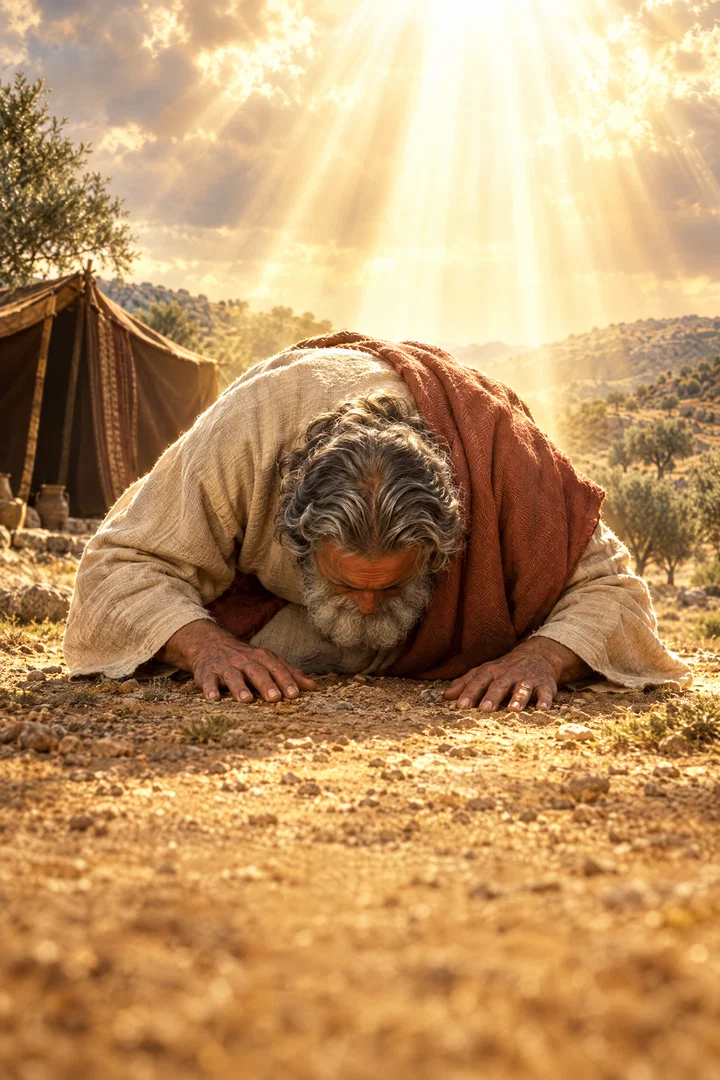
The promise was spoken when Abraham was ninety-nine, after he was called to walk faithfully before God, and Abraham fell on his face as God spoke to him.13MR 184.2–3 The covenant is thus connected with the call for Abraham to walk before God and be perfect.SG3 296.2 It came as God prepared Abraham, who had been called out of an idolatrous setting and separated from his father's household, to be His chosen instrument.13MR 184.2–3
The covenant was to continue through Abraham's descendants and included God's promise to be their God.SG3 296.2 It required Abraham and his descendants to remain separate from other nations and faithful to God, with circumcision as its sign and pledge to keep its conditions.SG3 297.1–2 Although their later mingling with surrounding peoples exposed them to idolatry, God did not forsake them in Egypt because of His covenant with Abraham.SG3 297.1–2
The covenant of Genesis 17:1-8 was continued to Abraham's son and was treasured by Isaac and Rebekah, with blessings of spiritual pre-eminence in that the holder of the birthright would serve as priest of the family and the Redeemer of the world would come through his descendants.PP 177.3–178.1 Inheriting those covenant blessings carried obligations, so that like Abraham the heir had to obey God and seek His will in marriage, family life, and public affairs.PP 177.3–178.1
Sources
Pioneers and periodicals
58 sources
God solemnly renews His covenant with Abraham as he lies facedown childless, declaring him father of many nations and changing his name to keep that certain future continually before him.ST Jun 2, 1881RH Oct 25, 1853ST Apr 6, 1888ST Apr 11, 1900
The many nations are an innumerable posterity as the dust and the stars, fulfilled literally in Israelites, Arabians, Midianites and others, yet they are not natural descendants alone but all of every nation who share Abraham's faith, Jew or Gentile, circumcised or uncircumcised.ST Sep 9, 1889RH Oct 3, 1871ST Jan 29, 1894ST Jan 29, 1894
The promised offspring is Christ, through whom all nations are blessed with salvation, forgiveness, life and the kingdom, so the covenant is the gospel and everlasting new covenant, and its inheritance comes by promise through righteousness of faith apart from the law given 430 years later at Sinai.ST Jul 15, 1886RH Dec 23, 1851ST Oct 17, 1900ST Feb 1, 1899ST Nov 11, 1930
That inheritance joins the seed, the land of Canaan as an everlasting possession, God as their God, and blessing to all nations, but it extends beyond Palestine to the whole world and the renewed new earth, which Abraham did not receive in his lifetime and which will be received together with all God's people at Christ's coming.ST Jun 2, 1881RH Oct 25, 1853ST Sep 17, 1874ST Oct 17, 1900
It calls for walking uprightly and perfectly before God in obedience to His already binding law, with circumcision given as its outward sign, seal and token whose perpetual term has expired, and its fulfillment comes through God's power in Isaac the miraculous child of promise by Sarah, not through human scheming with Hagar, Isaac representing freedom by faith under the new covenant.ST Jun 2, 1881ST Jun 29, 1882ST Apr 11, 1900RH Apr 15, 1873
Covenant Words and Setting
As for me, the covenant is established with solemn formality, not as an isolated promise but as the ratification of what had been given earlier and would be renewed afterward to descendants, here formally ratified for the fourth time with greatly multiplied posterity.RH Oct 25, 1853ST Apr 11, 1900ST Jun 4, 1902 The promise belongs to the wider covenant embracing descendants, land, and blessing for all nations, with circumcision given as its outward sign, and the promised seed and the salvation it represented would come through God's power and in God's way, not through human schemes such as the arrangement with Hagar.RH Oct 25, 1853ST Apr 11, 1900 Through repeated promises and an oath it stands as part of God's everlasting covenant through which every saved person receives salvation.ST Jun 4, 1902
It was spoken to Abram while he lay facedown, giving reassurance in covenant renewal and declaring a certain future when he had no child and seemed unlikely to have one.ST Apr 6, 1888RH Apr 28, 1868 His coming near to having no child at all did not make the promise or its fulfillment any less real.RH Apr 28, 1868 For that reason his name was changed from Abram to Abraham, meaning father of a multitude, to express his future role and to keep the promise of numerous descendants continually before him.ST Jun 2, 1881ST Apr 6, 1888ST Apr 11, 1900
In this place covenant means God's promise and arrangement in which God makes promises, and a promise is called a covenant because God's promises to make him a father of many nations are called God's covenant with him.RH Apr 12, 1860RH Mar 18, 1875RH Aug 13, 1872 The word is used in more than one biblical sense rather than necessarily meaning a mutual agreement, a law, or a contract concerning the Ten Commandments, and Genesis 17:1-11 is an example of that varied usage, not the first covenant concerning the Ten Commandments.RH Apr 16, 1861RH Apr 12, 1860RH Oct 21, 1873RH Mar 18, 1875 The verse belongs to the progressive steps of God's dealing with Abraham in Genesis 12 to 24, from his call to the time he fully trusted God and sent his tried servant to obtain a wife for Isaac.ST Dec 20, 1910 There Abraham stands as father of the faithful, taught by repeated lessons in the school of faith, shown providential favors to him who chooses unselfishly, warnings before punishment, and providential care and interest among men, with the characters of Abram and Lot clearly revealed and the influence of worldly associations upon a good man, all to be read with the Promised Seed ever in mind.ST Dec 20, 1910
It stands in Genesis 12-50, which sets forth God's dealings with the chosen race, distinct from Genesis 1-11, which sets forth God's dealings with the human race, so that studying by books makes its interest and fruitfulness plain and making titles for each chapter retains knowledge of its contents.ST Mar 17, 1914 It shows the Lord instructing people directly by an audible voice.PGGC 5.1–2 It must be read with Genesis 15:18 and the whole of Genesis 16, Genesis 17, and Genesis 21, then with Galatians 4:21-30, especially Galatians 4:24 about the two covenants.RH Jun 26, 1900 It is part of God's covenant with Abraham concerning the promised inheritance, whose blessings including possession of the land are for Abraham and his seed, without explaining the promise that Abraham would be father of many nations.RH Jun 2, 1859
Promised Inheritance and Conditions
The covenant joins the promise that Abraham would become father of many nations to promises to his seed, to the land of Canaan as an everlasting possession, to God being their God, and to blessing for all nations.ST Jun 2, 1881RH Oct 25, 1853ST Oct 10, 1900 It was solemnly established here rather than given as an isolated promise, then renewed to his seed afterward, with circumcision instituted as its token, sign and surety.ST Jun 2, 1881RH Oct 25, 1853 The change of his name to Abraham, meaning father of a multitude, gave force to the promise of numerous descendants.ST Jun 2, 1881RH Oct 25, 1853
The promised inheritance includes Palestine but extends to the whole world and to the rehabilitated new earth.ST Jul 28, 1914ST Jan 28, 1903ST Nov 11, 1930 Abraham and his seed were promised the earth as an everlasting possession, equivalent to the promise that the meek shall inherit the earth.ST Oct 17, 1900 That larger promise that Abraham and his seed should be heir of the world, first given in Genesis 13 and repeated here, is distinct from the other promise in Genesis 15:13-21 that fixed the boundaries of earthly Canaan and set its possession in the fourth generation.ST Nov 11, 1930 Though living in Canaan, Abraham was there as a pilgrim stranger, not as its heir.ST Jul 28, 1914ST Nov 11, 1930
The everlasting possession was not received by Abraham in his lifetime.ST Sep 17, 1874 It was not fulfilled merely by his descendants possessing Canaan, nor by Israel entering Canaan while Abraham, Isaac and Jacob were dead, but remains to be fulfilled when the patriarchs receive it together with the rest of God's people.ST Sep 17, 1874RH Jun 2, 1859 That fulfillment brings everlasting inheritance and life beyond death, with sin and death ultimately destroyed and the earth renewed, received through the righteousness of faith as God's free gift and connected to Christ the promised seed, and it cannot precede his coming.RH Jun 2, 1859ST Oct 17, 1900
The covenant commands Abraham to walk uprightly, sincerely and perfectly before God, and keeping God's law is presented as the condition for receiving the inheritance.ST Jun 29, 1882ST Sep 17, 1874 God's grace enables obedience to his perfect law, and the promise to his seed is for those who serve the Lord, keep his commandments and obey his word.ST Jun 29, 1882ST Apr 6, 1888 Abraham showed this joining of promise with obedient action when he circumcised the males of his household on the same day, and the later assurance of fulfillment is linked to such faithfulness and household obedience.ST Nov 8, 1899
God's law was already binding as the basis of the covenant with Abraham and was not first introduced at Sinai.ST May 11, 1915RH Feb 4, 1873 Circumcision, though practiced before Moses and enjoined on Abraham's family and retained by his descendants, was not part of the divine moral law contained in the Ten Commandments.RH Nov 2, 1911RH Dec 17, 1861
Many Nations Identified
The promised posterity is innumerable, as the dust of the earth and the stars of heaven, and the name Abraham kept that multitude continually before him.RH Oct 3, 1871RH Sep 2, 1902 That number implies a multitude too great to be represented by only the few thousand stars visible to the naked eye.RH Oct 3, 1871 Its fulfillment is illustrated by innumerable descendants coming from one who was as good as dead.RH Sep 2, 1902
The promise was literally fulfilled in literal descendants, including the Israelite tribes who afterward divided into two powerful nations, as well as the Arabians, the Midianites, the Dedanites, and others.ST Jan 29, 1894 It will be fulfilled more gloriously when the great company of the faithful, the nations of the redeemed, inherit the new earth.ST Jan 29, 1894 The many nations are not merely natural descendants but all who share his faith, Jew or Gentile, circumcised or uncircumcised, having equal title to the promises.ST Sep 9, 1889ST Jan 29, 1894RH Jul 17, 1866 Abraham is the father of all who believe, both to that which is of the law and to that which is of the faith of Abraham.ST Sep 9, 1889ST Jan 29, 1894RH Jul 17, 1866
The covenant was made to him while he was in uncircumcision so that righteousness might be reckoned to believing Gentiles as well as Jews, making circumcision its seal and not a condition for receiving its blessings.ST Sep 9, 1889ST Jan 29, 1894RH Jul 17, 1866 The heirship, including heirship of the world, comes not through the law but through the righteousness of faith, by grace, to the end that the promise may be sure to all the seed.ST Jan 29, 1894RH Jul 17, 1866 Abraham became righteous and an heir by believing God, and it was counted to him for righteousness not for his sake alone but for all who believe on Him that raised Jesus from the dead.ST Jan 29, 1894 So then they which be of faith are blessed with faithful Abraham.ST Jan 29, 1894RH Jul 17, 1866
These nations are people of faith, born from above by God's power, and are children of the heavenly Jerusalem who inherit the new earth.RH Jan 15, 1901ST Jan 29, 1894RH Aug 20, 1901 Those who belong to Christ are Abraham's seed and heirs according to promise, gathered from every nation, kindred, tongue, and people.RH Jan 15, 1901ST Jan 29, 1894RH Aug 20, 1901 The heavenly city has mansions enough for them.RH Aug 20, 1901 Descendants after the flesh alone constitute one nation and are not heirs of the promise.RH Jan 15, 1901
Wicked works, hardness of heart, and final rejection of Christ disqualify natural descendants from claiming the promises made to the children of Abraham.RH Jan 15, 1901RH Jan 14, 1873RH Jul 17, 1866 An unbelieving Jew has no more claim to the promises than an unbelieving Gentile, since both Jews and Gentiles are all under sin and boasting by works is excluded by the law of faith.RH Jul 17, 1866 Those not of his seed who bring forth fruits sit down with Abraham, Isaac, and Jacob in the kingdom, while the natural children who reject are cast out into outer darkness.RH Jan 14, 1873RH Jul 17, 1866 The promised nations are described as twelve, with Christ's twelve apostles reigning as kings over them in the renewed earth.RH Jan 15, 1901 This refers to the saved nations rather than to a future re-established Hebrew nation ruling in Palestine during a temporal millennium, yet Israel and Judah remain as names for a distinct believing people descended from Jacob and Judah, with Israel as one of those nations.RH Jan 15, 1901RH May 29, 1855
Christ Faith and Covenant Seal
The promised offspring through whom the blessing reaches all nations is Christ, and through him come salvation, forgiveness of sins, life, the kingdom, and the inheritance of the world.ST Jul 15, 1886RH Dec 23, 1851ST Feb 1, 1899ST Jan 28, 1903 The covenant with Abraham is the gospel covenant, the same as the second covenant and as the everlasting new covenant in Christ, through which every saved person receives salvation.ST Jul 15, 1886RH Dec 23, 1851ST Feb 1, 1899ST Jun 4, 1902 Its fulfillment comes through Christ, and those who belong to Christ by faith are counted Abraham's descendants and heirs, with believers from every nation included and no difference between Jew and Greek.RH Dec 23, 1851ST Feb 1, 1899ST Jan 28, 1903 Descent in the flesh alone does not make one a child of the promise, for the promise embraces the rehabilitated earth extending to the whole world.RH Dec 23, 1851ST Jan 28, 1903
The inheritance was given to Abraham by promise contingent on faith, through the righteousness of faith by grace apart from unaided works.ST Jul 15, 1886ST Oct 17, 1900ST Jan 29, 1894 It comes not through law but through righteousness of faith, which is itself God's free gift and not earned by keeping the law given at Sinai 430 years later.ST Jul 15, 1886ST Oct 17, 1900ST Nov 11, 1930 That later law could not cancel the earlier promise, so that the promise may be sure to all the seed, not to that only which is of the law but to that also which is of the faith of Abraham.ST Jul 15, 1886ST Jan 29, 1894 The seed includes all who are Christ's, heirs according to promise, and as Abraham became righteous and an heir by believing God and it was counted to him for righteousness, so they which be of faith are blessed with faithful Abraham, not for his sake alone but for all who believe on Him that raised Jesus from the dead.ST Nov 11, 1930ST Jan 29, 1894
The covenant was made to Abraham while he was in uncircumcision, and his faith was reckoned for righteousness then, so that righteousness and blessing could rest on believing Gentiles as well as Jews.ST Sep 9, 1889ST Jan 29, 1894RH Jul 17, 1866 For this reason Abraham is father of all them that believe, whether circumcised or uncircumcised, that righteousness might be reckoned unto them, father not of the Jews alone but of Gentiles also, with the promise made with the Gentiles in view as much as the Jews.ST Sep 9, 1889ST Jan 29, 1894RH Jul 17, 1866 The blessing of Abraham comes on the Gentiles through Jesus Christ, who redeemed from the curse of the law, that all who believe might receive the promise of the Spirit through faith and the promise by faith of Jesus Christ.ST Jan 29, 1894RH Jul 17, 1866 Although advantage belonged to those to whom the oracles of God were committed, both Jews and Gentiles are all under sin, boasting by works is excluded by the law of faith, and an unbelieving Jew has no more claim than an unbelieving Gentile.ST Sep 9, 1889RH Jul 17, 1866
Circumcision originated in Abraham's family as the covenant's outward sign, token, seal, and surety of the promise and inheritance.ST Jun 2, 1881RH Oct 25, 1853ST Oct 17, 1900 It marked separation to God and setting apart from other peoples, signified that God's righteousness was upon them, and pointed to the need for cleanliness of heart.ST Jun 2, 1881RH Oct 25, 1853ST Jul 11, 1911 Abraham's circumcision was a seal of the faith he had before he was circumcised, not a condition for receiving the blessings, and the command to circumcise was joined with the call to act in obedience to God's word on the same day.ST Sep 9, 1889ST Nov 8, 1899ST Oct 17, 1900 The Holy Spirit's seal is the earnest of that inheritance of the redeemed earth.ST Oct 17, 1900 Though its ordinance is called perpetual and everlasting, that period has expired, showing that perpetual and everlasting do not prove unending obligation, being no stronger than commanded to a thousand generations.RH Apr 15, 1873
The promised seed and the salvation it represented would come through God's power and in God's way, by God's word and power and not by fleshly schemes.ST Apr 11, 1900ST Mar 1, 1905 The promise belongs to the covenant renewed after the birth of Ishmael and after the attempt to secure an heir through Hagar, and it is fulfilled through the son God said Sarah would bear.ST Apr 11, 1900ST Mar 1, 1905ST Sep 8, 1898 Though the announcement of a child in old age was hard to believe, God's word was fulfilled in Isaac, the miraculous child of promise.ST Mar 1, 1905ST Sep 8, 1898 Abraham's attempt through Hagar was human scheming and led to bondage, while Isaac, born through God's promise, represents those who receive freedom through faith in Christ and the new covenant, which rests on God's promises.ST Apr 11, 1900ST Sep 28, 1915
Prophecy History and Fulfillment
Genesis 17:1-8 is part of God's twofold witness concerning Israel according to the flesh, a prediction given to Abraham to be fulfilled in distant descendants so far apart in time that no human connivance or collusion was possible.ST Jul 22, 1913 It shows God calling Abram out from country and kindred and home to a strange land, promising to make a great nation from him and to make his name great and that through him all families of the earth would be blessed, and after testings confirming him with a covenant and changing his name from Abram to Abraham as ancestor of many nations.ST Jul 22, 1913 It means no adopted son but one of his own blood would be his heir through whom the promised Seed would come, that the seed would become numerous and would early become afflicted.ST Jul 22, 1913 Four hundred years would pass from that affliction before deliverance, thirty years after the first promise, and afterward his descendants would receive the Land of Promise from the river Euphrates to the river of Egypt by dispossessing certain named nations, some stronger than the Hebrews.ST Jul 22, 1913
The promise to the fathers belongs to one unified divine plan continued through all ages and dispensations toward one end, the restoration of the dominion lost in Adam, with implications in heaven and on earth.ST Jun 29, 1882ST Jun 17, 1897 The covenant and its promise that Abraham would be father of many nations was later renewed to Isaac and confirmed to Jacob.ST Jun 29, 1882ST Dec 15, 1898
God chose Abraham for the special work of being the father of the promised Seed and the chosen progenitor of that Seed.ST Apr 10, 1907ST This was a choice for a particular work, not a guarantee of eternal salvation.ST Apr 10, 1907 The covenant is a definite and detailed account of something that really happened, not myth, fiction, legend, or dream.ST Oct 8, 1912 Christian theology and Messianic doctrine stand or fall with its historical truth, because the conception of the Messiah is interwoven with Jewish history and the identification of Jesus of Nazareth as that Messiah rests on the Hebrew Scriptures having the historical character claimed for them.ST Oct 8, 1912 The writers of the New Testament accept this covenant as solid truth and build the very foundations of Christian teaching and Messianic doctrine upon it, so that if the covenant was not made, Messianic doctrine has no evidential value and their authority is destroyed.ST Oct 8, 1912
Trust and Obedient Living
God called Abraham father of many nations before he had a son because what exists only in divine purpose is certain to come to pass and may be spoken of as already existing.ST Jun 30, 1881ST Mar 15, 1877RH Mar 28, 1865RH May 12, 1874 The promised outcome stood secure in that purpose and would surely happen, so the future fatherhood was declared as present fact.ST Jun 30, 1881ST Mar 15, 1877RH May 12, 1874 Lazarus rests in hope as an heir to the inheritance promised to Abraham.RH Mar 28, 1865
Abraham trusted what God said and spoke of himself accordingly even though he had no child and the promise was not yet visible in his circumstances.ST Jan 16, 1896 Though he could not see by natural means how fatherhood of many nations would come through his barren wife, faith trusted that God would fulfill the promise.ST Jan 16, 1896 This is reckoning God's word true without being able to see how it will be fulfilled. He was rewarded for that trust.ST Jan 16, 1896 Though he came near to having no child at all, his near failure did not make the promise or its fulfillment any less real.RH Apr 28, 1868
The covenant with Abraham holds the promises to Abraham, which are the blessings of the gospel, and that covenant embraces many nations.RH Feb 4, 1873 A Gentile who keeps God's law secures a covenant interest in those promises.RH Feb 4, 1873 His uncircumcision is then counted for circumcision and he becomes a Jew inwardly.RH Feb 4, 1873 The moral law is the basis of the Abrahamic covenant.RH Feb 4, 1873
Sources