Genesis 15:4
And, behold, the word of the LORD came unto him, saying, This shall not be thine heir; but he that shall come forth out of thine own bowels shall be thine heir.
Translations
And, behold, the word of the LORD came to him, saying, This shall not be your heir; but he that shall come forth out of your own bowels shall be your heir.
And, behold, the word of the LORD came unto him, saying, This shall not be thine heir; but he that shall come forth out of thine own bowels shall be thine heir.
And behold, the word of the Lord came unto him, saying, This shall not be thine heir; but he that shall come forth out of thine own bowels shall be thine heir.
And behold, the word of the LORD came to him, saying, This shall not be thy heir; but he that shall come forth out of thy own bowels shall be thy heir.
And, behold, the word of the LORD came unto him, saying, This man shall not be thine heir; but he that shall come forth out of thine own bowels shall be thine heir.
And, behold, the word of Jehovah came unto him, saying, This man shall not be thine heir; but he that shall come forth out of thine own bowels shall be thine heir.
And lo, the word of Jehovah [is] unto him, saying, 'This [one] doth not heir thee; but he who cometh out from thy bowels, he doth heir thee;'
And behold, the word of Jehovah [ came] to him, saying, This shall not be thine heir, but he that will come forth out of thy body shall be thine heir.
And lo! the word of Yahweh [came] unto him, saying, This one, shall not be thine heir: But one who cometh forth of thy body—he shall be thine heir.
Berean Standard Bible, Majority Standard Bible
Then the word of the LORD came to Abram, saying, “ This one will not be your heir, but one who comes from your own body will be your heir.”
Behold, the LORD’s word came to him, saying, “ This man will not be your heir, but he who will come out of your own body will be your heir.”
Then said the Lord, This man will not get the heritage, but a son of your body will have your property after you.
Then beholde, the worde of the Lord came vnto him, saying, This man shall not be thine heire, but one that shall come out of thine owne bowels, he shalbe thine heire.
Douay-Rheims (Challoner revision)
And immediately the word of the Lord came to him, saying: He shall not be thy heir: but he that shall come out of thy bowels, him shalt thou have for thy heir.
Pictures

Cross-references 20 of 44
- Genesis 13:15-16
For all the land which thou seest, to thee will I give it, and to thy seed for ever.
God promises Abraham the land and numerous descendants, implying an heir.
- Genesis 16:1-4
Now Sarai Abram’s wife bare him no children: and she had an handmaid, an Egyptian, whose name was Hagar.
Sarai and Abram seek the promised heir through Hagar rather than waiting for God’s promise.
- Genesis 12:2-3
And I will make of thee a great nation, and I will bless thee, and make thy name great; and thou shalt be a blessing:
God promises Abraham numerous descendants and blessing for all families through him.
- Romans 4:13
For the promise, that he should be the heir of the world, was not to Abraham, or to his seed, through the law, but through the righteousness of faith.
Connects Abraham’s promise to inheriting the world through faith.
- Genesis 17:19
And God said, Sarah thy wife shall bear thee a son indeed; and thou shalt call his name Isaac: and I will establish my covenant with him for an everlasting covenant, and with his seed after him.
God names Isaac as Sarah’s promised son and Abraham’s covenant heir.
- Galatians 4:22-23
For it is written, that Abraham had two sons, the one by a bondmaid, the other by a freewoman.
Ishmael was born after the flesh, but Isaac was born by promise.
- Genesis 15:13-16
And he said unto Abram, Know of a surety that thy seed shall be a stranger in a land that is not theirs, and shall serve them; and they shall afflict them four hundred years;
Foretells Israel’s affliction in Egypt, deliverance, and return to the land.
- Genesis 21:1-3
And the LORD visited Sarah as he had said, and the LORD did unto Sarah as he had spoken.
Sarah bears Isaac, the promised heir.
- Genesis 3:15
And I will put enmity between thee and the woman, and between thy seed and her seed; it shall bruise thy head, and thou shalt bruise his heel.
The promised Seed is carried forward in Abraham’s promised offspring.
- Genesis 17:1-14
And when Abram was ninety years old and nine, the LORD appeared to Abram, and said unto him, I am the Almighty God; walk before me, and be thou perfect.
The covenant is later formally established and given circumcision as its sign.
- Galatians 3:29
And if ye be Christ’s, then are ye Abraham’s seed, and heirs according to the promise.
Those who belong to Christ are Abraham’s seed and heirs according to the promise.
- Acts 7:5
And he gave him none inheritance in it, no, not so much as to set his foot on: yet he promised that he would give it to him for a possession, and to his seed after him, when as yet he had no child.
God promised Abraham an heir and seed while he had no child.
- Nehemiah 9:8
And foundest his heart faithful before thee, and madest a covenant with him to give the land of the Canaanites, the Hittites, the Amorites, and the Perizzites, and the Jebusites, and the Girgashites, to give it, I say, to his seed, and hast performed thy words; for thou art righteous:
God covenants to give Abraham’s seed the land and fulfills his promise.
- Hebrews 11:17-19
By faith Abraham, when he was tried, offered up Isaac: and he that had received the promises offered up his only begotten son,
Abraham offered Isaac, trusting God to raise the promised heir.
- Genesis 22:17-18
That in blessing I will bless thee, and in multiplying I will multiply thy seed as the stars of the heaven, and as the sand which is upon the sea shore; and thy seed shall possess the gate of his enemies;
God confirms the promises to Abraham with an oath.
- Hebrews 11:8
By faith Abraham, when he was called to go out into a place which he should after receive for an inheritance, obeyed; and he went out, not knowing whither he went.
Abraham obeys God’s call and leaves his country.
- Genesis 15:18
In the same day the LORD made a covenant with Abram, saying, Unto thy seed have I given this land, from the river of Egypt unto the great river, the river Euphrates:
The covenant pledges the land to Abram’s seed.
- Genesis 15:17
And it came to pass, that, when the sun went down, and it was dark, behold a smoking furnace, and a burning lamp that passed between those pieces.
At sunset, the burning lamp passes between the divided sacrifice in the covenant ceremony.
- Galatians 3:16
Now to Abraham and his seed were the promises made. He saith not, And to seeds, as of many; but as of one, And to thy seed, which is Christ.
Christ is identified as Abraham’s promised seed.
- Genesis 21:12
And God said unto Abraham, Let it not be grievous in thy sight because of the lad, and because of thy bondwoman; in all that Sarah hath said unto thee, hearken unto her voice; for in Isaac shall thy seed be called.
The passage cites the assurance that Abraham’s seed would be called through Isaac.
Commentary
Each commentary is drawn from primary sources: the writings of Ellen G. White and Adventist pioneers and periodicals. Each commentary is separate. Its own words are not a quotation; follow the references to read the source passages.
Ellen G. White
6 sources
The word of the Lord declared that Abraham's trusted household servant would not be his heir, but that his heir would be a son coming forth out of his own body, so that his descendants would come through his own family.ST Mar 27, 1879PP 136.1–3SG3 100.2–31SP 95.2–3PP 145.1 The servant thus set aside was Eliezer.PP 136.1–3SG3 100.2–3SG3 101.1–2 Abraham had proposed to adopt Eliezer as heir to inherit the promise, having considered him as the one who would receive it.PP 136.1–3SG3 100.2–3
The assurance answered Abraham's distress at having no child to inherit the promise.PP 136.1–3 God confirmed the promise by directing Abraham to the stars and promising descendants as numerous as they, too numerous to count.ST Mar 27, 1879PP 136.1–3 Abraham at first accepted the promise of a son without question.PP 145.1
The promise required Abraham to trust God's power to give him a son even though he and Sarah were old, and God permitted a delay in fulfilling His word to test Abraham's faith to trust His power to fulfill it in His own time and way.SG3 101.1–21SP 95.2–3PP 145.1 God's promise did not depend on Abraham and Sarah devising their own way to fulfill it, but thinking a child impossible in old age they tried to fulfill the divine purpose by Sarah's plan of Abraham taking her handmaiden Hagar as a secondary wife, which showed a failure to endure the trial and to trust God.SG3 101.1–21SP 95.2–3PP 145.1 That resort to Hagar brought unhappiness and evil not only to Abraham's own household but to future generations, for although polygamy was then so widespread it had ceased to be regarded as sin, it was still a violation of God's law and fatal to the sacredness and peace of the family.SG3 101.1–21SP 95.2–3PP 145.1
Sources
Pioneers and periodicals
50 sources
God positively promised Abraham that his heir would not be his trusted household steward Eliezer adopted by human reckoning, but a true free-born son coming forth out of his own body.ST Mar 27, 1879ST Apr 11, 1900ST Nov 21, 1900ST Dec 20, 1910ST Mar 1, 1905 That promise of a son was tied to the promise of the land and a seed numberless as the stars, confirmed by solemn covenant and oath to guarantee every promise would be accomplished.ST Apr 11, 1900RH Jan 9, 1900ST Jun 2, 1881RH Jun 5, 1900 Abraham believed that word, looking to the promise and not to his age or Sarah's condition, and it was counted to him for righteousness.RH Jan 9, 1900RH Jun 5, 1900 The heir through Sarah's son Isaac was born wholly by the power of the One who promised and not by fleshly devising through Hagar, teaching that justification rests wholly in God's promises by Jesus Christ and not in works of the law.ST Nov 21, 1900ST Dec 16, 1897ST Sep 28, 1915 That promised Seed is Christ, in whom the gospel begun in Eden is enlarged, and true faith lays hold of that covenant Word to do its part and then wait for God's time without giving up.ST Jun 29, 1876RH Nov 2, 1869RH Jun 5, 1900ST Jun 12, 1907ST Feb 1, 1899
Words and Historical Setting
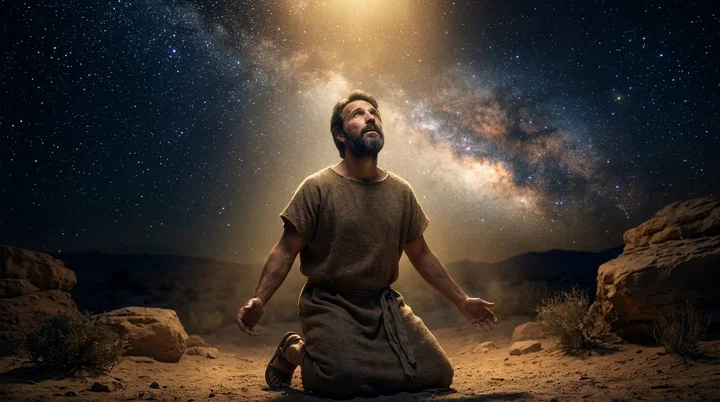
The word came to Abraham in a night-season vision in which the Lord conversed with him and took him forth abroad out of doors to see the stars.ST Aug 21, 1879ST Jun 29, 1876RH Nov 2, 1869 When that night vision ended he immediately prepared and offered the sacrifice God had directed as the token that he should actually inherit the land, in answer to his request for assurance that he would inherit it.ST Aug 21, 1879ST Jun 29, 1876RH Nov 2, 1869 Then through the whole livelong day until the going down of the sun he watched his sacrifice and waited for the hand of God to appear in acceptance without becoming weary, discouraged, or giving up, because he had entered upon something worth all that it could cost and sure to bring the wished-for result if he waited long enough.ST Aug 21, 1879ST Jun 29, 1876RH Nov 2, 1869
The vision was given after Abraham's victory over the five kings, and its setting is understood by reading the account of that victory and the intervening scripture.ST Aug 7, 1901 It stands fourth in the order of Abraham's experiences after his call, his sojourn in Egypt, and his experience with Lot, and before circumcision, Hagar, Sodom, Isaac, and the closing scenes and death.ST Aug 9, 1905 It belongs within the Abraham section of Genesis covering chapters 12-20, whose contents are best recalled and summarized by the single word Covenant.ST Aug 9, 1905
It belongs to the Genesis 12 to 26 account of God's providential dealings with the family of Abraham, in which Abraham is the chosen progenitor of the promised Seed.ST God's word that Abraham's heir would come from his own body carries forward the promise of the Seed given after the Fall, in the continuing story against Satan's efforts to destroy the Seed in Abel, to corrupt the Seed by mingling, and to destroy the nation of the Seed in Egypt.ST It is one of the repeated lessons by which Abraham was brought toward fullness of faith rather than coming to it at once, with the promised Seed kept in view in his sojourn and trials of faith under God's overruling providence.ST Jan 2, 1912ST Dec 20, 1910 It tests whether its readers are children of Abraham.ST Jan 2, 1912
The chapter is where God formally commands and directs Abraham to make offerings unto the Lord, the first record of that requirement.RH Aug 17, 1876 Abraham had already built an altar unto the Lord at least twice before, as Cain, Abel, and Noah had offered before any recorded command, and Genesis 22 again records God instructing Abraham to make burnt offerings.RH Aug 17, 1876 This shows God's children in those early ancient days and from the very first were carefully and thoroughly instructed not only in the moral law of God but in whatever was essential to rectitude of life, to worship of God, to atonement for sin, and in essential faith.RH Aug 17, 1876
True Heir Promised
Abraham had already been promised all the land of Canaan to himself and his seed after him while he had no child, and the greatness of that inheritance made childlessness a deep anguish, so he questioned how his reward could be sure while he feared dying childless.ST Sep 8, 1898ST Jun 2, 1881 God told him to give no place to fear and to trust that his reward would be sure, and by positively promising an heir of his own flesh and bone He set those fears at rest for a time.ST Sep 8, 1898 The same word told him that his descendants would afterward be strangers and suffer affliction and cruel oppression in another land before possessing it.ST Jun 2, 1881
By human reckoning Abraham concluded that having no son he must adopt his trusted household steward Eliezer of Damascus, born in his house, as heir, and God corrected that plan by positively declaring that Eliezer shall not be heir.ST Mar 27, 1879ST Apr 11, 1900ST Mar 1, 1905ST Jan 20, 1898ST Jan 26, 1915 The promise was thereby renewed a second time, that one coming forth out of Abraham's own body should be heir, and it was then confirmed by a solemn covenant and expanded with the numberless seed which Abraham believed and which was counted to him for righteousness.ST Apr 11, 1900ST Mar 1, 1905 The promised seed's work would not be accomplished immediately, for the prophecy that followed said his descendants would first live as strangers and suffer in another land for four hundred years.GSAM 42.1 Abraham later thought the promise might come through Hagar, but God said it would come through Sarah, and Abraham believed Him.ST Feb 12, 1894
The heir would not be adopted or another person Abraham had in mind, but his own literal offspring and true free-born son coming forth out of his own body, not a bond-servant.ST Nov 21, 1900ST Dec 20, 1910ST Jan 29, 1894ST Jan 20, 1898 This promise concerning natural descendants is to be distinguished from the promise that Abraham and his spiritual children by faith would inherit the world.ST Mar 2, 1915 Abraham attempted to fulfill the promise himself by hearkening to Sarai instead of the Lord and taking her Egyptian bondmaid Hagar, by whom he had Ishmael, but because Hagar was a bond-servant and slave Ishmael could be nothing else than a slave, so Abraham gained nothing.ST Nov 21, 1900
That promise was God's own plan to be fulfilled through Sarah's son, and afterward narrowed so it would be fulfilled through Isaac individually, with Ishmael decidedly rejected from being heir or co-heir with him.ST Sep 28, 1915 Isaac was then Abraham's only son and alone heir to the great promises, with the vast possession and the perpetuation of his name and house resting on him and no other son to fall back on. The purpose was that Abraham should have a son to whom he could personally teach the great principles of righteousness committed to him, who would in turn teach them to his children so they would pass from generation to generation as a blessing to mankind. Though Abraham was about a hundred years old and Sarah had passed childbearing age and been childless, the promise stood as unmistakable evidence to which Abraham looked rather than to his age or Sarah's condition.
God patiently corrected Abraham when he concluded from human calculation that the promise of a numerous seed through whom all the earth would be blessed in Christ must be fulfilled through his faithful servant Eliezer.ST Mar 1, 1905ST Jun 15, 1904ST Dec 11, 1901 The answer that the servant would not be heir but one coming from Abraham's own body would be heir taught that Jehovah Himself provides all He has promised without human planning, circumvention, or aid.ST Dec 11, 1901 The saving seed must come in God's own way and by God's power and not by fleshly human devising, whether by making a faithful servant heir or by making the wife's handmaid the mother of the seed.ST Mar 1, 1905ST Dec 11, 1901 Abraham later tried through human weakness and temporary lack of faith to accomplish in his own way what God had promised to do.ST Sep 23, 1913
Land and Covenant Inheritance
The promise of a son cannot be separated from the promise of the land, for the land had already been promised to Abraham and to his seed after him, so that dying childless would leave that promise without fulfillment and without assured blessing to his house.ST Jun 2, 1881 God therefore answered the fear of dying childless by rejecting the one born in the house as heir and declaring that the heir would come forth from his own body.RH Jan 9, 1900 That declaration stands together with the blessing to all nations, the promise of the world for an inheritance, the promise to give the land to inherit, and the benefit of the priesthood of the Most High, and it was immediately joined to the promise that the seed would be as innumerable as the stars.RH Jan 9, 1900 Belief in this word was counted for righteousness, fitting Abraham to enter of right into the eternal inheritance.RH Jan 9, 1900
God renewed the promise of the seed a second time, correcting the human reckoning that the childless patriarch must adopt his steward Eliezer of Damascus, born in his house, and declaring that Eliezer should not be heir.ST Apr 11, 1900RH Jun 5, 1900ST Mar 1, 1905 After earlier promises had been renewed, He then confirmed it by solemn covenant and oath.ST Apr 11, 1900RH Oct 25, 1853ST Oct 4, 1899 He pledged His own life by blood covenant, passing between the divided heifer, she-goat, ram, turtledove and young pigeon, to guarantee that every promise would be accomplished as surely as God exists.RH Jun 5, 1900 That covenant teaches that the saving seed must come in God's own way and by God's power and not by fleshly human devising.ST Mar 1, 1905
In the same covenant transaction He renewed the assurance that He had brought Abraham out of Ur to give him this land to inherit it, covenanting to give to his seed the land from the river of Egypt to the Euphrates. He also foretold that the descendants would first be strangers in another land and suffer affliction and cruel servitude for four hundred years before possessing it.RH Oct 25, 1853ST Oct 4, 1899GSAM 42.1 Because the promised inheritance was so great, having no child to inherit it caused deep anguish, yet darkness and trials lay between Abraham and his seed and the fulfillment of the inheritance.ST Jun 2, 1881
The family could not at once possess the land prepared for them because the iniquity of the Amorites who lived in it was not yet full until they should be thrust out.RH Mar 9, 1869RH Dec 17, 1861 Their time in Egypt allowed that iniquity to reach its appointed limit while giving Israel time to become numerous enough to possess the land, and Egypt was the place where they waited for the promise.RH Mar 9, 1869 The horror of great darkness and the smoking furnace in the vision meant the iron furnace of bitter servitude they must enter, where brief prosperity would be followed by long and terrible oppression.RH Dec 17, 1861
God's promise of an everlasting possession was made to Abraham personally, so it was not fulfilled during his lifetime, for He foretold that Abraham would die in peace while his descendants would first be strangers and suffer affliction.RH Dec 11, 1866 Nor was it fulfilled merely by the descendants' later possession of Canaan. It remains to be fulfilled when Abraham and the faithful who died trusting it are raised and perfected with the saints to peaceably possess the land in the future kingdom and the redeemed earth, renewed by God's creative power, which is the world to come.RH Dec 11, 1866ST Oct 4, 1899RH Mar 3, 1853ST Nov 4, 1886
Righteousness Through Faith
God answered Abraham's definite inquiry about the promised seed by rejecting the steward born in his house, Eliezer of Damascus, as heir when Abraham was still childless and old, years after the first mention of his seed, and by promising a second time that his heir would come forth from his own body and flesh.RH Jan 9, 1900RH Jun 5, 1900ST Mar 1, 1905 That declaration belongs to repeated references to the seed and stands together with the promise that his seed would be as innumerable as the stars, with the blessing making him a blessing to all nations, with the promise of the world for an inheritance, with the promise to give the land from the river of Egypt to the Euphrates to inherit, and with the benefit of the priesthood of the Most High, and God then pledged His own life by blood covenant to guarantee every promise would be accomplished as surely as God exists.RH Jan 9, 1900RH Jun 5, 1900 Abraham believed this word about the heir and the numberless seed, looking to the promise and not to his age or to Sarah's condition though he was about a hundred years old and she had passed childbearing age and been childless, and it was counted to him for righteousness, fitting him to enter of right into the eternal inheritance.RH Jan 9, 1900RH Jun 5, 1900 Though his faith had begun to waver and having a son seemed impossible, he wavered not through unbelief but grew strong through faith, holding the promise as constant joy and ever-present reality and fully assured God was able to perform what he could not yet see, and that faith was reckoned to him for righteousness for the purpose that he should have a son to whom he could personally teach the principles of righteousness to pass from generation to generation as a blessing to mankind.RH Sep 14, 1911
God expressly promised that a servant could not be heir but a true free-born son coming forth out of Abraham's own body would be heir, and Abraham attempted to fulfill that promise himself by hearkening to Sarai instead of the Lord and taking her Egyptian bondmaid Hagar, by whom he had Ishmael.ST Nov 21, 1900ST Dec 16, 1897 Because Hagar was a bond-servant and slave Ishmael could be nothing else than a slave, so Abraham gained nothing, while afterward Isaac was born as the free child of promise, able to inherit all that Abraham had.ST Nov 21, 1900 Sarai represents the new covenant and the promised son Isaac is born by promise, in contrast with Ishmael born after the flesh, proving the inheritance of righteousness is by promise and not by works of the law, since the covenant from Mount Sinai brings forth only bondage, condemnation and death.ST Nov 21, 1900ST Dec 16, 1897
God refused Abraham's plan to obtain the promised heir and seed by his own device through the bondwoman and taught that the heir could come only through righteousness by faith.ST Mar 1, 1905 The son of the bondwoman is in bondage, a type of those who would earn justification by the law and by obedience of the law as self-righteousness, while Isaac was the child of promise coming through no planning or device of his father but wholly through the power of the One who promised, making plain the saving seed must come in God's own way and by God's power and not by fleshly human devising.ST Mar 1, 1905 Hope of justification and salvation therefore rests not in self nor in any work done to earn it, but wholly in the promises of God by Jesus Christ, in trusting the righteousness of Christ alone in the obedience of faith.
Isaac, born from Abraham himself, was the promised heir and a child of faith who shared Abraham's faith, so Abraham's seed in the promise includes those who have that same faith and not merely those descended from him by birth.ST Sep 9, 1889 The promise has a deeper meaning than bodily descent and concerns the spiritual seed, whether Jew or Gentile, circumcised or uncircumcised, distinguishing the promise concerning natural descendants fulfilled to Israel from the promise that Abraham and his spiritual children by faith would inherit the world.ST Sep 9, 1889ST Mar 2, 1915 God's promise that Abraham's seed would be as numerous as the stars shows that God alone can number His people and know which of them are faithful, because only God reads the heart.ST Feb 10, 1898
Christ and Gospel Seed
The rejection of Eliezer of Damascus, the steward born in Abraham's house, when Abraham was old and still childless years after the first mention of his seed, declared that the heir would be a son coming forth out of Abraham's own body.RH Jun 5, 1900 That declaration belongs to the promise that his seed would be as the stars of heaven, that in him all families of the earth would be blessed, and that his seed would receive the land of promise which is the world to come.RH Jun 5, 1900 It was God's own heavenly everlasting covenant made with Abraham and his seed, not seeds, which is Christ, confirmed in Christ when Abraham believed God and it was counted to him for righteousness, answering to Jerusalem which is above in which he looked for a city which hath foundations whose builder and maker is God.RH Jun 5, 1900 God then pledged His own life by blood covenant, passing between the divided heifer, she-goat, ram, turtledove and young pigeon to guarantee that every promise would be accomplished as surely as God exists.RH Jun 5, 1900 The promise that the heir would come from his own body amplifies the gospel, the good tidings to sin-sick souls, enlarging the promise given in Eden that the Seed would bruise the destroyer's head and deliver those bound in sin's prison-house.ST Jun 12, 1907 It belongs to God's relation with men through the everlasting gospel begun in Eden, renewed to Noah, renewed to Abraham by repeated promise and oath, and confirmed by Christ upon the cross, by which every saved soul is saved.ST Feb 1, 1899ST Jun 4, 1902 The promise of life, salvation, and the kingdom through Jesus Christ includes the promise made to Abraham.ST Feb 1, 1899ST Jun 4, 1902
Abraham saw Christ's day and rejoiced in it, becoming acquainted by faith with the Lord Jesus and accepting Him as Saviour from sin and sinning.ST Jun 3, 1908 Thereby he entered into covenant relation with Heaven in which the Son of God as the Angel of Jehovah ministered to him.ST Jun 3, 1908 The same faith in the gift of God's only-begotten Son later enabled him to offer up Isaac, and what Christ did for him then shows what He will do in a larger way now, giving hope.ST Jun 3, 1908 The One who talked with Abraham concerning his heir and inheritance was the Lord Jesus Christ, as the Voice of the eternal Father and the Speaker of the words the prophets uttered.ST Jul 16, 1902 His speaking with an audible voice proves that God spoke to men audibly before the time of Christ.ST Jul 16, 1902
The Lord's appearing and speaking to Abraham about his heir belongs to the special promise made and confirmed to Abraham, Isaac, and Jacob, given under the covenant in which the patriarchs lived.ST Dec 15, 1898 It belongs to the revelation of the plan of redemption in Genesis.ST Dec 15, 1898 This promise that the heir would come from his own offspring was among the revelations about his posterity.ST Dec 15, 1898RH Aug 3, 1916
Waiting Trusting and Obeying
The word to Abraham about his heir is part of the covenant Word that true faith lays hold of instead of appearance, meaning to do one's part and then wait for God's time for God to come and fulfill what He promised.ST Jun 29, 1876RH Nov 2, 1869ST Nov 8, 1899 It came in a night-season vision in which God conversed with him, proved to be at night because He took Abraham forth abroad out of doors to see the stars.ST Jun 29, 1876RH Nov 2, 1869 When that night vision ended Abraham immediately prepared and offered the sacrifice God had bidden him offer as a token that he should actually inherit the land, in answer to his request for such a token.ST Jun 29, 1876RH Nov 2, 1869 Then through the whole livelong day until the going down of the sun he watched his sacrifice and waited for the hand of God to appear in acceptance without becoming weary, discouraged, or giving up, because he had entered upon something worth all that it could cost and sure to bring the wished-for result if he waited long enough.ST Jun 29, 1876RH Nov 2, 1869
The promise and communion with God strengthened Abraham for trial when a great darkness came upon him, and God repeated the promise in the darkness. That darkness did not mean Abraham had lost God's favor, for God remained with him and darkness was no barrier to God. Satan sought to adulterate and thwart God's plan for a true heir and seed to come from Abraham's own body by bringing in a child in a way altogether different from what God purposed.ST Mar 30, 1904 Ishmael was born through that different way, but he was not the child of promise, and he soon showed a malignant spirit toward the one who truly filled that place as the promised heir.ST Mar 30, 1904
God had answered Abraham's lament about going childless with Eliezer of Damascus, the steward born in his house, as his heir, by declaring that Eliezer would not be his heir but a son coming forth out of Abraham's own body would be his heir. The promise from the first was to Abraham and to his seed, and it was afterward narrowed so it would be fulfilled not only through Sarah's son but through Isaac individually, with Ishmael decidedly rejected from being heir or co-heir with him. This made the command to offer Isaac the severest test of faith, because Isaac was then Abraham's only son, the alone heir to the great promises, with the vast possession and the perpetuation of his name and house resting on him and no other son to fall back on. Abraham met it by faith that grasped resurrection, accounting that God was able to raise Isaac even from the dead, having been told that affliction, oppression, trials and sorrow would befall his posterity before possessing the promised land and being taught by offering his only son and receiving him as from the dead that death and a resurrection must take place before his seed received the inheritance, proving faith looked beyond temporal blessings to the life to come.ST May 17, 1899 Abraham believed the promise that his heir would come from his own body even when having a son seemed impossible, and that faith enabled him to obey when God later tested him by commanding him to sacrifice his son, trusting that God could raise the son from the dead.ST May 17, 1899
Sources