Genesis 23:17
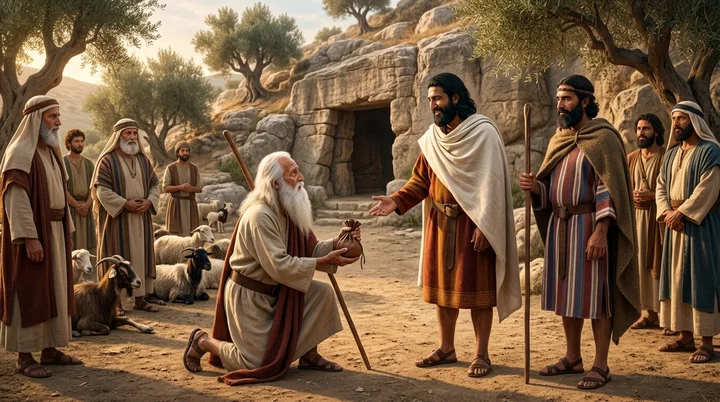
And the field of Ephron, which was in Machpelah, which was before Mamre, the field, and the cave which was therein, and all the trees that were in the field, that were in all the borders round about, were made sure
Translations
And the field of Ephron which was in Machpelah, which was before Mamre, the field, and the cave which was therein, and all the trees that were in the field, that were in all the borders round about, were made sure
King James Version, KJV Cambridge Paragraph Bible
And the field of Ephron, which was in Machpelah, which was before Mamre, the field, and the cave which was therein, and all the trees that were in the field, that were in all the borders round about, were made sure
And the field of Ephron, which was in Machpelah, which was before Mamre, the field and the cave which was in it, and all the trees that were in the field, that were in all the borders round about, were made sure
Revised Version, American Standard Version
So the field of Ephron, which was in Machpelah, which was before Mamre, the field, and the cave which was therein, and all the trees that were in the field, that were in all the border thereof round about, were made sure
And established are the field of Ephron, which [is] in Machpelah, which [is] before Mamre, the field and the cave which [is] in it, and all the trees which [are] in the field, which [are] in all its border round about,
So the field of Ephron, which was at Machpelah, which was before Mamre, the field, and the cave that was in it, and all the trees that were in the field, that were in all its borders round about,
So was confirmed the field of Ephron, which is in Machpelah, which is before Mamre,—the field and the cave which is therein, and all the timber which was in the field, which was in all the boundary thereof round about,
Berean Standard Bible, Majority Standard Bible
So Ephron’s field at Machpelah near Mamre, the cave that was in it, and all the trees within the boundaries of the field were deeded over
So the field of Ephron, which was in Machpelah, which was before Mamre, the field, the cave which was in it, and all the trees that were in the field, that were in all of its borders, were deeded
So Ephron's field at Machpelah near Mamre, with the hollow in the rock and all the trees in the field and round it,
So the fielde of Ephron which was in Machpelah, and ouer against Mamre, euen the field and the caue that was therein, and all the trees that were in the fielde, which were in all the borders round about, was made sure
Douay-Rheims (Challoner revision)
And the field that before was Ephron’s, wherein was the double cave, looking towards Mambre, both it and the cave, and all the trees thereof in all its limits round about,
Pictures
Cross-references
- Acts 7:5
And he gave him none inheritance in it, no, not so much as to set his foot on: yet he promised that he would give it to him for a possession, and to his seed after him, when as yet he had no child.
Abraham received no inheritance in the land, despite the promise.
- Hebrews 11:8-9
By faith Abraham, when he was called to go out into a place which he should after receive for an inheritance, obeyed; and he went out, not knowing whither he went.
Abraham lived as a sojourner, awaiting his inheritance.
- Genesis 49:29-32
And he charged them, and said unto them, I am to be gathered unto my people: bury me with my fathers in the cave that is in the field of Ephron the Hittite,
Jacob identifies the purchased field and cave at Machpelah as his burial place.
- Genesis 23:4
I am a stranger and a sojourner with you: give me a possession of a buryingplace with you, that I may bury my dead out of my sight.
Abraham describes himself as a stranger seeking a burial place.
- Genesis 13:15
For all the land which thou seest, to thee will I give it, and to thy seed for ever.
God promises Abraham and his seed the land he sees.
- Joshua 24:3
And I took your father Abraham from the other side of the flood, and led him throughout all the land of Canaan, and multiplied his seed, and gave him Isaac.
Abraham is led through Canaan, where he acquires the field and cave.
- Genesis 28:13-14
And, behold, the LORD stood above it, and said, I am the LORD God of Abraham thy father, and the God of Isaac: the land whereon thou liest, to thee will I give it, and to thy seed;
God repeats the promise of the land to Jacob, though the patriarchs had not inherited it.
- Genesis 12:7
And the LORD appeared unto Abram, and said, Unto thy seed will I give this land: and there builded he an altar unto the LORD, who appeared unto him.
God promised Abraham’s descendants the land of Canaan.
Commentary
Each commentary is drawn from primary sources: the writings of Ellen G. White and Adventist pioneers and periodicals. Each commentary is separate. Its own words are not a quotation; follow the references to read the source passages.
Ellen G. White
3 sources
The field and cave at Machpelah before Mamre is at Hebron, later called Mamre, and it became the burial place of the patriarchs.PP 697.2 Although the whole of Canaan had been promised as an everlasting possession and Abraham had been told to walk through its length and breadth, he owned none of it, not even a foot of ground.10MR 120.2PP 169.3 So when Sarah died he owned no ground to bury her and had to buy this field from the Canaanites for her burial.10MR 120.2PP 169.3 It remained his only possession in the promised land, which neither he nor his descendants received during their lifetimes.10MR 120.2PP 169.3
The verse therefore shows that Abraham did not treat this world as his home but lived as a pilgrim and stranger in it.10MR 120.2PP 169.3 In the same way, God's people do not realize full prosperity now in land or gold or silver.10MR 120.2 As pilgrims they must leave positions of self-interest when God calls and follow the light given regardless of consequences.10MR 120.2
Abraham was satisfied with his pilgrim lot because he was shown immortal life on this earth purified as his true home and the city designed and built by God, the greater inheritance that had been promised.10MR 120.2PP 169.3 Christians hold the same claim to future immortal life and an eternal weight of glory while seeking that city.10MR 120.2
Sources
Pioneers and periodicals
16 sources
The field of Ephron at Machpelah before Mamre, with its cave and all its trees within its borders, was legally secured and confirmed to Abraham as his own property.RH Jan 27, 1910RH Apr 25, 1854 He bought it at full price in money for a burial place for Sarah, and its cave became the burial place of Abraham and Sarah, Isaac and Rebecca, and Jacob and Leah.RH Jan 27, 1910RH Apr 25, 1854ST May 12, 1898 That bought field and cave was his only permanent possession in Canaan, for he owned no inheritance there during his lifetime.AUST Jun 14, 1920ST May 12, 1898AUST Jun 14, 1920 Its purchase did not fulfill the promise that he and his seed would possess the land and the whole earth as an everlasting inheritance, for he sojourned in the land of promise as in a strange country and with Isaac and Jacob died without receiving it, confessing they were strangers and pilgrims on the earth (Hebrews 11:9, 13). ST May 12, 1898ST Oct 12, 1904ST May 8, 1884 The contrast between that small bought grave, all he received in this life, and the vast promised inheritance proves the sublimity of his faith, for he knew God would somehow and sometime fulfill His word and looked for the city whose builder and maker is God (Hebrews 11:10).AUST Jun 14, 1920AUST Jun 14, 1920
Purchase and Its Setting
The field of Ephron in Machpelah before Mamre, with the cave therein and all the trees in the field in all its borders round about, were made sure to Abraham as a legally secured and confirmed transfer of property.RH Jan 27, 1910RH Sep 26, 1854ST Apr 6, 1888 The securing covered the field, the cave, the trees within its boundaries, and the surrounding land, making them his property by purchase.RH Apr 25, 1854ST Jan 9, 1912ST Apr 6, 1888 The transaction is part of the simple record of a patriarch's life and death, with no mention of a distinct immortal soul or spirit surviving death.RH Sep 26, 1854
Abraham bought the field from Ephron at a time when Hittites lived at Hebron, and the account places the Hittites in Abraham's time as a people known in the biblical record from that period onward.RH Jan 27, 1910ST Jun 23, 1909ST Oct 1, 1885 The confirmed transfer recognized the Hittite family's established ownership of that district, even as Abraham claimed Canaan more broadly as the inheritance of his ancestors and descendants. His stay and purchase there did not fulfill the promise that he and his seed would possess the land, for he sojourned in the land of promise as in a strange country and with Isaac and Jacob as fellow heirs died without receiving it.ST Oct 12, 1904
Though the Hittites, or Hethites, offered to give Abraham land to bury his dead, he chose to pay its worth in money at full price rather than accept it as a gift.RH Apr 25, 1854ST Jan 9, 1912ST Aug 21, 1884 When he insisted they name a price they demanded about $250, which was more than the land was worth.ST Jan 9, 1912 The purchase was made with money, and the account of Abraham's purchase of Sarah's burial place is the first mention of money in Scripture.AUST Jun 14, 1920AUST Jun 14, 1920ST Jan 28, 1875
The purchase was a burial place for Sarah, bought because Abraham owned no part of Canaan until he purchased this property and possessed no inheritance there during his lifetime.RH Jan 27, 1910RH Apr 25, 1854ST May 12, 1898ST May 8, 1884 The field and cave were a real possession, but only a burial place and not the promised inheritance fulfilled.ST May 12, 1898ST Aug 21, 1884 The cave became the family burial place of Abraham and Sarah, Isaac and Rebecca, and Jacob and Leah, while Rachel was buried elsewhere.RH Jan 27, 1910
Promise Faith and Lessons
Abraham owned no part of Canaan until he bought the field and cave at Machpelah with its trees and borders round about for its full price with money, and that bought burial place was a real possession but his only permanent possession there in his lifetime, all he received in this life after wandering among unknown and perhaps hostile tribes.AUST Jun 14, 1920ST May 12, 1898ST Apr 6, 1888ST May 8, 1884ST Aug 21, 1884 His stay and that purchase did not fulfill the promise to him and his seed of the land as an everlasting inheritance, for that promise included the whole earth and heirship of the whole world with a future permanent home, which the meek have not yet inherited.AUST Jun 14, 1920ST May 12, 1898ST Oct 12, 1904ST May 8, 1884ST Aug 21, 1884 He sojourned in the land of promise as in a strange country and with Isaac and Jacob as fellow heirs died without receiving it, seeing its fulfillment in the future while confessing they were strangers and pilgrims on the earth.ST Oct 12, 1904 The contrast between the small bought grave and the vast promised inheritance glimpsed in visions of the city whose builder and maker is God proves the sublimity of his faith, for he knew that somehow and sometime God would fulfill His word, a faith worthy of emulation till time shall end, in which hope he looked for that city and went forth to his great field of missionary endeavor.AUST Jun 14, 1920AUST Jun 14, 1920
His insistence on paying its worth in money is an example of dealing generously and paying what is owed, and his life in this account traces growing trust in God and God's providential care for him.ST Dec 20, 1910RH Apr 25, 1854 The verse belongs to the continuing Genesis account following the family through which the Seed was to come, with the promises extending from Abraham to Isaac and from Isaac to Jacob.ST Jan 14, 1913 It stands in the simple record of a patriarch's life and death with no mention of a distinct immortal soul or spirit surviving death.RH Sep 26, 1854
Sources