Genesis 23:4
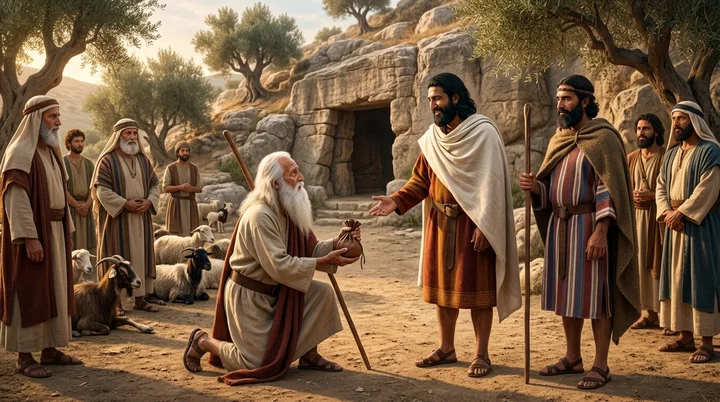
I am a stranger and a sojourner with you: give me a possession of a buryingplace with you, that I may bury my dead out of my sight.
Translations
I am a stranger and a sojourner with you: give me a possession of a burial plot with you, that I may bury my dead out of my sight.
King James Version, KJV Cambridge Paragraph Bible, Revised Version
I am a stranger and a sojourner with you: give me a possession of a buryingplace with you, that I may bury my dead out of my sight.
I am a stranger and a sojourner with you; give me a possession of a burying-place with you, that I may bury my dead out of my sight.
I am a stranger and a sojourner with you: give me a possession of a burying-place with you, that I may bury my dead out of my sight.
'A sojourner and a settler I [am] with you; give to me a possession of a burying-place with you, and I bury my dead from before me.'
I am a stranger and a sojourner with you; give me a possession of a sepulchre with you, that I may bury my dead from before me.
A sojourner and settler, am I with you,—Give me a possession of a buryingplace with you, That I may bury my dead, from before me.
Berean Standard Bible, Majority Standard Bible
“ I am a foreigner and an outsider among you. Give me a burial site among you so that I can bury my dead.”
“ I am a stranger and a foreigner living with you. Give me a possession of a burying-place with you, that I may bury my dead out of my sight.”
I am living among you as one from a strange country: give me some land here as my property, so that I may put my dead to rest.
I am a stranger, and a forreiner among you, giue me a possession of buriall with you, that I may burie my dead out of my sight.
Douay-Rheims (Challoner revision)
I am a stranger and sojourner among you: give me the right of a burying place with you, that I may bury my dead.
Pictures
Cross-references
- Hebrews 11:13
These all died in faith, not having received the promises, but having seen them afar off, and were persuaded of them, and embraced them, and confessed that they were strangers and pilgrims on the earth.
Abraham confessed he was a stranger and sojourner while living in faith.
- Hebrews 11:9
By faith he sojourned in the land of promise, as in a strange country, dwelling in tabernacles with Isaac and Jacob, the heirs with him of the same promise:
Abraham sojourned in the promised land as a stranger.
- Acts 7:5
And he gave him none inheritance in it, no, not so much as to set his foot on: yet he promised that he would give it to him for a possession, and to his seed after him, when as yet he had no child.
Abraham received no inheritance in the land, though it was promised to him and his seed.
- 1 Peter 2:11
Dearly beloved, I beseech you as strangers and pilgrims, abstain from fleshly lusts, which war against the soul;
Believers are called strangers and pilgrims in the world.
- Leviticus 25:23
The land shall not be sold for ever: for the land is mine; for ye are strangers and sojourners with me.
God calls Israel strangers and sojourners in his land.
- 1 Chronicles 29:15
For we are strangers before thee, and sojourners, as were all our fathers: our days on the earth are as a shadow, and there is none abiding.
David calls God’s people strangers and sojourners before God.
- Hebrews 11:10
For he looked for a city which hath foundations, whose builder and maker is God.
Abraham looks for the city built by God.
- 1 Peter 1:17
And if ye call on the Father, who without respect of persons judgeth according to every man’s work, pass the time of your sojourning here in fear:
Believers are urged to live reverently during their sojourn.
- Joshua 24:3
And I took your father Abraham from the other side of the flood, and led him throughout all the land of Canaan, and multiplied his seed, and gave him Isaac.
God led Abraham through Canaan and gave him Isaac, though Abraham had no land there.
- 2 Samuel 24:24
And the king said unto Araunah, Nay; but I will surely buy it of thee at a price: neither will I offer burnt offerings unto the LORD my God of that which doth cost me nothing. So David bought the threshingfloor and the oxen for fifty shekels of silver.
David insisted on paying for what he offered to God.
- Genesis 13:15
For all the land which thou seest, to thee will I give it, and to thy seed for ever.
God promises Abraham the land as an inheritance.
Commentary
Each commentary is drawn from primary sources: the writings of Ellen G. White and Adventist pioneers and periodicals. Each commentary is separate. Its own words are not a quotation; follow the references to read the source passages.
Ellen G. White
1 source
Abraham stood in Canaan as a pilgrim and a stranger, not as a settled possessor.10MR 120.2 Though the land had been promised to him by God, he owned none of it for himself, so that when Sarah died he had to purchase a burial place from those among whom he dwelt.10MR 120.2 That lack of earthly possession did not annul the promise, for he looked beyond the present to the future home God would give and rested content to wait for its fulfillment.10MR 120.2
Sources
Pioneers and periodicals
19 sources
Abraham owned no land in Canaan and called himself a stranger and sojourner among the Hittites when he asked to buy a burial place to lay Sarah out of his sight.RH May 27, 1915ST Jun 7, 1905ST Aug 19, 1897 Though offered a burial place, he insisted on paying its full worth in money rather than receiving it without cost.RH Apr 25, 1854 That purchase of a grave was only a limited possession, not the inheritance of the land God had promised to him and his seed.RH May 27, 1915 He lived in the promised land as a stranger by promise without possessing its fulfillment in his lifetime, and he with Isaac and Jacob died without receiving it, seeing it still future and confessing they were strangers and pilgrims on the earth.ST Aug 19, 1897ST Oct 12, 1904ST May 12, 1898ST May 8, 1884ST Apr 6, 1888 His calling himself a temporary resident teaches that God's people are strangers and sojourners in this world, not citizens of the earthly country they pass through.ST Jun 7, 1905
Setting and Transaction Details
Abraham owned no land in Canaan and lived there without owning it, calling himself a stranger and sojourner and resident alien among the Hittites while asking them to sell him a possession of a burying place for Sarah so he could bury her away from his sight.RH May 27, 1915ST Jun 7, 1905ST Aug 19, 1897ST Feb 19, 1894 His purchase of a grave was only a limited possession, not the inheritance of the land God had promised him and his seed, and his words express that he and his descendants had not yet received the promised inheritance and regarded themselves as pilgrims on earth.RH May 27, 1915ST Aug 19, 1897 Although offered a burial place by the children of Heth, he insisted on paying its worth in money rather than accepting it without cost, paying for what he received.RH Apr 25, 1854
The Hittites’ offer of land concealed an expectation of generous payment, and when Abraham insisted on a price they demanded more than the land was worth.ST Jan 9, 1912 His purchase from a Hittite family was an exception to his wider claim to the land, for the Hittites had become settled there and their local property was recognized. That burial place also preserved the patriarchs’ connection to Canaan as the land promised to their descendants.
Hittites were living at Hebron in Abraham’s time when he asked them for a possession of a burying place, a true historical people represented as present from Abraham’s time who at one point rivaled Babylon and Egypt.ST Jun 23, 1909ST Oct 1, 1885 Historians once disputed that any such nation existed and skeptics charged the Bible with inaccuracy for mentioning them, but discovery of the Hittite empire confirmed the account and explained facts that otherwise did not admit of solution.ST Jun 23, 1909 Burial in a cave or rock-hewn sepulcher, as in Genesis 23:4-15, was still called burial.ST Dec 3, 1896
The verse falls within the account of God’s providential dealings with Abraham’s family as the chosen family through which the Seed would come.STST Jan 14, 1913 It belongs to the continuing account of that line in which the promises given to Abraham extend to Isaac and from Isaac to Jacob.ST Jan 14, 1913
Promise Not Yet Inherited
Abraham owned no land in Canaan and had to ask its inhabitants to sell him a burial place, calling himself a stranger and sojourner among them, and the grave he purchased was only a limited possession and not the inheritance of the land God had promised him and his seed.RH May 27, 1915 Although God had promised the land to him and his descendants, he had no land inheritance there during his lifetime and had to buy the cave of Machpelah from the Hittites to bury his dead, which shows the promise had not yet been fulfilled in his possession of the land.ST May 12, 1898 He was a stranger and sojourner in Canaan who had to buy a burial place from its inhabitants to bury Sarah, and his need to purchase even a burial plot shows he had not received the promised land as his inheritance.ST May 8, 1884ST Apr 6, 1888 He owned no inheritance in Canaan, and his purchase for Sarah is evidence the promised inheritance had not yet been given to him.ST Apr 6, 1888 He lived in the land promised to him as a stranger and had to buy a burial place there because he had not yet inherited the land, living by God's promise of an inheritance without possessing its fulfillment in his lifetime and without permanent land of his own.ST May 8, 1884ST Aug 21, 1884
He lived in the land God had promised him without owning it, and his words in asking to buy a burial place for Sarah express that he and his descendants had not yet received the promised inheritance and regarded themselves as pilgrims on earth.ST Aug 19, 1897 He with Isaac and Jacob died without receiving the promised inheritance, seeing its fulfillment still in the future and confessing for the present that they were strangers and pilgrims on the earth.ST Aug 19, 1897ST Oct 12, 1904 His experience illustrates that the promised inheritance was still future and that his children meanwhile lived as strangers under earthly powers.ST May 8, 1884 His buying the cave of Machpelah from a Hittite, even though the promise to him included the whole earth, proves that the promise that the meek shall inherit the earth has not yet been fulfilled, for even Abraham sojourned in the land of promise as in a strange country.ST Oct 12, 1904
He did not possess the promised land as his own inheritance but lived there as a stranger and had to buy a place to bury Sarah. His need to pay for a burial place illustrates that his faithful children likewise do not yet possess the promised land but remain there only by paying tribute to wicked rulers. The land is to be peaceably possessed by Abraham and his seed in the future.
Pilgrim Life and Application
Abraham's calling himself a stranger and sojourner among the Hittites while asking to buy a burial place for Sarah shows that God's people are temporary residents in this world.ST Jun 7, 1905 They are strangers and sojourners passing through, not citizens of the earthly country where they dwell.ST Jun 7, 1905 Though the children of Heth offered him a burial place, he insisted on paying its worth in money, and his conduct stands as the pattern of paying for what is received rather than accepting it without cost.RH Apr 25, 1854
To bury the dead is to put them out of sight, even out of the sight of neighbors.ST Jun 29, 1876 Such putting out of sight does not mean the dead are forgotten, but that grief may be borne inwardly without being continually displayed to others.ST Jun 29, 1876 The same putting of the dead out of sight applies to those who remain spiritually dead, who face the second death and are removed from God's sight as something repulsive.ST Apr 14, 1881 Life comes through Christ the crucified One, and those who receive life in Him share the hope of resurrection.ST Apr 14, 1881
Sources