Genesis 23:16
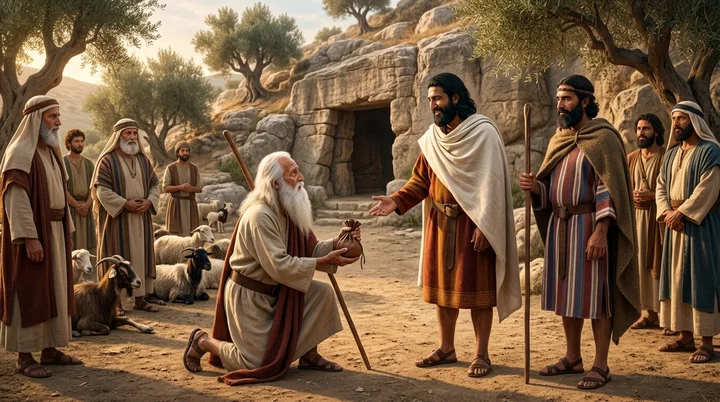
And Abraham hearkened unto Ephron; and Abraham weighed to Ephron the silver, which he had named in the audience of the sons of Heth, four hundred shekels of silver, current money with the merchant.
Translations
And Abraham listened to Ephron; and Abraham weighed to Ephron the silver, which he had named in the audience of the sons of Heth, four hundred shekels of silver, current money with the merchant.
King James Version, KJV Cambridge Paragraph Bible
And Abraham hearkened unto Ephron; and Abraham weighed to Ephron the silver, which he had named in the audience of the sons of Heth, four hundred shekels of silver, current money with the merchant.
And Abraham hearkened to Ephron; and Abraham weighed to Ephron the silver which he had named in the audience of the sons of Heth, four hundred shekels of silver, current money with the merchant.
And Abraham hearkened unto Ephron; and Abraham weighed to Ephron the silver, which he had named in the audience of the children of Heth, four hundred shekels of silver, current money with the merchant.
And Abraham hearkened unto Ephron; and Abraham weighed to Ephron the silver which he had named in the audience of the children of Heth, four hundred shekels of silver, current money with the merchant.
And Abraham hearkeneth unto Ephron, and Abraham weigheth to Ephron the silver which he hath spoken of in the ears of the sons of Heth, four hundred silver shekels, passing with the merchant.
And Abraham hearkened to Ephron; and Abraham weighed to Ephron the money that he had named in the ears of the sons of Heth — four hundred shekels of silver, current with the merchant.
And Abraham hearkened unto Ephron, and Abraham weighed out to Ephron the silver of which he had spoken in the ears of the sons of Heth,—four hundred shekels of silver, current with the merchant,
Berean Standard Bible, Majority Standard Bible
Abraham agreed to Ephron’s terms and weighed out for him the price he had named in the hearing of the Hittites: four hundred shekels of silver, according to the standard of the merchants.
Abraham listened to Ephron. Abraham weighed to Ephron the silver which he had named in the hearing of the children of Heth, four hundred shekels of silver, according to the current merchants’ standard.
And Abraham took note of the price fixed by Ephron in the hearing of the children of Heth, and gave him four hundred shekels in current money.
So Abraham hearkened vnto Ephron, and Abraham weyed to Ephron the siluer, which he had named, in the audience of the Hittites, euen foure hundreth siluer shekels of currant money among marchants.
Douay-Rheims (Challoner revision)
And when Abraham had heard this, he weighed out the money that Ephron had asked, in the hearing of the children of Heth, four hundred sicles of silver of common current money.
Pictures
Cross-references
- Acts 7:5
And he gave him none inheritance in it, no, not so much as to set his foot on: yet he promised that he would give it to him for a possession, and to his seed after him, when as yet he had no child.
Abraham received no land inheritance during his life, apart from a purchased burial place.
- Genesis 49:29-32
And he charged them, and said unto them, I am to be gathered unto my people: bury me with my fathers in the cave that is in the field of Ephron the Hittite,
Jacob asks to be buried in the family tomb at Machpelah.
- Genesis 25:9-10
And his sons Isaac and Ishmael buried him in the cave of Machpelah, in the field of Ephron the son of Zohar the Hittite, which is before Mamre;
Isaac and Ishmael bury Abraham at Machpelah.
- Genesis 50:13
For his sons carried him into the land of Canaan, and buried him in the cave of the field of Machpelah, which Abraham bought with the field for a possession of a buryingplace of Ephron the Hittite, before Mamre.
Jacob is buried in the cave Abraham bought from Ephron.
- Genesis 23:11
Nay, my lord, hear me: the field give I thee, and the cave that is therein, I give it thee; in the presence of the sons of my people give I it thee: bury thy dead.
Ephron offers Abraham the land before naming its price.
- Genesis 23:7
And Abraham stood up, and bowed himself to the people of the land, even to the children of Heth.
Abraham bows before the sons of Heth during the cave purchase.
Commentary
Each commentary is drawn from primary sources: the writings of Ellen G. White and Adventist pioneers and periodicals. Each commentary is separate. Its own words are not a quotation; follow the references to read the source passages.
Ellen G. White
4 sources
The verse completes Abraham's purchase of a cave in which to bury his beloved Sarah from Ephron and the sons of Heth, by weighing out the agreed silver publicly before them in the audience of those witnesses.19MR 12.2–13.2Lt 49, 1875, par. 21–23 That burial cave is Machpelah at Hebron, which served as the burial place of the patriarchs.PP 697.2 In the transaction Abraham bowed before the sons of Heth.19MR 12.2–13.2 His conduct is the finest example of the power of true courtesy, showing courtesy and respect toward fellow men, what is due from one person to another, and what it means to be a Christian gentleman and a true gentleman.19MR 12.2–13.2Lt 49, 1875, par. 21–23
Although God had promised Abraham the whole of Canaan, he owned none of it and had to buy with silver even a place to bury Sarah.10MR 120.2 This shows he lived as a pilgrim and stranger in the promised land, without earthly prosperity in land or possessions, and he was satisfied because he had been shown immortal life on this earth purified as his future home.10MR 120.2 It teaches those who follow the light God gives, even when called to leave positions of interest and to endure trial, to seek the city whose builder and maker is God and not to expect full reward here in land or gold or silver but to expect an eternal weight of glory.10MR 120.2
Sources
Pioneers and periodicals
17 sources
Abraham bought the field and cave of Machpelah from Ephron the Hittite as a burial place for Sarah, which became the family grave for Abraham, Sarah, Isaac, Rebekah, and Leah, with Jacob also brought there from Egypt.RH Jan 27, 1910 He paid the price Ephron had named publicly before the sons of Heth, weighing out four hundred shekels of silver at the current merchant standard, rather than accepting the land as a free gift.RH Apr 25, 1854ST Feb 19, 1894ST Jan 28, 1875 His having to buy even a burial plot shows he held no present, permanent, or inherited possession in Canaan during his lifetime, and had not yet received the promised inheritance.ST May 12, 1898ST Apr 6, 1888ST Aug 21, 1884 Though the promise to him embraced the whole earth, he sojourned in the land of promise as in a strange country and died with Isaac and Jacob without receiving it, as strangers and pilgrims, proving that Canaan as Israel later possessed it was only a type of the everlasting inheritance.ST Oct 12, 1904ST May 8, 1884 The purchased grave was all he received in this life, so his reward was still future, and his going forth to wander while holding to God's word shows a sublime faith and hope worthy of emulation till time shall end.AUST Jun 14, 1920AUST Jun 14, 1920
Transaction and Historical Setting
The weighing out of silver records Abraham's purchase of the field and cave of Machpelah from Ephron the Hittite as a burial place for Sarah, which afterward became the family burial place of Abraham, Sarah, Isaac, Rebekah, and Leah, with Jacob's body also brought there from Egypt.RH Jan 27, 1910 Abraham hearkened to Ephron and paid the price Ephron had named publicly in the audience of the sons of Heth, weighing out four hundred shekels of silver at the current standard of money with the merchant.ST Feb 19, 1894ST Jan 28, 1875ST Oct 1, 1885RH Oct 1, 1901 He did not accept the offered burial place as a free gift but paid its worth in money at the agreed price and the merchant's rate.RH Apr 25, 1854
The transaction illustrates duplicity on the part of the Hittites, who offered the land while expecting a generous reward and then, when required to name a price, asked more than it was worth, about $250.ST Jan 9, 1912 It shows that Hittites lived at Hebron in the time of the patriarchs and owned land there.ST Jun 23, 1909 The Hittite nation then rivaled Babylon and Egypt, though all memory of it was later lost and its existence denied, and the discovery and deciphering of Hittite monuments and clay libraries explains otherwise unsolved facts, supplies the missing link in ancient Eastern history, and proves the Genesis account correct.ST Jun 23, 1909
The weighing of silver here is the first example of money being mentioned in Scripture.ST Jan 28, 1875 Abraham acquired this particular land by purchase despite his broader claim to Canaan because the Hittites had established a settled claim to that district. The verse belongs to the account of God's providential dealings with Abraham's family running from Genesis 12 through 26, presenting Abraham as the chosen progenitor of the Seed.ST That account carries the promises given to him on toward Isaac and then to Jacob.ST Jan 14, 1913
Promised Inheritance Still Future
Abraham had no present possession of the land promised to him, for though he sojourned in Canaan he had to buy a burial cave and field there from its Hittite inhabitants.ST May 12, 1898ST Apr 6, 1888ST Aug 21, 1884 He received no inheritance there during his lifetime, and had no permanent or inherited possession in Canaan except a burial place, which he bought by weighing out the full price of the silver Ephron had named.ST Apr 6, 1888ST May 8, 1884ST Aug 21, 1884 His purchase of Machpelah illustrates that he had not yet received the promised inheritance.ST May 12, 1898
Though the promise to him included the whole earth, his buying the cave of Machpelah from a Hittite for a burial place proves the time when the meek inherit the earth had not yet come.ST Oct 12, 1904 He sojourned in the land of promise as in a strange country, and he with Isaac and Jacob died without receiving the promised inheritance, seeing its fulfillment still in the future as strangers and pilgrims on the earth.ST Oct 12, 1904 His need to pay its inhabitants for a burial place for Sarah confirms he had not received the promised land, so Canaan in the condition Israel later possessed it was not the promised everlasting inheritance but a type of it.ST May 8, 1884
The purchased grave was all he received in this life, though God had promised him a future permanent home and heirship of the whole world.AUST Jun 14, 1920AUST Jun 14, 1920 He purchased his burial place with money, and that fact means his reward was still future.AUST Jun 14, 1920AUST Jun 14, 1920 His acceptance of this, and his going forth to wander among unknown and perhaps hostile tribes as a missionary while holding to the promise that God would somehow and sometime fulfill His word, proves sublime faith and hope worthy of emulation till time shall end.AUST Jun 14, 1920AUST Jun 14, 1920
Sources