Genesis 25:24
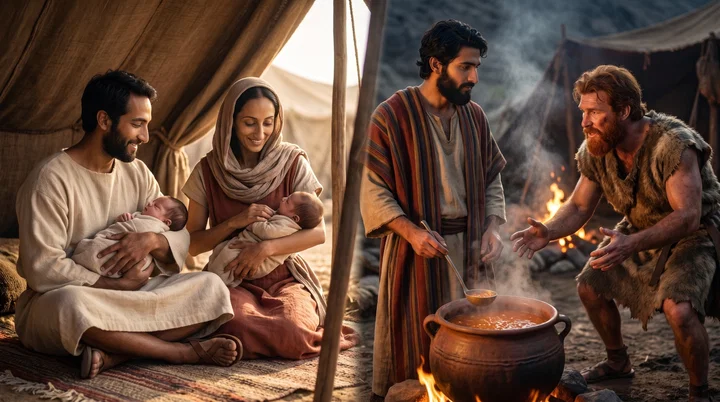
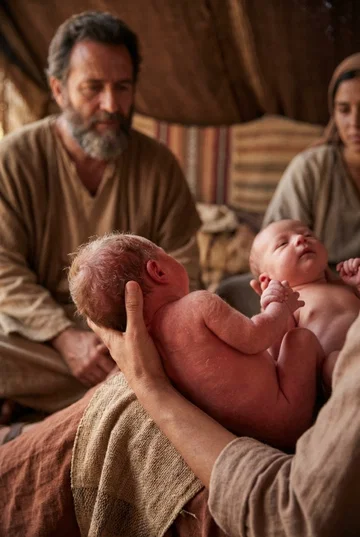
And when her days to be delivered were fulfilled, behold, there were twins in her womb.
Translations
American King James Version, King James Version, KJV Cambridge Paragraph Bible, Webster Bible, Revised Version, American Standard Version, Darby Translation
And when her days to be delivered were fulfilled, behold, there were twins in her womb.
And her days to bear are fulfilled, and lo, twins [are] in her womb;
Then were fulfilled her days to bring forth,—and lo! twins in her womb.
Berean Standard Bible, Majority Standard Bible
When her time came to give birth, there were indeed twins in her womb.
When her days to be delivered were fulfilled, behold, there were twins in her womb.
And when the time came for her to give birth, there were two children in her body.
Therefore when her time of deliuerance was fulfilled, behold, twinnes were in her wombe.
Douay-Rheims (Challoner revision)
And when her time was come to be delivered, behold twins were found in her womb.
Pictures
Cross-references
- Genesis 25:29-34
And Jacob sod pottage: and Esau came from the field, and he was faint:
Jacob buys Esau’s birthright by taking advantage of his hunger.
- Genesis 27:1-29
And it came to pass, that when Isaac was old, and his eyes were dim, so that he could not see, he called Esau his eldest son, and said unto him, My son: and he said unto him, Behold, here am I.
Rebekah helps Jacob deceive Isaac to obtain Esau’s blessing.
- Genesis 25:28
And Isaac loved Esau, because he did eat of his venison: but Rebekah loved Jacob.
parents' divided favoritism
- Matthew 1:2
Abraham begat Isaac; and Isaac begat Jacob; and Jacob begat Judas and his brethren;
Jesus’ genealogy traces his descent from Jacob.
Commentary
Each commentary is drawn from primary sources: the writings of Ellen G. White and Adventist pioneers and periodicals. Each commentary is separate. Its own words are not a quotation; follow the references to read the source passages.
Ellen G. White
1 source
Before the twins were delivered, God told Rebekah that the birthright would fall to Jacob, the younger.PP 178.2–3 Jacob learned of that divine announcement from his mother.PP 178.2–3 Jacob wanted the birthright not for his father's wealth but for its spiritual privileges.PP 178.2–3 The spiritual birthright meant communing with God as righteous Abraham had done.PP 178.2–3
It meant offering the sacrifice of atonement for his family.PP 178.2–3 It meant becoming the progenitor of the chosen people and of the promised Messiah.PP 178.2–3 It meant inheriting the immortal possessions embraced in the blessings of the covenant.PP 178.2–3 Jacob thus esteemed eternal blessings above temporal blessings.PP 178.2–3
Even so, he had no experimental knowledge of the God he revered, and his heart had not been renewed by divine grace.PP 178.2–3 He believed the promise concerning himself could not be fulfilled while Esau retained the rights of the firstborn.PP 178.2–3 He therefore constantly studied how to secure the blessing that his brother held lightly but that was precious to himself.PP 178.2–3
Sources
Pioneers and periodicals
9 sources
When her days to be delivered were fulfilled, Rebekah's pregnancy reached its full term and appointed time and she bore twins, Jacob and Esau.ST Jan 9, 1912 The twins were born to Isaac and Rebekah, of the same father and the same mother.ST May 28, 1912RH Nov 4, 1862RH Sep 8, 1874 After many years without children, Isaac and Rebekah received the twin sons in answer to earnest prayer and faith.ST Feb 17, 1914
The birth begins the account that forecasts the characters of Esau and Jacob.ST Jan 9, 1912 Jacob and Esau represent two kinds of character, with Jacob representing those faithful to God and Esau, who became Edom, representing those who place all their hopes in this world.ST May 28, 1912 The birth stands within God's providential dealings with Abraham's chosen family through which the Seed would come, with the promises extending from Abraham to Isaac and from Isaac to Jacob.STST Jan 14, 1913
The birth marks the point where the promised line divides, meaning the Messiah was to be the Son of Jacob and not of Esau, which was fulfilled in that Jesus Christ descended from Jacob and not from his brother Esau.RH Nov 18, 1862 Rebekah knew the promise of God would be manifest through Jacob and kept the importance of the Seed before him in a material way without the fullest appreciation of the spiritual blessings.ST Jan 14, 1913 Isaac's overfond affection for Esau drew stronger sympathy from Rebekah for Jacob and brought division to the family.ST Jan 14, 1913 Jacob's material overreaching demonstrated the fitness of his name meaning supplanter, yet God in mercy brings a change.ST Jan 14, 1913
Jacob and his twin brother Esau produced two separate nations.RH Nov 4, 1862 The house of Esau has utterly perished with none remaining, while the children of Israel, Jacob's descendants, remain a distinct and separate people scattered through all nations and distinct in religion, customs and appearance.RH Nov 4, 1862RH Sep 8, 1874 That opposite outcome of extinction of one twin's line and preservation of the other proves Israel's long preservation without amalgamation cannot be explained by purity of blood or race or any human cause.RH Nov 4, 1862RH Sep 8, 1874 Their story shows that first-born can mean first in rank or pre-eminence, not first in time, since Esau was older than Jacob.ST Jan 11, 1905
Sources