Genesis 25:29
And Jacob sod pottage: and Esau came from the field, and he was faint:
Translations
American King James Version, King James Version, KJV Cambridge Paragraph Bible
And Jacob sod pottage: and Esau came from the field, and he was faint:
And Jacob boiled pottage: and Esau came from the field, and he was faint.
And Jacob sod pottage: and Esau came in from the field, and he was faint:
And Jacob boiled pottage: and Esau came in from the field, and he was faint:
And Jacob boileth pottage, and Esau cometh in from the field, and he [is] weary;
And Jacob had cooked a dish; and Esau came from the field, and he was faint.
And Jacob had boiled pottage,—when Esau came in from the field, he, being famished.
Berean Standard Bible, Majority Standard Bible
One day, while Jacob was cooking some stew, Esau came in from the field and was famished.
Jacob boiled stew. Esau came in from the field, and he was famished.
And one day Jacob was cooking some soup when Esau came in from the fields in great need of food;
Nowe Iaakob sod pottage, and Esau came from the fielde and was wearie.
Douay-Rheims (Challoner revision)
And Jacob boiled pottage: to whom Esau, coming faint out of the field,
Pictures
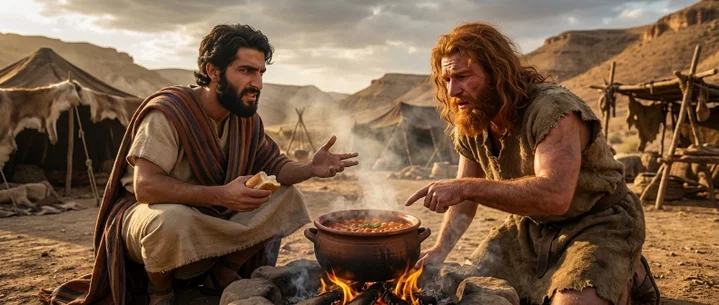
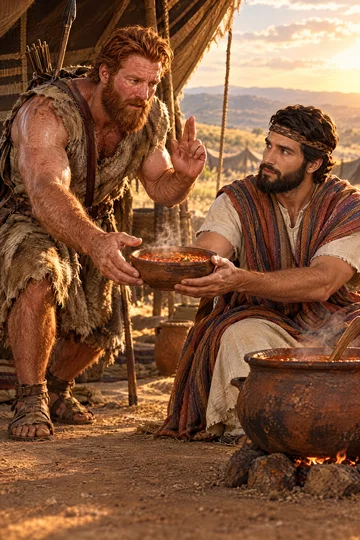
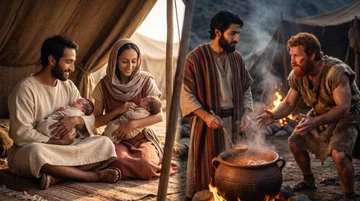
Cross-references
- Hebrews 12:16-17
Lest there be any fornicator, or profane person, as Esau, who for one morsel of meat sold his birthright.
Esau traded his birthright for a meal and later sought the blessing in vain.
- Genesis 27:27-29
And he came near, and kissed him: and he smelled the smell of his raiment, and blessed him, and said, See, the smell of my son is as the smell of a field which the LORD hath blessed:
Jacob obtains Isaac’s blessing through deceit, completing his course against Esau.
- Genesis 25:23
And the LORD said unto her, Two nations are in thy womb, and two manner of people shall be separated from thy bowels; and the one people shall be stronger than the other people; and the elder shall serve the younger.
The prophecy that the elder would serve the younger frames the birthright bargain.
- Hebrews 12:17
For ye know how that afterward, when he would have inherited the blessing, he was rejected: for he found no place of repentance, though he sought it carefully with tears.
Esau later sought the lost blessing with tears but could not recover it.
- Romans 9:13
As it is written, Jacob have I loved, but Esau have I hated.
Quotes the statement that God loved Jacob and hated Esau.
- Genesis 25:33-34
And Jacob said, Swear to me this day; and he sware unto him: and he sold his birthright unto Jacob.
Esau sold his birthright for bread and pottage.
- Genesis 27:36
And he said, Is not he rightly named Jacob? for he hath supplanted me these two times: he took away my birthright; and, behold, now he hath taken away my blessing. And he said, Hast thou not reserved a blessing for me?
Esau connects the birthright Jacob obtained with the blessing he lost.
- Genesis 25:34
Then Jacob gave Esau bread and pottage of lentiles; and he did eat and drink, and rose up, and went his way: thus Esau despised his birthright.
Records Jacob’s purchase of Esau’s birthright.
- Malachi 1:2-3
I have loved you, saith the LORD. Yet ye say, Wherein hast thou loved us? Was not Esau Jacob’s brother? saith the LORD: yet I loved Jacob,
Gives the passage’s quoted words about Jacob and Esau.
- Genesis 27:1-4
And it came to pass, that when Isaac was old, and his eyes were dim, so that he could not see, he called Esau his eldest son, and said unto him, My son: and he said unto him, Behold, here am I.
Isaac prepares to bless Esau, unaware that Esau has sold his birthright.
- Genesis 33:4
And Esau ran to meet him, and embraced him, and fell on his neck, and kissed him: and they wept.
Esau embraces Jacob, reversing the conflict surrounding Jacob’s earlier conduct over the birthright.
- Joshua 24:4
And I gave unto Isaac Jacob and Esau: and I gave unto Esau mount Seir, to possess it; but Jacob and his children went down into Egypt.
God gave Isaac Jacob and Esau, assigning Esau Mount Seir and sending Jacob’s children to Egypt.
- Genesis 32:6
And the messengers returned to Jacob, saying, We came to thy brother Esau, and also he cometh to meet thee, and four hundred men with him.
Esau approaches Jacob with four hundred men.
- Genesis 27:41
And Esau hated Jacob because of the blessing wherewith his father blessed him: and Esau said in his heart, The days of mourning for my father are at hand; then will I slay my brother Jacob.
Esau plans to kill Jacob after losing the birthright.
- Genesis 35:29
And Isaac gave up the ghost, and died, and was gathered unto his people, being old and full of days: and his sons Esau and Jacob buried him.
brothers unite in grief at Isaac's death
- Genesis 36:6-7
And Esau took his wives, and his sons, and his daughters, and all the persons of his house, and his cattle, and all his beasts, and all his substance, which he had got in the land of Canaan; and went into the country from the face of his brother Jacob.
brothers part because possessions too great after restoration
- Matthew 1:1-16
The book of the generation of Jesus Christ, the son of David, the son of Abraham.
Jesus’ genealogy is presented as descending through Jacob.
Commentary
Each commentary is drawn from primary sources: the writings of Ellen G. White and Adventist pioneers and periodicals. Each commentary is separate. Its own words are not a quotation; follow the references to read the source passages.
Ellen G. White
46 sources
Jacob was cooking pottage when Esau came in faint, exhausted and intensely hungry from the field, and that meeting opened the bargain over the birthright.Lt 111, 1899, par. 6CH 110.2SG3 113.2 For one dish of pottage Esau sold and renounced all claim to his birthright as firstborn and confirmed it with a solemn oath, though that birthright carried family honor and authority, consecration to God, and a double portion with the blessing of possession.2T 37.3–38.2ST Apr 17, 1879SG3 113.21SP 106.1ST Dec 4, 1879 Appetite long indulged had grown strong until it ruled his judgment and made the sacred blessing seem worthless, so living only for present gratification he despised the heavenly heirship and treated it as cheap.2T 37.3–38.2CH 110.2Lt 5, 1877, par. 16CTBH 43.1–44.2PP 181.3–182.1 Once he understood his loss he sought it carefully with tears and bitter regret, but it was too late to recover what the Lord had removed, his sorrow being over the consequences rather than true repentance.2T 37.3–38.2CH 110.21SP 108.1–22SP 205.2–206.1ST Apr 19, 1877 The mess of pottage stands for trading everlasting life and heaven for immediate desire and passing advantage, a bargain many still repeat for sensual pleasure, intemperance, money, honor, and self-gratification until the end of earth's history.ST Apr 24, 18795T 274.3Lt 7, 1864, par. 10–12Lt 110, 1897, par. 36PP 181.3–182.1
Scene and Setting
Jacob was cooking pottage when Esau came in from the field faint, exhausted and intensely hungry, and their meeting in that condition sets the scene for the birthright bargain.Lt 111, 1899, par. 6SG3 113.21SP 108.1–21SP 106.1ST Feb 24, 1887 The faintness was urgent physical need pressing for immediate relief, with appetite growing until it overpowered judgment.CH 110.2SG3 113.21SP 108.1–21SP 106.1ST Feb 24, 1887 Jacob used that urgent need to offer food if Esau would give up his claim as firstborn, and Esau sold it and confirmed the sale with a solemn oath.CH 110.2SG3 113.21SP 106.1ST Feb 24, 1887 A valuable inheritance was thus nearly sold for an immediate, passing need, with heavenly inheritance treated as worth less than immediate gratification.Lt 111, 1899, par. 6CH 110.21SP 108.1–2 He recklessly traded it away thinking he could later buy it back, but when he tried to regain it he could not, and he bitterly regretted despising the blessing which the Lord had removed from him, a warning against sacrificing lasting blessings for perishable pleasures with regret coming too late to undo the loss.CH 110.21SP 108.1–2
Esau's hunger and desire for immediate satisfaction exposed the traits that governed his character, showing that he valued present relief above sacred privilege and the service of his Master.Lt 5, 1877, par. 165T 274.3 That choice of present worldly advantage above future inheritance shaped the course of his life.Lt 5, 1877, par. 165T 274.3Lt 13, 1900, par. 7–8 The birthright stands for a valuable inheritance that people can surrender for temporary appetite or gain, and people will continue to make that exchange until the end of earth's history.5T 274.3Lt 13, 1900, par. 7–8
Birthright Exchange Described
For one dish of pottage, for a single morsel of meat, Esau sold his birthright as firstborn and renounced all claim to it.2T 37.3–38.2SG3 113.21SP 106.1ST Feb 24, 1887SG3 114.1 He confirmed the sale to Jacob with a solemn oath.ST Apr 24, 1879ST Feb 24, 1887SG3 114.1 The hunger that drove the bargain was his faint, urgent need on coming in from the field, which Jacob turned to his own advantage to obtain what Esau lightly regarded.ST Apr 17, 1879SG3 113.21SP 106.1
The birthright thus sold carried honor and authority in family and tribe next to the parents.ST Apr 17, 1879 It carried consecration to God and selection to the priest's office, and a double portion of the father's goods, including the blessing of possession.ST Apr 17, 1879ST Dec 4, 1879 The bargain over the meal, joined with the later taking of the father's blessing, bred enmity, jealousy and hatred between the brothers, so that Esau looked to Isaac's death as the time for revenge on Jacob.ST Dec 4, 1879 When Jacob had become wealthy and returned to Esau the blessing of possession bought with the pottage, their feelings were greatly changed, so they could meet in united grief at their father's deathbed and then part without enmity, separating because of their possessions and because their religious faith was unlike.ST Dec 4, 1879
The mess of pottage stands for trading everlasting life and heaven for immediate worldly desire and passing advantage.5T 274.3Lt 7, 1864, par. 10–12Lt 110, 1897, par. 36Lt 117, 1897, par. 8–10 It is valuing present relief and present worldly advantage above future inheritance.5T 274.3Lt 110, 1897, par. 36Lt 13, 1900, par. 7–8 To hold fast to earthly treasures and withhold from God the tithes and offerings that belong to Him is to repeat that sale, selling the birthright to eternal life for money and worldly advantage, when it is far better to weaken love for earthly treasure and lay up treasure in heaven.5T 274.3 People will continue to make that foolish exchange of what is precious and lasting for temporary appetite or gain until the end of earth's history, and the warning is not to sacrifice the soul for it.Lt 110, 1897, par. 36Lt 13, 1900, par. 7–8Lt 117, 1897, par. 8–10
Appetite Despising Sacred Blessing
Appetite long indulged had grown strong in Esau until it controlled and overcame his judgment, so that when he came faint from the field the sacred, lasting blessing seemed worthless and no longer sacred.2T 37.3–38.2CH 110.2CTBH 43.1–44.2PP 181.3–182.1 Desire for the food strengthened by repeated self-indulgence ruled the man, and he traded the birthright for the dish he wanted.2T 37.3–38.2CH 110.2CTBH 43.1–44.2PP 181.3–182.1 Ruled by appetite and self-gratification he lived for the present with no thought for the future, indifferent to divine blessings and requirements.Lt 5, 1877, par. 16PP 181.3–182.1Lt 47, 1894, par. 41–42 His hunger and desire for immediate satisfaction exposed the traits that governed his character, valuing present relief above sacred privilege and the service of his Master, and this choice shaped the course of his life.Lt 5, 1877, par. 16PP 181.3–182.1Lt 47, 1894, par. 41–42 Following inclination instead of duty he treated a lasting spiritual inheritance as something cheap, selling his soul, his peace and his integrity for gratification and selfish advantage and walking unguarded into Satan's snare.PP 181.3–182.1Ms 2, 1871, par. 13–15Lt 47, 1894, par. 41–42
He recklessly assumed he could recover the birthright later and buy it back, not seeing that despising it would bring irreversible loss.2T 37.3–38.2CH 110.2CTBH 43.1–44.2 He treated the sacred blessing as worthless and traded it away, thinking to regain it afterward, but when he tried he could not, for the Lord had removed it from him, and he bitterly regretted his rash choice.2T 37.3–38.2CH 110.2CTBH 43.1–44.2 In despising his birthright he counted of little value the heavenly heirship purchased by Christ and promised only to the self-denying and God-fearing.ST Apr 24, 1879SG3 116.1–117.1PP 181.3–182.1 For self-gratification God and heaven were virtually despised, as the clamors of appetite prevailed over the high and heavenly blessings.ST Apr 24, 1879SG3 116.1–117.1PP 181.3–182.1 His sale stands as the course of those who count the redemption purchased by Christ of little value and sacrifice their heirship to heaven for perishable treasures and temporary pleasures.ST Apr 24, 1879SG3 116.1–117.1PP 181.3–182.1
Jacob's Motive and Method
Jacob had learned from his mother that God had declared the elder would serve the younger.ST Apr 17, 1879 He reasoned that this promise could not be fulfilled while Esau retained the privileges of the firstborn, namely honor and authority in family and tribe next to the parents, consecration to God and selection to the priest's office, and a double portion of the father's goods.ST Apr 17, 1879 When Esau came in faint and hungry from the field while Jacob was cooking pottage, Jacob turned that faint hunger to his own advantage.ST Apr 17, 1879 He proposed to feed Esau the pottage he had cooked if Esau would renounce all claim to the birthright, and by that bargain Esau sold his birthright to Jacob.ST Apr 17, 1879
In using Esau's immediate need for food to secure the birthright, Jacob lacked faith and sought to secure for himself what God had promised instead of waiting for God to fulfill the promise in his own time.ST Jul 31, 1884 That attempt to gain by fraud what was already his by God's promise began when Esau returned exhausted while Jacob was preparing food, and his course brought his brother's hatred upon him.ST Jul 31, 1884ST Nov 17, 1909
Jacob's sin in obtaining the birthright by fraud was repented of before his night of wrestling, when he pleaded for mercy.PP 201.3–202.2 His repentance and his trust in God's mercy enabled him to seek deliverance with confidence.PP 201.3–202.2 God mercifully preserved his life.PP 201.3–202.2
Irreversible Loss and Regret
Once Esau understood what he had lost he sought it carefully with tears and bitter regret, but he could not regain the blessing and it was too late to remedy his rash act.2T 37.3–38.2CH 110.21SP 108.1–2ST Apr 24, 1879SG3 116.1–117.1 The Lord had removed the despised blessing from him, and his regret came too late to undo the loss.CH 110.21SP 108.1–2SG3 116.1–117.1CTBH 43.1–44.2 He had treated the sacred, lasting blessing as worthless and no longer sacred, letting strong appetite long indulged overpower his judgment for a dish of food.2T 37.3–38.2CH 110.2CTBH 43.1–44.2 He had recklessly traded it away and confirmed the sale with a solemn oath, assuming he could recover it later and buy it back.2T 37.3–38.2CH 110.2ST Apr 24, 1879CTBH 43.1–44.2 When he learned his brother had obtained the blessing that would have been his had he not rashly sold it, he was greatly distressed and repented of his rash act when it was too late.2T 37.3–38.2CH 110.2ST Apr 24, 1879
His grief was sorrow over the unexpected consequences of his sin, not true repentance.2SP 205.2–206.1ST Apr 19, 1877 He regretted despising and selling his birthright only because its loss broke upon him, not because his heart was turned from the sin itself.2SP 205.2–206.1ST Apr 19, 1877
As Esau awoke to see the folly of his rash exchange when too late to recover his loss, so in the day of God sinners who have bartered away their heirship to heaven for selfish gratifications and hurtful lusts will find no place for repentance although they seek it carefully and with tears.ST Apr 24, 1879PP 181.3–182.1 They have counted the redemption purchased by Christ of little value and sacrificed their heirship to heaven for perishable treasures, and they will awake too late.ST Apr 24, 1879PP 181.3–182.1
A person with a divided heart who yields service and affections to another than God sells away spiritual inheritance even while for a time professing godliness and appearing as a shepherd.Lt 23, 1890, par. 6–7 Unless he puts on Christ and puts away idols and the indulgence of selfish passions and lusts he becomes unfaithful to his solemn trust and finally something else than a faithful child of God.Lt 23, 1890, par. 6–7 He that does the will of God abides forever, but the birthright once sold for indulgence leaves repentance coming too late.Lt 23, 1890, par. 6–7
Repeating Esau's Bargain Today
Multitudes still sell their birthright for mere temporary, weakening and debasing sensual pleasure at the cost of health, mental strength and heaven, controlled by inclination and unwilling to deny unhealthy appetite.ST Apr 24, 1879ST Jun 20, 1900PP 181.3–182.1 When gratification of depraved appetite must be yielded or the high heavenly blessings promised only to the self-denying and God-fearing be kept, the clamors of appetite generally prevail as with Esau, and for self-gratification God and heaven are virtually despised.ST Apr 24, 1879PP 181.3–182.1 Self-indulgence makes worldly pleasure seem more desirable than a heavenly birthright.ST Jun 20, 1900
Clinging to health-destroying indulgences such as tea, coffee, snuff, tobacco and spirits, intemperate habits and excessive indulgence, which benumb the finer sensibilities of the soul, enfeeble the mind and sacrifice health, repeats Esau's choice.ST Apr 24, 1879PP 181.3–182.1Ms 34, 1902, par. 9–12 Even professed Christians cling to these indulgences, and when told they cannot have heaven with them but must cleanse themselves from all filthiness of flesh and spirit and perfect holiness in the fear of God, they are offended and will no longer walk in the straight way.ST Apr 24, 1879PP 181.3–182.1 Corrupt passions especially control those who count heaven of little worth, and they turn from eternal life because the way is strait.ST Apr 24, 1879PP 181.3–182.1
Yielding to appetite and greed for money repeats the bargain, for many holding fast to earthly treasures and withholding from God the tithes and offerings that belong to Him sell their birthright to eternal life for money and worldly advantage.5T 274.3Ms 14a, 1897, par. 13–14Lt 83, 1897, par. 17–20 A covetous spirit that values money above spiritual responsibility trades sacred privilege for immediate material gain and betrays sacred interests entrusted for humanity's blessing.Ms 14a, 1897, par. 13–14Lt 15, 1898, par. 17–19Lt 83, 1897, par. 17–20 It is far better to weaken love for earthly treasure and lay up treasure in heaven in harmony with God.5T 274.3 Young people especially waste the inheritance God has given them when they give in to appetite and greed.Ms 14a, 1897, par. 13–14Lt 83, 1897, par. 17–20
Spending on display rather than what nourishes the soul, and giving up what is spiritually precious rather than deny self, foolishly values immediate appetite over the birthright and wastes the inheritance.6MR 160.3Ms 56, 1900, par. 16–17 Sacrificing spirituality and eternal life for position, worldly honor and praise of men trades durable honor, enduring riches and everlasting life for temporary self-exaltation.Lt 25, 1873, par. 4–5 Yielding to temptation with motives not single to God's glory accepts Satan's tempting bribe of honor.Lt 25, 1873, par. 4–5 Avoiding it requires humbling the heart, seeing the danger, making a strong determined effort for everlasting life and being willing to make any and every sacrifice to gain it.Lt 25, 1873, par. 4–5
Becoming absorbed in education and neglecting prayer, religious duties and responsibility for immediate but lesser interests barters the soul for a mess of pottage.CE 246.1–2 Choosing the friendship of the Lord's enemies over faithfulness to God gives up the birthright in the same way.Lt 1, 1880, par. 14 Choosing financial advantage or revenge at the cost of faithfulness to God and His people barters the soul for a mess of pottage and becomes a traitor.Lt 15, 1898, par. 1–5
Choosing an unbeliever for a wife and yielding up the claims of God trades loyalty to God and the Sabbath for immediate self-gratification to obtain a wife.10MR 190.1–194.1Lt 17, 1896, par. 8–9 Promising to give up God's Sabbath to gain consent to marry chooses between God and the wife by becoming disloyal to God and sells God cheaply.10MR 190.1–194.1Lt 17, 1896, par. 8–9 It brings the reproach of disloyalty upon the Christian life, brings unhappiness into the family and imperils the soul by buying the wife.Lt 17, 1896, par. 8–9 The woman who trusts her life to such a man will never feel the respect for him that a wife ought to feel for her husband.Lt 17, 1896, par. 8–9 Giving up personal stewardship by entrusting money to another to use as they please likewise despises the birthright for an immediate need.Lt 170, 1899, par. 28–30
Selling eternal interests for a cheap price by departing from the living God to establish idol self in the heart and worship at its shrine leaves no room for Jesus and no room for light, love, meekness and lowliness of heart.Lt 17a, 1891, par. 25–2618MR 245.3–247.2 Self magnified sets before the seller life or death.Lt 17a, 1891, par. 25–26 The only hope is to repent, be converted, renew the covenant at the cross of Calvary, cleanse the soul-temple of moral defilement, let God's Spirit supply the vacuum, die to self and crucify self and choose to serve the Lord, or lose that life which measures with the life of God.Lt 17a, 1891, par. 25–26
Selling the soul for a mess of pottage by daily steps for worldly gain that lose the soul does more than personal ruin.Lt 63, 1896, par. 16 Words, example and evil-spun theories lead others into perplexity and difficulty, drawing men away from Christ to rank under the black banner of the prince of darkness.Lt 63, 1896, par. 16 Such a man becomes a soul-slayer, doing his best to destroy the principles God commanded to live and destroying souls Christ came to save, when the result of life day by day should be to heal, not bruise, and to save, not destroy.Lt 63, 1896, par. 16
Trading what is precious and lasting for temporary gain must not be done: a person must not sell the soul or its hope of heaven for a mess of pottage by choosing worldly advantage over right principles and eternal life.Lt 13, 1900, par. 7–8Ms 5, 1897, par. 16–20Lt 117, 1897, par. 8–10 The birthright represents a valuable inheritance that people can surrender for temporary appetite or gain.Lt 13, 1900, par. 7–8Ms 5, 1897, par. 16–20Lt 117, 1897, par. 8–10 People will continue to make Esau's exchange until the end of earth's history.Lt 13, 1900, par. 7–8
Sources
Pioneers and periodicals
84 sources
Jacob was boiling pottage, a red lentil dish, when Esau came in faint and hungry and weary from the field.ST Feb 19, 1894ST Sep 22, 1898RH Jun 10, 1902ST Apr 30, 1902 The birthright at stake meant the firstborn's special privileges and priestly honor with the double portion, and in Abraham's line it carried the covenant promises, the possession of Canaan, a part in blessing all families through Christ, and a home in God's kingdom.ST Apr 17, 1879RH Sep 21, 1911RH Nov 18, 1862ST Mar 30, 1888 Esau voluntarily despised and sold that lasting inheritance for momentary relief of hunger, valuing present gratification above future and spiritual blessing, and the sale could not afterward be undone though he sought it with tears.ST Sep 22, 1898ST Oct 21, 1886RH May 15, 1866ST Feb 19, 1894RH Nov 24, 1859 Jacob in contrast valued the promise above all else, yet lacking faith tried to secure by craft and advantage what God meant to give him in His own way, so he obtained it in spite of his scheming and only later repented and was changed.ST Oct 4, 1905ST Feb 19, 1894ST Oct 6, 1914ST Apr 11, 1906 The same foolish bargain is repeated whenever eternal inheritance is thrown away for brief indulgence, especially for unsanctified appetite, worldly gain, or refusal of obedience under plea of need.ST Apr 24, 1879RH May 15, 1866ST Oct 21, 1886RH May 15, 1866ST Feb 14, 1884
Words and Scene Setting
The word sod means boiled, so Jacob was boiling pottage.RH Jan 22, 1861 It has gone out of use and its meaning is unknown to the ordinary reader, so few understand what Jacob was doing.RH Jan 22, 1861 Putting it as was boiling pottage leaves no doubt about the action.RH Jan 22, 1861
The pottage was split lentils, the mess of pottage.ST Apr 30, 1902 It was a boiled dish, like soup, made from lentils, a yellowish-red pulse of the pea family.ST Feb 19, 1894 The people of the East especially enjoyed this food.ST Feb 19, 1894 It was cooked as a savory, smoking meal of bread and beans or lentils.RH May 15, 1866 It was a red lentil dish, probably the same red variety of dahl that is a chief food in Bengal and is used extensively in India, a simple staple that most foreigners become fond of after a time.ST Feb 19, 1894ST Mar 14, 1906
Jacob was cooking pottage when Esau returned from the field faint.ST Feb 19, 1894ST Sep 22, 1898ST Feb 19, 1894 Esau came faint with hunger, faint and hungry from hunting, weary and exhausted.ST Sep 22, 1898RH Jun 10, 1902ST Mar 31, 1881 He found Jacob preparing lentil stew.ST Mar 31, 1881 His hunger set the scene for him to ask for food and sell his birthright for a meal, trading it for immediate relief.ST Feb 19, 1894ST Sep 22, 1898ST Feb 19, 1894
Contents of the Birthright
The birthright meant the special privileges belonging to the firstborn: a double portion of the inheritance, succession to whatever position was held by the father, headship of the family with honor and authority in family and tribe next to the parents, and special spiritual blessings because the firstborn was devoted to God.ST Apr 17, 1879ST Mar 30, 1888ST Feb 19, 1894ST May 17, 1910 It included consecration to God and selection to the priest's office, that is the family priesthood, with rulership and the privileges of prophet, priest, and king.ST Apr 17, 1879RH Sep 21, 1911ST Feb 19, 1894ST May 17, 1910 Jacob sought that headship, and Esau on coming in faint from the field sold to Jacob all claim to it for the pottage Jacob had cooked.ST Apr 17, 1879ST Mar 30, 1888ST Feb 19, 1894ST May 17, 1910
In Abraham's family it also carried all claim to the promises made to Abraham and Isaac and afterward to Jacob.ST Mar 30, 1888ST Oct 4, 1905ST Feb 19, 1894 It represented God's covenant favor: the promised possession of Canaan and, as its pledge, the heavenly inheritance, with a home in God's kingdom involving obedience and self-denial.ST Mar 31, 1881ST Mar 30, 1888 It included the honor of becoming an ancestor of Christ, through whom all families of the earth would be blessed, and thus having a part in the salvation of the human race.RH Sep 21, 1911RH Nov 18, 1862ST Feb 19, 1894ST May 17, 1910 Esau knew what it meant yet deliberately sold that entire claim, showing contempt for God's gift and no trace of Abraham's faith, while Jacob believed God, remembered the promises to Abraham and Isaac, and valued the promise above everything else.ST Mar 31, 1881ST Mar 30, 1888ST Oct 4, 1905ST May 17, 1910
Jacob received the birthright except for the double portion of the father's estate.RH Sep 21, 1911 That double share of the inheritance and of the family property remained apart from what passed to him with the family priesthood and the ancestral honor.RH Sep 21, 1911ST May 17, 1910
Brothers and Divided Family
The chapter forecasts the characters of Esau and Jacob and records the beginning of their troubled relationship.ST Jan 9, 1912 It opens the account of trickery and fraud, duplicity and deception by Jacob and his mother against Esau, showing disobedience and transgression manifested even among God's chosen people.ST Feb 28, 1906
The verse belongs to God's providential dealings with Abraham's family, whose line was chosen to carry forward the promised Seed.ST It belongs to the continuing story of Abraham and his family, showing Abraham's gradual development of faith and Isaac and his two sons in their defects, on the way to Jacob's victory by which he became Israel, prevailer with God.ST Jan 6, 1909 It belongs to Jacob's unsatisfactory early experience in the family line through which the Seed was to come as the promise passed from Abraham to Isaac to Jacob.ST Jan 14, 1913 It is part of the story of the birthright and blessing connected with Rebekah helping Jacob deceive Isaac.ST Feb 17, 1914
The setting was a divided home where the overfond aged father's overweening affection for Esau drew stronger sympathy from the mother for her neglected child Jacob, whom she favored.ST Jan 14, 1913 She knew God's promise would be manifest through Jacob and ever kept before him the importance of the Seed in a material way without the fullest appreciation of the spiritual blessings.ST Jan 14, 1913 Isaac favored Esau partly because he enjoyed the savory food Esau prepared, while Rebekah favored Jacob.ST Esau returning from the field hungry and faint then sold his birthright for food, having not valued it, while Jacob used the occasion to obtain it, and favoritism and deceit brought sorrow and lasting separation even though the desired blessing was obtained.ST
Jacob's grasping, mercenary character fits the meaning of his name supplanter.ST Apr 1, 1897 Having learned from his mother that God had said the elder would serve the younger, he reasoned the promise could not be fulfilled while Esau kept the firstborn's privileges of honor and authority in family and tribe next to the parents, consecration to God and selection to the priest's office, and a double portion of the father's goods.ST Apr 17, 1879 When Esau came faint from the field, Jacob turned that hunger to his own advantage and proposed to feed him the pottage he had cooked if Esau would renounce all claim to the birthright.ST Apr 17, 1879 Esau sold his birthright to Jacob and confirmed the sale with an oath.ST Feb 24, 1887 Jacob cooking pottage when Esau came faint and hungry from the chase took advantage of him in that state to get him to sell his birthright.ST Oct 4, 1905 His effort to secure his advantage by taking advantage of his brother brought trouble rather than success.ST Nov 21, 1906 He lacked faith and tried to secure for himself what God had promised, instead of waiting for God to fulfill the promise in His own time.ST Jul 31, 1884
Esau is shown coming in faint from the field wanting Jacob's pottage, revealing a hunter absorbed in present appetite with his eye on the game and seldom looking upward to God in prayer and consecration. Though he had heard of a glorious heritage and spiritual birthright he was absorbed in something more to his taste and treated the birthright as a thing that could be had any day for a meal. He was appetite-loving and lust-loving while Jacob was more pious.ST Oct 4, 1905 He was passionate and uncontrolled, determined to have what he wanted at any cost, losing all reason so he could see only the desire of a passionate heart.RH Aug 27, 1901 Faint from the field, his demand for the red pottage was gratification of appetite, trading his birthright for a single meal and reasoning that the birthright would profit him nothing if he died.RH Aug 27, 1901 His intense hunger and impatience led him to trade his birthright for food, though he knew his father loved him and would provide for him, showing he failed to value his inheritance.ST Mar 7, 1906
Getting the birthright in this wrong way, joined with Jacob's deceit in obtaining his father's blessing, was too much for Esau and stirred his hot wrath and sworn vengeance to shed Jacob's blood, forcing Jacob to flee in eager haste.ST Oct 4, 1905 The bargain joined the theft of his father's blessing in breeding enmity, jealousy, and hatred between the brothers, so that Esau once looked to Isaac's death as the time for revenge on Jacob.ST Dec 4, 1879 Supplementing the Lord's promise with human works rather than waiting in faith stands as a demonstrated failure that gendered family trouble, Esau's life-threatening hatred, Jacob's flight from home, long separation, and enmity affecting their descendants for hundreds of years with no moral influence of Israel upon Edom.ST Oct 1, 1902 Jacob taking advantage of Esau's weakness when Esau was faint, using the pottage and the birthright in a selfish, sinful transaction, caused estrangement and lasting trouble between the brothers.RH Jan 7, 1915 Though better in principle than Esau, Jacob was still selfish and sinful in taking advantage of his brother's hunger from the field to buy his birthright for a mess of pottage.ST Jul 27, 1904 That act belongs with deceiving his father through his mother's connivance to steal Esau's blessing, and those sins separated him from Heaven like a great gulf, leaving him to stand alone in darkness with a guilty, despairing heart to feel his lost and forsaken condition as he fled from Esau's threat of death toward Padan-aram until God revealed love and care to him.ST Jul 27, 1904 Esau later persecuted Jacob, who was loyal to God, illustrating that the wicked persecute the righteous.RH Jun 8, 1916 Their later reconciliation came through Jacob's repentance and prayer, not by first arguing over the pottage and birthright.RH Jan 7, 1915
Esau Despises Future Blessing
Esau came in faint and hungry from the field while food was ready, and of his own free will he traded his birthright for a meal.ST Sep 22, 1898ST Oct 21, 1886ST Mar 7, 1906 The birthright was the special privilege of the firstborn, a double portion of the inheritance, succession to the father's place, and special spiritual blessings, since the firstborn was consecrated to God, and in that family it carried the whole claim to the promises made to Abraham and Isaac and afterward to Jacob.ST Mar 30, 1888 By selling it for food he treated a valuable inheritance with its future possibilities, the promised blessing, and God's gift as worth less than something to eat at once, and in this he showed contempt for God's blessings and no trace of Abraham's faith.ST Oct 21, 1886ST Mar 30, 1888ST Oct 4, 1905ST Apr 11, 1906 His hunger and impatience governed him even though he knew his father loved him and would provide for him, so he failed to prize what was his.ST Mar 7, 1906 His choice belongs to his character in contrast with Jacob's, for Jacob valued the promise above everything else, believed God, and remembered the promises to Abraham and Isaac, and God knew that desire even though Jacob's method was wrong.ST Oct 4, 1905ST Apr 11, 1906
The decision was not an arbitrary act of God but Esau's own despising of the gift, revealing a selfish character set against Jacob's prizing of the blessing.ST Apr 11, 1906 Present physical hunger made a small immediate gratification seem more valuable than great future blessings and spiritual privileges, so appetite, ease, and relief were put above character and future prospects.RH Jun 10, 1902ST Feb 19, 1894RH Nov 3, 1874 The present outweighed the future, though he did not intend to lose everything and supposed he might still reach the future good in some other way apart from the birthright, and this is the choice of trading what faith holds out for a sensuous benefit near and visible.RH Nov 19, 1857ST Aug 21, 1884 In the same way people who put appetite, drink, or any cherished desire before God's blessing despise their heavenly birthright and may afterward long for that blessing without finding it.ST Feb 19, 1894 His earthly share, including Mount Seir, came because he preferred what he could have at once, while Jacob's portion in the long run was the inheritance in God's promises, teaching that God gives people what they choose and that the promises are worth more than immediate comforts or property.ST Aug 21, 1884 The warning is against giving up a lasting inheritance for a temporary need or advantage, whether for pleasure, power, wealth, fame, temporary pleasures, or gain, and against letting self-indulgence make worldly pleasure seem more desirable than a heavenly birthright.ST Jun 20, 1900ST Oct 21, 1886ST Oct 4, 1905RH Nov 3, 1874
The meal was momentary gratification, craved, tasted, and gone, yet it cost inheritance, peace, innocence, purity, and honor.RH May 15, 1866 He confirmed the sale with a solemn oath, and afterward bitterly rued the act and earnestly sought day and night with tears to change the settled purpose, but found no way to undo it.ST Apr 24, 1879RH May 15, 1866 The savory venison he later brought could not buy back what he had bartered, for a birthright sold for pottage is never redeemed on earth.ST Mar 31, 1881 He found no place for repentance although he sought it carefully and with tears, being greatly distressed when too late to remedy it, and so it will be with sinners who have bartered heirship to Heaven for selfish gratifications and hurtful lusts.ST Apr 24, 1879RH Nov 24, 1859 His pain was the consequence of his own choice rather than a special act of divine judgment, and his later grief was sorrow over consequences rather than repentance.ST Apr 11, 1906
Many are controlled by inclination and will sacrifice high and valuable considerations rather than deny unhealthy appetite, so that when depraved appetite must be yielded or the high heavenly blessings promised only to the self-denying and God-fearing be kept, the clamor of appetite generally prevails and God and Heaven are virtually despised.ST Apr 24, 1879 Even professed users of tea, coffee, snuff, tobacco, and spirits have their finer sensibilities benumbed, sacrifice health, enfeeble the mental faculties, and sell Heaven for pleasure as Esau sold his birthright, and when told they must cleanse themselves from all filthiness of flesh and spirit they are offended and will not walk in the straight way without gross indulgence.ST Apr 24, 1879 The verse means neglecting the case in heaven's court, from which there is no appeal, to amuse oneself with earthly toys, while God requires giving up present comfort and making covenant by sacrifice, and at last will gather only those who have made such covenant.RH Nov 19, 1857 Those who sell out in an hour of sensual passion fix destiny and cannot undo it, and will too late curse the pottage and seek with tears the birthright of the sons of God, but in vain, with inheritance lost, birthright gone, and the crown on another brow, leaving only abiding shame, everlasting contempt, and perdition, as with Sodom and as it will be when the world is overwhelmed at the revelation of the Son of man amid earth's carnival of pleasure.RH May 15, 1866 After treacherous silence and sanction of sin, awaking too late brings desolation without remedy.RH Nov 24, 1859
The bargain joined with the theft of the father's blessing in breeding enmity, jealousy, and hatred, so that Esau once looked to Isaac's death as the time for revenge on Jacob.ST Dec 4, 1879 When Jacob had become wealthy he returned to Esau the blessing of possession bought with the pottage, and Esau's feelings were greatly changed.ST Dec 4, 1879 Then the brothers could meet in united grief at their father's deathbed and part without enmity, separating because of their possessions and because their religious faith was unlike.ST Dec 4, 1879
Jacob Values but Schemes
In contrast to Esau, who was satisfied with immediate earthly things and valued ease and appetite above lasting privilege, Jacob valued the promise above everything else and desired better, spiritual things.ST Oct 4, 1905ST Jan 30, 1907 He believed God and remembered the promises made to Abraham and Isaac, and he longed to know and do God's will.ST Oct 4, 1905ST May 17, 1910 God knew his desire for the blessing, though his method of obtaining it was wrong.ST Oct 4, 1905 The birthright he prized included a double share of the inheritance and of the family property, authority and rulership and headship within the family, the family priesthood with the privileges of prophet, priest and king, and in this family a part in carrying the promise through which all families of the earth would be blessed, becoming an ancestor through whom Christ would come and thus having a part in the salvation of the human race.ST Feb 19, 1894ST May 17, 1910 The warning drawn is that people may still trade God's promises and their eternal birthright for passing worldly pleasures such as pleasure, power, wealth or fame.ST Oct 4, 1905
Jacob prized the birthright but, lacking a heart renewed by divine grace and being as yet unconverted, he lacked faith to leave its fulfillment to God in His own time.ST Jul 31, 1884ST Feb 19, 1894ST Oct 6, 1914ST May 17, 1910 Instead he relied on human planning and took an unrighteous course by craft, fraud and deceit, supplementing the Lord's promise with human works rather than waiting in faith.ST Feb 19, 1894RH Dec 30, 1915ST Oct 1, 1902 When Esau came faint from the field he took the seemingly favorable opportunity and took advantage of his hunger and reckless character to purchase the birthright for a paltry mess of pottage.ST Feb 19, 1894ST Oct 1, 1902 His course was driven at times by temporal as well as spiritual aims.ST Feb 19, 1894 That grasping desire helped lead him into exile, loneliness and sorrow, and the act gendered family trouble, Esau's life-threatening hatred, Jacob's flight from home, long separation, and enmity affecting their descendants for hundreds of years with no moral influence of Israel upon Edom.ST Feb 19, 1894ST Oct 1, 1902
Though Jacob then used worldly means in a selfish, sinful transaction that caused estrangement and lasting trouble between the brothers, he later repented, yielded himself to God, and was changed in character.ST Oct 6, 1914RH Jan 7, 1915 He had to confess his sinful scheming and seek pardon.RH Dec 30, 1915 Their later reconciliation came through his repentance and prayer, not by first arguing over the pottage and birthright.RH Jan 7, 1915
God intended the birthright and blessing for Jacob because he had the superior character that prized God's gift and blessing, while Esau's willingness to trade it for a meal showed that he despised them, but God intended to give them in His own way.ST Apr 11, 1906ST Feb 26, 1894 Jacob therefore obtained the blessing by deception afterward, not because of his scheme but in spite of it.ST Feb 26, 1894 God's love for Jacob and rejection of Esau concern these characters and God's choice of a line through which to give His truth to the world, not an arbitrary taking of the birthright nor a ban on salvation.ST Apr 11, 1906ST Sep 22, 1898 God's grace through Christ is freely available to all, people turn from God and not God from them with each person bearing responsibility, Jacob's deception did not prevent Esau from seeking God's blessing, and God's hatred of Esau means hatred of sin, not exclusion from salvation.ST Sep 22, 1898
Prophecy Doctrine and Types
The account marks Jacob rather than Esau as the line through whom the Messiah was to descend, as Jesus' genealogy traces through Jacob.RH Nov 18, 1862 Jacob and Esau show that firstborn can mean first in pre-eminence rather than first in time, for Esau was older yet Jacob is called firstborn in this sense.ST Jan 11, 1905 Esau's descent from Isaac shows that Abrahamic descent alone does not establish a claim to Israel's promises, whose descendants are distinguished from Israel.RH Jan 16, 1872
The episode is evidence that the commandments were known and violated before they were proclaimed at Sinai, with Jacob violating the eighth commandment by stealing the birthright.ST Jun 6, 1906 Jacob coveted Esau's birthright and blessing and took an unrighteous course to obtain them.ST Jun 6, 1906 Esau selling his birthright for a meal when hungry and for food that quickly perishes types people without faith, marked by unbelief and disobedience, who trade spiritual blessing for passing temporal and worldly gain.ST Nov 18, 1897ST Sep 1, 1909 Jacob's taking advantage of his brother's need and supposed need also represents religious people who seek God's blessing through selfishness and deceit, valuing temporal position and gain and worldly power over spiritual things.ST Nov 18, 1897ST Sep 1, 1909
Jacob's later life as Israel represents those who humble themselves before God, make restitution, surrender everything to Him, and strive for victory.ST Sep 1, 1909 The contrast between Jacob and Esau is repeated in Israel's difference from the surrounding peoples, with Jacob representing those who desire better spiritual things while Esau represents those satisfied with immediate earthly things, so that Israel longed for God while the world had rejected Him.ST Jan 30, 1907 Behind Esau's sale for pottage stands the choice to reject God's purpose and die with the world, or accept God and live. Adam likewise sold his birthright and heritage through disobedience and therefore had nothing of that inheritance left to bestow on his children, picturing the same bondage entered through disobedience as Esau's sale.ST Sep 24, 1894ST Oct 13, 1898
Present Warning and Application
Esau's faint return to Jacob's smoking meal of bread and beans or lentils is the pattern of a foolish bargain where what is permanent and valuable is thrown away for what is momentary and worthless.RH May 15, 1866RH Jul 24, 1855ST Aug 22, 1878 For one hour's refreshment and gratification of appetite he sold his title to the inheritance and his right as first-born son, trading priceless birthright and heritage for brief sensual indulgence enjoyed and gone in an hour while innocence, purity, peace and honor were lost.RH May 15, 1866RH May 15, 1866 The meal was craved, tasted and gone, a hellish compound to tempt appetite, yet the sale cost inheritance, peace, innocence, purity and honor and left only loathsome memories, broken health, conscious meanness and self-abhorrence, a burdensome life, and death as a leap in the dark.RH May 15, 1866RH May 15, 1866 Those who are faint or charmed still buy innumerable such messes with their birthrights, selling happiness for a whim and conscience and heavenly inheritance for present gain, and finding themselves losers in the long run.RH May 15, 1866RH Jul 24, 1855 The same trade continues when men barter away manhood, honesty, nobility, purity of soul, fellowship with God, heavenly hope, eternal inheritance and unspeakable joy for the savory messes furnished to gluttonous appetites, such as wealth and trinkets, luxury and rioting, intoxicating drink, and the harlot's embrace that brings disease, rottenness, remorse, death and perdition.RH May 15, 1866RH May 15, 1866
The same exchange treats valuable inheritance and future possibilities as worth less than immediate food, warning against giving up a lasting inheritance for a temporary need or advantage.ST Oct 21, 1886ST Oct 4, 1905 It is worldliness pursuing the riches, honors, pleasures and applauses of the world to entire forgetfulness of what is to come, sacrificing the future for the present and putting money, luxury, pleasure and financial success first while seeking what is to come only in odd moments and by side efforts, a choice still repeated by hundreds and thousands today.ST Oct 4, 1905 The hunter absorbed in present appetite with his eye on the game and seldom looking upward to God in prayer and consecration hunts business, money and pleasure, seeking nothing higher, and though he has heard of a glorious heritage and spiritual birthright he is absorbed in something more to his taste and treats the birthright as a thing that can be had any day for a meal.ST Aug 26, 1889RH Jul 13, 1905 People in this way trade God's promises and eternal birthright for pleasure, power, wealth, fame, passing worldly pleasures, worldly fame and honor, and earthly satisfaction, including the double share of inheritance, family priesthood and rulership, counting a precious spiritual inheritance worth less than a fleeting earthly reward.ST Oct 4, 1905ST Aug 26, 1889RH Jul 13, 1905 Other forms are fashions, fashionable clothing, stage career, filthy habits, superfluities of dress and vain ornaments, disposing of inherited God-given capital for present gain until dependent on others, and bartering a priceless pearl for pottage.RH May 15, 1866
Appetite especially repeats the sale, for many are controlled by inclination and rather than deny an unhealthy appetite will sacrifice high and valuable considerations.ST Apr 24, 1879ST Feb 19, 1894RH Jan 12, 1864 When gratification of a depraved appetite must be yielded or the high and heavenly blessings promised only to the self-denying and God-fearing, the clamors of appetite generally prevail as with Esau, and for self-gratification God and Heaven are virtually despised.ST Apr 24, 1879ST Feb 19, 1894RH Jan 12, 1864 Even professed Christians use tea, coffee, snuff, tobacco, and spirits, which benumb the finer sensibilities of the soul, and when told they cannot have Heaven with these hurtful indulgences but must cleanse themselves from all filthiness of the flesh and spirit, perfecting holiness in the fear of God, they are offended and will no longer walk in the straight way if they cannot indulge gross appetites.ST Apr 24, 1879ST Feb 10, 1881 Corrupt passions especially control those who count Heaven of little worth, health is sacrificed, the mental faculties are enfeebled, and Heaven is sold for these pleasures as Esau sold his birthright.ST Apr 24, 1879ST May 2, 1878RH Nov 29, 1864 The same exchange is made when a man sells his birthright for a glass of liquor, when hope of eternal life is traded for tobacco, whisky, or keeping income instead of giving tithe, and when those professing to follow Christ practice no real self-denial but, wrapped in self-righteousness and expecting to merit eternal life by good deeds while hugging idols, sell heaven for present indulgence when tried.ST May 2, 1878RH Jan 12, 1864ST Feb 10, 1881 To make a god of the belly instead of denying appetite trades eternal inheritance for momentary gratification, while the Christian life of self-denial and cross-bearing, with health reform and disciplined eating, keeps the birthright through the time of trouble rather than giving it up for food.ST Feb 19, 1894RH Nov 29, 1864RH Jan 12, 1864
Making the law of bread and butter higher than God's claim reproduces Esau's willingness to satisfy hunger first, as when men convinced the seventh day is the Sabbath refuse the fourth commandment because earning a living is treated as a higher law.ST Feb 14, 1884RH Jul 13, 1905RH Sep 30, 1852 The lesson applies to those who stay silent about what they believe to protect possessions or reputation, and to those who value earthly things above heaven.ST Feb 14, 1884RH Sep 30, 1852 It applies to trading hope of eternal life for keeping income instead of giving tithe, to giving up the chance to attend meeting for worldly work, and to giving up the chance to meet Jesus at meeting and to be in the Father's house happy and grieving no more for one evening's work to gain a material thing like a new hat or a bonnet.ST Feb 10, 1881RH Apr 18, 1871ST Jul 4, 1878 To do so is to be just as bad as Esau, gaining the whole world and losing one's own soul, bringing aching regret and complete physical and mental prostration from being overtaxed.RH Jul 13, 1905ST Jul 4, 1878 It also warns against knowing the truth but refusing obedience because obedience requires sacrifice, and against giving up eternal life to escape temptations, conflicts and trials rather than enduring them for hope.ST Feb 14, 1884RH Jul 13, 1905
Ministers make the same sale when they give up their God-given calling to lead worship that brings divine influence into souls and to preach salvation through Christ Jesus alone.ST Sep 20, 1905 They trade that birthright for turning the church into a social center, lectureship, school, literary society, place of amusement, bazaar, library, philanthropy, nursery, kindergarten, soup kitchen, employment bureau, or political caucus, and for running after every fad and scheme for saving the world by fiat, vote, purchase, organization, or institution, quoting poets instead of Christ, lecturing instead of preaching, writing novels instead of sermons, and giving entertainments and excursions.ST Sep 20, 1905 This bargain leaves the churches destitute of soul life and spiritual power, and as the church declines sin and evil increase.ST Sep 20, 1905 Likewise the church sells its inheritance when it surrenders all along the line to evolution to win approval as up-to-date and no old fogy, accepting it in rapid haste not as a scientific hypothesis confined to science but as a master key to unlock mysteries of mind and spirit as well as matter. Baptists surrender religious inheritance and independence for interdenominational cooperation, people barter away birthright when they surrender individual liberty to an organization, the nation's liberties are sacrificed for money or political ambition, and lifelong principles of faith and temperance are traded for temporary preservation of life and favor.ST Sep 9, 1886ST Sep 4, 1893ST Oct 19, 1904
Selling the birthright also means neglecting the case in heaven's court from which there is no appeal to amuse oneself with the toys of earth, for Esau did not mean to lose all in the future but in his strait let the present outweigh the future, thinking he might still reach future good in some other way apart from the birthright.RH Nov 19, 1857RH Nov 23, 1911 It means sinning against the Holy Spirit through bitterness allowed in the heart leading to entire separation from God, hasty words, hasty conclusions, and speaking without thought, with passionate, uncontrolled determination to have what pleases the fancy irrespective of what the Lord says, whether gratification of appetite or any other passionate lust, reasoning the birthright would profit nothing if present desire died unsatisfied.RH Aug 27, 1901RH Nov 16, 1911 It means trading away God's gift of a spirit not only of power but of love for temporary satisfaction, which desecrates the gift and sins against God who gave it.RH Nov 16, 1911RH Nov 23, 1911 It means bending the faculties God gave toward selfish ends such as gold and amassed wealth, repeating the sale day by day and perverting what was meant for God's service into ruin of the soul, until the sale is complete and there is no longer any desire to turn to God.RH Aug 27, 1901RH Nov 23, 1911 It includes selling truthfulness, reputation, self-respect and virtue for money or momentary satisfaction until burned out and exiled from self-respect, selling oneself for a living through laziness, and making Satan's bargains which never fulfill pledges and prove worthless, while integrity and principles are worth more than worldly approval and must not be traded away.ST Feb 18, 1913RH Dec 6, 1870
The loss warns thousands of careless souls who flatter themselves with hope of everlasting life while striving to enjoy the present life too that they will be engulfed in ruin with no more chance of repentance, weeping when it is too late.RH Nov 19, 1857RH May 15, 1866 God requires giving up present comfort and making great sacrifice, for at last He will gather only those who have made a covenant with Him by sacrifice.RH Nov 19, 1857ST Jan 11, 1916RH Sep 15, 1874 The fatal pottage means guilty sensual pleasure whose choice in an hour of sensual passion fixes destiny and cannot be undone, so that those who sell out will too late curse the pottage and seek with tears the birthright of the sons of God, but in vain, with inheritance lost, birthright gone, crown shining on another brow, and only abiding shame, everlasting contempt, and perdition of ungodly men.RH May 15, 1866RH Oct 8, 1857 A birthright sold for pottage is never redeemed on earth, and giving up the eternal reward to have one's own way is likewise a disastrous trade.RH Oct 8, 1857ST Jan 11, 1916RH Sep 15, 1874 As with Sodom destroyed by fire and brimstone, so it will be when the whole world is overwhelmed at the revelation of the Son of man in the midst of earth's carnival of pleasure, when warnings are useless now and regrets vain tomorrow, applying to the Christless sinner who chooses worldly things and forfeits crown and life through Christ.RH May 15, 1866RH May 15, 1866 Yet all who have sold inheritance in the earth and forfeited life may still return because God in pity through Christ reconciles sinners to Himself, calling them to count perishable possessions loss to win Christ and become joint heirs with Him rather than despise the eternal home.ST Jan 11, 1916
Under trial and privation some sell their birthright for a mess of pottage by murmuring and longing for the flesh-pots of Egypt, and such surrender of faith for immediate relief brings no profit but only grief to soul and body, against which stands fighting valiantly and trusting God to lay no unbearable burden but to help bear it.RH Dec 6, 1870RH Apr 18, 1912 After treacherous silence and sanction of sin that makes one the great instrument of desolation, awaking too late brings desolation without remedy, leaving no place for repentance afterward though it is sought carefully with tears.RH Nov 24, 1859 This warns a people driven to untimely action only by terror that God will answer them in this way.RH Nov 24, 1859
Sources