Genesis 30:2
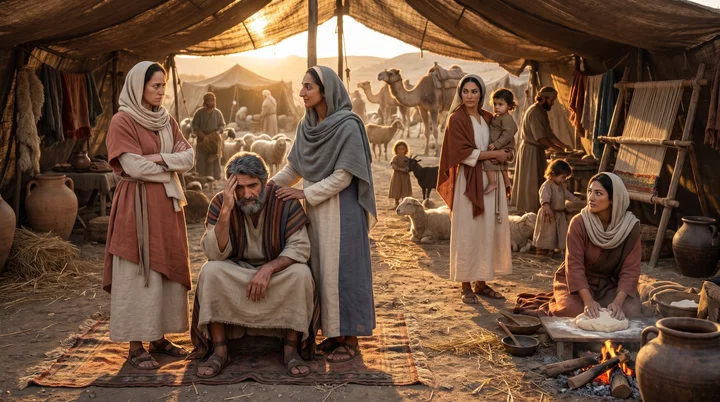
And Jacob’s anger was kindled against Rachel: and he said, Am I in God’s stead, who hath withheld from thee the fruit of the womb?
Translations
And Jacob’s anger was kindled against Rachel: and he said, Am I in God’s stead, who has withheld from you the fruit of the womb?
King James Version, KJV Cambridge Paragraph Bible, Revised Version, American Standard Version
And Jacob’s anger was kindled against Rachel: and he said, Am I in God’s stead, who hath withheld from thee the fruit of the womb?
And Jacob's anger was kindled against Rachel; and he said, Am I in God's stead, who hath withheld from thee the fruit of the womb?
And Jacob's anger burneth against Rachel, and he saith, 'Am I in stead of God who hath withheld from thee the fruit of the womb?'
And Jacob's anger was kindled against Rachel, and he said, Am I in God's stead, who has withheld from thee the fruit of the womb?
Then kindled the anger of Jacob with Rachel,—and he said, Am I, in the place of God, who hath withheld from thee the fruit of the womb?
Berean Standard Bible, Majority Standard Bible
Jacob became angry with Rachel and said, “Am I in the place of God, who has withheld children from you?”
Jacob’s anger burned against Rachel, and he said, “Am I in God’s place, who has withheld from you the fruit of the womb?”
But Jacob was angry with Rachel, and said, Am I in the place of God, who has kept your body from having fruit?
Then Iaakobs anger was kindled against Rahel, and he sayde, Am I in Gods steade, which hath withholden from thee the fruite of the wombe?
Douay-Rheims (Challoner revision)
And Jacob being angry with her, answered: Am I as God, who hath deprived thee of the fruit of thy womb?
Pictures
Cross-references
- Genesis 29:21-30
And Jacob said unto Laban, Give me my wife, for my days are fulfilled, that I may go in unto her.
Jacob is deceived into marrying Leah and takes Rachel as a second wife.
- Genesis 16:1-4
Now Sarai Abram’s wife bare him no children: and she had an handmaid, an Egyptian, whose name was Hagar.
Both describe patriarchs taking a woman to bear children when their wives were barren.
Commentary
Each commentary is drawn from primary sources: the writings of Ellen G. White and Adventist pioneers and periodicals. Each commentary is separate. Its own words are not a quotation; follow the references to read the source passages.
Pioneers and periodicals
9 sources
The verse belongs to the account of the sons born to Jacob while he lived in the land of the children of the East, where he met Laban and served him fourteen years for his two daughters.ST Mar 19, 1894 The surrounding chapter describes Jacob's marriages to Leah and Rachel and his sojourn with Laban, where he who had deceived his father was himself deceived, yet the narrative shows God's care for Jacob despite his selfishness and unfaithfulness.ST Jan 3, 1911 The verse falls within the record of Jacob's troubled and unsatisfactory experiences, in which his selfish dealings brought suffering and his own overreaching was met with overreaching as God's providence brought retribution in time.ST Jan 9, 1912
The chapter is part of the larger story of Abraham's family and Jacob's development toward his victory when he was called Israel, meaning prevailer with God.ST Jan 6, 1909 In the verse Jacob answers Rachel's distress over having no children by denying that he stands in God's place, affirming that it is God who has withheld the fruit of the womb and thereby recognizing God's power over conception and childbirth.RH Sep 3, 1903 The passage belongs to the patriarchal record of plain violation of the institution of marriage through Jacob's plural marriages.RH Feb 3, 1852ST Jun 10, 1875RH Nov 8, 1853
Such violation does not destroy or lessen the sacred character of marriage.RH Feb 3, 1852ST Jun 10, 1875RH Nov 8, 1853 Marriage was made for humanity before the fall, so its sanctity is not derived from the Decalogue, and the seventh commandment guards its sacredness.RH Feb 3, 1852RH Nov 8, 1853 As the seventh commandment guards marriage, the fourth commandment guards the Sabbath, so even a proven Sabbath violation in the patriarchal age would no more destroy the sacred character of the Sabbath than the violations in this passage destroy that of marriage.RH Nov 8, 1853 The chapter displays the very great unhappiness that polygamy brought into Jacob's family, which together with the families of Abraham and David proves that polygamy was always evil and wrong and contrary to the original order in Eden, though tolerated because of hardness of heart.RH Mar 1, 1870
Sources