Genesis 31:44
Now therefore come thou, let us make a covenant, I and thou; and let it be for a witness between me and thee.
Translations
Now therefore come you, let us make a covenant, I and you; and let it be for a witness between me and you.
King James Version, KJV Cambridge Paragraph Bible, Webster Bible
Now therefore come thou, let us make a covenant, I and thou; and let it be for a witness between me and thee.
Revised Version, American Standard Version
And now come, let us make a covenant, I and thou; and let it be for a witness between me and thee.
and now, come, let us make a covenant, I and thou, and it hath been for a witness between me and thee.'
And now, come, let us make a covenant, I and thou; and let it be a witness between me and thee.
Now, therefore, come on! Let us solemnise a covenant, I and thou,—So shall it be a witness betwixt me and thee.
Berean Standard Bible, Majority Standard Bible
Come now, let us make a covenant, you and I, and let it serve as a witness between you and me.”
Now come, let’s make a covenant, you and I. Let it be for a witness between me and you.”
Come, let us make an agreement, you and I; and let it be for a witness between us.
Nowe therefore come and let vs make a couenant, I and thou, which may be a witnes betweene me and thee.
Douay-Rheims (Challoner revision)
Come therefore, let us enter into a league: that it may be for a testimony between me and thee.
Pictures
Cross-references
- Genesis 31:49-53
And Mizpah; for he said, The LORD watch between me and thee, when we are absent one from another.
God witnesses the covenant and its terms concerning Laban’s daughters.
- Genesis 31:54
Then Jacob offered sacrifice upon the mount, and called his brethren to eat bread: and they did eat bread, and tarried all night in the mount.
A feast confirms the covenant before they part.
- Genesis 26:28-31
And they said, We saw certainly that the LORD was with thee: and we said, Let there be now an oath betwixt us, even betwixt us and thee, and let us make a covenant with thee;
Isaac and Abimelech make a covenant, seal it with an oath, and share a feast.
Commentary
Each commentary is drawn from primary sources: the writings of Ellen G. White and Adventist pioneers and periodicals. Each commentary is separate. Its own words are not a quotation; follow the references to read the source passages.
Ellen G. White
4 sources
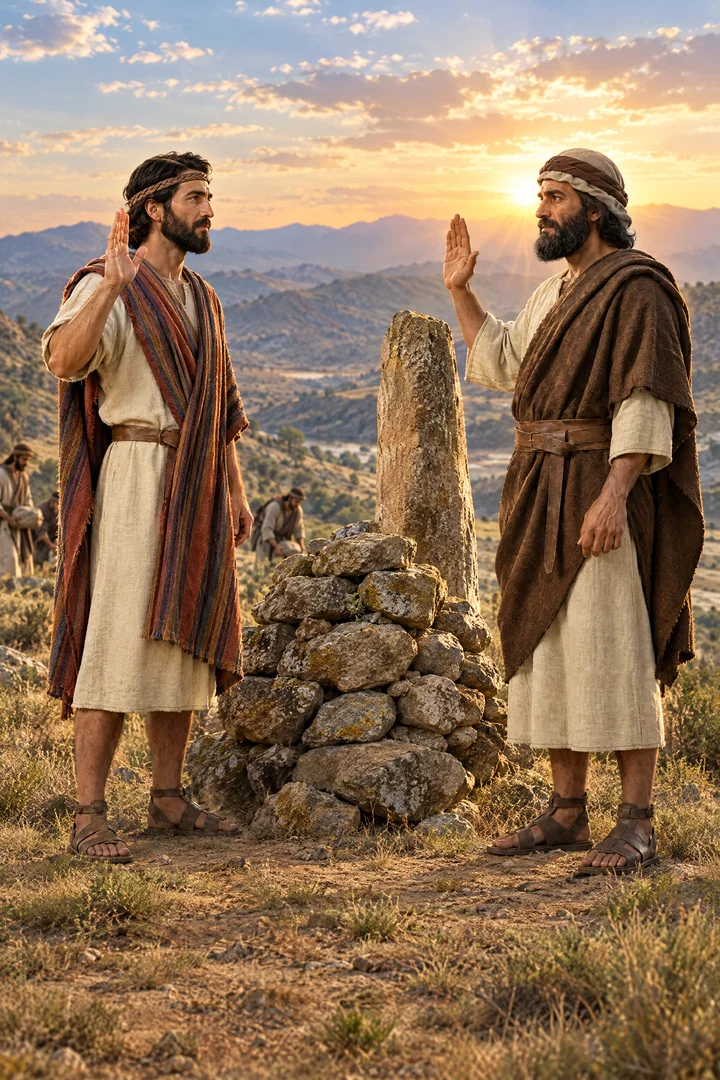
Laban is the one who proposes making a covenant between himself and Jacob.1SP 116.2PP 193.6–194.1SG3 126.1–127.1 The proposed covenant is one of peace, and Jacob accepts it.PP 193.6–194.1 The covenant itself is to stand as a witness between Laban and Jacob.1SP 116.2ST May 1, 1879SG3 126.1–127.1 A heap of stones is raised as a visible token of the compact, and a pillar, a stone pillar, is also set up as a witness to the agreement.ST May 1, 1879PP 193.6–194.1SG3 126.1–127.1
Its terms forbid either man from crossing the boundary to harm the other.PP 193.6–194.1SG3 126.1–127.1 Through it Laban assures Jacob of his continuing interest in his daughters and their children and that he will not harm them.1SP 116.2 Through it Jacob swears before God not to take other wives besides Laban's daughters and not to mistreat them, with God called to witness.SG3 126.1–127.1
The place is called Mizpah, meaning watch tower, because Laban calls on the Lord to watch between them while they are apart from each other.PP 193.6–194.1 Both parties appeal to God as judge over the covenant.PP 193.6–194.1 The covenant is confirmed with a feast.PP 193.6–194.1
Sources
Pioneers and periodicals
9 sources
The verse belongs to the continuing story of Abraham and his family through which the Seed was to come, with the promises extending from Abraham to Isaac and from Isaac to Jacob.ST Jan 6, 1909ST Jan 14, 1913 It falls in the account of Jacob's visit to Laban his mother's brother, his marriages to Leah and Rachel, his sojourn with Laban, and his leaving Syria for Palestine to set his face homeward.ST Jan 3, 1911 It is Laban's proposal at Gilead after he pursued Jacob as Jacob left Haran, where Jacob and Laban made a covenant together.ST May 1, 1879ST Oct 6, 1898ST Mar 19, 1894
The covenant itself was to serve as a witness between them.ST May 1, 1879ST Mar 19, 1894 It was marked by a raised pile of stones as a visible token of their compact.ST May 1, 1879 It was marked also by a feast, exemplifying the custom of concluding covenants or treaties with a meal.RH Mar 7, 1912
The meeting shows God's providential care over Jacob as He had promised, notwithstanding Jacob's selfishness, unfaithfulness, selfish plotting and overreaching.ST Oct 6, 1898ST Jan 3, 1911ST Jan 9, 1912 Jacob's checkered and unsatisfactory experience shows him being deceived by Laban as he had deceived his father, with suffering and others overreaching him following his own overreaching.ST Jan 3, 1911ST Jan 9, 1912 So the deceiver is deceived, and God's providence brings retribution sooner or later.ST Jan 9, 1912 The passage belongs to Jacob's trials and victories, set against Abraham's gradual development of faith and the defects of Isaac and his two sons.ST Jan 6, 1909 It culminates in Jacob's complete change of heart and victory that made him Israel, a prevailer with God with a place among the Israel of God.STST Jan 6, 1909
The passage teaches readiness to obey God's leading. Jacob's humility and faithfulness were connected with his faithfulness to Laban, and his offering of sacrifice showed remembrance of God.ST Oct 6, 1898 If Jacob had gained a better experience earlier he would have saved himself much of his later trouble in this unsatisfactory part of his life.ST Jan 14, 1913 His rash declaration about whoever had Laban's images was unwise and showed over-trust in Rachel's goodness.ST Oct 6, 1898
Sources