Translations
American King James Version, King James Version, KJV Cambridge Paragraph Bible, Webster Bible, Revised Version, American Standard Version
And Jacob took a stone, and set it up for a pillar.
And Jacob taketh a stone, and lifteth it up [for] a standing pillar;
And Jacob took a stone, and set it up [ for] a pillar.
So Jacob took a stone,—and set it up as a pillar.
Berean Standard Bible, Majority Standard Bible
So Jacob picked out a stone and set it up as a pillar,
Jacob took a stone, and set it up for a pillar.
Then Jacob took a stone and put it up as a pillar.
Then tooke Iaakob a stone, and set it vp as a pillar:
Douay-Rheims (Challoner revision)
And Jacob took a stone, and set it up for a title:
Pictures
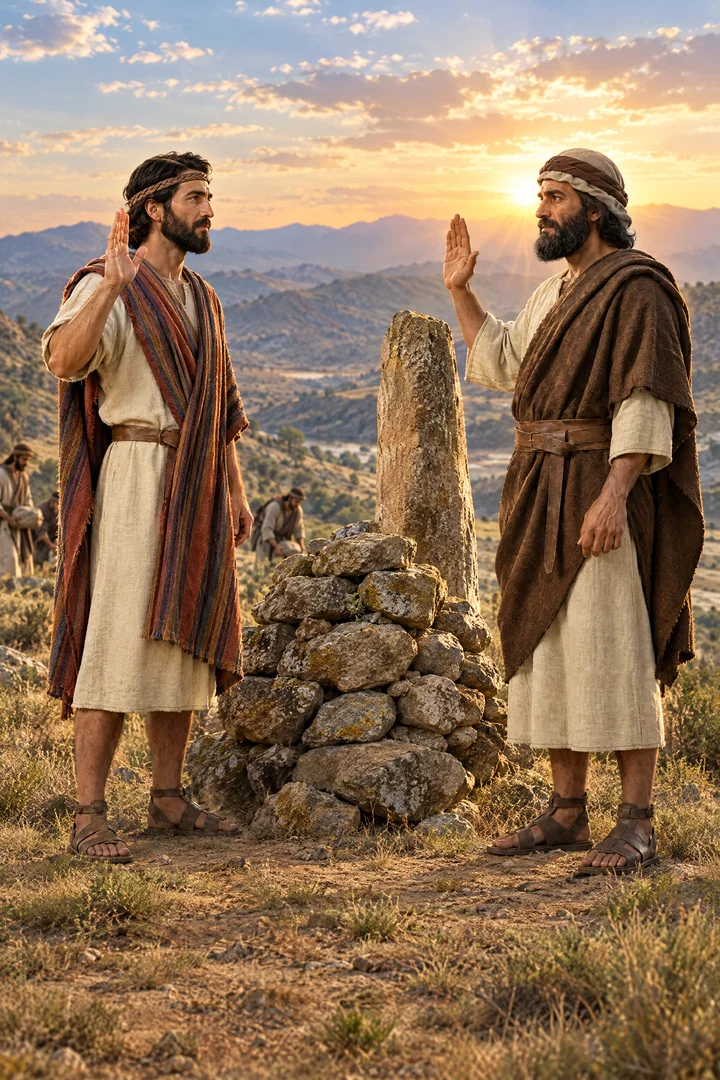
Cross-references
- Genesis 31:51-52
And Laban said to Jacob, Behold this heap, and behold this pillar, which I have cast betwixt me and thee;
defines heap and pillar as witness against harm
- Genesis 31:49
And Mizpah; for he said, The LORD watch between me and thee, when we are absent one from another.
gives Mizpah name and watch charge for pillar
- Genesis 31:54-55
Then Jacob offered sacrifice upon the mount, and called his brethren to eat bread: and they did eat bread, and tarried all night in the mount.
feast and parting seal the compact
- Genesis 31:53
The God of Abraham, and the God of Nahor, the God of their father, judge betwixt us. And Jacob sware by the fear of his father Isaac.
Jacob swears by the Fear of Isaac to confirm the treaty.
- Genesis 31:50
If thou shalt afflict my daughters, or if thou shalt take other wives beside my daughters, no man is with us; see, God is witness betwixt me and thee.
Laban invokes God as witness concerning the treatment of his daughters.
Commentary
Each commentary is drawn from primary sources: the writings of Ellen G. White and Adventist pioneers and periodicals. Each commentary is separate. Its own words are not a quotation; follow the references to read the source passages.
Ellen G. White
3 sources
Laban assured Jacob that he cared for his daughters and their children and would do them no harm, and then proposed a covenant between them.1SP 116.2 Jacob consented to Laban's proposal of a covenant of peace after Laban could not deny the facts Jacob had brought forward.PP 193.6–194.1 The stone Jacob set up as a pillar was the witness, token, and mark of that covenant between Jacob and Laban.1SP 116.2PP 193.6–194.1SG3 126.1–127.1 The pillar was the beginning of the covenant memorial, followed by Jacob telling his brethren to gather stones into a heap.1SP 116.2
The heap or pile of stones, together with the pillar, stood as a witness and boundary that neither man would pass beyond them to the other for harm.PP 193.6–194.1SG3 126.1–127.1 The pillar was named Mizpah, meaning watch-tower, with the declaration that the Lord watch between them when they were absent from one another.PP 193.6–194.1 The treaty was confirmed by Jacob's oath by the Fear of his father Isaac.PP 193.6–194.1 The covenant was celebrated and confirmed by eating together upon the heap, in a feast followed by a night of friendly communing.1SP 116.2PP 193.6–194.1 Afterward Laban and his company departed at dawn, ending all trace of connection between the children of Abraham and the dwellers in Mesopotamia.PP 193.6–194.1
Sources
Pioneers and periodicals
10 sources
And Jacob took a stone, and set it up for a pillar during the events of his departure from Laban in his family's story.ST Jan 9, 1912ST Jan 6, 1909 The stone was a memorial stone of the kind called menhirs.RH Jun 14, 1870
Its immediate setting is the meeting of Laban and Jacob at Mount Gilead after Jacob's departure from Haran and Laban's pursuit.ST Oct 6, 1898ST Mar 19, 1894 There Jacob and Laban made a covenant or agreement with each other.ST Oct 6, 1898ST Mar 19, 1894 The occasion was concluded with a feast, illustrating the custom of confirming engagements, treaties, or oaths with a meal.RH Mar 7, 1912
Its broader account is Jacob's visit to Laban his mother's brother, his marriage to Leah and Rachel in which he was deceived as he had deceived his father, his sojourn with Laban, and his leaving Syria for Palestine as he set his face homeward.ST Jan 3, 1911 This stands within the continuing account of Abraham's family and the family line through which the Seed was to come, with the promises extending from Abraham to Isaac and from Isaac to Jacob.ST Jan 6, 1909ST Jan 14, 1913 It belongs to Jacob's checkered, troubled and unsatisfactory experience in Genesis 27-31 of trials and victories.STST Jan 9, 1912ST Jan 9, 1912 That experience was marked by family division from his father's favoritism toward Esau and his mother's favoritism toward him, by his mother's keeping before him the importance of the Seed in a material way without the fullest appreciation of the spiritual blessings, and by his own selfish plotting and material overreaching fitting his name supplanter, in which his overreaching was met by overreaching.ST Jan 14, 1913ST Jan 9, 1912
The verse shows God's care and special providence over His servant and over the progenitors of the promised Seed as promised, notwithstanding selfishness and unfaithfulness.ST Oct 6, 1898ST Jan 3, 1911ST Jan 9, 1912 God's providence brings retribution sooner or later though seeming slow.ST Jan 9, 1912ST Jan 9, 1912 The verse shows Jacob's obedient and faithful response and transformation, in his humility and faithfulness to God reflected in faithfulness to Laban, in his remembrance of God by offering sacrifice, and in his obeying God's leading to return home.ST Oct 6, 1898 This culminated through God's mercy in a complete change of heart and eventual victory by which he became Israel and gained a place among the Israel of God.STST Jan 6, 1909ST Jan 14, 1913 The verse warns against speaking hastily and trusting too confidently in another person's goodness, as seen in Jacob's rash accusation about whoever had taken Laban's images.ST Oct 6, 1898 It teaches readiness always to obey God's leading.
Sources