Genesis 41:34
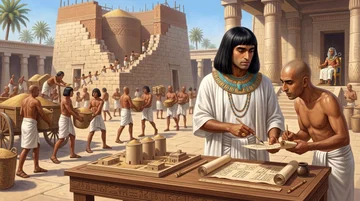
Let Pharaoh do this, and let him appoint officers over the land, and take up the fifth part of the land of Egypt in the seven plenteous years.
Translations
American King James Version, King James Version, KJV Cambridge Paragraph Bible, Webster Bible
Let Pharaoh do this, and let him appoint officers over the land, and take up the fifth part of the land of Egypt in the seven plenteous years.
Revised Version, American Standard Version
Let Pharaoh do this, and let him appoint overseers over the land, and take up the fifth part of the land of Egypt in the seven plenteous years.
let Pharaoh make and appoint overseers over the land, and receive a fifth of the land of Egypt in the seven years of plenty,
Let Pharaoh do [ this]: let him appoint overseers over the land, and take the fifth part of the land of Egypt during the seven years of plenty,
Let Pharaoh do this, that he may appoint overseers over the land,—so shall he take up a fifth of the land of Egypt, during the seven years of plenty.
Berean Standard Bible, Majority Standard Bible
Let Pharaoh take action and appoint commissioners over the land to take a fifth of the harvest of Egypt during the seven years of abundance.
Let Pharaoh do this, and let him appoint overseers over the land, and take up the fifth part of the land of Egypt’s produce in the seven plenteous years.
Let Pharaoh do this, and let him put overseers over the land of Egypt to put in store a fifth part of the produce of the land in the good years.
Let Pharaoh make and appoynt officers ouer the lande, and take vp the fift part of the land of Egypt in the seuen plenteous yeeres.
Douay-Rheims (Challoner revision)
That he may appoint overseers over all the countries: and gather into barns the fifth part of the fruits, during the seven fruitful years,
Pictures

Cross-references
- Genesis 42:1-2
Now when Jacob saw that there was corn in Egypt, Jacob said unto his sons, Why do ye look one upon another?
Jacob sends his sons to Egypt to buy food during the famine.
- Genesis 41:29
Behold, there come seven years of great plenty throughout all the land of Egypt:
years when the fifth is taken
- Genesis 41:30
And there shall arise after them seven years of famine; and all the plenty shall be forgotten in the land of Egypt; and the famine shall consume the land;
famine the stored fifth prepares for
- Genesis 47:24-26
And it shall come to pass in the increase, that ye shall give the fifth part unto Pharaoh, and four parts shall be your own, for seed of the field, and for your food, and for them of your households, and for food for your little ones.
Joseph establishes Pharaoh’s one-fifth levy on the land’s increase.
- Genesis 41:53-57
And the seven years of plenteousness, that was in the land of Egypt, were ended.
Joseph’s preparations supplied food during the famine.
- Genesis 41:1-7
And it came to pass at the end of two full years, that Pharaoh dreamed: and, behold, he stood by the river.
same Pharaoh dream of Nile, kine, grain
- Genesis 42:6
And Joseph was the governor over the land, and he it was that sold to all the people of the land: and Joseph’s brethren came, and bowed down themselves before him with their faces to the earth.
Joseph’s brothers bow before him, fulfilling his dreams.
- Genesis 47:11-12
And Joseph placed his father and his brethren, and gave them a possession in the land of Egypt, in the best of the land, in the land of Rameses, as Pharaoh had commanded.
Joseph settles and supplies his family during the famine.
- Genesis 41:16
And Joseph answered Pharaoh, saying, It is not in me: God shall give Pharaoh an answer of peace.
Joseph meets Pharaoh and acknowledges God as the source of the answer.
- Genesis 41:25
And Joseph said unto Pharaoh, The dream of Pharaoh is one: God hath shewed Pharaoh what he is about to do.
Both show God revealing what He is about to do.
- Psalms 105:21-22
He made him lord of his house, and ruler of all his substance:
Both show Joseph’s wise administration in Egypt.
Commentary
Each commentary is drawn from primary sources: the writings of Ellen G. White and Adventist pioneers and periodicals. Each commentary is separate. Its own words are not a quotation; follow the references to read the source passages.
Ellen G. White
6 sources
This counsel came after the declaration that the dream was one and that God had shown Pharaoh what He was about to do, that seven years of plenty would be followed by seven years of severe famine, with the years of plenty giving time to prepare.SG3 150.1–151.2PP 220.4 The seven years of great plenty would cause field and garden to yield more abundantly than ever before, followed by seven years of grievous famine so severe that the plenty would not be known, and the doubling of the dream proved the fulfillment certain and near.PP 220.4 Pharaoh was urged to appoint officers over the land under a wise and discreet overseer to take up the fifth part of Egypt during the seven plenteous years.SG3 150.1–151.2PP 220.4
That work was to gather all the food of those good years and lay up corn under Pharaoh's hand and keep food in the cities as store against the seven years of famine.PP 220.4 As revealed in the dream seven years beforehand, Egypt gathered and stored provisions during the seven plenteous years, so it had food when the famine came.SG3 153.11SP 139.2 Those preparations later provided food for people from many countries.1SP 139.2
The passage predicts definite periods of seven plenteous years and seven famine years, which happened exactly as foretold.GC 323.2–324.2GC88 323.2 It stands with many other cases where events once only a matter of prophecy for a stated time were fulfilled accordingly, showing that God fulfills prophetic events within the given time.GC 323.2–324.2GC88 323.2 The chronological portions of Scripture are as much God's word and as entitled to serious consideration as any other portion.GC 323.2–324.2 Chronological periods extending to the second coming are divinely appointed times revealed by God that may be confidently expected to be fulfilled.GC 323.2–324.2
Sources
Pioneers and periodicals
38 sources
Joseph's counsel called for Pharaoh to appoint officers over the land to gather a fifth of Egypt's harvest through the seven plenteous years and lay up food in the cities under Pharaoh's hand as a store against the seven years of famine so the land would not perish.ST Nov 10, 1898RH Oct 18, 1853ST Jan 1, 1885 It called also for setting a wise and discreet man over that work, and Joseph who devised the storehouses became the ruler appointed to control and distribute the provision.ST Apr 9, 1894RH Sep 2, 1902ST Oct 16, 1901 God made known beforehand by Pharaoh's dream that seven years of great plenty would be followed by seven years of great scarcity, so that the stored supply saved multitudes in Egypt and Canaan and other lands from starvation.ST Apr 9, 1894ST May 9, 1878ST Jan 1, 1885ST Jul 29, 1875RH Jul 25, 1854 In giving future events to a heathen king while keeping His own servant to interpret them, God showed that He rules in the kingdoms of men and by a roundabout providence lifted Joseph from prison to the throne to rescue Jacob's whole house.RH Jan 19, 1860RH Mar 14, 1865ST Jan 21, 1889ST Nov 28, 1900ST Oct 12, 1904 The plan is practical wisdom and wise administration, proving that prophecy is given for a purpose and must be heeded in practical preparation for the duty of the hour.ST Oct 16, 1901RH May 2, 1865RH May 20, 1915ST Mar 3, 1881
Counsel and Egyptian Setting
Joseph advised Pharaoh to appoint officers or overseers over the land to take up the fifth part of Egypt's produce during the seven plenteous years.ST Nov 10, 1898RH Oct 18, 1853ST Jan 1, 1885ST Apr 16, 1894RH Jun 23, 1903 That fifth was to be gathered as the food of those good years and laid up as corn under Pharaoh's hand for food in the cities, to be kept as a store against the seven years of famine so the land would not perish through famine.ST Nov 10, 1898RH Jun 23, 1903ST Oct 16, 1901 The storing belonged to Joseph's rule during the seven years of plenty, when large quantities of grain were laid up in preparation for the famine so that people would be saved from famine and death.ST Jan 1, 1885ST Apr 16, 1894ST Oct 16, 1901 It was inspired counsel after the interpretation of the dreams, showing practical wisdom given by God to prepare during plenty so lives could be spared in the famine to come.RH Oct 18, 1853ST Oct 16, 1901
The counsel also called for selecting a discreet and wise man as ruler over Egypt to oversee the gathering and laying up of food during the years of plenty as provision against the famine.ST Apr 9, 1894RH Sep 2, 1902ST Oct 16, 1901 God gave Pharaoh the dream and brought Joseph to the king so that Egypt — and Israel — could be saved.ST Apr 9, 1894 Because Joseph planned the storehouses and their provisions, he was the proper person to control them and distribute the food when famine came, and this brought him to the governorship of Egypt.RH Sep 2, 1902ST Oct 16, 1901
The counsel was given after the wise men of Egypt failed to interpret Pharaoh's two dreams and the chief butler remembered the young Hebrew prisoner who had correctly interpreted his dream two years before.ST Oct 16, 1901 God called the innocent Joseph from prison to Pharaoh's throne, and Joseph told Pharaoh the dreams meant seven years of plentiful crops followed by seven years of famine.ST Jan 3, 1911ST Oct 16, 1901 Though innocent of any crime, Joseph had spent two years in prison to humble pride fostered by his father's favoritism as the petted child of old age, while principles of integrity and purity instilled by his father developed in him.ST Jan 3, 1911 His exaltation led to his brethren coming and humbly bowing before him without knowing him, fulfilling the dreams that had aroused their envy against him.ST Jan 3, 1911
The story is thoroughly Egyptian in form, dress, words, and customs.ST Dec 14, 1915 Pharaoh's dream of the Nile River, the kine, the grain, and the sacred seven is significantly Egyptian even in wording.ST Dec 14, 1915 The surrounding narrative reflects Egyptian life in the grape juice prepared as the duty of the chief butler, the beheading of the chief baker according to Egyptian custom, shaving before appearing before the ruler, and the collar of gold as a mark of distinction among the Egyptians.ST Dec 14, 1915
The preparation by collecting part of the harvest in the plentiful years and distributing stored grain to hungry people in famine is reflected in an inscription describing a harvest gathered, watchfulness at sowing, and grain distributed during a famine lasting many years.ST May 20, 1880 The governor Baba of El-Kab is Joseph, who stored corn in times of plenty and issued corn to the city in each year of famine.ST May 20, 1880ST Dec 14, 1915 Such a long famine at El-Kab would have reached the adjoining lands and even the fruitful delta.ST Dec 14, 1915 Famines in Egypt were rare and a long one a very unusual event, with the last seven years' famine in 1064-1071 A.D. and a similar famine in the twelfth dynasty.ST Dec 14, 1915
Prophecy and Divine Providence
God made known beforehand through Pharaoh's dream as interpreted by Joseph that seven years of great plenty in Egypt would be followed by seven years of great scarcity, giving advance notice of events before they took place so that food gathered and stored during the plentiful years would provide for the years of famine.ST May 9, 1878ST Jul 29, 1875RH Jul 25, 1854ST Mar 23, 1882 That famine brought Jacob and his family to Egypt, and the provision saved multitudes in Egypt, Canaan, and all lands from starvation.ST May 9, 1878ST Jul 29, 1875ST Mar 23, 1882 The seven years of plenty shown in Genesis 41 were a predicted event set within a stated period that was fulfilled in its appointed time, illustrating that biblical prophecies can specify periods whose events later occur as foretold.RH Apr 18, 1854RH Feb 18, 1873 Pharaoh's proposal to appoint officers and collect a fifth of the harvest during those years belonged to that foretold period and its fulfillment.RH Apr 18, 1854
The seven years shown in Pharaoh's dreams were a set time foretold beforehand that came to pass within the given time exactly as predicted, proving that God-announced chronological periods are fulfilled in accordance with prediction.RH Mar 31, 1868 This gives ground to trust the longer chronological periods reaching to the coming of the Saviour.RH Mar 31, 1868
Pharaoh's dream of the seven fat and lean kine was produced by the power of the Holy Ghost moving upon the mental faculties in natural sleep, stamping upon perception and memory the intelligence God designed to give about the approaching famine.RH Feb 28, 1856 Dreams differ from visions in that the outward senses are closed by natural sleep instead of by the direct operation of God's power, yet when given by God they bear the impress of divine wisdom and are as truly communications from God as visions.RH Feb 28, 1856
God rules in the kingdoms of men and is not confined to His own people in His workings or in imparting instruction, using whomever His purposes require.RH Mar 14, 1865 He gave the dream and vision of future events to Pharaoh, a heathen king, as a divine warning to rulers about what lay ahead, yet kept His own people concerned and directly connected with it so that Joseph must come in to explain it.RH Mar 14, 1865ST Nov 28, 1900 This shows God's method of casting down and setting up kingdoms to open a way for His people and of going before His church to pilot them through a world blighted by the curse and made perilous by sin.RH Mar 14, 1865 It is an example of God bringing His truth to the attention of kings and other people in authority, sometimes through the oppression or hardship of His children.ST Oct 12, 1904
Pharaoh's dream was God's means to lift up the head of His captive servant Joseph and advance him by a roundabout path from captivity to the intended place where he could help others in tribulation.RH Jan 19, 1860ST Jan 21, 1889ST Mar 11, 1913 What seemed against Jacob's house, the seeming loss of Joseph, was God's plan for the rescue of the whole house from famine.ST Jan 21, 1889 This proves that out of what is insignificant or naught God can bring deliverance and blessing through providence working in circumstances.ST Jan 21, 1889ST Mar 11, 1913
By Joseph's wise counsel and vigorous action, Egypt, Jacob's family brought to Egypt by the famine, and other countries survived the severe seven-year famine.ST Apr 9, 1894ST May 9, 1878ST Jan 1, 1885ST Mar 23, 1882RH Nov 28, 1912 God gave Pharaoh the dream and brought Joseph to the king so that Egypt — and Israel — could be saved, with Joseph arranging for food to be gathered during the years of plenty so people would be saved from famine and death.ST Apr 9, 1894ST Jan 1, 1885 Without it the Egyptians would have perished and the land would have perished through famine.ST Feb 4, 1889 Pharaoh recognized the Spirit of God in Joseph and saw the counsel to appoint officers and store one-fifth of Egypt's produce during the seven plentiful years as evidence of divine presence and wisdom.RH Oct 18, 1853
That counsel brought Pharaoh and Egypt's people to see the superiority of the God Joseph worshiped, and the grain stored in Egypt drew people from many lands, spreading knowledge of Israel's God.RH Jun 10, 1902 Joseph's service also led Pharaoh to provide generously for Jacob and his sons and helped make Egypt indebted to the Hebrews, leaving the kingdom with an abundant food supply during the famine and greatly enriching it.ST Feb 12, 1880RH Jun 10, 1902ST Feb 4, 1889
Wisdom and Faithful Administration
Joseph's counsel to store food in the years of plenty so lives would be spared in the years of famine showed practical wisdom given by God, and by that forecast and stored provision famine was prevented.ST Oct 16, 1901RH May 2, 1865 The organized plan to take up a fifth and lay it by for the lean years was wise administration.ST Oct 16, 1901RH May 20, 1915 It was the fruit of the physical and industrial education received in the family school until eighteen years of age.RH May 20, 1915
Fitness for the work grew from principles of integrity and purity instilled by the father and developed through trial.ST Jan 3, 1911 Though innocent of any crime, two years were spent in prison to humble pride fostered by favoritism as the petted child of old age.ST Jan 3, 1911 The story in Genesis 39-42 is a beautiful record of faithfulness, conscientiousness and integrity.ST Exaltation from prison to the throne led to the brethren coming and humbly bowing without knowing him, fulfilling the dreams for which they had hated and been envious.ST Jan 3, 1911ST
Advising the appointment of officials to collect one-fifth of the produce during the seven plentiful years prepared the kingdom for what was coming.ST Feb 12, 1880ST Nov 14, 1906 That management left an abundant food supply in famine and greatly enriched the kingdom.ST Feb 12, 1880 The plan also established a land law whose combined rent and taxes were easy for the people, so that under that leadership the land prospered and its people were not oppressed.ST Nov 14, 1906 The resulting laws for the support of the realm brought the government into possession of the land except for land belonging to the priests and provided it with one-fifth of the income.ST Jun 17, 1903 This revenue helped make the great building projects possible, and the same faithful service led to generous provision for Jacob and his sons.ST Feb 12, 1880ST Jun 17, 1903
The counsel was part of the interpretation of dreams that saved the greater part of the world from the terrors of seven years of famine.ST Mar 3, 1881 It proves prophecies are given for a purpose and have a practical application.ST Mar 3, 1881 Those who heeded them were favored, while those who neglected them perished.ST Mar 3, 1881 Prophecies therefore should be studied to know duty in the age in which one lives.ST Mar 3, 1881 Joseph in Egypt is an example of what workers are to be in the world in its closing act, with each worker led individually in medical missionary work.RH Dec 20, 1906
Sources