Genesis 42:1
Now when Jacob saw that there was corn in Egypt, Jacob said unto his sons, Why do ye look one upon another?
Translations
Now when Jacob saw that there was corn in Egypt, Jacob said to his sons, Why do you look one on another?
King James Version, KJV Cambridge Paragraph Bible
Now when Jacob saw that there was corn in Egypt, Jacob said unto his sons, Why do ye look one upon another?
Now when Jacob saw that there was corn in Egypt, Jacob said to his sons, Why do ye look one upon another?
Now Jacob saw that there was corn in Egypt, and Jacob said unto his sons, Why do ye look one upon another?
Now Jacob saw that there was grain in Egypt, and Jacob said unto his sons, Why do ye look one upon another?
And Jacob seeth that there is corn in Egypt, and Jacob saith to his sons, 'Why do you look at each other?'
And Jacob saw that there was grain in Egypt, and Jacob said to his sons, Why do ye look one upon another?
Then saw Jacob that there was corn in Egypt,—and Jacob said to his sons, Wherefore look ye one at another?
Berean Standard Bible, Majority Standard Bible
When Jacob learned that there was grain in Egypt, he said to his sons, “ Why are you staring at one another?”
Now Jacob saw that there was grain in Egypt, and Jacob said to his sons, “ Why do you look at one another?”
Now Jacob, hearing that there was grain in Egypt, said to his sons, Why are you looking at one another?
Then Iaakob saw that there was foode in Egypt, and Iaakob said vnto his sonnes, Why gaze ye one vpon an other?
Douay-Rheims (Challoner revision)
And Jacob hearing that food was sold in Egypt, said to his sons: Why are ye careless?
Pictures
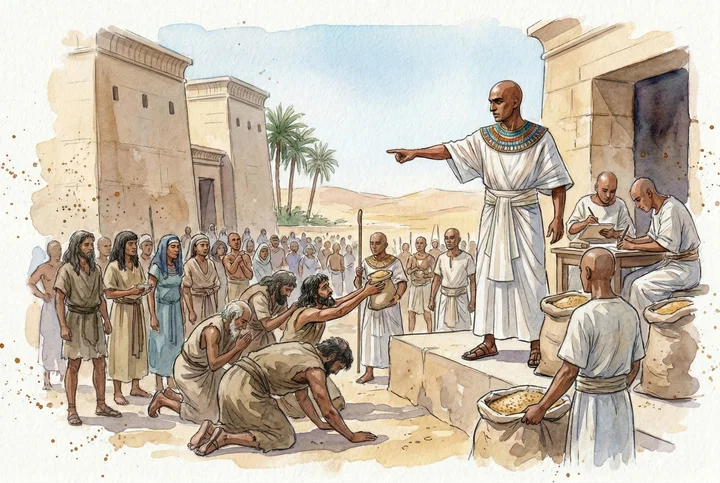
Cross-references
- Genesis 41:57
And all countries came into Egypt to Joseph for to buy corn; because that the famine was so sore in all lands.
The famine led people to Egypt to buy grain.
- Genesis 45:5-7
Now therefore be not grieved, nor angry with yourselves, that ye sold me hither: for God did send me before you to preserve life.
Joseph explains that God sent him ahead to Egypt to preserve lives.
- Genesis 41:29-36
Behold, there come seven years of great plenty throughout all the land of Egypt:
Joseph foretells famine and prepares Egypt by storing grain.
- Genesis 43:1-2
And the famine was sore in the land.
Both describe the famine-driven need to obtain food from Egypt again.
- Genesis 37:35
And all his sons and all his daughters rose up to comfort him; but he refused to be comforted; and he said, For I will go down into the grave unto my son mourning. Thus his father wept for him.
Jacob mourned Joseph, believing he had been killed.
- Genesis 42:24-25
And he turned himself about from them, and wept; and returned to them again, and communed with them, and took from them Simeon, and bound him before their eyes.
Joseph detains Simeon and sends his brothers home with corn, requiring them to return with Benjamin.
- Genesis 41:47-49
And in the seven plenteous years the earth brought forth by handfuls.
Joseph stored grain in Egypt during the years of plenty.
- Genesis 41:40-43
Thou shalt be over my house, and according unto thy word shall all my people be ruled: only in the throne will I be greater than thou.
brothers bow before enthroned Joseph
- Genesis 37:28
Then there passed by Midianites merchantmen; and they drew and lifted up Joseph out of the pit, and sold Joseph to the Ishmeelites for twenty pieces of silver: and they brought Joseph into Egypt.
hatred leads to sale into Egypt
- Genesis 43:14
And God Almighty give you mercy before the man, that he may send away your other brother, and Benjamin. If I be bereaved of my children, I am bereaved.
Jacob asks God Almighty for mercy as his sons return to Egypt.
- Genesis 42:18
And Joseph said unto them the third day, This do, and live; for I fear God:
Joseph tells his brothers how they can live and return with food.
- Genesis 42:21-22
And they said one to another, We are verily guilty concerning our brother, in that we saw the anguish of his soul, when he besought us, and we would not hear; therefore is this distress come upon us.
The brothers connect their distress to their cruelty toward Joseph.
- Genesis 42:36
And Jacob their father said unto them, Me have ye bereaved of my children: Joseph is not, and Simeon is not, and ye will take Benjamin away: all these things are against me.
Jacob laments that his children have been taken from him.
- Genesis 37:3
Now Israel loved Joseph more than all his children, because he was the son of his old age: and he made him a coat of many colours.
Both verses belong to the story of Joseph and his family.
- Genesis 37:5-11
And Joseph dreamed a dream, and he told it his brethren: and they hated him yet the more.
bowing fulfills the envied dreams
- Genesis 46:29-30
And Joseph made ready his chariot, and went up to meet Israel his father, to Goshen, and presented himself unto him; and he fell on his neck, and wept on his neck a good while.
Jacob and Joseph are reunited after the journey to Egypt.
Commentary
Each commentary is drawn from primary sources: the writings of Ellen G. White and Adventist pioneers and periodicals. Each commentary is separate. Its own words are not a quotation; follow the references to read the source passages.
Ellen G. White
4 sources
The famine had reached Canaan, and Jacob's household needed grain from Egypt to survive.1SP 139.2PP 224.3–225.1SG3 153.11SP 141.1–142.2 Their own food was nearly gone, leaving the sons anxiously looking at one another, troubled and perplexed about feeding their families, speaking despondingly with want and starvation before them.1SP 139.2SG3 153.1 Egypt had corn because supplies had been stored ahead of the famine after God warned the king in a dream seven years beforehand to lay up large supplies for the coming years of famine.1SP 139.2SG3 153.1 People from all countries were traveling to Egypt to buy grain.SG3 153.1
When Jacob heard there was corn in Egypt, he rebuked his sons for looking helplessly at one another.1SP 139.2SG3 153.1 He challenged them for hesitating instead of acting to obtain it.1SP 139.2PP 224.3–225.1SG3 153.1 He told them to go down to Egypt to buy corn there so the family might live and not die.1SP 139.2SG3 153.11SP 141.1–142.2 Their hesitation reflected the danger and distress surrounding the journey.1SP 141.1–142.2
Sources
Pioneers and periodicals
21 sources
Famine had nearly exhausted the supplies in Canaan while grain stored during the years of plenty remained in Egypt, so Jacob reproved his sons for only staring at one another and sent them down to buy food that the family might live and not die.ST Jan 22, 1880ST Nov 17, 1898ST Apr 16, 1894ST Feb 10, 1881ST Dec 6, 1883
Ten of them made this first journey while Benjamin was held back lest harm befall him, opening the reunion with Joseph and Jacob's later removal to Egypt.ST Nov 17, 1898ST Nov 17, 1898
Their humble coming to bow before Joseph, now raised from prison to throne and palace, unknowingly fulfilled his dreams after their envy had sold him into Egypt, and God thereby preserved the whole family and turned seeming calamity into good.ST Jan 3, 1911RH Jan 20, 1916ST Jan 28, 1913ST Jan 23, 1912RH Jan 19, 1860
Even when time and separation make brothers forget one another, God knows and watches over His own wherever they are, guiding such distress to awaken conscience and reveal His preserving hand.ST Dec 14, 1915ST Nov 17, 1898ST Jan 9, 1912RH Nov 4, 1858
Famine and Journey to Egypt
The famine lay heavy upon Canaan and had nearly exhausted the food of Jacob's household, while Egypt still had corn to be bought.ST Jan 22, 1880ST Nov 17, 1898ST Dec 6, 1883ST Jan 9, 1912 The supply in Egypt came from granaries filled during the years of plenty, and the need in Canaan set in motion the going down of the sons to fetch grain and the distress and reunion that followed.ST Dec 6, 1883ST Oct 28, 1897ST Nov 14, 1906 Egypt could furnish corn because it was a fertile land brought to a high state of cultivation by irrigation, and its husbandry has continued with little or no change down through the centuries to the same manner it had when Jacob sent thither for corn.RH Jun 13, 1907
When Jacob saw that there was corn in Egypt he reproved his sons for standing and looking upon one another without acting.ST Nov 17, 1898ST Apr 16, 1894ST Nov 17, 1898 He bade them cease hesitating and get down to Egypt and buy from thence, that the household might live and not die.ST Jan 22, 1880ST Nov 17, 1898ST Feb 10, 1881ST Jan 9, 1912 His word turned their uncertainty into resolve to seek bread where it was to be had.ST Jan 22, 1880ST Feb 10, 1881
That command began the first visit of the brethren to Egypt, in which ten sons went down to buy grain.ST Nov 17, 1898ST Nov 17, 1898ST Apr 16, 1894 Benjamin was kept back, for Jacob feared lest harm might befall him.ST Jan 22, 1880ST Nov 17, 1898 The going down opened the closing story of Joseph, his meeting with his brethren and the fulfilling of his dreams, their reunion with him in Egypt, and the way prepared for Jacob himself to be taken down thither.ST Nov 17, 1898ST Jan 28, 1913
Providence and Joseph's Exaltation
Joseph had been lifted from prison to throne and to palace in Egypt, and the power to interpret was declared to lie not in himself but in God.ST Jan 3, 1911RH Jan 20, 1916 Jacob's sending of his sons to Egypt for food brought them to come humbly and bow before Joseph in that exalted place.ST Jan 3, 1911RH Jan 20, 1916 In so doing they unconsciously fulfilled his dreams, which had aroused their envy and hatred.ST Jan 3, 1911ST Jan 28, 1913ST That hatred had grown out of their father's favoritism toward Joseph and out of jealousies between Jacob's wives and families, leading the brothers first to try to kill him and then to sell him as a slave into Egypt.ST Jan 3, 1911
God guided Joseph's family through the events that brought them to Egypt during the famine, and by providential care preserved the lives of his relatives.ST Jan 23, 1912RH Jan 19, 1860 Famine had nearly exhausted the food of Jacob's family, and when Jacob learned that Egypt had grain he urged his sons to stop hesitating and go there to buy provisions.ST Jan 9, 1912 Their journey led to Joseph's reunion with his father and helped preserve many lives, so that what appeared to be calamity became God's providential means of bringing good.ST Jan 9, 1912 The famine that drove Abraham's descendants to Egypt to preserve their lives came as punishment after they mingled with idolaters and lost much of their holy character, yet God did not forsake them in Egypt because of his covenant with Abraham.ST Jun 10, 1880
In this chapter Joseph wisely dealt with his brothers, seeking to awaken their consciences, while Jacob was tested through his beloved sons.ST Nov 17, 1898 Time and separation may cause brothers to forget one another, as Joseph might forget his brothers or his brothers forget him.RH Nov 4, 1858 Human forgetfulness cannot make God forget those who are his, because he knows and watches over them wherever they are.RH Nov 4, 1858
Spiritual Lessons and Connections
The chapters of Genesis 39 through 42 are to be read together with Psalm 18 with the promised Seed constantly in view and attention given to the channels through which that Seed was to come.ST The report that there was grain in Egypt set Jacob in motion across the desert toward Joseph, whom he supposed to be dead, because he discerned that food was there and reproved his sons for only staring at one another instead of acting.ST Feb 10, 1881 That news of bread in a distant land becomes a picture of the small tokens that come from far places and beckon those who are spiritually thirsty to press on toward fullness.ST Feb 10, 1881
The verse opens a sequence of distress extending through Genesis 42:1-28, in which the sons returned with word that Simeon was detained in Egypt and that Benjamin must go down with them, followed by the discovery of money in their sacks.ST Dec 14, 1915 Jacob looked upon these happenings as threats against his household and broke out with the cry that all these things were against him.ST Dec 14, 1915 His anguish illustrates the trouble that arises from fastening upon visible difficulties instead of discerning the hand of God at work in events.ST Dec 14, 1915
Sources