Genesis 48:12
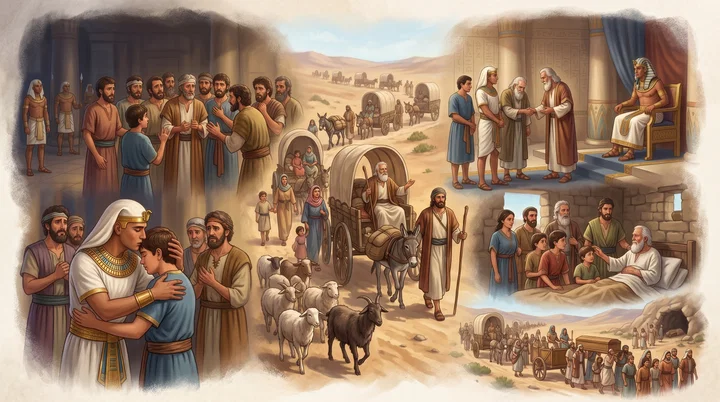
And Joseph brought them out from between his knees, and he bowed himself with his face to the earth.
Translations
American King James Version, King James Version, KJV Cambridge Paragraph Bible, Webster Bible
And Joseph brought them out from between his knees, and he bowed himself with his face to the earth.
Revised Version, American Standard Version
And Joseph brought them out from between his knees; and he bowed himself with his face to the earth.
And Joseph bringeth them out from between his knees, and boweth himself on his face to the earth;
And Joseph brought them out from his knees, and bowed down with his face to the earth.
And Joseph brought them out from beside his knees, and bowed himself down with his face towards the earth.
Berean Standard Bible, Majority Standard Bible
Then Joseph removed his sons from his father’s knees and bowed facedown.
Joseph brought them out from between his knees, and he bowed himself with his face to the earth.
Then Joseph took them from between his knees, and went down on his face to the earth.
And Ioseph tooke them away from his knees, and did reuerence downe to the ground.
Douay-Rheims (Challoner revision)
And when Joseph had taken them from his father’s lap, he bowed down with his face to the ground.
Pictures
Cross-references
- Jeremiah 31:9
They shall come with weeping, and with supplications will I lead them: I will cause them to walk by the rivers of waters in a straight way, wherein they shall not stumble: for I am a father to Israel, and Ephraim is my firstborn.
Ephraim called firstborn though younger
- Genesis 42:6
And Joseph was the governor over the land, and he it was that sold to all the people of the land: and Joseph’s brethren came, and bowed down themselves before him with their faces to the earth.
brothers bow with faces to earth
- Genesis 47:27-31
And Israel dwelt in the land of Egypt, in the country of Goshen; and they had possessions therein, and grew, and multiplied exceedingly.
Continues the account of Jacob’s family living in Egypt.
- Genesis 49:1-28
And Jacob called unto his sons, and said, Gather yourselves together, that I may tell you that which shall befall you in the last days.
Jacob blesses his sons and foretells what will befall them.
- Genesis 50:22-26
And Joseph dwelt in Egypt, he, and his father’s house: and Joseph lived an hundred and ten years.
completes story of Joseph together
- Genesis 46:1-7
And Israel took his journey with all that he had, and came to Beer-sheba, and offered sacrifices unto the God of his father Isaac.
Begins the account of Jacob’s journey to Egypt.
Commentary
Each commentary is drawn from primary sources: the writings of Ellen G. White and Adventist pioneers and periodicals. Each commentary is separate. Its own words are not a quotation; follow the references to read the source passages.
Ellen G. White
1 source
The account belongs to the history of Joseph and his brothers in Egypt after the seven years of famine begin exactly as Joseph had predicted.PP 224.3–225.1 The dearth reaches beyond Egypt to Canaan where Jacob dwells, creating need in his household.PP 224.3–225.1 Because of that want, ten of Jacob's sons go down to Egypt to buy grain.PP 224.3–225.1
When they present themselves before Joseph as ruler, they stoop before him to the ground in obeisance.PP 224.3–225.1 Joseph recognizes them, but they do not recognize him, since his Hebrew name has been exchanged and his appearance as prime minister is changed from the youth who was sold to the Ishmaelites.PP 224.3–225.1 Their bowing brings his former dreams back to his mind.PP 224.3–225.1
Sources
Pioneers and periodicals
8 sources
Genesis 48:12 belongs to the Book of Beginnings in the closing story of Joseph and his brethren. It falls within Genesis 46-50, the account of Israel's journey to Egypt and their reception by Joseph and Pharaoh, Jacob's prophetic blessing upon Joseph's sons and upon his own sons, and Jacob's death and burial.ST Jan 28, 1913 It follows Joseph's meeting with his brethren, the fulfilment of his dreams, and the bringing of his father down into Egypt, and it stands with the adoption of Joseph's sons among the twelve tribes, leading to the death of the old patriarch Jacob and finally to the death of Joseph.ST Jan 28, 1913 It belongs to Jacob going down into Egypt and adopting Joseph's sons, joined to his blessing of his sons and his prophecy concerning them and his death. The regard paid to Jacob at his burial showed the impression Israel made upon Egypt.
In its immediate setting the verse is part of the presentation of Ephraim and Manasseh to Jacob before he blesses them.ST Dec 1, 1898 It is part of Joseph bringing his sons to Jacob for a blessing.ST Dec 1, 1898ST The verse depicts Joseph's respectful bow before his father.ST
It shows Jacob taking Joseph's sons onto his knees.ST Dec 6, 1883 It shows Joseph then respectfully withdrawing his sons out from between Jacob's knees and bowing himself with his face to the ground before his aged father.ST Dec 1, 1898ST This later visit with Joseph and his grandsons marked a time of happiness after grief.ST Dec 6, 1883
In this context of Israel in Egypt God's care for the preservation of the progenitors of the Seed is everywhere manifest. Joseph's history to which the verse belongs shows that God can lead a person by a roundabout path and still bring him safely to the purpose God intends.RH Jan 19, 1860 What had made Jacob feel his troubles were against him had instead led toward reunion with his long-lost son and years of joy, revealing God's peaceful purpose for him.ST Dec 6, 1883
The blessing to which the verse belongs is one in which Manasseh was the older yet the birthright was given to Ephraim.ST Nov 15, 1910ST Oct 29, 1902 This means that firstborn rank rests on divine appointment and preeminence rather than age or birth order, as also seen in Jacob receiving it over Esau and Joseph receiving it over Reuben.ST Nov 15, 1910ST Oct 29, 1902 This explains how Jesus is the Firstborn from the dead even though others were raised from the dead before Him.ST Nov 15, 1910ST Oct 29, 1902 He holds the place by preeminence as the One by virtue of whose offering and work all others are brought from the dead.ST Nov 15, 1910ST Oct 29, 1902
Sources