Genesis 48:13
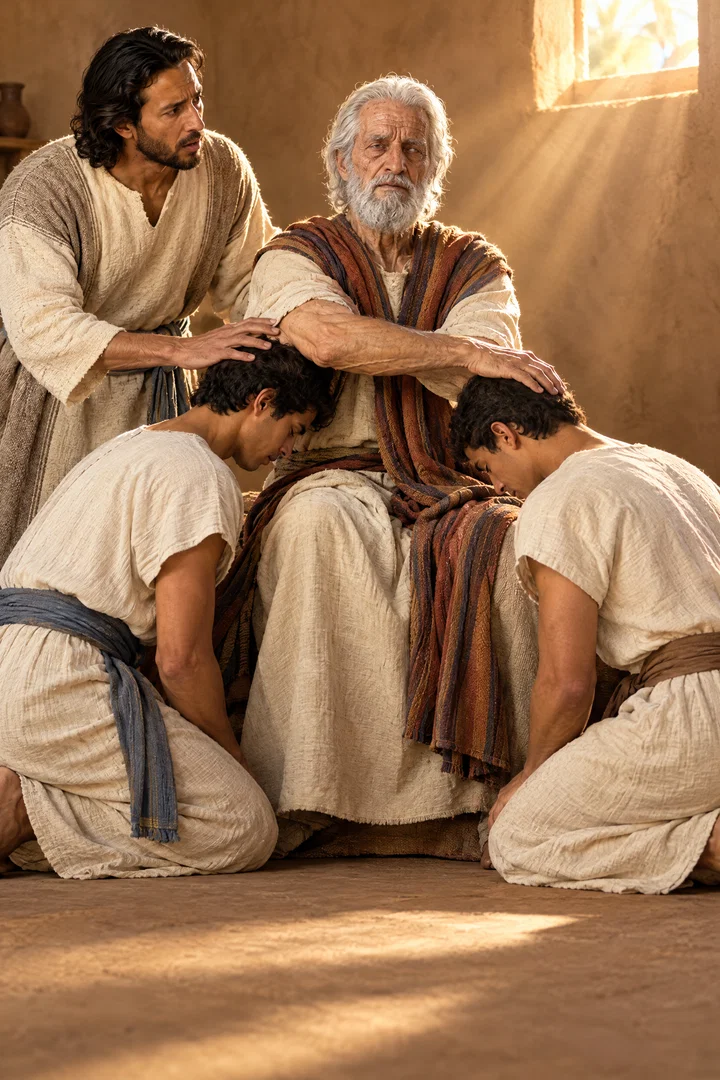
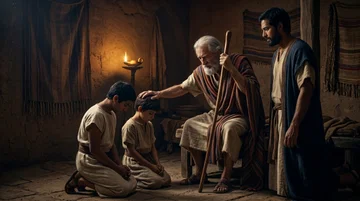
And Joseph took them both, Ephraim in his right hand toward Israel’s left hand, and Manasseh in his left hand toward Israel’s right hand, and brought them near unto him.
Translations
And Joseph took them both, Ephraim in his right hand toward Israel’s left hand, and Manasseh in his left hand toward Israel’s right hand, and brought them near to him.
King James Version, Revised Version, American Standard Version
And Joseph took them both, Ephraim in his right hand toward Israel’s left hand, and Manasseh in his left hand toward Israel’s right hand, and brought them near unto him.
And Joseph took them both, Ephraim in his right hand toward Israel’s left hand, and Manasseh in his left hand towards Israel’s right hand, and brought them near unto him.
And Joseph took them both, Ephraim in his right hand towards Israel's left hand, and Manasseh in his left hand towards Israel's right hand, and brought them near to him.
and Joseph taketh them both, Ephraim in his right hand towards Israel's left, and Manasseh in his left towards Israel's right, and bringeth [them] nigh to him.
And Joseph took them both, Ephraim in his right hand toward Israel's left hand, and Manasseh in his left hand toward Israel's right hand, and brought [ them] near to him.
And Joseph took them both,—Ephraim in his right hand on Israel’s left hand, and Manasseh in his left hand, on Israel’s right hand, and drew them near unto him.
Berean Standard Bible, Majority Standard Bible
And Joseph took both of them— with Ephraim in his right hand toward Israel’s left hand, and Manasseh in his left hand toward Israel’s right hand— and brought them close to him.
Joseph took them both, Ephraim in his right hand toward Israel’s left hand, and Manasseh in his left hand toward Israel’s right hand, and brought them near to him.
Then taking Ephraim with his right hand, Joseph put him at Israel's left side, and with his left hand he put Manasseh at Israel's right side, placing them near him.
Then tooke Ioseph them both, Ephraim in his right hand towarde Israels left hand, and Manasseh in his left hand toward Israels right hand, so he brought them vnto him.
Douay-Rheims (Challoner revision)
And he set Ephraim on his right hand, that is, towards the left hand of Israel; but Manasses on his left hand, to wit, towards his father’s right hand, and brought them near to him.
Pictures
Cross-references
- Jeremiah 31:9
They shall come with weeping, and with supplications will I lead them: I will cause them to walk by the rivers of waters in a straight way, wherein they shall not stumble: for I am a father to Israel, and Ephraim is my firstborn.
Ephraim is called firstborn though he was younger than Manasseh.
- Mark 10:16
And he took them up in his arms, put his hands upon them, and blessed them.
Both texts describe children being brought near and blessed with hands laid upon them.
- Genesis 27:1-29
And it came to pass, that when Isaac was old, and his eyes were dim, so that he could not see, he called Esau his eldest son, and said unto him, My son: and he said unto him, Behold, here am I.
Rebekah schemes to secure Isaac’s blessing for her favored son.
- Genesis 49:3-4
Reuben, thou art my firstborn, my might, and the beginning of my strength, the excellency of dignity, and the excellency of power:
Reuben also loses the birthright despite being the eldest.
- Genesis 47:27-31
And Israel dwelt in the land of Egypt, in the country of Goshen; and they had possessions therein, and grew, and multiplied exceedingly.
listed as same lesson scripture
- 1 Chronicles 5:1
Now the sons of Reuben the firstborn of Israel, (for he was the firstborn; but, forasmuch as he defiled his father’s bed, his birthright was given unto the sons of Joseph the son of Israel: and the genealogy is not to be reckoned after the birthright.
Reuben lost birthright to Joseph
Commentary
Each commentary is drawn from primary sources: the writings of Ellen G. White and Adventist pioneers and periodicals. Each commentary is separate. Its own words are not a quotation; follow the references to read the source passages.
Ellen G. White
1 source
The scene belongs to the extended Genesis 42-50 narrative of Joseph as ruler in Egypt during the seven years of famine.PP 224.3–225.1 It takes place when there is bread throughout all the land of Egypt while dearth lies upon all other lands including Canaan, so that Jacob's sons journey from Canaan to buy grain.PP 224.3–225.1 At that time they bow down with their faces to the earth before Joseph without recognizing him, in fulfillment of his dreams.PP 224.3–225.1
Sources
Pioneers and periodicals
13 sources
Joseph brought his two sons near to Jacob for blessing, setting the elder Manasseh toward Jacob's right hand and the younger Ephraim toward his left hand after the customary order that the elder should have preeminence.ST Dec 1, 1898ST Nov 10, 1914ST Dec 1, 1898 The placing was so that Jacob might lay his hands upon their heads to impart blessing in adopting them among the tribes of Israel, in the closing blessing and prophecy before his death for the preservation of the progenitors of the Seed.RH Feb 13, 1879ST Jan 28, 1913ST Apr 23, 1894 Jacob then crossed his hands, laying his right hand upon the younger Ephraim and his left upon Manasseh, not by mistake of dim eyesight which Joseph could not correct, because he was delivering the message of God that the younger should excel the elder.ST Jan 10, 1911ST Nov 10, 1914ST Dec 1, 1898 Firstborn therefore means preeminence and right by God's choice rather than birth first in time, which is how Jesus is the First-born from the dead though others rose before Him, by virtue of His offering and work by which all others are brought from the dead.ST Nov 15, 1910ST Oct 29, 1902 Jacob's crossed arms, like Joseph's roundabout path, illustrate that God's providence guides events and fulfills His purposes even when human plans are thrust against them.RH Jan 19, 1860RH Oct 3, 1907
Setting and Positioning
The verse belongs to the last chapters of Genesis, the Book of Beginnings, and to the rest of the story of Joseph and his brethren, which is full of lessons on the surface as well as deeper ones. It takes place after Jacob goes down into Egypt and belongs to his adoption of Joseph's sons together with his blessing of his sons and his prophecy concerning them before his death. It manifests God's care for the preservation of the progenitors of the Seed.
It belongs to the account of Israel in Egypt, together with Israel taking his journey with all that he had to Beer-sheba and offering sacrifices unto the God of his father Isaac.ST Dec 1, 1898 God spoke to Israel in the visions of the night, promising to make of him a great nation in Egypt and to go down with him into Egypt and surely bring him up again.ST Dec 1, 1898 Jacob was then carried with his little ones and his wives and his cattle and his goods which he had gotten in the land of Canaan into Egypt in the wagons which Pharaoh had sent to carry him.ST Dec 1, 1898 This journey was followed by their reception by Joseph and Pharaoh and by Jacob's death and burial.
Joseph brings Ephraim and Manasseh near to Jacob for blessing, positioning them so that Manasseh is toward Jacob's right hand and Ephraim toward his left.ST Dec 1, 1898ST Dec 1, 1898 He places the firstborn Manasseh by the right hand and Ephraim by the left following the customary order so the elder would receive preeminence.ST Nov 10, 1914ST Dec 1, 1898 He arranges each to stand by the hand he intended for him.RH Oct 3, 1907
The positioning is so Jacob can lay his hands on their heads.RH Feb 13, 1879 The act of laying on of hands outwardly signified imparting something to another, and in this instance it was connected with the bestowal of blessing.RH Feb 13, 1879 This took place in the context of Jacob's adoption of Joseph's sons among the twelve tribes of Israel.ST Jan 28, 1913ST Apr 23, 1894
Crossed Hands and Birthright
Joseph had set the two boys before Jacob so that the elder Manasseh stood toward the right hand and the younger Ephraim toward the left, according to the customary order for preeminence.ST Nov 10, 1914ST Dec 1, 1898 Jacob then crossed his hands, laying his right hand upon the head of the younger Ephraim and his left hand upon Manasseh.ST Nov 10, 1914ST Dec 1, 1898
The crossing was deliberate and not an error caused by dim eyesight.ST Nov 10, 1914 Joseph could not correct it, because in that act Jacob was delivering a message from God.ST Nov 10, 1914
The blessing signified that Ephraim, though younger, would excel Manasseh.ST Nov 10, 1914 In blessing Joseph's sons and adopting Ephraim and Manasseh as his own sons, Jacob gave the younger Ephraim preference over Manasseh the firstborn, so that Manasseh the older son lost the birthright to Ephraim.ST Jan 10, 1911ST Nov 10, 1914ST Apr 23, 1894 Age does not ensure favor with God.ST Jan 10, 1911
Those who held the Anglo-Israel view taught that the passage with its context establishes Ephraim and Manasseh as two distinct tribes descended from Joseph's sons, with Ephraim meaning the English people and Manasseh meaning the Americans.ST Oct 13, 1881 On that view tribal identity follows parentage and is fixed by birth, so English colonists who crossed the Atlantic to America and their descendants remain Ephraimites and cannot become Manassehites, and merely crossing the sea cannot turn a child of Ephraim into a child of Manasseh or the reverse.ST Oct 13, 1881
Firstborn Meaning and Providence
Joseph set his sons before Israel with the elder Manasseh toward Israel's right hand and the younger Ephraim toward Israel's left hand, yet the birthright was given to the younger Ephraim.ST Nov 15, 1910ST Oct 29, 1902 Firstborn does not mean born first in time but means preeminence and right.ST Nov 15, 1910ST Oct 29, 1902 Firstborn rank is given by God's choice and preeminence, not by order of birth.ST Nov 15, 1910ST Oct 29, 1902
This shows how Jesus is the First-born from the dead even though others were raised from the dead before Him, because He holds the place by preeminence.ST Nov 15, 1910ST Oct 29, 1902 His firstborn standing rests on the virtue of His offering and work by which all others are brought from the dead.ST Nov 15, 1910ST Oct 29, 1902 Joseph's history, to which this arranging of his sons belongs, shows that God may lead a person by a roundabout path while guiding that person to the purpose He intends.RH Jan 19, 1860 Joseph arranged Ephraim and Manasseh before Jacob so each would stand by the hand he intended for him, and Jacob's crossed arms as he blessed them illustrate that God's providence can guide events and fulfill His purposes even when human plans are thrust against them.RH Oct 3, 1907
Sources