Genesis 49:2
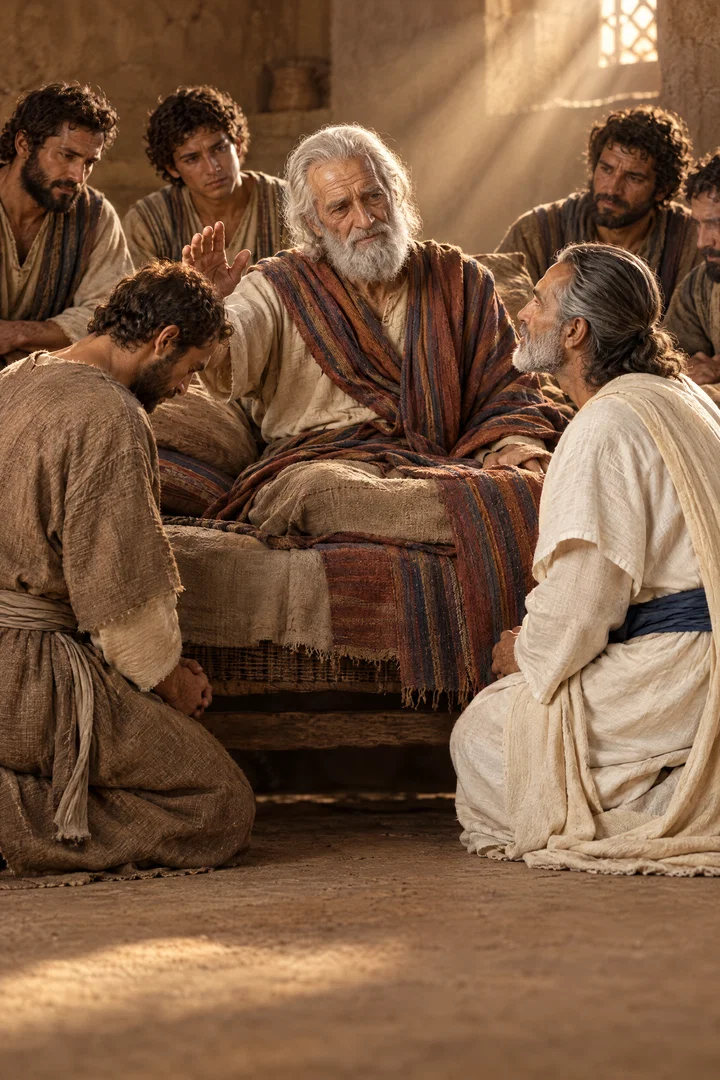
Gather yourselves together, and hear, ye sons of Jacob; and hearken unto Israel your father.
Translations
Gather yourselves together, and hear, you sons of Jacob; and listen to Israel your father.
Gather yourselves together, and hear, ye sons of Jacob; and hearken unto Israel your father.
Gather yourselves together, and hear, ye sons of Jacob;
And hearken unto Israel your father.Assemble yourselves, and hear, ye sons of Jacob: and hearken to Israel your father.
Revised Version, American Standard Version
Assemble yourselves, and hear, ye sons of Jacob; And hearken unto Israel your father.
'Be assembled, and hear, sons of Jacob, And hearken unto Israel your father.
Assemble yourselves, and hear, ye sons of Jacob, And listen to Israel your father.
Assemble yourselves and hear ye sons of Jacob,—And hearken unto Israel your father!
Berean Standard Bible, Majority Standard Bible
Come together and listen, O sons of Jacob;
listen to your father Israel.Assemble yourselves, and hear, you sons of Jacob.
Listen to Israel, your father.Come near, O sons of Jacob, and give ear to the words of Israel your father.
Gather your selues together, and heare, ye sonnes of Iaakob, and hearken vnto Israel your father.
Douay-Rheims (Challoner revision)
Gather yourselves together, and hear, O ye sons of Jacob, hearken to Israel your father:
Pictures
Cross-references
- Genesis 49:10
The sceptre shall not depart from Judah, nor a lawgiver from between his feet, until Shiloh come; and unto him shall the gathering of the people be.
Judah’s scepter and Shiloh point forward to Christ, to whom the peoples gather.
- Genesis 49:22-26
Joseph is a fruitful bough, even a fruitful bough by a well; whose branches run over the wall:
Jacob prophesies blessing and strength for Joseph.
- Genesis 34:25-30
And it came to pass on the third day, when they were sore, that two of the sons of Jacob, Simeon and Levi, Dinah’s brethren, took each man his sword, and came upon the city boldly, and slew all the males.
Their attack on Shechem is the violence Jacob recalls in his final words.
- Deuteronomy 33
And this is the blessing, wherewith Moses the man of God blessed the children of Israel before his death.
to be compared with Jacob's prophecy
- Genesis 35:22
And it came to pass, when Israel dwelt in that land, that Reuben went and lay with Bilhah his father’s concubine: and Israel heard it. Now the sons of Jacob were twelve:
Reuben’s sin explains why he forfeited the birthright blessing.
- Genesis 48:14-20
And Israel stretched out his right hand, and laid it upon Ephraim’s head, who was the younger, and his left hand upon Manasseh’s head, guiding his hands wittingly; for Manasseh was the firstborn.
Manasseh’s firstborn status did not secure him the greater blessing.
- Genesis 37:18-28
And when they saw him afar off, even before he came near unto them, they conspired against him to slay him.
The brothers’ treatment of Joseph forms part of the past conduct addressed in Jacob’s blessings.
- Revelation 5:5
And one of the elders saith unto me, Weep not: behold, the Lion of the tribe of Juda, the Root of David, hath prevailed to open the book, and to loose the seven seals thereof.
The Lion of Judah fulfills the prophecies concerning Jacob’s sons.
Commentary
Each commentary is drawn from primary sources: the writings of Ellen G. White and Adventist pioneers and periodicals. Each commentary is separate. Its own words are not a quotation; follow the references to read the source passages.
Ellen G. White
4 sources
The verse is Jacob's deathbed call gathering his sorrowing sons around him to hear his final words, blessing, and counsel.PP 235.2–4ST Feb 5, 1880SG3 171.2 As he speaks the Spirit of inspiration rests upon him, so his call is inspired prophecy rather than personal feeling.PP 235.2–4SG3 172.2ST Feb 5, 1880SG3 171.2 God by that Spirit lifts his mind above his natural feelings, with angels around him in his last hours and the power of God's grace shining upon him.SG3 172.2 Under that Spirit he speaks about their past conduct and foretells the character and future history of the tribes descended from them.PP 235.2–4ST Feb 5, 1880
He has forgiven his children's wrongs and loves them to the last with no resentful or unforgiving spirit.SG3 172.2ST Feb 5, 1880 His own affectionate, paternal feeling would have spoken only love and tenderness, but inspiration leads him to utter truth even when it is painful.SG3 172.2ST Feb 5, 1880 His inspired words expose the sins of some sons and present God's view of their deeds of violence, declaring that God would visit them for their sins in judgment.ST Feb 5, 1880SG3 171.2 His words concerning Simeon and Levi are gloomy, while his prophetic words concerning his other sons are not as gloomy.SG3 171.2
Sources
Pioneers and periodicals
14 sources
Dying Jacob gathers his twelve sons to hear his final inspired blessing and counsel as their father Israel.ST Dec 8, 1898ST Jan 28, 1913 Speaking in order from Reuben onward, he lays open each son's past character and conduct and declares the blessing and future belonging to his tribe, including loss of preeminence for sin and eminence for noble conduct.ST Feb 5, 1880RH Jul 4, 1865ST Dec 8, 1898ST Dec 8, 1898 He does this to tell them prophetically what shall befall them and their descendants in after days, meaning future time in general.ST Dec 8, 1898ST Dec 8, 1898ST Sep 9, 1889 The words upon eleven sons were fulfilled within the history of Israel before the first advent, while the words upon Judah alone embrace eternity.ST Sep 9, 1889ST In Judah the promise centers on Christ, for when Shiloh comes the peoples and nations gather in obedience to him, and those who belong to him are Abraham's seed and the true Israel.ST Sep 9, 1889ST Jan 23, 1912ST Feb 12, 1880ST
Setting and Content
The verse stands in the closing portion of Genesis that treats the last days and death of Jacob and Joseph.RH Jan 20, 1916 It comes after Israel's journey into Egypt and his reception by Joseph and Pharaoh, and before Jacob's death and burial, showing God's care in preserving the progenitors of the Seed. It is Jacob's last inspired duty in life before his death, when he gathers his sons to hear him as their father Israel in order to give them his blessing and final counsel.ST Feb 5, 1880ST Dec 8, 1898ST Jan 28, 1913
He addresses them in order, beginning with Reuben the eldest, declaring to each of the twelve tribes according to his blessing its character, blessing, and prophetic future.RH Jul 4, 1865ST Dec 8, 1898ST Dec 8, 1898 That declaration includes loss of birthright and pre-eminence for heinous sin and instability, prophetic denunciation and scattering for cruelty, and priority and eminence among the brethren for noble and generous conduct.RH Jul 4, 1865 Near death and under the Spirit of God he recounts their past conduct, failures, and character and declares what these will mean for their future generations.ST Feb 5, 1880 Even though he loved his sons and had forgiven them, he exposes the sins of some and declares God's judgment upon them, with inspiration leading him to speak painful truth where natural affection would have spoken only tenderly.ST Feb 5, 1880
Prophecy and Application
Jacob called his sons to assemble and hear him as Israel their father so that he might tell in prophetic blessing what should befall them, each one according to his blessing, and this gathering was his last inspired life duty before his death.ST Dec 8, 1898ST Dec 8, 1898RH Jun 23, 1903 Near death he recounted their past conduct, failures and character and declared with prophetic foresight what those things would mean for their future generations, their descendants and their posterity in the latter days.ST Dec 8, 1898ST Jan 23, 1912RH Jun 23, 1903 The prophecies of the chapter concern their descendants and posterity, foretelling what would happen to them.ST Jan 23, 1912RH Jun 23, 1903
The latter days there mean after days, futurity of days, and future time in general, not necessarily the Christian dispensation or the end of the world.ST Sep 9, 1889 The predictions on eleven of the sons were all fulfilled within the Jewish dispensation before the first advent and do not extend beyond the Israelite nation and the old covenant.ST Sep 9, 1889 Many of them were fulfilled in their national life as Israel.ST Sep 9, 1889ST
The predictions and promises concerning Judah alone embrace eternity as the continuation of the Abrahamic promises, with the gathering of the peoples and nations of the earth to Shiloh, of the seed of Judah according to the flesh.ST Sep 9, 1889 The dying prophecy uses symbols fitting the character of each tribe and is to be compared with Deuteronomy 33.ST Dec 8, 1898 The word on Judah there reveals the only royalty of worth in the sight of God and the only law, and keeps the sceptre with Judah through the division of Solomon's kingdom into Israel or Ephraim and Judah and Ephraim's later absorption into Judah until Shiloh came.ST Dec 8, 1898 It continues the prophetic spirit in which Jacob saw the ministration of angels, Christ the way, and God over all.ST Dec 8, 1898
The prophecies of the chapter center on Christ: when Shiloh comes, the peoples gather in obedience to him.ST Jan 23, 1912 The gathering pointed to belongs to the Messiah, and includes people from all nations, not only Israel.ST Jan 23, 1912ST Feb 12, 1880 Christ is the true stock of Israel, and those who belong to him are Abraham's seed, heirs according to the promise, and the true tribes of Israel.ST Jan 23, 1912 The dying words to his sons are prophecies worthy of study, many fulfilled in their national life as Israel, and some still awaiting fulfilment through the Lion of the tribe of Judah.ST Jan 23, 1912ST
As part of the history of Joseph, the verse proves that whatever God has intended a person for, He can be safely trusted to bring them to it, leading roundabout yet guiding right.RH Jan 19, 1860 As part of the history of the patriarchs about Jacob and Joseph, it belongs to familiar Scripture narrative taught to children from the earliest dawn of intelligence.RH Jul 2, 1908 It was used in the home at the fireside to lead infant minds up to God, to form tender minds, to impress the infant heart with piety and the knowledge and faith of the Scriptures, and to train children in the fear of God apart from corrupting association so they grow without taste for debasing pleasures and take their place as consistent workers.RH Jul 2, 1908
Sources