Hebrews 7:6
But he whose descent is not counted from them received tithes of Abraham, and blessed him that had the promises.
Translations
American King James Version, King James Version
But he whose descent is not counted from them received tithes of Abraham, and blessed him that had the promises.
but he whose descent is not counted from them received tithes of Abraham, and blessed him that had the promises.
But he whose descent is not counted from them received tithes from Abraham, and blessed him that had the promises.
Revised Version, American Standard Version
but he whose genealogy is not counted from them hath taken tithes of Abraham, and hath blessed him that hath the promises.
and he who was not reckoned by genealogy of them, received tithes from Abraham, and him having the promises he hath blessed,
but he who has no genealogy from them has tithed Abraham, and blessed him who had the promises.
But, he who deriveth not his pedigree from among them, hath taken tithes of Abraham. And, the holder of the promises, hath he blessed.
Berean Standard Bible, Majority Standard Bible
But Melchizedek, who did not trace his descent from Levi, collected a tenth from Abraham and blessed him who had the promises.
but he whose genealogy is not counted from them has accepted tithes from Abraham, and has blessed him who has the promises.
But this man, who was not of their family, took the tenth from Abraham, and gave a blessing to him to whom God had given his undertaking.
But he whose kindred is not couted among them, receiued tithes of Abraham, and blessed him that had the promises.
Douay-Rheims (Challoner revision)
But he, whose pedigree is not numbered among them, received tithes of Abraham, and blessed him that had the promises.
Pictures
Cross-references 20 of 28
- Genesis 14:18-20
And Melchizedek king of Salem brought forth bread and wine: and he was the priest of the most high God.
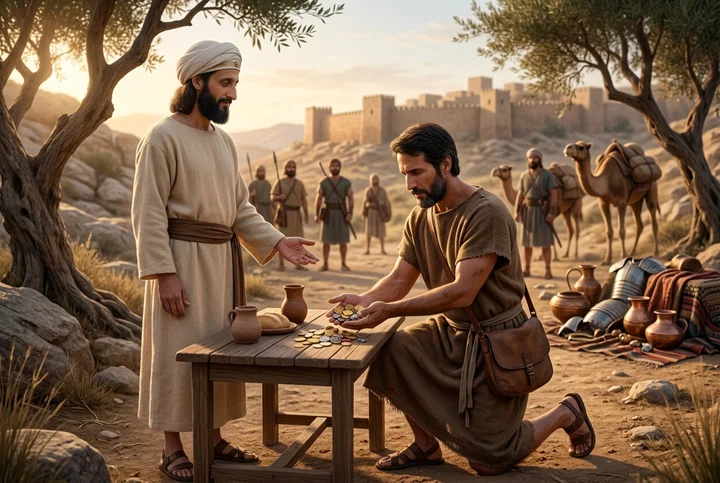
Melchizedek receives Abraham’s tithe and blesses him.
- Hebrews 8:1-2
Now of the things which we have spoken this is the sum: We have such an high priest, who is set on the right hand of the throne of the Majesty in the heavens;
Christ ministers as High Priest at God’s right hand in the true heavenly sanctuary.
- Psalms 110:4
The LORD hath sworn, and will not repent, Thou art a priest for ever after the order of Melchizedek.
God’s oath establishes Christ’s enduring priesthood after Melchizedek’s order.
- Hebrews 6:20
Whither the forerunner is for us entered, even Jesus, made an high priest for ever after the order of Melchisedec.
Jesus is a high priest after Melchizedek’s order.
- Hebrews 7:12
For the priesthood being changed, there is made of necessity a change also of the law.
A change in priesthood requires a change in its law.
- Leviticus 27:30-32
And all the tithe of the land, whether of the seed of the land, or of the fruit of the tree, is the LORD’s: it is holy unto the LORD.
The law identifies the tenth as holy to the Lord.
- Genesis 28:22
And this stone, which I have set for a pillar, shall be God’s house: and of all that thou shalt give me I will surely give the tenth unto thee.
Jacob vows to give God a tenth of all he receives.
- Hebrews 7:17
For he testifieth, Thou art a priest for ever after the order of Melchisedec.
Christ is priest forever after Melchizedek’s order.
- Hebrews 7:23-24
And they truly were many priests, because they were not suffered to continue by reason of death:
Contrasts many mortal priests with Christ’s unchangeable priesthood.
- Hebrews 5:6
As he saith also in another place, Thou art a priest for ever after the order of Melchisedec.
Christ is a priest forever in Melchisedec’s order.
- Numbers 18:21
And, behold, I have given the children of Levi all the tenth in Israel for an inheritance, for their service which they serve, even the service of the tabernacle of the congregation.
Israel’s tithes are given to the Levites for their service.
- Hebrews 7:1-2
For this Melchisedec, king of Salem, priest of the most high God, who met Abraham returning from the slaughter of the kings, and blessed him;
Melchizedek, priest and king, met and blessed Abraham.
- Galatians 3:29
And if ye be Christ’s, then are ye Abraham’s seed, and heirs according to the promise.
Those who belong to Christ are Abraham’s seed and heirs according to the promise.
- Hebrews 7:11
If therefore perfection were by the Levitical priesthood, ( for under it the people received the law,) what further need was there that another priest should rise after the order of Melchisedec, and not be called after the order of Aaron?
Contrasts Aaron’s priesthood with Melchizedek’s and explains why the Levitical priesthood gave way.
- Hebrews 7:21
( For those priests were made without an oath; but this with an oath by him that said unto him, The Lord sware and will not repent, Thou art a priest for ever after the order of Melchisedec:)
Christ is made priest forever after Melchisedec’s order.
- Psalms 110:1
The LORD said unto my Lord, Sit thou at my right hand, until I make thine enemies thy footstool.
The verse predicts Christ’s priesthood after Melchizedek’s order and his reign at God’s right hand.
- Hebrews 7:18
For there is verily a disannulling of the commandment going before for the weakness and unprofitableness thereof.
The commandment is annulled in connection with the change of priesthood.
- Hebrews 7:16
Who is made, not after the law of a carnal commandment, but after the power of an endless life.
Melchizedek’s priesthood rests on the power of an endless life.
- John 8:39
They answered and said unto him, Abraham is our father. Jesus saith unto them, If ye were Abraham’s children, ye would do the works of Abraham.
Abraham’s children do his works, including faithful tithing.
- Genesis 14:18
And Melchizedek king of Salem brought forth bread and wine: and he was the priest of the most high God.
Melchizedek meets Abraham and receives his tithe.
Commentary
Each commentary is drawn from primary sources: the writings of Ellen G. White and Adventist pioneers and periodicals. Each commentary is separate. Its own words are not a quotation; follow the references to read the source passages.
Ellen G. White
1 source
Abraham gave tithes of all he possessed to Melchizedek.Lt 44, 1876, par. 5–6 Those who live under the Melchizedek priesthood bear the same duty of tithing.Lt 44, 1876, par. 5–6 If tithing was obligatory for Abraham, it is obligatory for them as well.Lt 44, 1876, par. 5–6
Sources
Pioneers and periodicals
69 sources
He whose descent was not counted from Levi received tithes from Abraham and blessed him who had received God's promises.ST Dec 17, 1912ST Dec 9, 1889RH Jan 16, 1913ST Sep 5, 1895
Receiving tithes from Abraham and blessing him shows he was greater than Abraham, for the lesser is blessed by the greater.ST Dec 17, 1912ST Dec 9, 1889ST Dec 10, 1902
His lack of recorded descent, birth, death, or beginning and end of priesthood makes him a type of Christ, whose priesthood has no predecessor or successor and is made after the power of an endless life.ST Sep 14, 1882ST Sep 20, 1883ST Nov 23, 1904
Christ is priest forever after the order of Melchizedek, a royal priesthood distinct from and greater than the Aaronic and Levitical priesthood, which it superseded.ST Dec 10, 1902RH Jan 20, 1853
Abraham's gift of a tenth before Moses proves tithing predates the Mosaic law and is not merely Jewish, but belongs to God and to Christ the great High Priest throughout the gospel age.ST Sep 3, 1912RH Jan 16, 1913RH Mar 18, 1873ST Mar 27, 1893RH Mar 18, 1873
Melchizedek's Descent and Identity
His descent not being counted means his descent was not reckoned from Levi, the line from which the tithe-receiving Levitical priests came, and not traced from among the Levites whose priestly line received tithes under the law.ST Sep 3, 1912ST Dec 9, 1889RH Jan 16, 1913ST Sep 5, 1895 Though his ancestry was not counted among the Levitical priests, he received Abraham's tithes and blessed the bearer of God's promises, which establishes the superiority and distinct authority of his priesthood to the Levitical priesthood.ST Dec 9, 1889RH Jan 16, 1913RH Feb 20, 1913ST Sep 5, 1895 His descent not being counted means no genealogy, birth, death, parents, or beginning or end of priesthood is recorded for him, unlike Aaron's priests and the patriarchs whose pedigrees and lifespans are entered in the record.ST Sep 14, 1882ST Sep 20, 1883ST Jun 25, 1896ST Oct 21, 1889 That lack of recorded pedigree and of any recorded beginning or end is essential to the argument, because it distinguishes his priesthood and allows him to represent aspects of Christ's priesthood that the Aaronic type does not show.ST Sep 14, 1882ST Sep 20, 1883 His parentage and genealogy existed but were left without record, his priesthood beginning with no other before him and ending with no other after him in the account.ST Jun 25, 1896RH Sep 7, 1869ST Oct 21, 1889
He was a real human king of Salem and priest-king in Abraham's time, not Christ himself but a type of Christ as king-priest after the same order.ST Jun 11, 1912ST Jun 25, 1896 Christ is made like him as priest after that order, so Melchizedek himself is Christ's representative, with a priesthood that like Aaron's was a type of Christ's but gave a fuller picture because it joined kingship with priesthood.ST Jun 11, 1912ST Oct 4, 1883ST Dec 9, 1889 His names declare his office: Melchizedek means king of righteousness and Salem means peace, so he was king of righteousness and king of peace, like Christ as priest-king.ST Jun 11, 1912ST Oct 21, 1889 He is set forth as a preacher and teacher of righteousness within God's system of religion, living near Sodom so its people had access to light and to the truth through a man connected with Abraham.RH Aug 17, 1876ST Oct 4, 1883RH Jul 19, 1870
He really had parentage and descent that was left without record, which proves he was a human man greater than Abraham who received tithes from him and blessed him, and not God the Father, who alone is without descent.RH Sep 7, 1869 Those who held that his not being chosen as father of the faithful while the inferior Abraham was so chosen proves he was not a member of the human family or race taught that he came from another inhabited world.ST Apr 12, 1905 Those who held that view taught that there he reigned as priest-king over a righteous, peaceful, sinless, bloodless kingdom with its capital city Salem.ST Apr 12, 1905
Greater Than Abraham
Hebrews 7:6 states that Melchizedek, whose descent was not counted from Abraham's people or traced from the Levites whose priestly line received tithes under the law, received tithes from Abraham and blessed Abraham, the patriarch and bearer who possessed and held God's promises.ST Dec 17, 1912ST Dec 9, 1889ST Sep 5, 1895ST Nov 3, 1909 Abraham's payment of tithes expressed homage to Melchizedek, showing he was no ordinary man.ST Dec 17, 1912ST Jun 11, 1912 Receiving tithes and giving blessing establishes Melchizedek's greatness and superiority above Abraham in relation to him, since the lesser is blessed by the greater and the one who blesses is greater than the one who is blessed.ST Dec 9, 1889ST Dec 10, 1902ST Sep 5, 1895ST Oct 4, 1883 Because Levi and Aaron and the Aaronic priesthood descended from Abraham, this proves the Melchizedek priesthood is greater than the Levitical priesthood and magnifies the priestly order after which Christ was called.ST Dec 9, 1889ST Dec 10, 1902
His superiority to Abraham was in his position as priest-king, not in every respect.ST Dec 9, 1889 Abraham was a stranger and pilgrim, not a king, and was otherwise doubtless not inferior to Melchizedek.ST Dec 9, 1889 Melchizedek's priesthood, like Aaron's, was a type of Christ's, but it gave a fuller picture because Melchizedek joined kingship with priesthood, while Aaron's priesthood had no kingship.ST Dec 9, 1889
Taken literally this greatness and superiority belongs to Jesus alone as the undying King-Priest.ST Dec 10, 1902 It belongs to Melchizedek only in a secondary metaphorical sense as His type, establishing that Christ's priesthood after the order of Melchizedek is superior to that of Aaron.ST Dec 10, 1902
Christ's Enduring Priesthood
Melchizedek's descent not being counted means no genealogy, pedigree, beginning or end of priesthood is recorded for him, unlike the priests of Aaron's line.ST Sep 14, 1882ST Sep 20, 1883ST Jun 25, 1896 He was a real king of Salem in Abraham's time, not Christ himself but a fitting type of Christ as king-priest after his order.ST Jun 25, 1896 This lack of recorded descent and of any other priest before or after him in the account is what makes him represent Christ, whose priesthood as priest has no genealogy and comes from no other and passes to no other.ST Sep 14, 1882ST Sep 20, 1883ST Jun 25, 1896 It is an age-lasting priesthood with no predecessor or successor, and the absence of an identifiable genealogy is essential because it allows him to show aspects of Christ's priesthood that the Aaronic type does not show.ST Sep 20, 1883ST Jun 25, 1896
Christ is a priest forever after the order of Melchizedek, a royal and kingly priesthood distinct from the Levitical and Aaronic priesthood.ST Dec 10, 1902RH Jan 20, 1853RH Dec 6, 1870RH Sep 11, 1856 Melchizedek, whose descent was not reckoned from the Levitical line, received tithes from Abraham and blessed him who possessed God's promises, which establishes his superiority in rank to Abraham and, since Levi and Aaron descended from Abraham, the superiority of his priesthood to the Levitical priesthood.ST Dec 10, 1902RH Jan 20, 1853 Taken literally this greatness as undying King-Priest belongs to Jesus alone and belongs to Melchizedek only in a secondary metaphorical sense as his type.ST Dec 10, 1902 That other priesthood therefore took the place of the former Levitical priesthood and superseded it, for Christ belongs to a priesthood not counted from Levi and is not and cannot be a Levitical priest.RH Jan 20, 1853RH Jan 20, 1853RH Dec 6, 1870RH Sep 11, 1856
The priests under Levi were dying men, so the office had to pass to others with repeated service, but the priest after the order of Melchizedek is made not after the law of a carnal commandment but after the power of an endless life.ST Nov 23, 1904RH Mar 28, 1854 Having assumed the office of priest it never can pass to another, for his priesthood is independent, unchangeable and forever.ST Nov 23, 1904ST Jun 25, 1896RH Mar 28, 1854 He ever lives to make intercession, and like Melchizedek his priesthood began with no other before him and ends with no other after him.ST Jun 25, 1896
Like Melchizedek, Christ is a priest-king, king of righteousness and peace. He is King of Peace and Prince of Peace only in his priestly office as a priest after the order of Melchizedek, and the title means he is our peace.RH Oct 27, 1863ST Dec 20, 1883RH Apr 14, 1874 In that office he makes peace for us with God on his Father's throne and reconciles us to God by the cross.RH Oct 27, 1863ST Dec 20, 1883RH Apr 14, 1874 He obtains redemption by his own blood shed as High Priest.RH Oct 27, 1863ST Dec 20, 1883RH Apr 14, 1874
His priesthood is not Levitical or after Aaron and does not rest on earthly Levitical descent, and its place is on the throne of his Father's majesty in heaven.RH Dec 6, 1870RH Apr 14, 1874RH Apr 1, 1873 Melchizedek was both king and priest while David had no priesthood, and Christ's present place on his Father's heavenly throne is connected with this priestly kingly role while he mediates for sinners until his enemies are put under his feet.ST Nov 16, 1882RH May 29, 1856RH Apr 1, 1873 He is a priest on his Father's throne in distinction from his own throne, and he does not officiate as priest on David's throne and never will serve as priest there.RH Dec 6, 1870RH May 29, 1856ST Sep 2, 1875 His serving there covers a limited period before he takes the throne of David, and the cleansing of the sanctuary in the Most Holy Place is part of this continuing priestly work which began in 1844 and ends just before the plagues, distinct from his later reception of his own subordinate throne and kingdom.RH May 29, 1856RH Apr 14, 1874
Melchizedek's priesthood gave a fuller picture of Christ's than Aaron's did because Melchizedek joined kingship with priesthood while Aaron's priesthood had no kingship, though both were types of Christ's.ST Dec 9, 1889 Its essentials include righteousness, sonship, fatherhood and eternal life, and these qualities make it an everlasting priesthood. The Levitical priesthood served the needs of a sinful world by dealing with sin, while the Melchizedek priesthood applies to all times and conditions.ST Oct 25, 1905
Heavenly Sanctuary Ministry
Hebrews 7:6 belongs to the explanation of Christ's priesthood and of how the old sanctuary's priestly service finds its fulfillment in Christ.ST Jun 30, 1914ST Nov 3, 1909RH Jan 20, 1874 It stands within the comparison of the priesthood of Melchizedek with the Aaronic priesthood and within the contrast between the earthly sanctuary and the heavenly one whose high-priestly work the earthly services foreshadowed.ST Nov 18, 1880 It shows that Melchizedek, whose ancestry was not reckoned from the Levitical priests, received tithes from Abraham and blessed him even though Abraham held the promises.ST Nov 3, 1909RH Jan 20, 1874
Christ as great High Priest after the order of Melchizedek has entered into heaven itself, the true tabernacle which the Lord pitched and not man, the Most Holy or Holy of Holies or Sanctum Sanctorum, not the earthly tabernacle made with hands.RH Aug 28, 1856RH May 8, 1856RH Jan 20, 1853RH Aug 18, 1863 There He ministers before the ark of God's testament with His own blood and sacrifice, doing there what Moses and Aaron did in its earthly pattern.RH May 8, 1856RH Jan 20, 1853RH Dec 12, 1854RH Mar 4, 1862RH Aug 18, 1863 He entered and consecrated the heavenly sanctuary with His own blood, fulfilling there the work that Moses and Aaron performed in the earthly sanctuary, its pattern.RH Jan 20, 1853 As the first covenant had a priesthood that ministered before the ark and made atonement for sin, so Christ is the great High Priest of the new covenant ministering in heaven before the ark of God's testament.RH Mar 4, 1862
The anointing of the earthly Holy of Holies immediately preceded the presentation of the sin offering before the mercy seat, so Christ had to go within the veil after His ascension to fulfill the type, accomplishing the anointing of the Most Holy in heaven foretold as the last event of the seventy weeks.RH May 8, 1856RH Aug 18, 1863 His priestly rule after the order of Melchizedek is on His Father's heavenly throne and continues while He mediates for sinners until His enemies are put under His feet, and He does not officiate as priest on David's throne.RH May 29, 1856 The cleansing of the sanctuary in the Most Holy Place is part of this continuing priestly work, which began in 1844 and ends just before the plagues, distinct from His later reception of His own subordinate throne and kingdom.RH May 29, 1856
The earthly sanctuary service had two stages, the regular priests' ministry and the high priest's distinct work, and its complete cleansing from sin took place at the year's end when the high priest entered the Most Holy Place and served before the mercy seat.RH Aug 10, 1916 This two-part earthly service was a faithful pattern of Christ's high-priestly ministry in the heavenly sanctuary.RH Aug 10, 1916 The Levitical priesthood with its repeated sacrifices by mortal, dying men could not bring perfection or take away sin, so the office had to pass to others and the priesthood gave way to Christ, the real Priest whose ministry is in the heavenly sanctuary.ST Oct 13, 1909RH Dec 12, 1854RH Mar 28, 1854 The priest after the order of Melchizedek is made not after the law of a carnal commandment but after the power of an endless life, so having assumed the office of priest it never can pass to another, His priesthood is unchangeable and forever, and He ever lives to make intercession and can save completely those who come to God through Him.RH Dec 12, 1854RH Mar 1, 1870RH Mar 28, 1854
This transition from the Levitical priesthood to Christ's priesthood in the order of Melchizedek stands alongside the transition from the earthly sanctuary to the heavenly sanctuary.RH Mar 1, 1870 Christ's mediatorial work as great High Priest is the heart of both the old and new dispensations, and both Melchizedek's priesthood and Aaron's priesthood serve under Him. Christ is the antitype fulfilling the old covenant's types and shadows, and the ceremonial law that ordained them was abolished at the cross when shadow was swallowed up in substance.RH Jul 4, 1854
Tithing Under Christ's Order
Abraham's gift of a tenth to Melchizedek took place before Moses and before the Jewish system, which proves that tithing reaches back to Abraham's time and predates the Mosaic law.RH Mar 18, 1873ST Mar 27, 1893RH Mar 18, 1873RH Mar 8, 1906RH May 18, 1869 It was therefore not a Jewish institution that began with that law system, nor merely a Mosaic enactment.RH Mar 18, 1873ST Mar 27, 1893RH Mar 18, 1873RH May 6, 1902 Because the Christian priesthood is of Melchizedek's order, the duty to give a tithe does not end with the Levitical system but belongs to the order of Melchizedek, under which Christ is priest forever, and is a matter of faith.ST Mar 27, 1893RH Mar 8, 1906RH May 18, 1869
The change of law spoken of in the chapter governs who could serve as priest, not tithing, for the Levitical priesthood was tied to Levi while Christ came from Judah and serves as priest in the order of Melchizedek.ST Sep 3, 1912 The tithe belonged to an eternal priesthood, and when the temporary Aaronic priesthood ended at Christ's death the tithe with its other non-typical duties and privileges returned to the Melchizedek priesthood whose high priest is Christ.RH Jan 16, 1913 When Israel's sanctuary service began the tithe was assigned to the Levitical priesthood instead, and this was a transfer of its recipient, not a new obligation to tithe.RH Jan 9, 1913 Since Abraham paid tithe before the Levitical law and to Melchizedek, whose descent was not reckoned from the Levitical line, the continuing obligation of God's people to give a tenth for the support of the gospel ministry remains.ST Sep 3, 1912RH Jan 16, 1913
Tithing was recognized under Melchizedek's priesthood and therefore belongs with Christ's priesthood, which is after the same order, throughout the gospel age.RH Mar 18, 1873ST Feb 16, 1915RH Mar 9, 1905 Because Melchizedek belonged to the same priestly order as Christ, he received the tithes as Christ's representative, so tithe paying belongs with Christ's priesthood.RH Feb 20, 1913RH Apr 8, 1902 The tithe belongs to God and to Christ the great High Priest for the support of his work and of those who minister at the altar in gospel ministry.ST Sep 3, 1912RH Jan 16, 1913RH Mar 18, 1873 This example places tithing before the Levitical priesthood and connects it to the Melchisedec priesthood that serves throughout the gospel age, so tithing remains in force with that priesthood.RH Mar 9, 1905
Abraham's tithe recognized his responsibility to give the Lord a tenth of the property that had come into his hands, and he gave it before returning the remaining spoils to the king of Sodom.ST Feb 16, 1915 His gift of a tenth of what he had to Melchizedek, priest of the Most High God, is paying tithes and is an example of dedicating a portion of one's substance to God alongside the later commanded system for supporting religious service and those devoted to God's cause. As father and representative of all believers his tithe shows what the Lord counts acceptable.ST Jan 28, 1875 Since Christians are all children of God by faith in Jesus Christ and the seed of Abraham according to the promises, they must do the works of Abraham and be tithe-paying people, with the tithes they pay to the Lord's priest received by their High Priest Jesus Christ. Abraham and the patriarchs thus recognized the tithe, with one tenth as the minimum portion set apart for God, and Abraham recognized the obligation to return a tithe to the Lord.RH Mar 16, 1916ST Oct 15, 1902
Melchisedec represented Jesus Christ, and Abraham's example supports the continuing duty to return God's tithe.RH Apr 8, 1902 The tenth belonged to God by right, and withholding it was robbery.RH May 6, 1902 Tithes are something God has set apart for his service and for the support of his servants and service, and withholding what is set apart is stealing holy things.RH Apr 8, 1909
Scripture Law and Promise
The lack of any recorded descent for Melchizedek is deliberate and instructive, not accidental or due to ignorance, because Scripture elsewhere records genealogies and lifespans with care.RH Sep 28, 1905 What is left out therefore teaches as truly as what is written, showing that omissions in Scripture carry the intended meaning of the Holy Spirit.RH Sep 28, 1905 No settling of questions about his identity is valid if it sets aside what Paul affirms concerning him.ST Apr 5, 1883
The promises given to Abraham are the ground of hope, since they display God's faithfulness and righteousness in keeping what He promised, with Abraham held forth as the example of that hope.ST Dec 23, 1889 That hope turns to Christ's priesthood after the order of Melchizedek, first introduced in Hebrews 5:6 and forming the great object of the epistle.ST Dec 23, 1889
The verse stands with mention of a carnal commandment and of a law changed with the priesthood, proving that law in Scripture can mean different laws.RH Mar 15, 1864 The Levitical law with its ordinances of divine service belonged to the ministration of the first covenant, set against the more excellent ministry of Christ that fulfills the ministration of the second covenant.RH Mar 8, 1906 That Levitical law was abolished by Christ, while the law of God remains holy, just, good, spiritual and enduring.RH Aug 20, 1872 The law of God given as the basis of the first covenant is distinct from its ministration in the handwriting of ordinances, and what was abolished and done away in Christ was the ministration of condemnation with its typical service and veil, when shadow was swallowed up in substance, not the law which Christ did not destroy, whose tables of the testament remain in the ark in the heavenly tabernacle where He ministers.RH Mar 8, 1906 The new covenant concerns the same law, which the Lord promises to put in hearts, and in teaching the new covenant ratified by His blood Christ taught the moral law in every jot and tittle.RH Apr 30, 1872 The change of law argued from the priesthood concerns the rules governing who could serve as priest, and does not abolish the Sabbath commandment.RH Mar 15, 1864RH Feb 4, 1873
Sources