Isaiah 14:13
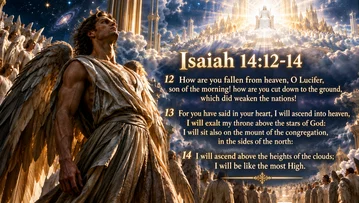
For thou hast said in thine heart, I will ascend into heaven, I will exalt my throne above the stars of God: I will sit also upon the mount of the congregation, in the sides of the north:
Translations
For you have said in your heart, I will ascend into heaven, I will exalt my throne above the stars of God: I will sit also on the mount of the congregation, in the sides of the north:
King James Version, KJV Cambridge Paragraph Bible
For thou hast said in thine heart, I will ascend into heaven, I will exalt my throne above the stars of God: I will sit also upon the mount of the congregation, in the sides of the north:
For thou hast said in thy heart, I will ascend into heaven, I will exalt my throne above the stars of God: I will sit also upon the mount of the congregation, in the sides of the north:
And thou saidst in thine heart, I will ascend into heaven, I will exalt my throne above the stars of God; and I will sit upon the mount of congregation, in the uttermost parts of the north:
And thou saidst in thy heart, I will ascend into heaven, I will exalt my throne above the stars of God; and I will sit upon the mount of congregation, in the uttermost parts of the north;
And thou saidst in thy heart: the heavens I go up, Above stars of God I raise my throne, And I sit in the mount of meeting in the sides of the north.
And thou that didst say in thy heart, I will ascend into the heavens, I will exalt my throne above the stars of God, and I will sit upon the mount of assembly, in the recesses of the north;
Yet, thou, didst say in thy heart—The heavens, will I ascend, Above the stars of GOD, will I lift up my throne,—That I may sit in the Mount of Assembly In the Recesses of the North:
Berean Standard Bible, Majority Standard Bible
You said in your heart:
“ I will ascend to the heavens;
I will raise my throne
above the stars of God.
I will sit on the mount of assembly,
in the far reaches of the north.You said in your heart, “ I will ascend into heaven! I will exalt my throne above the stars of God! I will sit on the mountain of assembly, in the far north!
For you said in your heart, I will go up to heaven, I will make my seat higher than the stars of God; I will take my place on the mountain of the meeting-place of the gods, in the inmost parts of the north.
Yet thou saidest in thine heart, I will ascende into heauen, and exalt my throne aboue beside the starres of God: I will sitte also vpon the mount of the Congregation in the sides of the North.
Douay-Rheims (Challoner revision)
And thou saidst in thy heart: I will ascend into heaven, I will exalt my throne above the stars of God, I will sit in the mountain of the covenant, in the sides of the north.
Pictures


Cross-references 20 of 42
- Revelation 12:7-9
And there was war in heaven: Michael and his angels fought against the dragon; and the dragon fought and his angels,
Describes Satan’s rebellion and expulsion from heaven.
- Ezekiel 28:14-17
Thou art the anointed cherub that covereth; and I have set thee so: thou wast upon the holy mountain of God; thou hast walked up and down in the midst of the stones of fire.
Both describe a heavenly being’s pride and self-exaltation followed by his fall.
- 2 Thessalonians 2:4
Who opposeth and exalteth himself above all that is called God, or that is worshipped; so that he as God sitteth in the temple of God, shewing himself that he is God.
Both describe a power exalting itself above God and claiming divine status.
- Ezekiel 28:14-15
Thou art the anointed cherub that covereth; and I have set thee so: thou wast upon the holy mountain of God; thou hast walked up and down in the midst of the stones of fire.
Describes Lucifer’s exalted position and the iniquity found in him.
- Revelation 12:4
And his tail drew the third part of the stars of heaven, and did cast them to the earth: and the dragon stood before the woman which was ready to be delivered, for to devour her child as soon as it was born.
The dragon draws a third of heaven’s stars after him, understood as angels joining Satan’s rebellion.
- Genesis 11:4
And they said, Go to, let us build us a city and a tower, whose top may reach unto heaven; and let us make us a name, lest we be scattered abroad upon the face of the whole earth.
The builders’ tower and attempt to make a name echo the same self-exalting ambition.
- 2 Peter 2:4
For if God spared not the angels that sinned, but cast them down to hell, and delivered them into chains of darkness, to be reserved unto judgment;
Both describe sinful angels cast down from heaven and reserved for judgment.
- Luke 10:18
And he said unto them, I beheld Satan as lightning fall from heaven.
Jesus describes Satan falling from heaven, connecting with Lucifer’s proud rebellion.
- Genesis 3:5
For God doth know that in the day ye eat thereof, then your eyes shall be opened, and ye shall be as gods, knowing good and evil.
Eden’s promise of becoming like God echoes Lucifer’s ambition to exalt himself.
- John 8:44
Ye are of your father the devil, and the lusts of your father ye will do. He was a murderer from the beginning, and abode not in the truth, because there is no truth in him. When he speaketh a lie, he speaketh of his own: for he is a liar, and the father of it.
The devil did not remain in truth, reflecting his rebellion and the origin of sin.
- Matthew 4:8-10
Again, the devil taketh him up into an exceeding high mountain, and sheweth him all the kingdoms of the world, and the glory of them;
Satan offers Christ the kingdoms of the world in exchange for worship.
- Revelation 12:7-8
And there was war in heaven: Michael and his angels fought against the dragon; and the dragon fought and his angels,
The heavenly war ends with the dragon losing his place in heaven.
- Ezekiel 28:15
Thou wast perfect in thy ways from the day that thou wast created, till iniquity was found in thee.
Both describe iniquity arising in a created being once perfect.
- Isaiah 14:4
That thou shalt take up this proverb against the king of Babylon, and say, How hath the oppressor ceased! the golden city ceased!
Introduces the king of Babylon whose pride is described.
- Ezekiel 28:2
Son of man, say unto the prince of Tyrus, Thus saith the Lord GOD; Because thine heart is lifted up, and thou hast said, I am a God, I sit in the seat of God, in the midst of the seas; yet thou art a man, and not God, though thou set thine heart as the heart of God:
Both rulers exalt themselves as God, linking earthly pride with Satan’s self-exaltation.
- Psalms 48:1-2
Great is the LORD, and greatly to be praised in the city of our God, in the mountain of his holiness.
Both place the holy mountain on the sides of the north.
- Jude 1:6
And the angels which kept not their first estate, but left their own habitation, he hath reserved in everlasting chains under darkness unto the judgment of the great day.
Angels abandoned their proper place and are reserved for judgment.
- Ezekiel 28:16
By the multitude of thy merchandise they have filled the midst of thee with violence, and thou hast sinned: therefore I will cast thee as profane out of the mountain of God: and I will destroy thee, O covering cherub, from the midst of the stones of fire.
Lucifer’s self-exaltation and rebellion lead to corruption, violence, and destruction.
- Luke 4:5-7
And the devil, taking him up into an high mountain, shewed unto him all the kingdoms of the world in a moment of time.
Satan claims the kingdoms of the world and offers them in exchange for worship.
- Ezekiel 28:6
Therefore thus saith the Lord GOD; Because thou hast set thine heart as the heart of God;
Both describe Lucifer’s heart aspiring to be like God.
Commentary part 1 of 3
Each commentary is drawn from primary sources: the writings of Ellen G. White and Adventist pioneers and periodicals. Each commentary is separate. Its own words are not a quotation; follow the references to read the source passages.
Ellen G. White
121 sources
The verse records the secret resolve formed in the heart of Lucifer, once a covering cherub next to Christ in glory, to ascend from his appointed place and exalt his throne above the angels and take a seat of rule in the heavenly assembly belonging to God.GC88 493.3–494.1RH Sep 24, 1901Ms 141a, 1897, par. 25–27RH Feb 4, 1909RH Feb 8, 1915 That resolve was ambition to be like the Most High, to be equal with God and rule the universe by coveting the position, authority and homage belonging to Christ alone.Ms 74, 1903, par. 12–13GC 493.3–494.1GC88 493.3–494.1GC 503.2–504.1GC88 503.3–504.1 To gain it he concealed his designs with insinuations and promises of liberty, drew nearly half the angels into sympathy and open war, and was overcome and cast out with his followers, stripped of honor and shut out from the heavenly council.Ms 74, 1903, par. 12–13CT 32.3RH Feb 4, 1909ST Nov 5, 1894RH Jan 16, 1913 His course was the origin of evil and war against God's unchangeable law, standing in direct contrast to Christ who, though equal with God, did not grasp at equality but submitted to the Father and left heaven to bring life.Ms 74, 1903, par. 12–13GC88 503.3–504.1DA 20.4–21.1Lt 412, 1907, par. 2DA 57.3 It warns that all pride, envy and grasping for the highest place banish from heaven and bring ruin, and calls for humility, submission to God and humble service instead of self-exaltation.MYP 58.2Ms 78, 1901, par. 25T 242.1ST Jan 11, 1905Ms 31, 1889, par. 76
Words and Heavenly Setting
The saying was spoken inwardly, in the heart, as a secret and proud resolve to climb upward and lift the self on high.Ms 141a, 1897, par. 25–27RH Feb 8, 1915RH Feb 8, 1915RH Feb 8, 19155T 242.1 It was envy, jealousy and hatred toward Jesus Christ when Christ was acknowledged as sovereign of heaven with power and authority the same as God's own, and though Satan bowed with the angels to acknowledge Christ's supremacy and rightful rule, his heart remained filled with envy and hatred.RH Feb 8, 1915RH Feb 8, 1915 Christ had been taken into God's special counsel concerning His plans while Satan was left unacquainted and not permitted to know God's purposes, and his resolve to rise to the height of God Himself grew from pride in his own loftiness.RH Feb 8, 1915RH Feb 8, 1915RH Feb 8, 1915 That pride fed on thinking himself a favorite in heaven, on his high exaltation, on knowing he was honored by the angels, on his special mission, on his nearness to the Creator with glorious light shining especially upon him, on the pleasurable alacrity with which angels had obeyed his command, and on his light and beautiful garments, until he asked why Christ should be honored before himself.RH Feb 8, 1915RH Feb 8, 1915 After leaving the immediate presence of the Father dissatisfied and filled with envy against Jesus, he concealed his real purpose while gathering the angels and presenting himself as aggrieved over the preference God had given Jesus.RH Feb 8, 1915RH Feb 8, 1915 He claimed their sweet liberty was at an end because a ruler had been appointed over them demanding servile honor, and declared he would no longer submit to this invasion of his rights and authority and would never again bow down to Christ.RH Feb 8, 1915RH Feb 8, 1915 It was the same self-exalting spirit later acted out by the man of sin, the son of perdition, who lifts himself above all that is called God or worshiped and sits as God in the temple of God showing himself to be God.Ms 141a, 1897, par. 25–27 Cherished in the heart, such pride and ambition banished him from heaven, and being deeply rooted in fallen human nature, if not removed they will overshadow every good and noble quality and bring forth envy and strife as their fruits.5T 242.1
To ascend into heaven and exalt the throne means seeking a higher place, supremacy, and rule above the appointed place.GC 659.2–660.1GC88 659.2–4RH Sep 24, 1901Ms 125, 1907, par. 24ST Jan 9, 1879 It was a set purpose to rise to heaven, raise the throne above God's stars, and claim place and authority like the Most High.GC 659.2–660.1GC88 659.2–4RH Sep 24, 1901 Though his glory came from God and he was already honored above the heavenly host, he sought to raise his throne above God's stars and claim homage and power belonging to the Creator and to Christ alone.Ms 125, 1907, par. 24ST Jan 9, 1879 His desire to exalt himself and take the place of Christ turned God-given gifts into grounds for self-exaltation and led to revolt, for pride will not enter God's kingdom.Ms 125, 1907, par. 24 He sought the honor given to Christ, refused to submit to Christ's authority, wanted to command the angels and be equal with God, and his claim to take the honor for himself expresses the pride and rebellion that led him to oppose God's government.ST Jan 9, 1879
The stars of God are the angels and heavenly host above whom he sought to raise himself.GC 493.3–494.1GC88 493.3–494.1GC88 503.3–504.1ST Nov 11, 1913GC 494.2–495.2 He aspired to raise his throne above God's heavenly beings and claim a place of rule reserved for Christ.GC 493.3–494.1GC 494.2–495.2Ms 140, 1906, par. 22 Rather than honoring God and serving others, he wanted God's creatures to give their service and homage to him.GC 493.3–494.1ST Nov 11, 1913GC 494.2–495.2 His ambition arose from jealousy of the honor God had given His Son and marked resistance to heaven's order, seeking a throne above the angels and a place of authority belonging to Christ.GC88 503.3–504.1ST Nov 11, 1913GC 494.2–495.2 That pride led to a rebellion that contaminated many angels, who were cast out of heaven.GC88 503.3–504.1Ms 140, 1906, par. 22
To sit upon the mount of the congregation in the sides of the north means taking a seat of rule in the heavenly assembly and councils belonging to God and Christ.GC88 493.3–494.1RH Sep 24, 1901Lt 24, 1910, par. 4–5Lt 15, 1889, par. 7 He resolved to take a seat on the mount of the congregation in the north as part of desiring to exalt himself and become like the Most High.GC88 493.3–494.1RH Sep 24, 1901 He sought to be first in heaven's councils and to occupy Christ's place, stirring discontent among the angels and disguising his purpose until many joined him.Lt 24, 1910, par. 4–5 His desire to rise above rightful authority is the spirit of self-sufficiency that refuses correction and leaves a person unbalanced, which is evidence that God has forsaken that person.Lt 15, 1889, par. 74MR 346.2 His self-exaltation to claim supremacy in the heavenly assembly was part of his deception and rebellion against God.4MR 346.2
The speaker is Lucifer, once a covering cherub next to Christ in power and glory, created good and perfect, beautiful and highly exalted, whose glory, wisdom, beauty and position were derived from God.RH Sep 24, 1901RH Feb 4, 1909RH Feb 8, 191520MR 176.6–177.1Lt 55, 1903, par. 15 He stood next to Christ in power and glory, next in honor to God's Son, with a mild and happy countenance, high and broad forehead showing powerful intellect, perfect form, and noble and majestic bearing, with a special light beaming in his countenance brighter than the other angels.RH Feb 4, 1909RH Feb 8, 1915Lt 162, 1906, par. 5–7 Jesus, God's Son, had the pre-eminence over all the angelic host and was one with the Father before the angels were created, and Christ is the express image of His Father's person in whom the angels could see a perfect representation of God.RH Feb 8, 1915Lt 55, 1903, par. 15Lt 24, 1910, par. 4–5 Lucifer was created by God as a beautiful, glorious being in the heavenly courts among all the heavenly intelligences, enshrouded with glory as the covering cherub, given a position next to Jesus Christ and entrusted with power.20MR 176.6–177.1Lt 55, 1903, par. 15Lt 162, 1906, par. 5–7 He coveted the honor and glory given to Christ, became so self-exalted that because of his high position he supposed he could do anything he desired, and tried to obtain for himself the position given to Christ.RH Feb 4, 1909Lt 55, 1903, par. 15Lt 162, 1906, par. 5–7 To carry out his purpose he concealed his true designs, worked deceptively to secure allegiance and honor to himself, and by sly insinuations making it appear that Christ had assumed the place that belonged to him, sowed seeds of doubt until he had won support and could declare it the sentiment of many heavenly beings that he should have preference to Christ.RH Feb 4, 1909Lt 162, 1906, par. 5–7
The words belong to Isaiah's prophecy of his overthrow, in which the seeker of exaltation is brought down to the pit, cut down to earth, and left to face ruin and humiliation.GC 659.2–660.1GC88 659.2–4Ms 141a, 1897, par. 25–27GC88 669.1–2 The one who sought exaltation is brought down to hell to the sides of the pit, fallen from heaven and cut down to earth, stared at as the one who weakened the nations, made the earth tremble, and shook kingdoms.GC 659.2–660.1GC88 659.2–4Ms 141a, 1897, par. 25–27 His envy of Christ and rebellion against God led to his fall from honor and exclusion from the heavenly council, and at last he sees that the exalted place he coveted is held by another.GC88 669.1–2 The passage in Isaiah 14:12-15 describes a highly exalted angelic being who became a rebel and originated sin, points to him as Satan, and shows that great intellectual ability and high position do not prevent rebellion against God.4T 422.1–2CT 204.4 He is the enemy of souls who seeks to gain control of children whose parents have not taught them faithfully about his snares.4T 422.1–2CT 204.4
Ambition for Supreme Place
The verse exposes inward self-exalting ambition to ascend higher, to raise a throne above the heavenly host, to become like the Most High, to be equal with God, to be God, and to rule the universe.Ms 74, 1903, par. 12–13GC 503.2–504.1GC88 503.3–504.1DA 20.4–21.1SG3 37.2 That desire for self-exaltation was pride and rebellion that brought sin into the universe, and its claims of seeking greater liberty and a higher state for heaven's inhabitants concealed a grasp for greater power and honor that challenged divine law by presenting its restraints as unnecessary.Ms 74, 1903, par. 12–13GC 503.2–504.1GC88 503.3–504.1 In contrast to this grasping stands Christ, who though equal with God did not grasp equality but gave back the scepter and left heaven's throne to bring light and life to humanity.DA 20.4–21.1 Satan believed his rebellion would succeed and that his voice of authority would command the host of heaven, refusing to submit to Christ's authority.SG3 37.21SP 20.1
That ambition coveted the honor, glory, position, authority and command belonging to Christ alone, springing from jealousy and envy that Christ was equal with the Father, pre-eminent over the angels, and taken into God's counsels.GC 493.3–494.1GC88 493.3–494.1Ms 140, 1903, par. 2PP 35.2 Though his own glory, beauty and exalted place came from God and he was already honored above the heavenly host, he treated those gifts as his own and sought the homage belonging only to the Creator and to the Son.GC88 493.3–494.1Ms 140, 1903, par. 2Ms 125, 1907, par. 24PP 35.2 He was not content with his appointed place but sought supremacy over the heavenly beings and the honor due to the Creator, striving to win the service and homage of God's creatures for himself rather than honor God.GC 493.3–494.1ST Nov 11, 1913GC 494.2–495.2 He wanted their service, homage, loyalty and obedience for himself, to turn them away from their Creator, to gain control of heavenly beings and receive their homage, and to become commander of all who would follow and obey him.GC 493.3–494.1Ms 140, 1903, par. 2PP 35.2GC 494.2–495.2DA 19.1–20.1
He wanted supremacy in heaven's government, to be first and to have no one above him, refusing to be second unless given evidence of appointment to be first.DA 19.1–20.1Lt 157, 1910, par. 1–2Lt 146, 1901, par. 2–7 He demanded to be taken into conference with the Father to understand unrevealed purposes, though secret purposes are revealed to the Son alone and implicit unquestioned obedience is required of all in heaven, and his dissatisfaction with what God had not revealed led him to disregard what God had revealed about his assigned work.RH Feb 8, 19151SP 22.2GC 523.1GC88 523.1 Discontented at being unable to look into unsearchable wisdom and ascertain the purposes in exalting Jesus and endowing Him with unlimited power and command, he with his sympathizers strove to reform the government of God in rebellion against the authority of the Son.RH Feb 8, 1915RH Feb 8, 1915 He pressed his claim by pointing exultingly to nearly half of all the angels as his sympathizers and declaring he was prepared to resist the authority of Christ and defend his place in heaven by force of might, strength against strength.RH Feb 8, 1915
His pride grew from his own brightness, wisdom, beauty, high exaltation, special mission, nearness to the Creator, and the ready obedience angels gave him, until he gloried in his exalted position and believed his wisdom came from himself rather than God.ST Nov 5, 1894ST Jan 9, 1879ST Sep 18, 1893Ms 200, 1903, par. 4 He thus considered himself worthy of God's honor and power, turned God-given gifts into grounds for self-exaltation, resented Christ's authority, and suggested to the angels that a change in the heavenly courts was coming.ST Sep 18, 1893Ms 200, 1903, par. 4GC88 494.2–495.2 Though already honored above the heavenly host he was discontented, wanted no one above him, and cherished envy and distrust over a coveted place and authority he could not have, with disaffection beginning as evil thoughts in his heart.Ms 125, 1907, par. 24Lt 66, 1909, par. 4–55T 56.1ST Sep 14, 1882Lt 157, 1910, par. 1–2 Because he could not have the power and glory he sought he rebelled against God's government without justification, challenging God's purposes and justice and seeking to turn the angels from loyalty to God, and his envy then led him to envy humanity and tempt the first parents into sin bringing ruin upon them and the human race.Lt 66, 1909, par. 4–55T 56.1TBC1882 32.3–33.2ST Sep 14, 1882
Deception War and Expulsion
To gain his purpose he concealed his true designs and worked deceptively for the allegiance and honor of the angels.RH Feb 4, 1909Ms 117, 1908, par. 5–7Lt 271a, 1903, par. 7 He used sly insinuations and seductive, subtle scattering of evil thoughts, engaging in ingenious underworking that remained hidden for a long period.RH Feb 4, 1909Lt 162, 1906, par. 5–7Lt 271a, 1903, par. 7 He made it appear that Christ had assumed the place that belonged to him and had usurped his place, sowing seeds of doubt and gaining the sympathy of associates.RH Feb 4, 1909Lt 162, 1906, par. 5–7 He criticized the government of God and challenged His law by presenting its restraints as unnecessary, promising the angels greater liberty, greater good, and a higher state.Ms 74, 1903, par. 12–131SP 28.1–29.1Lt 162, 1906, par. 5–7 He gathered the ideas he himself had implanted and presented them before the highest angels as the thoughts of other minds, declaring it was the sentiment of many heavenly beings that he should have preference to Christ.RH Feb 4, 1909Lt 162, 1906, par. 5–7
He drew angels with him and persuaded them to join his rebellion, winning nearly half to sympathy and support so that he could point exultingly to them as prepared to resist Christ's authority by force of might, strength against strength.CT 32.3RH Feb 8, 1915RH Jan 16, 1913 His rebellion led other angels to question God's will and law and to lose the sense of Christ's presence, bringing instead discord, loss, and separation from His peace and joy.1SP 28.1–29.1 In this way he brought division and open war in heaven between Satan and his followers on one side and God and His angels on the other.Ms 142, 1906, par. 2–4Ms 117, 1908, par. 5–7Lt 162, 1906, par. 5–7 His desire to rise above his appointed place and to seize supreme authority to be God and rule heaven reflects the spirit of ambition that seeks control and draws others into ruin.STB 710.3CT 32.3RH Jan 16, 1913 He pressed his claim proudly before the Father, demanding to be equal with God and to be taken into conference to understand His purposes, though God reveals His secret purposes to His Son alone and requires implicit, unquestioned obedience from all in heaven.RH Feb 8, 1915RH Feb 8, 1915
His rebellion had no justification, for God's government was just and gave no cause for disaffection.ST Sep 14, 1882Lt 54, 1895, par. 15SPBC 179.4 There was no defect in heaven's order that could justify his course, and God withheld from him no divine influence.Lt 54, 1895, par. 15SPBC 179.4 His course arose from his own dissatisfied ambition and desire for supreme honor and authority, not from any failure in God's government.ST Sep 14, 1882Lt 54, 1895, par. 15SPBC 179.4 The same principles of heaven's order must therefore guide those responsible for God's work on earth, so their conduct gives no cause for disaffection.SPBC 179.4
He was overcome in that war and cast out of heaven with his sympathizers, stripped of honor and authority.CT 32.3RH Apr 24, 1900Ms 117, 1908, par. 5–7 His pride in his brightness and wisdom and his refusal to submit led to rebellion and expulsion, including seeking to set aside God's unchangeable law and despising it.ST Nov 5, 1894EW 116.2ST May 28, 1894 He had sought a position equal with God and a place above the authority given to God's Son, the Commander of heaven, and that self-exaltation resulted in his exclusion from heaven and from the heavenly council.RH Apr 24, 1900EW 116.2ST May 28, 1894 After being cast out he established a kingdom of his own to draw the world to his side and continued to oppose God's order on earth.RH Jan 16, 1913RH Apr 24, 1900 His removal left peace in heaven.Ms 142, 1906, par. 2–4
After expulsion he continued opposition by claiming the earth as his dominion and Eden as the place where he would establish his throne and reign as monarch of the world, following his winning of angels and his overcoming of Adam and Eve.LC1 116.4GC 531.1 Unable to take Christ's position in heaven, he resolved to make himself his own god and carry out his plans on earth, though God restrained him and remains Ruler of heaven and earth.STB 38.5–39.1Lt 114, 1910, par. 12–14 He sought to enlist human beings in the same revolt through lies about the Creator that led Adam and Eve into apostasy, with the forces of evil hoping their numbers will enable them to dethrone God.STB 38.5–39.1STB 396.2–3 His desire to gain possession of the earth and rule it in opposition to the Most High followed his rebellion in heaven.LC1 116.4GC 531.1 His loss of heaven's riches and glory drove him to seek revenge by leading people to undervalue heaven and set their affections on earthly treasures.LC1 131.2–132.1
His course shows how sin works, beginning as jealousy, envy, and evil surmising hidden in the mind and allowed to develop.Ms 142, 1906, par. 2–420MR 176.6–177.1Lt 310, 1906, par. 13–14 He worked underhandedly to supersede God and Christ and take Their position by putting ideas and dissatisfaction into the minds of the angels and then laying the dissatisfaction upon them, declaring that man is bound and fettered if he makes God first and last and best in everything.Ms 142, 1906, par. 2–420MR 176.6–177.1Lt 310, 1906, par. 13–14 God let this hidden wickedness, whose origin no one can tell, work itself out until division came and it had to come to an end in the heavenly courts.Ms 142, 1906, par. 2–4Lt 162, 1906, par. 5–7 By practice he has gained ever-increasing knowledge of transgression with ever-increasing energy in using that acquired knowledge, with poisoned thought and force of wickedness that abuses his powers to hurt and destroy God's heritage, measuring itself in human daring and cruel treatment of man against fellow man.19MR 165.1 In boastful self-exaltation as one rich and increased with goods and having need of nothing, full of knowledge and satanic craft and pomp, he pressed his own schemes as superior wisdom, demerited the good and true and righteous, and when opposed revealed resentment and abuse of smartness and power without wisdom to use it rightly.Lt 299, 1903, par. 6–8
The purpose he cherished in heaven to dethrone God and take the place of the Most High did not end with his casting out from the heavenly courts after first bringing temptation there.17MR 164.4–165.2 Since that time he works constantly against the peace and prosperity of the church on earth.17MR 164.4–165.2 He represents the authority of the church as harsh and lacking in sympathy because it seeks to free its members from corrupting influences.17MR 164.4–165.2 He tries to instill in hearts the belief that God is arbitrary and harsh in His dealings with His creatures.17MR 164.4–165.2
Doctrine Law and Christ
The verse marks the origin of evil and the first sin in heaven, when selfishness sought to grasp power, exalt self, and supersede God.GC88 503.3–504.1Lt 412, 1907, par. 2RH Jun 4, 1901Lt 165, 1901, par. 4–8 The inward resolve for self-exaltation to a throne above the heavenly beings and to likeness with the Most High was pride and rebellion that brought sin into the universe.GC88 503.3–504.1Ms 78, 1901, par. 2 That desire for supremacy and ruling power became the pattern reproduced whenever those in responsible positions try to dominate fellow workers.Lt 412, 1907, par. 220MR 176.6–177.1 Refusal of allegiance to God's law made its author the first lawbreaker who brought evil into heaven.RH Jun 4, 190120MR 176.6–177.1
Though created as a beautiful, glorious being among the heavenly intelligences, he brought jealousy and evil-surmising into God's fair domain because he himself was not in the place of God, saying in his heart that he would take God's place and be first.20MR 176.6–177.1Ms 78, 1901, par. 2 As the angel next to Christ in the heavenly courts he gave way to jealousy, aspired to the throne of God, determined to rule independent of God, and sought prerogatives that cannot be given to any created being.20MR 176.6–177.1Ms 78, 1901, par. 2 This revolt ended in war in heaven and loss of place, and teaches the need for humility of mind that forbids selfishness, pride, envy, and jealousy.Ms 78, 1901, par. 2Lt 165, 1901, par. 4–8 He declared that man is bound and fettered if he makes God first and last and best in everything, and his intrusion of apostasy, rebellion, and discord was the first disaffection that made it necessary for God to speak of allegiance to His laws, which He had not been obliged to do before.RH Jun 4, 190120MR 176.6–177.1 All sin is that same selfishness, committed first in a kind of insanity to supersede God, then sown in the human heart through the lie to Adam, bringing in selfish principles that extinguished the love God had placed in man, which must be confronted and destroyed and replaced by benevolence through God's self-sacrificing gift of His Son to redeem and restore man to oneness with Him.Lt 165, 1901, par. 4–8
His rebellion was war against God's law and government, the highest crime, springing from ambition to exalt himself and unwillingness to submit to the authority of God's Son, heaven's great Commander.RH Feb 8, 1915ST Jan 9, 18791SP 22.1ST May 28, 1894 With heart lifted up he aspired to raise his throne above God's authority and to be like the Most High, while claims of seeking greater liberty and a higher state for heaven's inhabitants concealed ambition for greater power and honor.Ms 74, 1903, par. 12–13RH Feb 8, 1915 His challenge presented the restraints of the law as unnecessary, despised God's law, and sought to set aside God's unchangeable law.Ms 74, 1903, par. 12–13ST Nov 5, 1894ST May 28, 1894 His pride grew from his brightness and wisdom, and his desire to rule, to be taken into conference to understand God's purposes, and to claim a place of authority alongside God arose from pride and rebellion against God's government and law.RH Feb 8, 1915ST Nov 5, 1894ST Jan 9, 1879 Though God reveals His secret purposes to His Son alone and requires implicit, unquestioned obedience from all in heaven, he stood up proudly before the Father and demanded to be equal with God, then pressed his claim by pointing exultingly to nearly one half of all the angels as his sympathizers and declaring he was prepared to resist the authority of Christ and defend his place in heaven by force of might, strength against strength.RH Feb 8, 1915 His failure and expulsion prove the law remains firm and refute the claim that the law was abolished.ST Nov 5, 18941SP 22.1ST May 28, 1894
His self-exaltation stands in contrast with Christ, who though equal with God did not grasp equality but willingly gave back the scepter, left heaven's throne in complete submission to the Father, and came to bring light and life to humanity.DA 20.4–21.13SP 76.2–78.1 The rebellion aimed to dethrone God and destroy Christ, through whom God's love was revealed, setting a rebellious will against God's plans.DA 57.3DA 129.33SP 76.2–78.1 Part of his challenge was the claim that he was merely imitating God, which helped deceive the angels.DA 129.33SP 76.2–78.1 In the temptation he offered Christ a way to escape suffering and death if He would acknowledge Satan's supremacy, but acceptance would have made rebellion triumph.DA 129.3Ms 86, 1910, par. 19–21 Christ came into the world to withstand his power and oppose his effort to win the souls of humanity.DA 20.4–21.1Ms 86, 1910, par. 19–21
His fall from a high and holy estate through transgression of God's law proves continuance in grace is conditional and refutes once in grace always in grace.Ms 2, 1904, par. 38–41 Before rebellion he lived in the heavenly abode and knew its pure contentment, peace, exalted holiness and unalloyed joys, realized the satisfaction of the full approval of God, fully appreciated the glory enshrouding the Father, knew there was no limit to God's power, and knew the inestimable value of eternal riches far exceeding anything fallen man anticipates.ST Apr 5, 18832RED 17.3–18.2 Through rebellion he, who had stood next in honor to Christ, lost all the riches and pure glories of heaven.ST Apr 5, 1883LC1 131.2–132.12RED 17.3–18.2 His knowledge of God's character and his experience of heaven made his guilt unpardonable, and his punishment matched the great privileges he had enjoyed.ST Apr 5, 18832RED 17.3–18.2 His soul being selfish, he could not comprehend benevolence and love so great as to lead the Prince of Heaven to leave His home for a world marred with sin and seared with the curse, and because he lost heaven he is determined to be revenged by causing as many as he can to undervalue heaven and place their affections upon earthly treasures.ST Apr 5, 1883LC1 131.2–132.1
Prophecy and Later Echoes
The same proud resolve spoken in the heart to climb into heaven, lift the throne above the stars of God, and become like the Most High is acted out again by the man of sin, the son of perdition, who lifts himself above all that is called God or worshiped and sits as God in the temple of God showing himself to be God.Ms 141a, 1897, par. 25–27 That self-exalting transgression of the law ends in the same ruin, fallen from heaven and cut down to earth, brought down to hell to the sides of the pit, stared at as the one who weakened the nations, made the earth tremble, and shook kingdoms.Ms 141a, 1897, par. 25–27 Babylon portrays that same ambition to rise above heaven and exalt its throne to the place of divine authority, with a claim to be divine and to possess immortal wisdom.GC88 237.1
The pope of Rome repeats on earth the attempt to place his own judgment above the Creator's and his own will above Jehovah's, seeking to alter God's law as though God's commands needed correction and better laws could be provided.Ms 91, 1894, par. 14 That boast of power above God's law is echoed when the papacy claims power to change God's law and time and points to the Sunday institution as the sign of her authority and jurisdiction, in place of the Sabbath God instituted as the sign of His authority and power.Ms 91, 1894, par. 18 The rebellion is directed against the seventh-day Sabbath as God's memorial and sign between Himself and His people, promoting the first day as a counterfeit Sabbath through his delegate, the man of sin, and through human laws that make Sabbath observance appear disloyal and bring God's law into contempt in order to gain control over the world.RH Apr 17, 1900 By intruding his own inventions upon God's children through human methods and human policy, the determination to be received as God and even to be placed above God leads men to disbelieve God's declarations, to regard their own ways and plans as exceeding wise in perverted judgment, to regard God's expressed commandments as of less force than human tradition, and to regard deviation from the law as of little account.18MR 34.2–3 The law remains always holy and just and good, and by thus preventing human agencies from walking as obedient children in harmony with God, the accomplishment of God's work in the world is hindered.18MR 34.2–3
The fall came through cherished flattery, desire to obtain forbidden knowledge, and ambition for self-exaltation, with the heart set to ascend and exalt its own throne, and men are now beguiled as Eve in Eden was beguiled by those same evils to compass their ruin, with the declaration Ye shall be as gods knowing good and evil.ST Dec 8, 1909 This appears in spiritualism teaching that man is a creature of progression toward the Godhead, that each mind judges itself, that the throne is within, that all men are unfallen demigods, and that any just and perfect being is Christ.ST Dec 8, 1909 Thus sinful, erring human nature is put in place of the righteousness and perfection of the infinite God as the object of adoration and in place of the perfect righteousness of the law as the standard of character and rule of judgment, which is progress downward, not upward.ST Dec 8, 1909 The determination to take and occupy the throne of God is also carried out through miracle-working power that uses everything in the earth, in the air, and in the water to confirm claims to greatness and glory.Ms 122, 1898, par. 73MR 340.1–3 Those who yield become intensely active, influencing and stimulating one another to advance that kingdom, forming a vast, countless, restless procession united in eager, nervous religious enthusiasm and open defiant rebellion against their Creator and Redeemer, thinking themselves mighty in their numbers, yet their apparent strength and numbers do not protect them from divine judgment.Ms 122, 1898, par. 73MR 340.1–3
Warning for Daily Life
Pride, envy, emulation and ambition for the highest place banish from heaven and bring certain ruin to all who repeat self-exaltation.MYP 58.2ST Jan 11, 1905Ms 31, 1889, par. 76Lt 44, 1910, par. 19–22Ms 33, 1891, par. 5–6 The inward resolve to ascend and exalt self was presumptuous refusal to acknowledge a superior power and to give God the glory claimed by and due to His great and excellent majesty.ST Jan 11, 1905Ms 31, 1889, par. 761T 294.1–2 To presume that power and goodness come from oneself, to treat God-given wisdom and abilities as one's own, and to think there is inherent power in oneself to accomplish great and good works is to cease relying on God, withhold the glory due to Him, and follow the deceived mind that Satan seeks to befog.MYP 58.2ST Jan 11, 1905Ms 31, 1889, par. 761T 294.1–2 If man exalts himself his ruin is just as certain as Satan's own ruin was, for those who follow the same course face ruin as surely as he did when thrust out.MYP 58.2ST Jan 11, 19051T 294.1–2 His fall from the heavenly courts warns against pride and any claim to infallibility, since refusing correction leads away from mercy and love.Ms 31, 1889, par. 76Lt 44, 1910, par. 19–22
That warning bears especially on those in responsible positions, for sin began when Lucifer desired supremacy and sought to become the ruling power, and Satan seeks to reproduce that desire for authority when leaders try to dominate fellow workers.Lt 412, 1907, par. 2SPBC 179.4PP 421.1 No man is to pattern after the fallen angels by setting himself up to devise and plan for every other human being and assert authority to control other human minds, for position does not qualify one who is not a pattern of piety.Lt 412, 1907, par. 2Ms 237, 1902, par. 13–14Ms 70, 1912, par. 3–6 All are amenable to Christ and are to live as little children in compassion for perishing souls, working and learning to be useful and helpful after His example rather than imposing personal plans and influence on God's work.Ms 237, 1902, par. 13–14Ms 70, 1912, par. 3–6 Those entrusted with God's work must let heaven's just order guide them so their conduct gives no cause for disaffection, and humility under the Spirit's control guards against taking for oneself the glory due to God, especially when tempted by trust in one's own abilities and refusal of correction.SPBC 179.4Lt 44, 1910, par. 19–22PP 421.1Ms 70, 1912, par. 3–6
The same pride and ambition deeply rooted in fallen nature, if not removed, overshadow every good and noble quality and bring forth envy and strife as their fruits.5T 242.1Lt 146, 1901, par. 2–7Lt 107a, 1900, par. 5–7 The jealous desire for supremacy was selfishness lusting for first place and refusing to be second, introduced into the heavenly courts where it caused trouble, and it still works in anyone determined never to stand unless first, producing jealousy, envy and a warped condition whose sure result is fall.5T 242.1Lt 146, 1901, par. 2–7ST Jul 2, 1894 That spirit of striving for the highest place exalts self by demeriting others to build self up, working in envy, evil thinking, evil surmising, watching others, finding fault, evil speaking, seeking supremacy over one another, advancing selfish and false principles, and opposing unity.Lt 107a, 1900, par. 5–7Lt 299, 1903, par. 6–8Ms 28, 1896, par. 3–5 In its boastful form it appears as one rich and increased with goods and having need of nothing, full of knowledge and craft, pompous, unable to appreciate true virtue, pressing its own schemes as superior wisdom and answering opposition with resentment and abuse of smartness and power without wisdom to use it rightly.Lt 107a, 1900, par. 5–7Lt 299, 1903, par. 6–8 Such lukewarm self-exaltation, if carried into heaven, would only educate itself to accuse the brethren and spoil the happiness of the host, so that class will never enter there unless humbled, confessed and put away.Lt 107a, 1900, par. 5–7Lt 299, 1903, par. 6–8Ms 28, 1896, par. 3–5 There is therefore religious duty to repress envy and emulation, to rejoice in the superior reputation or prosperity of brethren even when one's own character seems cast in the shade, and to cast out the envious spirit by submitting to God, resisting the devil, humbling self under His mighty hand, and learning meekness and lowness of heart from Christ.5T 242.1Lt 146, 1901, par. 2–7Lt 107a, 1900, par. 5–7
The same spirit stirred envy, discontent and rebellion in Korah, Dathan and Abiram to overturn established order, as in Lucifer's pride and ambition to exalt himself.PP 403.3 Covetousness, which is idolatry, forfeited forever the brightness and bliss of heaven for the son of the morning who coveted a higher state, and that original fearful doom of covetousness stands behind the dooms of Achan, Judas, and Ananias and Sapphira.ST Sep 1, 1909 The nation that exalted itself to heaven while boasting of liberty and looking down on monarchical governments yet cherishing slavery degraded millions in a system worse than monarchical tyranny.1T 258.2 After expulsion the fallen angel entered with great zeal into commercialism, resolving to be his own God and to do a great work through it, laying plans to turn the world into a place for his strange devisings, plunging it into commercial strife to make it uncivilized through things God never ordained.19MR 394.319MR 395.3–4 Unless people stand loyal and true by the side of Prince Emmanuel they will be ensnared, and ministers who would not follow given light have departed from the faith and, perhaps without realizing it, are following him, holding their own ideas about commercialism and judgment as exalted unchangeable theory and refusing to harmonize with Christ.19MR 394.3Lt 132, 1910, par. 1–319MR 395.3–4 The Lord has forbidden those plans and made known that there is a Ruler in the heavens over earth's inhabitants, and God remains Ruler of heaven and earth carrying out His divine will when men and women carry out His requirements.19MR 395.3–4
The hidden principle of all sin revealed here is rejection of the will of God and refusal to acknowledge dependence upon Him, seen when self is allowed to gain supremacy and man becomes rebellious and self-exalted.Ms 78, 1901, par. 2Ms 134, 1899, par. 27–29ST Jul 8, 1889 Lucifer, the angel next to Christ, gave way to jealousy, aspired to the throne of God, determined to rule independent of God and sought prerogatives that cannot be given to any created being, ending in war and loss of place.Ms 78, 1901, par. 2Lt 80, 1898, par. 2ST Jul 10, 1901 The same ambition to be first and unwillingness to be under restraint causes thousands to fall today, for mere union with the church does not save until the seal of God is placed upon one made complete in Christ.Ms 78, 1901, par. 2Lt 80, 1898, par. 2 Just as surely as the church forgets God and exalts self, He will withdraw blessings and punish, since God alone is independent while every created being in heaven and earth is dependent upon Him.Ms 134, 1899, par. 27–29 Man is designed to subordinate his will to the divine will and, by realizing dependence and subjecting his will to God, to grow in character like Christ who lived in entire conformity to His Father's will, rather than pressing his own will against God's will after the evil one's example.Ms 134, 1899, par. 27–29ST Jul 8, 1889 The remedy is humility of mind before God that forbids selfishness, pride, envy and jealousy, hiding in Christ the source of all wisdom and power, subduing appetite and passion, guarding thoughts and words, laboring for purity, and serving humbly.Ms 78, 1901, par. 2ST Jul 10, 1901ST Jul 8, 1889
Great intellectual ability and high position do not prevent rebellion against God, as shown in the highly exalted angelic leader who fell from purity and became instigator of rebellion.4SP 331.14T 422.1–2Ms 30, 1896, par. 11 Knowledge alone may be a power for evil as well as good according to the direction given it, and many a mind of superior attainments is now led captive because God has not been made its trust.4T 422.1–2Ms 30, 1896, par. 11 Students must therefore be educated to think for themselves, instructors of youth must be connected with God and be men of wisdom, and sanctified knowledge imparted by God must be of the right quality telling to His glory rather than destroying.STB 367.3–4Ms 30, 1896, par. 11 The same rebellious pattern repeats when one follows schemes contrary to God's direction under evil leading and thereby misrepresents God, calling sin righteousness and righteousness sin and blaming and mistreating faithful servants.STB 367.3–4GC88 192.2–3GC 192.1–2 Through faith in the preached Word people gain victory so that the adversary loses hold on their minds, and he will ultimately lose power over all who continue to believe.Lt 119, 1905, par. 28–29 His history shows what failure to obey the principles of the gospel means, and Christ's death on the cross guarantees salvation to those who hide in Him and obey.Lt 119, 1905, par. 28–29ST Jul 10, 1901
Sources