Genesis 11:4
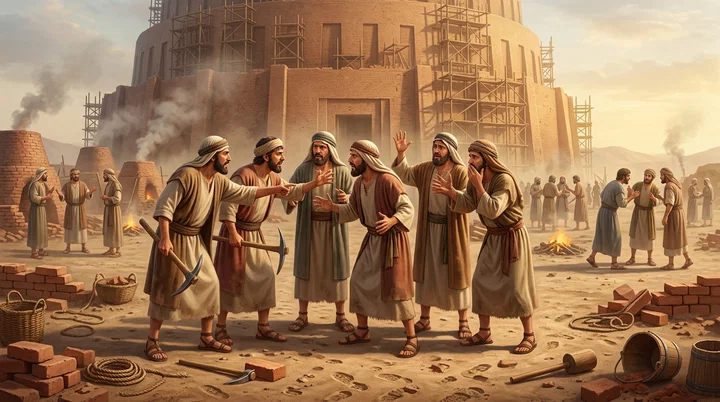
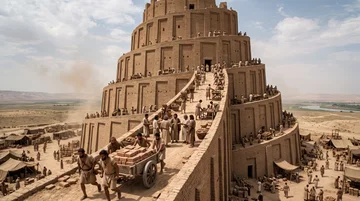
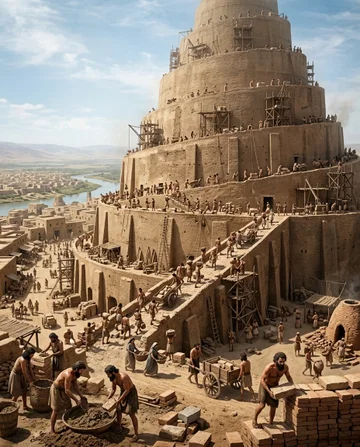
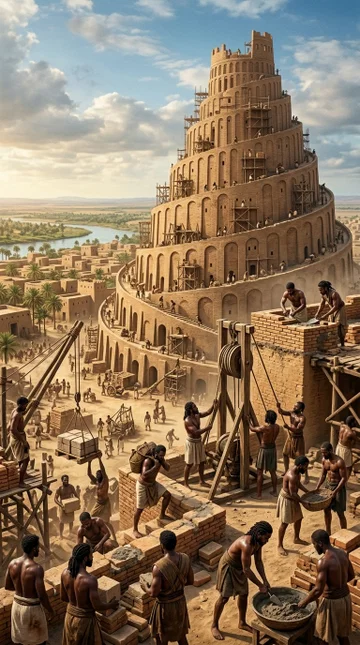
And they said, Go to, let us build us a city and a tower, whose top may reach unto heaven; and let us make us a name, lest we be scattered abroad upon the face of the whole earth.
Translations
And they said, Go to, let us build us a city and a tower, whose top may reach to heaven; and let us make us a name, lest we be scattered abroad on the face of the whole earth.
King James Version, KJV Cambridge Paragraph Bible
And they said, Go to, let us build us a city and a tower, whose top may reach unto heaven; and let us make us a name, lest we be scattered abroad upon the face of the whole earth.
And they said, come, let us build us a city, and a tower, whose top may reach to heaven; and let us make us a name, lest we should be scattered abroad upon the face of the whole earth.
And they said, Go to, let us build us a city, and a tower, whose top may reach unto heaven, and let us make us a name; lest we be scattered abroad upon the face of the whole earth.
And they said, Come, let us build us a city, and a tower, whose top may reach unto heaven, and let us make us a name; lest we be scattered abroad upon the face of the whole earth.
And they say, 'Give help, let us build for ourselves a city and tower, and its head in the heavens, and make for ourselves a name, lest we be scattered over the face of all the earth.'
And they said, Come on, let us build ourselves a city and a tower, the top of which [ may reach] to the heavens; and let us make ourselves a name, lest we be scattered over the face of the whole earth.
And they said Come on! let us build for ourselves a city, and a tower with its head in the heavens, so let us make for ourselves a name,—lest we be scattered abroad over the face of all the earth.
Berean Standard Bible, Majority Standard Bible
“ Come,” they said, “let us build for ourselves a city with a tower that reaches to the heavens, that we may make a name for ourselves and not be scattered over the face of all the earth.”
They said, “ Come, let’s build ourselves a city, and a tower whose top reaches to the sky, and let’s make a name for ourselves, lest we be scattered abroad on the surface of the whole earth.”
And they said, Come, let us make a town, and a tower whose top will go up as high as heaven; and let us make a great name for ourselves, so that we may not be wanderers over the face of the earth.
Also they said, Goe to, let vs builde vs a citie and a towre, whose top may reache vnto the heauen, that we may get vs a name, lest we be scattered vpon the whole earth.
Douay-Rheims (Challoner revision)
And they said: Come, let us make a city and a tower, the top whereof may reach to heaven: and let us make our name famous before we be scattered abroad into all lands.
Pictures
Cross-references 20 of 34
- Genesis 10:10
And the beginning of his kingdom was Babel, and Erech, and Accad, and Calneh, in the land of Shinar.
Names Babel as the beginning of Nimrod’s kingdom.
- Genesis 9:1
And God blessed Noah and his sons, and said unto them, Be fruitful, and multiply, and replenish the earth.
God commanded Noah’s descendants to fill the earth, contrary to the builders’ plan to avoid dispersal.
- Genesis 11:9
Therefore is the name of it called Babel; because the LORD did there confound the language of all the earth: and from thence did the LORD scatter them abroad upon the face of all the earth.
God confounds their language, scatters them, and the city is named Babel.
- Revelation 18:1-2
And after these things I saw another angel come down from heaven, having great power; and the earth was lightened with his glory.
Declares the fall of the later Babylonian power that began at Babel.
- Isaiah 14:13-14
For thou hast said in thine heart, I will ascend into heaven, I will exalt my throne above the stars of God: I will sit also upon the mount of the congregation, in the sides of the north:
The tower builders’ ambition parallels Lucifer’s desire to exalt himself above God.
- Revelation 17:5
And upon her forehead was a name written, MYSTERY, BABYLON THE GREAT, THE MOTHER OF HARLOTS AND ABOMINATIONS OF THE EARTH.
Babylon’s name links ancient Babel with the enduring mother of harlots.
- Daniel 4:30
The king spake, and said, Is not this great Babylon, that I have built for the house of the kingdom by the might of my power, and for the honour of my majesty?
Nebuchadnezzar’s boast over Babylon reflects the builders’ self-exalting spirit.
- Revelation 14:8
And there followed another angel, saying, Babylon is fallen, is fallen, that great city, because she made all nations drink of the wine of the wrath of her fornication.
Babylon’s symbolic rebellion and confusion are traced to Babel.
- Genesis 1:28
And God blessed them, and God said unto them, Be fruitful, and multiply, and replenish the earth, and subdue it: and have dominion over the fish of the sea, and over the fowl of the air, and over every living thing that moveth upon the earth.
The builders refuse God’s command to fill and disperse across the earth.
- Genesis 11:8
So the LORD scattered them abroad from thence upon the face of all the earth: and they left off to build the city.
God scattered the builders and halted their city project.
- Acts 2:4-11
And they were all filled with the Holy Ghost, and began to speak with other tongues, as the Spirit gave them utterance.
Pentecost’s gift of tongues overcomes Babel’s language divisions and scattering.
- Genesis 9:7
And you, be ye fruitful, and multiply; bring forth abundantly in the earth, and multiply therein.
The builders resist God’s command to multiply and spread across the earth.
- Genesis 28:12
And he dreamed, and behold a ladder set up on the earth, and the top of it reached to heaven: and behold the angels of God ascending and descending on it.
Jacob’s ladder connects heaven and earth, unlike Babel’s tower built to reach heaven.
- Revelation 18:7-8
How much she hath glorified herself, and lived deliciously, so much torment and sorrow give her: for she saith in her heart, I sit a queen, and am no widow, and shall see no sorrow.
Babylon’s boast and judgment echo the builders’ ambition and punishment.
- Jeremiah 51:37
And Babylon shall become heaps, a dwellingplace for dragons, an astonishment, and an hissing, without an inhabitant.
Babylon is prophesied to become heaps and desolate.
- Isaiah 14:4
That thou shalt take up this proverb against the king of Babylon, and say, How hath the oppressor ceased! the golden city ceased!
The king of Babylon’s pride reflects Babel’s self-exaltation.
- Revelation 18:4
And I heard another voice from heaven, saying, Come out of her, my people, that ye be not partakers of her sins, and that ye receive not of her plagues.
Calls God’s people to leave Babylon.
- Psalms 115:1
Not unto us, O LORD, not unto us, but unto thy name give glory, for thy mercy, and for thy truth’s sake.
It directs glory to God, contrasting the builders’ wish to make a name for themselves.
- Zechariah 5:11
And he said unto me, To build it an house in the land of Shinar: and it shall be established, and set there upon her own base.
Both texts place their building in Shinar.
- Daniel 1:2
And the Lord gave Jehoiakim king of Judah into his hand, with part of the vessels of the house of God: which he carried into the land of Shinar to the house of his god; and he brought the vessels into the treasure house of his god.
Daniel places the vessels carried to Babylon in the land of Shinar.
Commentary part 1 of 2
Each commentary is drawn from primary sources: the writings of Ellen G. White and Adventist pioneers and periodicals. Each commentary is separate. Its own words are not a quotation; follow the references to read the source passages.
Ellen G. White
27 sources
The builders were apostate descendants of Noah who left His worshipers for the plain of Shinar, where in defiance of His direction to disperse and replenish the earth they determined to stay united in one body and build a city to prevent being scattered abroad.SG3 96.28MR 42.1Ms 94a, 1903, par. 1–2Ms 94, 1903, par. 1–3 By making themselves a name they sought fame and admiration through a tower of stupendous height to be the wonder of the world, a monument to their power and wisdom that would make them illustrious and let them rule over others.SG3 96.2ST Mar 20, 18791SP 91.2–92.1 The tower was planned for independence from God, built so high and massive that no flood could reach or sweep it away, expressing unbelief in His covenant, pride and rebellion urged on by the first great rebel, while part of it was furnished for idols to turn minds from God to idolatry.SG3 96.2ST Mar 20, 1879SG3 97.18T 213.2–215.1 God stopped the heaven-daring confederacy by sending angels to confound speech so cooperation ended in confusion and strife, breaking off its upper portion by lightnings from heaven and scattering the builders across the earth.SG3 97.1PP 119.2Lt 232, 1903, par. 8–9 The scattering teaches that His people are to spread throughout the world rather than centralize for security and greatness, while tower-building continues when professed Christians exalt human wisdom above His word in lawless creeds and self-chosen enterprises to make a name, whose confusion is Babylon.8T 213.2–215.1Ms 200, 1899, par. 9PP 124.1Ms 165, 1902, par. 15
Builders' Defiant Plan
The builders were apostate descendants of Noah who, as their numbers increased, divided from the worshipers of God through a deliberate turning away from Him and from faith in the coming Redeemer.8MR 42.1Ms 94a, 1903, par. 1–2Ms 94, 1903, par. 1–3 Desiring to forget their Creator and to cast off the restraint of His law, they separated from His faithful followers and journeyed to the plain of Shinar on the banks of the Euphrates.8MR 42.1Ms 94a, 1903, par. 1–2Ms 94, 1903, par. 1–3 There they resolved to build a city with a tower whose top might reach unto heaven.8MR 42.1Ms 94a, 1903, par. 1–2Ms 94, 1903, par. 1–3
Their resolve was direct defiance of God's direction to disperse throughout the earth to replenish and subdue it.Ms 94a, 1903, par. 1–2PP 118.5 They determined instead to keep their community united in one body in a city and to prevent being scattered abroad in colonies.ST Mar 20, 1879SG3 97.11SP 91.2–92.1Ms 94a, 1903, par. 1–2PP 118.5 The city was to be the metropolis of a universal empire, for they intended to found a monarchy that would eventually embrace the whole earth.Ms 94a, 1903, par. 1–2PP 118.5
By making themselves a name they sought fame, honor, admiration and homage from the world.SG3 96.2ST Mar 20, 18791SP 91.2–92.1PP 118.5 The tower was to be of stupendous height, the wonder of the world, a monument to the power and wisdom of its builders.Ms 94a, 1903, par. 1–2PP 118.5Lt 232, 1903, par. 8–9 It would make the founders illustrious and perpetuate their fame to the latest generations, while exalting them as gods and enabling them to rule over others.SG3 96.2ST Mar 20, 18791SP 91.2–92.1PP 118.5
The tower was planned for self-protection and independence from God, made so high that no flood could rise to its top and so massive that nothing could sweep it away.8MR 42.1Ms 94a, 1903, par. 1–2Ms 94, 1903, par. 1–3Lt 232, 1903, par. 8–9 It was to rise far above the waters reached by the Flood, reaching even to the clouds, so that if the earth were flooded again they would be beyond danger and would not need to trust to any boat like the ark.SG3 96.21SP 91.2–92.1CE 208.2PP 119.1 The whole undertaking expressed unbelief, rebellion and pride, for it defied God's promise and covenant that He would not again bring a flood upon the earth.CE 208.2PP 119.1
Many denied God's existence and explained the Flood by natural causes, while others who believed a supreme being had destroyed the antediluvian world rebelled against Him with hearts like Cain's.PP 119.1 They also meant to ascend to the region of the clouds to discover the cause of the Flood and the reasons for it.SG3 96.2ST Mar 20, 1879CE 208.2Lt 232, 1903, par. 8–9PP 119.1
The undertaking was meant to exalt the pride of its projectors and to turn minds, including future generations, from God to idolatry.SG3 96.21SP 91.2–92.1CE 208.2Lt 232, 1903, par. 8–9PP 119.1 Part of the tower was made a dwelling for the builders and part splendid apartments furnished and adorned for idols, where the people rejoiced and praised gods of silver and gold against the Ruler of heaven and earth.ST Mar 20, 1879PP 119.2 They corrupted the sacrificial system, having no faith in the coming Redeemer but sacrificing to gods of their own choosing, offering animals and even human beings to idols to gain favor, prosperity and national wealth.PP 119.2
The project was a united, heaven-daring confederacy born of rebellion against God to thwart His purposes and carry out their own purposes, refusing and heeding not the counsel of the Lord.SG3 97.1Ms 94, 1903, par. 1–3Ms 94a, 1903, par. 3–48MR 42.2 It was established for self-exaltation and not for the glory of God, with determined men inspired and urged on by the first great rebel permitting nothing to interfere or stop their evil course.8T 213.2–215.1Ms 94, 1903, par. 1–38MR 42.3 The great majority were fully united in this proud, rebellious idol-building.Ms 94, 1903, par. 1–3ST Mar 20, 1879
Had they been permitted to go on unchecked and succeed, they would have demoralized the world by their wonderful plans.Ms 94, 1903, par. 1–3Ms 94a, 1903, par. 3–48MR 42.2 A mighty power would have borne sway, banishing righteousness and inaugurating a new religion that mixed certain religious ideas with a mass of erroneous theories.Ms 94, 1903, par. 1–38MR 42.3Ms 94a, 1903, par. 3–4 Carried out and perfected, their plans would have banished knowledge of Jehovah's holy, just and good law from minds that felt no need to obey the divine statutes, substituting in place of the divine precepts laws framed according to the desires of selfish hearts to carry out their purposes, and closing the door to peace, happiness and security.Ms 94, 1903, par. 1–38MR 42.3Ms 94a, 1903, par. 3–4
Among the builders were some God-fearing men who had been deceived by the pretensions of the ungodly and drawn into their schemes by wonderful representations and a grand outlook.Ms 94, 1903, par. 1–38MR 42.2 But they refused to join the confederacy and would not be deceived.Ms 94, 1903, par. 1–38MR 42.2 For the sake of these faithful ones God delayed His judgments and gave the people time to reveal their true character.8MR 42.2
Divine Judgment and Scattering
God halted the defiant building project by sending angels to frustrate its purpose, confounding the builders' speech so the work stopped, the tower was abandoned, and the people were scattered abroad over the earth.SG3 97.1PP 119.2ST Mar 20, 1879Ms 200, 1899, par. 9 The confusion of tongues quenched an ambitious human movement for self-security apart from God, teaching that such movements gain nothing but confusion.Ms 200, 1899, par. 9Lt 232, 1903, par. 8–9 Their united idol-building to resist His purposes was thus brought to nothing and they were dispersed.ST Mar 20, 1879Lt 232, 1903, par. 8–9
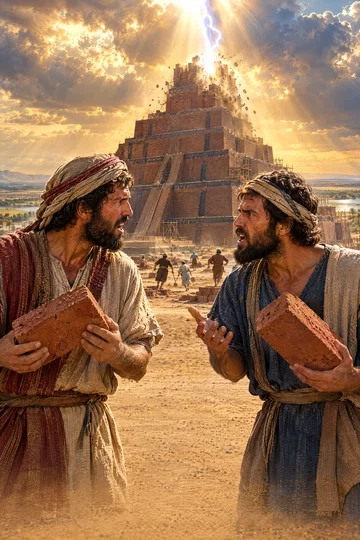
Because the tower was so lofty, commands had to pass through men stationed at different points between top and base.PP 119.2Lt 232, 1903, par. 8–9 When language was confounded, material that was not needed was called for and directions were reversed.PP 119.2Lt 232, 1903, par. 8–9 Confusion and dismay stopped all work and ended harmony and cooperation.PP 119.2Lt 232, 1903, par. 8–9 In rage and disappointment the builders reproached one another until their confederacy ended in strife and bloodshed.PP 119.2Lt 232, 1903, par. 8–9
Lightnings from heaven, as evidence of divine displeasure, broke off the upper portion of the tower and cast it to the ground.PP 119.2Lt 232, 1903, par. 8–9 This was to make men feel that there is a God who rules in the heavens.PP 119.2Lt 232, 1903, par. 8–9 He is able to confuse and to multiply confusion in order to teach men that they are only men.Lt 232, 1903, par. 8–9
The barrier of language that divides people originated in sin in this setting at Babel, where men sought to build a city and tower and keep themselves together rather than be scattered.HSFM 225.5 That origin points to the hope of a time when nothing will prevent people from communicating with one another.HSFM 225.5
Nineveh was founded about the time of the dispersion from the tower of Babel, whose builders had sought to establish a city and tower, make a name for themselves, and prevent scattering.RH Dec 4, 1913
Warnings for Later Generations
The scattering that broke up the proud, rebellious plan to build a city and a lofty tower teaches that God's people are to spread throughout the world rather than gather in one place, carrying the gospel to others. That original joining together in Shinar to remain united and make a name sought security from another flood and independence from God, serving self-exaltation and rebellion against God's law rather than God's glory.8T 213.2–215.1 Seeking security and greatness apart from God by centralizing repeats the same resistance to His purposes that He stopped by confounding language and scattering the builders across the earth.8T 213.2–215.1
Tower-building continues when professedly Christian people turn away from the plain teachings of the Bible and build up a creed from human speculations and pleasing fables, pointing to their tower as a way to climb up to heaven.PP 124.1 The tower in that sense means salvation taught without obedience to the law of God, and the claim that the transgressor shall not die.PP 124.1 Exalting human wisdom above God's holy word destroys unity and brings divisions and dissension, and the existing confusion of conflicting creeds and sects is Babylon, which prophecy applies to the world-loving churches of the last days.PP 124.1
Building a tower also pictures men who have stood in the light of truth failing to search and understand the Scriptures and instead following their own inventions until the mind becomes perverted and spiritual perception is clouded.Lt 93, 1900, par. 1016MR 17.4 Making a name in this way means self-exaltation, and building the tower means carrying on a self-chosen and self-supported enterprise they are determined to finish, going to warfare at their own charges apart from God.Lt 93, 1900, par. 1016MR 17.4 In pursuing it they become a means of tempting others and tear down what they once built up in order to complete their own work.Lt 93, 1900, par. 1016MR 17.4 The decision after the Flood to build a tower reaching to heaven came because its builders would not trust to any boat like the ark that had been built, and though the planning showed wonderful talent, the project was an ambitious human movement for self-security apart from God that the Lord quenched with confusion of tongues to teach that such movements gain nothing but confusion.Ms 200, 1899, par. 9 When people will not walk in the ample light God gives on the way each one should travel, a spirit takes possession of them that makes them think they must do something unusual to call attention to the great things they can do, and the Lord leaves them to themselves to do their wonderful works.Ms 165, 1902, par. 1518MR 177.4 Ample light shines on the pathway of the righteous, but many do not walk in this light, and their self-exalting building up of towers to make a name and finish what they are determined to finish is a farce.Ms 165, 1902, par. 1518MR 177.4Lt 93, 1900, par. 10
The ambition to build high and make a name for oneself repeats itself in building greatly and proudly for selfish gain, in great mansions and lofty buildings built to glorify their owners, and in men and women in the cities of America erecting buildings whose towers reach high into the heavens.9T 12.1–13.2Ms 154, 1902, par. 2 Their minds are filled with schemes and ambitious devisings and they are becoming more and more entangled in business relations, acting wildly, and this condition is transgression and sin.Ms 154, 1902, par. 2 Such heights, defenses, and wealth sought for selfish gain are foolish and sinful, cannot keep doom away or make earthly wealth lasting, and cannot protect from God's judgment, especially when the wealth used for them has been gained by oppressing the poor.9T 12.1–13.2 Human plans for greatness apart from glorifying God cannot stand, for when His appointed time comes even buildings thought fireproof can be destroyed, and this calls for God's ministering servants to proclaim His encouraging message of mercy by crying aloud and lifting up the voice like a trumpet.9T 12.1–13.2Ms 154, 1902, par. 2
Sources
Pioneers and periodicals
197 sources
Shortly after the Flood, while humanity was still united in one language on the plain of Shinar, the builders led by Nimrod resolved to build themselves a city and a tower whose top would reach to heaven and make themselves a name so they would not be scattered abroad.ST Jun 20, 1911RH Oct 2, 1855RH Nov 12, 1861RH Sep 8, 1853 This was a direct refusal of God's command given at creation and renewed after the Flood to multiply, spread abroad, replenish the earth and carry His glory everywhere.STST Feb 13, 1907 Their motive was pride and self-exaltation, distrust of God's rainbow promise never again to destroy all flesh by flood, and a desire for security from another flood by their own power, soon bound up with idolatry and independence from God.ST Mar 20, 1879ST Dec 24, 1896RH Feb 4, 1909RH Dec 17, 1861 The city and tower thus express a human way to heaven and perverted plan of salvation by works apart from faith, putting human effort, law and expediency in place of God's grace, Spirit and Word.ST Dec 24, 1896ST Jul 11, 1911RH Aug 15, 1907RH Jul 28, 1904 In goodness and mercy God frustrated the scheme by confusing their language and scattering them abroad by the very union they sought, and the embryo He named Babel or Confusion became the historical root of Babylon and a pattern of end-time religious division and confusion that the gospel of Christ's sacrifice and the gift of tongues at Pentecost reverses.ST Jun 20, 1911ST Jan 2, 1912ST Sep 5, 1911RH Mar 4, 1862
Setting After the Flood
The verse belongs to the first remarkable occurrence after the Flood, when humanity was still united in one language and dwelling on the plain of Shinar in the rich valley of the Tigris and Euphrates, later called Chaldea or Babylonia.RH Nov 12, 1861RH Sep 8, 1853RH Mar 10, 1859ST May 24, 1883ST Nov 23, 1904 About forty-five centuries ago the inhabitants of earth were largely dwellers in western Asia, with the dominant part in that valley just washed by the Deluge.ST Nov 23, 1904RH Jul 28, 1904RH Jul 28, 1904 The event came about a century after the Flood, a little more than a hundred years after it, at the beginning of the 375-year period from B.C. 2247 to B.C. 1872.ST Jan 2, 1912RH Sep 10, 1872ST Nov 23, 1904RH Jul 28, 1904RH Jul 28, 1904 By one reckoning it was only a few years after the Flood, with Babylon founded about 2,232 years before Christ and the tower built about sixteen years after the founding of the city.RH Apr 18, 1871
The enterprise was led by Nimrod, grandson of Ham and great-grandson of Noah, whose name signifies rebellion and who is called the reputed father of the sun god, together with his followers joined under him in defiance of God.ST Mar 6, 1893ST Feb 15, 1883ST May 20, 1913ST Jan 23, 1879 Pagan records describe the builders as giants waging war against the gods, at length dispersed with the edifice beaten down by a great wind.RH Nov 12, 1861 The tower was constructed with burnt bricks and bitumen or slime, and also with sun-baked bricks and sun-dried clay.RH Nov 12, 1861RH Jan 27, 1874ST Oct 10, 1900 It was described as six hundred feet high, and as an unfinished pile of sun-dried clay about one hundred fifty-six feet high when speech was confounded.RH Jul 26, 1864RH Jan 27, 1874 It was a seven-staged tower-temple or ziggurat with each stage for a heavenly body and deity and the god's shrine at the top, later bearing in Nebuchadnezzar's day a gold image valued at $15,575,000.RH Jul 26, 1864RH Sep 21, 1905RH Sep 21, 1905
The builders called their work Bab-il or Bab-ilu, meaning Gate of God or Gate of Heaven, stamping it on the bricks as an opening to felicity and success.ST Jun 20, 1911STST Dec 7, 1904 God called it Babel, meaning Confusion, perpetuated in Greek as Babylon, meaning confusion or mixture.STST Dec 7, 1904RH Sep 8, 1853RH Mar 10, 1859 Their intended Gate of Heaven was thus turned into Babylon, exposing what their work actually was.ST Jun 20, 1911 The tower stands to the south of the mounds of Babylon in Turkish Arabia near Bagdad and the Euphrates, in a land once of grain, fruit, canals and cities, visible for miles.ST Mar 14, 1911ST Feb 20, 1912ST Jan 21, 1913 It is identified with Birs-Nimrod at ancient Borsippa, which has the stronger claim, though another ruin called Babil is also proposed.ST Mar 14, 1911RH Sep 21, 1905 Its remains of crumbling bricks with burnt mountain appearance attest its ruin and stand as a memorial of that ancient undertaking.ST Oct 10, 1900ST Feb 20, 1912ST Jan 21, 1913
The account is true history, not parable, fable, legend or myth, preserved closer to its original than extravagant versions among other peoples.ST Dec 7, 1915ST Feb 27, 1907 It is confirmed by heathen writers and by modern travelers viewing the ruins, by an inscription of the Temple of Bel, and by a broken British Museum tablet recording in substance the lofty tower at Babylon struck down with ruins called Babel and one language divided into different languages.RH Nov 12, 1861ST Dec 7, 1915ST Oct 14, 1908 It is confirmed by the ancient tower at Borsippa with legends of disordered speech and names meaning tower of tongues and tower of dispersion of tribes.ST Oct 9, 1901 It is confirmed by Mexican and Cholula traditions of a giant-built pyramid to reach the clouds, by Aztec traces of creation, flood and confusion, and by primitive traditions worldwide extending to Babel and no further.ST Oct 14, 1908
The chapter stands after the Deluge in chapters 6 to 9 and the peopling by Noah's sons, after the generations traced in Genesis 10 involving length of time for several generations, and before God's dealings with Abraham in chapters 12 to 26.ST Dec 20, 1910STRH Sep 10, 1872 It stands amid the eight generations between Noah and Terah father of Abraham.RH Nov 2, 1869 It also records Shem's generations through whom the Promised Seed would come.ST Dec 20, 1910 Nineveh was founded about the time of the dispersion from the tower.RH Dec 4, 1913
Refusal to Scatter Abroad
God had commanded at creation and again after the Flood to multiply and spread abroad and replenish the earth, to people it and till the soil and live as an agricultural people under vine and fig tree, to carry righteousness and His glory everywhere and to divide into nations, and the builders answered Nay.STST Dec 16, 1903ST Sep 5, 1911RH Dec 17, 1861 Their city and tower to reach heaven and make a name and avoid scattering left God out and defied His purpose, setting man's way of salvation and man's glory against God's way and God's glory.STST Feb 13, 1907 They named their work Bab-il, the gate of God, to mark their own plan to save themselves from another flood He had promised would not come, but God called it Babel, confusion, exposing what it actually was.STST Feb 13, 1907ST Sep 5, 1911 The confounding of tongues that followed revealed its inward working and remains His name for every human attempt to save self, thwart the divine plan, or pervert God's plan.STST Sep 5, 1911 The episode marks the origin of idolatry and the Gentile apostasy, as people turned from God to worship idols.RH Dec 17, 1861
The proposal is recorded as Go to, with let us build a city and a tower whose top may reach unto heaven, and let us make a name, lest we be scattered abroad upon the face of the whole earth.ST Jun 20, 1911RH Oct 2, 1855RH Aug 6, 1908ST Jul 11, 1911 It shows independence of God and refusal to trust His word, expressed in building to reach heaven to make a name and prevent scattering, in opposition to His command to Noah's descendants to fill the earth.RH Oct 2, 1855ST Jan 23, 1896 The repeated we and us express the principle of seeking salvation apart from God, putting human work in place of God's grace and Spirit and exalting the creature above the Creator.ST Jul 11, 1911ST Jan 23, 1896 That same race and spirit still lives, with each person striving to build a tower of wealth or fame or other vanity, and all such building will soon end in confusion called Babel.RH Oct 2, 1855 God scattered them, using the very means by which they intended to stay united.RH Aug 6, 1908
Their aim to remain together and join under one flag as one nation, to concentrate power and secure unity, ease and stability and make themselves arbiters of human destiny, threatened unchecked power and despotism crushing liberty.ST Dec 16, 1903ST Jul 18, 1916ST Mar 3, 1898ST Sep 11, 1901 The city was intended as the capital of a worldwide empire, and the tower as a temple from which a state-controlled heathen religion would be taught and enforced.ST Jul 18, 1916 Their aim to make a name and avoid being scattered was part of a plan for one empire, ruler, capital, and religion.ST Jul 18, 1916 God checked the plan by introducing different languages, which would hinder world empire and allow persecuted worshippers to find refuge in other lands.ST Jul 18, 1916
Gathering sinful people into compact masses for selfish purposes and love of ease opposed God's righteous plans of diffusion.ST Dec 16, 1903ST Aug 8, 1900ST Mar 3, 1898ST Oct 25, 1899 Concentration driven by selfishness and self-centered interest stands against peopling the earth.ST Mar 3, 1898ST Oct 25, 1899RH Dec 7, 1905 Even schemes that seem practical or admirable bring confusion when they depart from God's way, and that confusion leads to destruction.ST Aug 8, 1900 The tower stands as a symbol of concentrated, self-centered effort, warning against churches and institutions clustering around great centers and seeking their own prominence, calling God's people to leave this tower and spread out to carry the gospel to the nations.ST Oct 25, 1899RH Dec 7, 1905ST Dec 15, 1898
The settlement on Shinar became the nucleus of Babylon, which Scripture uses as a symbol of corruption and abominable practices, and the beginning of kingdoms in biblical history.ST May 1, 1907ST Mar 15, 1899 The confusion of tongues marks the beginning of the history of empires traced from that event to the Babylonian captivity.ST Mar 15, 1899ST Feb 11, 1897 The account reveals the circumstances and time when people left Shinar to settle distant lands, including India and China.ST Mar 20, 1893 Because Babel was near the center of Asia, Europe, and Africa, this east-west and north-south settlement after God scattered them supports locating the natural day-line in the broad Pacific, between populated lands, rather than in the Euphrates region.ST Dec 17, 1902
Pride Distrust and Idolatry
The builders sought their own fame, glory, greatness and lasting name, to exalt themselves as gods, rule over others, assert human omnipotence and independence, and cast off reverence for God and trust in His word.RH Oct 2, 1855RH Feb 4, 1909ST Sep 11, 1901 Their plan to build a city and tower to reach heaven and prevent scattering was rebellion against God's plan to spread people over the earth, an effort to stay together, concentrate human power, and make themselves arbiters of human destiny.RH Feb 4, 1909ST Sep 11, 1901ST Oct 16, 1901 That same race and spirit still lives, with each person striving to build a tower of wealth or fame or other vanity, and all such building will soon end in confusion called Babel.RH Oct 2, 1855 Their self-exalting spirit later appeared in Nebuchadnezzar's pride and in Babylon through the ages.
They distrusted God's promise signified by the rainbow and His covenant never again to destroy all flesh by flood, denied the Flood was divine judgment, and sought security from another flood by building higher than the waters had reached.ST Dec 24, 1896ST Apr 8, 1897ST Sep 4, 1907ST Nov 28, 1911 They intended the city and tower to exalt themselves and become a center of worship, make a name, protect themselves from another flood, and keep people from spreading across the earth.ST Dec 24, 1896ST Apr 8, 1897ST Nov 28, 1911 Their Gate of God scheme arose from selfishness and self-salvation and amounted to rebellion against God, though they thought it served a divine purpose, and this was the beginning of earthly Babylon rooted in distrust of God.ST Dec 24, 1896ST Apr 8, 1897ST Sep 4, 1907 Its promised Gate of God or Gate of Heaven became Babel, meaning confusion, and stands as a type of human plans apart from God that bring confusion into His work.ST Apr 8, 1897
They built a refuge and tower of their own making to escape judgment and the consequences of sin in a way and a place God had not prepared, trusting human power instead of the refuge He provided.RH Nov 7, 1912RH Nov 7, 1912ST Jul 20, 1904 Their plan to remain united in one place and make themselves a name opposed God's direction to spread across the earth, and served self-exaltation and rebellion rather than God's glory. They believed a flood could not destroy their tower, and showed strong faith in the enterprise by union of effort and spirit of sacrifice in building.RH Oct 8, 1872 Their construction with bricks and mortar shows they possessed substantial skill and civilization rather than living as primitive savages.RH Dec 6, 1870 Their failure when God demolished the tower with lightnings and scattered them proves all such self-made attempts to find deliverance are vain, and stands as the pattern for people now preparing their own towers and refuge hills before earth's greatest calamity.RH Nov 7, 1912RH Oct 8, 1872ST Jul 20, 1904
By ascending to the region of the clouds they hoped to investigate and explain the Flood as natural phenomenon by science, discover its cause and the secrets of the Almighty, and guard against its return by their own provision.ST Mar 20, 1879RH Aug 15, 1907RH Jul 28, 1904RH Jul 28, 1904ST Mar 10, 1909 They disbelieved God's covenant to send no more flood, many denied the existence of God and attributed the flood to natural causes, and set aside revelation as untrustworthy in favor of their own findings to preserve their own lives by themselves.RH Aug 15, 1907RH Jul 28, 1904RH Jul 28, 1904 Reaching heaven would let them investigate the cause of the flood that had covered the highest mountains and destroyed all except those who trusted God for deliverance, and secure a place of safety if it returned.RH Aug 15, 1907 Pride and unbelief were stamped on every brick, making the tower a monument to self-salvation and righteousness by works.RH Aug 15, 1907 Their Babel project stands as a pattern for human speculation and philosophy that oppose God's word by relying on human plans to seek divine mysteries and protect from catastrophe, and such efforts will end in confusion.RH Aug 26, 1909
The tower was furnished with rooms for idols and intended to draw people away from God into idolatry and sun-worship, and to turn the minds of future generations away from God.ST Mar 20, 1879RH Jul 28, 1904RH Jul 28, 1904 After apostatizing from the true God, separating from His faithful followers, and corrupting sacrifice and Noah's teaching, they made idolatry an instrument of national power bound up with independence from God.RH Dec 17, 1861RH Jul 31, 1866RH Jan 18, 1870 Mankind united in rebellion at Shinar defied God's command to divide humanity into nations, and the episode marks the origin of idolatry and the Gentile apostasy as people turned from God to worship idols.RH Dec 17, 1861 The tower was intended to take God's place as their protection, and God confounded their language in judgment, vindicating the second commandment against idolatry.RH Jan 18, 1870
The tower was an attempt to reach God's dwelling place, whose way was screened from human sight to prevent further futile efforts to escape floods and attacking enemies. Babel exemplifies false religion leading people amiss, in contrast with true religion, which consists in joyfully doing God's words.ST Mar 14, 1911
Human Way of Salvation
The city and tower were a perverted plan of salvation, a human gate to heaven meant to reach the sky, secure salvation, and build a bridge back to lost paradise by human effort apart from simple faith in God.ST Dec 24, 1896ST Jul 11, 1911ST Apr 8, 1897 The builders called their work Bab-il or Bab-ilu, meaning Gate of God or Gate of Heaven, yet God called it Babel, meaning confusion, for all such efforts prove to be confusion.ST Apr 8, 1897 They intended the city and tower to exalt themselves, make a name and center of worship for themselves, protect themselves from another flood, and keep from being scattered and filling the earth as commanded.ST Dec 24, 1896ST Jul 11, 1911ST Apr 8, 1897 Their scheme arose from selfishness and self-salvation and was rebellion against God, though they thought it served a divine purpose, and it became the origin of Babylonian ideas.ST Dec 24, 1896ST Apr 8, 1897
Its repeated we and us show human beings, not God, as the agents of the plan, expressing the principle of seeking salvation and security on earth apart from God.ST Jul 11, 1911ST Nov 23, 1904ST Dec 3, 1896 Their claim that the tower was a gate to heaven put human work in the place of God's grace and Spirit and exalted the creature above the Creator.ST Nov 28, 1911ST Sep 11, 1901 The same pattern puts human laws, traditions and expediency in place of God's law, truth and eternal principles of right, whenever the church turns to the world or sets up human opinions as divine.ST Nov 18, 1897 The name they gave the city expressed what they hoped their rebellious work would achieve, to make their own way to the divine and become arbiters of human destiny.ST Nov 28, 1911ST Sep 11, 1901
By human planning they claimed to force entrance into heaven and control access between earth and heaven as self-appointed gatekeepers with keys, presuming to admit or refuse people, dictate to God, and control destiny and national greatness.ST Sep 4, 1907ST Mar 23, 1915ST Sep 4, 1907RH Mar 12, 1908 They called the tower Bab-il, meaning the gate of God, and imagined that control of this gate would secure the city's and nation's greatness and exalt them over the rest of the world.ST Sep 4, 1907ST Sep 4, 1907ST Nov 8, 1905 Their tower was an act of defiance against the command to scatter abroad, cultivate and replenish the earth, and its promised human gate to heaven became the way of division, defeat and confusion.ST Sep 4, 1907ST Mar 23, 1915RH Mar 12, 1908 The same spirit that stood by self-appointment between man and God at Babel still actuates spiritual Babylon, whose head stands as keeper of the keys where Babel stood, and its judgment will be the same.RH Mar 12, 1908
The project was righteousness by works and self-salvation, with pride and unbelief stamped on every brick, set against salvation and righteousness by faith which come from God.RH Aug 15, 1907RH Jul 28, 1904ST Nov 23, 1904 Only God's power can save souls, and any other plan comes from His age-long enemy who contradicted His word in Eden and inspired the tower of self-salvation that leads to ruin.RH Nov 28, 1907ST Oct 10, 1911 It grew from the germ of Cain's self-invented offering of the fruits of his own labor, reaching full development and perfection at Babel in the claim that man is able to do for himself what God could do for him only through the death of His Son.RH Mar 5, 1914RH Aug 16, 1906 It is kept alive in penances and self-inflicted punishments and in modern teaching that denies the place and work of Christ, declaring man able to liberate and cure himself, root himself in God, and need no Saviour but himself.RH May 16, 1912RH Aug 16, 1906RH Jan 19, 1911
The same self-exalting spirit began with Satan's temptation in Eden to exalt humanity and become divine, and with his attempt to exalt himself in heaven.RH Mar 12, 1908ST Jan 3, 1905RH Jan 19, 1911 Their self-exalting plan followed Lucifer's rebellion and his ambition to establish a rival earthly kingdom and win the loyalty and obedience due to God, as seen when Nimrod pursued a kingdom acknowledging no higher authority.RH Aug 4, 1904 Babel was therefore a monument to rebellion actuated by him, putting man in the place of God to do for himself what none but God can do, discrediting God's Word and trampling underfoot the plan of redemption and all God has done for man.RH May 16, 1912ST Jan 3, 1905RH Jan 19, 1911
Sources