Isaiah 3:22
The changeable suits of apparel, and the mantles, and the wimples, and the crisping pins,
Translations
American King James Version, King James Version
The changeable suits of apparel, and the mantles, and the wimples, and the crisping pins,
The changeable suits of apparel, and the mantles,
And the wimples, and the crisping pins,The changeable suits of apparel, and the mantles, and the wimples, and the crisping-pins,
Revised Version, American Standard Version
the festival robes, and the mantles, and the shawls, and the satchels;
Of the costly apparel, and of the mantles, And of the coverings, and of the purses,
the festival-robes, and the tunics, and the mantles, and the wallets;
the robes, and the over-tunics, and the cloaks and the purses;
Berean Standard Bible, Majority Standard Bible
their festive robes, capes, cloaks, and purses;
the fine robes, the capes, the cloaks, the purses,
The feast-day dresses, and the robes, and the wide skirts, and the handbags,
The costly apparell and the vailes, and the wimples, and the crisping pinnes,
Douay-Rheims (Challoner revision)
And changes of apparel, and short cloaks, and fine linen, and crisping pins,
Pictures
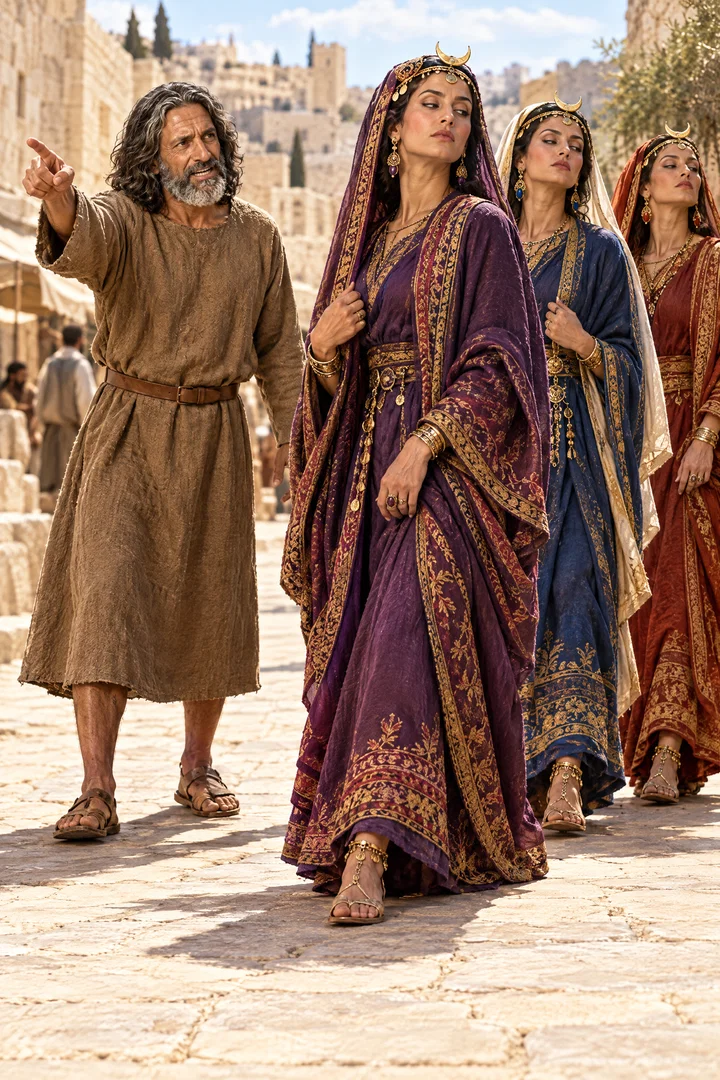
Cross-references
- 1 Peter 3:3-4
Whose adorning let it not be that outward adorning of plaiting the hair, and of wearing of gold, or of putting on of apparel;
Contrasts outward adornment with the beauty of a meek and quiet spirit.
- Isaiah 3:18
In that day the Lord will take away the bravery of their tinkling ornaments about their feet, and their cauls, and their round tires like the moon,
The Lord will remove the women’s adornments as judgment on condemned fashions.
- 1 Timothy 2:9-10
In like manner also, that women adorn themselves in modest apparel, with shamefacedness and sobriety; not with broided hair, or gold, or pearls, or costly array;
Apostolic teaching against costly, ornamental dress.
- Isaiah 4:1
And in that day seven women shall take hold of one man, saying, We will eat our own bread, and wear our own apparel: only let us be called by thy name, to take away our reproach.
Their own apparel continues the daughters’ departure.
Commentary
Each commentary is drawn from primary sources: the writings of Ellen G. White and Adventist pioneers and periodicals. Each commentary is separate. Its own words are not a quotation; follow the references to read the source passages.
Ellen G. White
3 sources
The verse enumerates changeable suits of apparel, mantles, wimples, and crisping pins as items of clothing, ornament, and fashionable garments and accessories for adornment.RH Mar 4, 1915RH Apr 25, 1871PK 306.1–2 These articles were worn by the daughters of Zion, the proud women of Judah, and they show their prevailing pride and love of display and attention to outward appearance.RH Mar 4, 1915RH Apr 25, 1871PK 306.1–2 That love of display existed amid widespread oppression and social corruption.PK 306.1–2
The listing functions as a reproof of that devotion to appearance and display.RH Apr 25, 1871 The prophecy and its reproof applies to the last days.RH Apr 25, 1871
Sources
Pioneers and periodicals
41 sources
The verse names costly and elaborate garments and accessories worn by fashionable women as part of a longer list of prideful finery under judgment.RH Mar 4, 1915RH Aug 21, 1900RH May 19, 1863 It belongs to the reproof of the haughty daughters of Zion for pride, love of display and extravagance in dress, which the Lord said He would take away in punishment.RH Apr 25, 1871RH Jun 16, 1859RH Feb 18, 1915RH Aug 21, 1855RH Aug 11, 1859 Their attention to adornment would be replaced by humiliation, loss, lamentation and mourning.RH Jun 16, 1859RH May 25, 1916RH Apr 21, 1868 The reproof applies to the last days, exposing backsliding in Isaiah's day as a type of last-day apostasy in the professed church.RH Apr 25, 1871ST Sep 22, 1909 In that setting the verse shows that fashionable display is a matter God addresses, calling for plain dress without pride and vanity and for the true ornament of a meek and quiet spirit instead of outward decoration.RH May 21, 1901RH Jan 9, 1900RH May 27, 1915RH Oct 8, 1872
Terms and Historical Setting
The verse catalogues costly, elaborate women's garments, accessories and fashionable finery, naming changeable suits of apparel, mantles, wimples and crisping pins as part of a longer list of luxury and display.RH Mar 4, 1915RH Aug 21, 1900RH May 19, 1863ST May 30, 1911 The changeable suits are the many dresses that fashionable women considered necessary, while wimples and curling pins are items still in common use.RH Apr 28, 1868 The list belongs to the finery and adornment practiced in that day and condemned for pride and luxury.RH Mar 4, 1915RH May 19, 1863RH Jun 20, 1871
The crisping pins were bodkins used to apply eye paint, so that painting the eyes was part of the elaborate adornment of the daughters of Zion along with wimples and other luxury articles.RH Mar 12, 1867 The Septuagint rendering of the list adds the image of transparent dresses.RH Jan 11, 1912 In Scriptural times the general style of dress remained much the same, while fashion was expressed chiefly through more or less elaborate adornment.
One place in the account of judgment in Isaiah 3 does not explain the clothing items named in this verse, leaving them within the prediction of wars that leave men greatly reduced in number.ST Jun 4, 1912 Clothing itself first came after transgression and the loss of innocence, making it a badge of disgrace rather than a proper decoration, so fashionable dress in the verse is evidence of human depravity.
Judgment on Haughty Zion
Isaiah 3:22 belongs to the reproof of the haughty daughters of Zion for pride, love of display, worldly pleasure, and giving their attention to appearance, whose extravagance in costly and elaborate dress is condemned.RH Apr 25, 1871RH Feb 18, 1915RH Aug 11, 1859RH May 25, 1916RH Jun 16, 1859 The apparel and accessories listed are part of that outward display of imitating the world in fashion, pride, and pleasure, set in contrast with being clothed in Christ's righteousness.RH Feb 18, 1915 Such ornamental dress encourages vanity and pride, and when worn by Christian women it can undermine the example set for converts.RH Aug 11, 1859 The warning provides instruction for later generations not to be high-minded, but to fear.RH Jun 16, 1859
The garments and ornaments listed are signs of pride and apostasy, associated with worship of other gods and with Judah's apostasy, and the Lord said He would take them away and punish His professed people.RH Aug 21, 1855RH Jan 11, 1912RH Apr 28, 1868RH Apr 21, 1868 Their extravagant attention to dress would be replaced by humiliation, loss, lamentation and mourning, and sitting desolate upon the ground, with baldness replacing well-set hair.RH Jun 16, 1859RH May 25, 1916RH Apr 21, 1868 That humiliation included being carried captive to Babylon, and the judgment in Isaiah 3 includes predicted wars that leave men greatly reduced in number.RH Jun 16, 1859ST Jun 4, 1912RH Jun 16, 1859
The forsaking of simplicity that brings Zion to lamentation and mourning and sitting desolate upon the ground is closely connected by conjunction to the time when seven women take hold of one man, asking only to be called by his name while eating their own bread and wearing their own apparel.RH Jun 3, 1902 In this prophetic setting Zion and Jerusalem symbolically represent the church nearing judgment for its sins, where the righteous are spared while the wicked suffer.RH Jun 27, 1865
Prophecy for the Last Days
The reproof to the daughters of Zion for attention to appearance and display applies to the last days.RH Apr 25, 1871 The chapter exposes the backsliding of God's people in Isaiah's day, and that condition serves as a type of last-day apostasy.ST Sep 22, 1909
Isaiah 2 and 3 together describe the exaltation of the professed church of the last days and its humbling in the day of the Lord that immediately follows when He arises to shake terribly the earth.RH Mar 18, 1875 The list of clothing and adornment that the Lord will take away when He judges His people is applied to the church in the judgment period, with changeable suits and other ornaments treated as signs of worldly pride and of neglect of the solemn events taking place in heaven.RH Jan 11, 1912 The Septuagint rendering of the list adds the image of transparent dresses.RH Jan 11, 1912 Many changes of apparel and extra trimmings are worldly adornment associated with Babylon and the last days, given as a warning sign against prideful display in dress.RH Dec 17, 1857
The chapter belongs with Isaiah 2 as the description of the day of the Lord of hosts in which the Lord will create upon every dwelling place of Mount Zion and upon her assemblies a cloud and smoke by day and the shining of a flaming fire by night for a defence.RH May 28, 1867 The changeable suits, mantles, wimples, crisping pins and the other fashions and ornaments named in Isaiah 3:16-26 show one part of the departure of the daughters of Zion from the simplicity God designs to characterize His people.RH Jun 3, 1902 Those fashions are prevailing fashions in some portions of the earth today, the nose jewels being as highly regarded by Eastern beauty as the ear jewels by her Western sisters.RH Jun 3, 1902 This forsaking of simplicity brings Zion to lamentation and mourning and sitting desolate upon the ground, closely connected by conjunction to the time when seven women take hold of one man and ask only to be called by his name while eating their own bread and wearing their own apparel.RH Jun 3, 1902
Call to Plain Dress
Among a list of elaborate and changeable articles of women's clothing and adornment associated with divine disapproval of display, the verse shows that fashionable display is a matter God addresses, and it calls for plain dress that avoids pride and vanity in appearance.RH May 21, 1901RH May 27, 1915 It stands as instruction against conforming to worldly styles of dress and using ornamental articles, against following worldly fashions and needless adornment, and especially against immodest styles worn in company with worldly-minded people.RH Oct 25, 1864RH Dec 9, 1858 Its garments and accessories condemn dress vanities and require rejecting excessive trimming and needless adornment as inconsistent with plain, godly dress.RH May 8, 1866
Ornamental articles of dress and jewelry are not fitting adornments for the daughters of Zion, so bracelets, rings, and earrings are to be put away before new members are received into the church.RH Apr 20, 1911 The extravagant, costly fashions condemned in the prophecy of judgment on Jerusalem expose pride and luxury, and when applied to departures from plainness of dress they evidence spiritual decline and warn against wearing fashionable and showy clothing and ornaments.RH Oct 5, 1869RH Jun 20, 1871 Fashionable clothing is to be judged by this list, beside which the reform dress worn by believing women is more acceptable to God than the fashions of the time.RH Aug 4, 1868
Giving up outward adornment marks the putting away of worldliness in accepting the gospel, a sacrifice especially costly where wealth itself is worn as jewelry.RH Dec 4, 1913 Elaborate adornment is vain whether worn by American churchgoers or by those called heathen, and showy outward adornment brought into the house of prayer stands opposed to humility and repentance.ST Dec 9, 1880RH Oct 2, 1855 Clothing worn for display and fashion is therefore distinct from dress chosen for decency, comfort, and convenience.
Pride Heart and Influence
The verse stands as a warning that pride brings loss and humiliation, for the costly garments and mantles and finery named in it would be taken from the haughty daughters of Zion in judgment, and their extravagant attention to dress would be replaced by humiliation and captivity in Babylon.RH Jun 16, 1859RH Aug 21, 1855RH Jun 16, 1859 It teaches against pride and calls not for being high-minded but for fear of God.RH Jun 16, 1859RH Jun 16, 1859 Wearing what God's word forbids advertises disobedience to God and fosters pride through dress.RH Jan 16, 1866 The daughters of Zion described here imitate the world in fashion and pride and pleasure in their apparel and accessories and outward display, in contrast with being clothed in Christ's righteousness.RH Feb 18, 1915
The outward decorations condemned are cheap, superficial adornment, unlike the true ornament of a meek and quiet spirit, which is of great price in God's sight.RH Jan 9, 1900RH Oct 8, 1872 That hidden adorning of the heart, in contrast to outward adorning with plaited hair and gold and fine clothing, belonged to the holy women who trusted in God.RH Oct 8, 1872 The warning applies to men as well as women, and presses seeking meekness and seeking righteousness in order to be hid in the day of the Lord's anger.RH Jan 9, 1900RH Oct 8, 1872 God has given very definite directions about the dress of His followers and never designed them to follow the foolish fashions of the world.RH May 30, 1912
Fashionable worldly apparel is infected with pride and vanity like a garment infected with leprosy.RH May 30, 1912 Wearing it misrepresents the Lord and sows seeds of pride and vanity in weaker believers even when the wearer claims pride is overcome.RH May 30, 1912 In the war between the prince of darkness and the Saviour each army has its uniform, and worldly fashion is the uniform of the enemy, so a marked difference should be seen between the dress of the Christian and the worldling.RH May 30, 1912 Garments infected with pride and vanity should be put away, even burned.RH May 30, 1912 Ornamental dress of elaborate women's garments and accessories, including mantles and wimples and hair ornaments and crisping pins, encourages vanity and pride through showy display.RH Aug 11, 1859RH Jul 8, 1862ST Aug 18, 1909 Such clothing worn by Christian women can undermine the example they set for converts and lead others to imitate costly adornment and resume it.RH Aug 11, 1859RH Jul 8, 1862ST Aug 18, 1909
Training little girls to come before the public for praise plants pride and a praise-seeking love of approbation.ST Oct 6, 1887 Such training robs them of childhood and of the humble, modest, childlike characteristics that belong to those who enter the kingdom of heaven, and replaces artless grace with boldness.ST Oct 6, 1887 Doing this work in connection with a good cause gives no excuse, since the child gains nothing that could not be given in ways free from objection.ST Oct 6, 1887 Delight in shimmering bangles and buckles and bracelets and chains and rings and pins and beads, with costly changes of clothing and mantles and head coverings and ornamental pins, is foolish pride and folly like that of the daughters of Zion who walk mincing and make a tinkling with their feet. It is seen when schoolgirls are dressed like grown women for evening parties in expensive silk and jewelry, walk sedately and feel their vast importance instead of running free in simple gingham, lose childish modesty and simplicity, and talk of parties and gentlemen's company and marrying rich. This vanity is the fruit of foolish training by mothers who demand costly dress and furniture beyond what husbands can afford, and mothers are called to confess their folly, quit fashion, and train daughters in simplicity.
Sources