Isaiah 3:18
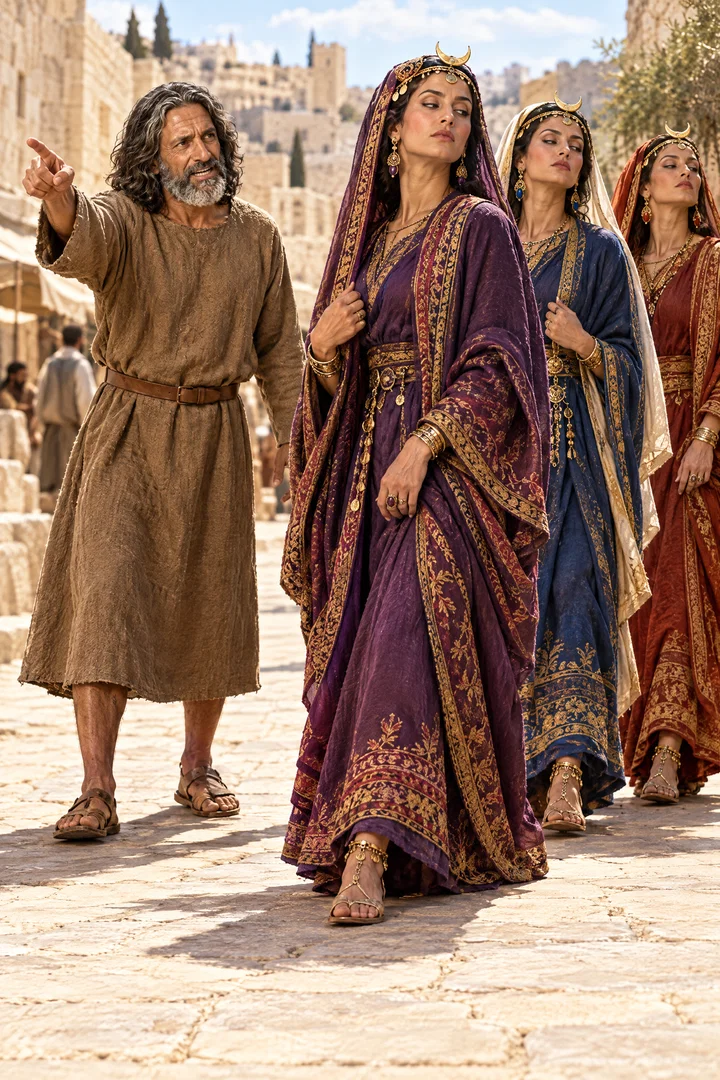
In that day the Lord will take away the bravery of their tinkling ornaments about their feet, and their cauls, and their round tires like the moon,
Translations
American King James Version, King James Version
In that day the Lord will take away the bravery of their tinkling ornaments about their feet, and their cauls, and their round tires like the moon,
In that day the Lord will take away the bravery of their tinkling ornaments about their feet,
And their cauls, and their round tires like the moon,In that day the LORD will take away the show of their tinkling ornaments about their feet, and their cauls, and their round tires like the moon.
In that day the Lord will take away the bravery of their anklets, and the cauls, and the crescents;
In that day the Lord will take away the beauty of their anklets, and the cauls, and the crescents;
In that day doth the Lord turn aside The beauty of the tinkling ornaments, And of the embroidered works, And of the round tires like moons,
In that day the Lord will take away the ornament of anklets, and the little suns and crescents,
In that day, will My Lord remove the finery—of the anklets, and the little suns and the little moons;
Berean Standard Bible, Majority Standard Bible
In that day the Lord will take away their finery:
their anklets and headbands and crescents;In that day the Lord will take away the beauty of their anklets, the headbands, the crescent necklaces,
In that day the Lord will take away the glory of their foot-rings, and their sun-jewels, and their moon-ornaments,
In that day shall the Lord take away the ornament of the slippers, and the calles, and the round tyres,
Douay-Rheims (Challoner revision)
In that day the Lord will take away the ornaments of shoes, and little moons,
Pictures
Cross-references
- Isaiah 4:1
And in that day seven women shall take hold of one man, saying, We will eat our own bread, and wear our own apparel: only let us be called by thy name, to take away our reproach.
The prophecy follows the judgment on Zion’s adornment and shares its “in that day” setting.
- Isaiah 3:24
And it shall come to pass, that instead of sweet smell there shall be stink; and instead of a girdle a rent; and instead of well set hair baldness; and instead of a stomacher a girding of sackcloth; and burning instead of beauty.
Beauty and finery are replaced by signs of humiliation and judgment.
- Isaiah 3:23
The glasses, and the fine linen, and the hoods, and the vails.
Both verses describe adornments the Lord removes.
- Isaiah 4:2
In that day shall the branch of the LORD be beautiful and glorious, and the fruit of the earth shall be excellent and comely for them that are escaped of Israel.
Judgment is followed by a promise of a beautiful and glorious remnant.
Commentary
Each commentary is drawn from primary sources: the writings of Ellen G. White and Adventist pioneers and periodicals. Each commentary is separate. Its own words are not a quotation; follow the references to read the source passages.
Ellen G. White
3 sources
The verse pictures the daughters of Zion making a show of pride by means of conspicuous finery and ornaments.RH Mar 4, 1915 Among these are ornaments that tinkle about the feet, together with other decorative articles worn for display.RH Mar 4, 1915 The Lord's taking away of those ornaments is judgment upon Judah for pride and love of display.PK 306.1–2
The same prophecy reaches to the last days, reproving those who care only about appearance and display.RH Apr 25, 1871 In that latter application the daughters of Zion are still rebuked for making outward appearance their chief concern.RH Apr 25, 1871 Such outward display stands opposed to the beauty God values in a God-fearing woman.RH Mar 4, 1915 Her valued adornment is a meek and quiet spirit rather than conspicuous ornament.RH Mar 4, 1915
Sources
Pioneers and periodicals
47 sources
In that day the Lord strips away tinkling foot ornaments that jingle with an affected gait, decorative hair coverings and nets, and crescent moon-like jewels, beginning a catalogue of costly clothing and sparkling adornment that shows how extravagant display was the principal fashion of the time.RH Apr 28, 1868RH Aug 21, 1866RH Aug 11, 1859ST Aug 18, 1909 It is judgment on the proud and haughty daughters of Zion for conspicuous finery and love of display, bringing humiliation and desolation from which outward luxury cannot protect them, as their later loss of finery in Babylonian captivity illustrates.RH Mar 4, 1915RH Jun 16, 1859RH Jan 11, 1912RH Aug 21, 1855RH Jun 16, 1859 In that day is the day of the Lord of hosts when predicted calamities come, placed in the last days as a warning to God's people, with Zion and Jerusalem symbolizing the professed church in its exaltation and humbling.RH Apr 25, 1871RH Apr 28, 1868RH Jan 11, 1912ST Feb 6, 1901RH Apr 21, 1868 Against showy decoration that is mere gloss beside it stands the true adorning of the hidden heart in a meek and quiet spirit, of great price in God's sight and worn by holy women who trusted in God, in place of plaited hair, gold and put-on apparel.RH Mar 4, 1915RH Jan 9, 1900RH Oct 8, 1872RH Mar 21, 1907 The verse therefore condemns extravagant ornaments, jewelry, artificial hairdressing and immodest worldly fashions and requires plain, modest dress with a marked difference between the Christian and the worldling, since fashionable display sows pride and vanity in others and persists even among professed believers until removed in the day of anger.RH Aug 21, 1900RH May 30, 1912RH Jan 16, 1866RH Oct 5, 1869
Words and Ornaments Described
The tinkling ornaments about the feet were ankle and foot ornaments worn by the proud women of Zion, made to jingle as the wearer walked with an affected mincing gait.RH Apr 28, 1868RH Aug 21, 1866RH Jun 20, 1871 They stood among other fashionable adornments whose removal was foretold as judgment for showy display.RH Apr 28, 1868RH Aug 11, 1859ST Aug 18, 1909 The cauls were decorative coverings for the hair, understood as nets worn in the hair.RH Jun 26, 1860RH Jun 16, 1859RH Apr 21, 1868 They included beaded and spangled hair-nets used to hold artificial hairpieces, and were classed with head ornaments to be set aside as unnecessary fashionable adornment.RH May 8, 1866RH Jun 3, 1902ST Aug 18, 1909RH Apr 21, 1868
The round tires like the moon were crescent-shaped and moon-shaped jewelry.RH Jun 16, 1859RH Aug 21, 1866RH Jun 20, 1871RH Jun 16, 1859 They were identified with hoops, which were raised as an example of clothing whose modesty is questioned and treated as an abomination in the Lord's sight.RH Nov 26, 1861 The same moon-shaped image was also understood to point to broad oversized shapes.RH Nov 26, 1861RH Jun 16, 1859 The word rendered tired was used in the older sense of attired, meaning to dress or arrange the hair, referring to women dressing their hair.
Verse 18 begins a catalogue continued through verses 18-24, and through verse 23 in the shorter reckoning, describing costly clothing, jewelry, and other decorative pieces taken away from the women of Jerusalem.RH Aug 11, 1859ST Aug 18, 1909 The list shows how extravagantly they adorned themselves, with adornment as the principal display of fashion in Scriptural times.RH Jun 16, 1859 The ornaments taken away mean bangles and buckles and bracelets and chains and rings and pins and beads and such shimmering and sparkling things, including elaborate dangling decorations and jewelry.ST Dec 9, 1880
Pride and Historical Judgment
The verse concerns the proud and haughty daughters of Zion, who displayed their pride through conspicuous finery, showy conduct and love of display.RH Mar 4, 1915RH Jun 16, 1859RH Aug 21, 1855ST Oct 6, 1887 Their elaborate adornment, with tinkling ornaments about the feet and other decorative jewelry, was a principal display of fashion and a manifestation of pride.RH Mar 4, 1915 This outward show stands in contrast to the beauty of a God-fearing woman, whose valued adornment is a meek and quiet spirit.RH Mar 4, 1915 The same haughtiness is produced when little girls are brought before the public and taught to listen eagerly for praise and applause, for the love of approbation and praise-seeking thus sown robs them of humble, artless childhood and makes them bold, proud and haughty instead of a type and example of those who enter the kingdom of Heaven.ST Oct 6, 1887
Their elaborate personal adornment shows that the love of finery is not new, belonging to a catalogue of extravagant self-decoration in Isaiah's day.RH May 19, 1863RH Jun 16, 1859 The Lord's taking away of their ankle ornaments, finery and outward luxury is judgment for that pride, bringing humiliation and desolation.RH Jun 16, 1859RH Jan 11, 1912RH Aug 21, 1855 Outward luxury and pride cannot protect people from such judgment.RH Jun 16, 1859 That removal is presented as the Lord's judgment upon display of pride and worldly attachment, identified also with the church.RH Jan 11, 1912 The practice of prideful adornment with gold, trinkets, jewelry and vain ornaments persists even among people professing the final message of mercy until God's judgments bring its removal in the day of His anger.RH Mar 3, 1874RH Dec 29, 1910ST Mar 2, 1882 Outward adornment is thus a sign of pride rooted in the heart, which falls away when a person turns from sin.ST Mar 2, 1882
Their later captivity in Babylon illustrates the calamity, when their finery was soon lost.RH Jun 16, 1859RH Jun 16, 1859 The ornaments were associated with idolatry and apostasy, drawing attention to self rather than pleasing God. The verse sets forth the awful backsliding of that time in Judah.ST May 30, 1911 That reproof of Judah's backsliding in Isaiah 1-5 becomes a type of last-day apostasy.ST May 30, 1911ST Sep 22, 1909
Prophetic Timing and Fulfillment
In that day means the day of the Lord of hosts, the judgment period when the predicted calamities come upon the nations of the earth.RH Jan 11, 1912ST Feb 6, 1901RH Apr 21, 1868 In that judgment period the ornamental adornments of the daughters of Zion will be removed, since they are part of a display of pride and worldly attachment, and their removal is a sign of judgment, including cauls and hair nets worn as fashionable adornments.RH Jan 11, 1912RH Apr 21, 1868 The prophecy is placed in the last days and belongs to a prophecy that applies to the last days, reproving caring only about appearance and display and applying to modern women's styles of dress as a warning to God's people not to indulge in immodest and showy fashion.RH Apr 25, 1871RH Apr 28, 1868 Zion and Jerusalem in this prophecy can symbolize the church under the Christian dispensation, including the professed church of the last days in its exaltation and its humbling in the day of the Lord that comes immediately afterward when He arises to shake terribly the earth, in a prophecy of judgment on a professing people whose sins are reaching their fullness.RH Jan 11, 1912RH Mar 18, 1875RH Jun 27, 1865
That day is when worldly pleasures, pride, and fashions are seen in the pretended daughters of Zion imitating the world, when the tinkling ornaments and finery are taken away.RH Feb 18, 1915 It is the time when the fallen churches care for no consecration except the name and outward form of Christianity so they will not be reproached and called unbelievers, willing to be called by the name of the Son of man while refusing to live by the Word of God and to be clothed with the righteous life of Jesus, choosing instead to be governed by their own theories and traditions and to be clothed with their own righteousness.RH Feb 18, 1915 The rebuke of pride in dress leads directly to lamentation and mourning and desolation of the gates of Zion and to the prophecy of coming judgment and wars that would greatly reduce the number of men, symbolized by seven women taking hold of one man.ST Jun 4, 1912RH Jun 3, 1902RH Mar 18, 1875
The apostatizing conditions described in Isaiah 1-5 become a type of last-day apostasy and fit symbols for the greater days and more important events of the Messianic age, setting forth the awful backsliding of that time in Judah's reproof.ST May 30, 1911ST Sep 22, 1909 Standing in Isaiah 2 and 3 describing the day of the Lord of hosts, the verse is the setting for the promise that the Lord will create upon every dwelling place of Mount Zion and upon her assemblies a cloud and smoke by day and the shining of a flaming fire by night for a defence, showing the Lord leading His people by His Spirit and giving light on their path step by step just as they can bear it and are prepared to practice it.RH May 28, 1867 Together with Isaiah 2-3 the verse is God's own divine commentary on the nations that say peace and fellowship among all religions are coming, showing the character of those false prophets and nations in heaven's light as forsaken because they are filled with customs from the east, are soothsayers like the Philistines, strike hands with the children of strangers, and their land is full of idols worshiped as the work of their own hands.ST Oct 23, 1901
Doctrine of True Adornment
Ornamental dress stands under prophetic rebuke as a badge of disgrace and evidence of depravity. Clothing began after transgression and the loss of innocence, so to wear it for decoration reverses its origin. Elaborate adornment is a manifestation of pride and fashion, with the tinkling ornaments about the feet and other jewelry showing how fashion was principally displayed. God never designed His people to follow the foolish fashions of the world, but requires a marked difference to be seen between the dress of the Christian and that of the worldling.RH May 30, 1912 To wear fashionable apparel like the world disobeys the Lord and misrepresents Him, and sows seeds of pride and vanity in weaker believers like garments infected with leprosy spreading disease.RH May 30, 1912
Outward showy decoration worn by the daughters of Zion is mere gloss and tinsel beside the inward ornament of a meek and quiet spirit.RH Jan 9, 1900 That inward ornament brings light, life, joy and peace, in contrast to conspicuous finery displayed in pride.RH Mar 4, 1915RH Jan 9, 1900 True adorning is the hidden man of the heart in the incorruptible ornament of a meek and quiet spirit, which is of great price in the sight of God and was worn by holy women who trusted in God, as opposed to plaiting the hair and wearing gold and putting on apparel.RH Oct 8, 1872 The beauty valued in a God-fearing woman is that meek and quiet spirit rather than outward finery.RH Mar 4, 1915 Professed Christians are called to seek meekness and seek righteousness that they may be hid in the day of anger when outward finery is taken away.RH Oct 8, 1872
To wear fashionable ornaments in order to be pretty is to bow down to fashion instead of God. For women professing godliness such display is inconsistent with modest apparel worn with shamefacedness and sobriety and with good works. It reverses their good influence upon the world, turning heavenly joy to mourning and giving hell cause to rejoice.RH Mar 21, 1907 Outward adornment with gold and trinkets and foolish ornaments is a sign of pride rooted in the heart, which falls away when a person turns from sin.ST Mar 2, 1882 The same warning rebukes worshippers who come into the house of prayer adorned with jewels and luxurious finery.RH Oct 2, 1855
Practical Application to Dress
The verse condemns extravagant ornaments and fashions and requires plain dress and opposition to jewelry, gold, jewels, trinkets, needless adornment and following immodest worldly fashions, including among the remnant.RH Aug 21, 1900RH Jan 16, 1866RH May 25, 1916RH Oct 25, 1864 Superfluous decorations in dress are contrary to God's word and evidence of disobedience, and contemporary extravagant dress and vain ornaments are evidence of departure from primitive Christian practice rather than advance in piety.RH Jan 16, 1866RH Oct 5, 1869RH Jun 20, 1871 The daughters of Zion's adornments and attire are subject to the Lord's judgment and removal.RH Jun 20, 1871RH May 25, 1916
The moon-shaped ornaments are hoops worn by the daughters of Zion, an abomination in the Lord's sight and an example of clothing whose modesty is questioned.RH Nov 26, 1861 The reference to cauls condemns beaded and spangled hair nets used to hold artificial hairpieces, with nets and coverings worn in the hair, and fashionable hairdressing and wearing ornaments displease God and should give way to plain dress and be set aside.RH May 21, 1901RH May 8, 1866RH Jun 26, 1860RH Apr 21, 1868 Elaborate dangling decorations and jewelry are not made virtuous by wearing them in supposedly civilized society, since they resemble the condemned ornaments.ST Dec 9, 1880 The image of small moon-shaped decorations is applied to oversized hats whose broad shape encroaches on space belonging to others.ST Apr 13, 1915
The warning leads to giving up earrings as an offering to the Lord, for the Lord disapproves of His people decking themselves with ornaments.RH May 27, 1915 Eastern women valuing nose jewels as highly as Western women value ear jewels shows these fashions of foot ornaments, decorative headpieces, crescent-shaped jewelry, nose jewels and ear jewels still prevail today in different portions of the earth, departing from the simplicity God designs to characterize His people.RH Jun 3, 1902 Converts who accept the message willingly put away jewelry and other outward adornments as marks of worldliness even when it is a costly sacrifice for poor believers whose jewelry represents years of work or family savings.RH Dec 4, 1913 Reform dress is contrasted with fashionable dress to show fashionable ornamentation is not acceptable in God's sight.RH Aug 4, 1868
Costly, showy adornment encourages vanity and pride, and the example of Christian women in wearing conspicuous jewelry and ornamental dress can lead others to take up those ornaments again and return to pride and vanity.RH Jul 8, 1862RH Aug 11, 1859ST Aug 18, 1909 Prideful use of jewelry, gold, trinkets, foolish ornaments and vain ornaments persists even among people professing the final message of mercy and professing faith until God's judgments bring its removal in the day of His anger.RH Mar 3, 1874RH Dec 29, 1910ST Mar 2, 1882 Bringing little girls before the public to listen eagerly for praise and applause sows love of approbation and a praise-seeking spirit that robs them of childhood and of the humble, artless characteristics that make children a type of those who enter the kingdom of Heaven, producing instead boldness, pride and haughtiness.ST Oct 6, 1887 Vanity and extravagance in dress, with bangles and buckles and bracelets and chains and rings and pins and beads and such shimmering and sparkling things worn with an affected mincing gait and jingling foot ornaments, is folly that makes girls fashion-fettered, sedate and self-important before their time, fond of fine silk gowns, ribbons, jewelry, parties and attention and hopes of marrying rich, and training by vain mothers in this love of display destroys childish modesty and simplicity.
Sources