Isaiah 39:3
Then came Isaiah the prophet unto king Hezekiah, and said unto him, What said these men? and from whence came they unto thee? And Hezekiah said, They are come from a far country unto me, even from Babylon.
Translations
Then came Isaiah the prophet to king Hezekiah, and said to him, What said these men? and from where came they to you? And Hezekiah said, They are come from a far country to me, even from Babylon.
King James Version, KJV Cambridge Paragraph Bible, Revised Version, American Standard Version
Then came Isaiah the prophet unto king Hezekiah, and said unto him, What said these men? and from whence came they unto thee? And Hezekiah said, They are come from a far country unto me, even from Babylon.
Then came Isaiah the prophet to king Hezekiah, and said to him, What said these men? and from whence came they to thee? and Hezekiah said, They have come to me from a far country, even from Babylon.
And Isaiah the prophet cometh in unto king Hezekiah, and saith unto him, 'What said these men? and whence come they unto thee?' And Hezekiah saith, 'From a land afar off they have come unto me — from Babylon.'
Then came the prophet Isaiah to king Hezekiah, and said to him, What said these men? and from whence came they to thee? And Hezekiah said, They came from a far country to me, from Babylon.
Then came Isaiah the prophet, unto King Hezekiah,—and said unto him—What said these men? and whence came they unto thee? And Hezekiah said, From a land far away, came they unto me, from Babylon!
Berean Standard Bible, Majority Standard Bible
Then the prophet Isaiah went to King Hezekiah and asked, “ Where did those men come from, and what did they say to you?”“ They came to me from a distant land,” Hezekiah replied, “ from Babylon.”
Then Isaiah the prophet came to King Hezekiah, and asked him, “ What did these men say? From where did they come to you?”Hezekiah said, “ They have come from a country far from me, even from Babylon.”
Then Isaiah the prophet came to King Hezekiah, and said to him, What did these men say, and where did they come from? And Hezekiah said, They came from a far country, even from Babylon.
Then came Isaiah the Prophet vnto King Hezekiah, and said vnto him, What said these men? and from whence came they to thee? And Hezekiah saide, They are come from a farre countrey vnto me, from Babel.
Douay-Rheims (Challoner revision)
Then Isaias the prophet came to king Ezechias, and said to him: What said these men, and from whence came they to thee? And Ezechias said: From a far country they came to me, from Babylon.
Pictures
Cross-references
- 2 Kings 20:12-19
At that time Berodach-baladan, the son of Baladan, king of Babylon, sent letters and a present unto Hezekiah: for he had heard that Hezekiah had been sick.
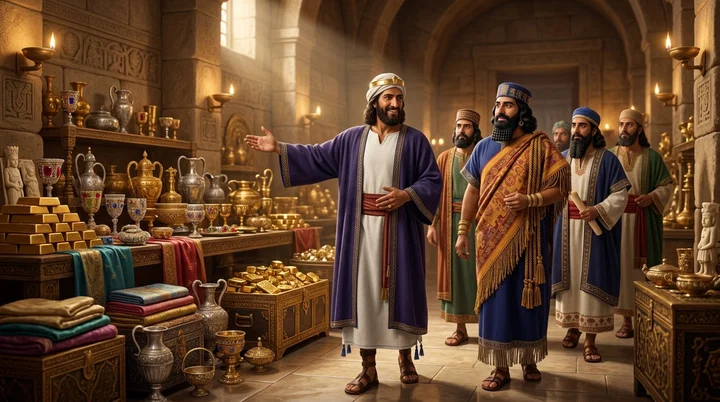
Hezekiah shows Babylon’s envoys his treasures, and Isaiah warns of the resulting captivity.
- 2 Chronicles 32:31
Howbeit in the business of the ambassadors of the princes of Babylon, who sent unto him to enquire of the wonder that was done in the land, God left him, to try him, that he might know all that was in his heart.
Records the visit that led to Isaiah’s warning.
- 2 Chronicles 32:25
But Hezekiah rendered not again according to the benefit done unto him; for his heart was lifted up: therefore there was wrath upon him, and upon Judah and Jerusalem.
Hezekiah’s pride explains his failure to respond rightly to God’s kindness.
- Isaiah 38:7-8
And this shall be a sign unto thee from the LORD, that the LORD will do this thing that he hath spoken;
The sundial sign accompanying Hezekiah’s recovery attracted Babylonian attention.
- 2 Kings 20:8-11
And Hezekiah said unto Isaiah, What shall be the sign that the LORD will heal me, and that I shall go up into the house of the LORD the third day?
The shadow sign accompanied Hezekiah’s recovery and prompted Babylon’s inquiry.
- Daniel 1:1-4
In the third year of the reign of Jehoiakim king of Judah came Nebuchadnezzar king of Babylon unto Jerusalem, and besieged it.
Shows royal descendants taken to Babylon after Jerusalem fell.
- 2 Chronicles 32:26
Notwithstanding Hezekiah humbled himself for the pride of his heart, both he and the inhabitants of Jerusalem, so that the wrath of the LORD came not upon them in the days of Hezekiah.
Hezekiah humbles himself after the events described.
Commentary
Each commentary is drawn from primary sources: the writings of Ellen G. White and Adventist pioneers and periodicals. Each commentary is separate. Its own words are not a quotation; follow the references to read the source passages.
Ellen G. White
11 sources
The prophet came to the king with two questions, what the men had said and from where they had come to him, and the king answered that they had come to him from a far country, even from Babylon.RH May 13, 1915ST Oct 1, 1902Ms 196, 1898, par. 6 The men were Babylonian ambassadors and envoys from a distant country.ST Oct 1, 19024MR 146.210MR 248.1–252.1Ms 123, 1902, par. 9Ms 1, 1853, par. 26–27 They had come after hearing of his recovery to inquire concerning the wonder that God had done.RH May 13, 1915ST Oct 1, 1902
Their coming gave him an opportunity to tell them about God and to honor Him.RH May 13, 1915ST Oct 1, 1902 The episode was a test that revealed what was in his heart.Ms 199, 1899, par. 1–4Ms 199, 1899, par. 5–6 Instead of using it for God, led by pride he showed them his treasures and advantages.RH May 13, 1915ST Oct 1, 1902Ms 199, 1899, par. 1–4Ms 199, 1899, par. 5–6 He showed them the riches of his kingdom and the treasures in God's house, exalting human achievements and leaving God out of view, hoping the display would gain him influence.Ms 199, 1899, par. 1–4Ms 199, 1899, par. 5–64MR 146.2Ms 173, 1902, par. 2410MR 248.1–252.1 Showing the visitors the Lord's riches is like displaying the riches of the Lord's Sanitarium.Ms 199, 1899, par. 1–4
The display began his downfall, for by revealing his possessions he exposed them to Babylon's future plunder and helped prepare the way for Babylon's later seizure of Jerusalem's wealth.ST Oct 1, 1902Ms 197, 1899, par. 5–6 The Babylonians left planning how to take those resources and advantages for themselves.Ms 173, 1902, par. 2410MR 248.1–252.1 To expose God's sacred treasures to enemies was a heinous sin that brought a heavy judgment.Ms 1, 1853, par. 26–27 His disclosure is an example of God's people wrongly exposing their prosperity to an enemy.Ms 196, 1898, par. 6
The setting warns that trusting and forming alliances with unbelievers instead of relying on God can betray sacred trusts, weaken Christian example, and bring harm to others.Ms 197, 1899, par. 5–6 The episode warns against exposing advantages to outsiders without discernment.Ms 173, 1902, par. 24 His mistake in showing the treasures in God's house warns against exposing an institution's private affairs to outsiders.Ms 123, 1902, par. 9 Exposing valuable institutional affairs to outsiders for a promised financial contribution risks harm far greater than the money gained.4MR 146.2 The lesson drawn is that God's people should not disclose the church's private troubles and weaknesses to the wicked.Ms 1, 1853, par. 26–27
Sources
Pioneers and periodicals
19 sources
Isaiah came to Hezekiah asking what the men had said and from where they had come to him, and Hezekiah answered that they had come from a far country, even from Babylon.RH May 13, 1915ST Oct 1, 1902ST Jan 13, 1888 They were Babylonian ambassadors sent by Merodach-baladan, who had heard of his recovery from sickness and the wonder of the sun's shadow turning back, and came with presents to inquire about it.RH May 13, 1915ST Oct 1, 1902ST Jan 13, 1888ST Jun 7, 1910ST Nov 27, 1884 The visit gave him the opportunity to honor God and tell them of His saving power, heavenly gifts and gospel light, but in pride he magnified himself instead of God and displayed his earthly treasures and possessions rather than the Lord's works.RH May 13, 1915ST Oct 1, 1902RH Aug 4, 1904 By so exalting himself he aroused Babylon's greed and prepared the way for the seizure of Jerusalem's wealth, setting the scene for the warning that his treasures and descendants would be taken to serve in the king of Babylon's palace.ST Oct 1, 1902RH Aug 4, 1904ST Jan 13, 1888ST Oct 6, 1909ST Jun 7, 1910 That warning was fulfilled about a hundred years later when Nebuchadnezzar plundered the temple and royal treasures and carried members of the royal family, including Daniel, to Babylon, teaching believers today to use visits to show Christ and tell of God's goodness rather than display worldly possessions.ST Jan 13, 1888ST Jul 22, 1875ST Jul 22, 1875
The Visit Described
Isaiah the prophet came unto King Hezekiah and asked what the men had said and from whence they had come unto him, and Hezekiah answered that they had come from a far country unto him, even from Babylon.RH May 13, 1915ST Oct 1, 1902ST Jan 13, 1888RH Aug 4, 1904ST Jun 18, 1902 The setting is the visit of men from Babylon and Isaiah's questioning of the king about who the visitors were.ST Jan 13, 1888 They were Babylonian ambassadors or envoys, nobles sent by Merodach-baladan, the rebellious ruler of Babylon.ST Oct 1, 1902ST Jun 7, 1910ST Nov 27, 1884ST
They had come after hearing of Hezekiah's recovery from sickness and the wonder God had done for him in the unusual movement of the sun's shadow on the sun-dial, the remarkable sign that had drawn Babylonian attention.RH May 13, 1915ST Oct 1, 1902ST Jan 13, 1888RH Aug 4, 1904 They came with presents and to inquire about the wonder, following God's deliverance of him from danger in battle as well as from sickness.RH May 13, 1915ST Jul 22, 1875ST The setting is Hezekiah's experience after he received fifteen more years of life in answer to prayer, in which he acted very foolishly in backsliding and pride.ST Jun 28, 1905ST Sep 13, 1905 It stands as his sad mistake and an instructive warning that even a good king could err in his dealings with the world.ST Jun 18, 1912 Receiving the envoys was a serious political blunder because it entangled Hezekiah with a rebel against the king of Assyria, and Isaiah was right to rebuke him.ST Nov 27, 1884
Lost Opportunity and Prophecy
The visitors from far-off Babylon had come to inquire about the wonder God had done for Hezekiah in his recovery and in the unusual movement of the sun's shadow on the dial, and their coming gave him an opening to honor God and make known His saving power and heavenly gifts.RH May 13, 1915ST Oct 1, 1902RH Aug 4, 1904 It was an opportunity to tell them of God, of the gift of life, and of gospel light, and to give God glory for his healing and show them the Lord's works.RH May 13, 1915ST Oct 1, 1902RH Aug 4, 1904ST Jun 18, 1902ST Jun 7, 1910 Instead pride led him to magnify himself rather than God, to exalt himself and fail to give God glory for his healing.ST Oct 1, 1902ST Oct 6, 1909ST Jun 18, 1902ST Jun 7, 1910 He displayed to the ambassadors his earthly treasures, wealth, riches, and possessions he had gathered instead of revealing God's heavenly gifts.RH May 13, 1915ST Oct 1, 1902RH Aug 4, 1904ST Oct 6, 1909ST Jun 7, 1910
By thus exalting man and displaying what he had gathered, he aroused the greed and cupidity of the ambassadors.ST Oct 1, 1902ST Jun 7, 1910 That failure helped prepare the way for Babylon's later seizure and plundering of Jerusalem's wealth and for Judah's subjection and despoiling.ST Oct 1, 1902RH Aug 4, 1904ST Jun 7, 1910
The visit from Babylon sets the scene for Isaiah's warning that Judah's treasures and Hezekiah's descendants would later be taken to Babylon to serve in the Babylonian king's palace.ST Jan 13, 1888ST Oct 6, 1909ST Oct 6, 1909 His children would be taken captive to Babylon and Jerusalem would be plundered.ST Jan 13, 1888ST Oct 6, 1909ST Oct 6, 1909
That warning was fulfilled about 106 to 114 years later, roughly a hundred years later, about a century before the calamity was foretold.ST Jan 13, 1888ST Jun 28, 1905ST Jul 13, 1904 Then Nebuchadnezzar captured Jerusalem, took the temple and royal treasures, and brought members of the royal family to serve in his palace.ST Jan 13, 1888 Daniel was a young prince of the royal family who was taken there in fulfillment of that prophecy.ST Jan 13, 1888
Judgment was postponed during Hezekiah's own lifetime, but his backsliding had consequences for his people afterward, when trouble came from Babylon.ST Jun 28, 1905 The people's reformation was temporary and incomplete, and the foretold calamity eventually came.ST Jun 28, 1905ST Jul 13, 1904
Warning for Believers Today
The inquiry about who the visitors were and where they had come from, answered by the statement that they had come from Babylon, belongs to the account of envoys from Babylon who saw the treasures in the house.ST Jul 22, 1875ST Jul 22, 1875 That visit warns that a home can display worldly possessions while failing to show visitors anything of Christ and his glory.ST Jul 22, 1875 The visit followed deliverance from danger in battle and from sickness, and the visitors came with presents and were entertained, yet they were not shown the Lord's works.ST Jul 22, 1875 The question of what they had seen in the house therefore prompts self-examination about whether opportunities with visitors are used to tell of God's goodness.ST Jul 22, 1875
Pride in displaying treasures to Babylon's nobles brought a fearful prophetic message, showing that God's law remains holy and that sin has consequences. The visit had given opportunity to tell of God's saving power, but wealth and possessions were displayed instead.RH May 21, 1908 That focus on material things and self rather than on God and spiritual truth helped bring Jerusalem's future captivity.RH May 21, 1908 What the people would not do willingly as messengers, they would be made to do as captives.RH May 21, 1908
Failure to be true to the trust in dealing with the men come from Babylon makes the king an example to those entrusted with life-saving, reformatory truths that keep people from dying and gather an army for the city of God.RH Nov 12, 1901 Like him, they are come to the kingdom for such a time as this.RH Nov 12, 1901 If like him they hold their peace and are unfaithful to their trust, deliverance will arise from another place while they and their father's house are destroyed.RH Nov 12, 1901 For the Lord will raise up Daniels who will faithfully give the truths the world must have.RH Nov 12, 1901
Sources