Isaiah 39:4
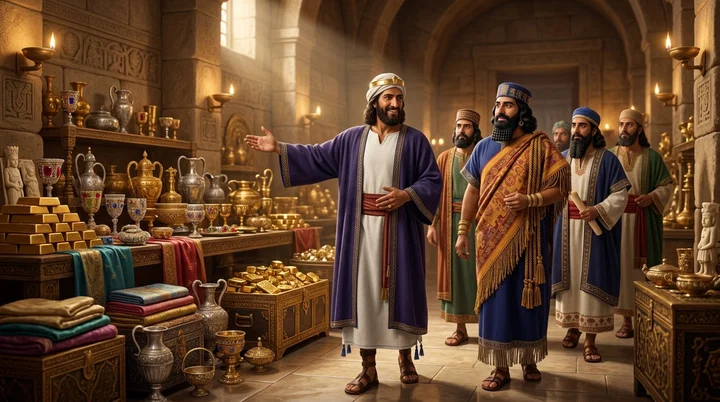
Then said he, What have they seen in thine house? And Hezekiah answered, All that is in mine house have they seen: there is nothing among my treasures that I have not shewed them.
Translations
Then said he, What have they seen in your house? And Hezekiah answered, All that is in my house have they seen: there is nothing among my treasures that I have not showed them.
King James Version, KJV Cambridge Paragraph Bible, Revised Version
Then said he, What have they seen in thine house? And Hezekiah answered, All that is in mine house have they seen: there is nothing among my treasures that I have not shewed them.
Webster Bible, American Standard Version
Then said he, What have they seen in thy house? And Hezekiah answered, All that is in my house have they seen: there is nothing among my treasures that I have not showed them.
And he saith, 'What saw they in thy house?' and Hezekiah saith, 'All that [is] in my house they saw; there hath not been a thing that I have not shewed them among my treasures.'
And he said, What have they seen in thy house? And Hezekiah said, All that is in my house have they seen: there is nothing among my treasures that I have not shewn them.
And he said, What have they seen in thy house? Then said Hezekiah,—All that is in my house, have they seen, there is nothing which I shewed them not among my treasures.
Berean Standard Bible, Majority Standard Bible
“ What have they seen in your palace?” Isaiah asked.“ They have seen everything in my palace,” answered Hezekiah. “ There is nothing among my treasures that I did not show them.”
Then he asked, “ What have they seen in your house?”Hezekiah answered, “ They have seen all that is in my house. There is nothing among my treasures that I have not shown them.”
And he said, What have they seen in your house? And Hezekiah said in answer, They saw everything in my house: there is nothing among my stores which I did not let them see.
Then saide he, What haue they seene in thine house? And Hezekiah answered, All that is in mine house haue they seene: there is nothing among my treasures, that I haue not shewed them.
Douay-Rheims (Challoner revision)
And he said: What saw they in thy house? And Ezechias said: All things that are in my house have they seen, there was not any thing which I have not shewn them in my treasures.
Pictures
Cross-references
- 2 Kings 20:13-15
And Hezekiah hearkened unto them, and shewed them all the house of his precious things, the silver, and the gold, and the spices, and the precious ointment, and all the house of his armour, and all that was found in his treasures: there was nothing in his house, nor in all his dominion, that Hezekiah shewed them not.
Hezekiah shows Babylon’s envoys all his treasures.
- 2 Chronicles 32:31
Howbeit in the business of the ambassadors of the princes of Babylon, who sent unto him to enquire of the wonder that was done in the land, God left him, to try him, that he might know all that was in his heart.
The Babylonian envoys’ visit tested Hezekiah and revealed what was in his heart.
- 2 Chronicles 32:25
But Hezekiah rendered not again according to the benefit done unto him; for his heart was lifted up: therefore there was wrath upon him, and upon Judah and Jerusalem.
Hezekiah displayed his treasures proudly after receiving God’s kindness.
- Isaiah 38:8
Behold, I will bring again the shadow of the degrees, which is gone down in the sun dial of Ahaz, ten degrees backward. So the sun returned ten degrees, by which degrees it was gone down.
The ambassadors had heard of the sun-dial sign that prompted Babylon’s interest.
- 2 Chronicles 32:26
Notwithstanding Hezekiah humbled himself for the pride of his heart, both he and the inhabitants of Jerusalem, so that the wrath of the LORD came not upon them in the days of Hezekiah.
Hezekiah humbled himself over the pride behind his failure, delaying judgment.
- Isaiah 38:1
In those days was Hezekiah sick unto death. And Isaiah the prophet the son of Amoz came unto him, and said unto him, Thus saith the LORD, Set thine house in order: for thou shalt die, and not live.
His illness and recovery led to the Babylonian inquiry.
- 2 Kings 20:8-11
And Hezekiah said unto Isaiah, What shall be the sign that the LORD will heal me, and that I shall go up into the house of the LORD the third day?
Hezekiah’s healing and the backward-moving shadow prompted Babylon’s inquiry.
- Isaiah 38:5
Go, and say to Hezekiah, Thus saith the LORD, the God of David thy father, I have heard thy prayer, I have seen thy tears: behold, I will add unto thy days fifteen years.
God had restored Hezekiah’s life before the ambassadors visited.
- 2 Kings 18:5-6
He trusted in the LORD God of Israel; so that after him was none like him among all the kings of Judah, nor any that were before him.
Hezekiah’s trust and obedience contrast with his failure here.
Commentary
Each commentary is drawn from primary sources: the writings of Ellen G. White and Adventist pioneers and periodicals. Each commentary is separate. Its own words are not a quotation; follow the references to read the source passages.
Ellen G. White
13 sources
Hezekiah openly admitted that he had shown the Babylonian envoys everything in his palace and hidden none of his treasures from them.RH May 13, 1915PK 346.3–347.2ST Oct 1, 1902
Their visit after his healing was a test of his gratitude and a chance to make God known in His power, goodness and compassion, but he failed it by acting from pride and self-exaltation to win their favor and leaving God out of sight.RH May 13, 1915ST Oct 1, 1902Ms 199, 1899, par. 1–4Ms 199, 1899, par. 5–6
To lay open sacred trusts and prosperity to covetous and unsafe confidants instead of trusting God was grave sin and great danger.RH May 13, 1915ST Oct 1, 1902Ms 196, 1898, par. 6Ms 1, 1853, par. 26–27
The completeness of what he let them see foreshadowed the coming judgment that all he prized and had stored up would be carried off and plundered by Babylon.PK 346.3–347.2ST Oct 1, 1902Ms 197, 1899, par. 5–6
The question still probes what visitors see in a home or a God-given institution, whether they are led to Christ and the riches of His grace or are merely impressed by display and material advantage, for unwise exposure to outsiders to gain influence brings harm far beyond any benefit and leaves them planning to take those advantages for themselves.ST Oct 1, 1902Ms 199, 1899, par. 5–64MR 146.210MR 248.1–252.1Ms 173, 1902, par. 24
Hezekiah's Answer and Motive
Hezekiah answered Isaiah's question with a full admission that the Babylonian ambassadors had seen everything in his house, with nothing among his treasures withheld from them.RH May 13, 1915PK 346.3–347.2ST Oct 1, 1902ST Oct 1, 1902Ms 199, 1899, par. 1–4 His reply laid open the extent of the display, that every treasure had been shown to the visitors.RH May 13, 1915PK 346.3–347.2ST Oct 1, 1902ST Oct 1, 1902Ms 199, 1899, par. 5–6
Their coming after his recovery was a test of his gratitude and devotion, and an opportunity to tell them of God's power and goodness and compassion.ST Oct 1, 1902 Mishandled as it was, it revealed failure of judgment and of heart.ST Oct 1, 1902Ms 199, 1899, par. 1–4
Instead of honoring God, his showing of what God had given him sprang from pride and self-exaltation.RH May 13, 1915ST Oct 1, 1902Ms 199, 1899, par. 5–6 God was left out of view while he showed off his wealth, in part to win their favor.RH May 13, 1915ST Oct 1, 1902Ms 199, 1899, par. 5–6Ms 173, 1902, par. 24
Sin, Danger, and Captivity
To admit that nothing among his treasures had been withheld was to confess the showing of sacred things to enemies, and that disclosure was a grave sin that drew a heavy judgment from God.Ms 1, 1853, par. 26–27 It was an imprudent laying open of Jerusalem's riches to the representatives of a powerful nation, men who were not safe confidants on whom to bestow such confidence.RH May 13, 1915ST Oct 1, 1902 Their eyes were covetous eyes, and to spread the treasures before them was to expose what belonged to God to the gaze and desire of outsiders.ST Oct 1, 1902Ms 196, 1898, par. 6 In this the act stands as the sin and danger of exposing God's people and their prosperity to the enemy, betraying a sacred trust by opening oneself to unbelieving allies instead of trusting God.Ms 196, 1898, par. 6Ms 197, 1899, par. 5–6
The fullness of the admission — all that was in the house had been seen — laid bare the extent of what Babylon now knew, and so foreshadowed the prophet's warning that followed.RH May 13, 1915PK 346.3–347.2 That display directed Babylon's interest toward what was prized and helped prepare the way for it to be taken, so that Judah's stored wealth would be carried away to Babylon.PK 346.3–347.2ST Oct 1, 1902 What he valued and exhibited became the object of plunder, for the showing led toward the spoiling of what he prized.ST Oct 1, 1902Ms 197, 1899, par. 5–6
Home and Institutional Applications
The question of what has been seen in the house presses upon every home to examine what visitors carry away from it, whether an impression of divine goodness or only of material display.ST Oct 1, 1902 In hospitality and social life it tests whether guests are led to Christ and to the riches of His grace, or leave remembering chiefly possessions, vanity, entertainment, and worldly concerns.ST Oct 1, 1902 The admission that nothing among the treasures was withheld thus becomes a measure of the home, distinguishing a witness to God from an exhibition of worldly things.ST Oct 1, 1902
The same disclosure stands as a warning against displaying the resources of the Sanitarium and opening its books to outsiders.Ms 199, 1899, par. 5–64MR 146.2Ms 123, 1902, par. 9 To uncover what belongs to God's work before those outside it is a mistake whose harm can far outweigh any financial benefit gained in return.4MR 146.2Ms 123, 1902, par. 9 The money promised after such inspection is small compared with the injury that follows exposure.Ms 123, 1902, par. 9 That act of showing everything entrusted to care repeats the failure of leaving God out of view through pride and self-exaltation.Ms 199, 1899, par. 5–6
Nor does such openness secure lasting influence or goodwill, for visitors shown every advantage may depart planning to take those resources for themselves.10MR 248.1–252.1Ms 173, 1902, par. 24 What was displayed in order to win favor only revealed riches and advantages to those who would then seek to possess them.Ms 173, 1902, par. 24 The verse therefore warns against laying resources and plans open to outsiders without discernment, especially when unbelievers are welcomed into confidence in hope of gaining influence.10MR 248.1–252.1
Sources
Pioneers and periodicals
26 sources
Isaiah asked Hezekiah what the Babylonian envoys who came with presents after his recovery had seen, and he admitted he had held nothing back but had shown them everything in his house and all his treasures.RH May 13, 1915ST Oct 1, 1902ST Jan 13, 1888RH Feb 15, 1870ST Jul 22, 1875 His full display came from pride and self-exaltation rather than a desire to honor God, for instead of telling of the Lord's power, goodness and deliverance he magnified himself and his earthly wealth.RH May 13, 1915RH Feb 2, 1905ST Jul 22, 1875RH Aug 4, 1904ST Oct 6, 1909 The visit was a test of gratitude and a chance to bless Babylon, but by exposing Judah's riches to covetous eyes he stirred greed for that wealth and helped prepare the way for the prophesied carrying away of Jerusalem's treasures and his descendants to Babylon.RH May 13, 1915ST Oct 1, 1902ST Jan 13, 1888ST Oct 6, 1909ST Jun 18, 1902 The same question is a test of hospitality and social life today, pressing every household to consider what guests see and hear and what is shown from its treasure house.ST Oct 1, 1902RH Feb 15, 1870ST Jul 22, 1875 Guests should be led to Christ and the riches of His grace and have attention drawn to God's works and love, rather than leaving impressed mainly by worldly possessions, pleasures and vanity, as when only buildings, fine ornaments and clothing are seen and Jesus is not spoken of.RH Feb 15, 1870ST Jul 22, 1875RH Aug 4, 1904ST Jul 22, 1875
Hezekiah's Admission and Setting
The prophet asked what the visitors had seen in the house, and Hezekiah answered that they had seen all that was in his house and everything among his treasures, with nothing withheld from them.RH May 13, 1915ST Jan 13, 1888RH Feb 15, 1870RH Feb 2, 1905ST Jul 22, 1875 The visitors were Babylonian ambassadors and envoys, to whom he made this complete display of Judah's possessions and wealth.RH May 13, 1915ST Oct 1, 1902ST Jan 13, 1888RH Feb 2, 1905ST Nov 27, 1884 His admission laid bare that foreign visitors had been shown everything without reserve.ST Oct 1, 1902ST Jan 13, 1888RH Feb 15, 1870RH Feb 2, 1905ST Jul 22, 1875
They had come after learning of his recovery from sickness and of the extraordinary change in the sun's shadow connected with it.ST Oct 1, 1902ST Jan 13, 1888 They came with presents, and he entertained them in his house.ST Oct 1, 1902ST Jul 22, 1875 What they were given to see was his wealth and possessions rather than anything else.RH Feb 2, 1905ST Jul 22, 1875
The visit involved Merodach-baladan, a rebel against the king of Nineveh, so receiving his envoys was a political blunder rightly rebuked.ST Oct 1, 1902ST Nov 27, 1884 The visitors were not safe confidants to be trusted with the riches of Jerusalem.ST Oct 1, 1902
Pride, Witness Lost, and Judgment
The open showing of everything in the house and among the treasures, with nothing withheld, came not from a desire to honor God but from pride and self-exaltation.RH May 13, 1915ST Oct 6, 1909ST Oct 6, 1909 The heart was lifted up and set on earthly things, man was exalted, and the display of earthly wealth instead of heaven's treasure and the principles of God's kingdom revealed weakness of character and slavery to sin.RH Aug 4, 1904RH May 21, 1908
Rather than turning the visitors' attention to God's works and glory, the treasures and wealth were put forward, even as tokens of divine favor, in place of telling of the Lord's acts of deliverance and healing.ST Oct 1, 1902RH Feb 2, 1905ST Jul 22, 1875 What was withheld was testimony to God's power, goodness and compassion, to the principles of His kingdom and heaven's treasure, to Christ, to the riches of grace, to the gift of life, and to the gospel message of life and health.RH Aug 4, 1904ST Jun 18, 1902ST Jun 7, 1910 The visit coming after recovery from sickness was a test of gratitude and devotion and an opportunity to bless Babylon, yet the opportunity to proclaim the God who had healed and to bless was turned into a cause of harm.ST Oct 1, 1902ST Jun 18, 1902
By imprudently laying Judah's riches before eyes that were not safe confidants, covetous eyes were fed and Babylon's desire and greed for that wealth were stirred.ST Oct 1, 1902ST Jun 7, 1910ST That exposure helped prepare the way for those very treasures to be carried away and for the kingdom to be plundered.ST Oct 1, 1902ST Jun 7, 1910ST
The disclosure was a great blunder and sad mistake, part of a backsliding whose result was foretold in the prophecy that Jerusalem's treasures would be taken to Babylon and that descendants and children would be taken into captivity to Babylon, with Jerusalem plundered.ST Jan 13, 1888ST Oct 6, 1909ST Oct 6, 1909 The warning came about a century before Judah's calamity, and its fulfillment came about a hundred years later, reckoned as about 106 to 114 years later.ST Jan 13, 1888ST Jun 28, 1905ST Jul 13, 1904 That warning did not lead to thorough and lasting reformation before the people relapsed into apostasy.ST Jul 13, 1904 The foretelling that descendants would be taken to Babylon to serve in the Babylonian king's palace evidently includes Daniel and his companions among those royal descendants.ST Nov 28, 1911
The account stands as admonition that prayer must be joined with complete submission to God's will, since asking for God's will to yield to one's own repeats Hezekiah's error.RH Dec 29, 1868 Pride that displayed treasures to Babylon's nobility drew a severe prophetic warning and penalty, showing that sin against God has fearful consequences. Failure to be true to trust and to willingly carry God's message to other nations sealed Jerusalem's fate, so that the people who would not go willingly would go as captives and Jerusalem's treasures would be carried to Babylon.RH Aug 4, 1904RH May 21, 1908RH Nov 12, 1901 The message of life and health that could have been shared under favorable circumstances was later proclaimed by God's people as captives in Babylon, warning that if those entrusted remain silent God will raise up faithful witnesses.RH Aug 4, 1904RH Nov 12, 1901
What Guests See in Homes
The question put to Hezekiah is a searching test for believers today in hospitality and social life, pressing every person and household to consider what guests see and hear in the home.ST Oct 1, 1902RH Feb 15, 1870ST Jul 22, 1875 It asks what is shown to visitors from one's own treasure house, and whether their attention is directed to God.ST Jul 22, 1875ST Jul 22, 1875ST Oct 1, 1902 The desired answer is that Christ's righteousness is prized and that Jesus' word dwells within so fully that it is shared with others.ST Jul 22, 1875 In this use the inquiry turns Christian witness in the home into a matter of deliberate reflection on what visitors carry away.ST Jul 22, 1875ST Jul 22, 1875
Guests should be led to Christ and the riches of His grace, with attention drawn to God's works, love, goodness and grace.ST Oct 1, 1902RH Feb 15, 1870ST Jul 22, 1875 Christ's righteousness is to be prized, and Jesus' word is to dwell within so richly that it is imparted to those who enter.ST Jul 22, 1875 What is shown should be heaven's treasure and the principles of God's kingdom, and the Lord's acts of deliverance, rather than a display of earthly wealth.ST Jul 22, 1875RH Aug 4, 1904 Visitors should not leave impressed mainly by material things, entertainment, worldly concerns and pleasures, worldly possessions, pursuits that war against the soul, and vanity.ST Oct 1, 1902RH Feb 15, 1870ST Jul 22, 1875 Hezekiah's failure was that he showed his riches as evidence of God's favor but did not reveal Christ, so the test now is whether visitors see Jesus or only buildings and possessions.
A home fails the test when family worship alone appears merely formal because it is overshadowed by worldly interests and conversation.RH Feb 15, 1870 It fails when only buildings and possessions are seen instead of Jesus. It fails when vanity, idleness and worldly possessions are displayed while the better things of faith are not shown and nothing is spoken about Jesus.ST Jul 22, 1875 The modern example is of visitors who saw fine paintings, drawings, jewels and concern with clothing, but were not shown the riches of Christ or the robe of God's righteousness.ST Jul 22, 1875 Such a lost opportunity to witness can even encourage worldly wants, as when the guest's desire for a bracelet followed the display.ST Jul 22, 1875
Sources