Translations
American King James Version, King James Version, Webster Bible
Then said Isaiah to Hezekiah, Hear the word of the LORD of hosts:
Then said Isaiah to Hezekiah, Hear the word of the Lord of hosts:
Then said Isaiah to Hezekiah, Hear the word of the LORD of hosts.
Then said Isaiah to Hezekiah, Hear the word of Jehovah of hosts:
And Isaiah saith unto Hezekiah, 'Hear a word of Jehovah of Hosts:
And Isaiah said to Hezekiah, Hear the word of Jehovah of hosts:
Then said Isaiah unto Hezekiah,—Hear thou the word of Yahweh of hosts:
Berean Standard Bible, Majority Standard Bible
Then Isaiah said to Hezekiah, “ Hear the word of the LORD of Hosts:
Then Isaiah said to Hezekiah, “ Hear the word of the LORD of Armies:
Then said Isaiah to Hezekiah, Give ear to the word of the Lord of armies:
And Isaiah saide to Hezekiah, Heare the worde of the Lord of hostes,
Douay-Rheims (Challoner revision)
And Isaias said to Ezechias: Rear the word of the Lord of hosts.
Pictures
Cross-references
- 2 Chronicles 32:31
Howbeit in the business of the ambassadors of the princes of Babylon, who sent unto him to enquire of the wonder that was done in the land, God left him, to try him, that he might know all that was in his heart.
God left Hezekiah to test his heart during the Babylonian envoys’ visit.
- 2 Kings 20:12-19
At that time Berodach-baladan, the son of Baladan, king of Babylon, sent letters and a present unto Hezekiah: for he had heard that Hezekiah had been sick.
Hezekiah’s display to Babylon’s envoys and Isaiah’s warning form the parallel account.
- Isaiah 38:1-8
In those days was Hezekiah sick unto death. And Isaiah the prophet the son of Amoz came unto him, and said unto him, Thus saith the LORD, Set thine house in order: for thou shalt die, and not live.
Hezekiah’s recovery and added years preceded the ambassadors’ visit.
- 2 Chronicles 32:25-26
But Hezekiah rendered not again according to the benefit done unto him; for his heart was lifted up: therefore there was wrath upon him, and upon Judah and Jerusalem.
Hezekiah’s pride brought the Lord’s wrath, but he humbled himself and the judgment was withheld.
- 2 Kings 20:8-11
And Hezekiah said unto Isaiah, What shall be the sign that the LORD will heal me, and that I shall go up into the house of the LORD the third day?
Hezekiah’s healing is confirmed by the miraculous sign of the returning shadow.
- 2 Kings 20:13
And Hezekiah hearkened unto them, and shewed them all the house of his precious things, the silver, and the gold, and the spices, and the precious ointment, and all the house of his armour, and all that was found in his treasures: there was nothing in his house, nor in all his dominion, that Hezekiah shewed them not.
Both recount Hezekiah displaying all his treasures.
- 2 Kings 24:13
And he carried out thence all the treasures of the house of the LORD, and the treasures of the king’s house, and cut in pieces all the vessels of gold which Solomon king of Israel had made in the temple of the LORD, as the LORD had said.
Nebuchadnezzar carries away Jerusalem’s treasures as foretold.
- Daniel 1:1-2
In the third year of the reign of Jehoiakim king of Judah came Nebuchadnezzar king of Babylon unto Jerusalem, and besieged it.
Babylon’s conquest fulfills the warning of Judah’s exile.
Commentary
Each commentary is drawn from primary sources: the writings of Ellen G. White and Adventist pioneers and periodicals. Each commentary is separate. Its own words are not a quotation; follow the references to read the source passages.
Ellen G. White
12 sources
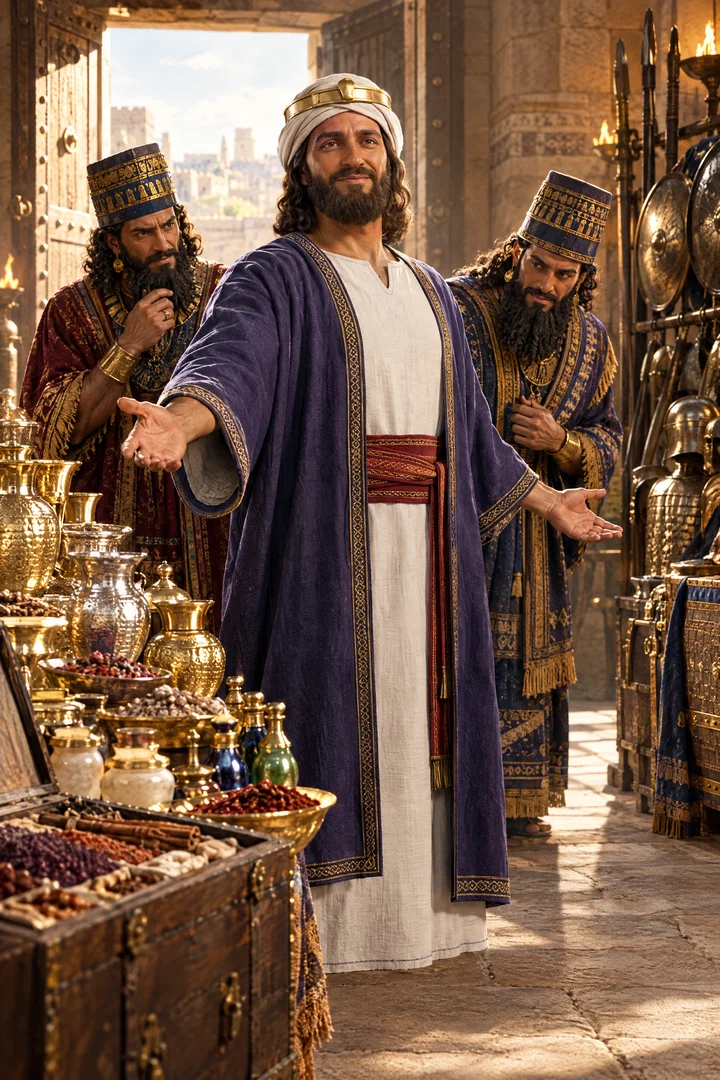
The call to hear the word of the Lord of hosts came through Isaiah to Hezekiah after Hezekiah had shown the Babylonian envoys all the treasures and riches of his house, kingdom, and storehouses.PK 346.3–347.2RH May 13, 1915ST Oct 1, 1902Ms 199, 1899, par. 1–4 It was the introduction to the Lord's judgment upon him for displaying his wealth instead of honoring God.PK 346.3–347.2RH May 13, 1915ST Oct 1, 1902 The episode is presented as a test in which God left Hezekiah to reveal what was in his heart.Ms 199, 1899, par. 1–4Ms 199, 1899, par. 5–6
What followed was the announcement that all the stored wealth of Jerusalem would be carried away to Babylon.PK 346.3–347.2RH May 13, 1915ST Oct 1, 1902 Some of Hezekiah's own descendants would also be taken away to serve in the palace of the king of Babylon.PK 346.3–347.2RH May 13, 1915 For Judah this was a heavy judgment.Ms 1, 1853, par. 26–27
The exposure revealed pride and self-exaltation, the exalting of human achievements in which God was left out.ST Oct 1, 1902Ms 199, 1899, par. 1–4Ms 199, 1899, par. 5–6 Rather than giving God the honor, Hezekiah lifted up himself and what he possessed.ST Oct 1, 1902Ms 199, 1899, par. 1–4 To show the sacred treasures of the temple and of God's house to enemy envoys was a heinous sin and an unwise decision.4MR 146.2Ms 123, 1902, par. 9Ms 1, 1853, par. 26–27
His display was intended to win influence, but it secured none.10MR 248.1–252.1Ms 173, 1902, par. 24 Instead it gave the Babylonians knowledge of what could later be taken and how to plan the seizure of those advantages.10MR 248.1–252.1Ms 173, 1902, par. 24 That indiscretion became a cause of national disaster and of future seizure.ST Oct 1, 190210MR 248.1–252.1Ms 173, 1902, par. 24
The account stands as a warning that God's people sin when they trust in unbelievers and form alliances with them instead of relying fully on God.Ms 197, 1899, par. 5–6 They sin likewise when they disclose their prosperity or their troubles to the enemy and turn from God to seek counsel at false sources.Ms 196, 1898, par. 6 Such a course betrays sacred responsibilities, brings loss of God's favor, and weakens their example to others.Ms 197, 1899, par. 5–6
For institutions and leaders the same warning applies to exposing resources, prosperity, weakness, and private affairs to outsiders for inspection or for money.4MR 146.2Ms 196, 1898, par. 6Ms 123, 1902, par. 9Ms 1, 1853, par. 26–27 It is a serious mistake born of misplaced confidence in the favor of outsiders.10MR 248.1–252.1 It exposes God's people and their resources to danger and can cause harm far greater than any money gained from such inspection.4MR 146.210MR 248.1–252.1 Leaders who disregard God's warnings in this way and expose those in their care to danger are held accountable for the harm that follows to those entrusted to them.Ms 197, 1899, par. 5–6
The same test was applied to Dr. Kellogg after he showed strangers the riches of the Sanitarium.Ms 199, 1899, par. 5–6 He was weighed and found wanting.Ms 199, 1899, par. 5–6 His pride, self-will, and display revealed what was in his heart and led to misguided actions.Ms 199, 1899, par. 5–6
Sources
Pioneers and periodicals
20 sources
Isaiah speaks the message and judgment of the Lord of hosts to Hezekiah after he displayed his treasures, wealth and possessions to the envoys from Babylon.RH May 13, 1915ST Oct 1, 1902RH Jul 6, 1916ST Jan 13, 1888ST May 28, 1912 The word to be heard announces that Jerusalem's stored treasures will be carried to Babylon with nothing left, and that Hezekiah's descendants will be taken to serve as captives in the Babylonian king's palace.RH May 13, 1915ST Jan 13, 1888RH Aug 4, 1904 The rebuke came because after he was healed Hezekiah in pride magnified himself and his earthly riches instead of giving God glory and revealing heavenly principles and saving power to the visitors.ST Oct 1, 1902RH Aug 4, 1904ST Oct 6, 1909ST Jun 7, 1910ST Oct 6, 1909 The warning of Judah's fall into Babylonian hands was given about a hundred years beforehand and was fulfilled about 106 to 114 years later when Nebuchadnezzar captured Jerusalem and took the treasures and royal youths, including Daniel as a young man.ST Jan 13, 1888ST Aug 16, 1905ST Jun 28, 1905 Even a favored king faced consequences for sin, as an instructive lesson on the danger of uniting with the world and failing to share God's message, for those who would not go willingly as messengers would go as captives.RH Aug 4, 1904RH May 21, 1908ST Jun 18, 1912RH Nov 12, 1901
Setting and Occasion
Isaiah 39 belongs to the historical section of Isaiah, chapters 36-39, which records events and messages from Hezekiah's reign.ST May 28, 1912 It stands in the first part of the book, which contains prophecies and historical accounts from Isaiah's active public ministry.RH Jul 6, 1916 The verse marks Isaiah's response to Hezekiah's actions as a message from the Lord.RH Jul 6, 1916 It introduces the word, message, and judgment of the Lord of hosts, spoken by Isaiah to Hezekiah.RH May 13, 1915ST Oct 1, 1902ST Jan 13, 1888RH Aug 4, 1904ST Jan 13, 1888
That word came after Hezekiah showed Babylon's envoys, ambassadors, messengers and visitors his treasures, royal treasures, wealth, and possessions.RH May 13, 1915ST Oct 1, 1902ST Jan 13, 1888RH Aug 4, 1904ST Jan 13, 1888 The visit was an embassy to Merodach-baladan, the rebel king of Babylon.ST Nov 27, 1884 It was a serious political blunder that Isaiah was right to rebuke.ST Nov 27, 1884
After he was healed, Hezekiah failed to give God glory.ST Jun 7, 1910 Instead in pride he magnified himself with a self-exalting display of his earthly riches.ST Oct 6, 1909ST Oct 6, 1909 That display aroused Babylon's greed.ST Jun 7, 1910 Even a favored king faced consequences for such sin and pride.
Instead of honoring God, he failed to reveal heavenly principles and God's saving power to the envoys.ST Oct 1, 1902RH Aug 4, 1904RH May 21, 1908 The account belongs to Hezekiah's foolish conduct during the fifteen years added to his life.ST Sep 13, 1905 In this he is an example of asking for his own desire rather than submitting to God's will, and he backslid.RH Dec 29, 1868ST Jun 28, 1905 The result of his petition and the consequences of his backsliding are preserved as an admonition for future generations.RH Dec 29, 1868ST Jun 28, 1905
Prophecy of Captivity
The word to be heard is a judgment announcing that all the stored wealth, treasures and possessions of Jerusalem will be carried away to Babylon with nothing left, that the city will be plundered, and that sons descended from Hezekiah will be taken to serve as captives in the palace of the king of Babylon.RH May 13, 1915ST Jan 13, 1888RH Aug 4, 1904ST Jan 13, 1888ST Oct 6, 1909 That foretelling to Hezekiah declared that Jerusalem and its people would fall into the hands of the Babylonians.ST Aug 16, 1905
Hezekiah's indiscretion and blunder in displaying his treasures made it a cause of national disaster and helped prepare for Judah's subjection to Babylon.ST Oct 1, 1902RH Aug 4, 1904 His self-exalting display aroused Babylon's greed, and Babylon later plundered the kingdom and led his descendants into captivity.ST Jun 7, 1910 The warning of Judah's coming calamity and fall was given about a hundred years before it arrived.ST Aug 16, 1905ST Jun 28, 1905ST Jul 13, 1904 It was fulfilled about 106 to 114 years later when Nebuchadnezzar captured Jerusalem and took the treasures and the royal youths to Babylon.ST Jan 13, 1888ST
Daniel was among those royal youths, taken to Babylon as a young man in fulfilment of the prophecy that Hezekiah's descendants would serve in the Babylonian king's palace.ST Jan 13, 1888 The warning did not produce lasting, thorough reformation, for Judah afterward returned to rebellion and rejected the Lord's word spoken through Jeremiah.ST Jul 13, 1904
Warning and Application
The word introduced here is a message of judgment delivered after Hezekiah in pride showed his treasures to Babylon's representatives, showing that even a king highly favored by God faces consequences for sin. It comes as a warning after the king's mistake, set within the record of events of his reign.ST Jun 18, 1912 That record stands as an instructive lesson.ST Jun 18, 1912 In particular it is an instructive lesson about the danger of uniting with the world.ST Jun 18, 1912
Hezekiah's failure was a failure to be true to his trust, for instead of revealing God's saving power and heavenly principles to Babylon's messengers and envoys he displayed his own treasures, and that unfaithfulness helped prepare for Judah's subjection to Babylon.RH Aug 4, 1904RH May 21, 1908 The judgment that follows announces that Jerusalem's possessions and wealth will be carried to Babylon with nothing left, because Israel failed to share God's message with other nations.RH May 21, 1908 Those who would not go willingly as messengers would go as captives.RH May 21, 1908 The message Hezekiah did not share with the envoys was later proclaimed in Babylon by the Jewish captives, warning that failing to share needed truth leaves the work to faithful witnesses raised up elsewhere.RH Aug 4, 1904RH Nov 12, 1901
Sources