Isaiah 44:19
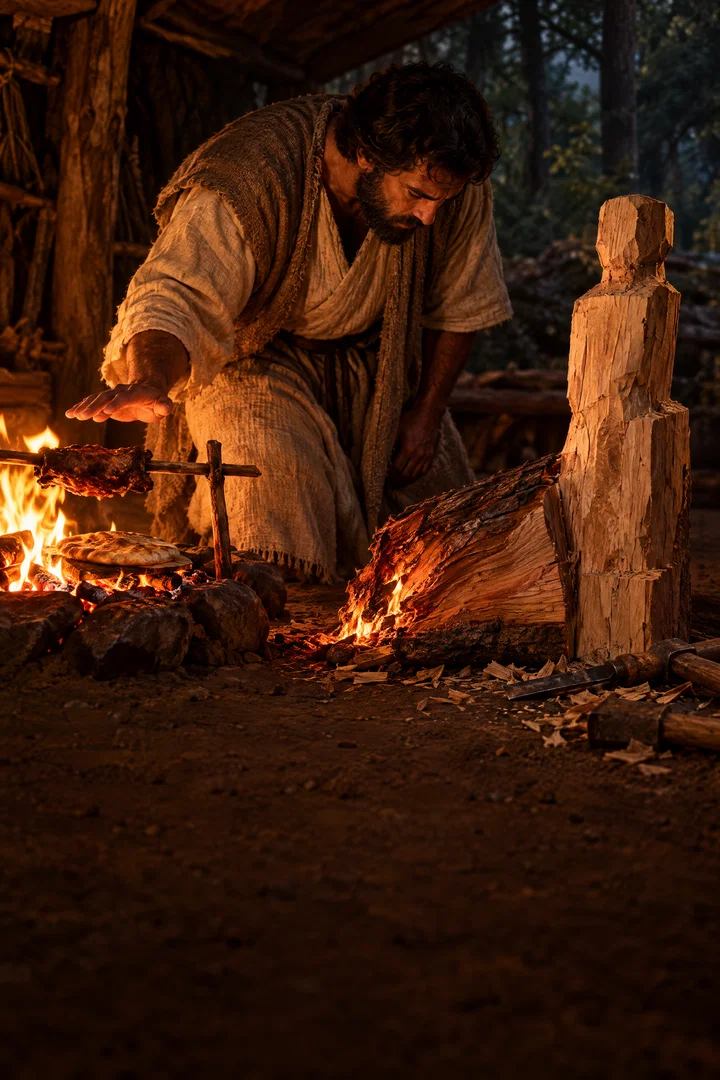
And none considereth in his heart, neither is there knowledge nor understanding to say, I have burned part of it in the fire; yea, also I have baked bread upon the coals thereof; I have roasted flesh, and eaten it: and shall I make the residue thereof an abomination? shall I fall down to the stock of a tree?
Translations
And none considers in his heart, neither is there knowledge nor understanding to say, I have burned part of it in the fire; yes, also I have baked bread on the coals thereof; I have roasted flesh, and eaten it: and shall I make the residue thereof an abomination? shall I fall down to the stock of a tree?
And none considereth in his heart, neither is there knowledge nor understanding to say, I have burned part of it in the fire; yea, also I have baked bread upon the coals thereof; I have roasted flesh, and eaten it: and shall I make the residue thereof an abomination? shall I fall down to the stock of a tree?
And none considereth in his heart,
Neither is there knowledge nor understanding to say,
I have burnt part of it in the fire;
Yea, also I have baked bread upon the coals thereof;
I have roasted flesh, and eaten it:
And shall I make the residue thereof an abomination?
Shall I fall down to the stock of a tree?And none considereth in his heart, neither is there knowledge nor understanding to say, I have burned part of it in the fire; I have also baked bread upon its coals; I have roasted flesh, and eaten it: and shall I make the residue of it an abomination? shall I fall down to the stock of a tree?
Revised Version, American Standard Version
And none calleth to mind, neither is there knowledge nor understanding to say, I have burned part of it in the fire; yea, also I have baked bread upon the coals thereof; I have roasted flesh and eaten it: and shall I make the residue thereof an abomination? shall I fall down to the stock of a tree?
And none doth turn [it] back unto his heart, Nor hath knowledge nor understanding to say, 'Half of it I have burned in the fire, Yea, also, I have baked bread over its coals, I roast flesh and I eat, And its remnant for an abomination I make, To the stock of a tree I fall down.'
And none taketh it to heart, neither is there knowledge nor understanding to say, I have burned part of it in the fire, and have also baked bread upon the coals thereof, I have roasted flesh, and eaten [ it], and with the rest thereof shall I make an abomination? shall I bow down to a block of wood?
And no one reflecteth—There is neither knowledge nor discernment—to say, Half thereof, have I burned up in the fire Moreover also I have baked, on the coals thereof, bread, I roasted flesh, and have been eating,—And of the remainder thereof, an abomination, shall I make? And, to a log of wood, shall I pay adoration?
Berean Standard Bible, Majority Standard Bible
And no one considers in his heart,
no one has the knowledge or insight to say,
“ I burned half of it in the fire,
and I baked bread on its coals;
I roasted meat and I ate.
Shall I make something detestable with the rest of it?
Shall I bow down to a block of wood?”No one thinks,
neither is there knowledge nor understanding to say,
“ I have burned part of it in the fire.
Yes, I have also baked bread on its coals.
I have roasted meat and eaten it.
Shall I make the rest of it into an abomination?
Shall I bow down to a tree trunk?”And no one takes note, no one has enough knowledge or wisdom to say, I have put part of it in the fire, and made bread on it; I have had a meal of the flesh cooked with it: and am I now to make the rest of it into a false god? am I to go down on my face before a bit of wood?
And none considereth in his heart, neither is there knowledge nor vnderstanding to say, I haue burnt halfe of it, euen in the fire, and haue baked bread also vpon the coles thereof: I haue rosted flesh, and eaten it, and shall I make the residue thereof an abomination? shall I bowe to the stocke of a tree?
Douay-Rheims (Challoner revision)
They do not consider in their mind, nor know, nor have the thought to say: I have burnt part of it in the fire, and I have baked bread upon the coals thereof: I have broiled flesh and have eaten, and of the residue thereof shall I make an idol? shall I fall down before the stock of a tree?
Pictures
Cross-references
- Psalms 115:8
They that make them are like unto them; so is every one that trusteth in them.
Both say worshipers become like their idols.
- Jeremiah 10:3-5
For the customs of the people are vain: for one cutteth a tree out of the forest, the work of the hands of the workman, with the axe.
Both describe wooden idols as human-made objects unable to speak or act.
- Isaiah 44:9
They that make a graven image are all of them vanity; and their delectable things shall not profit; and they are their own witnesses; they see not, nor know; that they may be ashamed.
both describe blindness of idol makers
- 1 Corinthians 10:19-20
What say I then? that the idol is any thing, or that which is offered in sacrifice to idols is any thing?
Idolatry involves fellowship with demons behind the idols.
- Romans 1:25
Who changed the truth of God into a lie, and worshipped and served the creature more than the Creator, who is blessed for ever. Amen.
Both describe idolatry as exchanging God’s truth for a lie.
Commentary
Each commentary is drawn from primary sources: the writings of Ellen G. White and Adventist pioneers and periodicals. Each commentary is separate. Its own words are not a quotation; follow the references to read the source passages.
Ellen G. White
2 sources
The chapters in which the verse stands reveal God's purpose for His people.Ms 73, 1907, par. 8–9 In that setting it exposes the folly of treating an idol made by human hands as God.STE 63.3 To fall down before such a workmanship as if it were divine is utter foolishness.STE 63.3
The exposure works by contrast between lifeless idols and the true God as the Maker of heaven and earth.STE 63.3 That contrast teaches that God can be known through His works.STE 63.3 Such knowledge through created things lays a foundation for understanding the spiritual truths of Scripture.STE 63.3 The chapters therefore direct God's people to seek wisdom from Him rather than turning to finite human beings for it.Ms 73, 1907, par. 8–9
Sources
Pioneers and periodicals
20 sources
The verse pictures a man who uses part of a tree for firewood to warm himself and cook his bread and meat, and then fashions what is left into a god and bows down to it without ever stopping to consider in his heart how senseless it is, because he lacks knowledge and understanding.RH Jul 6, 1916ST Aug 29, 1911RH May 6, 1909 What he worships is still only the stock of a tree, an abomination and a vanity that puts a lie in the place of the truth about the one living and true God.RH May 6, 1909ST Jun 25, 1912ST Jul 22, 1875 With scathing irony it exposes such gods as mere manufactured things of wood and stone with no spirit or divine power in them, unable to hear, help, choose, act, or save those who trust in them.ST Apr 22, 1889RH Apr 23, 1901 The same blindness continues wherever men venerate images, whether in heathen lands or under Christian names, and wherever they shape their own teachings and leaders by their own hands and then trust them to guide and deliver them.RH Nov 3, 1910ST Jan 13, 1887RH Mar 7, 1907 Once it is clearly seen that an idol is only wood that cannot hear prayer or care for its worshiper, faith in idols is broken and cast aside with joy for the God who hears prayer.RH Apr 23, 1901ST Aug 6, 1894
Folly of Idol Worship
The woodworker burns part of the same tree in the fire for fuel, bakes bread upon its coals, roasts flesh and eats it, and then fashions the residue into an idol and falls down to it, and none considers in the heart the absurdity of treating the remainder as a god for lack of knowledge and understanding.RH Jul 6, 1916ST Aug 29, 1911RH May 6, 1909ST Nov 21, 1892RH Nov 3, 1910 The failure is a failure to think, to recognize the contradiction between ordinary use of one part for fuel and food and sacred treatment of the other part as an object of worship.ST Aug 29, 1911RH May 6, 1909ST Nov 21, 1892ST Jan 13, 1887RH Mar 30, 1869 The maker does not say within himself that he has burned part in the fire and cooked by it, and therefore cannot rightly bow to what is left as if it could save and deliver.RH Jul 6, 1916ST Nov 21, 1892RH Nov 3, 1910ST Jan 13, 1887RH Mar 30, 1869
The residue so made is an abomination and the stock of a tree, and its vanity shows that to substitute a false god for the true God is to put a lie in place of the truth.RH May 6, 1909ST Jul 22, 1875 With scathing irony the folly is exposed as senseless impotence, for idol gods are merely manufactured objects of wood and of brick and stone, only a block of the same tree with no spirit or divine power in them.RH Apr 23, 1901ST Aug 6, 1894ST Jun 17, 1886RH Mar 30, 1869 They have no power of will to act or choose, and no power to save or hear or help or care for the worshiper or do what the worshiper expects.ST Apr 22, 1889RH Apr 23, 1901ST Aug 6, 1894ST Jun 17, 1886
The chapter to which the verse belongs exposes the folly and weakness of idolatry and contrasts it with the power and wisdom of God.ST Apr 22, 1889ST Jun 25, 1912 It shows that there is only one living and true God and shows the way to him, while setting aside all other gods and describing the vanity of those gods and of all who trust in them.ST Jun 25, 1912 The last part of the chapter also gives light on the finishing of the temple in the sixth year of Darius, its dedication with joy and the keeping of the Passover that followed, and on the temple Christ now builds with himself as chief cornerstone and believers as living stones.ST Jan 23, 1893
Exposure Brings Deliverance Today
The verse condemns the failure to think clearly in the heart about worshiping what human hands have made from material put to ordinary use.ST Apr 22, 1889RH Mar 7, 1907 Anyone turning from idols to serve the Maker of heaven and earth must first recognize that such objects have no power of will and cannot act or choose.ST Apr 22, 1889 Hindu images and shrine practices show that same worship of created objects rather than the true Creator.RH Mar 7, 1907
The same kind of gods are still found in heathen lands, including the god of war, the queen of heaven, and the goddess of maternity worshiped by prospective mothers. They are also seen in Hindu images and shrine practices, in images made of sticks and mud, and in idols of brick and stone.RH Mar 7, 1907ST Aug 20, 1894ST Aug 6, 1894 One example is a wooden healing image in a temple that people rub and then rub the corresponding part of their bodies in hope of healing, yet it has no power to do what worshipers expect.ST Jun 14, 1910 Every such image is only a block of the same tree, with no spirit or divine power, and wood used for ordinary fuel and cooking is not made worthy of worship by being manufactured into an object.ST Aug 20, 1894ST Jun 14, 1910ST Nov 7, 1892
The exposure applies to kneeling before and venerating images, including images presented as Christian objects of devotion.RH Nov 3, 1910 It also shows how people can make something with their own hands and then wrongly trust it to deliver them.ST Jan 13, 1887 That principle applies to people who shape their own religious teaching and leaders to support their errors and then trust those leaders as if they could guide and save them.ST Jan 13, 1887
Idolaters lose all true knowledge and understanding, all sense of right and wrong is confounded in their minds, and they descend to a condition scarcely higher than the gods they adore.RH Sep 9, 1902 The verse exposes the terrible, bewitching character of heathen idolatry that holds millions bound to their idols and leads to sins of unchastity.RH Sep 9, 1902 Knowing that an idol is only wood, brick and stone and cannot hear, help, save, hear prayer, or care for the worshiper destroys faith in idols.RH Apr 23, 1901ST Aug 6, 1894ST Jun 17, 1886ST May 20, 1913 That is illustrated by a young man's rejection of idols as useless because they are only made of wood, by a girl's refusal to pray to idols because trees, wood and stone cannot save, and by refusal to worship at the pagoda even by one not yet a Christian.RH Apr 23, 1901ST Aug 6, 1894ST Jun 17, 1886 Teaching this truth in missionary schools is an important means of evangelization, and there is cause for rejoicing when these gods are disgraced and dethroned, no longer holding sway over people who formerly feared them and bowed down to them, because they have been cast aside for the God who hears prayer and to whom all flesh comes.ST Aug 6, 1894
Sources