Jeremiah 36:21
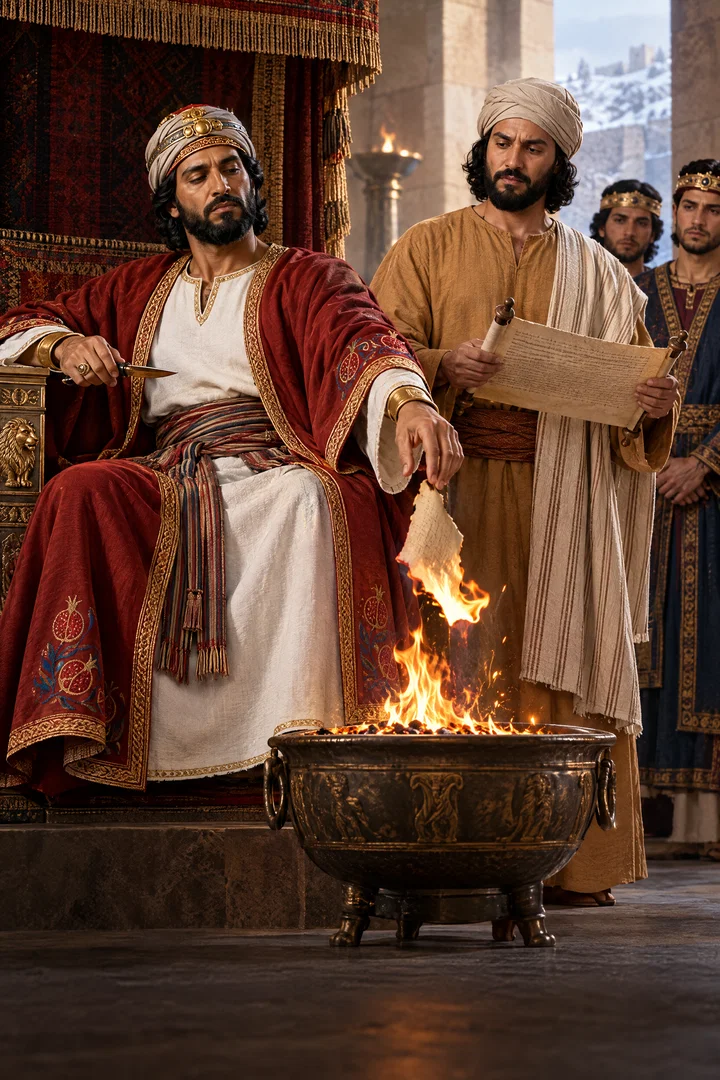
So the king sent Jehudi to fetch the roll: and he took it out of Elishama the scribe’s chamber. And Jehudi read it in the ears of the king, and in the ears of all the princes which stood beside the king.
Translations
American King James Version, King James Version
So the king sent Jehudi to fetch the roll: and he took it out of Elishama the scribe’s chamber. And Jehudi read it in the ears of the king, and in the ears of all the princes which stood beside the king.
So the king sent Jehudi to fet the roll: and he took it out of Elishama the scribe’s chamber. And Jehudi read it in the ears of the king, and in the ears of all the princes which stood beside the king.
So the king sent Jehudi to bring the roll: and he took it out of the chamber of Elishama, the scribe. And Jehudi read it in the ears of the king, and in the ears of all the princes who stood beside the king.
So the king sent Jehudi to fetch the roll: and he took it out of the chamber of Elishama the scribe. And Jehudi read it in the ears of the king, and in the ears of all the princes which stood beside the king.
So the king sent Jehudi to fetch the roll; and he took it out of the chamber of Elishama the scribe. And Jehudi read it in the ears of the king, and in the ears of all the princes that stood beside the king.
And the king sendeth Jehudi to take the roll, and he taketh it out of the chamber of Elishama the scribe, and Jehudi readeth it in the ears of the king, and in the ears of all the heads who are standing by the king;
And the king sent Jehudi to fetch the roll, and he fetched it out of the chamber of Elishama the scribe. And Jehudi read it in the ears of the king, and in the ears of all the princes that stood beside the king.
The king, therefore sent, Jehudi, to fetch the roll, and he fetched it out of the chamber of Elishama the scribe,—and Jehudi read it in the ears of the king, and in the ears of all the princes who were standing near the king.
Berean Standard Bible, Majority Standard Bible
Then the king sent Jehudi to get the scroll, and he took it from the chamber of Elishama the scribe. And Jehudi read it in the hearing of the king and all the officials who were standing beside him.
So the king sent Jehudi to get the scroll, and he took it out of the room of Elishama the scribe. Jehudi read it in the hearing of the king, and in the hearing of all the princes who stood beside the king.
So the king sent Jehudi to get the book, and he took it from the room of Elishama the scribe. And Jehudi gave a reading of it in the hearing of the king and all the rulers who were by the king's side.
So the King sent Iehudi to fet the roule, and he tooke it out of Elishama the Chancellours chamber, and Iehudi read it in the audience of the King, and in the audience of all the princes, which stoode beside the King.
Douay-Rheims (Challoner revision)
And the king sent Judi that he should take the volume: who bringing it out of the chamber of Elisama the scribe, read it in the hearing of the king, and of all the princes that stood about the king.
Pictures
Cross-references
- Jeremiah 36:27-32
Then the word of the LORD came to Jeremiah, after that the king had burned the roll, and the words which Baruch wrote at the mouth of Jeremiah, saying,
After the scroll is burned, God commands its words to be written again, with more added.
- Jeremiah 36:2
Take thee a roll of a book, and write therein all the words that I have spoken unto thee against Israel, and against Judah, and against all the nations, from the day I spake unto thee, from the days of Josiah, even unto this day.
The roll fetched and read to the king contains the Lord’s recorded warnings.
- Jeremiah 36:32
Then took Jeremiah another roll, and gave it to Baruch the scribe, the son of Neriah; who wrote therein from the mouth of Jeremiah all the words of the book which Jehoiakim king of Judah had burned in the fire: and there were added besides unto them many like words.
The burned scroll is rewritten with its words and additional warnings.
- Jeremiah 36:29
And thou shalt say to Jehoiakim king of Judah, Thus saith the LORD; Thou hast burned this roll, saying, Why hast thou written therein, saying, The king of Babylon shall certainly come and destroy this land, and shall cause to cease from thence man and beast?
The king’s rejection brought further warning of judgment.
- Jeremiah 36:3
It may be that the house of Judah will hear all the evil which I purpose to do unto them; that they may return every man from his evil way; that I may forgive their iniquity and their sin.
The scroll’s warnings were meant to turn the people from evil.
Commentary
Each commentary is drawn from primary sources: the writings of Ellen G. White and Adventist pioneers and periodicals. Each commentary is separate. Its own words are not a quotation; follow the references to read the source passages.
Ellen G. White
5 sources
At the king's command Jehudi fetched the prophetic roll from Elishama the scribe's chamber and read its warnings aloud in the ears of Jehoiakim and in the ears of all the princes standing beside him.Lt 152, 1907, par. 14–22Lt 35, 1891, par. 22–27MWISDAP 58.2–59.1Lt 18, 1876, par. 2–3Ms 111, 1905, par. 5 That reading brought God's special message of warning and reproof directly before the king, exposing the condition of the people and calling them to hear and return from evil.Lt 152, 1907, par. 14–22Lt 35, 1891, par. 22–27MWISDAP 58.2–59.1Lt 18, 1876, par. 2–3Ms 111, 1905, par. 5 The scroll thus set the Lord's reproofs to ancient Israel plainly before Jehoiakim and his officials while they listened together.Lt 152, 1907, par. 14–22Lt 35, 1891, par. 22–27MWISDAP 58.2–59.1Lt 18, 1876, par. 2–3Ms 111, 1905, par. 5
Hearing it led directly to the king's cutting up and burning the roll, an act of defiant rejection and contempt for God's message that refused its reproofs.Lt 152, 1907, par. 14–22Lt 35, 1891, par. 22–27MWISDAP 58.2–59.1Lt 18, 1876, par. 2–3Ms 111, 1905, par. 5 After listening to three or four pages he cut the roll with a penknife and cast it into the fire.Ms 111, 1905, par. 5 Destroying the written scroll could not cancel or destroy the message, for the Word of God will never return void but accomplishes its purpose.MWISDAP 58.2–59.1Ms 111, 1905, par. 5 The same Holy Spirit who gave the first testimony that was refused and burned repeated the very message that had been rejected, caused it to be written again, and added a great deal more to it.MWISDAP 58.2–59.1Ms 111, 1905, par. 5
The act is to be studied because in the last days those with great light virtually repeat it by turning from the messages of the Spirit of God instead of repenting and reforming.Lt 152, 1907, par. 14–22 It exposes those who hear the evidence of the binding claims of the law of God and the obedience His commandments enjoin, feel their own characters in contrast to its requirements, and would reject it just as Jehoiakim did.Ms 111, 1905, par. 5
Sources
Pioneers and periodicals
15 sources
Jehoiakim sent Jehudi to bring the prophetic roll from Elishama the scribe's chamber, and Jehudi read it aloud before the king and the princes standing beside him.RH Jul 27, 1916ST Sep 13, 1905RH Jul 26, 1870 The roll, written by Baruch at Jeremiah's dictation, carried God's warnings of coming evil against Judah and Jerusalem to turn the people from their evil ways to repentance and forgiveness.RH Jul 27, 1916ST Jul 21, 1881RH Jan 3, 1865RH Sep 13, 1906 After only three or four leaves were heard, the king cut the roll apart and burned it in the fire, and neither he nor his servants were afraid or tore their garments.ST Sep 13, 1905ST Dec 8, 1898RH Jul 23, 1901 God then had the message written again with still more words of the same import, showing that burning the page cannot destroy His Word, which endures in power and truth.ST Sep 13, 1905RH Jul 26, 1870ST Dec 8, 1898
Narrative Setting and Content
King Jehoiakim sent Jehudi to fetch the roll from Elishama the scribe's chamber, and Jehudi read it aloud in the ears of the king and in the ears of all the princes who stood beside him.RH Jul 27, 1916ST Sep 13, 1905RH Jul 26, 1870ST Dec 8, 1898ST Jul 12, 1910 That roll was what Baruch wrote at Jeremiah's direction, from which the book of Jeremiah grew.RH Jul 27, 1916 The event falls within the account of the two years before Jerusalem's fall.RH Jul 27, 1916 It occurred in Jehoiakim's reign, earlier in historical sequence than some accounts of Zedekiah's reign.ST Jul 12, 1910 It belongs as part of Jeremiah's warnings to Judah's rulers within the wider history of Zedekiah's choices and Jerusalem's fall.RH Jan 2, 1900
The roll was not carried first to the king but taken directly to the people, and was afterward called for by the king and read only in part before him.RH Sep 13, 1906 The king sought to hear the message for himself rather than rely only on what others reported.RH Jul 26, 1870
The scroll contained God's warnings through Jeremiah against Judah and Jerusalem of the evil purposed against them.ST Jul 21, 1881RH Jan 3, 1865RH Sep 13, 1906 It was intended to turn the people from their evil ways to repentance and lead them to receive forgiveness.ST Jul 21, 1881RH Jan 3, 1865RH Sep 13, 1906
Rejection and Enduring Message
After only three or four leaves had been read, the king cut the roll with a penknife and cast it into the hearth fire until it was wholly consumed, and neither the king nor his servants who heard it were afraid nor rent their garments.ST Sep 13, 1905ST Dec 8, 1898ST Jul 21, 1881RH Jan 3, 1865RH Sep 13, 1906 The roll so destroyed contained God's warnings through Jeremiah against Judah and Jerusalem of the evil purposed against them, given that they might hear, turn every man from his evil way, and receive forgiveness.ST Jul 21, 1881RH Jan 3, 1865RH Sep 13, 1906 The king had sought to hear the message for himself rather than rely only on what others reported, having the scroll fetched from Elishama the scribe's chamber and read in his ears and in the ears of all the princes who stood beside him.ST Sep 13, 1905RH Jul 26, 1870ST Dec 8, 1898 Yet human opposition could not undo the words of God, for He directed Jeremiah to have the scroll written again with additional words of like import.RH Jul 26, 1870ST Dec 8, 1898RH Aug 5, 1873 Burning the written page cannot destroy God's Word, for it endures, and even the killing of the Lord cannot undo its power or truth.ST Sep 13, 1905ST Dec 8, 1898
The chapter holds a message directly from the Lord that was not preserved, showing that much has been written by inspiration that has not been given.ST Jul 3, 1884 Those lost inspired writings were just as inspired as the records that remain, but they were allowed to be lost because they were not of especial importance, for otherwise they would have been preserved.ST Jul 3, 1884 God has given in His word everything necessary to do His will, so until all that has been received is put into practice there is no ground to find fault for not giving more of the same instruction.ST Jul 3, 1884 The reading that the king heard was plain Scripture with no comment, yet it convicted him that he was not living in accordance with its teaching, leaving him confused, hurt, and stunned.RH Jul 23, 1901 To ease his conscience he destroyed the troubling evidence, treating references to Scripture texts as dangerous things to have around.RH Jul 23, 1901
The king and his princes heard the reading with a criticizing and dissecting spirit, seeking technical errors or inconsistencies as grounds to reject its counsels.RH Jun 10, 1915 Heeding such prophetic instruction brings rich blessing, while meeting it with faultfinding rejection brings shipwreck of faith and Christian experience.RH Jun 10, 1915 Such contempt for a message sent that Judah might hear, return, and be forgiven illustrates God's manner of dealing when an individual so apostatizes that correction is used to create distrust of the instrument.RH Sep 13, 1906 Then the Lord no longer sends messages to him but gives them directly to the church, and such mistreatment brings divine woe and stands as a warning to those in later time who are being passed by for the same reason.RH Sep 13, 1906 Here apostate Israel persecuted Jeremiah as a prophet of God, proving the principle that he that was born after the flesh persecutes him that was born after the Spirit, that the wicked persecute the righteous.RH Jun 8, 1916
Sources