Jeremiah 36:22
Now the king sat in the winterhouse in the ninth month: and there was a fire on the hearth burning before him.
Translations
Now the king sat in the winter house in the ninth month: and there was a fire on the hearth burning before him.
King James Version, KJV Cambridge Paragraph Bible
Now the king sat in the winterhouse in the ninth month: and there was a fire on the hearth burning before him.
Now the king sat in the winter-house in the ninth month: and there was a fire on the hearth burning before him.
Now the king sat in the winter house in the ninth month: and there was a fire in the brasier burning before him.
Now the king was sitting in the winter-house in the ninth month: and there was a fire in the brazier burning before him.
and the king is sitting in the winter-house, in the ninth month, and the stove before him is burning,
Now the king was sitting in the winter-house in the ninth month, and with the fire-pan burning before him.
Now, the king, was sitting in the winter house in the ninth month,—with the fire-stove before him burning.
Berean Standard Bible, Majority Standard Bible
Since it was the ninth month, the king was sitting in his winter quarters with a fire burning before him.
Now the king was sitting in the winter house in the ninth month, and there was a fire in the brazier burning before him.
Now the king was seated in the winter house, and a fire was burning in the fireplace in front of him.
Nowe the King sate in the winter House, in the ninth moneth, and there was a fire burning before him.
Douay-Rheims (Challoner revision)
Now the king sat in the winter house, In the ninth month: and there was a hearth before him full of burning coals.
Pictures
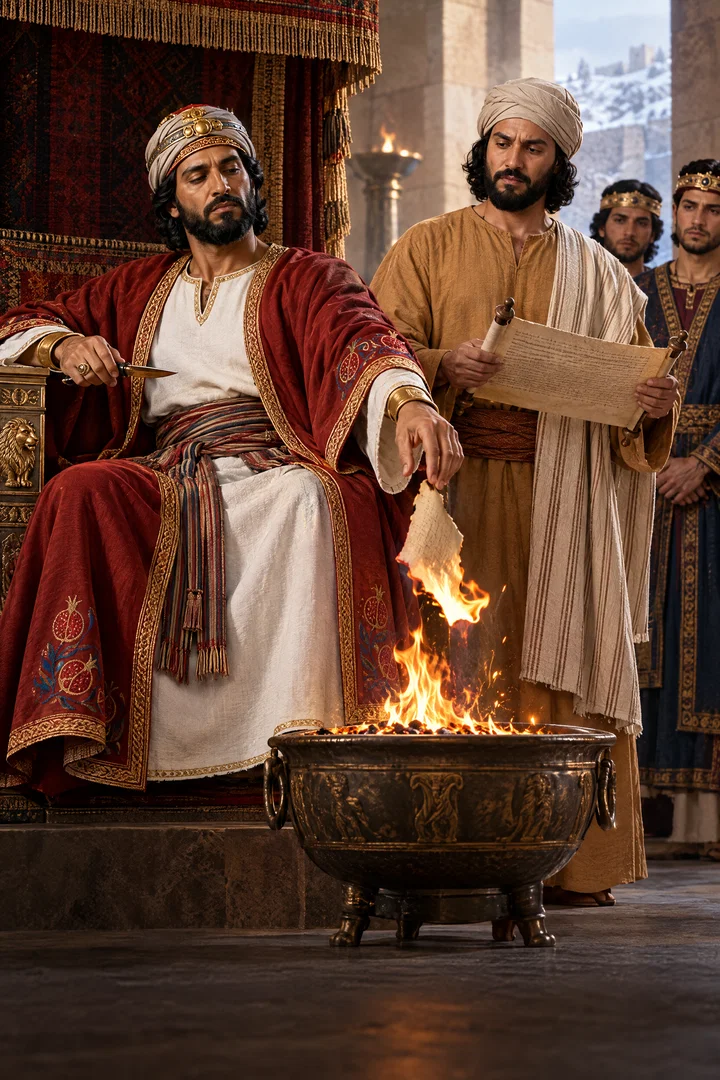
Cross-references
- Jeremiah 36:32
Then took Jeremiah another roll, and gave it to Baruch the scribe, the son of Neriah; who wrote therein from the mouth of Jeremiah all the words of the book which Jehoiakim king of Judah had burned in the fire: and there were added besides unto them many like words.
The destroyed scroll is rewritten with its words and additional warnings.
- Jeremiah 36:28
Take thee again another roll, and write in it all the former words that were in the first roll, which Jehoiakim the king of Judah hath burned.
God commands the burned words to be written again.
- Jeremiah 36:2
Take thee a roll of a book, and write therein all the words that I have spoken unto thee against Israel, and against Judah, and against all the nations, from the day I spake unto thee, from the days of Josiah, even unto this day.
Identifies the roll written by Baruch that frames the account.
- Jeremiah 36:30
Therefore thus saith the LORD of Jehoiakim king of Judah; He shall have none to sit upon the throne of David: and his dead body shall be cast out in the day to the heat, and in the night to the frost.
punishment pronounced for burning the roll
- 2 Chronicles 36:5-8
Jehoiakim was twenty and five years old when he began to reign, and he reigned eleven years in Jerusalem: and he did that which was evil in the sight of the LORD his God.
Recounts the reign and acts of Jehoiakim, the king in this scene.
Commentary
Each commentary is drawn from primary sources: the writings of Ellen G. White and Adventist pioneers and periodicals. Each commentary is separate. Its own words are not a quotation; follow the references to read the source passages.
Ellen G. White
8 sources
The verse places King Jehoiakim in his winterhouse in the ninth month, with a fire burning on the hearth before him, while Jehudi reads Jeremiah's scroll in his hearing.Lt 66, 1897, par. 9–10Lt 152, 1907, par. 14–22Ms 65, 1912, par. 21–23Lt 35, 1891, par. 22–27MWISDAP 58.2–59.1 Jehoiakim is king of Judah, sitting to hear a special message from God read to him.Ms 111, 1905, par. 5 The roll being read contains God's words against Israel and Judah and the nations.Ms 65, 1912, par. 21–23 It consists of written reproofs and rebuke and warning about the people's condition, sent through Jeremiah as God's chosen instrument and meant to turn Judah from evil to forgiveness.Ms 65, 1912, par. 21–23Lt 35, 1891, par. 22–27Ms 111, 1905, par. 5Lt 18, 1876, par. 2–35T 678.1
The setting explains how the king was able to destroy the message as he heard it.Lt 35, 1891, par. 22–27 After Jehudi had read three or four leaves or pages, the king cut the roll with a penknife and threw it into the hearth fire before him until the whole roll was consumed.Lt 152, 1907, par. 14–22Ms 65, 1912, par. 21–23Lt 35, 1891, par. 22–27MWISDAP 58.2–59.1Ms 111, 1905, par. 5 Neither the king nor his servants were afraid nor tore their garments, and though Elnathan and Delaiah and Gemariah pleaded with him not to burn the roll, he would not listen.Lt 152, 1907, par. 14–22 The act was a deliberate rejection and refusal to receive the Lord's warnings.Lt 152, 1907, par. 14–22Ms 65, 1912, par. 21–23Lt 18, 1876, par. 2–3 It expressed contempt for God's warning, despising of faithful reproof, and defiance of the words of the Lord.Lt 152, 1907, par. 14–22Lt 35, 1891, par. 22–275T 678.1
The act shows what men do when they pass the boundary line and trifle with the Lord.Lt 152, 1907, par. 14–22 They spend in criticism and man-formed opinions and selfish devisings the time that should be given to repentance and reform, turning from light and truth to join the enemy while Satan gains victory after victory for souls.Lt 152, 1907, par. 14–22 Burning the roll could not destroy the message, for God's Word never returns void.Ms 111, 1905, par. 5 The same Holy Spirit who gave the first testimony that was refused and burned came again to the servant who had caused the first roll to be written, repeated the very rejected message, caused it to be written again, and added a great deal more to it.Lt 152, 1907, par. 14–22MWISDAP 58.2–59.1Ms 111, 1905, par. 5
Such opposition does not hinder the execution of God's threatenings but provokes His anger and brings certain ruin upon the offender.5T 678.1 The historical rejection is a warning to be studied because similar things would happen in the present generation and the same events will be repeated.Lt 66, 1897, par. 9–10Lt 152, 1907, par. 14–22Ms 65, 1912, par. 21–23 Some in recent years have virtually repeated Jehoiakim's act by burning the messages of the Spirit of God, but as of old the messages of warning are repeated.Lt 152, 1907, par. 14–22 The same spirit is seen in the persecution and suffering Christ endured at the hands of wicked men and in the treatment the Lord's faithful servants have received in every age.Lt 152, 1907, par. 14–22 It appears in indignation against the agent God chooses to deliver reproof, belonging to the same spirit that persecuted and imprisoned Jeremiah for obeying the word of the Lord and still existing today.Lt 152, 1907, par. 14–225T 678.1
Sources
Pioneers and periodicals
22 sources
The verse places King Jehoiakim in his winter apartment in the cold season of the ninth month, with a warming fire burning on the hearth before him while Jehudi read the roll Baruch had written at Jeremiah's direction in the hearing of the king and his princes.RH Jul 27, 1916ST Nov 24, 1898ST Aug 9, 1905ST Dec 8, 1898RH Mar 21, 1865 As the warning was read the king cut its leaves with his penknife and threw them into the fire until the whole was consumed, without fear or repentance, in contemptuous and defiant rejection of God's reproof and counsel after years of pleading to turn from evil.RH Jul 26, 1870RH Nov 22, 1906RH Sep 13, 1906 Destroying the written roll could not destroy the word of God or stay His judgments, whose purpose and truth endure despite human efforts to suppress them.ST Sep 13, 1905RH Jul 26, 1870ST Jul 21, 1881 Because he rejected it the message was written again with words of like import and many like words added, including judgment that the king of Babylon would destroy the land and that Jehoiakim himself would perish and his body be exposed to heat and frost.RH Jul 26, 1870RH Nov 22, 1906ST Jul 21, 1881 The plain straight testimony must therefore live in the church, for heeding what God speaks for its edifying brings rich blessing, while treating it as the king and his princes treated Jeremiah's writings rejects its counsels and brings the curse as surely as upon ancient Israel.RH Nov 22, 1906RH Sep 13, 1906RH Jun 10, 1915
Setting and Background
The scene is set in the winter residence of Jehoiakim king of Judah, in the ninth month, with a fire burning on the hearth before him.RH Jul 27, 1916ST Nov 24, 1898ST Dec 8, 1898ST Nov 24, 1898RH Jan 3, 1865 The hearth was a brazier set before him as the written warning was read to him there.ST Nov 24, 1898RH Jan 3, 1865ST Dec 1, 1898 The fire was kept burning to give warmth to the king and those with him, because the ninth month fell in the cold season.ST Aug 9, 1905RH Mar 21, 1865 Winter in Judah and in Jerusalem could be cold enough to make such fires necessary.RH Mar 21, 1865RH Oct 21, 1873RH Jan 7, 1862
What was read in that setting was the roll that Baruch had written at Jeremiah's direction, containing the Lord's warning delivered through Jeremiah.RH Jul 27, 1916ST Nov 24, 1898ST Dec 1, 1898 It was read aloud by Jehudi in the hearing of the king and of the princes and officials who stood beside him.ST Nov 24, 1898RH Jul 26, 1870ST Nov 24, 1898RH Sep 13, 1906 The message had not been carried first to the king but had been taken directly to the people.RH Jul 26, 1870RH Sep 13, 1906 It was afterward sent for by the king himself and read in part before him.RH Jul 26, 1870RH Sep 13, 1906 The passage belongs to the account of Jehoiakim's reign, though the chapters of Jeremiah are not always arranged in chronological order, and it is to be read with chapter 36 after chapter 35 and before chapter 45.ST Jul 12, 1910
Rejection of God's Word
Jehoiakim did not act from hearsay but sent for the roll himself and listened to it read by Jehudi in his own hearing, holding back his anger until he had heard it, while seated with his princes around him in whose faces he could read encouragement.RH Jul 26, 1870 As the reading went forward he snatched the roll and, leaf by leaf as fast as it was read, cut it out with his penknife and threw it into the fire burning before him until the whole roll was consumed, without fear and without rending of garments.RH Jul 26, 1870RH Nov 22, 1906RH Sep 13, 1906RH Jan 3, 1865 The deed was rash, wrathful and undignified, an act of contempt and defiance and persistent rejection of the testimonies.RH Jul 26, 1870RH Nov 22, 1906RH Dec 13, 1870
For years Jeremiah had pleaded with him to turn from idolatry and his evil ways and come back to obedience to the law, yet misreading continued prosperity as divine approval despite repeated warnings, the king had grown defiant against what would come to pass if he did not repent.RH Nov 22, 1906 When convicted by its teaching he sought to ease his conscience by destroying the evidence that he was not living in accordance with it rather than by obeying it.RH Jul 23, 1901 In the same spirit he and his princes met Jeremiah's writings with criticism and dissection, seeking technical errors or inconsistencies on which to base rejection of their counsels.RH Jun 10, 1915
The burning was rejection of the Lord's word and message of reproof, counsel and warning, with Israel in apostasy persecuting Jeremiah a prophet of God.RH Jun 8, 1916RH Dec 13, 1870 Destroying the written words with penknife and fire could not destroy the Word of God nor prevent His judgments, for God's purpose still lives and stands though men disbelieve, and its power and truth endure despite human efforts to suppress it, even to the killing of the Lord.ST Sep 13, 1905RH Jul 26, 1870ST Jul 21, 1881 Demonstrative opposition to God's uttered word gains nothing, and striking hatefully at doctrines not loved avails as little as penknife and fire.RH Jul 26, 1870
Because the king rejected the warning instead of repenting, the warning was written again resolutely with words of like import and many like words added.RH Jul 26, 1870ST Jul 21, 1881RH Aug 5, 1873 The rewritten roll contained also the judgments determined against him, that the king of Babylon would come and destroy the land and that Jehoiakim would be killed and his dead body exposed to heat and frost.RH Nov 22, 1906 Even after the warning was written again it did not turn the people from their wickedness, and in the surrounding history Jeremiah was later cast into a dungeon and then spared.RH Dec 13, 1870
Doctrine and Application
The cold that made the fire necessary shows that winter in Jerusalem could be cold enough for a fire to be burning before the king in the winterhouse, and that in Palestine's cold winter climate kindling a fire on the Sabbath could be an act of mercy.RH Oct 21, 1873RH Jan 7, 1862 A ban on kindling fires on the Sabbath would cause suffering in parts of the year, and therefore the prohibition against lighting fires was temporary and applied to Israel under different conditions in the wilderness, not a permanent part of the fourth commandment or a rule intended for life in Palestine.RH Oct 21, 1873RH Jan 7, 1862
Jeremiah 36 records a message directly from the Lord that was not preserved, showing that much was written by inspiration that has not been given to later readers.ST Jul 3, 1884 What was lost was not of especial importance, for otherwise it would have been preserved, and God has given in His word everything necessary to enable obedience.ST Jul 3, 1884 There is therefore no ground to find fault for not giving more of the same instruction until all that has been received is put into practice.ST Jul 3, 1884
The passage proves the principle that he that was born after the flesh persecuted him that was born after the Spirit, that the wicked persecute the righteous because their own works are evil and their brother's righteous, as seen in Israel in apostasy persecuting Jeremiah, a prophet of God.RH Jun 8, 1916 The message was not carried first to the king but was taken directly to the people, and was afterward called for by the king himself and read in part before him in the winterhouse in the ninth month with the fire on the hearth burning before him while Jehudi read the roll in the ears of the king and of all the princes which stood beside him.RH Sep 13, 1906 When an individual so far apostatizes that instead of using a message sent for personal correction and encouragement he uses it to create distrust of the instrument through which it is sent, the Lord forbids that messages be sent to the individual and directs that future testimonies concerning him be sent to the church.RH Sep 13, 1906 Jehoiakim's hearing in this setting, followed by cutting the roll and burning it without fear or rending of garments, is a sad illustration of mistreating God's messages and a warning to those who do so that they will be passed by and the message given directly to the church.RH Sep 13, 1906
For years Jeremiah had pleaded with the king to turn from idolatry and his evil ways and come back to obedience to the law, but misreading continued prosperity as approval despite repeated warnings, the king had become defiant against what would come to pass if he did not repent.RH Nov 22, 1906 As fast as the roll of that last appeal was read, he cut out its leaves with his penknife and threw them into that fire until the whole roll was burned, in persistent rejection of the testimonies and defiance of God himself, meeting the writings with criticism and dissection to seek technical errors or inconsistencies on which to base rejection of their counsels.RH Nov 22, 1906RH Jun 10, 1915 Because of that rejection another roll was sent containing also the judgments determined against him, that the king of Babylon would come and destroy the land and he would be killed and his dead body exposed to heat and frost.RH Nov 22, 1906 The incident teaches that the plain, straight testimony must live in the church or the curse of God will rest upon His people as surely as it did upon ancient Israel for such sins.RH Nov 22, 1906 Heeding the instruction God speaks for the edifying of His church brings rich blessing, while regarding it as the king and his princes regarded Jeremiah's writings rejects its counsels and makes shipwreck of faith and Christian experience.RH Jun 10, 1915
Sources