Job 14:7
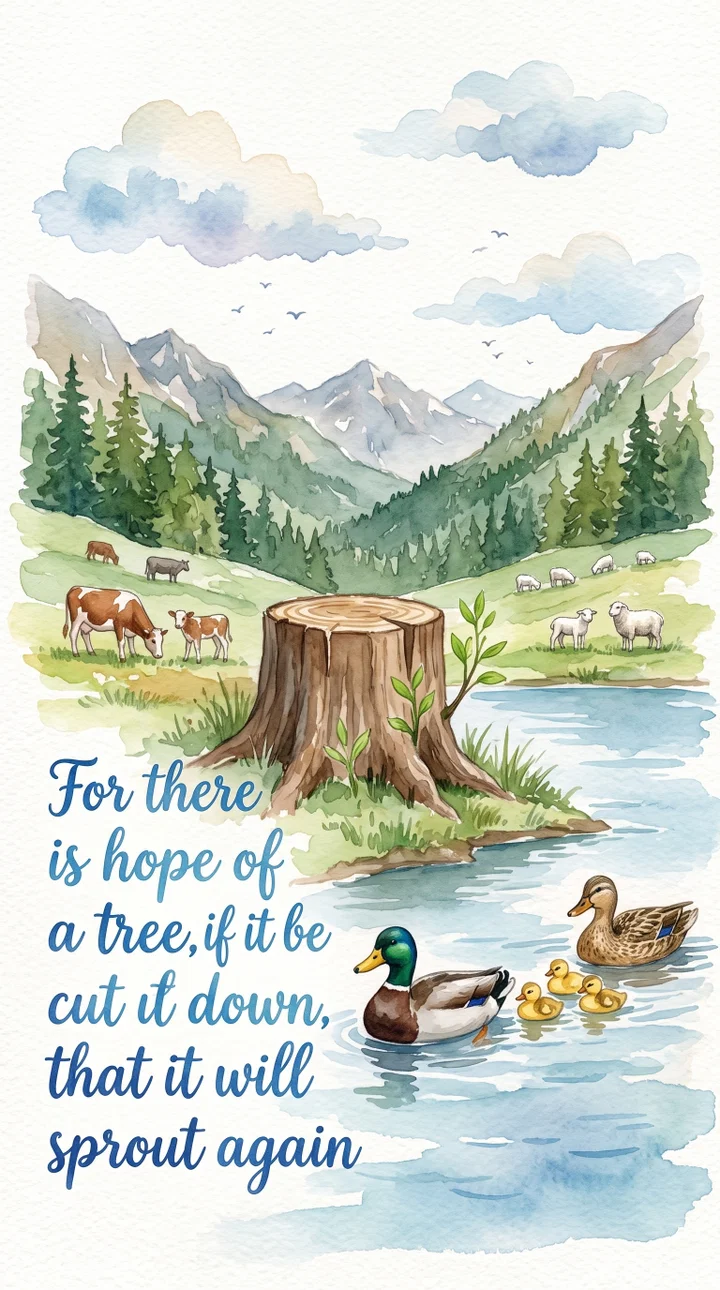
For there is hope of a tree, if it be cut down, that it will sprout again, and that the tender branch thereof will not cease.
Translations
American King James Version, King James Version, Revised Version
For there is hope of a tree, if it be cut down, that it will sprout again, and that the tender branch thereof will not cease.
KJV Cambridge Paragraph Bible, American Standard Version
For there is hope of a tree,
If it be cut down, that it will sprout again,
And that the tender branch thereof will not cease.For there is hope of a tree, if it is cut down, that it will sprout again, and that its tender branch will not cease.
For there is of a tree hope, if it be cut down, That again it doth change, That its tender branch doth not cease.
For there is hope for a tree: if it be cut down, it will sprout again, and its tender branch will not cease;
Though there is—for a tree—hope,—if it should be cut down, that, again, it will grow, and, the tender branch thereof, will not cease;
Berean Standard Bible, Majority Standard Bible
For there is hope for a tree:
If it is cut down, it will sprout again,
and its tender shoots will not fail.“ For there is hope for a tree if it is cut down,
that it will sprout again,
that the tender branch of it will not cease.For there is hope of a tree; if it is cut down, it will come to life again, and its branches will not come to an end.
For there is hope of a tree, if it bee cut downe, that it will yet sproute, and the branches thereof will not cease.
Douay-Rheims (Challoner revision)
A tree hath hope: if it be cut, it groweth green again, and the boughs thereof sprout.
Pictures

Cross-references
- Job 14:14-15
If a man die, shall he live again? all the days of my appointed time will I wait, till my change come.
Job waits through death for his appointed time, when God will call him to live again.
- Isaiah 26:19
Thy dead men shall live, together with my dead body shall they arise. Awake and sing, ye that dwell in dust: for thy dew is as the dew of herbs, and the earth shall cast out the dead.
The dead are promised life and rising.
- Job 14:11-12
As the waters fail from the sea, and the flood decayeth and drieth up:
Man lies asleep until the heavens are no more.
- Psalms 49:15
But God will redeem my soul from the power of the grave: for he shall receive me. Selah.
God redeems soul from power of the grave
- Job 17:15
And where is now my hope? as for my hope, who shall see it?
Hope is contrasted with remaining unfulfilled in the grave.
- Ezekiel 37:11-12
Then he said unto me, Son of man, these bones are the whole house of Israel: behold, they say, Our bones are dried, and our hope is lost: we are cut off for our parts.
Hope is not cut off, for graves will be opened.
Commentary
Each commentary is drawn from primary sources: the writings of Ellen G. White and Adventist pioneers and periodicals. Each commentary is separate. Its own words are not a quotation; follow the references to read the source passages.
Pioneers and periodicals
37 sources
For there is hope of a cut-down tree that it will sprout again and its tender growth will not cease, because life remains in its root from which new growth springs by a natural process.RH Jan 19, 1864ST Aug 1, 1916ST Jun 15, 1882ST Oct 13, 1881 This is set as a contrast with human death, not as proof of resurrection from nature, for a person cut down by death has no remaining life or spark within himself and cannot arise by any natural process.ST Aug 1, 1916ST Jun 15, 1882ST Jan 21, 1913RH Sep 26, 1854ST Feb 15, 1877 Death is a sleep of blank unconsciousness without sense or thought or knowledge, and the dead do not awake or return to earthly life until the heavens be no more.ST Oct 28, 1875ST Jan 17, 1906ST Feb 10, 1881RH Feb 20, 1872RH Sep 26, 1854 The hope is that God's own power will bring man again from the dust, hiding him in the grave till the appointed time when God calls and he answers to immortality through Christ at the last day.RH Jan 19, 1864RH Sep 5, 1854ST Oct 13, 1881ST Jun 15, 1904 So the image of renewed life after apparent loss comforts mourners, that sorrow for the faithful dead is held with hope of their return through the first resurrection and reunion.RH Dec 16, 1862RH Nov 24, 1910RH Apr 2, 1901RH Mar 7, 1912
Tree's Renewal and Contrast
For there is hope of a tree cut down that it will sprout again and that its tender branch will not cease.RH Jan 19, 1864ST Oct 13, 1881RH Apr 2, 1901 Even when its root grows old in the earth and its stock dies in the ground, through the scent of water it will bud and bring forth boughs like a plant.RH Jan 19, 1864ST Oct 13, 1881 The reason it can do so is that it has not become utterly dead, for life remains in its root from which new growth can spring by a natural process.ST Aug 1, 1916ST Jun 15, 1882ST Jan 21, 1913ST Aug 1, 1916ST Jan 21, 1913
The tree is set as a contrast with human death, not as an analogy for resurrection.ST Jun 15, 1882ST Feb 15, 1877 What human observation knows about a cut-down tree growing anew gives no answer to whether a dead man will live again.ST Feb 15, 1877 The yearly return of leaves and blossoms after autumn's seeming death shows nature renewed by God as a promise of resurrection.ST Apr 11, 1911
Against the tree's hope, man dies and wastes away and gives up the ghost.RH Jan 19, 1864ST Oct 13, 1881RH Aug 18, 1863ST Jan 18, 1877 He is dissolved and mingled with dust like water failed and dried up by evaporation.RH Jan 19, 1864ST Oct 13, 1881 He lies down and rises not, sleeping unawakened till the heavens be no more.RH Jan 19, 1864RH Sep 5, 1854ST Oct 13, 1881RH Aug 18, 1863
A person cut down by death has no remaining life or spark within himself from which to begin again.ST Aug 1, 1916ST Jan 21, 1913ST Aug 1, 1916ST Jan 21, 1913 He cannot be restored by any human skill and cannot arise by any natural process.ST Aug 1, 1916ST Jun 15, 1882RH Sep 26, 1854 Life after death requires power from outside the person, by God's direct power.ST Aug 1, 1916ST Jun 15, 1882ST Jan 21, 1913
Death as Unconscious Sleep
Job 14:7 belongs to Job's teaching that death is a sleep of blank unconsciousness, excluding sense and thought and enjoyment, and it does not teach that the dead are conscious.ST Oct 28, 1875ST Feb 10, 1881RH Feb 20, 1872ST Aug 18, 1887RH May 13, 1858 Unlike a cut-down tree that can sprout again, a dead person does not awaken or return to earthly life until the heavens are no more.ST Oct 28, 1875RH Feb 20, 1872 Death is the exact opposite of life, the cessation of continued conscious existence, which disproves natural immortality.ST Feb 10, 1881 Death is a house of darkness and a place of dust and corruption, a land of darkness and forgetfulness with no remembrance, where thoughts perish and there is no work nor device and no knowledge nor wisdom.RH Aug 18, 1863ST Feb 10, 1881ST Aug 18, 1887
The human dead do not awake or return to conscious earthly life in the present world and cannot communicate with the living until the heavens are no more.ST Oct 28, 1875ST Jan 17, 1906RH Sep 26, 1854 A cut-down tree can sprout again even after its root has grown old and its trunk has died when it receives water, but this hope contrasts with man, who dies and cannot be restored to life by any human skill.RH Sep 26, 1854 The dead lie in the grave unconscious until they are awakened and raised when the heavens are no more, for Job's hope is not life at death but resurrection at God's appointed time.ST Oct 28, 1875RH Sep 26, 1854 Death is not a gate to endless life, and the hope of the grave is answered by the resurrection described in 1 Corinthians 15.RH May 3, 1860 Human beings are naturally mortal, not inherently immortal, so that without a resurrection even they that are fallen asleep in Christ are perished, with immortality coming only through faith in Christ and given at the resurrection or translation at the Lord's coming.ST Feb 10, 1881ST Jun 15, 1904
Job, though righteous, prayed to be hid in Sheol, which proves Sheol there is the grave, the common place of the dead for righteous and wicked alike and not the punishment of the wicked.ST Jun 28, 1877
Hope of Future Resurrection
The hope held out is not that consciousness continues in death, but that divine power can bring a person again from the dust, as condensed vapor reproduces water, by hiding him in the grave until wrath is past.RH Jan 19, 1864 The dead wait there all the days of their appointed time, with God appointing a set time and remembering them, until their change to immortality comes when God calls and they answer and He shows desire for the work of His hands.RH Jan 19, 1864RH Sep 5, 1854RH Aug 18, 1863ST Jan 18, 1877 That waiting is a sleep of death from which there is no awaking until the heavens are no more, with no other hope but to remain until the change comes at the resurrection of the just.RH Sep 5, 1854ST Oct 13, 1881RH Aug 18, 1863ST Jan 18, 1877
All that there is of man returns to dust, and future life depends wholly on the resurrection of the dead through Christ Jesus at the last day, with no other hope held out even for the righteous dead.ST Jan 18, 1877 Immortality comes only through faith in Christ and is given at the resurrection or translation at the Lord's coming.ST Jun 15, 1904 That resurrection is by reorganization from dust rather than raising the same buried particles, without respect to one portion of matter above another.ST Jan 18, 1877 It cannot be learned from philosophy or scientific deduction and is unaffected by it, because it depends only on the fiat of the Almighty and can be known only by faith in the Word of God, so that if Scripture affirms that the man who dies will live again, no natural, physical, or philosophical obstacle can thwart God's purpose to bring it to pass.ST Feb 15, 1877
Job expected to be called from death and to see his living Redeemer, when the Redeemer stands at the latter day upon the earth and raises the dead to see God in flesh, giving eternal life and the kingdom of glory beyond the resurrection.ST Oct 13, 1881ST Mar 11, 1886 Though death brings silence and darkness and the dead sleep in the dust, that hope of the grave is answered by the resurrection described in 1 Corinthians 15, showing that death is not a gate to endless life in itself.ST Mar 11, 1886RH May 3, 1860 The verse thus expresses concern about what happens to the dead and the future of deceased loved ones, with hope that the upright who die rest in God's care even when people do not regard their death as a loss.ST Jan 21, 1913
Comfort for Mourners
Job 14:7 was used at funerals as words of comfort, applying the image of a cut-down tree that sprouts again and whose tender shoot does not cease to hope in the face of death and apparent loss.RH Apr 2, 1901RH Mar 7, 1912ST Mar 11, 1886RH Mar 20, 1913 In that setting it pointed to hope in the resurrection of the dead and to reunion beyond death.RH Mar 9, 1905RH Apr 2, 1901 It gave comfort in bereavement at the death of a faithful Christian who lived a consistent Christian life.RH Mar 22, 1906RH May 5, 1904
For those who sleep in death there is no conscious existence, but there is hope of their return through resurrection.RH Dec 16, 1862 Sorrow for the faithful dead who die believing is therefore held with hope and not as hopeless grief.RH Sep 16, 1909RH Nov 24, 1910 Death is a short sleep in Jesus, and one who dies in triumph of faith will rise again when Jesus soon comes.RH Aug 28, 1860
There is hope for one cut down by death, like a tree cut down that will sprout again, and that hope is the first resurrection.RH Sep 16, 1909RH Apr 18, 1907ST Mar 11, 1886 The faithful dead who die holding the truth will live again, and their mourning loved ones grieve with hope and look forward to reunion at the first resurrection.RH Sep 16, 1909RH Mar 9, 1905 The dead were described as asleep and awaiting the resurrection, with hope of sharing in the first resurrection beyond apparent death.RH Apr 18, 1907RH May 5, 1904
The chapter gave consolation to bereaved parents and friends after the death of a child. Its place alongside passages about resurrection and the dead in Christ connects it with hope beyond death for those grieving a believer. Beyond mourning, Job's story offers comfort and hope to people who suffer, that God can bring lasting good and blessing out of a trial even when His purposes are not yet understood.ST Mar 27, 1893
Sources