John 11:40
Jesus saith unto her, Said I not unto thee, that, if thou wouldest believe, thou shouldest see the glory of God?
Translations
Jesus says to her, Said I not to you, that, if you would believe, you should see the glory of God?
King James Version, KJV Cambridge Paragraph Bible
Jesus saith unto her, Said I not unto thee, that, if thou wouldest believe, thou shouldest see the glory of God?
Jesus saith to her, Said I not to thee, that if thou wouldest believe, thou shouldest see the glory of God?
Revised Version, American Standard Version
Jesus saith unto her, Said I not unto thee, that, if thou believedst, thou shouldest see the glory of God?
Jesus saith to her, 'Said I not to thee, that if thou mayest believe, thou shalt see the glory of God?'
Jesus says to her, Did I not say to thee, that if thou shouldest believe, thou shouldest see the glory of God?
Jesus saith unto her—Said I not unto thee, that, if thou wouldst believe, thou shouldst see the glory of God?
Berean Standard Bible, Majority Standard Bible
Jesus replied, “ Did I not tell you that if you believed, you would see the glory of God?”
Jesus said to her, “Didn’ t I tell you that if you believed, you would see God’s glory?”
Jesus said to her, Did I not say to you that if you had faith you would see the glory of God?
Iesus saide vnto her, Saide I not vnto thee, that if thou diddest beleeue, thou shouldest see the glorie of God?
Douay-Rheims (Challoner revision)
Jesus saith to her: Did not I say to thee, that if thou believe, thou shalt see the glory of God?
Pictures
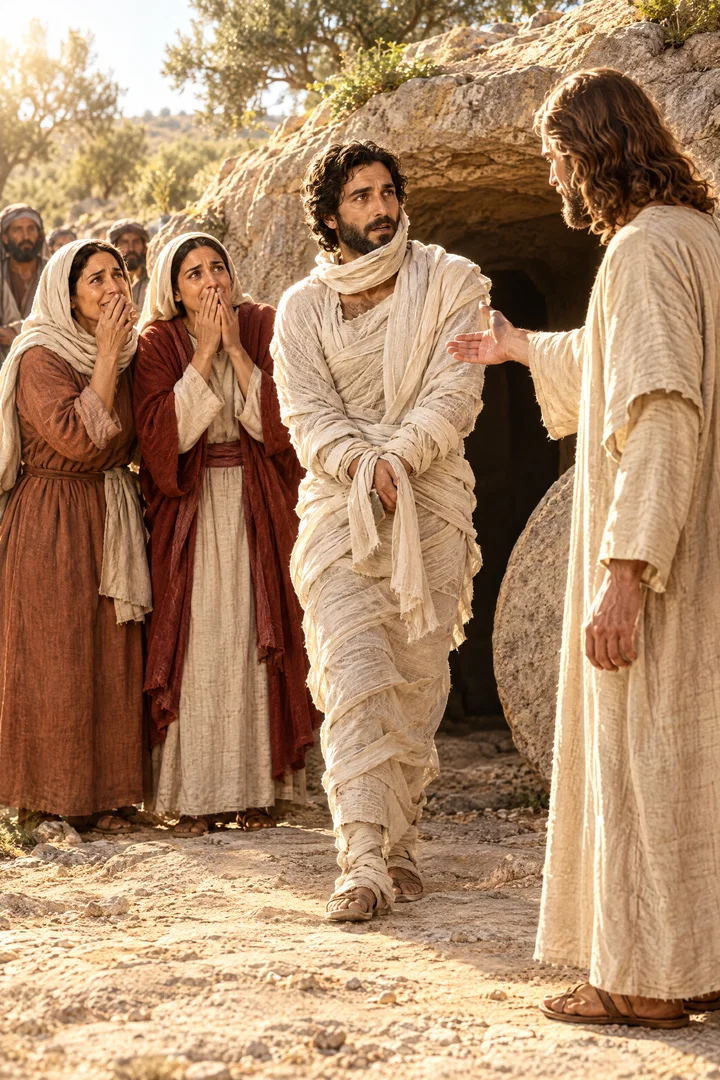
Cross-references 20 of 40
- John 11:25
Jesus said unto her, I am the resurrection, and the life: he that believeth in me, though he were dead, yet shall he live:
Jesus identifies himself as the resurrection and the life, directing Martha’s faith to his power.
- John 12:10-11
But the chief priests consulted that they might put Lazarus also to death;
Leaders sought to kill Lazarus because his raising led many to believe in Jesus.
- Luke 7:11-15
And it came to pass the day after, that he went into a city called Nain; and many of his disciples went with him, and much people.
Jesus raises the widow’s son from the dead, bringing joy to his grieving mother.
- John 5:25
Verily, verily, I say unto you, The hour is coming, and now is, when the dead shall hear the voice of the Son of God: and they that hear shall live.
Lazarus hears the Son’s voice and lives, anticipating the resurrection at Christ’s voice.
- John 11:11-14
These things said he: and after that he saith unto them, Our friend Lazarus sleepeth; but I go, that I may awake him out of sleep.
Jesus describes Lazarus’s death as sleep, then explains that he has died before raising him.
- John 11:35
Jesus wept.
Jesus’ tears show his sympathy for mourners at Lazarus’s grave.
- John 11:45
Then many of the Jews which came to Mary, and had seen the things which Jesus did, believed on him.
Many who saw Lazarus raised believed in Jesus.
- 1 Corinthians 15:20
But now is Christ risen from the dead, and become the firstfruits of them that slept.
Christ is the firstfruits of the dead, grounding hope in resurrection.
- John 11:24
Martha saith unto him, I know that he shall rise again in the resurrection at the last day.
Martha looks forward to Lazarus rising in the resurrection at the last day.
- 2 Kings 4:32-35
And when Elisha was come into the house, behold, the child was dead, and laid upon his bed.
Elisha raises the Shunammite’s son from the dead.
- Hosea 13:14
I will ransom them from the power of the grave; I will redeem them from death: O death, I will be thy plagues; O grave, I will be thy destruction: repentance shall be hid from mine eyes.
Both texts connect God’s glory with redemption from death and the grave.
- Mark 5:41-42
And he took the damsel by the hand, and said unto her, Talitha cumi; which is, being interpreted, Damsel, I say unto thee, arise.
Jesus raises Jairus’s daughter from the dead.
- John 11:15
And I am glad for your sakes that I was not there, to the intent ye may believe; nevertheless let us go unto him.
Jesus says Lazarus’s death will help the disciples believe.
- Isaiah 26:19
Thy dead men shall live, together with my dead body shall they arise. Awake and sing, ye that dwell in dust: for thy dew is as the dew of herbs, and the earth shall cast out the dead.
Lazarus’s rising illustrates the prophecy that the dead will live and awake.
- 1 Corinthians 15:22
For as in Adam all die, even so in Christ shall all be made alive.
All who die in Adam are made alive in Christ.
- 1 Corinthians 15:42-44
So also is the resurrection of the dead. It is sown in corruption; it is raised in incorruption:
The raising of the dead in glory supports belief in bodily resurrection.
- John 2:11
This beginning of miracles did Jesus in Cana of Galilee, and manifested forth his glory; and his disciples believed on him.
Jesus revealed his glory through a sign, prompting belief.
- 1 Kings 17:17-23
And it came to pass after these things, that the son of the woman, the mistress of the house, fell sick; and his sickness was so sore, that there was no breath left in him.
Elijah restores the widow’s son to life.
- Luke 10:38-42
Now it came to pass, as they went, that he entered into a certain village: and a certain woman named Martha received him into her house.
Both texts concern Christ’s visit to the Bethany household he loved.
- John 11:4
When Jesus heard that, he said, This sickness is not unto death, but for the glory of God, that the Son of God might be glorified thereby.
Lazarus’s sickness serves the glory of God.
Commentary
Each commentary is drawn from primary sources: the writings of Ellen G. White and Adventist pioneers and periodicals. Each commentary is separate. Its own words are not a quotation; follow the references to read the source passages.
Ellen G. White
39 sources
Jesus spoke these words to Martha at the grave of Lazarus to remind her that if she trusted His word she would witness God's saving power displayed.2SP 365.1–3ST Nov 10, 1909Ms 111, 1898, par. 6–8 Though Lazarus had lain four days in decay, human reasoning and fear were to give way to obedient faith that removed the stone and left the impossible to the Omnipotent One.ST Nov 10, 1909DA 534.3–535.43RED 106.1 When human hands had done all they could, Christ's word called the dead man back to life and health, revealing His majesty as Son of God, Saviour and Lifegiver.DA 524.1COS 92.4–93.32SP 373.1–374.1 That crowning miracle, done in daylight before many witnesses, was decisive proof that convinced honest minds yet only hardened those who had already rejected light.2SP 367.121MR 110.7–111.23RED 108.2 Christ still requires His followers to act in faith and remove the stone of unbelief so that His power can bring the spiritually dead to life.16MR 324.2–326.3Lt 2a, 1878, par. 19–21Lt 2, 1878, par. 11–14
Setting at Lazarus's Tomb
Jesus spoke these words to Martha at the grave of Lazarus of Bethany, gently reminding her of a promise her faith had not yet fully grasped.2SP 365.1–3ST Nov 10, 1909Ms 111, 1898, par. 6–8COL 145.2–3DA 534.3–535.4 Belief in him and in his word would open her eyes to see the glory of God, and the raising of Lazarus from the dead would reveal that glory and display Christ's power over death and his saving power.2SP 365.1–3Ms 111, 1898, par. 6–8COL 145.2–3DA 534.3–535.4ST Apr 13, 1882 Trust in God was to remain firm even when the answer seemed delayed.Ms 111, 1898, par. 6–8COL 145.2–3
Martha doubted because Lazarus had been dead four days and his body was decomposing and had begun to decay and see corruption.ST Nov 10, 1909DA 534.3–535.42SP 373.1–374.1ST Apr 13, 18824RED 106.1–2 The glory promised to belief was to be seen in Christ raising such a one after four days in the grave.RH Nov 13, 19002SP 373.1–374.1ST Apr 13, 1882
He called her to trust his power and obey his command to remove the stone rather than reason against it.ST Nov 10, 1909DA 534.3–535.43RED 106.1 Objections and fear made the mourners doubt, yet they were to act in faith by removing the stone and doing what he required before he performed his work.3RED 106.1Lt 2a, 1878, par. 19–21Lt 2, 1878, par. 11–14 She was to trust him rather than dwell on the past and draw strength from God's promises.ST Nov 10, 1909DA 534.3–535.4Lt 3, 1893, par. 9–11
Lazarus belonged to the beloved family at Bethany where Jesus had often rested at his house.DA 524.1ST Jan 4, 1883 He was among the most steadfast of Christ's disciples, strong in faith from their first meeting and deep in love for him, and greatly beloved by the Saviour, whose heart was knit by a strong bond of affection to the family at Bethany and by peculiarly tender associations, though he loves all the human family and blesses all who seek his help.DA 524.1ST Jan 4, 1883 At the grave Jesus wept in sympathy and gave Mary and Martha their buried brother back, showing he is touched by the grief of the bereaved and ready to help those who trust in him.DA 524.1ST Mar 23, 1882
Once human hands had done all they could by rolling away the stone, Jesus by his word called the decaying man back to life and to life and health, demonstrating his power to raise the dead.2SP 373.1–374.14RED 106.1–23RED 106.1Lt 2a, 1878, par. 19–21 The restored Lazarus lived on alive and strong and continued as a witness to the miracle.COS 92.4–93.34RED 106.1–2 He joined the crowd escorting Jesus to Jerusalem, and the miracle drew a large and enthusiastic crowd to see Jesus.COS 92.4–93.3Ms 128, 1899, par. 1
Faith Sees God's Glory
If a person will believe in Christ and in his word, that person will see the glory of God as his saving power and salvation and as divine power displayed in raising Lazarus from the dead.2SP 365.1–3ST Mar 16, 1915Ms 111, 1898, par. 6–83RED 108.2ST Apr 13, 1882 The assurance was given to Martha at the grave that faith would let her witness God's salvation and power over death, and the return to life of one dead four days and already decaying, as the stone was removed, revealed that glory.2SP 365.1–3Ms 111, 1898, par. 6–8ST Apr 13, 1882 That glory was a demonstration of divine power giving unquestionable proof that Jesus is the Son of God, enough to convince any mind under the control of reason and enlightened conscience, done in the full light of day before a crowd of witnesses so that no trick or excuse could explain it away.3RED 108.2 Those who had rejected all lesser evidence were only enraged by it, and their hatred against Jesus grew deadlier until they watched for every chance to destroy him and were murderers in heart.3RED 108.2
Natural impossibilities cannot prevent the work of the Omnipotent One, for Martha's faith had not grasped the meaning of the promise and she doubted because the body had begun to decay, yet she was gently reminded that belief rather than reasoning against his command would let her witness his power.DA 534.3–535.4 Implicit trust in Christ's word without reasoning is true humility and self-surrender, while unbelief leaves believers spiritually weak.Ms 111, 1898, par. 6–8DA 534.3–535.4 Faith in Christ is answered by seeing God's glory, as Christ raised Lazarus to bring his sisters unspeakable joy and to demonstrate his power to do more than people could ask or imagine.Ms 1, 1867, par. 44–47
Trust in God must remain firm when the answer is delayed, persisting in prayer with confidence that belief enables people to see his glory.ST Mar 16, 1915COL 145.2–3 Trouble and suffering are not reasons to doubt being God's children or to lose faith, and greater faith brings a clearer sight of his glory.Ms 97, 1909, par. 24 The promise also belongs to faith in the risen, living Jesus who lives to make intercession for his people, for because he lives believers may hope to live also.GW92 467.4DA 794.5 This hope holds the soul securely and firmly like an anchor and keeps it from despair.GW92 467.4DA 794.5
Proof of Christ's Divinity
The raising of Lazarus was the greatest and most wonderful of the miracles, the last and crowning miracle, revealing God's majesty, power and truth.DA 524.121MR 110.7–111.2RH Nov 13, 1900COL 264.2–265.1 The glory promised to belief was the display of divine power in that raising, giving decisive, wonderful, unquestionable proof that Jesus is the Son of God, the Saviour and Lifegiver, and the Messiah.2SP 367.121MR 110.7–111.23RED 108.220MR 147.3–5 God's plan allowed Lazarus to die and be buried before Jesus arrived, so that faith would see that glory in the resurrection.21MR 110.7–111.2Ms 19, 1892, par. 18–21
That glory was seen after four days in the grave, as a testimony to the mighty power of Jesus of Nazareth, with no greater evidence that could have been given.RH Nov 13, 1900 It was done in the full light of day before a crowd of witnesses, so that no trick or excuse could explain it away.3RED 108.2
It was enough to convince any mind guided by reason and an enlightened conscience, wonderful enough to banish all prejudice even in the most unbelieving.2SP 367.13RED 108.2RH Nov 13, 1900 It led many to believe in Jesus and glorify God, and led rulers already convinced of the Saviour's divinity to believe in Him and confess Him.21MR 110.7–111.2RH Nov 13, 1900Ms 19, 1892, par. 18–21 Lazarus's living presence itself became the testimony that Christ is the Son of God, not a report of after-death experiences.20MR 147.3–5
Those who had repeatedly rejected light and all lesser evidence remained hardened in unbelief despite this overwhelming evidence.21MR 110.7–111.23RED 108.2Ms 19, 1892, par. 18–21COL 264.2–265.1 The Pharisees, priests, rulers and Jewish leaders met it with bitterest opposition in stubbornness, self-exaltation and proud boasting, and would not humble themselves to confess they were in error.RH Nov 13, 1900 They were only enraged by it, were maddened because they could not refute what had been done, and their hatred against Jesus grew deadlier until they watched for every chance to destroy Him and were murderers in heart, seeking to turn the people against the truth and growing more determined to kill Him.2SP 367.13RED 108.2RH Nov 13, 1900 The miracle thus shows that further signs do not persuade those who refuse the light already given in God's Word.Ms 6, 1899, par. 15–21
Resurrection and Christ's Mission
Christ's raising of the dead during His ministry included Lazarus together with the son of the widow of Nain and Jairus's daughter, and these raisings showed His power as Lifegiver.Ms 115, 1897, par. 17–20 In bringing back a man who had been dead long enough for his body to decay, He gave convincing proof of His divinity and revealed the Father through His works.Ms 41, 1897, par. 14–20Ms 115, 1897, par. 17–20
Lazarus's return to life was not immortality and not to everlasting life, for he was not clothed with immortality but remained subject to death and decay.ST Feb 3, 1914Ms 115, 1897, par. 17–20 This stands in contrast to the saints raised at Christ's own resurrection, who were raised to everlasting life never more to see death or sorrow.ST Feb 3, 1914Ms 115, 1897, par. 17–20
As His word called Lazarus from the tomb after he had been dead four days, so when He returns His voice will call the dead in Christ from their tombs to glorious, immortal life.COS 86.2–87.2 Then they will be with the Lord forever, which shows His power to give life.COS 86.2–87.2
The raising was permitted to become the final and crowning evidence to the Jews that Jesus was the Son of God.Ms 18, 1898, par. 5–7 Christ knew that restoring Lazarus to life would lead to His own death on the cross, where He would pay the ransom for humanity.Ms 18, 1898, par. 5–7
Raising the dead to life was Jesus fulfilling His mission as the Pattern Man just as certainly as toiling for wages as a carpenter at Nazareth while hiding His divine mission.Lt 1, 1880, par. 5–6 It was the same fulfillment as walking on the white-capped waves of the Sea of Galilee and as dying as man's sacrifice on the cross to lift the whole race to a new and perfect life.Lt 1, 1880, par. 5–6
Cooperation and Present Application
Christ required human hands to roll away the stone from Lazarus's tomb and afterward to unbind Lazarus, even though His own divine power could have done both without them.16MR 324.2–326.3Lt 2a, 1878, par. 19–21 Objections and fear made the mourners hesitate to act, yet He called them to obey in faith by removing the stone despite the decay.Lt 2a, 1878, par. 19–21Lt 2, 1878, par. 11–14 Only after they did what He required did He perform the work they could not do by raising the dead, showing that practical obedience and faith prepare the way for His work to be seen.16MR 324.2–326.3Lt 2a, 1878, par. 19–21
He still works in the same way through human faith and action to bring those who are spiritually dead to life.16MR 324.2–326.3Lt 2, 1878, par. 11–14 His followers must remove the stone of unbelief and cooperate with Him so that the spiritually dead can hear His life-giving word, while unbelief and resistance can hinder that work.16MR 324.2–326.3Lt 2, 1878, par. 11–1416MR 326.4 In Switzerland He stood ready to make the spiritually dead alive, but doubts and jealousies and the desire to have their own way blocked His working until they removed the stone of unbelief from their hearts.16MR 326.4
If a suffering sick person will believe, she will see the glory of God as God's salvation in bodily healing.Lt 58a, 1893, par. 1–9 Jesus as the Mighty Healer will take her case in hand and do wonderful things beyond asking when she comes to Him as a helpless suffering child and reaches out the hand of faith.Lt 58a, 1893, par. 1–9 She must draw nigh to God, unite with others in special seasons of persevering prayer, and keep the soul in perpetual communion with God.Lt 58a, 1893, par. 1–9 Grasping the promise and the God whose word is pledged with full assurance, she may trust that bodily and mental vigor He can and will bestow in accordance with His promise for Christ's sake.Lt 58a, 1893, par. 1–9
Sources
Pioneers and periodicals
108 sources
Jesus spoke these words to Martha at the cave tomb after He commanded the stone to be taken away, when she objected and held back because Lazarus had been dead four days and his body had begun to decay.ST Mar 15, 1899ST Aug 23, 1899 He was reminding her of what He had already told her, that if she would believe she would see the glory of God, and urging her to trust His word and power rather than reason against His command.ST Mar 29, 1905ST Aug 23, 1899 Believing in Him and in God and His word with simple childlike faith is the condition for seeing that glory, which means witnessing God raise the dead and seeing His power and gracious willingness to help when the stone is removed.ST Mar 15, 1899ST Mar 29, 1905ST Aug 23, 1899ST Aug 23, 1899 The raising that followed was the crowning miracle of His earthly ministry, displaying divine creative power by producing living tissue in a corrupted dead body and restoring its breath, and giving ample proof that He is the Messiah, the Son of God.ST Jun 14, 1905ST Jun 7, 1899ST Nov 8, 1883RH Sep 25, 1913ST Dec 3, 1894 Death is a profound sleep and total unconsciousness, from which Lazarus was literally and bodily restored without report of any conscious experience, foreshadowing the greater day when all in the graves shall hear His voice and come forth.ST Feb 7, 1906ST May 30, 1895STRH Dec 28, 1911RH Aug 24, 1905 The weary and grieving are therefore to keep trusting when God seems to delay, for His time makes the final victory more glorious, while doing all human hands can do and then letting divine power finish the work as the bystanders removed the stone and loosed the grave-clothes.ST Jul 15, 1886RH Jan 6, 1916ST Jun 29, 1876RH Mar 11, 1915RH Nov 25, 1902
Setting at Lazarus' Tomb
The words belong to the raising of Lazarus at Bethany, the home of Mary and Martha and Lazarus about two miles from Jerusalem.ST Nov 17, 1898 Bethany lies on the eastern slope of the Mount of Olives, about a mile beyond the summit near where the road from Jerusalem to Jericho begins its descent toward the Jordan valley, and is now called Lazarieh or el-Aziriyeh, meaning the place of Lazarus.ST Mar 6, 1901 It was a place where Jesus had often rested at the house of Lazarus.ST Jan 4, 1883
They were spoken to Martha at the cave tomb after the command to take away the stone, when she objected and hesitated to have it opened.ST Mar 15, 1899ST Aug 23, 1899ST Mar 29, 1905 Lazarus had then been dead four days, and decay had begun with evident corruption and smell.ST Jan 14, 1897ST Apr 10, 1901 In saying this Jesus was reminding Martha of what He had already told her, that if she would believe she would see the glory of God.ST Mar 29, 1905ST Aug 23, 1899ST Jan 14, 1897 He was urging her to trust His word and power rather than reason against His command.ST Nov 10, 1909
His tone both gently reminded her of His promise and reproachfully rebuked unbelief, calling for faith that would see the glory of God in raising the dead.ST Jul 15, 1886ST Nov 10, 1909RH Apr 8, 1873 After the rebuke the stone was taken away and the decayed body with evident putrefaction was revealed while friends gathered to see what He would do.ST Jul 15, 1886 Then Jesus thanked the Father aloud so the multitude standing around might believe the Father had sent Him, called Lazarus forth with a loud voice, and Lazarus came out bound hand and foot with grave-clothes to be loosed.ST Mar 29, 1905 Many of the Jews who beheld it believed on Him, for He is the resurrection and the life.ST Mar 29, 1905ST Aug 23, 1899
The miracle took place during the about five months before the triumphal entry in the last week of Christ's life on earth.ST Apr 14, 1898 After that miracle and during the days from the triumphal entry until the crucifixion there was a general desire among all classes to see Jesus, for varied purposes including mere curiosity, hope that He was the Messiah who would give victory over Rome and secure special favors, desire for relief from physical suffering, desire to entrap Him by questions and break His influence, desire to accuse Him and have Him put to death, and faith that He was really the Son of God.ST Oct 17, 1895 The Lazarus whom Jesus raised is the brother of Martha and Mary, distinct from the Lazarus in the parable, and Jesus had raised someone else before him.ST Mar 24, 1909 One explanation holds that Lazarus had not died but his spirit had not entirely left his body and he was in a trance, which Christ in His superior condition perceived, and by His magnetic power restored the action of his system, the same power and method used in the restoration of the maid.RH Sep 8, 1853
Belief Reveals God's Glory
Believing in Jesus is the condition for seeing the glory of God, for if Martha believed Him she would witness that glory in the raising of Lazarus after four days in the tomb.ST Mar 15, 1899ST Aug 23, 1899ST Mar 15, 1899ST Jan 14, 1897 Belief in Jesus enables beholding God's glory, confirms His power over death, and shows that the Father sent Him when resurrection power is revealed at the tomb.ST Aug 23, 1899ST Mar 15, 1899ST Jan 14, 1897ST Apr 10, 1901 Faith in Jesus before the stone is removed leads to seeing God's glory displayed when Lazarus returns to life, even after Martha objected that the body would smell.ST Mar 15, 1899ST Mar 15, 1899ST Jan 14, 1897ST Apr 10, 1901 Believing in God and His word with simple childlike faith is what opens sight of His glory.ST Mar 15, 1899ST Aug 23, 1899ST Mar 15, 1899ST Jan 14, 1897
Seeing the glory of God means witnessing God raise the dead when the stone is removed, after Martha hesitated because Lazarus had been dead four days and his body had decayed.ST Mar 29, 1905ST Aug 23, 1899ST Aug 23, 1899 It is beholding Jesus thanking the Father aloud so the multitude may believe the Father sent Him, calling Lazarus forth with a loud voice, and seeing Lazarus come out bound hand and foot with grave-clothes to be loosed, so that many Jews who beheld it believed on Him as the resurrection and the life.ST Mar 29, 1905ST Aug 23, 1899ST Aug 23, 1899 Faith in God is met by display of His glory through divine power that overcomes death even after decomposition begins, pledging power to change nature and resist sin.ST Mar 11, 1889 It is also seeing His power at work joined with His gracious willingness to help, so that nothing is too hard for Him and the needy are compassionately invited to ask freely.ST Mar 11, 1889
Christ Himself is the visible manifestation of the glory of the invisible God, so that belief in Christ leads to seeing God's glory.ST Jun 18, 1896 The saying about blinded eyes and hardened heart is misread when taken to declare that some could not believe because Isaiah foretold it, as if God made belief impossible and laid Himself open to complaint as unjust and partial.ST Dec 23, 1897 That reading breeds certainty that belief is impossible, yet the Bible contains none of doubt and despair and is full of hope and comfort.ST Dec 23, 1897
Belief in Jesus' works opens the way to see God's glory, for His mighty works were great light.ST Dec 23, 1897 Blindness came not because God withheld light, but because people grown used to darkness responded by closing their eyes and hating Him, rejecting Him the more the greater the light became.ST Dec 23, 1897
Christ's Power Over Death
The raising of Lazarus is the crowning miracle of earthly ministry, displaying divine creative power by producing living tissue in a corrupted dead body and restoring its breath of life.ST Oct 9, 1879ST May 6, 1889ST Jun 14, 1905ST Jun 7, 1899ST Dec 3, 1894 Lazarus had lain four days until decay had begun, yet a word called him back to life and health, and the incontestable reality of that restoration crowned preceding miracles and stirred the people.ST Oct 9, 1879ST May 6, 1889ST Apr 20, 1882 He was permitted to die and help was delayed until the fourth day so the glory of God would be shown, for though the dead had been raised before, this raising after corruption proved no length of time after death limits power to raise.ST Jun 7, 1899 Resurrection is re-creation, and because the One who raises was the active agent in the original creation of man He is able to re-create.ST Jun 7, 1899
That same creative power by which the world was made and all things are upheld worked miracles on human bodies.ST Dec 3, 1894 The resurrection of Lazarus shows the direct method of working for the sick and suffering, healing and raising the dead by divine power alone without natural agencies, in contrast to healing through means.ST Jun 7, 1899ST Dec 3, 1894ST Mar 31, 1898 The miracle was ample proof that Jesus is the Messiah, the Son of God, and the King of Israel.ST Nov 8, 1883 It was a crowning proof of Messiahship and divine mission, displaying divine power openly before witnesses and giving clear proof and crowning evidence of divinity and of God's majesty, power and truth, a testimony to the mighty power of Jesus of Nazareth than which no greater evidence could have been given.ST Jul 15, 1886RH Nov 13, 1900ST Jul 15, 1886RH Sep 25, 1913ST Jan 3, 1911
Lazarus's return from the tomb displayed the power of Christ and glorified Him, and afterward his theme was to glorify the Lord who had called him from his four-day sleep.ST Jun 8, 1915 Life comes from Christ, for He is the resurrection and the life, directing faith toward Himself as Author of the resurrection with power to give eternal life.ST Jul 15, 1886ST Sep 17, 1912 He has life in Himself from the Father to bestow life on those who hear His voice, so the dead hear His voice and live, and all in the graves shall rise, some to life and some to judgment.RH Dec 11, 1855 Martha's confession that her brother shall rise in the resurrection at the last day expresses the hope set before disciples, that he who believes though dead shall live again by resurrection, ransomed from the grave and redeemed from death, as proved after four days dead.ST Dec 19, 1916
Groaning in spirit and weeping at the tomb show true man, while the word bringing Lazarus to life shows true God, the divine controlling the human through one person to manifest God as He is and man as he should be and to manifest the power of love human and divine in the One who is God with us.RH Jul 6, 1916RH Jul 6, 1916 The weeping was not for Lazarus and four days of silent slumber, since omniscient sight already knew he would come forth, lay aside grave garments, and rejoice in new life and young manhood's strength at the trembling word of command.RH Dec 15, 1859ST Nov 11, 1897 It was the burden of the world's sorrow, seeing countless graves yawning for the race and remembering death must come to all because all have sinned, grief for human sinfulness and tender pity that sin's awful consequences must fall on men, and infinite tenderness welcoming cross and Calvary so men might live and the redeemed come forth at last as Lazarus came to share life everlasting.ST Nov 11, 1897 His return from the dead was made possible by the Son's death and resurrection established in God's purpose beforehand, and with Moses, Enoch, the Shunammite's son and others proves first-fruits means first in pre-eminence not first in time and does not preclude resurrection before His own.ST Oct 12, 1876ST Jan 11, 1905
At the grave mercy was shown in weeping, drying the tears of the orphaned sisters, restoring joy to those afflicted by death even after corruption had begun, breaking death's prison chain and restoring the dead brother to joyful embrace to be brought home alive.ST Feb 1, 1899RH Jun 13, 1871 There was comforting and instructing of Martha and Mary in grief with personal care, reminding that faith would enable seeing God's glory and calling to trust.ST Jan 24, 1911RH May 4, 1911RH Feb 8, 1915
Witness and Unbelief
The raising happened openly before witnesses and not in a corner, with many people from Jerusalem who had come to comfort the family present to see it, and it is counted among three instances in which Jesus raised the dead.ST Jul 15, 1886ST Nov 17, 1898ST May 8, 1907 Many Jews who saw it believed in Him, while more than any other miracle it stirred the Pharisees to put Jesus to death and intensified opposition.ST Mar 29, 1905RH Nov 6, 1866ST Nov 14, 1900
Even the greatest evidence did not lead everyone to believe, for the Jewish rulers witnessed it without recognizing Him and hardened themselves in unbelief.RH Nov 13, 1900ST Jul 15, 1886RH Sep 25, 1913ST Mar 5, 1902RH Nov 6, 1866 They met it with bitter opposition and greater hatred rather than accepting the evidence, being maddened because they could not refute what had been done.ST Jul 15, 1886RH Nov 13, 1900 Some went to the chief priests, and they plotted to kill both the Life-giver and Lazarus to remove the witness.RH Sep 25, 1913ST Mar 5, 1902RH Nov 6, 1866 In stubbornness, self-exaltation and proud boasting they would not humble themselves to confess they were in error, though no greater evidence could have been given and it was wonderful enough to banish all prejudice even in the most unbelieving.RH Nov 13, 1900 Witnessing God's power does not guarantee faith, since unbelief can reject even the clearest evidence.ST Mar 5, 1902RH Nov 6, 1866 Unbelief could keep the grieving from receiving the help and comfort Jesus alone could give, for He wanted the people to believe the Father had sent Him because only through Him can they be saved.
The raising is true history in the inspired Gospels and not an impossible invented moral lesson, and the fact that such a restoration seems impossible does not make the account false.ST Aug 22, 1916ST Mar 13, 1907 It is acknowledged among Jesus' miracles in the Talmud and supported by John's firsthand witness to the miracle and to the living Christ.RH Sep 5, 1865RH Aug 17, 1916 It is an account ministers must be able to affirm and use to console mourners, and doubting its truth undermines confidence in the Gospel story.RH May 23, 1912 To refuse credit to it is to discard the Bible as an infallible book and all doctrines of inspiration, treating what the Gospels add beyond Mark as unreliable human embellishments rather than authoritative testimony to the life, teachings, works and character of Jesus.ST Mar 13, 1907 Such denial stands together with denial of devils, the virgin birth of Jesus, His physical resurrection, imputed righteousness, the immutability of the law, and His vicarious atonement in dying for sins.ST Mar 13, 1907
The case does not fit the claim that Christ's miracles were produced by psychotherapeutic principles and needs another explanation to account for it.RH Mar 18, 1909 The raising was a mighty work, yet the conversion of three thousand Jews at Pentecost was more wonderful still because the Spirit overcame their hardness, hatred, and unbelief.RH May 1, 1913
Resurrection and State of Dead
Lazarus had been dead four days when corruption had set in, and his coming out of the grave alive again was real and incontestable, not a deception, figure, fable, or merely spiritual raising.ST Aug 20, 1896RH Mar 7, 1865RH Jun 8, 1916ST Apr 20, 1882ST Oct 6, 1909 His resurrection was a literal, bodily restoration to life after four days in the tomb, crowned among the miracles that stirred the people.ST Aug 20, 1896RH Mar 7, 1865RH Jun 8, 1916ST Apr 20, 1882 It was renewed life given back to the dead body, not a soul leaving the body at death nor a continuation of life without death.ST Mar 18, 1886
Risen existence is material in a form to be recognized by friends, not merely an immaterial spirit, sown a natural body and raised a spiritual body as God gives to every seed his own body.ST Aug 9, 1905 The same Jesus who had power over death even after the body had lain four days in the tomb can raise loved ones at His coming to remove the curse, bring the earth back to Eden beauty, and give immortality and eternal life to His sleeping jewels.RH May 5, 1868 Believing His words about resurrection brings sight of the glory of God in this work, giving comfort by day and by night and hope and rejoicing in His soon return in the rending heavens.RH May 5, 1868
Death is a profound sleep and total unconsciousness until resurrection, and Jesus called it sleep when He said He would awaken Lazarus.STRH Dec 28, 1911 Lazarus lay asleep in the sepulcher and passed into total unconsciousness when life ceased, with no report of heaven or conscious experience during those four days.RH Dec 28, 1911RH Aug 24, 1905 He and others raised from the dead are silent about any conscious experience of death, and that silence proves the dead know nothing and disproves that the soul leaves the body at death to go at once to glory.RH Aug 24, 1905ST May 5, 1881ST Feb 17, 1881 The question is raised whether Lazarus had been conscious and enjoying heaven during that time, and whether calling him back brought him from a happy abode to a world of sin.ST Oct 19, 1915
Martha's answer that her brother shall rise again in the resurrection at the last day expresses the hope Christ set before His disciples.ST Dec 19, 1916ST He who believes in Him, though he were dead, yet shall live again by resurrection, and Christ's power to give life to the dead ransoms them from the power of the grave and redeems them from death.ST Dec 19, 1916 The raising after four days dead proves this teaching.ST Dec 19, 1916
The event was a concrete demonstration of the power Christ described, that the dead hear His voice and live, and that all who are in the graves will rise, some to life and some to judgment.RH Dec 11, 1855 Christ's coming meant life to Lazarus, and in the same way His coming will bring life to all who sleep in Jesus and in Christ.ST Feb 7, 1906ST May 30, 1895 His death was permitted so that raising him would demonstrate power to bring followers out of death and make the hope of resurrection and everlasting life real.RH Apr 28, 1910 Faith in Jesus thus leads to seeing the glory of God, with the promise that He will restore believers from death and take them to live forever.ST Jun 29, 1876
Lazarus's return to life was not immortality, for he remained subject to death, unlike those raised to everlasting life at Christ's resurrection.ST Feb 3, 1914 He was one of the exceptions to the general rule that the dead live again only through a resurrection at Christ's coming.ST Jan 28, 1889 His raising stands with the widow's son, the widow of Nain's son, and Jairus's daughter as restoration from natural death back to earthly life before Christ died.RH Feb 25, 1873 Therefore Christ being the first begotten of the dead, the firstfruits of them that slept, and the first to rise from the dead cannot mean first to restore natural life, but rising out from among the dead who have left earth and occupy the hadesian regions of the spirit world, where Christ went after His death to preach to the spirits in prison and whence at the trump those who have done good will come forth to the resurrection of life and the evil to the resurrection of condemnation.RH Feb 25, 1873
Christian Life and Service
Believing opens the way to see divine glory when help seems delayed, and the delay itself serves a purpose, for the sisters hoped only for healing while the raising revealed a far greater victory over death after four days in the tomb.RH Jan 6, 1916RH Nov 25, 1902 The same encouragement belongs to the weary and tempted, and to the discouraged, despondent, sick and weary, that they should not doubt the promises but trust and wait because the divine way and timing are best.RH Jan 6, 1916RH Mar 11, 1915RH Nov 25, 1902 As spring follows winter, the restoration of life shows that death and the curse will not hold the earth and humanity forever, and the life of Christ is already working unseen to deliver believers from sin, disease and death, so that apparent delay makes the final transformation more striking and glorious.RH Apr 22, 1902
Human cooperation is required before divine power finishes the work, for bystanders were required to remove the stone before the call to come forth, and then to remove the wrappings afterward.ST Jul 15, 1886ST Jun 29, 1876RH Jun 16, 1859ST Jun 27, 1900 People must do the duty made clear to them and all that it is possible for them to do, rather than ask God to do what they can do themselves, and then look to Him for what they cannot do.ST Jul 15, 1886ST Jun 29, 1876RH Jun 16, 1859 Human effort and prayer work together, so that people do what they can while trusting and cooperating with God, and then God answers prayer.RH Nov 11, 1902ST Jan 27, 1909 In this way God saves through human agency, since Christ alone can call the dead to life yet people must roll away the stone before the miracle and loose the graveclothes after it.ST Jun 27, 1900 This proves that every member of the kingdom must be a servant and worker, that soul-saving faith makes soul-saving men, and that service is the test of saintship, so that no one is saved without trying by direct or indirect action to save another, lest the whole plan of redemption be arrested and nullified.ST Jun 27, 1900 Faith working with human action joins confidence that God can act with practical effort, as prayer is joined with the engineer's work.ST Jan 2, 1893
The scene at the tomb brings comfort in grief, for faith looks toward the day when the dead who sleep in Jesus will rise to glorious deathless life, and belief is joined to seeing divine glory as the basis of comfort even at a child's funeral.ST Aug 24, 1915RH Feb 16, 1911 At the grave Jesus wept in sympathy, was touched by the grief of a bereaved mother, dried the tears of the orphaned sisters, broke the chain that bound the dead in the prison of death, and gave the buried brother back to joyful embrace.ST Mar 23, 1882RH Jun 13, 1871 His voice there expressed love, and that same voice of love remains near the meek, lowly and penitent, comforting weeping sisters, healing broken hearts and binding the wounded spirit.ST Jan 31, 1911ST Oct 28, 1880 To bear heavy sorrow alone is needless folly, because the great Healer stands at the door with pity and waits to be asked, proving that healing grief belongs to His mission, that no earthly sorrow is beyond His healing, and that He is the same yesterday, today and forever.ST Oct 28, 1880
The call is to surrender the whole heart to Jesus, to trust Him each day, and to turn troubled souls from doubt and fear to complete trust.ST May 2, 1878RH Apr 8, 1873RH Mar 4, 1873 Unbelief is reproved with the assurance that faith will be followed by the display of life-giving power, and the promise is offered to the poor, helpless and guilty as the means by which the soul receives help.RH Apr 8, 1873 Belief therefore enables the beholder to see divine power, sustaining persistence in prayer with trust in God and preparing the way through belief in the advent message for the powerful work that follows.ST Mar 16, 1915RH Mar 4, 1902 The same life-giving power seen at the tomb is present in renewed strength, restored health and blessing for sufferers in soul, body and spirit.RH Mar 4, 1902 By giving new life where putrefaction had set in, Christ demonstrated His ability to take away sin by taking away its consequences, proving He can heal the sin-stricken soul, preserve it from further affliction, change the nature and give power to resist sin.ST Dec 1, 1898ST Mar 11, 1889
The same miracle in equal greatness is performed for every sinner dead in trespasses when the loved sinner hears the call to awake and arise, obeys as Lazarus obeyed, and comes forth into the light of Christ as one truly awake and a new creature to whom nature and fellows appear lighter and more lovely, so that to refuse and remain in delusive dreams is strange, unreasonable and terrible.ST Nov 29, 1905 By contrast, the faith of the dying thief was more remarkable because it arose without such a visible wonder meeting faith at the tomb.ST Sep 5, 1911 At the grave Jesus also exemplified calm and self-possession, a repose sustained by faith and loving confidence in God.ST Jul 29, 1886 Giving the dead back to the living reveals true greatness, in contrast to worldly greatness that lays waste and makes desolate by war, for instead of destroying life He restores it.ST Aug 27, 1885 Together with feeding hungry multitudes, alleviating suffering, comforting the sad and lonely, opening blind eyes and unstopping deaf ears, it proves noble self-sacrificing deeds and impartial love, and it is a pattern not only to admire but to copy daily by active interest in the welfare of others, putting away selfishness and growing in the love and meekness that characterized His life.ST Aug 27, 1885
Sources