John 2:11
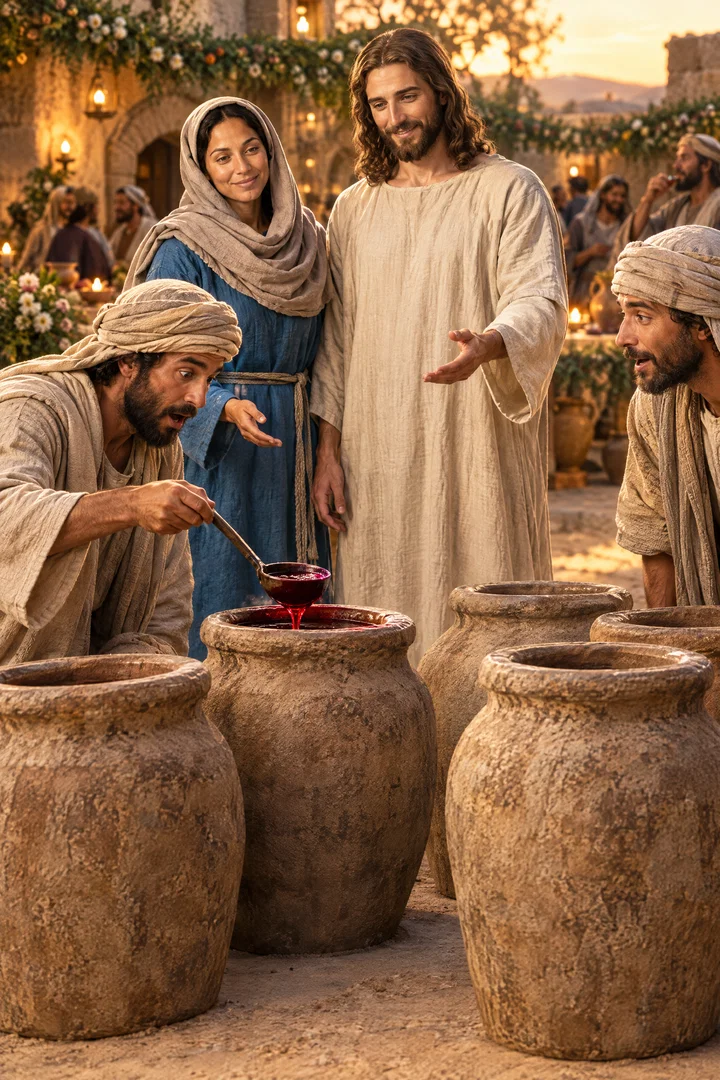
This beginning of miracles did Jesus in Cana of Galilee, and manifested forth his glory; and his disciples believed on him.
Translations
American King James Version, King James Version, KJV Cambridge Paragraph Bible
This beginning of miracles did Jesus in Cana of Galilee, and manifested forth his glory; and his disciples believed on him.
This beginning of miracles Jesus performed in Cana of Galilee, and manifested his glory; and his disciples believed on him.
Revised Version, American Standard Version
This beginning of his signs did Jesus in Cana of Galilee, and manifested his glory; and his disciples believed on him.
This beginning of the signs did Jesus in Cana of Galilee, and manifested his glory, and his disciples believed in him;
This beginning of signs did Jesus in Cana of Galilee, and manifested his glory; and his disciples believed on him.
This, beginning of his signs, did Jesus, in Cana of Galilee, and manifested his glory; and his disciples believed on him.
Berean Standard Bible, Majority Standard Bible
Jesus performed this, the first of His signs, at Cana in Galilee. He thus revealed His glory, and His disciples believed in Him.
This beginning of his signs Jesus did in Cana of Galilee, and revealed his glory; and his disciples believed in him.
This, the first of his signs, Jesus did at Cana in Galilee and let his glory be seen openly; and his disciples put their faith in him.
This beginning of miracles did Iesus in Cana a towne of Galile, and shewed forth his glorie: and his disciples beleeued on him.
Douay-Rheims (Challoner revision)
This beginning of miracles did Jesus in Cana of Galilee; and manifested his glory, and his disciples believed in him.
Pictures
Cross-references 20 of 23
- John 4:46-54
So Jesus came again into Cana of Galilee, where he made the water wine. And there was a certain nobleman, whose son was sick at Capernaum.
The Cana water-into-wine miracle leads into another sign and the nobleman’s faith in Jesus’ healing.
- John 1:14
And the Word was made flesh, and dwelt among us, ( and we beheld his glory, the glory as of the only begotten of the Father,) full of grace and truth.
Jesus’ sign at Cana manifests the glory of the Word made flesh.
- John 2:23
Now when he was in Jerusalem at the passover, in the feast day, many believed in his name, when they saw the miracles which he did.
Many believed in Jesus after seeing the signs he performed.
- John 2:4
Jesus saith unto her, Woman, what have I to do with thee? mine hour is not yet come.
Jesus asserts his divine mission in replying to Mary before the Cana miracle.
- John 20:31
But these are written, that ye might believe that Jesus is the Christ, the Son of God; and that believing ye might have life through his name.
Jesus’ signs reveal him and lead people to believe and have life through his name.
- John 11:40
Jesus saith unto her, Said I not unto thee, that, if thou wouldest believe, thou shouldest see the glory of God?
Both link belief with seeing God’s glory manifested.
- John 2:5
His mother saith unto the servants, Whatsoever he saith unto you, do it.
Mary’s call to obey Jesus precedes his miracle and the disciples’ belief.
- John 3:2
The same came to Jesus by night, and said unto him, Rabbi, we know that thou art a teacher come from God: for no man can do these miracles that thou doest, except God be with him.
Jesus’ works are identified as signs performed with God’s presence.
- Isaiah 40:5
And the glory of the LORD shall be revealed, and all flesh shall see it together: for the mouth of the LORD hath spoken it.
Cited alongside the manifestation of Christ’s glory.
- Exodus 33:18-19
And he said, I beseech thee, shew me thy glory.
God’s glory is revealed through his goodness and character.
- John 14:12
Verily, verily, I say unto you, He that believeth on me, the works that I do shall he do also; and greater works than these shall he do; because I go unto my Father.
Greater works are heart changes, not more Cana miracles.
- Hebrews 1:3
Who being the brightness of his glory, and the express image of his person, and upholding all things by the word of his power, when he had by himself purged our sins, sat down on the right hand of the Majesty on high;
The Son is the outshining of God’s glory.
- John 6:2
And a great multitude followed him, because they saw his miracles which he did on them that were diseased.
Both accounts describe Jesus’ miraculous signs, which reveal his glory and inspire belief.
- John 21:2
There were together Simon Peter, and Thomas called Didymus, and Nathanael of Cana in Galilee, and the sons of Zebedee, and two other of his disciples.
Identifies Cana as Nathanael’s home.
- John 12:37
But though he had done so many miracles before them, yet they believed not on him:
Both describe Jesus’ miracles as signs.
- John 11:47
Then gathered the chief priests and the Pharisees a council, and said, What do we? for this man doeth many miracles.
Both texts describe Jesus’ miracles.
- John 5:36
But I have greater witness than that of John: for the works which the Father hath given me to finish, the same works that I do, bear witness of me, that the Father hath sent me.
Jesus’ works bear witness to who he is.
- John 7:31
And many of the people believed on him, and said, When Christ cometh, will he do more miracles than these which this man hath done?
Both describe Jesus’ miracles as signs that lead people to believe in him.
- John 6:26
Jesus answered them and said, Verily, verily, I say unto you, Ye seek me, not because ye saw the miracles, but because ye did eat of the loaves, and were filled.
Both verses use the word translated “miracle.”
- John 9:16
Therefore said some of the Pharisees, This man is not of God, because he keepeth not the sabbath day. Others said, How can a man that is a sinner do such miracles? And there was a division among them.
Both describe Jesus’ works as miracles.
Commentary
Each commentary is drawn from primary sources: the writings of Ellen G. White and Adventist pioneers and periodicals. Each commentary is separate. Its own words are not a quotation; follow the references to read the source passages.
Ellen G. White
66 sources
This beginning of miracles was the changing of water into wine at the wedding in Cana of Galilee, opening His public ministry.DA 144.1ST Sep 6, 1899Ms 22, 1898, par. 36–40 In it He manifested forth His glory by displaying miraculous power in an unassuming manner, and His disciples believed on Him with confirmed and strengthened faith in Him as the Saviour of the world.DA 144.1Ms 22, 1898, par. 36–40Ms 126, 1903, par. 12–14Ms 79, 1900, par. 20–25 By attending the marriage festival and working His first miracle there He gave marriage His clear sanction as a divine and sacred institution He Himself had established.DA 144.12SP 110.1Ms 16, 1899, par. 5–9 The wine He made was pure, unfermented juice of the grape with nothing intoxicating in it, giving no sanction for drinking fermented wine.ST Sep 6, 1899Ms 22, 1898, par. 36–403RED 7.2–8.3MH 333.2–3Ms 16, 1899, par. 17–21 The act showed His sympathy for people and desire to promote their happiness, sanctioning innocent social fellowship without self-indulgence or worldly levity.DA 144.1ST Apr 8, 1886COS 56.1–57.1COS 57.5–6MYP 384.1 The provision symbolized salvation, with the water representing baptism into His death and the wine representing His blood shed to cleanse the world from sin.3RED 7.2–8.32SP 103.3–104.2
Wedding Setting and Beginning
This beginning of miracles was the turning of water into wine at the wedding feast in Cana of Galilee, the first display of miraculous power and the opening of the public ministry.DA 144.1ST Sep 6, 1899Ms 22, 1898, par. 36–40Ms 126, 1903, par. 12–1410MR 204.1–206.2 It stands as the beginning of signs, left on record to show divine power put forth in human perplexity.Ms 126, 1903, par. 12–143RED 7.2–8.3 The wedding was at Cana, a town near Nazareth, among relatives of Joseph and Mary.ST Apr 8, 1886DA 144.2 Jesus went there with His newly made disciples after returning from the Jordan, gracing the feast with His presence by special invitation because many influential persons would be gathered there.ST Apr 8, 1886DA 144.2
It took place after He had been separated from His widowed mother for about two months.ST Apr 8, 1886 During that time He had been baptized by John and had endured temptation in the wilderness.ST Apr 8, 1886 Marks of the fierce conflict remained upon His countenance, yet with holy expression and gentle dignity showing His high mission.ST Apr 8, 1886 His glory was seen in that changed countenance and presence.ST Apr 8, 1886 His disciples put faith in Him as young men who reverently called Him Master, telling Mary they had witnessed wonderful things at His baptism and afterward and declaring they had found Jesus of Nazareth, the long-looked-for Messiah written of by Moses in the law and the prophets.ST Apr 8, 1886
He did not publicize the miracle but withdrew so quietly that even His disciples did not notice.DA 149.5 Its knowledge spread when the guests marveled at the superiority of the new wine and were astonished by it.ST Sep 6, 1899DA 149.5Ms 16, 1899, par. 22 They asked about it and heard from the servants how it had been made, though at first they were too amazed to fix attention on Jesus Himself.DA 149.5 In this quiet spreading of the knowledge His purpose was accomplished.ST Sep 6, 1899
Miracle's Nature and Glory
At Cana Jesus changed the water in the jars into wine without touching it, meeting the need of the feast at the moment of perplexity.2SP 103.1–2Ms 16, 1899, par. 25 He supplied wine that was better and best, superior in quality to what had been served before, and He supplied it in abundance.2SP 103.1–2COS 56.1–57.1Ms 16, 1899, par. 17–21 By that ample, superior provision He preserved the household from the disgrace of failing to show hospitality and added to the happiness of the gathering.COS 56.1–57.1 The servants' obedience to His instructions served the miracle, and Mary's trust in His wisdom and power was honored.2SP 103.1–2
In that act He manifested forth His glory and first displayed His miraculous power.DA 144.1Ms 22, 1898, par. 36–40Ms 126, 1903, par. 12–1410MR 204.1–206.23RED 7.2–8.3 He did it in an unassuming manner, doing what no other man had done.ST Apr 8, 1886 The deed stands left on record for all ages to show that He does not fail even in such a perplexity.Ms 126, 1903, par. 12–14 Yet He never worked a miracle to help Himself or to supply His own necessities, and He never used divine power to win popular favor.Ms 126, 1903, par. 12–14
Faith and Wider Response
The turning of water to wine at Cana manifested divine glory and confirmed and strengthened the faith of the humble fishermen disciples, increasing their confidence that the Saviour of the world, the world's Redeemer, was laying the foundation of His kingdom.Ms 22, 1898, par. 36–40Ms 126, 1903, par. 12–14Ms 79, 1900, par. 20–253RED 7.2–8.32SP 103.1–2 Their belief on Him grew as they beheld what no other man had done.Ms 126, 1903, par. 12–14Ms 79, 1900, par. 20–2510MR 204.1–206.2 It gave them their first opportunity to acknowledge their faith openly and to tell others what they had seen and heard of Him at the Jordan.DA 149.5DA 149.6–150.1 That strengthening honored Mary's trust in Him and fitted them to withstand the unbelief, prejudice, and hostility they would meet from religious leaders who rejected Him as the Messiah, while awakening hope that God had raised up a deliverer for His people.DA 147.4DA 149.6–150.1
The report spread through all that region even to Jerusalem and awakened interest throughout Palestine in Christ and His work.Ms 126, 1903, par. 12–1410MR 204.1–206.2ST Apr 8, 18862SP 104.3–105.23RED 10.1 The priests and elders heard with wonder and searched with new interest and intense anxiety the prophecies of Christ's coming to learn the aim and mission of this new Teacher.ST Apr 8, 18863RED 10.1 Reports of the Cana miracle, joined with reports from the Passover of His cleansing of the desecrated temple and His healing of the sick and restoring of sight to the blind and hearing to the deaf, prepared the way for His warm and cordial reception when He returned to Galilee.ST Feb 3, 18812SP 151.23RED 14.2–15.1ST Feb 1, 1877 Many who lamented the abuse of the temple and the arrogance of the priests hoped that One with power to put the rulers to flight might be the looked-for Deliverer who could challenge the temple rulers.ST Feb 3, 18812SP 151.2ST Feb 1, 1877
That display of power in changing water into wine gave the Jewish nobleman in Capernaum reason to believe Jesus could heal his incurably sick, dying son even from the brink of the grave.ST Feb 3, 18813RED 15.2–16.12SP 152.1–153.1ST Feb 1, 1877
Symbol of Salvation
The provision at Cana was a symbol of salvation, in which the water stood for baptism into Christ's death and the wine stood for His blood shed to cleanse and purify the world from sin.3RED 7.2–8.32SP 103.3–104.2 The wine itself was pure grape juice, not intoxicating liquor.3RED 7.2–8.3 The ample supply pointed to the abundant provision made for blotting out sin.2SP 103.3–104.2
His gifts remain fresh and satisfying, unlike worldly pleasures which end in weariness and bitterness.2SP 103.3–104.2 He performed the miracle to bring the governor's perverted taste toward a healthy condition by leading him to acknowledge that this wine was better than any he had tasted before.2SP 103.3–104.2ST Aug 29, 1878 In this way the gift brought the taste into harmony with a healthful appetite.2SP 103.3–104.2
Christ's power to turn the common water of life into the wine of heaven still works with a God-fearing mother who keeps close connection with Him.GW 206.2–3RH Jan 24, 1907 It transforms her loving ministry and service in the home into a ministry of lasting spiritual value.GW 206.2–3 Her ministry of love makes the home a Bethel, because Christ works with her.RH Jan 24, 1907 His presence brings happiness and makes the home a place of heavenly joy, like Eden, and a symbol of the family in heaven.RH Jan 24, 1907Ms 43, 1900, par. 50
Together with the feeding of the multitude, providing drink at the feast shows Jesus as the heavenly Provider who supplies human necessities.CH 599.1–2Ms 81, 1902, par. 14GW 362.2–363.1 This lesson is applied to the preparation and provision of healthful food.CH 599.1–2 The food business is one of the Lord's own instrumentalities to supply human necessity, and health-food work is one means God uses to supply these needs.Ms 81, 1902, par. 14GW 362.2–363.1 As the heavenly Provider of all foods, God will not leave His people in ignorance but will teach them the preparation of the best foods for all times and occasions.Ms 81, 1902, par. 14GW 362.2–363.1
Marriage Honored and Restored
By attending the marriage festival at Cana and performing His first miracle there, Jesus gave marriage His clear sanction and high endorsement.2SP 110.1Ms 16, 1899, par. 5–9ST Apr 8, 1886MH 356.1Ms 36, 1899, par. 6 He thereby honored it as a divine and sacred institution He Himself had established and formed, and He hallowed the relationships of human life.DA 144.12SP 110.1Ms 16, 1899, par. 5–9MH 356.13RED 13.3–14.1 His presence and act showed that He would be present at marriage occasions.Ms 16, 1899, par. 5–9 His respect for the marriage covenant continued throughout His ministry, and He used marriage to illustrate important truths.2SP 110.1ST Apr 8, 1886
He came not to forbid marriage, destroy family life, put a cloud over happiness, or enforce celibacy on any class.Ms 16, 1899, par. 25Ms 126, 1903, par. 23–24Ms 22, 1898, par. 41 He came not to destroy the sacred relationship of marriage but to restore, elevate, purify, ennoble, and exalt it to its original sanctity.Ms 126, 1903, par. 23–24Ms 22, 1898, par. 41 Marriage joined with purity, holiness, truth, and righteousness is a sacred blessing to the human family.Ms 16, 1899, par. 5–9 It is to unite husband and wife in mutual respect, love, and care, and their belief in Christ is to make them one in Him as they learn from Jesus and grow in His Spirit.Ms 36, 1899, par. 6
The family on earth is to symbolize the family in heaven.Ms 22, 1898, par. 41 God's grace in the Christian home is to transform human character so that the church becomes active and living.Ms 22, 1898, par. 41 Christ looks with pleasure on the family where sacred and unselfish love rules.Ms 126, 1903, par. 23–24
Pure Wine and Temperance
The wine made at Cana was pure, clarified, refined juice of the grape, fresh and unfermented, wholesome and refreshing, with no fermentation, adulteration, or anything intoxicating in it.ST Sep 6, 1899Ms 22, 1898, par. 36–403RED 7.2–8.3HL 113.1ST Apr 8, 1886 It was the new wine found in the cluster in which is blessing, the safe kind of drink to use.Ms 22, 1898, par. 36–40MH 333.2–3 Its purity also brought the taste into harmony with a healthful appetite.ST Apr 8, 18862SP 103.3–104.2
The miracle set an example of strict temperance rather than endorsing intoxicating wine, and gives no sanction for drinking fermented wine.ST Sep 6, 1899Ms 16, 1899, par. 17–21ST Apr 16, 1896Ms 126, 1903, par. 15 Christ never by word or act approved the use of fermented wine, and the Bible nowhere sanctions intoxicating wine.MH 333.2–3Ms 126, 1903, par. 15 He who warned in the Old Testament that wine is a mocker and strong drink is raging provided no such beverage at Cana and did not contradict His own teaching.MH 333.2–3 He foresaw the harm wine would cause in every generation, and the miracle does not make fermented wine harmless or endorse its use.Ms 16, 1899, par. 17–21ST Apr 16, 1896
He never places temptation before men but teaches the lower nature to be brought into subjection.MH 333.2–3Ms 106, 1903, par. 8–11 His whole life was self-denial, and He came straight from His long fast and suffering in the wilderness to break the power of appetite over man including the free use of intoxicating liquor.ST Apr 8, 1886MH 333.2–3 What He gives is soul-refreshing and life-giving, with nothing connected with it that ministers to evil.Ms 106, 1903, par. 8–11
The same pure, unfermented juice was what He gave His disciples as a symbol of His own blood and what was used at the first communion.MH 333.2–3Ms 106, 1903, par. 8–11 Just as there was to be no leaven in the Passover bread there was to be no fermentation in the wine.MH 333.2–3Ms 106, 1903, par. 8–11 Only such wine should always be used on the communion table as a symbol of His blood, because the sacramental service is designed to be soul-refreshing and life-giving with nothing connected with it that could minister to evil.MH 333.2–3 His use of unleavened bread and unfermented wine at the sacramental service proves the same temperance lesson.Ms 126, 1903, par. 15
His act requires keeping wine and liquor out of the house and using only unfermented grape juice, leaving the mind clear to honor God with full strength.Ms 230, 1902, par. 32–33 It shows that God's people must be temperate in all things to be susceptible to the sanctifying influence of truth.STA 127.1 The verse teaches true health reform by showing Jesus giving life and health to cure and prevent sickness.STA 127.3–128.1 Its object is securing the highest possible development of mind and soul and body through obedience to nature's laws which are God's laws for good in this life and preparation for the life to come.STA 127.3–128.1 This requires ministers to become intelligent on health reform and teach its principles by precept and by quiet, consistent example, with instruction at large gatherings to arouse the intellect and conscience.STA 127.1
Sympathy and Social Ministry
This beginning of miracles at Cana showed sympathy for people and a desire to promote their happiness, adding joy to the gathering by blessing the feast and sharing in human happiness.DA 144.1COS 56.1–57.1COS 57.5–6 He welcomed innocent happiness and took part in ordinary human life, while rejecting intemperance, self-indulgence, and revelry.MYP 384.12SP 109.1–2 He came not to put a cloud over family happiness but was in full sympathy with pure joy.DA 144.12SP 109.1–2 The miracle also displayed mercy and compassion and care for the needs of people who followed Him to hear His teaching.Ms 79, 1900, par. 20–25
By attending He sanctioned innocent social happiness and social fellowship without self-indulgence or worldly levity.ST Apr 8, 1886MYP 384.13RED 10.1 He joined the mixed assembly of a festal gathering without any shadow of worldly levity, unlike the Pharisees and dignitaries who preserved an austere seclusion.ST Apr 8, 18863RED 10.1 His presence there proves His character was genial and beneficent rather than secluded, self-righteous, bigoted, and exclusive.GW92 319.2–320.115MR 132.2–3 His attendance was consistent with a generous, benevolent character.GW92 319.2–320.115MR 132.2–3
His attendance does not justify theaters, parties, and dances or remove the call to practical godliness, and His presence was not worldly conformity.GW92 319.2–320.121MR 242.6–243.2GW 334.4–335.1 Through precious teachings and generous conduct He honored those who invited Him, enshrined Himself in their hearts, and gave them opportunity to become acquainted with Him and to know His character.GW92 319.2–320.116MR 318.2–319.1Lt 2a, 1878, par. 8–1015MR 132.2–3 In this He revealed the marked contrast between His life and teachings and those of the Pharisees, with their self-righteous, bigoted, exclusive and restrictive ideas.GW92 319.2–320.1GW 334.4–335.116MR 318.2–319.1Lt 2a, 1878, par. 8–1015MR 132.2–3
His example gives a lesson for His disciples through all time not to exclude themselves from society or to preserve religion by hiding it within stone walls to escape contamination of the world.2SP 106.1–107.2GW92 319.2–320.1ST Apr 8, 1886 They are to break down icy reserve and social and religious divisions, bringing people together as members of one family.DA 150.23RED 11.2–12.1GW92 319.2–320.1 To reach all classes they must meet people where they are at their daily work and temporal affairs and show real interest in their lives, because people will seldom seek them on their own and hearts are not touched by divine truth from the pulpit alone.2SP 106.1–107.2ST Apr 8, 1886 The Saviour sought men in the public streets, in private houses, on boats, in the synagogue, by the shores of lakes, and at marriage feasts, carrying instruction into households so whole families in their own homes came under the influence of His divine presence.ST Apr 8, 1886ST Apr 8, 1886 Those who follow Him are to hold property, mental powers, and spiritual strength as lent to advance His cause, and not to shun the society of fellow men but to seek it with a kind, generous spirit toward the poor in order to bestow heavenly benefits upon others.GW92 319.2–320.1
At such pleasant gatherings He revealed the way of salvation to hearts ready to receive it.COS 57.5–6 Christ awakened interest by going among people as one who desired their good.ST Apr 8, 1886 The miracle helped break down Jewish prejudice, taught the disciples sympathy and humanity, and drew His relatives to Him with warm affection.2SP 109.1–2
Sources
Pioneers and periodicals
130 sources
This beginning of miracles was the first sign of the public ministry, wrought at a wedding in Cana of Galilee soon after the baptism, the calling of the disciples and the witness of John.ST Apr 8, 1886ST Feb 15, 1899ST Feb 15, 1899ST Jan 11, 1905 In turning water to wine He manifested forth His glory, revealing character, goodness, righteousness and power as the Son of God in flesh, and His disciples believed on Him as Messiah and Redeemer.ST Apr 8, 1886ST Sep 17, 1894ST Feb 15, 1899ST Feb 15, 1899ST Apr 3, 1893 By His bare word He did in a moment what nature takes months to do through the vine, the same creative power of the Word by whom all things were made that still changes water to wine each season in every vineyard.ST Sep 29, 1898RH Jun 22, 1916ST Aug 13, 1894RH Feb 8, 1906 The wine He made was pure unfermented juice of the grape without decay or alcohol, setting an example of temperance and giving no approval to intoxicating drink.ST Sep 6, 1899ST Nov 25, 1908ST Jul 1, 1897ST Jun 30, 1881 By beginning His ministry at a marriage He sanctioned marriage as a divine Eden-born institution and sanctified pure social joy, while the change preaches the Gospel as transformation of the heart from water to wine unto salvation.ST Nov 10, 1914ST Apr 8, 1886ST Apr 5, 1905RH Jul 28, 1903ST Aug 13, 1894
Cana Wedding Setting
This beginning work was the first miracle, done a little while after the temptation in the wilderness, after baptism by John and after the calling of disciples, on the third day after John bore witness to Jesus a second time, early in the public work before taking up abode.ST Apr 8, 1886ST Aug 13, 1894ST Sep 16, 1886ST Aug 13, 1896 It happened at a wedding in the little village of Cana, where Jesus had reached Galilee with His disciples and was present along with Mary.ST Aug 13, 1894 He had been separated from His widowed mother for about two months, leaving marks of fierce conflict on His countenance with holy expression and gentle dignity showing His high mission.ST Apr 8, 1886
The place is Cana of Galilee, eight or nine miles northeast of Nazareth and the home of Nathanael, in the region where Jesus spent His early life, lived among His chief companions, spoke important words, and did much of His important work.ST Aug 13, 1894ST Dec 12, 1878 Cana is the name of the place, not the bride, whose name is not given.ST Jul 13, 1882 It lies nearly an hour and a half from Nazareth and scarce half an hour from Gath-Hepher, reached from its spring by a road lined with high cactus hedges, now called Kefr Kenna with about 600 inhabitants half Moslems and half Christians, with a Greek church where a broken water-pot claimed to be from the wedding is shown.ST Jun 2, 1898 That earlier work at Cana identifies it as the place of the later healing of the nobleman's son, which is called the second sign in Galilee, and the marriage supper took place there.RH Jul 28, 1904ST Feb 1, 1905
The occasion was a marriage in Cana of Galilee among relatives of Joseph and Mary, which Jesus attended with His newly made disciples because many influential persons would be gathered there, gracing the feast with His presence by special invitation.ST Apr 8, 1886 He was present at the wedding as a guest of the bridegroom, together with His mother, who remained after He departed, and though He was the Master His presence as guest brought joy and blessing to the celebration and to the hearts that loved Him.ST Jul 26, 1910 He turned water into wine to supply the occasion's needs as an honored guest at the marriage feast where He came with His newly made disciples.ST Dec 30, 1880ST Aug 5, 1897
When the wine ran out Mary told Jesus of the need, suggesting He could help, and Jesus replied that His hour had not yet come.ST Dec 30, 1880 The failure happened about the sixth hour when the table was spread and the guests were seated, through a strange and unaccountable mistake.ST Jul 26, 1910 At His command the servants filled the six great stone water-pots with water, which they did, and He commanded that it be drawn out and taken to the man in charge of the ceremonies, turning the water into wine.ST Mar 10, 1887 The wine was drawn from the stone pots as soon as they were filled, leaving no time for fermentation, and the event was not a concealed supply of wine or a deceptive trick but a real miracle.ST Mar 10, 1887ST Jul 13, 1882 The butler witnessed the miracle, though the bridegroom did not know about it at the time.ST Jul 26, 1910
The first miracle at Cana was performed openly before the wedding company: the servants, His mother, and the disciples knew of it, and the whole company soon learned that He had changed water into wine.ST Apr 5, 1905 The water became good, pure wine as the servants drew it from the pots, while the steward did not know that the wine had run out or where the new wine came from, and both the lack and the supply were hidden from the bridegroom until many hours afterward.ST Jul 26, 1910ST Jul 26, 1910 When the guests asked where the wine came from, the servants' account of what had happened brought attention to Jesus; He withdrew modestly, giving His disciples the opportunity to proclaim Him as the Son of God and the Messiah.ST Feb 15, 1899 The miracle was not spoken of until after Jesus had departed.ST Jul 26, 1910
News of the event spread as far as Judea and through all that region even to Jerusalem, and Jesus then sought a few days of retirement.ST Apr 8, 1886ST Feb 15, 1899 Its news caused the priests and elders to hear with wonder and to search with new interest the prophecies of the coming of Christ with intense anxiety to know the aim and mission of this new Teacher.ST Apr 8, 1886 Reports of the miracle, along with reports of His acts in Jerusalem, prepared the way for a warm reception when He returned to Galilee and helped people see Him as a possible Deliverer who could challenge the temple rulers and helped prepare people in Galilee to receive Him.ST Feb 3, 1881ST May 6, 1886 The changing of water into wine displayed His glory and led His disciples to believe in Him, confirmed their faith and testified to them that He was the world's Redeemer, and also encouraged the nobleman to trust that Jesus could heal his dying son.ST Sep 6, 1899ST May 6, 1886
First Sign Reveals Glory
This work at Cana was the beginning of miracles, the first sign and the opening of the miracle-working career and public ministry.ST Feb 15, 1899ST Feb 15, 1899ST Jan 11, 1905ST Aug 13, 1894ST Dec 23, 1897 Through it glory was manifested and the disciples believed.ST Feb 15, 1899ST Feb 15, 1899ST Jan 11, 1905ST Aug 13, 1894RH Sep 11, 1860 It was performed before the ministry taken up afterward, and it revealed glory to bring belief.ST Dec 23, 1897RH Sep 11, 1860
The word rendered miracles means a sign or token, especially a supernatural indication of divine mission.ST Apr 23, 1902 Such signs stood distinct from the ordinary workings of nature, showing power beyond its common operation.ST Apr 23, 1902 Each representative miracle disclosed a lesson and an added aspect of grace or power.ST Apr 12, 1905 The many miracles, including this one at Cana, stand as evidence of that mission.ST Aug 16, 1910
To manifest glory is to reveal character, what He truly is, in goodness, righteousness, power and beauty.ST Sep 17, 1894ST Apr 3, 1893ST Jan 14, 1897 He is the brightness of the Father's glory, the visible manifestation to the world of the glory of the Invisible One, a running thought through John's Gospel.ST Jan 14, 1897ST Jun 18, 1896 Though appearing as an ordinary man, His glory was present as grace veiled so mortal eyes would not be dazzled, not mere outward display.ST May 21, 1896 It was seen in changed countenance and presence and word, after separation from His widowed mother for about two months, baptism by John, and temptation in the wilderness that left marks of fierce conflict with holy expression and gentle dignity showing His high mission.ST Apr 8, 1886 By creative power He supplied temporal need, teaching that the same power can meet spiritual need.ST Sep 17, 1894
Glory and power are the same, for by wondrous power turning water to wine by the bare word He manifested forth His glory.ST Nov 24, 1898 The record is brief, simple and natural, giving a close-range view of mighty power with a father's simplicity toward a little child to encourage confidence.ST Sep 29, 1898 That glory is to be seen as clearly now as the disciples saw it then, with the same result of believing for life in His name.ST Sep 29, 1898 To say all glory belongs to God means all power belongs to Him and salvation is wholly His work, since man is without strength and does not save himself but God the Almighty can and does save, and confessing this keeps men from vain-glory and boasting so God is glorified in them.ST Nov 24, 1898
Through the sign He showed Himself as both Son of God and Son of Man, bringing God's life, righteousness and purity to humanity as a brother sharing human feelings and responding to pure thoughts, sympathies, hopes and longings.ST Apr 5, 1905 The first sign revealed divine power and spiritual nature hidden beneath human form.ST Jul 9, 1896ST Jan 11, 1905 Seeing the glory led the disciples to believe, confirming and greatly strengthening faith in Him as Master, Messiah, Son of God and world's Redeemer, unto life through His name.ST Sep 17, 1894ST Feb 15, 1899ST Sep 29, 1898ST Jul 9, 1896ST Jan 11, 1905
Creative Power in Nature
The turning of water into wine at Cana was a real miracle done at command, when the servants filled the six stone water-pots and the water became wine, not a hidden store brought forward and not a trick of appearance.ST Mar 10, 1887 It stands in Scripture as a miracle, affirming that miracles are real against the claim that they are impossible.ST Jan 21, 1903 It belongs with the Bible's supernatural works that cannot be set aside while still holding to the Bible's account of God and faith.RH May 10, 1906
By His bare word, without explaining how, He did in a minute what is done through the vine over months and about a year, bringing together in a moment the elements that make good wine.ST Sep 29, 1898RH Aug 20, 1908RH May 29, 1900 This was an acceleration of natural law, distinct from a suspension of natural law, from a direct act of creative power in the strict classification used, and from the lifting of the curse in the healing of disease, marking where divine action goes beyond what laws of health can accomplish in curing sickness. It was a distinct, miraculous interposition of God, yet not contrary to the laws of nature.RH Aug 20, 1908RH May 29, 1900 It did not establish instant production as the new or ordinary or better way to obtain wine, for ordinary wine-making continued afterward through cultivating the soil and vines.RH Jun 22, 1916 The sudden shortening of the process directs attention beyond the visible change to the power behind it, which is also displayed in nature's slower process.
The vines are not independent powers but only visible forms through which the life of the true Vine works, and the miracle was the same life God puts into grapes through nature, produced instantly by word rather than through the slower natural course.ST Sep 29, 1898ST Aug 13, 1894 In nature water is gradually transformed through vine and grape, while at Cana He dispensed with the visible vine and with time and did the same work directly.ST Sep 29, 1898RH Feb 8, 1906 Instant and gradual provision require the same power and differ only in speed and method, direct or indirect, so that the uncommon instant miracle reveals the same divine power at work when grapes become wine over time.RH Apr 9, 1901 Bread and wine produced instantly point to the same divine provision in food and drink produced over time, and a gradual process is as much a miracle as an instantaneous one.RH Apr 9, 1901 The same power is at work each season in every vineyard, and the same Jesus is the true healer, working through gradual recovery as well as through instantaneous healing.RH Mar 4, 1902ST Dec 22, 1898
The glory manifested is His glory as the Word by whom all things were made and by whose powerful word all things are upheld and hold together, maintaining the stars and all operations of nature.ST Sep 29, 1898 The ordinary processes by which food and drink come to men ultimately depend on Christ, and the miracle does not reject or disparage those processes but links them to Him as their source and honors them as expressions of His power.RH Feb 8, 1906 It bears the stamp of creative power and authority over nature in creating wine from water.RH Jun 18, 1914 The God who provides wine through nature can also provide it miraculously when the natural supply fails.RH Oct 7, 1902
The work displayed divine power, bore witness that its Author was divine, relieved the ruler of the feast and cheered the guests.ST Nov 1, 1910ST Dec 17, 1885ST Sep 15, 1898 From that miracle until death on Calvary all that He did was a revelation of the wisdom, power, and love of God.ST Sep 15, 1898
It is a marvel men notice, while they take for granted the grape's transformation of water into wine as it grows.ST Aug 26, 1880 The same power at work through the grape is unrecognized through unbelief.ST Dec 22, 1898 The rapid change at Cana was a sudden emergency case, unlike the usual growth of Christian character which takes a lifetime to reach perfection, yet it does not prove that an even, growing experience has less power than a sudden conversion, since both depend on divine life and power.RH Jan 28, 1902
Pure Wine Teaches Temperance
The wine made at Cana was pure, good, sweet, rare, purple, rich, new, healthful and refreshing unfermented juice of the grape.ST Sep 6, 1899ST Nov 25, 1908ST Jun 30, 1881ST Mar 6, 1893 It was the finished product of growth without decay, leaven or alcohol, for it was drawn as soon as the pots were filled and there was no time for fermentation to decompose the sugar.ST Sep 6, 1899ST Apr 8, 1886ST Jul 13, 1882ST Jun 30, 1881ST Aug 19, 1889 Alcohol is not a good gift found in the vine or its fruit, and the drink provided was like fresh juice, delicious and health-giving, fitting the Bible's language about good fruit and fruit of the vine.ST Nov 25, 1908ST Aug 19, 1889ST Mar 6, 1893 No drunkenness followed it.ST Nov 25, 1908
It set an example of temperance rather than endorsing intoxicating wine.ST Sep 6, 1899ST Apr 8, 1886ST Feb 7, 1878 Fermentation is always a symbol of corruption, decay and rottenness, and no fermented drink is ever used for sacred purposes, including the marriage feast, where fresh grapes, unfermented juice and raisins are the symbol of benediction.ST Apr 8, 1886ST Feb 7, 1878 He who inspired the warning that wine mocks and deceives and that red wine moving in the cup bites like a serpent would not make what He condemns.ST Apr 8, 1886ST Feb 7, 1878 Having come straight from long fasting and suffering in the wilderness to break the power of appetite over man, including the free use of intoxicating liquor, He made pure clarified refined juice with nothing intoxicating or adulterated.ST Apr 8, 1886ST Apr 16, 1896 The miracle therefore does not make fermented wine harmless or endorse its use, and the kind He provided is distinct as the kind the Lord permits men to drink from intoxicating wine condemned elsewhere in Scripture.ST Apr 16, 1896ST Jul 1, 1897
The account gives no command to drink intoxicating wine and no basis for treating it as approval of such drinking.ST Jul 13, 1882ST Jan 12, 1882ST Apr 22, 1889ST Jan 12, 1882ST Apr 22, 1889 What is honored by miracle may still be set aside, for He also miraculously fed five thousand with barley loaves yet men may set barley bread aside because they dislike it.ST Jan 12, 1882ST Jan 24, 1878ST Apr 22, 1889ST Apr 22, 1889 So a man may give up wine, not from reproach or ingratitude toward Christ, but to help a weaker brother, to bear another's infirmity, and to fulfill the law of Christ.ST Jan 12, 1882ST Jan 24, 1878ST Apr 22, 1889ST Jan 12, 1882 Whether other wines of that time were intoxicating or non-intoxicating is not established by this account alone.ST Jul 13, 1882
The harmless useful wine is the same kind as the fruit of the vine in the Lord's Supper, the pure blood of the grape to be drunk new in the Father's kingdom and furnished to all guests at the marriage supper of the Lamb.RH Dec 24, 1901 It is by nature incapable of producing intoxication or poison, good enough to be drunk in heaven, entirely distinct from fermented poisonous wine that brings misery to hearts and homes.RH Dec 24, 1901 It is the food-drink that makes glad the heart of man and in which there is a blessing, and the little wine directed for Timothy's stomach and infirmities. The superior new wine accomplished its purpose when the governor acknowledged it better than any he had tasted, bringing perverted taste toward a healthy condition and into harmony with healthful appetite.ST Apr 8, 1886ST Aug 29, 1878ST Jan 11, 1905
Marriage and Social Life
By beginning His public ministry at a marriage He sanctioned marriage and affirmed it as an institution He Himself had established.ST Nov 10, 1914ST Apr 8, 1886RH Jul 28, 1868RH Nov 19, 1861 It is a divine Eden-born institution, established before sin entered, twin with the Sabbath, honorable, right and sacred.ST Apr 8, 1886ST Aug 13, 1894STRH Jul 28, 1868 It is intended for men and women to form families whose members are honored as part of the family above, and when shared in one faith to glorify God it is not to be entered lightly or hastily.ST Nov 10, 1914ST Apr 8, 1886ST His respect for the marriage covenant continued throughout His ministry, and He used marriage to illustrate important truths.ST Apr 8, 1886RH Nov 19, 1861
His presence and miraculous power at Cana sanctioned and cheered the marriage bond and honored marriage.ST Apr 5, 1905ST Apr 5, 1905 That presence showed that divine goodness and blessing belong in marriage.ST Apr 5, 1905 It showed that His goodness, life and blessing belong in the marriage bond as in every other part of life.ST Apr 5, 1905
He accepted hospitality at the marriage, displaying a generous nature and taking pleasure in friendly social gatherings.RH Oct 16, 1913 He was present as guest though He was Master, and His presence brought joy and blessing to the celebration and to the hearts that loved Him.RH Aug 26, 1902 His first miracle there was performed to increase the happiness of His friends and spare them embarrassment, teaching that people may come to Him in every emergency, including ordinary needs that are not cases of intense suffering or dire distress.ST Jan 2, 1912 His presence there shows that He sanctifies true earthly joys.ST Aug 13, 1894 He affirmed innocent happiness without approving intemperance, self-indulgence or revelry, and His willingness to meet people in ordinary social settings exemplifies meeting people where they are in pure refined social gatherings overflowing with joy.RH Oct 16, 1913ST Dec 30, 1880RH Aug 26, 1902
He sanctioned the social gathering with His presence by joining the mixed assembly of a festal gathering.ST Apr 8, 1886RH Oct 16, 1913 No shadow of worldly levity marred His conduct, and He kept His character as the Son of God and did not conform to worldly ways.ST Apr 8, 1886ST Dec 4, 1884RH Oct 16, 1913 He rebuked intemperance, self-indulgence and folly and gave no license to scenes of dissipation and revelry, yet He was social in nature and innocent happiness was pleasing to Him.ST Dec 30, 1880RH Nov 26, 1901RH Oct 16, 1913 He was present to manifest saving power and bear witness to present truth, not simply to seek amusement or to indulge Himself or lower His conduct, but He used social contact to lift people's thoughts toward spiritual and eternal things while standing there as much the Saviour as when teaching the multitude, by no word or act lowering the dignity and standard of His high and holy calling.RH Feb 25, 1904RH Nov 26, 1901RH Oct 16, 1913 A Jewish marriage was a solemn and impressive occasion whose pleasure and joy were not displeasing to the Son of man.RH Oct 16, 1913
He began His wonder-working ministry through a social rather than an ecclesiastical act, revealing God's power there to manifest His glory and win His disciples' belief and attachment.RH Jul 28, 1903 The event showed God's concern for human social life and love, and His approval of simple social observances.RH Jul 28, 1903RH Jul 28, 1903 It stood against the idea that religious holiness requires separating the sexes.RH Jul 28, 1903 He attended to break down Jewish exclusiveness and open the way for freer relations with other peoples, because He came as Redeemer of the world, not only as Messiah of the Jews.RH Oct 16, 1913
His doing His first miracle at a marriage feast gives a lesson for His disciples through all time not to exclude themselves from society, renouncing social communion and seeking strict seclusion from others.ST Apr 8, 1886 Those who try to preserve religion by hiding it within stone walls to escape contamination of the world lose golden opportunities to enlighten and benefit humanity.ST Apr 8, 1886 To reach all classes they must meet people where they are, because people will seldom seek them on their own, and hearts are not touched by divine truth from the pulpit alone.ST Apr 8, 1886 Christ awakened interest by going among people as one who desired their good, seeking them at their daily work and showing real interest in their temporal affairs, carrying instruction into households so whole families in their own homes came under the influence of His divine presence, and using social contact at a simple wedding gathering to lift thoughts to spiritual and eternal things when no principle is compromised.ST Apr 8, 1886RH Nov 26, 1901 The Saviour sought men in the public streets, in private houses, on boats, in the synagogue, by the shores of lakes, and at marriage feasts.ST Apr 8, 1886
His gracious service at the wedding is an example of true politeness, whose essence is unselfishness.ST Oct 6, 1887 His conduct there manifested perfect self-possession and calm repose, exemplifying power sustained by quietly reposing in God, a condition of mind that keeps mental balance under duties, cares and perplexities rather than inaction, and is the strongest expression of faith in the heavenly Father and loving confidence in His promises.ST Jul 29, 1886 He was the same in ordinary settings as in solemn ones.RH Dec 3, 1861
Salvation and Daily Application
The change of water into wine preaches the gospel, for to manifest glory is to reveal goodness and character and righteousness, which is the gospel of the glory of Christ.ST Sep 17, 1894ST Sep 29, 1898 That same power which turned the water is the power of God unto salvation, in which the righteousness of God is revealed, and the glory then shown is life-giving glory, the glory by which Christ was raised from the dead.ST Sep 29, 1898 By the exceeding greatness of that power those dead in trespasses and sins are quickened together with Christ and raised to sit in heavenly places, and beholding that glory changes them from glory to glory, so that those who sinned and came short of the glory of God are crowned again with glory and honor.ST Sep 29, 1898 The power Christ used to supply temporal need can meet spiritual need, and the lesson is to abide in Him as the true Vine, to see Him and submit to Him and be filled with the fruits of righteousness unto the glory and praise of God, since without Him nothing can be done.ST Sep 17, 1894ST Sep 29, 1898
The wine provided points to salvation in abundance, as abundant as the provision for forgiveness and for blotting out iniquity.ST Jul 9, 1896ST Jan 11, 1905 The water stands for baptism into Christ's death, and the wine for His blood shed to purify from sin and cleanse the sins of the world.ST Jul 9, 1896ST Jan 11, 1905 His divine power and spiritual nature were hidden beneath human form, and the sign confirmed and strengthened faith in Him as the expected Messiah, while showing that no human need is too small for His attention and that social life can serve to uplift.ST Jan 11, 1905 Ceremonial forms have no value without life and power from Christ, whose power creates and cleanses and raises the dead.ST Jul 9, 1896
The change also pictures Christ turning a weak and characterless human heart into something desirable and blessed.ST Apr 5, 1905 Water becoming wine shows progress from simple lower things to higher results by divine power, in which ordinary instincts become sacred inspiration and animal appetite gives way to human love sanctified by Christ.RH Jul 28, 1903 The same creative power that made the wine can change the heart to glorify God and make it fit for the kingdom, for His glory is His goodness in caring for need and meeting men where they are when they trust Him, while the refreshing juices of fruit continue to display that goodness through nature, which sin and sinful men do not show forth.ST Aug 13, 1894 Under His rule ordinary life is transformed, so that in union with Him ordinary labor becomes cooperation with God and divine duty, lifting the heart from lower life into divine change, making ordinary life divine and turning fasting into feasting.RH Jul 28, 1903RH Sep 3, 1903 God often turns water into wine for the Christian in this way, changing low common things into better richer things, as brass into silver and silver into gold, giving reason not to murmur.RH May 12, 1863
The miracle fittingly foreshadows the introduction of the saints to the heavenly kingdom at the marriage supper of the Lamb.ST Mar 8, 1899 As Bridegroom He will give His guests to drink it new in His Father's glorious kingdom, and the wine He made, rare and purple and rich and sweet and new and unfermented, is the same pure fruit of the vine that will be furnished there, incapable of producing intoxication or poison.RH Dec 24, 1901 As the best wine was kept until the last at Cana, so the riches of truth abound especially at the close of the inspired book.ST Jun 26, 1907 For life's rugged path the lesson remains: when the wine of life seems spent and only empty vessels and tears and discontent remain, fill the vessels full with flowing sap fresh from the living Vine, and before the feast is done He will turn life's water into wine.
He cares for ordinary practical needs and attends to the details of daily life, as when He provided wine for the feast.ST Jan 2, 1912RH Oct 28, 1909 The wine was not a necessity but a customary part of the celebration, yet Mary brought the problem to Him because it mattered, and He helped at the proper moment, showing that troubles are easier to bear with Him and extending that help to all who do the will of God.ST Feb 7, 1911 His first work increased the happiness of friends and spared the host the mortification of lack, giving courage to trust that He desires lawful comforts in this life as well as the life to come, granting temporal blessing as fully as possible without spiritual or physical harm.ST Jan 2, 1912ST Jan 2, 1912ST Jan 26, 1882 Men may therefore come to Him in every emergency, even in ordinary needs that are not cases of intense suffering or dire distress, for His works took a common everyday form in saving the feast.ST Jan 2, 1912RH Sep 2, 1902
He waited until the wine was wholly gone and human need was complete, responding to Mary's faith in His wisdom and power.ST Aug 13, 1894 She prepared the way by bidding the servants do whatever He said, and when all other help failed Christ became help, for man's need is God's opportunity.ST Aug 13, 1894 So still, when life's wine seems spent, those filled from the living Vine find Him turning water into wine before the feast is done.
Men assisted Him by filling the stone pots with water and carrying to the guests what had become wine, yet none of the praise for the excellent wine served last belongs to them, for all praise belongs to the Lord whose part was the all-important part.ST Jan 9, 1907 That working together illustrates the home: when a mother close to Christ serves in love, Christ works with her and transforms that service into ministry of lasting spiritual value. When a God-fearing mother keeps close connection with Christ, her ministry makes the home a Bethel, turning the common water of life into the wine of heaven and showing the power and excellency of home religion.RH Jan 24, 1907
The sign directs men to recognize God's power in ordinary life as well as in extraordinary events, so that ordinary labor is seen as cooperation with God.RH Jul 28, 1903RH Apr 9, 1901 He who changed water into wine at Cana changes water into wine each season in every vineyard, disclosing Himself as the personal agent behind nature's work and as the true healer, working through gradual recovery as well as instantaneous healing.RH Mar 4, 1902 Bread and wine made instantly point to the same divine provision in food and drink produced over time, for a gradual process is as much a miracle as an instantaneous one, and the wine in grapes eaten today has no less divinity in it than the wine made at Cana, both displaying life from God continuing in daily provision and healing.RH Apr 9, 1901RH Jan 28, 1902
News of the display of power encouraged faith for healing, leading the nobleman to trust that Jesus could heal his dying son.ST Feb 3, 1881ST May 6, 1886 That father in Capernaum took reason from Cana to believe Jesus could raise his incurably sick son even from the brink of the grave.ST Feb 1, 1877 Yet the earlier miracle did not keep the disciples from being slow to see by His word that He could also meet the hungry crowd's need.ST Mar 11, 1908
Cana opens the public work of drawing hungry souls, as the first scene of gathering men like a fisherman's net, belonging to the acts of mercy that reveal the divine mission.RH Dec 8, 1859ST Oct 31, 1916 His good works and power drew men to belief, and the hope that He will turn water into wine remains a sign of His presence bringing joy.RH Aug 23, 1906 He is remembered there as the Miracle-Worker who turned the water from the stone jars into wine.ST Jan 24, 1911
Those who held the Catholic view taught that the first miracle was wrought at Mary's request as proof of divinity, proving her great power with God as Mother of the Redeemer and advocate with her divine Son, in whom to confide most next to the Saviour.ST Mar 30, 1876RH May 12, 1874 In that account Mary is described as wishing for the change, and His reply to her is joined to the turning of water into wine.
Cana is not the clearest example of humility and submission to the Father; that example is His agony prayer in the garden.RH Apr 7, 1868 The marriage feast is contrasted with Gethsemane, where submission was illustrated through agony and trial.RH Apr 7, 1868ST Jun 14, 1877
The turning of water into wine in a moment on one special occasion does not make instant production the basis of grape culture or of training men.RH Aug 21, 1913 The normal way is to sow with tears, dig about the growing plant in hope, wait with patience for the harvest in harmony with God's laws of growth, and then reap in joy.RH Aug 21, 1913 Jesus can transform those born again after natural maturity into successful laborers in a short time, but for the most part youth require time under God-fearing instructors for discipline and Christian culture, sound judgment and essential knowledge, until character is firmly established and brought to maturity.RH Aug 21, 1913
Sources