Luke 7:11
And it came to pass the day after, that he went into a city called Nain; and many of his disciples went with him, and much people.
Translations
American King James Version, King James Version, KJV Cambridge Paragraph Bible
And it came to pass the day after, that he went into a city called Nain; and many of his disciples went with him, and much people.
And it came to pass the day after, that he went into a city called Nain: and many of his disciples went with him, and many people.
Revised Version, American Standard Version
And it came to pass soon afterwards, that he went to a city called Nain; and his disciples went with him, and a great multitude.
And it came to pass, on the morrow, he was going on to a city called Nain, and there were going with him many of his disciples, and a great multitude,
And it came to pass afterwards he went into a city called Nain, and many of his disciples and a great crowd went with him.
And it came to pass thereafter, that he journeyed unto a city called Nain, and there were journeying with him, his disciples and a great multitude.
Soon afterward, Jesus went to a town called Nain. His disciples went with Him, accompanied by a large crowd.
Soon afterward, Jesus went to a town called Nain. Many of His disciples went with Him, accompanied by a large crowd.
Soon afterwards, he went to a city called Nain. Many of his disciples, along with a great multitude, went with him.
And it came about, after a little time, that he went to a town named Nain; and his disciples went with him, and a great number of people.
And it came to passe the day after, that he went into a citie called Nain, and many of his disciples went with him, and a great multitude.
Douay-Rheims (Challoner revision)
And it came to pass afterwards, that he went into a city that is called Naim; and there went with him his disciples, and a great multitude.
Pictures
Cross-references
- John 11:43-44
And when he thus had spoken, he cried with a loud voice, Lazarus, come forth.
Jesus raises Lazarus from the dead before witnesses, as he does the widow’s son.
- 1 Kings 17:21-22
And he stretched himself upon the child three times, and cried unto the LORD, and said, O LORD my God, I pray thee, let this child’s soul come into him again.
Elijah prays, and the widow’s son returns to life.
- 2 Kings 4:32-35
And when Elisha was come into the house, behold, the child was dead, and laid upon his bed.
Elisha raises a child from the dead.
- Mark 5:22-43
And, behold, there cometh one of the rulers of the synagogue, Jairus by name; and when he saw him, he fell at his feet,
Jesus raised Jairus’s daughter.
- Luke 8:54-55
And he put them all out, and took her by the hand, and called, saying, Maid, arise.
Christ raises Jairus’s daughter to life before witnesses, as at Nain.
- John 11:39-40
Jesus said, Take ye away the stone. Martha, the sister of him that was dead, saith unto him, Lord, by this time he stinketh: for he hath been dead four days.
Lazarus’s raising and the widow’s son’s raising are literal resurrections.
- John 5:28-29
Marvel not at this: for the hour is coming, in the which all that are in the graves shall hear his voice,
Christ's voice raises the dead.
- John 11:25-26
Jesus said unto her, I am the resurrection, and the life: he that believeth in me, though he were dead, yet shall he live:
Jesus’ raising of the dead at Nain displays his power over death.
- Acts 9:36-41
Now there was at Joppa a certain disciple named Tabitha, which by interpretation is called Dorcas: this woman was full of good works and almsdeeds which she did.
Dorcas is named as another person raised from the dead.
Commentary
Each commentary is drawn from primary sources: the writings of Ellen G. White and Adventist pioneers and periodicals. Each commentary is separate. Its own words are not a quotation; follow the references to read the source passages.
Ellen G. White
13 sources
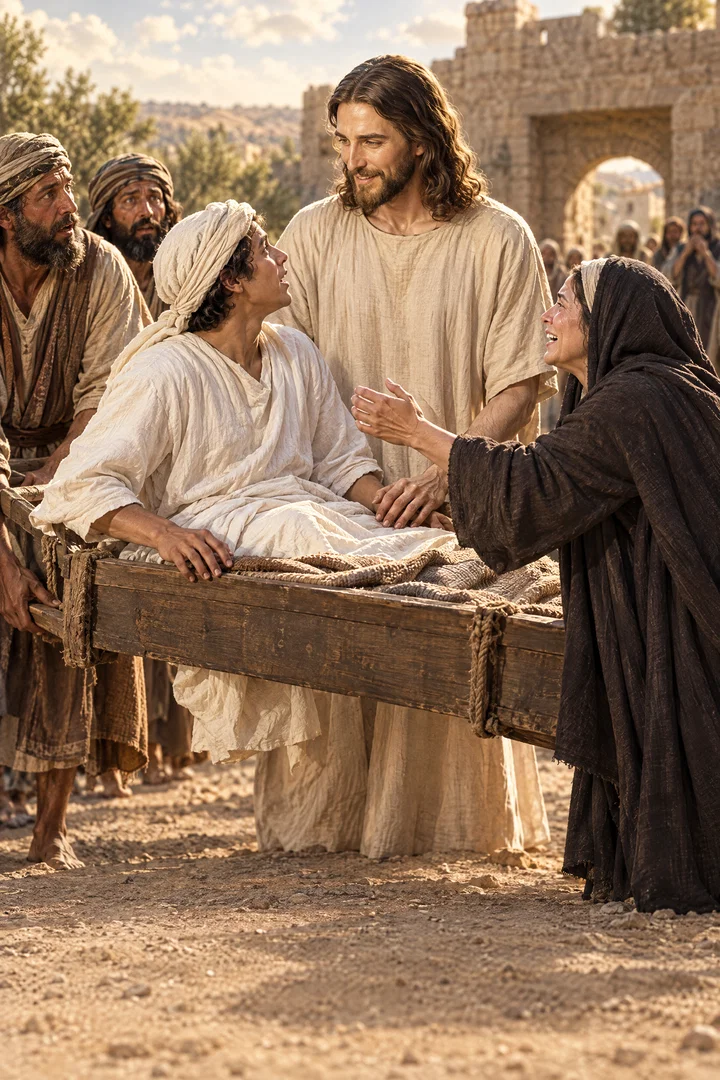
The day after leaving Capernaum Jesus went to Nain on the tableland overlooking the plain of Esdraelon, accompanied by many of His disciples and much people who joined along the way eager to hear Him, to bring their sick for healing, and hoping He would reveal Himself as Israel's King.DA 318.3–5DA 318.1–2Ms 169, 1903, par. 5–7 As He and the expectant crowd approached the city they met a funeral procession coming out, carrying to burial the only son of a widow.DA 318.3–5DA 318.1–2ST Moved with compassion for the grieving mother, He took the young man by the hand and called him back to life and gave him alive to her, bringing rejoicing and glorifying of God and spreading of the news.DA 318.3–5STDA 512.2DA 319.1–320.1Ms 1, 1867, par. 44–47 The act shows He is touched by a bereaved mother's grief and sympathizes with mourners, bringing comfort and help in grief and need to those who trust in Him, demonstrating that death is subject to His power and the power of His word over death remains undiminished for He is still a living Savior.DA 318.3–5STDA 512.2DA 319.1–320.1Ms 1, 1867, par. 44–47 The son returned only to earthly, mortal life and remained subject to death and decay, unlike the everlasting resurrection of the faithful when Christ rose, so lasting hope comes through His victory over death, and as woman's best friend He knows the burden of every mother and will uphold her with His everlasting arms and give peace and strength and wisdom and aid in every emergency if she will go to Him and trust in Him.DA 319.1–320.1Ms 115, 1897, par. 17–20ST Aug 20, 1902DA 786.1–3
Journey to Nain
The day after leaving Capernaum, Jesus went into a city called Nain, with many of His disciples and much people accompanying Him.DA 318.3–5DA 318.1–2Ms 169, 1903, par. 5–7COS 86.2–87.2ST Aug 20, 1902 Nain lay more than twenty miles from Capernaum on a tableland overlooking the plain of Esdraelon.DA 318.1–2 People joined Him along the way, eager to hear His words, to bring their sick for healing, and hoping He would reveal Himself as Israel's King.DA 318.1–2
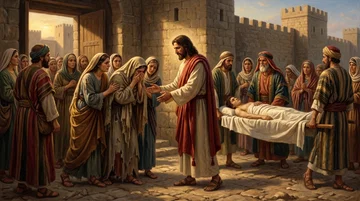
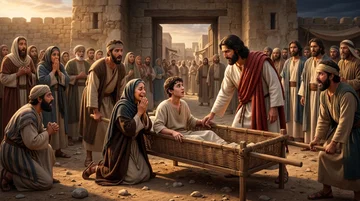
As Jesus and the expectant crowd approached Nain, they met a funeral procession coming from the city, carrying a widow's only son to burial with mourners accompanying the dead.DA 318.3–5DA 318.1–2STST Mar 23, 1882Ms 1, 1867, par. 44–47 Beside the grieving mother He took the young man by the hand and called him back to life, giving him back to her alive, which brought rejoicing and glorifying of God and spreading of the news of what had happened.DA 318.3–5DA 319.1–320.1Ms 1, 1867, par. 44–47COS 86.2–87.2ST Aug 20, 1902
Compassion and Restored Life
Jesus met the widow of Nain as her only son was being carried to burial and gave him back to her alive, because He is touched by a bereaved mother's grief and sorrow.STDA 512.2ST Mar 23, 1882MH 41.4–42.4ST Aug 20, 1902 Standing beside that grieving mother He showed His sympathy for mourners and brought comfort to her sorrow.DA 512.2DA 319.1–320.1MH 41.4–42.4 His care brings comfort and help in grief and need to those who trust in Him, and He is ready to help those in need who trust in Him.STDA 512.2MH 41.4–42.4 He could do for them more than they could ask or imagine, restoring life and comforting the bereaved mother.Ms 1, 1867, par. 44–47
His raising of the widow's son on the way into Nain with His disciples and a large crowd is an example of His compassionate medical missionary work.Ms 169, 1903, par. 5–7 In that act He demonstrated that death was subject to His power, so that the people glorified God and spread the news of what had happened.DA 318.3–5 The power of His word over death remains undiminished, for He is still a living Savior.DA 319.1–320.1 That same power is present today to help the afflicted.
The young man was called back only to earthly, mortal life and would face death again, remaining subject to death and decay.DA 319.1–320.1Ms 115, 1897, par. 17–20DA 786.1–3 His restoration differed from the everlasting resurrection of the faithful who came from their graves when Christ rose.Ms 115, 1897, par. 17–20DA 786.1–3 Lasting hope comes through Christ's victory over death.DA 319.1–320.1 As woman's best friend He knows the burden of every mother, sympathizes with her in her work, hears her earnest prayers, and upholds her with His everlasting arms.ST Aug 20, 1902 He does as much for the afflicted mother today, ready to welcome her and give her peace and joy, and to give her strength, courage, wisdom and aid in every emergency and most trying hour if she will go to Him and trust in Him.ST Aug 20, 1902
Sources
Pioneers and periodicals
71 sources
The day after healing the centurion's servant at Capernaum, Jesus went to Nain about twenty-five miles to the southwest, accompanied by many of his disciples and much people, and met a funeral procession just outside the city gate.ST Jan 30, 1896ST Sep 13, 1899ST Oct 30, 1907ST Sep 16, 1886ST Jun 2, 1881 The dead man was the only son of a widowed mother left desolate and without support, and moved with pity Jesus told her not to weep, stopped the bearers, touched the bier, commanded the young man to arise, and gave him back alive to his mother.ST Oct 30, 1907RH Jan 6, 1916ST Apr 7, 1914ST May 24, 1905RH Dec 15, 1859 He was truly dead and not merely sleeping, having died that morning with no breath left in him, and after being raised he spoke and remembered nothing except his sickness.ST Sep 20, 1910ST Aug 20, 1896ST Sep 20, 1910 The act reveals Jesus as the Giver of Life with authority and power over death as well as disease, whose spoken word makes the dead hear his voice and live.ST May 24, 1905ST Oct 30, 1907ST Apr 12, 1905ST May 24, 1905ST May 24, 1905 The restoration was a literal raising of the dead and not merely a figurative change, recording no awareness or heavenly experience during death and so showing the dead are unconscious and know nothing, while standing with the raising of Jairus's daughter and Lazarus to foreshadow the coming hour when all in the graves will hear his voice to the resurrection of life or judgment.RH Nov 20, 1860STRH Mar 7, 1865RH Jan 23, 1913ST Nov 29, 1883
Time, Place, and Company
The day after the healing of the centurion's servant at Capernaum, Jesus went into the city called Nain.ST Jan 30, 1896ST Sep 13, 1899ST Jun 2, 1881RH Mar 22, 1906ST Mar 26, 1894 That journey belonged to the early and popular period of his ministry, when disciples and crowds followed him from place to place.ST Jun 2, 1881 It came among the notable miracles performed soon after the Sermon on the Mount.ST Sep 16, 1886
Nain lay about twenty-five miles southwest of Capernaum and about seven miles from Nazareth.ST Jan 30, 1896ST Jun 2, 1881 It was more than twenty miles from Capernaum, situated on the northwest slope of Little Hermon with Tabor and the heights of Zebulon in view.
He entered the city accompanied by many of his disciples and much people, a large crowd going with him.ST Jan 30, 1896ST Sep 13, 1899RH Nov 20, 1860ST Jan 30, 1896RH Mar 22, 1906 That company set the scene at Nain for what followed.ST May 24, 1905
The verse opens the meeting with a funeral procession as Jesus enters the city.ST Oct 30, 1907STST Jan 30, 1896ST Sep 20, 1910ST Sep 20, 1910 The solemn procession was met near the verge of the city, moving through the street just outside its gate.ST May 24, 1905
Widow, Son, and Miracle
The one carried out was the only son of a widowed mother whose husband had long been dead, leaving her desolate and deprived of her support.ST Apr 7, 1914ST May 24, 1905RH Mar 22, 1906 Her grief was stern and speechless, with no solace from the past and no hope in days to come, and though many accompanied her the sorrow was overwhelming.ST May 24, 1905ST Sep 20, 1910 She followed in pale sorrow and distress, bereft of her child as he was borne toward burial.RH Mar 22, 1906RH Jun 13, 1871ST Oct 28, 1880 Jesus met the funeral procession with measured tread and its hired mourners falling silent as He passed by.ST May 24, 1905
Moved with pity and compassion by the mother's grief, He told her not to weep, approached the bier, touched it and stopped the bearers.ST Oct 30, 1907RH Dec 15, 1859ST Sep 20, 1910 He commanded the dead young man to arise, and the dead heard His voice and lived, speaking again after being raised.ST Oct 30, 1907ST Aug 20, 1896 He gave the son back alive to his mother, while those carrying him to the grave stood still in amazement.ST Oct 30, 1907RH Jan 6, 1916RH Nov 25, 1902 This was one of three detailed cases, between the raising of Jairus's daughter just after death and the raising of Lazarus after four days dead.RH Nov 25, 1902
The young man was truly dead and not merely sleeping, for after sickness unto death he had died that morning at sunrise with no breath left in him.ST Sep 20, 1910ST Aug 20, 1896ST Sep 20, 1910 A sudden fever had brought him to death, as attested by the attending physician.ST Sep 20, 1910ST Sep 20, 1910 After being given life again he remembered nothing except his sickness, and there is no record that he saw or heard anything or was in heaven while dead.ST Sep 20, 1910ST Jan 4, 1877 The work was therefore a real resurrection from death, not waking from sleep, showing authority over death itself.ST Aug 20, 1896ST Sep 20, 1910
The restoration was to earthly life, returning the boy's features to his mother's gaze once more.RH Dec 15, 1859RH Jun 13, 1871 Her pale sorrow was turned to rejoicing, with a smile lighted on her sad face as her sorrow-stricken heart rejoiced.RH Jun 13, 1871ST Oct 28, 1880 The tear was wiped from her eye and consolation poured into her bosom, for compassion reached the bereaved mother in her grief.ST Apr 4, 1911RH Jun 13, 1871 Her sorrow turned to joy when the dead heard His voice and lived again.
Christ's Power and Compassion
Luke 7:11 opens the account of Jesus coming to Nain as the Giver of Life, meeting a world of pain, death, and grief that longs for hope beyond the grave and answering whether death is the end.ST May 24, 1905ST Apr 12, 1905ST May 24, 1905 He entered with many disciples and much people and met a funeral procession, and his coming was not as a messenger of death but to give life to the widow's son by compassion and power over death.ST May 24, 1905ST May 10, 1910 The following miracle is the setting in which that life-giving work is shown.ST Apr 12, 1905
At his spoken word the dead hear his voice and live, for he told the grieving mother not to weep, stopped the bearers, commanded the dead young man to arise, and gave him back to his mother.ST Oct 30, 1907ST May 24, 1905ST Aug 20, 1896 This displays authority over death as well as disease, restoring life and pointing to continuing victory over sin and death with power to raise the dead to everlasting life.ST May 24, 1905ST Aug 20, 1896ST Jan 26, 1915 The dead hearing the voice of the Son of God and living stands with the raising of the ruler's daughter, Lazarus of Bethany, and the saints raised after Christ's resurrection as a literal showing of the power given because the Father gave the Son to have life in himself, foreshadowing the greater hour when all in the graves will hear his voice, those who did good to the resurrection of life and those who did evil to the resurrection of judgment followed by the second death.RH Oct 19, 1869 It became a public miracle that Jairus could have heard about and that encouraged faith in power to heal and restore life.ST Feb 6, 1896
That raising was done by virtue of the sacrifice of the Son of God, although his death had not yet been accomplished, because it was already established in the purpose of God.ST Oct 12, 1876 It was made possible by Christ's promised death and resurrection, with Christ as firstfruits as chief and not as first raised in time.ST Nov 29, 1883 It happened only by virtue of the promise that Christ would pass through death and come forth triumphant bearing the keys of death and the grave, a promise made before any man died when Christ stood as the Lamb slain from the foundation of the world, and a promise as sure as if already fulfilled.ST Jun 5, 1884
The journey to Nain was a labor of love in going about doing good, caring for and helping the poor and afflicted.RH Jun 13, 1871ST Aug 5, 1886 In mercy he commanded death itself and restored the boy to his mother's gaze, lighting a smile on her sad face, wiping the tear from her eye, pouring consolation into her bosom, and returning her support with great joy.RH Jun 13, 1871 His compassion and every other excellence perfectly followed God's law in benevolent, self-renouncing love, neither going beyond its demands nor falling short of them.ST Aug 28, 1884 His ministry was active and selfless, freeing a victim from the enemy's power and going on to meet human need rather than pausing to celebrate or seek praise.
The same creative, life-giving word that raised the widow's son, cleansed the leper, and healed the centurion's servant has power to give life to the heart dead in sin.ST Oct 30, 1907ST Oct 30, 1907 By the Spirit of God it brings the dead to life, awakening sinners dead in trespass and delivering those made alive to God.ST Oct 30, 1907 That divine power will also raise the dead, so that those who sleep in Jesus will receive life that transforms them from mortality to immortality. The act of bringing the widow's son back to life and giving him to his mother illustrates how Jesus brings sinners out of spiritual death and delivers them to their mother, the holy city which is above, whose children must therefore be born again from above.
Death, Resurrection, and Doctrine
The restoration that follows is a literal raising of the dead, not merely a figurative change nor the soul's continued life in another form.RH Mar 7, 1865ST Nov 29, 1883 The young man speaks only after he is raised, and the account records no awareness, no thoughts, no heavenly experience, and no revelation of Paradise during the time he was dead.STST Jan 4, 1877ST Nov 4, 1880 There is no record that he was in heaven and no statement that he saw or heard anything, and like Lazarus and the ruler's daughter he returns to life without revealing anything about an alleged conscious existence in Paradise between death and resurrection.ST Jan 4, 1877ST Nov 4, 1880 This shows that the dead are unconscious and know nothing and have no heavenly experience between death and resurrection.ST Jan 4, 1877ST Nov 4, 1880 At death no one goes at once to heaven or to torment, for there would be no reason to call the son back from the reward of the righteous to live again on earth, nor to take him away from punishment with the wicked to give him another probation here.RH Jan 23, 1913 These resuscitations in the presence of many onlookers furnish the means of solving the problem of man's condition after death.ST Oct 7, 1913
Resurrection means bringing to life and activity what was dead and inactive, so the event is called a resurrection even though the restored person did not receive immortality and dying again would not undo the fact that he was raised.RH Nov 20, 1860 That raising was not to immortality, yet the power of death was broken by it just as veritably as though it had been a resurrection to eternal life.ST Aug 12, 1889 Whether the son was raised to immortality is not revealed, but nothing forbids the idea that some raised before Christ were made immortal, since the same power that made others immortal by translation could make others immortal by resurrection.ST Jun 5, 1884 Ordinarily, however, the miracle was an extraordinary act and an exception to the general pattern, not meaning that all who have died should be raised in the same way before the resurrection at the appointed time when the dead will otherwise live again through Christ's power.RH Jun 22, 1916ST Jan 28, 1889 That resurrection gave no pledge that another would be raised, and it happened only by virtue of the promise that Christ would pass through death and come forth triumphant bearing the keys of death and the grave, a promise made before any man died when Christ stood as the Lamb slain from the foundation of the world, and a promise as sure as if already fulfilled.ST Jun 5, 1884
The raising at Nain is one of six resurrections before Jesus' own resurrection and took place long before Christ's own resurrection.RH Nov 20, 1860ST Aug 12, 1889 It also took place before Christ raised Lazarus the brother of Martha and Mary, so Lazarus was not the first man Christ raised from the dead.ST Mar 24, 1909ST Nov 29, 1910ST Dec 21, 1882 Its occurrence before Christ rose proves that texts calling Christ the first to rise from the dead cannot mean first in point of time.ST Aug 12, 1889ST Dec 21, 1882 Christ is the first-fruits as the chief, not the first raised in time, and first to rise, firstborn from the dead, and first to rise out from among the dead in the spirit world mean chief, pre-eminent, and first in God's purpose as the One through whom all are raised.ST Nov 29, 1883 The event stands as one of three detailed cases of persons Christ raised from the dead, between the raising of Jairus's daughter just after her death and the raising of Lazarus after he had been dead four days, and his work in it was done openly before many people and not in a corner.RH Nov 25, 1902ST May 8, 1907 It stands with the raising of the ruler's daughter, Lazarus of Bethany, and the saints raised after Christ's resurrection as a literal showing of the power given because the Father gave the Son to have life in himself, in which the dead heard the voice of the Son of God and lived.RH Oct 19, 1869 It foreshadows the greater coming hour when all in the graves will hear His voice and come forth, those who did good to the resurrection of life and those who did evil to the resurrection of judgment followed by the second death in the lake of fire, and the same divine power that restored the widow's son will raise the dead, transforming those who sleep in Jesus from mortality to immortality and making the promised resurrection certain for them.RH Oct 19, 1869
Public Witness and Scripture Links
The work at Nain was done openly before many onlookers and not in a corner, for Jesus entered with many disciples and much people to raise the dead on one of three such occasions.ST Oct 7, 1913ST May 8, 1907 It belonged among the recent miracles that brought wonder, joy and gratitude and drew crowds wherever He went. The widow herself knew what had happened and could testify to it.ST Jan 19, 1882 The account is recorded by Luke but not in the other Gospels.ST Sep 20, 1905
The event led people to recall earlier prophets who had raised the dead.ST Jun 2, 1881 It was seen by eyewitnesses together with making the lame walk, making the dumb shout, and cleansing the leper until his flesh became like that of a little child, as proof of mighty power so that John in prison would not be forgotten and left to perish.ST Sep 27, 1910 It became a public miracle that Jairus could have heard about, though he apparently had not, and it encouraged faith that the same power could heal and restore life and has power over death.ST Feb 6, 1896ST Feb 6, 1896 The public response to these miracles helped intensify Pharisaic opposition as the work continued in Galilee.
The raising provoked doubt that the young man was truly dead and accusation that the whole circumstance was staged and prearranged.ST Sep 20, 1910 He had been sick unto death with a fever and died that morning at sunrise with no breath left in him, as attested by the attending physician, and after being given life again he remembered nothing except his sickness.ST Sep 20, 1910ST Sep 20, 1910 Yet it was charged that he had only been sleeping and that all from beginning to end had been contrived by Jesus and His friends with the youth, his family, and even the physician in league with Him to make good His claim to Messiahship, so the most wonderful signs were made of none effect before the people.ST Sep 20, 1910ST Sep 20, 1910 The people were divided, with the Pharisees contending for resurrection from the dead while Annas the Sadducean high priest denied that the dead rise at all and said Moses teaches no resurrection and gave life to no dead men.ST Sep 20, 1910
The woman is identified as Adah, cousin of Martha, whose son Reuben after dying from a sudden fever lived again healthy.ST Sep 20, 1910ST Nov 29, 1910ST Feb 14, 1911 She later wrote to Martha that the work was that of the Messiah, the promised Shiloh.ST Sep 20, 1910 The restored son pointed to Jesus the son of Joseph the carpenter of Nazareth as the one who had given him life, raising the question whether He is the Messiah, and Jesus left with His disciples before the son could find Him to worship Him.ST Sep 20, 1910ST Sep 20, 1910 Both mother and son became believers who loved Jesus and were with Lazarus, Mary, Martha, the eleven apostles and many other followers in the upper room in Jerusalem on the evening of the fortieth day after the crucifixion to hear of His ascension.ST Feb 14, 1911
The raising of the dead man at Nain in Luke 7:11-17 is compared with the raising of Jairus's daughter, who was likewise restored to life and seen again afterward.ST Nov 22, 1910
Comfort and Christian Living
The approach to Nain comforts all who mourn bereavement, for it points to Christ's power over death and to the certain promise of resurrection for those who sleep in Jesus, showing that he can heal deep grief and make the sorrow-stricken heart rejoice.ST Oct 28, 1880ST Jan 16, 1896 His earthly works there are an earnest of the complete salvation to come, when he will heal the sick and raise the dead, and these works strengthen faith.ST Mar 12, 1896
He is touched by a bereaved mother's woe and is ready to help all in need who trust in him, giving back the son, wiping tears, and turning sorrow into joy.STST Mar 23, 1882ST Apr 4, 1911ST Sep 9, 1886 He knows every mother's burden, sympathizes with her work, hears her prayers and upholds her, giving peace, joy, strength, courage, wisdom and aid in every emergency.ST Dec 18, 1907ST Jun 23, 1914 As woman's best friend he comforts and helps mothers in every grief and in all the relations of life today.ST Dec 18, 1907ST Jun 23, 1914ST Sep 9, 1886
The goodness, mercy, compassion and uplifting pathos of the act stand in mighty contrast to the low condition of Israel in the time of the judges, giving wonderfully interesting and touching material for meditation and spiritual growth every day.ST Mar 24, 1909 The same event is a parallel to a gravely ill young man in later time who was also his widowed mother's only son.ST Apr 7, 1914
Traveling with Jesus to witness his mighty works made the disciples' experience more than reading and enabled them to testify, illustrating the blessing of accompanying Jesus and not merely following the route he traveled.ST Feb 16, 1915 He fashioned his way to meet the funeral as it sought the grave, looking on tears with pity, touching the bier and stretching out his hand to save by raising gladness from sorrow and freeing a victim from the enemy's power.RH Jun 18, 1908 His ministry was active and selfless, going on to meet human need rather than pausing to celebrate or seek praise, then passing on to find other needs and pressing on toward Judah and Bethany with his cup of suffering yet to brim, until the day of visitation when the sleep of death ends and captives burst through death into life.RH Jun 18, 1908
Living faith today touches that bier as Jesus did and stops the march of death, where the funeral march is infidelity and the bier carries withered hopes, calling to its aid the resources of the Almighty so the corpse sings for joy in the very presence of its pall-bearers. The raising at Nain was an exception to the usual pattern in which his miracles followed his teaching, for there the circumstances called for a miracle.ST Sep 13, 1905
The widow whose personal name is not recorded is one of many unnamed women blessed by the Lord, showing the conspicuous place women hold in the gospel records. Bringing her son back to life and delivering him to his mother illustrates how Jesus brings sinners out of spiritual death and, when they are made alive to God, delivers them to their mother, the holy city which is above, so its children must be born again from above. The arrival at Nain is the setting for his raising of the young man from the dead and for meeting a grieving mother's sorrow with compassion.RH Oct 4, 1870
Sources