John 2:6
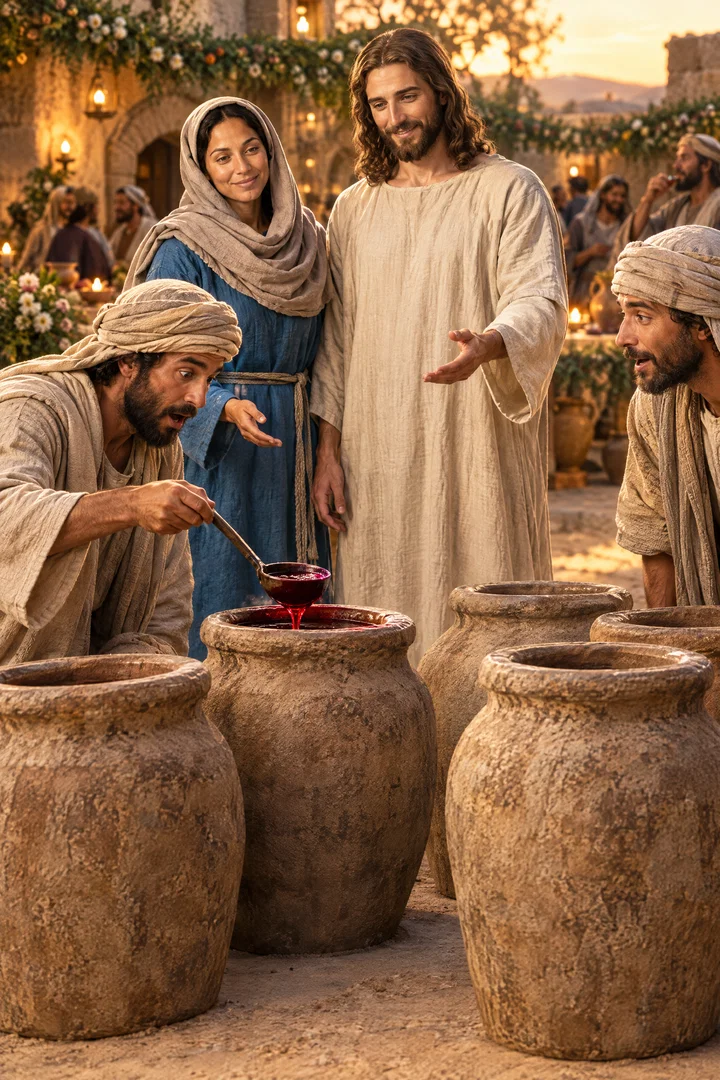
And there were set there six waterpots of stone, after the manner of the purifying of the Jews, containing two or three firkins apiece.
Translations
And there were set there six water pots of stone, after the manner of the purifying of the Jews, containing two or three firkins apiece.
King James Version, KJV Cambridge Paragraph Bible, Webster Bible
And there were set there six waterpots of stone, after the manner of the purifying of the Jews, containing two or three firkins apiece.
Revised Version, American Standard Version
Now there were six waterpots of stone set there after the Jews’ manner of purifying, containing two or three firkins apiece.
And there were there six water-jugs of stone, placed according to the purifying of the Jews, holding each two or three measures.
Now there were standing there six stone water-vessels, according to the purification of the Jews, holding two or three measures each.
Now there were there, six stone water-vessels, placed, according to the purification of the Jews; holding each, two or three measures.
Berean Standard Bible, Majority Standard Bible
Now six stone water jars had been set there for the Jewish rites of purification. Each could hold from twenty to thirty gallons.
Now there were six water pots of stone set there after the Jews’ way of purifying, containing two or three metretes apiece.
Now six pots of stone, every one taking two or three firkins of water, were placed there for the purpose of washing, as is the way of the Jews.
And there were set there, sixe waterpots of stone, after the maner of the purifying of the Iewes, conteining two or three firkins a piece.
Douay-Rheims (Challoner revision)
Now there were set there six waterpots of stone, according to the manner of the purifying of the Jews, containing two or three measures apiece.
Pictures
Cross-references
- John 2:11
This beginning of miracles did Jesus in Cana of Galilee, and manifested forth his glory; and his disciples believed on him.
The Cana miracle revealed Jesus’ glory and strengthened his disciples’ belief.
- John 4:46-54
So Jesus came again into Cana of Galilee, where he made the water wine. And there was a certain nobleman, whose son was sick at Capernaum.
The later healing at Cana follows Jesus’ water-to-wine miracle and strengthens faith.
- Mark 7:3
For the Pharisees, and all the Jews, except they wash their hands oft, eat not, holding the tradition of the elders.
Both describe Jewish purification customs.
- John 2:1-2
And the third day there was a marriage in Cana of Galilee; and the mother of Jesus was there:
Places the marriage supper at Cana.
- John 2:10
And saith unto him, Every man at the beginning doth set forth good wine; and when men have well drunk, then that which is worse: but thou hast kept the good wine until now.
The feast ruler recognizes the resulting wine as superior.
- John 21:2
There were together Simon Peter, and Thomas called Didymus, and Nathanael of Cana in Galilee, and the sons of Zebedee, and two other of his disciples.
Both verses mention Cana in Galilee.
Commentary
Each commentary is drawn from primary sources: the writings of Ellen G. White and Adventist pioneers and periodicals. Each commentary is separate. Its own words are not a quotation; follow the references to read the source passages.
Ellen G. White
67 sources
At a marriage feast in Cana at the opening of His ministry stood six large stone jars by the doorway, kept for Jewish purification and holding two or three firkins apiece.DA 144.2Ms 36, 1899, par. 1–3Ms 126, 1903, par. 9–11Ms 16, 1899, par. 15–16 At His word the servants filled them to the brim with water and drew out to the ruler of the feast, and the water had become wine of the finest quality, better than that served before.Ms 36, 1899, par. 1–3ST Sep 6, 1899Ms 126, 1903, par. 9–11DA 148.2 That wine was pure unfermented juice of the grape, wholesome and refreshing, for He never made nor endorsed intoxicating drink and the miracle gives no sanction to the use of fermented wine.ST Sep 6, 1899Ms 79, 1900, par. 20–253RED 7.2–8.3ST Aug 29, 1878Ms 16, 1899, par. 17–21 By His presence and first miracle at a household gathering He sanctioned marriage as a divine and sacred institution, to exalt and restore it to its original sanctity.Ms 16, 1899, par. 5–9ST Apr 8, 1886MH 356.1Ms 126, 1903, par. 23–24 The water represents baptism into His death and the wine His blood shed to cleanse the world from sin, with ample supply for forgiveness, turning the common things of life into something heavenly.3RED 7.2–8.32SP 103.1–22SP 103.3–104.2GW 206.2–3RH Jan 24, 1907
Setting and Waterpots
John 2:6 belongs to the opening of the ministry, to the first work and first miracle of Jesus.DA 144.1MH 356.1Ms 146, 1899, par. 5–6 It was done not as a great public work before the Sanhedrim at Jerusalem but at a household gathering and marriage festival in Cana.DA 144.1MH 356.1Ms 146, 1899, par. 5–6 Cana was a little Galilean village and small town near Nazareth.DA 144.1DA 144.2
The wedding involved relatives of Joseph and Mary, and many influential persons were gathered there.ST Apr 8, 1886DA 144.2 Jesus came with His newly made disciples.ST Apr 8, 1886DA 144.2 After arrival He and His friends received a special invitation and graced the feast with His presence.ST Apr 8, 1886
He came soon after separation from His mother, His baptism by John, and temptation and long fast in the wilderness.ST Apr 8, 1886 He had been absent two months, during which His widowed mother mourned His sufferings with sorrow and with joy over His Messiahship.ST Apr 8, 1886 He met her as the same tender, dutiful son, yet changed in countenance with marks of conflict, holy expression, and gentle dignity.ST Apr 8, 1886 He was accompanied by young men who called Him Master and declared Him Jesus of Nazareth of whom Moses and the prophets wrote.ST Apr 8, 1886
There were set there six large waterpots or jars of stone.Ms 36, 1899, par. 1–3Ms 126, 1903, par. 9–11Ms 16, 1899, par. 15–1610MR 204.1–206.23RED 7.2–8.3 They stood at the entrance and beside the doorway.3RED 7.2–8.3 They were kept after the manner of Jewish purification and marriage customs.Ms 126, 1903, par. 9–11Ms 16, 1899, par. 15–1610MR 204.1–206.210MR 197.1–201.53RED 7.2–8.3 Each contained two or three firkins apiece.Ms 36, 1899, par. 1–3Ms 126, 1903, par. 9–11Ms 16, 1899, par. 15–1610MR 204.1–206.210MR 197.1–201.5
The required washing for purification had been burdened with extreme, tedious forms and procedures beyond what God commanded.Ms 16, 1899, par. 15–1610MR 197.1–201.5 Cleansing and refreshment had thus been turned into excess.Ms 16, 1899, par. 15–1610MR 197.1–201.5
Miracle Act and Result
At His word the servants were told to fill the six stone purification pots to the brim with water.Ms 36, 1899, par. 1–3Ms 79, 1900, par. 20–25Ms 126, 1903, par. 9–11 He did not touch the water nor approach the jars, but simply looked upon it, and the water became the finest wine.Ms 36, 1899, par. 1–3Ms 126, 1903, par. 9–11Ms 16, 1899, par. 25 The filling was of the jars identified as holding two or three firkins apiece for the Jewish manner of purifying.Ms 36, 1899, par. 1–3Ms 79, 1900, par. 20–25Ms 126, 1903, par. 9–11
He then told the servants to draw out now and bear it to the governor or ruler of the feast.Ms 79, 1900, par. 20–25Ms 126, 1903, par. 9–11 When drawn, the water had been made wine of the purest flavor and finest quality.ST Sep 6, 1899Ms 126, 1903, par. 9–11 It was better than the wine served earlier and the best the guests had tasted.ST Sep 6, 1899DA 148.2Ms 16, 1899, par. 17–21
The ruler tasted it with glad surprise and commended it to the bridegroom as good wine kept until now.Ms 126, 1903, par. 9–11 The bridegroom made no reply and did not know whence it had come.Ms 126, 1903, par. 9–11 The servants who drew it knew and told how water had been changed to wine, and the quality prompted questions that revealed a miracle had been performed.Ms 126, 1903, par. 9–11DA 149.5
After the miracle Jesus withdrew so quietly that even His disciples did not notice.DA 149.5
Symbolic Meaning Explained
The water held in the six stone vessels set for Jewish purification represented baptism into Christ's death.3RED 7.2–8.32SP 103.1–22SP 103.3–104.2 The wine made from that water represented His blood shed to cleanse and purify the world from sin.3RED 7.2–8.32SP 103.3–104.2 The largeness of the supply, filling all six pots to the brim, illustrated abundant provision for forgiveness.3RED 7.2–8.3
The change itself shows how Christ takes the common water of life and the common things of life and turns them into something heavenly, into the wine of heaven.GW 206.2–3RH Jan 24, 1907Ms 43, 1900, par. 50 He does this work together with a mother closely connected with Him, so that a God-fearing mother's ministry of love makes home life and the Christian home a Bethel.GW 206.2–3RH Jan 24, 1907
Pure Wine and Temperance
The wine drawn from the six stone pots was the best the guests had tasted, yet it was unfermented, pure juice of the grape, clarified and refined, a wholesome and refreshing drink rather than an intoxicant.ST Sep 6, 1899Ms 79, 1900, par. 20–253RED 7.2–8.3ST Apr 8, 1886HL 113.1 Christ never made or endorsed intoxicating or fermented wine, for to do so would have been contrary to all His teachings and example.ST Sep 6, 1899ST Aug 29, 1878Ms 16, 1899, par. 17–21Ms 126, 1903, par. 15 The changing of water into wine therefore gives no support for the moderate use of fermented wine.ST Aug 29, 1878Ms 126, 1903, par. 15
He is the same One who led Israel in the wilderness and spoke the law from Sinai.ST Aug 29, 1878 He forbade those in holy office to use wine so they might have clear judgment to distinguish between the common and the sacred, do justice, teach His statutes, and refuse bribes.ST Aug 29, 1878 He told the wife of Manoah to drink no wine or strong drink because her son would be a Nazarite from birth, and He told Zacharias that the unborn John should drink no wine or strong drink, so He would not then make intoxicating wine for a wedding feast.ST Aug 29, 1878
The charge that He was a Sabbath-breaker and wine-bibber is false, refuted by His character and teachings and by His declaration that He kept His Father's commandments.ST Aug 29, 1878 Had He been a wine-bibber He could not have been a perfect offering, and the virtue of His blood would have been of no avail.ST Aug 29, 1878 The drink He provided was the same kind later given at the first communion, pure juice in its natural state being the only proper symbol of Christ's blood established by Himself.ST Aug 29, 1878MH 333.2–3Ms 106, 1903, par. 8–11 Just as no leaven was allowed in the bread, no fermentation was allowed in the wine, and fermented wine should never be placed on the Lord's table.ST Aug 29, 1878Ms 106, 1903, par. 8–11
The standard for the home is to have no wine nor liquor except fresh grape juice, with not one particle of fermentation in it.Ms 230, 1902, par. 32–33Ms 106, 1903, par. 8–11 Its object and effect was to bring the taste into harmony with a healthful appetite, and to bring the perverted taste of the governor of the feast to a healthy condition by leading him to acknowledge that this wine was superior in quality to any he had tasted.3RED 7.2–8.3ST Apr 8, 1886ST Aug 29, 1878 This followed His long fast in the wilderness, suffered to break the power of appetite over man, which had led among other evils to the free use of intoxicating liquor.ST Apr 8, 1886
His provision teaches bringing the lower nature into subjection and shows His whole life of self-denial to break the power of appetite.Ms 106, 1903, par. 8–11 By making this safe, pure drink He set an example of temperance for all people and showed He did not endorse intoxicating wine.ST Sep 6, 1899Ms 16, 1899, par. 17–21 He would never place before anyone what would tempt to evil or minister to evil.Ms 106, 1903, par. 8–11
Marriage Honored and Blessed
The six stone waterpots stand in the account of Jesus' first miracle at a marriage festival in Cana, and His presence there sanctioned marriage as a divine, sacred institution and ordinance which He Himself had formed and blessed.Ms 16, 1899, par. 5–9ST Apr 8, 1886MH 356.13RED 13.3–14.1Ms 170, 1905, par. 10 That presence gave high endorsement to marriage as a sacred ordinance and treated the marriage covenant with respect, honoring the marriage relation.Ms 16, 1899, par. 5–93RED 13.3–14.1Ms 170, 1905, par. 10Ms 36, 1899, par. 6 Marriage thus joined with purity, holiness, truth, and righteousness is a great blessing to the human family.Ms 16, 1899, par. 5–9 His attendance showed that He would not refuse His presence at marriage occasions.Ms 16, 1899, par. 5–9
Marriage is not forbidden by God.Ms 16, 1899, par. 25 He enforces celibacy upon no class of men, and He came not to destroy marriage but to exalt it and restore it to its original sanctity.Ms 126, 1903, par. 23–24 He came to restore, elevate, purify, and ennoble pure affection, so that the earthly family might symbolize the family in heaven.Ms 22, 1898, par. 41Ms 126, 1903, par. 23–24 It was His design that men and women should form families whose members would be honored as part of the family above.MH 356.1 Upon the family relationship where sacred and unselfish love bears sway He looks with pleasure.Ms 126, 1903, par. 23–24
The power put forth among those waterpots was put forth to add to the joy of a wedding feast, showing sympathy with men and desire to minister to their happiness.DA 144.1 Having drunk the cup of woe in the wilderness of temptation, He came forth to give men the cup of blessing, hallowing the relations of human life by His benediction.DA 144.1 The miracle showed His care for people's needs and confirmed the disciples' faith in Him.Ms 79, 1900, par. 20–25
He came in full sympathy with pure joy and would put no cloud over the happiness of family and guests.Ms 126, 1903, par. 23–24 The feast was a solemn occasion whose innocent joy and happiness pleased Him.ST Apr 8, 1886MYP 384.13RED 13.3–14.1 Innocent happiness was pleasing to Him, and His presence at the celebration sanctioned a gathering marked by innocent happiness.MYP 384.13RED 13.3–14.1 He gives His sanction to every gathering that is pure and lovely and of good report.Ms 126, 1903, par. 23–24
Social Ministry Example
The six stone jars for Jewish purification mark the wedding at Cana as the place where public ministry began, and attending that household feast was a deliberate step in reform.2SP 106.1–107.2DA 150.23RED 11.2–12.1 There He began to break down Jewish exclusiveness and prejudice and to break down religious and social separation and social barriers, mingling with people to bring them together as one family and to reach all classes.2SP 106.1–107.2DA 150.23RED 11.2–12.13RED 13.3–14.1 That same work at the feast helped break down Jewish prejudices and taught the disciples sympathy and humanity.2SP 109.1–23RED 13.3–14.1
He met people in ordinary social settings and festal gatherings instead of withdrawing from them, taking part in social life, gracing the celebration with His presence, and refusing to shun ordinary social life or His own countrymen.ST Apr 8, 18863RED 10.1Lt 66, 1878, par. 7Ms 146, 1899, par. 5–6Lt 2, 1878, par. 6–8 The wedding He attended shows He did not shun ordinary social gatherings but shared in the social life of His countrymen.GW 334.4–335.1Ms 146, 1899, par. 5–6Lt 2, 1878, par. 6–8 His presence there at the opening of ministry belonged to a festal gathering He chose to attend.ST Apr 8, 18863RED 10.1
Unlike the austere and secluded Pharisees and dignitaries, He lived a genial and beneficent life among men to bless them.ST Apr 8, 1886GW92 319.2–320.1 In contrast to their self-righteous bigotry, rigid and condemning ways, narrow rules of religious propriety, icy chilliness, reserve and exclusiveness, His conduct showed liberal mercy and generous conduct with no shadow of worldly levity.ST Apr 8, 1886GW92 319.2–320.116MR 318.2–319.1Lt 2a, 1878, par. 8–1015MR 132.2–3 He joined the mixed festal assembly and sanctioned the social gathering with His presence while remaining free from worldly conformity.ST Apr 8, 1886GW92 319.2–320.1 His gracious, generous conduct and precious teaching revealed how unlike Pharisaic restrictive self-righteousness He was.GW 334.4–335.116MR 318.2–319.1Lt 2a, 1878, par. 8–1015MR 132.2–3
He used presence and teaching on that occasion to bless those around Him, to enshrine Himself in their hearts, to reveal His character, and to give them opportunity to become acquainted with Him.GW92 319.2–320.116MR 318.2–319.1Lt 2a, 1878, par. 8–10Lt 2, 1878, par. 6–8 That acquaintance let guests see the marked contrast between His life and teachings and those of the Pharisees.GW92 319.2–320.1GW 334.4–335.116MR 318.2–319.115MR 132.2–3 The example rebukes icy chilliness, reserve and exclusiveness in His followers, who should seek the society of fellow men to bestow heavenly benefits rather than remain withdrawn or bound by narrow religious propriety.GW92 319.2–320.1Lt 2a, 1878, par. 8–10 The miracle itself taught the disciples sympathy and humanity while helping break down their prejudices.2SP 109.1–23RED 13.3–14.1
Faith Witness and Application
The changing of the water in the six stone purification jars showed power beyond ordinary human healing, and the servants' account of it amazed the guests, gave the disciples opportunity to acknowledge Jesus as Saviour of the world, confirmed their faith, and testified that He was the world's Redeemer.Ms 79, 1900, par. 20–253RED 9.1–2ST Sep 6, 18993RED 15.2–16.1Ms 16, 1899, par. 22
That same display of power showed the nobleman that Jesus could do what no ordinary healer could do, and encouraged him to believe and to seek Jesus for his dying son.ST Feb 1, 18772SP 152.1–153.1
The report spread through all that region even to Jerusalem, causing priests and elders to search with new interest the prophecies pointing to Christ's coming, with intense anxiety to know the aim and mission of the new Teacher who came unassumingly yet did what no other man had done.ST Apr 8, 1886
It prepared the way for a warm and cordial reception in Galilee, for people returning from the Passover carried news of it along with reports of His other works.2SP 151.23RED 14.2–15.1ST Feb 3, 1881
Those reports included His cleansing of the desecrated temple and His healings of the sick, blind, and deaf, so that many hoped He was the looked-for Deliverer who had power against the rulers and priests.ST Feb 1, 1877
Together with the feeding of the multitude, the providing of wine and food at the feast teaches that God provides for human needs and gives guidance and knowledge for preparing suitable, wholesome foods and health foods for different times and occasions.CH 599.1–27T 114.3Ms 81, 1902, par. 14GW 362.2–363.1
The business of supplying food to meet human necessity is one of God's own instrumentalities, and God as the heavenly Provider of all foods will not leave His people in ignorance but will teach them how to prepare the best foods for all times and occasions.Ms 81, 1902, par. 14
Turning the common water of life into heavenly wine illustrates how Christ works together with a God-fearing mother closely connected with Him.GW 206.2–3RH Jan 24, 1907
Her ministry of love makes home life and the Christian home a Bethel.RH Jan 24, 1907
The passage calls for living in harmony with the laws of health and teaching others the better way, line upon line and precept upon precept, keeping the subject fresh because it is essential.STBk 126.2
It arouses conscience to the duty of practicing true health reform and being temperate in all things, without which there is no susceptibility to the sanctifying influence of truth.STBk 126.2
Ministers must become intelligent upon true health reform and temperance, not ignore nor dismiss it as extremism, but teach it by precept and by quiet, consistent example, with instruction at large gatherings to arouse intellect and conscience, using all talent at command and following up with publications.STA 127.1
Those who would follow Christ must be grounded upon the principles of truth, understand what the Bible teaches in regard to faith and sanctification through the truth, remain unmoved from the true doctrine of holiness, illustrate in life the practical workings of this heaven-given principle, and be able to distinguish between the genuine and the spurious.GW92 226.1
Sources
Pioneers and periodicals
119 sources
The six stone jars stood ready for the Jews' ceremonial washings, each holding two or three firkins, and at His word they were filled with water to the brim and the water became wine.ST Feb 15, 1899ST Jan 11, 1905ST Mar 10, 1887 This was His very first miracle, worked at a marriage in Cana of Galilee where His mother and His disciples were present with Him.ST Nov 10, 1914ST Oct 4, 1899 The act revealed Him as both Son of God and Son of Man, using creative power to supply a temporal need and teaching that He will much more supply spiritual need.ST Apr 5, 1905ST Sep 17, 1894ST Nov 1, 1910 The drink He made was the best the guests had tasted, pure juice of the grape, fresh and wholesome, that did not intoxicate or degrade.ST Sep 6, 1899ST Nov 25, 1908ST Dec 30, 1880 By His presence He honored marriage as holy and divine, and by beginning His ministry in social fellowship He sanctified true earthly joy.ST Nov 10, 1914ST Mar 8, 1899
Pots and Purification Customs
There were set there six waterpots of stone, after the manner of the purifying of the Jews, containing two or three firkins apiece, and these are the vessels Jesus ordered filled with water to the brim and then used when the water became wine.ST Feb 15, 1899ST Jan 11, 1905ST Mar 10, 1887ST Aug 13, 1894ST Dec 22, 1898 They stood nearby at the wedding in Cana, set aside for the Jews' purification customs.ST Jul 9, 1896
The pots stood by the doorway or house entrance leading into the court to supply water for the many ceremonial washings at the feast.ST Apr 5, 1905ST Jul 26, 1910ST Feb 15, 1899 Those washings included cleansing the hands before eating and washing guests' feet on arrival.ST Aug 13, 1894ST Feb 15, 1899 Outward washing was exalted by the rabbis above inward righteousness.ST Aug 13, 1894 They were vessels for water, not wine, and therefore probably held no wine residue that could flavor the water.ST Aug 13, 1894
The keeping of water in stone jars is taken to mean that people let water stand until it settled and became clear.RH Jun 16, 1868 Ancient measures are too uncertain to fix the amount confidently.RH Sep 11, 1860 By one reckoning the six pots would total about fourteen gallons under the Syriac measure, by another more than two hogsheads under the Greek measure.RH Sep 11, 1860 The verse does not by itself settle how much became wine, whether all the water in the pots became wine or only what was drawn for serving, nor whether the wine was intoxicating.RH Sep 11, 1860
Together the six pots held about twenty-six gallons.ST Apr 5, 1905 A firkin translates a measure of about nine gallons, so each pot held roughly eighteen to twenty-seven gallons.ST Aug 13, 1894 Each pot held about ten gallons on the lowest estimate, so filling all six with wine shows overflowing generosity.ST Feb 15, 1899 A firkin was about nine gallons, so even at two firkins per pot the six held one hundred eight gallons altogether, a large quantity that makes the servants' account of how the wine was obtained beyond dispute.ST Dec 22, 1898 A firkin was seven pints, so each pot held fourteen to twenty-one pints and the six together held eighty-four to one hundred twenty-six pints.ST Mar 13, 1893
Cana is the name of the place in Galilee, not the bride.ST Jul 13, 1882 It lies nearly an hour and a half from Nazareth and scarce half an hour from Gath-Hepher, now called Kefr Kenna, in the country where Jesus spent His early life and did much of His important work.ST Dec 12, 1878ST Jun 2, 1898 It is the place where the wedding feast and the changing of water into wine occurred.ST Feb 1, 1905RH Jul 28, 1904 The servants filled the pots to the brim with water from the nearby fountain or spring at Cana where women still come with jars on their heads to draw water.ST Jul 26, 1910ST Jun 2, 1898 A broken waterpot claimed to be from the wedding is shown in the village Greek church.ST Jun 2, 1898
Wedding Setting and History
This was Jesus' very first miracle, performed as He began His ministry at a marriage feast in the little village of Cana of Galilee, where Jesus and His disciples and Mary His mother were present.ST Nov 10, 1914ST Oct 4, 1899RH Sep 2, 1902RH Aug 26, 1902 It came a little while after Satan tempted Him in the wilderness, after He had been baptized by John, after long separation from His mother, and after two months' absence during which His widowed mother mourned His sufferings with both sorrow and joy over His Messiahship.ST Apr 8, 1886 The wedding was among relatives of Joseph and Mary, with many influential persons gathered, and Jesus with His newly made disciples received a special invitation and graced the feast with His presence.ST Apr 8, 1886 He met His mother as the same tender, dutiful son, yet changed in countenance, bearing marks of His conflict in the wilderness and evidence of His high mission in holy expression and gentle dignity, while the young men with Him reverently called Him Master and told her of wonderful things witnessed at the baptism and afterward, declaring Him Jesus of Nazareth of whom Moses in the law and the prophets wrote, the long-looked-for Messiah.ST Apr 8, 1886
It happened after Jesus had chosen some of His disciples and before He went to take up His abode elsewhere, at the beginning of His public ministry and at His first public appearance.ST Nov 10, 1914ST Sep 16, 1886ST Aug 13, 1894 He Himself was never married, but His mother was present as friend or relative of those holding the marriage, familiar enough to give commands to the servants.ST Aug 13, 1894 When the wine was gone there was perplexity and regret, for going without wine at such a feast was unusual, and the shortage was discovered late when more could not be provided.ST Dec 30, 1880 The bridegroom himself did not then know of the shortage, for the wine ran out after the guests had sat down.ST Jul 26, 1910
At Mary's word Jesus asked the servants to fill the great pots and they did, then commanded that it be drawn out and taken to the man in charge of the ceremonies, and instead of water there was wine in the vessels.ST Sep 29, 1898 The servants discovered the change as they drew from the vessels, while the steward, the governor of the feast, did not know its source, and the miracle was spoken of after Jesus had departed.ST Sep 29, 1898ST Jul 26, 1910 The brief, simple, natural record gives a close-range view of mighty power with a father's simplicity to encourage confidence, manifesting His glory so that beholders believe for life in His name.ST Sep 29, 1898 The miracle astonished the guests and confirmed the disciples' faith in Jesus as the world's Redeemer, bearing witness to His divinity.ST Sep 6, 1899ST Sep 29, 1898ST Dec 17, 1885
That miracle prepared the way for a cordial reception of Jesus in Galilee.ST Feb 3, 1881ST Feb 1, 1877ST May 6, 1886 People returning from the Passover spread the report of it together with His cleansing of the desecrated temple and His healings of the sick, blind, and deaf, and many hoped He was the looked-for Deliverer with power against the rulers and priests.ST Feb 1, 1877 It encouraged the nobleman to believe Jesus could heal his dying son.ST Feb 1, 1877 It had taken place just before He came to Nazareth and was likely already being discussed there, and that transformation was remembered as one of His mighty signs and as evidence of His power.ST Apr 12, 1905 The report spread through all that region even to Jerusalem, causing the priests and elders to search with new interest the prophecies pointing to the coming of Christ, with intense anxiety to know the aim and mission of the new Teacher who joined the mixed festal assembly unlike the austere, secluded Pharisees and dignitaries, yet with no shadow of worldly levity marring His conduct.ST Apr 8, 1886
Power Shown in Miracle
The opening wonder-working act displays both Son of God and Son of Man, bringing God's life and righteousness and purity to humanity as a brother who shares human feeling and answers human longing.ST Apr 5, 1905ST Nov 1, 1910 It reveals character through use of creative power to supply temporal need, teaching that the same power will much more be used to supply spiritual need.ST Sep 17, 1894ST Mar 11, 1908ST May 6, 1886RH Dec 8, 1859 By His word water became wine, alongside healing of the deaf and blind and sick and demon-possessed, showing power to act miraculously.ST Mar 11, 1908ST May 6, 1886RH Dec 8, 1859
The change acted directly and instantaneously above the ordinary processes of nature, with nature obeying His word.ST Apr 5, 1905RH Jun 18, 1914 The elements of nature are His, and He is the source both of gradual provision of food and drink through natural processes and of immediate provision by His word.RH Feb 8, 1906 It was a real miracle, not merely poetic language or an incredible story.RH May 10, 1906
The miracle shortened the ordinary making of wine from several months or about a year to a minute, an acceleration of natural law by His word.RH Aug 20, 1908 Neither the water nor the wine was anything new, the miracle being only the shortening of the process. Out in the vineyard water becomes wine through many steps seen all along the way, while at Cana the process and the power behind it were unseen and only the result appeared. Doing it instantly was no more difficult than making wine in the ordinary way by working the soil and planting vines and obtaining wine as before.RH Jun 22, 1916 It was not done to introduce a new and better plan of obtaining wine, and the ordinary way still stands.RH Jun 22, 1916
The transformation is like the daily marvel of moisture in a vine becoming wine, which familiarity hides from notice.ST Aug 26, 1880 Ordinary processes and the instant miracle alike depend on God's power, and the wine that takes months to produce is also God's work though its gradual course makes it seem ordinary.RH Apr 9, 1901RH Apr 9, 1901 The wine in grapes today has no less divinity in it than the wine at Cana, both showing God's life-giving power at work.RH Jan 28, 1902 The act brought together without the vine the elements that ordinarily produce grape juice, and was not contrary to nature's laws.RH May 29, 1900 It showed the same divine power at work in a different way rather than greater power than in nature, changing the water by divine power rather than through the gradual process by way of grapes and winemaking.ST Mar 31, 1898 Ordinarily wine is produced through the natural process of water passing through the vine, and He usually works through nature and its regular processes rather than always healing or providing through instantaneous miracles to meet an immediate need.ST Sep 3, 1902
The miracle revealed that Jesus, not an impersonal force, is the one who changes water into wine in the vineyards each season.RH Mar 4, 1902 His healing miracles likewise show that He is the healer whether recovery comes gradually or instantly.RH Mar 4, 1902 He can provide wine by turning water into wine when the natural supply has failed, for God's power and resources do not depend on ordinary conditions.RH Oct 7, 1902 The same account is taken to prove from Scripture that Mary has great power with God as Mother of the Redeemer and advocate next to the Saviour, since Christ wrought His first proof of divinity at her request.ST Mar 30, 1876RH May 12, 1874 Those who deny it hold that she wanted the change from curiosity just as Eve wanted the fruit of the tree of knowledge, that Jesus answered by asking what He had to do with her, that she was nothing more than a woman and no advocate between God and man, and that exalting her burdens Christianity and holds back its triumph while Catholicism built on her will perish and Christ will prevail.
Unfermented Wine He Made
The wine made at Cana was the best the guests had tasted, exceptionally sweet like new wine found in the cluster that brings blessing, rich and red and purple and rare, pure juice of the grape clarified and refined, fresh and wholesome grape juice and good healthful refreshment that did not intoxicate or degrade, and no drunkenness followed its use.ST Sep 6, 1899ST Apr 8, 1886ST Nov 25, 1908ST Apr 5, 1905 The shortage had caused perplexity and regret because going without wine at such a feast was unusual, and it was discovered late when more could not be provided.ST Dec 30, 1880 The same pure wine the Bridegroom provided will be given new to His guests to drink with Him at the marriage supper of the Lamb in His Father's kingdom.
It was good because it was made by creative power from pure water, like ripe grape juice as the finished result of the vine's growth rather than a substance beginning corruption.ST Jun 30, 1881 It had not begun to ferment or decay, but was formed directly rather than produced by leaven decomposing sugar, and it was drawn off as soon as it was poured, leaving too little time for fermentation.ST Jun 30, 1881ST Jul 13, 1882ST Aug 19, 1889 Ancient people used best wine for grape juice preserved without fermentation, including juice boiled down for its flavor, and the household gave no indication of serving a condemned drink.RH Jun 25, 1914
Both fermented and unfermented wine were known to the Jews.ST Jul 1, 1897 Scripture speaks of two kinds of wine, the blessed wine to be drunk in the kingdom and the mocker that bites like a serpent, besides the wine of the wrath of God, and the wine Jesus made was the harmless and useful kind belonging with the blessing.ST Jul 1, 1897ST Dec 5, 1892ST Apr 22, 1889 Making unfermented grape juice was consistent with His mission to heal and save rather than to enslave people through alcohol.ST Dec 5, 1892 Providing drink just after His long fast in the wilderness, suffered to break the power of appetite over man which had led among other evils to the free use of intoxicating liquor, its effect was to bring taste into harmony with healthful appetite, and its object was to bring the perverted taste of the governor to a healthy condition by leading him to acknowledge that this wine was superior in quality to any he had tasted.ST Apr 8, 1886ST Aug 29, 1878
He is the same one who led Israel in the wilderness and spoke the law from Sinai, who forbade those in holy office to use wine so they might have clear judgment to distinguish between the common and the sacred, do justice, teach His statutes, and refuse bribes.ST Aug 29, 1878 He is the same one who told the wife of Manoah to drink no wine or strong drink because her son would be a Nazarite from birth, and who told Zacharias that the unborn John should drink no wine or strong drink, and He would not then make intoxicating wine for a wedding feast.ST Aug 29, 1878 The charge that He was a Sabbath-breaker and wine-bibber is false and is refuted by His character and teachings and by His declaration that He kept His Father's commandments, for had He been a wine-bibber He could not have been a perfect offering and the virtue of His blood would have been of no avail.ST Aug 29, 1878
As an observant Jew He would not drink fermented wine and would not provide intoxicating wine, because fermented liquor comes under leaven which is forbidden and removed from the house at Passover. The wine He made there is the same kind used in the institution of the Lord's Supper, the pure blood of the grape, the fruit of the vine, a food-drink that makes glad the heart of man and contains a blessing, wholly distinct from poisonous fermented wine that brings misery to hearts and homes. Only pure juice in its natural state, not fermented intoxicating wine established by Himself, is the proper symbol of the blood of Christ, and fermented wine should never be placed on the Lord's table.ST Aug 29, 1878
The mention of stone waterpots set aside for Jewish purification does not establish that the drink made was fermented.RH Jun 18, 1914 The verse does not by itself settle whether all the water in the pots became wine or only what was drawn for serving, nor whether the wine was intoxicating or harmless, and ancient measures are too uncertain to fix confidently how much became wine.RH Sep 11, 1860 The changing of water into wine gives no support for moderate use of fermented wine, nor does making wine by miracle by itself establish that wine should be used as a beverage, and the account is not support for the modern liquor trade or for drinking alcoholic liquor produced by modern breweries and distilleries.ST Aug 29, 1878ST Jan 12, 1882ST Jan 16, 1912
The miracle honored wine because wine was wanted at the feast, but honoring it no more makes drinking obligatory than His honoring barley bread in feeding the five thousand makes eating it obligatory.ST Jan 12, 1882ST Jan 24, 1878ST Apr 22, 1889 A person may set aside something Christ honored in order to bear a weaker brother's infirmity and fulfill the law of Christ.ST Jan 12, 1882ST Apr 22, 1889ST Jan 24, 1878 Giving up wine for the sake of a weak brother who stumbles over example into sin is bearing that weakness from a higher motive than putting it away from dislike, and avoids leading him into sin.ST Apr 22, 1889ST Apr 22, 1889ST Jan 24, 1878
Marriage and Social Fellowship
His presence at Cana honored marriage itself and the social celebration that accompanied it, affirming marriage as Eden-born, holy, right and sacred, a divine institution given by Him in Eden before sin entered, established by Him and sanctioned at the beginning of His public ministry.ST Nov 10, 1914ST Mar 8, 1899ST Aug 13, 1894ST Those who destroy or weaken the marriage relation in any way are contrary to Him, while those united in faith to glorify God have His blessing, and His attendance showed innocent joy at so solemn an occasion pleased Him.ST Apr 8, 1886ST Mar 8, 1899ST Aug 13, 1894 The wedding celebration was also a fitting symbol of the saints' welcome into the heavenly kingdom at the marriage supper of the Lamb.ST Mar 8, 1899 He Himself was never married, but His mother was present as friend or relative familiar enough to command the servants.ST Aug 13, 1894
Beginning His ministry through a social act at a village wedding feast, He expressed God's concern for human relationships and opposed the idea that religious life requires separation from ordinary social life.ST Apr 8, 1886RH Oct 16, 1913RH Jul 28, 1903 He accepted others' hospitality and took part in social gatherings and ordinary social customs when no principle was at stake, which gave Him relief and relaxation from demanding public work.ST Apr 8, 1886RH Oct 16, 1913 His presence there sanctifies all true earthly joys, and He met people in ordinary social settings rather than withdrawing from them.ST Apr 8, 1886ST Aug 13, 1894 He came as guest yet served as Master, and mention of His name brought blessed benediction and joy to the festival.
He approved innocent social joy and wholesome social fellowship while rejecting intemperance, self-indulgence, folly and worldly excess.ST Jul 9, 1896ST Dec 30, 1880RH Oct 16, 1913 His attendance taught His disciples sympathy and humanity and helped break down Jewish prejudice and exclusiveness to open the way for freer fellowship with other peoples, showing He came as Redeemer of the world.ST Dec 30, 1880RH Oct 16, 1913 He opposed neither marriage nor wholesome social fellowship, for innocent social gatherings pleased Him.ST Jul 9, 1896RH Oct 16, 1913
He was at ease among the people at the simple wedding gathering without indulging appetite or lowering His conduct or the dignity of His calling.ST Apr 8, 1886RH Nov 26, 1901RH Oct 16, 1913 Joining the mixed festal assembly unlike the austere secluded Pharisees and dignitaries, He sanctioned the social gathering with His presence while no shadow of worldly levity marred His conduct, for the wedding was a solemn, joyful occasion.ST Apr 8, 1886RH Oct 16, 1913 His presence proves He wishes His people to be happy and to overflow with joy and approves social gatherings of a pure and refined nature.RH Jul 20, 1916 It gives no sanction to the modern dance, in which pure girls are embraced in the arms of libertines and to the strains of voluptuous music dance into the small hours of the morning.RH Jul 20, 1916
He cares about people's ordinary happiness and lawful comforts as well as their deepest needs, acting at His mother's request though wine was customary rather than necessary at the feast.ST Feb 7, 1911ST Jan 2, 1912ST Jan 2, 1912 He acted to spare His friends and His host the embarrassment of not having enough for the guests and to increase their happiness, providing needed wine and attending to an ordinary practical need.ST Jan 2, 1912RH Oct 28, 1909ST Jan 26, 1882ST Aug 5, 1897 He gives temporal blessings as far as they can be received without harm to a person's spiritual or temporal good, and the wine also pictures the richness of His love.ST Jan 2, 1912 He helps with even ordinary troubles and meets the needs of the occasion.ST Feb 7, 1911ST Aug 5, 1897
Filling all six jars kept by the doorway for the Jews' many ritual washings, including handwashing before meals and washing guests' feet, each holding about ten gallons on the lowest estimate, shows the Lord's overflowing generosity in answering requests for spiritual blessings.ST Feb 15, 1899 The miracle is an example of divine love that gives generously, like a cup of cold water offered in love.ST Mar 10, 1909
His gracious service at the Cana marriage party is true courtesy and true politeness in action, whose essence is unselfishness, and Jesus is its only perfect exemplar, so taking His life as the highest standard of true politeness is right and reverent.ST Oct 6, 1887 His calm self-possession there exemplifies a repose in God that sustains the mind through duties and cares and expresses faith in the Father and confidence in His promises.ST Jul 29, 1886
At Cana He rejoiced with the guests and shared in ordinary human joys, smiling on the hearts that loved Him and making them doubly blessed. This shows His self-forgetting love that gladdens in His children's joy and saddens in their pain, that bids no sweet affection die and does not call His children to hide their eyes from daily joy. He still walks with them in homeliest household care and makes their homes His own.
Symbols and Spiritual Applications
The water stands for baptism into Christ's death and the wine for His shed blood that purifies sin, and the ample, abundant supply shows full provision for blotting out human iniquity and cleansing the world.ST Jul 9, 1896ST Dec 30, 1880ST Jan 11, 1905 The changing of that water into wine illustrates how He can change a weak, characterless heart into one bearing goodness and blessing.RH Jul 28, 1903ST Apr 5, 1905 It shows simple elements of life receiving a new character through Christ's power, lifted from merely material use to spiritual and sanctified life, with lower instincts sanctified into sacred inspiration.RH Jul 28, 1903RH Jul 28, 1903 Even the humblest, most common things may thus be touched by the divine.RH Sep 3, 1903 The jars themselves provide the setting to show that religious ceremonies have no value without life and power from Christ.ST Jul 9, 1896
God often turns the Christian's water into wine, changing poor common provision into richer blessing as brass is changed into silver and silver into gold, and this repeated transforming mercy forbids murmuring.RH May 12, 1863 When life's wine seems spent and only empty vessels of tears and discontent remain, filling them full with flowing sap fresh from Christ the living Vine lets Him turn life's water into wine before the feast is done. That new, pure, unfermented wine pictures what the Bridegroom will give His guests to drink new with Him at the marriage supper of the Lamb in His Father's kingdom. Instant miraculous transformation is real, and some born again after natural maturity can be transformed by Christ in a short time into successful laborers for others, yet that instant work is a special exception and not the basis for grape culture or for education.RH Aug 21, 1913 Ordinarily the growth and development of Christian character over a lifetime, with patient sowing with tears, digging about the growing plant in hope, and waiting with patience for the harvest until maturity produces educated ability, has as much divine power in it as that sudden emergency change.RH Aug 21, 1913RH Jan 28, 1902 The promise that believers will do greater works does not necessarily mean more literal miracles of that kind, more water turned into wine, more dead raised, more paralytics healed, more storms stilled, or more fig trees blighted, but more miracles of grace upon the hearts of men, women, and children, because transformation of the unregenerated heart is the greatest work of all.RH Aug 7, 1913
Men truly helped the Lord by filling the stone waterpots with water and then bearing to the guests what had become wine, yet none of the praise for the wine belongs to them, for all the praise belongs to the Lord whose part is the all-important part.ST Jan 9, 1907 Servants standing by the pots fully ready and waiting for the commands of the Great Master, already heeding the preparatory direction to do whatever He says, picture believers held back by social bonds who trust God and wait for Him to lead consecrated lives onward step by step in His own time and way.RH Sep 5, 1865 Christ works with a mother in the home, turning common water into heavenly wine, so a mother connected with Christ makes home life a ministry of love and the Christian home a Bethel.RH Jan 24, 1907 The keeping of the best wine until last illustrates that the inspired Book holds riches of truth with its best kept until the last.ST Sep 4, 1901ST Jun 26, 1907 Christ's kindness and consideration at the feast reveal the character of God, and with relieving the ruler of the feast and cheering the guests, all He did until He died on Calvary revealed the wisdom, power, and love of God as the Faithful and True Witness of what the Father is.ST Feb 25, 1897ST Sep 15, 1898
Sources