John 2:7
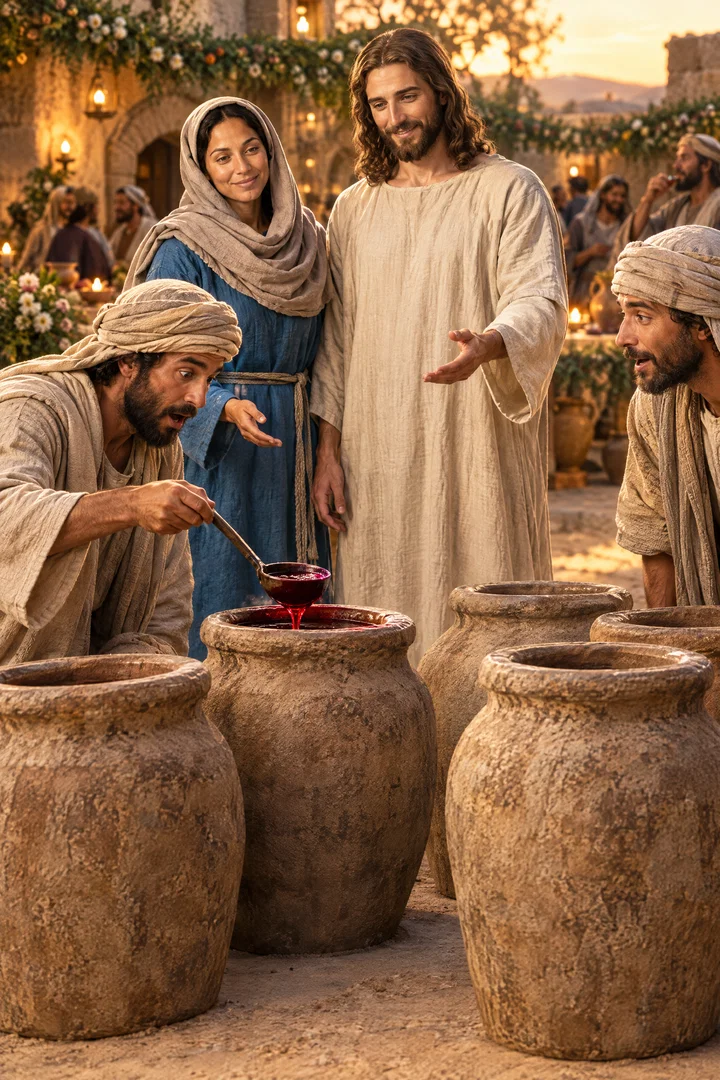
Jesus saith unto them, Fill the waterpots with water. And they filled them up to the brim.
Translations
Jesus says to them, Fill the water pots with water. And they filled them up to the brim.
King James Version, KJV Cambridge Paragraph Bible, Revised Version, American Standard Version
Jesus saith unto them, Fill the waterpots with water. And they filled them up to the brim.
Jesus saith to them, Fill the waterpots with water. And they filled them to the brim.
Jesus saith to them, 'Fill the water-jugs with water;' and they filled them — unto the brim;
Jesus says to them, Fill the water-vessels with water. And they filled them up to the brim.
Jesus saith unto them—Fill the vessels with water. And they filled them up to the brim.
Berean Standard Bible, Majority Standard Bible
Jesus told the servants, “ Fill the jars with water.”So they filled them to the brim.
Jesus said to them, “ Fill the water pots with water.” So they filled them up to the brim.
Jesus said to the servants, Make the pots full of water. And they made them full to the top.
And Iesus sayde vnto them, Fill the waterpots with water. Then they filled them vp to the brim.
Douay-Rheims (Challoner revision)
Jesus saith to them: Fill the waterpots with water. And they filled them up to the brim.
Pictures
Cross-references
- John 2:11
This beginning of miracles did Jesus in Cana of Galilee, and manifested forth his glory; and his disciples believed on him.
The completed miracle reveals Christ’s glory and leads his disciples to believe in him.
- John 4:46-54
So Jesus came again into Cana of Galilee, where he made the water wine. And there was a certain nobleman, whose son was sick at Capernaum.
The nobleman seeks healing after Jesus’ Cana miracle, and the healing leads his household to believe.
- John 2:1-3
And the third day there was a marriage in Cana of Galilee; and the mother of Jesus was there:
The waterpots were filled at the wedding where Jesus was a guest and wine had run short.
- John 2:3
And when they wanted wine, the mother of Jesus saith unto him, They have no wine.
The wine runs out before Jesus acts.
- John 4:14
But whosoever drinketh of the water that I shall give him shall never thirst; but the water that I shall give him shall be in him a well of water springing up into everlasting life.
Those who come to Christ for the water of salvation are supplied.
Commentary
Each commentary is drawn from primary sources: the writings of Ellen G. White and Adventist pioneers and periodicals. Each commentary is separate. Its own words are not a quotation; follow the references to read the source passages.
Ellen G. White
70 sources
At a wedding feast in Cana of Galilee, after the wine ran out, Jesus directed the servants to fill the six large stone jars used for Jewish purification, and they readily obeyed by filling them up to the brim.ST Apr 8, 1886Ms 36, 1899, par. 1–3Ms 79, 1900, par. 20–25Ms 126, 1903, par. 9–1110MR 204.1–206.2 Without touching the jars He changed the water by His word alone into pure, wholesome, unfermented juice of the grape, superior in flavor to what had been served before and sufficient for all the guests.ST Sep 6, 1899Ms 79, 1900, par. 20–25Ms 126, 1903, par. 9–112SP 103.1–2HL 113.1 It was His first miracle at the opening of His public ministry, revealing His divine power and mercy toward human need and confirming His disciples in faith that He was the Redeemer.ST Sep 6, 1899Ms 79, 1900, par. 20–252SP 104.3–105.2ST Sep 6, 1899Ms 16, 1899, par. 22 By gracing the feast with His presence He sanctioned marriage as a divine and sacred institution He Himself had established, to be restored, purified, and exalted to its original holiness.2SP 110.1Ms 16, 1899, par. 5–9MH 356.1Ms 16, 1899, par. 25Ms 126, 1903, par. 23–24 The act also showed His sympathy with innocent joy and social fellowship, while the ample, fully finished provision teaches that His grace and righteousness for forgiveness and salvation are abundant and more than sufficient for all who come to Him.DA 144.13RED 7.2–8.32SP 103.3–104.2COS 57.5–6ST Apr 8, 1886
Wedding Setting at Cana
Jesus attended with His newly made disciples a wedding feast in Cana of Galilee among relatives of Joseph and Mary after returning from the Jordan, and there He used His power to add to the joy of the guests in sympathy with people and desire to promote their happiness.DA 144.1DA 144.2ST Apr 8, 1886 His blessing at that feast sanctified the relations of human life.DA 144.1 He graced the feast by special invitation, knowing many influential persons would be brought together there.ST Apr 8, 1886
He came after about two months of separation from His widowed mother Mary, during which He had been baptized by John and had endured temptation in the wilderness.ST Apr 8, 1886 His countenance was changed, bearing marks of fierce conflict and evidence of His high mission in holy expression and gentle dignity, while He remained the same tender, dutiful son.ST Apr 8, 1886 He was accompanied by young men who addressed Him with reverence as Master and told Mary of wonderful things witnessed at the baptism and on other occasions, declaring they had found Jesus of Nazareth of whom Moses in the law and the prophets wrote, the long-looked-for Messiah, gladdening her cherished hope of long years of anxious waiting.ST Apr 8, 1886
This belongs to Jesus' first miracle at the opening of His public ministry, when He turned water into wine at Cana.ST Sep 6, 18992SP 104.3–105.2Ms 16, 1899, par. 5–9 It was performed at a marriage feast as He began His public ministry, where friends and kindred rejoiced together.Ms 16, 1899, par. 5–9MH 356.1 His attendance there showed He did not shun the social life of His countrymen but mingled with people of all classes so they could know God revealed in human form.Ms 146, 1899, par. 5–6
Filling the Waterpots
Jesus directed the servants to fill the six large stone water-jars standing there for Jewish purification.Ms 79, 1900, par. 20–25Ms 126, 1903, par. 9–113RED 7.2–8.32SP 103.1–2COS 56.1–57.1 Each jar held about two or three firkins.Ms 126, 1903, par. 9–11 The servants readily and completely obeyed at His word, filling the pots up to the brim.Ms 36, 1899, par. 1–3Ms 79, 1900, par. 20–25Ms 126, 1903, par. 9–113RED 7.2–8.32SP 103.1–2
This happened after the wine had run out, when the shortage threatened a disgraceful failure of hospitality and created a human need.Ms 79, 1900, par. 20–2510MR 204.1–206.2COS 56.1–57.1 He did not touch the water or approach the jars but changed it by His spoken word, only looking upon it, which brought the divine into connection with the human.Ms 79, 1900, par. 20–25Ms 126, 1903, par. 9–11Ms 16, 1899, par. 25 Their obedience prepared the water that became wine of the purest flavor, superior to the wine served earlier and enough for the guests.Ms 36, 1899, par. 1–3Ms 126, 1903, par. 9–112SP 103.1–2COS 56.1–57.1DA 148.2
Pure Unfermented Wine
The water that filled the pots to the brim became the pure, unfermented juice of the grape, clarified and refined, wholesome and refreshing, not a drink made intoxicating by fermentation or adulteration.ST Sep 6, 1899Ms 79, 1900, par. 20–25HL 113.1ST Apr 8, 1886ST Aug 29, 1878 It was the new wine found in the cluster in which is a blessing.MH 333.2–3 Its effect was to bring the taste into harmony with a healthful appetite.ST Apr 8, 1886 Even the governor of the feast, whose taste had been perverted, recognized it as superior to what had been served before, and in that recognition his taste was restored.ST Apr 8, 1886ST Aug 29, 1878
He who made it had just come from suffering the forty days' fast in the wilderness to break the power of appetite over man, which had led among other evils to the free use of intoxicating liquor.ST Apr 8, 1886MH 333.2–3 His whole life was self-denial, and in that severest test He suffered to break that power.MH 333.2–3 The miracle therefore gives no sanction for the use of fermented wine or strong drink, and never by word or act did He sanction it, for the Bible nowhere sanctions intoxicating wine.MH 333.2–3Ms 126, 1903, par. 15ST Apr 16, 1896 He Himself provided no such beverage.MH 333.2–3
This is consistent with His own warning that wine is a mocker and strong drink is raging.MH 333.2–3 It agrees with His direction that John the Baptist should drink neither wine nor strong drink, and with His similar injunction of abstinence to the wife of Manoah.MH 333.2–3Ms 126, 1903, par. 15 He foresaw the harm alcohol would bring in later ages.ST Apr 16, 1896 He does not contradict His own teaching, never places before men what would tempt them to evil, but teaches that the lower nature is to be brought into subjection.MH 333.2–3ST Apr 16, 1896Ms 106, 1903, par. 8–11
The unfermented wine provided for the wedding guests is the same as the cup He gave His disciples at the first communion as a symbol of His own blood shed to cleanse from sin.MH 333.2–3Ms 126, 1903, par. 15Ms 106, 1903, par. 8–11 As no leaven was allowed in the Passover bread, no fermentation was allowed in this wine.MH 333.2–3Ms 106, 1903, par. 8–11 Only such unfermented wine should always be used on the communion table, because the sacramental service is designed to be soul-refreshing and life-giving with nothing connected to evil and nothing that ministers to evil.MH 333.2–3Ms 126, 1903, par. 15Ms 106, 1903, par. 8–11
Power and Purpose Revealed
The command to fill the waterpots set the miracle in motion as a sign of miraculous power, tender mercy toward human need, and generous provision, answering Mary's confident trust in His wisdom and power.Ms 79, 1900, par. 20–252SP 103.1–2DA 148.22SP 152.1–153.1ST Feb 1, 1877 It became for the disciples their first opportunity to openly acknowledge faith in Him, confirming the faith they already held and giving them convincing testimony that He was the world's Redeemer.Ms 79, 1900, par. 20–25ST Sep 6, 1899Ms 16, 1899, par. 22DA 149.6–150.1 That confirmation remained with them as the abiding result of what they witnessed at the feast.Ms 79, 1900, par. 20–25ST Sep 6, 1899Ms 16, 1899, par. 22
Though the work was not publicized at first, it amazed those present when the new provision proved better than what had been served before.3RED 9.1–2ST Sep 6, 1899Ms 16, 1899, par. 22 Jesus quietly withdrew before the guests could question Him, yet the disciples told others what they had witnessed.3RED 9.1–2 In that way its fame spread through all that region even to Jerusalem.ST Apr 8, 18863RED 10.1 That report prepared the way for His cordial reception in Galilee when those returning from the Passover told of it together with His cleansing of the desecrated temple and His healings of the sick, the blind, and the deaf.3RED 14.2–15.12SP 151.2ST Feb 3, 1881ST Feb 1, 1877
By thus displaying His power, the miracle encouraged the nobleman to believe that Jesus could heal his dying son.2SP 152.1–153.1ST Feb 3, 1881ST Feb 1, 18773RED 15.2–16.1 It showed that He had done what no other man had done.ST Apr 8, 18863RED 10.1 Priests and elders, hearing of it, searched with new interest and intense anxiety the prophecies pointing to Christ, seeking to know the aim and mission of this unassuming Teacher.ST Apr 8, 18863RED 10.1
Marriage and Social Fellowship
His presence and blessing at Cana sanctioned marriage as a divine, sacred institution worthy of marked respect, for He Himself had established it when He gave Eve to Adam as a helpmeet.2SP 110.1MH 356.13RED 13.3–14.1Ms 126, 1903, par. 23–24Ms 36, 1899, par. 6 The marriage covenant serves to illustrate important truths, and His honoring of the ceremony showed His high endorsement of it as a sacred ordinance.2SP 110.1ST Apr 8, 1886Ms 36, 1899, par. 6 He will be present at marriage occasions when the union is marked by purity, holiness, truth, and righteousness.Ms 16, 1899, par. 5–9
He came not to put a cloud over the happiness of family and guests but in full sympathy with pure joy, in harmony with marriage as a blessed institution.Ms 126, 1903, par. 23–24Ms 22, 1898, par. 41 He did not come to forbid marriage, enforce celibacy on any class, or destroy family relationships and the sacred relationship of marriage, but to restore, purify, ennoble, and exalt it to its original sanctity.Ms 16, 1899, par. 25Ms 126, 1903, par. 23–24Ms 22, 1898, par. 41 He looks with pleasure on family life where sacred and unselfish love rules, and gives His sanction to every gathering that is pure and lovely and of good report.Ms 126, 1903, par. 23–24
He will be present where husbands and wives honor and cherish one another and their shared faith unites them in Him.Ms 16, 1899, par. 5–9Ms 126, 1903, par. 23–24Ms 36, 1899, par. 6 The earthly family is to become a symbol of the family in heaven, with men and women united in holy wedlock to rear families whose members, crowned with honor, will be recognized as members of the family above.MH 356.1Ms 22, 1898, par. 41
The feast showed His sympathy with people and desire to promote their happiness, and His blessing sanctified the relations of human life.DA 144.12SP 109.1–23RED 13.3–14.1 Innocent joy and social fellowship pleased Him, and it is right to gather for a pleasant occasion.COS 57.5–6ST Apr 8, 18862SP 109.1–2MYP 384.1 Where people were open to the divine message He turned their thoughts to God's goodness and love and taught them the way of salvation.COS 57.5–6
His attendance was an expression of genial, beneficent, generous kindness, not worldly conformity, and without any shadow of worldly levity.ST Apr 8, 1886GW92 319.2–320.1GW 334.4–335.1 By His precious teachings and generous conduct on that occasion He enshrined Himself in the hearts of those present and gave them opportunity to become acquainted with Him and know His character.GW92 319.2–320.1Lt 2a, 1878, par. 8–1015MR 132.2–316MR 318.2–319.1 In this was seen the marked contrast between His life and teachings and the bigotry, exclusiveness, narrowness, and self-righteousness of the Pharisees.GW92 319.2–320.1GW 334.4–335.1Lt 2a, 1878, par. 8–1016MR 318.2–319.1 Yet His presence there does not justify theater, dancing, or other pleasures that conflict with practical godliness.Lt 35, 1878, par. 9–10
It was a step toward breaking down Jewish prejudice and social and religious barriers and bringing people together as one family, opening contact with people across divisions.2SP 109.1–2DA 150.23RED 11.2–12.1 The disciples learned sympathy and humanity from it, and His relatives were drawn to Him in affection.2SP 109.1–23RED 13.3–14.1
It teaches His followers through all time not to live in strict seclusion renouncing social communion or to exclude themselves from society, for people will seldom seek them on their own.2SP 106.1–107.2ST Apr 8, 1886 To reach all classes they must meet them where they are, seeking men in public streets, in private houses, on boats, in the synagogue, by shores of lakes, at daily vocations, in households, and at marriage feasts.ST Apr 8, 1886 He did not shun the social life of His countrymen but mingled with people of all classes so they could know God revealed in human form, awakening interest by going among them as one desiring their good.ST Apr 8, 1886Ms 146, 1899, par. 5–6 Hearts are touched not alone from the pulpit; by manifesting unfeigned interest in their temporal affairs, carrying instruction into households, and bringing whole families in their own homes under divine influence, they do good and share truth while keeping life pure, lest by hiding religion to escape contamination of the world they lose golden opportunities to enlighten and benefit humanity.2SP 106.1–107.2GW92 319.2–320.1ST Apr 8, 1886
Symbolic and Spiritual Meaning
The filling of the waterpots and the wine provided for the wedding feast symbolize salvation and the abundant provision made for the forgiveness of sin.3RED 7.2–8.32SP 103.3–104.2 The water represented baptism into Christ's death, while the wine represented His blood shed to cleanse the world from sin and to purify it from sin and blot out human iniquity.3RED 7.2–8.32SP 103.3–104.2 The ample supply reflects the abundance of that provision for salvation.3RED 7.2–8.32SP 103.3–104.2 The work Christ does is fully done, and the provision of the Saviour's grace and righteousness is full and more than sufficient, so that those who come to Him for the bread of heaven and the water of salvation will be supplied.Ms 36, 1899, par. 5
The same transformation illustrates Christ working with and through a mother's loving ministry to turn the ordinary life of the home into a blessing of heavenly worth and a life shaped by heaven.GW 206.2–3 When a God-fearing mother keeps a close connection with Christ, Christ works with her, turning the common water of life into the wine of heaven, and her ministry of love makes the home a Bethel.RH Jan 24, 1907 His presence brings happiness and can transform the ordinary waters of life into the wine of heaven, making the home like an Eden of bliss, with the family a symbol of the family in heaven.Ms 43, 1900, par. 50
Health Temperance and Provision
By directing the servants to fill the waterpots to the brim and turning the water into the best drink the guests had tasted, which was unfermented grape juice, Jesus at His first miracle set an example of temperance and offered a safe drink for all.Ms 16, 1899, par. 17–21 The wine He created from water at the marriage feast was only the juice of the fresh grape, with not one particle of fermentation in it.Ms 230, 1902, par. 32–33 That unfermented grape juice is the only wine to have in the house, and the command forbids the use of fermented wine, liquor, and tobacco that confuse the brain and destroy the strength given to honor God.Ms 230, 1902, par. 32–33
The command to fill the waterpots belongs to His healing, life-giving work to give life and health and to cure and prevent sickness.STA 127.3–128.1STA 127.2 It proves that the great object of hygienic reform is to secure the highest possible development of mind and soul and body in obedience to the laws of nature as the laws of God for good in this life and preparation for the life to come.STA 127.3–128.1 It supports true health reform and temperance.STA 127.1 Knowledge of the laws of health promotes spiritual as well as physical life, and supports the duty to preserve physical powers in the best possible condition to render acceptable service to God.STA 127.2
It gives scriptural ground for ministers to become intelligent on health reform and to teach its principles by precept and by quiet, consistent example.STA 127.1 They are to give instruction on health and temperance at large gatherings, to arouse intellect and conscience, and to follow up the work with publications.STA 127.1 This is because temperance in all things and preservation of physical powers in the best condition are required for acceptable service and for susceptibility to the sanctifying influence of truth.STA 127.1STA 127.2
In supplying a need at the wedding feast He teaches that the Lord provides for human needs.CH 599.1–27T 114.3GW 362.2–363.1 He guides His people in preparing suitable, wholesome, best foods for different times and occasions.CH 599.1–27T 114.3GW 362.2–363.1 He will not leave them ignorant about it.GW 362.2–363.1 The food business is one of God's own instrumentalities to supply that necessity under the heavenly Provider of all foods, who teaches His people how to prepare the best foods for all times and occasions.Ms 81, 1902, par. 14
Sources
Pioneers and periodicals
124 sources
Jesus began his public work at a wedding in Cana of Galilee by telling the servants to fill the waterpots with water, and they obeyed fully even to the brim.ST Sep 17, 1894ST Mar 8, 1899RH Jun 25, 1914ST Mar 10, 1887ST Apr 5, 1905 The vessels were six large stone jars kept for Jewish purifying, holding two or three firkins apiece.ST Dec 22, 1898ST Apr 5, 1905ST Feb 15, 1899 By his word alone without touch he changed the water instantly into real wine, apart from the slow growth of vine and grape.ST Mar 10, 1887ST Apr 5, 1905ST Aug 13, 1894ST Nov 1, 1910 The wine he made was pure unfermented juice of the grape, sweet and healthful, with no time for fermentation and no drunkenness following.ST Sep 6, 1899ST Dec 5, 1892ST Nov 25, 1908ST Jun 30, 1881ST Jul 13, 1882 The act revealed his divine power and glory as Son of God and Son of Man, and honored marriage as a divine institution from Eden.ST Sep 17, 1894ST Apr 5, 1905RH Jul 28, 1903ST Mar 30, 1876
Wedding Setting and Background
Jesus' command to fill the waterpots belongs to his first miracle at a wedding in Cana of Galilee, which marked the beginning of his public ministry and the manifestation of heavenly grace and glory.ST Sep 17, 1894ST Mar 8, 1899ST Apr 5, 1905ST Aug 5, 1897 It was his first public appearance, begun in a social rather than an ecclesiastical setting, revealing his divine authority and God's concern for human social life, honoring marriage and sanctifying true earthly joys.ST Mar 8, 1899RH Jul 28, 1903ST Aug 13, 1894 In supplying a temporal need through creative power he revealed his glory, which is his character, showing both Son of God and Son of Man bringing God's life, righteousness and purity as man's human Brother, and showing he will use that power to meet spiritual needs as well.ST Sep 17, 1894ST Apr 5, 1905
The wedding took place a little while after Satan tempted Jesus in the wilderness, on the third day after John bore witness to Jesus a second time.ST Aug 13, 1896 It followed about two months of separation from his widowed mother Mary, during which he was baptized by John and endured temptations in the wilderness.ST Apr 8, 1886 His countenance was changed with marks of fierce conflict and evidence of his high mission in holy expression and gentle dignity, while he remained the same tender, dutiful son.ST Apr 8, 1886
Present were Jesus in company with his newly made disciples, his mother Mary, and relatives of Joseph and Mary, with many influential persons brought together there by special invitation which he graced with his presence.ST Apr 8, 1886 He knew many influential persons would be brought together there, and he was accompanied by young men who addressed him with reverence calling him Master and told Mary of wonderful things witnessed at the baptism and on other occasions, declaring they had found Jesus of Nazareth of whom Moses in the law and the prophets did write, the long-looked-for Messiah, gladdening her cherished hope of long years of anxious waiting.ST Apr 8, 1886 The bridegroom did not know of the shortage of wine until later, and one account identifies the feast as the wedding of Chuza and Joanna.ST Jul 26, 1910ST Sep 13, 1910
Cana is the place of the marriage, not the bride's name.ST Jul 13, 1882 It was a little village in Galilee nearly an hour and a half from Nazareth and scarce half an hour from Gath-Hepher, now called Kefr Kenna in the Arabic, home of Nathanael, where a Greek church shows a broken water-pot claimed to be from the wedding.ST Dec 12, 1878ST Jun 2, 1898 When the wine ran out Mary told Jesus, and told the servants to do whatever he said.ST Dec 22, 1898 Jesus helped with this customary but nonessential shortage in response to his mother's request.ST Feb 7, 1911
The marriage at Cana is not where Jesus illustrated humility and submission in the petition Thy will be done.ST Jun 14, 1877 That illustration belongs to his agony alone in the garden, uncared for by his chosen followers, when his soul was sorrowful even unto death and after three times asking the Father to remove the bitter cup if it were possible, he set aside his own will that only the Father's will be done.ST Jun 14, 1877 The account of his first miracle at a Jewish wedding is mentioned in answer to a claim that the wedding was polygamous, which the passage does not support.ST Oct 2, 1884
Waterpots Filled to Brim
Jesus told the servants to fill the waterpots with water, and in full obedience to his mother's charge to do whatever he said they filled them up to the brim.RH Jun 25, 1914ST Mar 10, 1887ST Jul 9, 1896ST Dec 22, 1898ST Sep 29, 1898 The command must have seemed strange, yet they obeyed completely.ST Feb 7, 1911ST Jul 26, 1910 The water they poured in came from the fountain.ST Jul 26, 1910
The vessels standing there were six large pots of stone, kept after the Jews' manner of purifying and used for the washings of the feast, containing two or three firkins apiece.ST Dec 22, 1898ST Apr 5, 1905ST Feb 15, 1899 Together the six pots held about twenty-six gallons, and the water was then drawn out as the sweetest wine.ST Apr 5, 1905 At the lowest estimate the six jars held about ten gallons each, and their abundant contents show the Lord's overflowing generosity in answering requests for spiritual blessings.ST Feb 15, 1899 A firkin being about nine gallons, even at two firkins each the six pots held 108 gallons, an enormous quantity that put beyond dispute the servants' word as to the manner in which the wine was procured.ST Dec 22, 1898
Their complete obedience in filling the vessels prepared the water for the miracle.ST Jul 9, 1896ST Sep 29, 1898 The filled vessels became the setting for the sign that follows, as the servants drew from them the water made good, sweet, pure wine.ST Jul 26, 1910ST Jul 26, 1910
Nature of the Miracle
A real supernatural miracle took place by his power, done openly and honestly without deception, trickery, or dishonesty, not by having disciples bring their own wine and pour it secretly into the pots to make it appear as the host's wine.ST Mar 10, 1887 By his word alone, without touch, he changed the water directly and instantaneously into wine apart from the natural process involving vine and grape, and divine power acted at his command.ST Apr 5, 1905ST Nov 1, 1910ST Mar 11, 1908RH Jun 18, 1914 The change was made instantly by his word, doing at once what God's life-giving power ordinarily does through the slower growth of the grape.ST Aug 13, 1894RH Apr 9, 1901ST Sep 3, 1902 His command acted with creative power, so the change was direct and instantaneous, not a gradual process, given to meet an emergency.RH Jun 18, 1914ST Sep 3, 1902
The miracle hastened, shortened, and accelerated by a word the ordinary process by which moisture drawn into a vine becomes wine through the growth of grapes over several months, doing suddenly in visible form what takes months out in the vineyard.ST Aug 26, 1880RH Aug 20, 1908ST Aug 13, 1894RH Apr 9, 1901 It displays in sudden visible form a marvel people overlook because it is familiar, the same divine power at work in the ordinary growth of grapes.ST Aug 26, 1880RH Apr 9, 1901 It marks where the laws of health, of which the law of rest is chief, cease to be fully effective in treatment and cure, and where miracles properly begin. The change produced nothing new, only familiar water-jars and drinking-cups with water and then wine already known, and the only marvel was the shortening of the process, with neither the process nor the power behind it seen at Cana, while out in the vineyard much of the steps can be seen.
The miracle did not break nature's laws but hastened the process by which God brings about the result, bringing together in a moment without a vine the elements that produce wine.ST Feb 15, 1899RH May 29, 1900 It was not contrary to the laws of nature.RH May 29, 1900 It shows that Christ is the source of the ordinary processes by which food and wine come to be, sunshine and rain, seedtime and harvest, and the gradual growth and transformation of the grape, revealing that the essences of things are his and that the usual natural processes are linked to his power, honoring rather than dismissing those processes.RH Feb 8, 1906 The instantaneous conversion was no harder for him than wine's ordinary production, and it displayed no more of God's power than the daily indirect process through growing grapes and wine-making, both being the same power manifested in different ways, by a direct method instead of his indirect method.RH Jun 22, 1916ST Mar 31, 1898 It did not establish a new or better way to obtain wine, for people still cultivate vines and work the soil, since ordinarily God provides wine through the natural growth of the vine and the miracle was for emergency rather than a rule for always making wine that way.RH Jun 22, 1916ST Sep 3, 1902
The brief record gives a close-range view of God's mighty power with fatherly simplicity to encourage confidence, one simple natural fact of commanding the waterpots to be filled and the servants filling them in full obedience.ST Sep 29, 1898 Together with the lack of wine, the six stone pots, the drawing out and bearing to the governor of the feast, and the tasting of the water made wine, it manifests his glory so that those who see it believe on him for life in his name.ST Sep 29, 1898 The turning of water into wine at his command was an act of miraculous power revealing his divine mission.RH Dec 8, 1859 That sign proclaimed its author divine and ranked among the signs that revealed his power.ST Dec 17, 1885ST Apr 12, 1905
Pure Unfermented Wine Provided
The drink made from the water that filled the pots to the brim was the good wine, pure unfermented juice of the grape, delicious, health-giving, sweet, rich and excellent, like fresh grape juice or the juice in a fully ripened grape, not intoxicating drink, and no drunkenness followed it.ST Sep 6, 1899ST Dec 5, 1892ST Nov 25, 1908ST Dec 30, 1880ST Jun 30, 1881 The six large stone pots kept after the manner of Jewish purifying for the washings of the feast together held about twenty-six gallons, and what was drawn out was the sweetest wine, which did not intoxicate or degrade.ST Dec 30, 1880ST Apr 5, 1905 Its effect was to bring taste into harmony with healthful appetite, clarified and refined, and it even restored the governor's perverted taste so that he recognized the new wine as superior to what he had tasted before.ST Apr 8, 1886ST Aug 29, 1878ST Dec 30, 1880
It was good because it was produced by creative power from pure water, not by fermentation or decay, the ripe perfect product of growth.ST Jun 30, 1881 Water was put into the stone pots and drawn off as wine immediately, leaving no time for fermentation, so the miracle gives no warrant for drinking intoxicating wine.ST Jul 13, 1882ST Aug 19, 1889 Alcohol results when leaven decomposes sugar over time, not from the unfermented fruit of the vine, and the pots were filled before the change with no interval for that process to produce alcohol.ST Jun 30, 1881ST Jul 13, 1882ST Aug 19, 1889
The wine was the ancients' best wine, grape juice preserved without fermentation, often boiled down for flavor and later mixed with water, and therefore the filling of the pots to the brim does not describe the making of intoxicating drink or contributing to the guests' intoxication.RH Jun 25, 1914 The best wines were preserved unfermented, and fermented drink was not used at Jewish feasts for sacred purposes, including marriage feasts, but the sweet unfermented juice of grapes was served.RH Jun 25, 1914ST Feb 7, 1878
Fermented liquor of any kind comes under the category of leaven forbidden in the Old Testament, so as an observant Jew he would not make, drink, or allow fermented wine, and would keep Passover only where everything fermented had been removed. The same unfermented wine was used at the Passover supper, and only unfermented wine belongs at the Lord's table.
He himself inspired the warnings that wine mocks and strong drink rages and deceives, and not to look on red fermented wine because it bites like a serpent, so he would not make what he condemns.ST Feb 24, 1881 The unfermented good wine fits his mission to heal, deliver, and save, since fermented wine causes harm and enslaves people, while what he made would cause no harm.ST Dec 5, 1892ST Feb 24, 1881 Coming just after his long fast in the wilderness where he suffered to break the power of appetite over man, which had led among other evils to the free use of intoxicating liquor, the drink he made was not rendered intoxicating by fermentation or adulteration.ST Apr 8, 1886
The words used do not by themselves settle whether the wine was fermented, but the beverage is described as delicious and health-giving like fresh grape juice, and the argument is that he would not supply a drink that could make people drunk.ST Mar 6, 1893 The pots' capacity, how much of their contents became wine, and whether the wine was intoxicating are noted as uncertain.ST Mar 6, 1893RH Sep 11, 1860
The filling of the pots is cited as an example of a kind of wine the Lord permits people to drink, distinct from the harmful wine warned against elsewhere, since both fermented and unfermented wine were known to the Jews.ST Jul 1, 1897ST Dec 5, 1892 The wine praised as a blessing is distinct from wine called a mocker and from the wine of God's wrath, the wholesome contrasted with the fermented condemned elsewhere.ST Dec 5, 1892ST Jan 12, 1882ST Jan 24, 1878 The miracle is acknowledged as turning water into wine because it was wanted and needed at the wedding.ST Jan 24, 1878ST Jan 24, 1878
Honoring the wine by making it did not make drinking wine obligatory, any more than miraculously feeding five thousand with barley loaves requires eating them.ST Jan 24, 1878ST Jan 12, 1882 He made wine because it was wanted, but abstaining to bear a weaker person's infirmity and avoid harm is presented as a higher motive, consistent with fulfilling Christ's law.ST Jan 24, 1878ST Jan 12, 1882ST Apr 22, 1889 A person may give up a permitted gratification to avoid leading a weaker person into sin, and total abstinence is permitted for the sake of one who might stumble.ST Jan 12, 1882ST Jan 24, 1878
Christ Revealed and Believed
At Cana Jesus showed himself as both Son of God and Son of Man, bringing God's life and righteousness and purity to men as their human Brother.ST Apr 5, 1905 In directing the servants to fill the waterpots he supplied a temporal need by creative power, revealing his glory, which is his character, and showing that he will use that power to meet spiritual needs as well.ST Sep 17, 1894 His presence there honored the institution of marriage.ST Sep 17, 1894
He began his wonder-working in a social setting rather than an ecclesiastical one, and the act revealed his divine authority and God's concern for human social life, including marriage and human love.RH Jul 28, 1903 It stands as proof of his divinity wrought at Mary's request.ST Mar 30, 1876RH May 12, 1874 Those who exalt Mary teach from it that she has great power with God as Mother of the Redeemer and advocate with her divine Son, so that confidence is placed in her most next to the Saviour and what is asked is more easily obtained by her intercession.ST Mar 30, 1876RH May 12, 1874
The miracle revealed that Jesus himself is the one who ordinarily changes water into wine each season in every vineyard, and that this work is not done by an impersonal force.RH Mar 4, 1902 The same divine power and source of life at work in the grapes that produce ordinary wine was displayed at Cana, for God's power is present not only in exceptional miracles but in the life-giving processes repeated every day.RH Jan 28, 1902 The brief record gives a close-range view of God's mighty power with fatherly simplicity to encourage confidence, and together with the lack of wine, the six stone pots, the drawing out and bearing to the governor of the feast, and the tasting of the water made wine, it manifests his glory so that those who see it believe on him for life in his name.ST Sep 29, 1898 The new wine was better than that served first and astonished the guests, confirming the disciples' faith and testifying to Jesus as the world's Redeemer.ST Sep 6, 1899 Through such continual kindness and good influence people were led to believe in him, for in him was manifested saving power and witness to present truth.RH Feb 25, 1904
The deed became known through all that region even to Jerusalem, causing priests and elders to search with new interest and intense anxiety the prophecies pointing to the coming of Christ, to know the aim and mission of this unassuming Teacher who did what no other man had done.ST Apr 8, 1886 It prepared the way for Jesus to be warmly received in Galilee, and that reception came when those returning from the Passover reported it together with his cleansing of the desecrated temple and his healings of the sick and blind and deaf.ST Sep 6, 1899ST Feb 3, 1881ST Feb 1, 1877ST May 6, 1886 His friends and new disciples likely publicized it shortly before he went to Nazareth, so that people there may have heard of it and expected him to perform wonders. That display of power at Cana gave the nobleman reason to believe and encouraged him to believe Jesus could heal his dying son.ST Feb 3, 1881ST Feb 1, 1877ST May 6, 1886 At that same marriage, where Jesus spoke of his hour, is seen his awareness of the suffering and death that lay ahead even before the cross was placed on his shoulders.ST Aug 14, 1884
Marriage Honored and Joy
Jesus was present at the marriage in Cana and by his presence and power honored marriage as a divine institution he himself had established.ST Nov 10, 1914ST Apr 8, 1886ST Sep 17, 1894STST Aug 13, 1894 That institution is Eden-born before sin, throwing a sacred halo around the holy ritual, consistent with Christian perfection, affirming the sacredness of married love and the marriage covenant.ST Apr 8, 1886ST In supplying a temporal need by creative power he revealed his glory, which is his character, showing he will use that power to meet spiritual needs as well.ST Sep 17, 1894 The act belonged to his first miracle and the beginning of his public ministry and manifestation of heavenly grace, honoring marriage and its celebration and sanctifying true earthly joys.ST Mar 8, 1899ST Aug 13, 1894
His holy presence sanctions marriage now as one of heaven's earliest institutions and an honorable ordinance from God.RH Dec 10, 1867RH Nov 30, 1911 Marriage comes down from the garden of Eden as a twin institution with the Sabbath, a solemn sacred relationship influencing life for time and eternity.RH Nov 30, 1911 It is not to be regarded lightly or treated indifferently, nor entered hastily or unadvisedly.RH Nov 30, 1911 This blessing belongs especially when bride and groom are of one faith, one hope, and one heart and purpose to glorify God, for choosing a lifelong companion of the same faith is marrying in the Lord and is far better than choosing one of opposite faith or of no faith.RH Dec 10, 1867
By attending he showed that innocent joy and innocent happiness pleased him and that innocent social enjoyment is approved.ST Apr 8, 1886ST Jul 9, 1896ST Feb 25, 1897RH Apr 21, 1859 He does not bid sweet affection die nor forbid daily joy and homely household care, but shares human joys and feelings, rejoices with the guests, gladdens in his children's joy, walks where they walk, and makes their homes his own.ST Apr 8, 1886 His harmless participation in human joy revealed God's character in Christ.ST Feb 25, 1897 He could be present at a joyful social gathering without approving dissipation, folly, revelry, worldly levity, or excess, and his conduct remained dignified and uplifting.ST Jul 9, 1896ST Dec 30, 1880RH Oct 16, 1913 Through this he challenged Jewish prejudice and taught the disciples sympathy and humanity.ST Dec 30, 1880
The command to fill the waterpots belongs to an account showing his appreciation of hospitality and his willingness to take part in ordinary family and social gatherings.RH Oct 16, 1913RH Aug 26, 1902ST Oct 6, 1887 He joined the guests with courtesy as an example of unselfish politeness, at ease among the people without indulgence, taking part in ordinary social customs when no principle was at stake.RH Nov 26, 1901ST Oct 6, 1887 His example supports meeting people where they are in order to help and rescue them. He cared about ordinary practical needs and life's conveniences and lawful comforts as well as hunger, sorrow, and weariness.ST Jan 2, 1912RH Oct 28, 1909 His first miracle was performed to spare his host embarrassment over running short and to bring happiness to his friends, showing that even a seemingly small trial matters to him and that people may come to him in every emergency.ST Jan 2, 1912ST Jan 26, 1882RH Dec 10, 1901
At the feast his presence brought blessed benediction and joy to the assembly, and though a guest he served the feast, smiling on the hearts that loved him and making them doubly blessed. He wishes his people to be happy and to overflow with joy, and he did not discredit social gatherings of a pure and refined nature.RH Jul 20, 1916 That approval gives no sanction to the modern dance, in which pure girls are embraced in the arms of libertines and to voluptuous music dance into the small hours of the morning.RH Jul 20, 1916 At Cana he began breaking down Jewish exclusiveness and opening the way for freer mingling with other peoples, showing he came as Redeemer of the world and not only as Messiah of the Jews.RH Oct 16, 1913
Disciples through all time are therefore taught not to exclude themselves from society in strict seclusion renouncing social communion.ST Apr 8, 1886 To reach all classes they must meet them where they are, since people will seldom seek them on their own, awakening interest by going among people as one desiring their good, seeking them at daily vocations, manifesting unfeigned interest in temporal affairs, carrying instruction into households, and bringing whole families in their own homes under divine influence.ST Apr 8, 1886 Those who hide religion to escape contamination of the world lose golden opportunities to enlighten and benefit humanity, for hearts are touched not alone from the pulpit.ST Apr 8, 1886 He is to be sought among men in public streets, private houses, boats, synagogues, shores of lakes, and marriage feasts.ST Apr 8, 1886 His calm self-possession at the feast was not inaction but a steady mind sustained by faith in his heavenly Father and confidence in his promises, and he was the same in ordinary social life as in solemn public moments.ST Jul 29, 1886RH Dec 3, 1861
Symbols of Salvation and Transformation
The water put into the pots stands for baptism into Christ's death, and the wine drawn out stands for his blood shed to purify the world from sin.ST Jul 9, 1896ST Dec 30, 1880ST Jan 11, 1905 The ample provision of six brimming pots pictures the abundance of salvation provided for blotting out human iniquity.ST Jul 9, 1896ST Dec 30, 1880ST Jan 11, 1905 That wine was pure unfermented grape juice, not intoxicating drink, harmonizing taste with healthful appetite.ST Jul 9, 1896ST Dec 30, 1880
The miracle teaches that ceremonies have no value without life and power from Christ.ST Jul 9, 1896 In it are presented God's power to create, to cleanse, and to raise the dead.ST Jul 9, 1896 By changing water directly, apart from the natural process of vine and grape, Christ publicly demonstrated creative power.ST Apr 5, 1905ST Aug 13, 1894 That same power transforms a weak, characterless human heart into one that bears blessing and glorifies God, fitting a person for the kingdom.ST Apr 5, 1905ST Aug 13, 1894 His goodness and care for human need are also shown through nature in the refreshing juices of fruit, and he meets people where they are when they trust him.ST Aug 13, 1894
Simple lower elements raised to a higher purpose show that ordinary things and even the humblest life may be made divine through Christ.RH Jul 28, 1903RH Jul 28, 1903RH Sep 3, 1903 Human instincts and common human experience are sanctified and filled with spiritual meaning, and the natural world and familiar social life can carry that meaning and his approval.RH Jul 28, 1903RH Jul 28, 1903 His work began at a marriage feast and saved the feast through ordinary things in the midst of everyday life.RH Sep 2, 1902 He repeatedly makes a Christian's common and poor things better, turning water into wine as he turns brass into silver and silver into gold, with changed heart, pardon, help, healing, deliverance and exalted standing, so removing all cause for murmuring.RH May 12, 1863
The wedding miracle honored marriage and marked the beginning of public ministry and manifestation of heavenly grace, and so is a fitting symbol of the saints' welcome into the heavenly kingdom at the marriage supper of the Lamb.ST Mar 8, 1899 There as Bridegroom he gives his guests rare, purple, rich and sweet new wine, unfermented wine made by the Master, which they shall drink new in his Father's glorious kingdom.RH Dec 24, 1901 It is the pure blood of the grape, the fruit of the vine, a wholesome food-drink that makes glad the heart and contains a blessing, entirely distinct from fermented wine, and fit for those guests.RH Dec 24, 1901 As the best wine was kept until the last of the feast, so the increasing riches and beauty of inspired Scripture are illustrated, whose fullness is reserved for the end.ST Sep 4, 1901ST Jun 26, 1907 Consecrated to be emptied of self so the Father could fill him, he relieved the ruler of the feast and cheered the guests, and from that act until death on Calvary everything he did revealed the wisdom, power and love of God as the Faithful and True Witness of what the Father is.ST Sep 15, 1898
Lessons for Christian Life
True waiting does not begin until preparation is complete, and the servants standing by the waterpots fully ready for the Great Master's commands show it, for having already heeded the preparatory direction to do whatever he says they stand consecrated and obedient, trusting to be led onward step by step in his own time and way even when held back by social bonds and obligations that may not be broken.RH Sep 5, 1865 Jesus had men help him furnish wine at the wedding, for the servants filled the stone waterpots with water and then bore to the guests what had blushed into wine at the sight of its Lord, excellent wine served last.ST Jan 9, 1907ST Jul 23, 1912 Their helping shows that God's power accomplishes the work through an instrument used according to his direction with water in the jars as the ordinary means, yet the Lord's part was the all-important part and all praise for the wine belongs to him, not to the helpers.ST Jan 9, 1907ST Jul 23, 1912
Turning water into wine by his word alone, without touch as in healing the deaf, the blind, the sick, and the demon-possessed, shows that no soul is ever sent from his presence empty, for he never refused counsel, forgiveness, blessing, or healing.ST Mar 11, 1908 It reveals unlimited love and boundless bounties of heaven within reach, a lesson slow to be learned when no way to supply the need of the hour is seen and the hungry would be sent away to buy for themselves.ST Mar 11, 1908 When the wine of life seems spent and only empty vessels, tears, and discontent remain to offer loved ones, filling those empty vessels full with flowing sap fresh from the living Vine leads Christ to turn life's water into wine before the feast is done. God can supply what his children need by miraculous means when the natural supply fails, displaying power unchanged by outward conditions.RH Oct 7, 1902 The changing of water into wine marks where the laws of health, of which the law of rest is chief, cease to be fully effective in treatment and cure of disease and where miracles by acceleration of natural law properly begin.
Instant transformation is possible, as proved when in a moment of time water became wine and as seen when some born again after natural maturity are quickly made successful laborers for others.RH Aug 21, 1913 Believers are promised greater works than raising the dead, healing paralytics, stilling stormy seas, and blighting the fig tree, meaning not necessarily more outward miracles of that kind but surely more miracles of grace upon the hearts of men, women, and children, for there is no greater work than transformation of the unregenerated heart.RH Aug 7, 1913 Yet the sudden short-time emergency change at Cana does not establish the rule for grape culture or for developing ability and Christian character, which takes a lifetime; the rule is to sow with tears, dig about the growing plant in hope, wait with patience for the harvest to reap in joy, and continue cultivating growing plants in harmony with the Creator's laws of growth until brought to maturity as educated ability.RH Aug 21, 1913RH Jan 28, 1902 Christ works with a God-fearing mother to transform the ordinary life of the home into a life shaped by heaven, and when she keeps close connection with Christ he turns life's common water into heaven's wine and her ministry of love makes the home a Bethel.RH Jan 24, 1907
The miracle is also taken by those who so hold it as proof that Mary has great power with God as Mother of the Redeemer and advocate with her divine Son, so that confidence is placed in her most next to the Saviour and what is asked is more easily obtained by her intercession because Christ wrought his first miracle as proof of his divinity at her request.ST Mar 30, 1876RH May 12, 1874 By contrast it is taught that Mary acted from curiosity like Eve in wanting Adam to eat the fruit of the tree of knowledge, and that his answer, Woman, what have I to do with thee, shows she is nothing beyond a woman and never an advocate between God and man, and that exalting her embarrasses Christianity with a narrow legend and delays its triumph. Those invited to meet the Lord at the marriage would dress with neatness, propriety, and simplicity and eschew extravagance, frippery, and finery, and Christians in public worship should dress in the same way.RH May 19, 1863 His work there attracts hungry souls as successful gospel work drawing people to him, and the miracle reminds that a small act of kindness like giving a cup of water in love has lasting value before God.ST Oct 31, 1916ST Mar 10, 1909 A higher critic regards the turning of water into wine as incredible.RH May 10, 1906
Sources