John 2:9
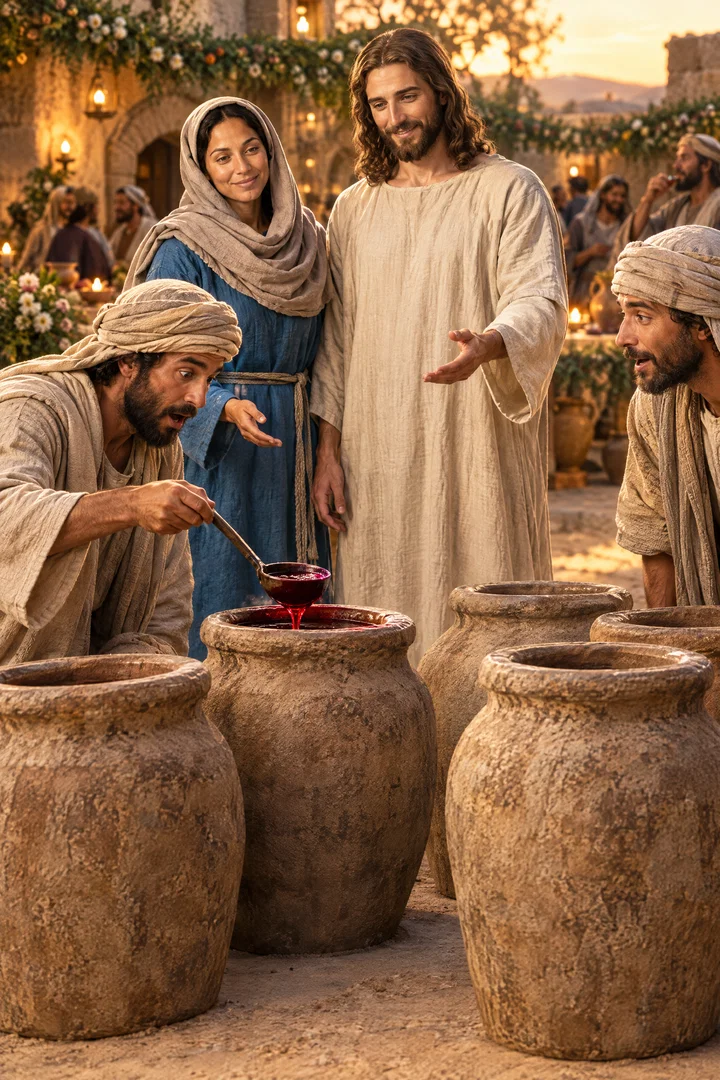
When the ruler of the feast had tasted the water that was made wine, and knew not whence it was: ( but the servants which drew the water knew;) the governor of the feast called the bridegroom,
Translations
When the ruler of the feast had tasted the water that was made wine, and knew not from where it was: (but the servants which drew the water knew;) the governor of the feast called the bridegroom,
When the ruler of the feast had tasted the water that was made wine, and knew not whence it was: ( but the servants which drew the water knew;) the governor of the feast called the bridegroom,
When the ruler of the feast had tasted the water that was made wine, and knew not whence it was: (but the servants which drew the water knew;) the governor of the feast called the bridegroom,
When the ruler of the feast had tasted the water that was made wine, and knew not whence it was; (but the servants who drew the water knew) the governor of the feast called the bridegroom,
And when the ruler of the feast tasted the water now become wine, and knew not whence it was ( but the servants which had drawn the water knew), the ruler of the feast calleth the bridegroom,
And when the ruler of the feast tasted the water now become wine, and knew not whence it was ( but the servants that had drawn the water knew), the ruler of the feast calleth the bridegroom,
And as the director of the apartment tasted the water become wine, and knew not whence it is, (but the ministrants knew, who have drawn the water,) the director of the feast doth call the bridegroom,
But when the feast-master had tasted the water which had been made wine ( and knew not whence it was, but the servants knew who drew the water), the feast-master calls the bridegroom,
And, when the master of the feast had tasted the water, now made, wine, and knew not whence it was,—though, they who were ministering, knew, even they who had drawn out the water, the master accosteth the bridegroom,
Berean Standard Bible, Majority Standard Bible
and the master of the banquet tasted the water that had been turned into wine. He did not know where it was from, but the servants who had drawn the water knew. Then he called the bridegroom aside
When the ruler of the feast tasted the water now become wine, and didn’ t know where it came from ( but the servants who had drawn the water knew), the ruler of the feast called the bridegroom
After tasting the water which had now become wine, the master of the feast (having no idea where it came from, though it was clear to the servants who took the water out) sent for the newly-married man,
Nowe when the gouernour of the feast had tasted the water that was made wine, (for he knewe not whence it was: but the seruants, which drewe the water, knewe) the gouernour of ye feast called the bridegrome,
Douay-Rheims (Challoner revision)
And when the chief steward had tasted the water made wine, and knew not whence it was, but the waiters knew who had drawn the water; the chief steward calleth the bridegroom,
Pictures
Cross-references
- John 4:46-54
So Jesus came again into Cana of Galilee, where he made the water wine. And there was a certain nobleman, whose son was sick at Capernaum.
The Cana water-to-wine miracle precedes another sign that leads a household to believe.
- John 2:5
His mother saith unto the servants, Whatsoever he saith unto you, do it.
The servants obey Jesus in the Cana wonder.
- John 2:4
Jesus saith unto her, Woman, what have I to do with thee? mine hour is not yet come.
Jesus speaks of his hour in reply to Mary at Cana.
- John 2:1
And the third day there was a marriage in Cana of Galilee; and the mother of Jesus was there:
Identifies Cana in Galilee as the place of the marriage.
- John 4:54
This is again the second miracle that Jesus did, when he was come out of Judæa into Galilee.
Identifies a later miracle in Galilee as Jesus’ second sign.
- John 6:1-14
After these things Jesus went over the sea of Galilee, which is the sea of Tiberias.
Both recount food miracles revealing Jesus’ miraculous provision.
Commentary
Each commentary is drawn from primary sources: the writings of Ellen G. White and Adventist pioneers and periodicals. Each commentary is separate. Its own words are not a quotation; follow the references to read the source passages.
Ellen G. White
65 sources
At the wedding feast in Cana the master of ceremonies tasted the newly made drink without knowing where it had come from, while the servants who had drawn the water knew, and surprised by its superior quality he called the bridegroom to praise him for keeping the best until last.Ms 22, 1898, par. 36–40Ms 126, 1903, par. 9–1110MR 197.1–201.5 The drink was of unsurpassed quality yet was pure unfermented juice of the grape, wholesome and harmless, not intoxicating liquor.ST Sep 6, 1899Ms 22, 1898, par. 36–4010MR 197.1–201.5 By performing His first sign there as He began His public ministry Jesus sanctioned marriage as a divine and sacred institution He Himself had ordained.2SP 110.1Ms 16, 1899, par. 5–9ST Apr 8, 1886 The abundant supply beyond the need of the feast pictures the ample provision of His grace and righteousness and the lasting satisfaction of His gifts.3RED 7.2–8.3Ms 36, 1899, par. 5 The miracle gives no license for fermented wine but calls for temperance and a clear mind for God's service.ST Sep 6, 1899Ms 16, 1899, par. 15–16Ms 16, 1899, par. 17–21
Wedding Feast Setting
This is the account of Jesus' first sign, performed at a marriage feast in Cana of Galilee.DA 144.1DA 144.2ST Apr 8, 1886 Jesus went there on purpose with His newly made disciples as guests, and graced the feast with His presence.DA 144.2ST Apr 8, 1886 The wedding party were relatives of Joseph and Mary, and many influential persons were gathered.DA 144.2ST Apr 8, 1886
He came after being separated from His widowed mother for about two months since His baptism by John and His temptations in the wilderness of temptation.ST Apr 8, 1886DA 144.3–145.1 She had awaited His return with sorrow and troubled forebodings.DA 144.3–145.1 He met her as the same tender, dutiful son, yet changed in countenance, bearing marks of fierce conflict and evidence of His high mission in holy expression and gentle dignity.ST Apr 8, 1886 He was accompanied by young men who reverently called Him Master and told her of wonderful things witnessed at the baptism and afterward, that He is Jesus of Nazareth of whom Moses in the law and the prophets wrote, the long-looked-for Messiah.ST Apr 8, 1886
During the feast the wine supply ran out, a shortage regarded as a disgraceful failure of hospitality.DA 148.2COS 56.1–57.1 At first only a few knew of the embarrassment.ST Sep 6, 1899 The ruler of the feast and the guests did not know the supply had failed.DA 148.2COS 56.1–57.1
The ruler tasted the water that had been made wine without knowing whence it was.Ms 22, 1898, par. 36–40Ms 126, 1903, par. 9–1110MR 197.1–201.5Ms 16, 1899, par. 15–1610MR 204.1–206.2 The servants which drew the water knew.Ms 22, 1898, par. 36–40Ms 126, 1903, par. 9–1110MR 197.1–201.5Ms 16, 1899, par. 15–1610MR 204.1–206.2 Surprised by its superior quality, he gladly found it better than what had been served first and better than any he had tasted.Ms 126, 1903, par. 9–113RED 7.2–8.3DA 148.2COS 56.1–57.1 He called the bridegroom and praised him for keeping the good wine until now, saying the best is usually served first.Ms 126, 1903, par. 9–1110MR 204.1–206.23RED 7.2–8.3DA 148.2 The bridegroom made no reply because he did not know its source.Ms 126, 1903, par. 9–11
Manner of Miracle
He changed the water into wine fresh from the cluster without touching the water or going near the jars, simply by looking upon the water and telling the servants to draw out and carry it to the ruler of the feast.Ms 126, 1903, par. 9–11Ms 16, 1899, par. 25
He performed the miracle quietly and left before the guests could find Him, withdrawing unnoticed even by His disciples.2SP 104.3–105.2DA 149.5 The guests did not learn of His work until after He had gone.COS 56.1–57.1 The company was at first too amazed to focus on Him.DA 149.5
The ruler's tasting without knowing where it came from, while the servants who drew the water knew, and the superior quality of what was served, drew remarks and astonishment from the guests that led to questions.COS 56.1–57.13RED 9.1–2DA 149.5Ms 16, 1899, par. 22DA 149.6–150.1 The servants who had drawn the water then told how the water had been changed to wine, and by their account the miracle became known.Ms 126, 1903, par. 9–1110MR 204.1–206.23RED 9.1–2DA 149.5Ms 16, 1899, par. 22
Pure Wine Provided
The ruler tasted what had been water turned to wine of unsurpassed quality, the best served at the feast, better than what had gone before and praised as unusually good.ST Sep 6, 189910MR 197.1–201.5Ms 16, 1899, par. 15–1610MR 204.1–206.23RED 7.2–8.3 That wine was pure, clarified and refined unfermented juice of the grape, fresh from the cluster, a safe, wholesome, refreshing and harmless drink for all.ST Sep 6, 1899Ms 22, 1898, par. 36–40Ms 16, 1899, par. 15–1610MR 204.1–206.23RED 7.2–8.3 It was not fermented or adulterated intoxicating liquor, and Christ made no intoxicating wine and set no example of drinking it.ST Sep 6, 1899Ms 22, 1898, par. 36–40Ms 16, 1899, par. 15–16ST Apr 8, 1886ST Aug 29, 1878 His care in providing such a safe drink confirmed faith in Him as the world's Redeemer.ST Sep 6, 189910MR 197.1–201.5Ms 16, 1899, par. 15–16
To have made intoxicating wine would have been contrary to all His teachings and example.ST Aug 29, 1878 It would have contradicted His speaking of the law from Sinai, His prohibition of wine to those officiating in holy office that they might have clear judgment to distinguish between common and sacred, do justice, teach His statutes and accept no bribes, and His commands of abstinence from wine and strong drink to the wife of Manoah for her Nazarite son and to Zacharias for the unborn John.ST Aug 29, 1878 The false charge that He was a winebibber is denied, for He kept His Father's commandments and His whole life was temperance and self-denial, and had He been a winebibber He could not have been a perfect offering and His blood would avail nothing.ST Aug 29, 1878
The object of the miracle was to bring the perverted taste of the governor of the feast to a healthy condition by inducing him to acknowledge that this wine was superior in quality to any he had before tasted.ST Aug 29, 1878 Its effect was to bring the taste into harmony with a healthful appetite.ST Apr 8, 18862SP 103.3–104.2 This act followed His long fast and suffering in the wilderness to break the power of appetite over man, which had led among other evils to the free use of intoxicating liquor.ST Apr 8, 1886
The same kind of pure juice with not one particle of fermentation in it is suitable as the symbol of the Saviour's blood and was used by Christ and His disciples at the first communion.MH 333.2–3Ms 230, 1902, par. 32–33Ms 106, 1903, par. 8–11 As the Passover bread had no leaven, so this wine had no fermentation.Ms 106, 1903, par. 8–11 Jesus never puts before anyone what would tempt to evil, so He did not provide intoxicating drink, but what He provides is soul-refreshing and life-giving.Ms 106, 1903, par. 8–11
The miracle gives no sanction or license for drinking fermented wine or for wine or liquor that confuses the brain.ST Sep 6, 1899Ms 16, 1899, par. 15–16Ms 230, 1902, par. 32–33Ms 126, 1903, par. 15 Christ never by word or act sanctioned the use of fermented wine, but set an example of temperance.ST Sep 6, 1899Ms 16, 1899, par. 15–16Ms 16, 1899, par. 17–21Ms 126, 1903, par. 15 Unfermented wine is the preferable and only kind to have in the house, and the call is to keep the mind clear to give God the full strength of the powers He created for His honor and glory.Ms 22, 1898, par. 36–40Ms 230, 1902, par. 32–33
Salvation Pictured Abundantly
The water turned to wine points beyond the feast to salvation itself, the water standing for baptism into Christ's death and the wine standing for His blood shed to cleanse and purify the world from sin.3RED 7.2–8.32SP 103.3–104.2 The ruler who tasted did not know where it came from, while the servants who drew the water knew, and his praise of it as better than what had been served first opened the way for that meaning to be seen.3RED 7.2–8.32SP 103.3–104.2
The supply was far more than the feast required, and that abundance pictures the ample, full and abundant provision made for forgiveness.3RED 7.2–8.3Ms 36, 1899, par. 5 It is the provision of the Saviour's grace and righteousness, so full that those who come to Him for the bread of heaven and the water of salvation will always be supplied.3RED 7.2–8.3Ms 36, 1899, par. 5 His good gifts do not fade or cloy but remain fresh and satisfying, bringing lasting satisfaction and joy, whereas worldly pleasures end in weariness and bitterness.3RED 7.2–8.32SP 103.3–104.2
As at Cana He turned common water into wine, so He still works with a God-fearing mother closely connected with Him.GW 206.2–3RH Jan 24, 1907 He joins her in the ordinary work of caring for her children and in the common things of life, transforming them into a loving ministry of heavenly worth and infinite value.RH Jan 24, 1907Ms 43, 1900, par. 50 By that ministry of love He makes the home a Bethel and a place of heavenly joy, turning the common water of life into the wine of heaven.GW 206.2–3RH Jan 24, 1907Ms 43, 1900, par. 50
Marriage Honored and Blessed
Jesus attended the wedding feast at Cana and performed His first miracle there as He began His public ministry, and by His presence and act He sanctioned marriage and set His blessing upon it.2SP 110.1Ms 16, 1899, par. 5–9ST Apr 8, 1886MH 356.1Ms 170, 1905, par. 10 That sanction recognized marriage as a divine and sacred institution which He Himself had formed and ordained at the creation of humanity.2SP 110.1Ms 16, 1899, par. 5–9MH 356.1 It declares marriage worthy of respect and gives it high endorsement and honor.ST Apr 8, 18863RED 13.3–14.1Ms 170, 1905, par. 10
By adding joy to the gathering and providing the cup of blessing, He honored the relations of human life.DA 144.1COS 57.5–6 His presence and gift showed sympathy with and approval of those at the wedding and His desire to promote their happiness and to turn their attention to God's goodness, love and salvation.DA 144.1COS 57.5–6Ms 22, 1898, par. 41 He came not to reject marriage or the family but to restore, elevate, purify and ennoble pure affection, so that the earthly family could symbolize the family in heaven.DA 144.1Ms 22, 1898, par. 41 It is therefore right to gather for pleasant occasions.COS 57.5–6
His active interest proves He came not to put a cloud over the happiness of family and guests but is in full sympathy with pure joy.Ms 126, 1903, par. 23–24 His presence declares harmony with marriage as a blessed institution, not forbidden by God.Ms 16, 1899, par. 25Ms 126, 1903, par. 23–24 He gives sanction to every gathering that is pure and lovely and of good report, enforces celibacy upon no class of men, and came not to destroy the sacred relationship of marriage but to exalt it and restore it to its original sanctity.Ms 126, 1903, par. 23–24 He looks with pleasure upon the family relationship where sacred and unselfish love bears sway.Ms 126, 1903, par. 23–24
Reaching People Socially
Jesus came to the wedding to draw near to ordinary people in ordinary social settings, mingling with all classes to bring them together as one family and to break down social barriers and Jewish prejudice.2SP 109.1–22SP 106.1–107.2DA 150.23RED 11.2–12.1Ms 146, 1899, par. 5–6 His presence there shows that innocent happiness and social fellowship pleased Him, and by it He taught His disciples sympathy and humanity.2SP 109.1–23RED 13.3–14.1 He did not shun ordinary social life but met people where they were in order to reach them and do them good, rather than withdrawing from society.2SP 106.1–107.2Ms 146, 1899, par. 5–6
He awakened interest by going among men as one desiring their good, seeking them at their daily vocations and manifesting unfeigned interest in their temporal affairs.ST Apr 8, 1886 He carried instruction into households and brought whole families in their own homes under the influence of His divine presence, to turn attention to God's goodness, love and salvation.ST Apr 8, 1886 So He is found seeking men in public streets, in private houses, on boats, in the synagogue, by shores of lakes, and at marriage feasts.ST Apr 8, 1886
This gives a lesson for disciples through all time not to exclude themselves from society, renouncing all social communion and seeking strict seclusion from fellow beings.ST Apr 8, 1886 Those who think to preserve religion by hiding it within stone walls to escape contamination of the world lose golden opportunities to enlighten and benefit humanity.ST Apr 8, 1886 To reach all classes they must meet people where they are, for people will seldom seek them of their own accord, and hearts are touched by divine truth not alone from the pulpit.ST Apr 8, 1886
His gracious presence and generous conduct at the feast gave those He honored opportunity to know Him and to see the contrast between His life and teaching and the Pharisees' austere seclusion, bigotry, self-righteousness and narrow censorious spirit.ST Apr 8, 1886GW92 319.2–320.1GW 334.4–335.115MR 132.2–3 Critics used His attendance to accuse Him of worldly conformity, but His participation was not worldly conformity.GW92 319.2–320.1GW 334.4–335.115MR 132.2–3 No shadow of worldly levity marred His conduct as He joined the mixed assembly of the festal gathering and sanctioned the social gathering with His presence.ST Apr 8, 18863RED 10.1 Yet His presence there does not establish that every form of pleasure or entertainment is proper.21MR 242.6–243.2
Faith and Reception
The turning of the water into wine confirmed the faith of the disciples in Jesus as the world's Redeemer.ST Sep 6, 189910MR 197.1–201.5ST Sep 6, 1899Ms 16, 1899, par. 22 It served as convincing testimony to them of who He was.ST Sep 6, 189910MR 197.1–201.5Ms 16, 1899, par. 22 It gave them opportunity openly to acknowledge that faith in Him.ST Sep 6, 1899Ms 16, 1899, par. 22DA 149.6–150.1
The report of the miracle spread through all that surrounding region even to Jerusalem.ST Apr 8, 1886 Priests and elders heard of it with wonder.ST Apr 8, 1886 They searched with new interest the prophecies pointing to the coming of Christ.ST Apr 8, 1886 They were filled with intense anxiety to know the aim and mission of this unassuming new Teacher who did what no other man had ever done.ST Apr 8, 1886
The sign stands as evidence of Jesus' power to do what seemed impossible.3RED 14.2–15.1ST Feb 3, 18812SP 151.2ST Feb 3, 1881 That changing of water into wine at Cana prepared the way for His warm and cordial reception in Galilee.3RED 14.2–15.1ST Feb 3, 18812SP 151.2ST Feb 1, 1877 It helped prepare the people of Galilee to receive Him.3RED 14.2–15.1ST Feb 3, 18812SP 151.2 That display of divine power showed power over disease and gave the Jewish nobleman of Capernaum reason to believe that One who could do such a work could raise his dying son to health even from the brink of the grave.ST Feb 1, 1877ST Feb 1, 1877 It encouraged him to believe that Jesus could restore his son.ST Feb 1, 1877ST Feb 1, 1877
Temperance and Provision
John 2 belongs to true health reform and temperance, setting the duty to live in harmony with the laws of health and to be temperate in all things.STBk 126.2STA 127.1 Temperance in all things is a duty of conscience, needed to receive the sanctifying influence of truth.STBk 126.2 God has put knowledge of the laws of health within reach and has made it duty to preserve the physical powers in the best possible condition to render acceptable service to Him.STA 127.2 Its principles are to be taught by precept and by quiet, consistent example, and this light promotes spiritual as well as physical life, so that to refuse to improve it is to reject one of the means God has granted for that life.STA 127.2STA 127.1
The providing of wine at the wedding feast shows that God provides for human needs.7T 114.3CH 599.1–2GW 362.2–363.1 Jesus there acts as the heavenly Provider of all foods in supplying a necessity.CH 599.1–2Ms 81, 1902, par. 14 The Lord will not leave His people in ignorance but guides and teaches them in preparing suitable and best foods for different times and all times and occasions.CH 599.1–2Ms 81, 1902, par. 14GW 362.2–363.1 Health foods and the food business are among His own instrumentalities to supply need.7T 114.3Ms 81, 1902, par. 14
Sources
Pioneers and periodicals
112 sources
At Cana Jesus turned water into wine, and when the master of the feast tasted it he did not know where it had come from, while the servants who had drawn it knew, so he called the bridegroom in astonishment at its excellence.ST Mar 10, 1887ST Dec 5, 1892ST Jul 9, 1896ST Feb 7, 1911ST Sep 29, 1898 It was His first miracle, worked by divine power at a wedding feast to supply the failed wine.ST Mar 8, 1899ST Apr 5, 1905ST Sep 17, 1894ST Jul 9, 1896 The wine He made was the best of the feast, pure sweet unfermented juice of the grape and not intoxicating drink.ST Apr 19, 1877RH Jun 25, 1914ST Dec 5, 1892 The act manifested His glory and proved His divinity and divine mission as Son of God, done instantly by His own word and will apart from vine and harvest.ST Apr 5, 1905ST Sep 17, 1894ST Aug 13, 1894RH Feb 8, 1906ST Mar 11, 1908 By working it there He honored and blessed marriage as a divine and sacred institution, and shared in innocent social joy without approving intemperance or worldly revelry.ST Apr 8, 1886ST Dec 30, 1880STRH Feb 25, 1904
Wedding Setting and Sequence
This is the account of Jesus' first miracle, performed at a wedding feast in Cana of Galilee where water was made wine by divine power.ST Mar 8, 1899ST Apr 5, 1905ST Sep 17, 1894ST Jul 9, 1896ST Sep 16, 1886 It was the beginning of His signs, wrought after He had chosen some of His disciples and before He took up His abode in the place named in John 2:12, beginning His public ministry and manifesting His glory so that His disciples believed on Him.ST Nov 10, 1914ST Jul 9, 1896ST Sep 16, 1886 The work honored the marriage celebration and affirmed marriage as an institution He had established, manifested heavenly grace and His character in supplying temporal needs as pledge of spiritual supply, and showed Him bringing God's life, righteousness and purity as both Son of God and brother sharing human feelings and sympathies.ST Nov 10, 1914ST Mar 8, 1899ST Apr 5, 1905ST Sep 17, 1894 It also serves as a fitting symbol of the saints' welcome to the heavenly kingdom at the marriage supper of the Lamb.ST Mar 8, 1899
The wedding took place on the third day after John bore witness to Jesus for the second time.ST Aug 13, 1896 It came a little while after Satan tempted Him in the wilderness, about two months after His baptism by John and His temptations in the wilderness of temptation, after Jesus had chosen disciples and before He took up His abode in the place named in John 2:12 and went to Nazareth.ST Apr 8, 1886ST Sep 16, 1886 The miracle was likely reported by His friends and new disciples.
Present were Jesus with His newly made disciples, His mother Mary, relatives of Joseph and Mary, many influential persons, the bridegroom, the ruler of the feast in charge of the ceremonies, and the servants.ST Apr 8, 1886ST Jul 9, 1896 Jesus went there on purpose and graced the feast with His presence as the honored guest, after being separated from His widowed mother for two months since His baptism.ST Apr 8, 1886RH Oct 16, 1913 He met His mother as the same tender, dutiful son yet changed in countenance, bearing marks of fierce conflict and evidence of His high mission in holy expression and gentle dignity, accompanied by young men who reverently called Him Master and told Mary of wonderful things witnessed at the baptism and afterward, that He is Jesus of Nazareth of whom Moses in the law and the prophets wrote, the long-looked-for Messiah.ST Apr 8, 1886
The wine ran out and could not be replaced at that late hour, the wine being pure grape juice, and when Mary told Jesus He had the servants fill six great stone water-pots with water, then commanded that it be drawn out and taken to the man in charge of the ceremonies.ST Jul 9, 1896ST Dec 30, 1880 The servants drew from the filled pots and carried what was drawn to the ruler of the feast, and the drink that he tasted came from those pots filled with water at Jesus' command.ST Jul 9, 1896ST Sep 29, 1898 He had men help Him by first filling the pots and then bearing the water after it became wine to the guests, the wine served last being excellent, and the men who filled and carried helped the Lord in the matter, but all praise belonged to the Lord and none to the helpers, because His part was the all-important part.ST Jan 9, 1907
Cana is the place where the marriage and marriage supper took place, not the bride's name.ST Jul 13, 1882RH Jul 28, 1904 It lies about an hour and a half from Nazareth, now called Kefr Kenna, where the water He turned was drawn from the spring just outside and carried in jars on the head as local women still do, and a broken water-pot shown in the Greek church there is claimed as one from the wedding.ST Jun 2, 1898
The change was genuine, the water having been made wine by Jesus, not secretly supplied by Him as ordinary wine or passed off through a trick.ST Mar 10, 1887 In Nazareth where the miracle was known some later disputed it and dismissed it as a trick.ST Aug 16, 1910 The claim that the wedding was polygamous is rejected, and the verse itself does not identify Jesus as the bridegroom, against the claim that uses the Cana wedding as basis for saying Jesus was married there with Mary, Martha and others as His wives.RH Dec 17, 1908ST Oct 2, 1884
Those who exalt Mary hold that Christ's first miracle at Cana of Galilee, recorded in John 2:1-11, was wrought at Mary's request as proof of His divinity, showing she has great power with God and is to be confided in most next to the Saviour as Mother of the Redeemer and advocate with her divine Son.ST Mar 30, 1876RH May 12, 1874
Tasting Knowledge and Testimony
The ruler of the feast tasted the water that had been made wine without knowing where it came from, while the servants who had drawn the water knew its source.ST Mar 10, 1887ST Dec 5, 1892ST Feb 7, 1911ST Jul 13, 1882ST Jun 30, 1881 The change had already taken place by the time he drank, for the wine was drawn from the stone pots soon after water was poured into them, leaving little time for ordinary process, and it was a fresh ripe product of creative power like fully grown fruit that had not begun to ferment or decay.ST Dec 22, 1898ST Jul 13, 1882ST Jun 30, 1881 It was not wine secretly supplied as ordinary wine or passed off by trick, but water made wine by Jesus, unfermented grape juice of a kind the ruler could call good, whose making and serving accorded with Christ's mission to heal the broken-hearted, free captives and save the lost.ST Mar 10, 1887ST Dec 5, 1892 The miracle was Jesus' help for His mother when she was troubled by the shortage, and the wine supplied was not a dire necessity but part of a long-established custom.ST Feb 7, 1911
After tasting he was astonished at its superior quality, finding it indeed the best wine of the feast, and he called the bridegroom.ST Sep 29, 1898ST Jul 26, 1910ST Dec 30, 1880ST Jan 2, 1912ST Jul 26, 1910 He declared the custom of setting out good wine first and worse wine after drinking, and that the good wine had been kept until now.ST Jul 9, 1896ST Sep 29, 1898ST Jul 26, 1910ST Jul 26, 1910 The drink came from the six stone water-pots filled with water at Jesus' command at the marriage in Cana of Galilee, and this work was the beginning of His signs by which He manifested His glory so that His disciples believed on Him.ST Jul 9, 1896 The water represented baptism into Christ's death and the wine His blood shed to purify the world from sin, with the ample supply picturing abundant provision for forgiveness, and the wine was pure unfermented grape juice rather than intoxicating liquor.ST Dec 30, 1880 The provision met no dire need but increased the happiness of Jesus' friends and spared them embarrassment, showing that Jesus cares about ordinary needs and may be approached in every emergency.ST Jan 2, 1912
The bridegroom himself did not know that the wine had run out or that a new supply had been provided, learning of it only later when called, while the servants knew what had happened and the steward did not know where it came from.ST Jul 26, 1910ST Jul 26, 1910 In this account “servants” is one New Testament translation of the Greek word diakonos.RH Nov 7, 1854 Christ did not publicize the miracle, and at first only a few knew of the governor's embarrassment, but the guests' astonishment at the wine's quality helped make the miracle known.ST Sep 6, 1899 The guests noticed the quality and asked where it came from, and the servants who had drawn the water knew how it had been made and told what had happened, prompting people to seek Jesus.ST Feb 15, 1899 The miracle confirmed the disciples' faith and testified to them that Jesus was the world's Redeemer, though one account holds that it was not spoken of until after Jesus had departed.ST Sep 6, 1899ST Jul 26, 1910
His unknowing praise of what Christ had done illustrates how Christ's work can be admired without its divine source being recognized, while picturing simple elements of life transformed by divine power and ordinary human relationships sanctified.RH Jul 28, 1903 Like the servants at the feast, those close to the deliverance of Abeokuta when the Dahoman army inexplicably left are associated with knowledge of an outcome others could not explain, suggesting God's intervention.RH Nov 27, 1913
Nature of the Wine
The wine Jesus made was the best wine of the feast, meaning the sweetest and finest-flavored, fresh unfermented pure clarified refined juice of the grape, rare, purple, rich, sweet, new, healthful, harmless, nourishing and refreshing.ST Sep 6, 1899ST Apr 19, 1877RH Jun 25, 1914ST Dec 5, 1892ST Nov 25, 1908 It was the good kind that makes glad the heart, not intoxicating liquor, mocking raging deceiving strong drink, or red wine that reddens in the cup and at last bites like a serpent and stings like an adder, and no drunkenness followed its use.ST Sep 6, 1899ST Dec 5, 1892ST Nov 25, 1908ST Jul 1, 1897 The English meaning of wine misleads, because in Bible times wine often meant unfermented grape juice, and the Bible recognizes two kinds of wine, one that does not intoxicate and one that intoxicates and is forbidden.RH Jun 25, 1914ST Nov 25, 1908ST Jul 1, 1897 The ruler calling it best did not mean most intoxicating, the guests were not habitual users of intoxicating liquor, and the householder was not setting a condemned drink before them.RH Jun 25, 1914ST Nov 25, 1908
It was produced instantly when drawn from the stone pots soon after water was poured in, by creative power and creative word apart from ordinary processes, like fully grown fruit and the life God puts in the grape.ST Apr 19, 1877ST Jul 13, 1882ST Jun 30, 1881RH Jun 22, 1916ST Aug 13, 1894 There was little time for fermentation, without time for leaven to decompose sugar or for the fresh ripe product to begin to ferment or decay.ST Apr 19, 1877ST Jul 13, 1882ST Jun 30, 1881ST Aug 19, 1889ST Aug 13, 1894 The instant bringing about of the natural process by which the vine turns water into the fruit's juice left it fresh and unfermented, not intoxicating.ST Apr 19, 1877ST Aug 19, 1889ST Aug 13, 1894 The miracle was an extraordinary act, not a replacement for the ordinary way of producing wine through cultivation and labor.RH Jun 22, 1916
Jews prized wines that were least strong, with unfermented wine considered especially fine.ST Apr 19, 1877RH Jun 25, 1914 The ordinary drink was grape juice mixed with hot or cold water, sometimes with spices, while fermented wine was rare and restricted.RH Jun 25, 1914 Fresh juice was boiled until thick like treacle to keep without fermentation, stored in jars and mixed with water for drinking, and when boiled down to one third of its bulk for finest flavor it was the best wine.RH Jun 25, 1914 Jewish sacred feasts including the marriage feast never use any kind of fermented drink, but use fresh grapes, unfermented grape-juice, and raisins as the symbol of benediction, since fermentation is always a symbol of corruption, decay and rottenness.ST Apr 19, 1877ST Feb 7, 1878
Making and serving fermented wine would conflict with Christ's mission to heal the broken-hearted, free captives, and save the lost and save that which was lost.ST Dec 5, 1892ST Feb 7, 1878 It would have been contrary to all His teachings and example, to His speaking of the law from Sinai, and to His warnings against intoxicating wine which He Himself inspired and would not make what He condemns.ST Aug 29, 1878ST Dec 5, 1892 It would have opposed His prohibition of wine to those officiating in holy office that they might have clear judgment to distinguish between common and sacred, do justice, teach His statutes, and accept no bribes, and His commands of abstinence from wine and strong drink to the wife of Manoah for her Nazarite son and to Zacharias for the unborn John.ST Aug 29, 1878 The charge that Christ was a winebibber is false, for He kept His Father's commandments and His whole life was temperance and self-denial after His long fast and suffering in the wilderness to break the power of appetite, and had He been a winebibber He could not have been a perfect offering and His blood and offering would avail nothing.ST Apr 8, 1886ST Aug 29, 1878 One object of the miracle was to bring the perverted taste of the governor of the feast to a healthy condition by inducing him to acknowledge this pure juice superior in quality to any he had before tasted, its effect bringing taste into harmony with a healthful appetite.ST Apr 8, 1886ST Aug 29, 1878
The amount produced is left uncertain because ancient measures varied, and it is not clear whether all the water in the jars became wine or only the portions drawn for serving.RH Sep 11, 1860 It is also left uncertain whether the wine was fermented or harmless unfermented wine, and what became of any surplus; therefore the quantity and use of the wine do not establish that Jesus promoted intemperance.RH Sep 11, 1860 By contrast, those who held otherwise present the miracle as honoring wine because it was wanted when needed, and appeal to it as evidence that Jesus made wine when it was wanted.ST Jan 12, 1882ST Jan 24, 1878ST Jan 24, 1878 The Cana wine is also remembered as rich red wine, the question is raised whether that wine was unfermented since fermented drink was said to be prohibited for Jews at Passover and Jesus would not have used it in that setting, and the claim that Jesus made intoxicating wine at Cana is false.ST Jan 24, 1911RH Jun 18, 1914
Divine Power Revealed
The miracle displayed divine glory, which is character and goodness shown in caring for temporal needs, and it proved miraculous power, divinity, and divine mission as Son of God who is also a brother sharing human feeling and sympathy.ST Feb 3, 1881ST Apr 5, 1905ST Sep 17, 1894ST Nov 1, 1910RH Dec 8, 1859 Creative power was in Him to supply what people lacked in the body, which assures still greater supply for spiritual need, and the changing of water into wine stands as evidence of power to do what seems impossible.ST Feb 3, 1881ST Sep 17, 1894ST Aug 13, 1894 From that work until Calvary the whole course of His deeds revealed the wisdom, power, and love of God as the faithful and true witness of the Father, bringing relief to the ruler of the feast and cheer to the guests.ST Sep 15, 1898
It was accomplished directly and instantly by word, will, and command with authority over nature, apart from vine, grape, and harvest, as the beginning of His work of creative power.RH Feb 8, 1906ST Mar 11, 1908RH Dec 8, 1859RH Jun 18, 1914 In a moment were brought together the elements that nature takes longer to combine in ripening grapes into good wine, yet without opposition to the laws of nature.RH May 29, 1900 The direct production shows that Christ is the source and worker behind the ordinary processes that provide food and drink, so those processes belong to His power rather than standing against it.RH Feb 8, 1906
The act hastened, shortened, and accelerated a process that in nature takes months in the vineyard, changing water into wine after it was drawn.ST Feb 15, 1899RH Aug 20, 1908 Both the instant miracle and the gradual growth require God's power and follow the order of nature, differing in time required and familiarity rather than in divine power involved.ST Feb 15, 1899RH Apr 9, 1901 It displayed no more power than belongs to the ordinary production of every cup of wine or to the life in grapes eaten daily, and the daily drawing of moisture through the vine into wine is likewise marvelous though taken for granted.ST Aug 26, 1880RH Apr 9, 1901 The ruler did not know whence the wine came while the servants who drew the water knew, illustrating direct intervention apart from the usual processes and showing that the change and the power behind it can be present even when the process is unseen.RH Aug 20, 1908 The abundance given also shows overflowing generosity in answering requests for spiritual blessing.ST Feb 15, 1899
The extraordinary, sudden work in an emergency did not replace the ordinary way of producing wine through cultivation and labor, nor is it the regular way wine must always be made.RH Jun 22, 1916ST Sep 3, 1902RH Jan 28, 1902 Neither is it a model for cultivating grapevines nor for the usual developing of people, for ordinary Christian character unto perfection requires a lifetime of growth and patient education toward maturity.RH Aug 21, 1913RH Jan 28, 1902 Some may be transformed quickly into effective workers, but most need gradual growth.RH Aug 21, 1913
This work was the beginning of His signs and of His miracle-working career, wrought with the six stone water-pots filled with water at His command, by which He manifested His glory so that His disciples believed on Him as the world's Redeemer.ST Sep 6, 1899ST Sep 6, 1899ST Jul 9, 1896 Becoming known in Galilee, it prepared the people to receive Him cordially.ST May 6, 1886 It also encouraged the nobleman to believe Jesus could heal his dying son, and its lesson of power to meet human need should have taught the disciples He could provide food for the hungry multitude.ST Mar 11, 1908ST May 6, 1886
It stands among His earthly physical miracles alongside raising the dead, healing paralytics, stilling stormy seas, and blighting the fig tree.RH Aug 7, 1913 The promise that believers will do greater works does not necessarily mean more such outward miracles, but more miracles of grace upon the hearts of men, women, and children, because transformation of the unregenerated heart is the greatest work of all.RH Aug 7, 1913 Ordinary water in jars was used by God's grace for the miraculous work, showing that God's power rather than the human instrument produced the result.ST Jul 23, 1912
Symbols and Spiritual Lessons
The water stands for baptism into Christ's death and the wine for His blood shed to purify the world from sin and cleanse its sins, with the ample supply picturing the abundant provision for forgiveness and for blotting out human iniquity.ST Jul 9, 1896ST Dec 30, 1880ST Jan 11, 1905 That wine was pure, clarified, unfermented grape juice, not intoxicating liquor or adulterated drink, and it brought taste into harmony with a healthful appetite.ST Jul 9, 1896ST Dec 30, 1880ST Jan 11, 1905 The wedding miracle teaches that ceremonies have no value unless they receive life and power from Christ, who can also create and cleanse and raise the dead.ST Jul 9, 1896 He changed water directly into excellent wine apart from the ordinary processes of nature, showing God's creative power was in Him.ST Apr 5, 1905ST Aug 13, 1894
That same change shows He can change a weak, characterless human heart into one marked by goodness and blessing and glorifying to God, lifting a person from a lower life to a higher, spiritual character fit for the kingdom of God.RH Jul 28, 1903ST Apr 5, 1905ST Aug 13, 1894 His glory is His goodness, caring for people's needs and meeting them where they are when they trust Him, while the life and refreshment in fruit continually show God's goodness and glory.ST Aug 13, 1894 His work can be admired without its divine source being recognized, as when the ruler praised what Christ had done without knowing whence it came.RH Jul 28, 1903RH Jul 28, 1903 The miracle pictures simple elements of life transformed by divine power and ordinary human relationships sanctified.RH Jul 28, 1903
Even common water and the humblest life may be touched by the divine, showing His power to transform what is ordinary.RH Sep 3, 1903RH Aug 23, 1906 He often does for the Christian what He did in turning water into wine, changing poor things into better things, so the believer has no reason to murmur.RH May 12, 1863 When along life's rugged path the wine of life seems spent and only empty vessels, tears and discontent remain, filling the empty vessels full with flowing sap fresh from the living Vine allows Him to turn life's water into wine before the feast is done. That cheers faith in ordinary life, turning spent water into wine.RH Jul 28, 1903RH Jul 28, 1903RH Sep 3, 1903RH May 12, 1863
The new wine represents the richness of His love and the wholesome fruit of the vine, the same unfermented kind fit to drink in heaven.ST Jan 2, 1912RH Dec 24, 1901 It is the wine the Bridegroom will give His guests to drink new in His Father's glorious kingdom at the marriage supper of the Lamb, a fitting symbol of the saints' welcome to the heavenly kingdom and of salvation.ST Mar 8, 1899RH Dec 24, 1901 The miracle honored the marriage celebration, manifested heavenly grace, met a social need, spared friends embarrassment, and revealed care for human happiness, lawful comforts and temporal blessings when they will not harm a person spiritually or materially.ST Mar 8, 1899ST Jan 2, 1912 The water made wine images Christ working with a mother closely connected with Him, transforming the ordinary work of caring for children into a ministry with heavenly worth and infinite value, making the home a Bethel and turning the common water of life into the wine of heaven.RH Jan 24, 1907 It also images six days' ordinary daily experience touched by divine help becoming rich with spiritual meaning for fitting Sabbath reflection, and pictures how a small act of kindness such as giving a cup of cold water in love becomes a precious offering in heaven.RH Mar 17, 1910ST Mar 10, 1909
Marriage and Social Approval
By working His first miracle at the wedding feast, Jesus honored, blessed, sanctioned and affirmed marriage as an Eden-born, divine, right, honorable, sacred and God-blessed institution given before sin, which He Himself had established and whose covenant His ministry honored.ST Apr 8, 1886STST Aug 13, 1894RH Jul 28, 1868 His presence there surrounded marriage with a sacred halo, sanctifying true earthly joys and showing that innocent happiness pleased Him.ST Apr 8, 1886ST Aug 13, 1894
His attendance as honored guest made the gathering an occasion for friendly social fellowship and ministry, for social joys, innocent happiness and lawful comforts.RH Oct 16, 1913RH Jul 28, 1903ST Jan 26, 1882RH Aug 26, 1902 He entered into human joys and sorrows, rejoiced with the guests, smiled on loving hearts and made them doubly blessed, blessing them by His presence and even by mention of His name.RH Jul 28, 1903 Though a guest He served the assembly, sparing His host embarrassment by supplying need, joining people in ordinary social settings and daily household care, and using such occasions to reach them, lift thoughts to eternal things, and manifest saving power and present truth.RH Feb 25, 1904ST Jan 26, 1882RH Aug 26, 1902 His self-forgetting love still gladdens in His children's joy, bids no sweet affection die, does not call His children to hide their eyes from daily joy, but still walks with men in homeliest household care and makes the home His own.
He could join a Jewish wedding feast and be at ease among the guests without approving intemperance, revelry, folly, amusement, self-indulgence or worldly frivolity, with no shadow of worldly levity, unlike the austere Pharisees.ST Dec 30, 1880RH Feb 25, 1904RH Nov 26, 1901RH Oct 16, 1913 Innocent happiness pleased Him and His presence sanctioned the social gathering, yet He was present not for amusement but to manifest saving power and bear witness to present truth, His conduct remaining uplifting, courteous, gentle and worthy of His calling while lifting minds toward spiritual and eternal things.ST Dec 30, 1880RH Feb 25, 1904RH Nov 26, 1901RH Oct 16, 1913 His attendance at Cana does not sanction modern dancing.RH Jul 20, 1916
That attendance helped break down Jewish exclusiveness and prejudice and taught His disciples sympathy and humanity.ST Dec 30, 1880 By coming to the marriage feast He opened the way for Jews to mingle more freely with other peoples, because He came as Redeemer of the whole world.ST Dec 30, 1880RH Oct 16, 1913
His example shows that innocent social pleasures are fitting when innocent, and that He meets people within ordinary social customs where no principle is at stake.RH Oct 16, 1913RH Apr 21, 1859 He seeks men where they are, in public streets, in private houses, on boats, in the synagogue, by shores of lakes, and at marriage feasts, rather than hiding religion within stone walls to escape contamination of the world.ST Apr 8, 1886 Disciples through all time are therefore not to exclude themselves from society in strict seclusion renouncing all social communion, for men will seldom seek them of their own accord; to reach all classes they must go among them as desiring their good, meet them at daily vocations and in households, manifest unfeigned interest in temporal affairs, awaken interest, carry instruction into homes, and bring whole families under the influence of His divine presence, since hearts are touched not by the pulpit alone and those who hide to preserve religion lose golden opportunities to enlighten and benefit humanity.ST Apr 8, 1886
He is present by His Spirit to bless and sanction marriage now when bride and groom are of one faith, one hope, one heart and purpose to glorify God in all things.RH Dec 10, 1867 Choosing a life companion who shares the same faith is marrying in the Lord, while choosing one of opposite faith or of no faith at all is not marrying in the Lord and is far worse.RH Dec 10, 1867 The miracle at Chuza's wedding was widely known and pointed to Jesus as Messiah, and is recalled when wine ran out as reason for replenishing wine at Herod's banquet.ST Sep 13, 1910ST Aug 9, 1910 It was not at Cana but in Gethsemane, in yielding over the bitter cup, that He most fully showed submission of His own will to the Father's.RH Apr 7, 1868 His gracious service in providing for the feast is true courtesy whose essence is unselfishness, making Him the only perfect example and highest standard for right speech and conduct in all social intercourse, and His complete self-possession and calm repose there exemplifies power sustained by repose in the Father, keeping mental equipoise under duties, cares and perplexities as the strongest expression of faith and loving confidence in His promises.ST Oct 6, 1887ST Jul 29, 1886
Temperance and Christian Practice
The making of wine at Cana does not lay any requirement on followers to use wine as a beverage, any more than the miraculous providing of barley bread lays a requirement to eat barley.ST Jan 24, 1878ST Apr 22, 1889ST Jan 12, 1882ST Jan 24, 1878 What was done because wine was wanted and to honor the occasion leaves full liberty to give up even a lawful pleasure and voluntarily abstain.ST Jan 24, 1878ST Jan 12, 1882ST Jan 24, 1878 Such abstinence may be chosen from the higher motive of bearing with the weaker person, of guarding one who might stumble into sin, and of so fulfilling the law of Christ.ST Jan 24, 1878ST Apr 22, 1889ST Jan 12, 1882ST Jan 24, 1878
The wine supplied was not a dire necessity but belonged to a long-established custom, and the help given when the supply failed met a social need, spared friends and host the embarrassment of shortage, and increased the happiness of the company.ST Feb 7, 1911ST Jan 2, 1912ST Jan 2, 1912ST Jan 26, 1882 In meeting that need the act reveals care for human happiness, for ordinary needs and practical conveniences, and for lawful comforts and temporal blessings when they will not harm a person spiritually or materially.ST Jan 2, 1912ST Jan 2, 1912RH Oct 28, 1909 The same care shows that ordinary need may be brought to Him in every emergency, and that power to provide stands ready beyond the limits of natural resources when the ordinary supply fails.ST Jan 2, 1912RH Oct 7, 1902
The abundance of the wine further shows overflowing generosity in answering requests for spiritual blessings.ST Feb 15, 1899 The presence that brought blessing and joy to the feast, serving the assembly though a guest and smiling on loving hearts to make them doubly blessed, shows a self-forgetting love that gladdens in the joy of His children, bids no sweet affection die, and does not call them to hide their eyes from daily joy. That same love still walks with men in the homeliest household care and makes the home His own.
Doing good and helping others in this miracle exemplifies casting bread upon the waters, for the power and influence seen led people to believe and that good influence returned. The glory thus shown is goodness in caring for needs and meeting people where they are when they trust, with power to change the human heart into one that glorifies God and fits it for the kingdom.ST Aug 13, 1894 The life and refreshment continually found in fruit likewise show that goodness and glory.ST Aug 13, 1894
Sources