John 2:4
Jesus saith unto her, Woman, what have I to do with thee? mine hour is not yet come.
Translations
Jesus says to her, Woman, what have I to do with you? my hour is not yet come.
King James Version, KJV Cambridge Paragraph Bible
Jesus saith unto her, Woman, what have I to do with thee? mine hour is not yet come.
Jesus saith to her, Woman, what have I to do with thee? my hour is not yet come.
Revised Version, American Standard Version
And Jesus saith unto her, Woman, what have I to do with thee? mine hour is not yet come.
Jesus saith to her, 'What — to me and to thee, woman? not yet is mine hour come.'
Jesus says to her, What have I to do with thee, woman? mine hour has not yet come.
And Jesus saith unto her—What part can I take with thee, O woman? Not yet, hath come, mine hour.
“ Woman, why does this concern us?” Jesus replied. “ My hour has not yet come.”
“ Woman, what is that to you and to Me?” Jesus replied. “ My hour has not yet come.”
Jesus said to her, “ Woman, what does that have to do with you and me? My hour has not yet come.”
Jesus said to her, Woman, this is not your business; my time is still to come.
Iesus saide vnto her, Woman, what haue I to doe with thee? mine houre is not yet come.
Douay-Rheims (Challoner revision)
And Jesus saith to her: Woman, what is that to me and to thee? my hour is not yet come.
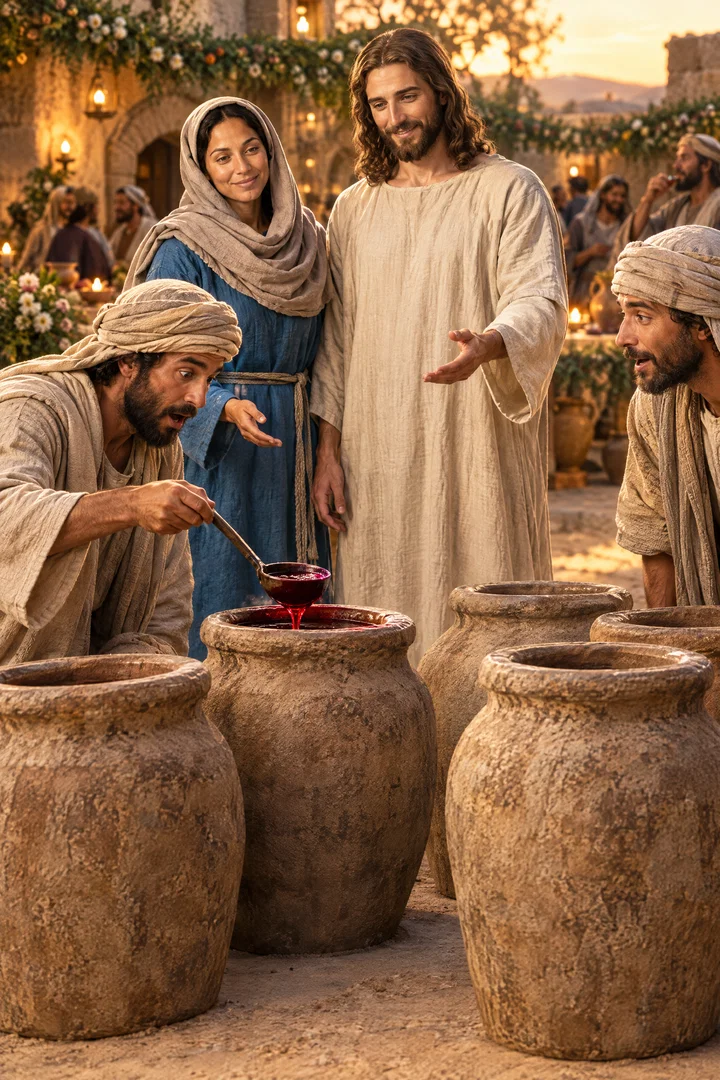
Pictures
Cross-references
- John 2:11
This beginning of miracles did Jesus in Cana of Galilee, and manifested forth his glory; and his disciples believed on him.
The Cana sign reveals Jesus’ glory and strengthens the disciples’ belief.
- John 19:26
When Jesus therefore saw his mother, and the disciple standing by, whom he loved, he saith unto his mother, Woman, behold thy son!
Jesus again addresses his mother as “Woman,” tenderly arranging her care.
- John 4:46-54
So Jesus came again into Cana of Galilee, where he made the water wine. And there was a certain nobleman, whose son was sick at Capernaum.
The later healing follows Jesus’ earlier miracle at Cana.
- Luke 2:49
And he said unto them, How is it that ye sought me? wist ye not that I must be about my Father’s business?
Jesus says his mission is governed by his Father’s will.
- John 7:6
Then Jesus said unto them, My time is not yet come: but your time is alway ready.
Jesus says his appointed time has not yet come.
- John 12:23
And Jesus answered them, saying, The hour is come, that the Son of man should be glorified.
Jesus later declares that the hour for his glorification has come.
- John 20:15
Jesus saith unto her, Woman, why weepest thou? whom seekest thou? She, supposing him to be the gardener, saith unto him, Sir, if thou have borne him hence, tell me where thou hast laid him, and I will take him away.
Jesus addresses Mary Magdalene as “Woman.”
- John 2:10
And saith unto him, Every man at the beginning doth set forth good wine; and when men have well drunk, then that which is worse: but thou hast kept the good wine until now.
The Cana story presents the best wine as kept until last.
- John 7:30
Then they sought to take him: but no man laid hands on him, because his hour was not yet come.
Jesus’ appointed hour had not yet come.
- Mark 3:31-35
There came then his brethren and his mother, and, standing without, sent unto him, calling him.
Jesus responds to his mother and brothers and defines his spiritual family.
- Matthew 12:50
For who soever shall do the will of my Father which is in heaven, the same is my brother, and sister, and mother.
Jesus identifies those who do the Father’s will as his family.
- Luke 8:21
And he answered and said unto them, My mother and my brethren are these which hear the word of God, and do it.
Jesus identifies those who hear and do God’s word as his family.
- Luke 2:35
( Yea, a sword shall pierce through thy own soul also,) that the thoughts of many hearts may be revealed.
Simeon foretold the sorrow Mary would face through Jesus’ mission.
- John 19:30
When Jesus therefore had received the vinegar, he said, It is finished: and he bowed his head, and gave up the ghost.
His suffering culminates in the cry that his work is finished.
- John 2:8
And he saith unto them, Draw out now, and bear unto the governor of the feast. And they bare it.
The servants carry the wine Jesus provided to the feast steward.
- John 20:13
And they say unto her, Woman, why weepest thou? She saith unto them, Because they have taken away my Lord, and I know not where they have laid him.
Mary addresses Jesus at the tomb as her Lord, understood as her husband.
Commentary
Each commentary is drawn from primary sources: the writings of Ellen G. White and Adventist pioneers and periodicals. Each commentary is separate. Its own words are not a quotation; follow the references to read the source passages.
Ellen G. White
63 sources
At the wedding at Cana the supply of wine failed and Mary told Jesus in hope He would relieve the difficulty and reveal Himself as the Messiah to take His throne.ST Apr 8, 1886Ms 36, 1899, par. 1–3Ms 126, 1903, par. 5–810MR 204.1–206.2DA 144.3–145.1 His reply was not cold or disrespectful but a respectful form whose tone carried love, while it set a boundary that her maternal authority to direct His actions and use of power had ended and His work must follow His Father's will and appointed time alone.2SP 100.2–101.1ST Sep 6, 1899Ms 16, 1899, par. 13–14Ms 126, 1903, par. 5–810MR 204.1–206.2 His hour had not yet come because He acted according to a divine plan established beforehand, having waited thirty years in obscurity and refusing to be hurried into display, with His glorification as King and His offering for sin still future while His present lot was humiliation and sorrow.ST Sep 6, 18993RED 5.1–6.1Ms 79, 1900, par. 20–25DA 486.1–32SP 101.2–102.2 Mary did not take the answer as refusal but as encouragement that He would help, trusting His wisdom and leaving the matter to Him when she told the servants to do whatever He said.Ms 79, 1900, par. 20–25Ms 16, 1899, par. 13–14Ms 126, 1903, par. 5–8 The wine He then provided was pure fresh juice of the grape with no fermentation, and His presence and gift honored marriage as a divine institution and showed His sympathy with innocent human happiness and social life.Ms 79, 1900, par. 20–25ST Apr 8, 1886ST Apr 8, 18862SP 110.1Ms 16, 1899, par. 5–9
Setting at Cana Wedding
The saying belongs to the wedding at Cana in Galilee, a family gathering attended by Jesus with His newly made disciples after He returned to Galilee at the opening of His public ministry.DA 144.2Ms 16, 1899, par. 5–9Lt 66, 1878, par. 7Ms 146, 1899, par. 5–6 There He met His mother after separation following His baptism and temptations in the wilderness, and He did not shun the social life of His countrymen.ST Apr 8, 1886Ms 146, 1899, par. 5–6 Mary still saw Him as the same tender son, yet marked by that conflict and by the dignity of His mission, while His disciples identified Him as the long-awaited Messiah foretold in the law and the prophets.ST Apr 8, 1886
The occasion was a Jewish wedding feast where the supply of pure juice of the grape failed at a late hour and could not be replaced.10MR 204.1–206.2ST Apr 8, 1886 Its absence was unusual and caused perplexity and regret, threatening embarrassment to the hosts.Ms 126, 1903, par. 5–810MR 204.1–206.2ST Apr 8, 1886 Mary, who had a prominent part to perform as a relative at the feast, told Jesus the wine had failed, hoping He would suggest something to relieve the difficulty.Ms 36, 1899, par. 1–3Ms 126, 1903, par. 5–8ST Apr 8, 1886 Her words carried a hidden request to One to whom all things were possible that He should relieve the need.ST Apr 8, 1886
That request sprang from glad assurance that her long-cherished hope that Jesus is the Messiah was true, mingled with a fond mother's natural pride.ST Apr 8, 1886 She hoped He would reveal His glory and show that He was the Messiah and take Israel's throne and be placed before the Jews in the position He should occupy as honored of God.DA 144.3–145.1ST Apr 8, 1886 Her hope rested on evidence she had treasured about Him and was renewed by the disciples' testimony, and in pride of heart she wanted Him proved before the wedding company.ST Apr 8, 1886DA 144.3–145.1ST Apr 8, 1886ST Apr 8, 1886
The setting was His first sign at a wedding feast, where He used His power to add to the guests' joy.DA 144.1 It shows His sympathy with people and His desire to minister to their happiness, and His blessing honored the relationships of human life.DA 144.1 His pleasure in innocent happiness at the Jewish feast helped break down Jewish prejudice.2SP 109.1–2
Meaning of Jesus Reply
His word for His mother was not cold, distant, or disrespectful, and it was no rebuke.Ms 16, 1899, par. 13–14Ms 126, 1903, par. 5–810MR 204.1–206.2DA 145.4–146.1 In that culture it was a respectful form of address, and His tone and look and manner carried love and honor toward her.Ms 126, 1903, par. 5–810MR 204.1–206.2DA 145.4–146.1 His question drew a boundary around her directing of His action, for her maternal authority to direct Him had ended.2SP 100.2–101.13RED 5.1–6.1Ms 16, 1899, par. 13–14DA 145.4–146.12SP 101.2–102.2 Family relationship gave her no special claim to direct His work, to determine His actions, or to guide how He used His power.2SP 100.2–101.13RED 5.1–6.1DA 145.4–146.12SP 101.2–102.2 His work would proceed according to the time appointed for it and His Father's will alone, free from personal considerations, human direction, and human sympathy, and no earthly tie could hold Him back from it.2SP 100.2–101.1ST Sep 6, 18993RED 5.1–6.1DA 145.4–146.12SP 101.2–102.2
His declaration that His hour had not yet come meant He acted or waited according to a divine plan established before His earthly life, with the Father guiding Him step by step.ST Sep 6, 1899Ms 79, 1900, par. 20–25DA 147.2–3 He had kept His divine power hidden and waited thirty years in obscurity and humiliation, and He was in no haste to act.DA 147.2–3ST Apr 8, 1886 He refused to be hurried into display or to use a miracle to convince people, but acted at the right moment.Ms 79, 1900, par. 20–25ST Apr 8, 1886 The appointed hour was the future time to be honored and glorified as King, while His appointed lot then was to be a man of sorrows and acquainted with grief, coming not then as a king.3RED 5.1–6.12SP 101.2–102.2DA 147.2–3ST Apr 8, 18863RED 6.2–7.1 This answered Mary's hope that He would reveal Himself as Messiah and take Israel's throne, and the same answer met His brothers when they urged Him to appear publicly at the feast.DA 486.1–3DA 147.2–3ST Apr 8, 1886 The hour was set by God's plan for Him to offer Himself for the sins of humanity, and as it drew near He went willingly to Jerusalem to face persecution and death without changing His course to save Himself.DA 486.1–3
The answer did not discourage Mary.Ms 79, 1900, par. 20–25Ms 16, 1899, par. 13–14Ms 126, 1903, par. 5–810MR 204.1–206.2 She took His words as encouragement and remained assured He would do something to help in the perplexity.Ms 79, 1900, par. 20–25Ms 16, 1899, par. 13–14Ms 126, 1903, par. 5–810MR 204.1–206.2 Trusting His wisdom and power and leaving the matter to His choice, she then told the servants to do whatever He said.Ms 16, 1899, par. 13–142SP 103.1–2
Mary and Divine Authority
His earthly relation to Mary as her submissive son had ended, and He now stands to her as her divine Lord.2SP 101.2–102.2ST Apr 8, 18863RED 6.2–7.1 That kinship gave her no authority to direct His ministry and no special claim upon His divine power, for His work proceeds by His Father's will and not by earthly relationship or human sympathy.2SP 101.2–102.2ST Apr 8, 18863RED 6.2–7.1 Being His mother did not raise her to His level or secure her future, but she stands on the same ground as the rest of mankind.ST Apr 8, 18863RED 6.2–7.1 Her only hope, like that of all people, is to believe in Him as Redeemer and yield Him implicit obedience.ST Apr 8, 18863RED 6.2–7.1
To exalt His mother as equal with the Son is delusion.ST Apr 8, 1886 Human sympathies and family claims must no longer affect Him, whose mission is to the world.ST Apr 8, 18863RED 6.2–7.1 He would not use His divine power to satisfy the wish that He prove His status before the guests.3RED 6.2–7.1 He remained devoted to His mission and would not be drawn away from His work even by His mother, for the needs of the sick and suffering called Him to labor for them.Ms 95, 1908, par. 27
Wine Provided and Symbolized
The wine He made out of water and set before the guests was pure, clarified, fresh juice of the grape in its natural state, the new wine found in the cluster in which is a blessing, with not one particle of fermentation.HL 113.12SP 103.3–104.2ST Aug 29, 1878MH 333.2–3Ms 230, 1902, par. 32–33 It was not fermented, adulterated, or intoxicating liquor, but unfermented and unfermenting wine, a wholesome and refreshing drink.Ms 79, 1900, par. 20–25ST Apr 8, 1886HL 113.1ST Aug 29, 1878MH 333.2–3 Its effect brings the taste into harmony with a healthful appetite.ST Apr 8, 1886
The provision symbolizes salvation, in which the water represents baptism into His death and the wine represents His blood shed to purify the world and cleanse sin.3RED 7.2–8.32SP 103.3–104.2 The miracle illustrates that the pleasures of the world fade into weariness and disappointment, while He gives lasting joy and fresh blessings in abundance.2SP 103.3–104.2 What He provided was better wine than had been served before.2SP 103.1–22SP 103.3–104.2
To have made intoxicating wine would have been contrary to all His teachings and example, and the Bible nowhere sanctions the use of intoxicating wine.ST Aug 29, 1878MH 333.2–3 He Himself had warned that wine is a mocker and strong drink is raging and deceives, He never places before men what would tempt them but teaches to bring the lower nature into subjection, and His whole life was an example of self-denial to break the power of appetite.MH 333.2–3 He suffered in behalf of humanity the severest test in the forty days' fast in the wilderness to break the power of appetite over man, including the free use of intoxicating liquor.ST Apr 8, 1886MH 333.2–3 As the Angel who led Israel He spoke the law from Sinai, prohibited those in holy office from using wine so they could judge clearly between common and sacred, do justice, teach His statutes, and refuse bribes, told the wife of Manoah to drink no wine or strong drink because her son should be a Nazarite, and told Zacharias that the unborn John should drink neither wine nor strong drink.ST Aug 29, 1878MH 333.2–3 The object of the miracle was to bring the perverted taste of the governor of the feast to a healthy condition by leading him to acknowledge that this wine was superior in quality to any he had tasted.ST Aug 29, 1878 The charges made to excuse sin that He was a Sabbath-breaker and wine-bibber are false and are refuted by His declaration that He kept His Father's commandments and by His whole life of temperance and self-denial, for had He been a wine-bibber He could not have been a perfect offering and the virtue of His blood would have been of no avail, and He did not contradict His own teaching at Cana.ST Aug 29, 1878MH 333.2–3
The miracle gives no sanction for the use of fermented wine, for He never by word or act sanctioned fermented wine, as shown by His use of neither leavened bread nor fermented wine at the sacramental service.Ms 126, 1903, par. 15 The unfermented wine He provided is the same wine used by Him and His disciples in the first communion, which should always be used on the communion table as the only proper symbol of His sacred blood, because the sacramental service is designed to be soul-refreshing and life-giving with nothing connected to it that could minister to evil.ST Aug 29, 1878MH 333.2–3 It shows only fresh grape juice is fit to keep and use in the home and that intoxicating wine, liquor, and tobacco that confuse the brain and destroy strength are to be excluded in order to honor God with clear minds and full capabilities.Ms 230, 1902, par. 32–33 The wine was harmless in itself, but the miracle did not make fermented wine safe or cancel the prohibition against wine and strong drink for John.ST Apr 16, 1896
Honor for Marriage and Society
His presence and action at Cana sanctioned marriage as a divine, holy institution He Himself had formed and established.2SP 110.1Ms 16, 1899, par. 5–9ST Apr 8, 1886MH 356.1 By attending He showed veneration for the law of God and taught obedience to its precepts, while through all His subsequent ministry He paid the marriage covenant marked respect by using it to illustrate important truths.2SP 110.1ST Apr 8, 1886 He affirmed marriage as sacred when joined with purity, holiness, truth, and righteousness, showing that marriage is not forbidden, honoring the marriage relation, accepting the ordinance, and being present with blessing when a couple unite.Ms 16, 1899, par. 5–93RED 13.3–14.1Ms 126, 1903, par. 23–24 This high endorsement is linked to the teaching that spouses are to respect and cherish one another and that shared belief should unite them in Him, and it affirmed the influence of the family, which He came to restore, purify, and ennoble, so that a Christian family shaped by grace can be a symbol of the family in heaven.Ms 16, 1899, par. 5–9MH 356.1
His presence shows it is right to gather for a pleasant occasion, for He welcomed people's happiness, visited them in their homes, and sought to turn their thoughts from care and trouble to God's goodness and love, teaching the way of salvation wherever people were open to receive it.COS 57.5–6ST Apr 8, 18863RED 13.3–14.1 Social in nature, He accepted invitations among learned and noble as well as poor and afflicted, with elevating and instructive conversation.ST Apr 8, 1886 His sanction of innocent happiness gave no license to dissipation, revelry, intemperance, self-indulgence, folly, or worldly levity, while He rebuked Pharisaic pretentious piety and senseless exactions.ST Apr 8, 1886MYP 384.1
He used the occasion to meet people and reach them with good, engaging ordinary social life rather than withdrawing into strict seclusion.2SP 106.1–107.2ST Apr 8, 1886Ms 146, 1899, par. 5–6 He joined the mixed festal gathering with no shadow of worldly levity marring His conduct, met people where they were in order to reach all classes, and thereby broke down social and religious exclusiveness and made His mission accessible as Redeemer of the world.3RED 11.2–12.1ST Apr 8, 1886 He sought men at their daily vocations, showed unfeigned interest in their temporal affairs, carried instruction into households bringing whole families under divine influence in their own homes, and sought them in public streets, private houses, boats, synagogues, shores of lakes, and marriage feasts.ST Apr 8, 1886 His willing attendance and generous conduct and precious teachings honored those present, enshrined Him in their hearts, and gave them opportunity to become acquainted with Him and know His character.GW92 319.2–320.1GW 334.4–335.115MR 132.2–3Lt 2a, 1878, par. 8–1016MR 318.2–319.1
His presence there revealed a genial, beneficent, generous character and liberal mercies, the opposite of Pharisaical bigotry, reserve, exclusiveness, icy chilliness, and self-righteous desire for pre-eminence.GW92 319.2–320.1 Critics who condemned Him for attending displayed the contrast between His life and teachings and the Pharisees' narrow, condemning, self-righteous ideas.GW92 319.2–320.1GW 334.4–335.115MR 132.2–316MR 318.2–319.1 His example rebukes withdrawal from the world and requires His followers to adopt the same broad, kind, generous plans of action, not to shun society or renounce social communion and hide religion to escape contamination, but to seek society to bestow heavenly benefits received from God with special stewardship toward the poor, lest golden opportunities to enlighten and benefit humanity be lost.ST Apr 8, 1886GW92 319.2–320.1
Fruit and Practical Application
As His first miracle, the turning of water into wine confirmed the disciples' faith and stood as testimony to them that He was the world's Redeemer.ST Sep 6, 1899Ms 16, 1899, par. 22 That miracle prepared the way for His cordial welcome in Galilee when He returned from Judea.3RED 14.2–15.1ST Sep 6, 18992SP 151.2ST Feb 1, 1877 Reports of His other miracles and of His cleansing of the temple also increased their interest in Him as the expected Deliverer.2SP 151.2 The news spread through all that region even to Jerusalem, and the priests and elders heard with wonder and searched with new interest the prophecies pointing to the coming of Christ, with intense anxiety to know the aim and mission of the new unassuming Teacher who did what no other man had ever done.ST Apr 8, 1886
Family love, though sacred, must not pull anyone away from serving God.3RED 5.1–6.12SP 101.2–102.2 It must not be allowed to draw people away from God's service or to influence His mission.3RED 5.1–6.12SP 101.2–102.2
A claim to holiness or to God's promises is not enough without obedience.GW92 226.2–227.1 Those who would follow Him must be grounded upon the principles of truth, understanding what the Bible teaches in regard to faith and sanctification through the truth.GW92 226.1 So established, they cannot be moved to take false positions on the doctrine of holiness but illustrate in their lives the practical workings of this heaven-given principle and are able to distinguish between the genuine and the spurious.GW92 226.1
The turning of water into wine provides an image for His working with a mother closely connected with Him in her loving, God-fearing ministry.GW 206.2–3RH Jan 24, 1907 He transforms ordinary home life and the common water of life and common experiences of the home into a heavenly blessing, the wine of heaven, and a work of lasting spiritual value.GW 206.2–3RH Jan 24, 1907Ms 43, 1900, par. 50 With Him in the home the family can become like Eden, a Bethel, and a symbol of the family in heaven.RH Jan 24, 1907Ms 43, 1900, par. 50 Her home missionary work is thus given infinite worth that endures through all eternity.RH Jan 24, 1907
His providing wine teaches that the Lord provides for human needs and necessities.CH 599.1–27T 114.3 The heavenly Provider can guide His people in preparing suitable and best foods for different times and occasions.CH 599.1–27T 114.3Ms 81, 1902, par. 14 The food business for supplying human necessity is one of the Lord's own instrumentalities, for He does not leave His people in ignorance but teaches them the preparation of foods.Ms 81, 1902, par. 14
Sources
Pioneers and periodicals
116 sources
At Cana of Galilee at the beginning of His public ministry He performed His first miracle, manifesting His glory so that His disciples believed in Him.ST Apr 5, 1905ST Mar 8, 1899 When the wine failed Mary told Him of the need with the hidden hope that He would reveal Himself as Messiah, and He answered tenderly with the respectful address of Woman, firmly checking her guidance because His time and work were governed by God and not by her, for His hour to be manifested and glorified had not yet come.ST Apr 8, 1886ST Apr 8, 1886ST Apr 5, 1905ST Feb 15, 1899ST Oct 14, 1913 Their earthly mother-and-son tie no longer gave her authority over His work or special claim upon His divine power, for He had passed from under her personal control to do His Father's work as her divine Lord.ST Aug 20, 1896ST Jan 11, 1905ST Jan 11, 1905 At His word the servants filled the water-pots with water and drew out wine by a direct instantaneous act of creative power, and the wine He made was good, pure, wholesome unfermented grape juice, not an intoxicating drink.ST Dec 5, 1892ST Nov 25, 1908ST Apr 5, 1905 By His presence and by His first miracle there He honored, sanctified and set the divine seal upon marriage as a God-given holy institution, showing His care for ordinary happiness and small personal needs.ST Nov 10, 1914ST Mar 8, 1899ST Jan 2, 1912ST Apr 5, 1905ST Jan 2, 1912
Cana Wedding Setting
Jesus' reply belongs to His first miracle at the wedding feast in Cana of Galilee, at the beginning of His public ministry, where He manifested His glory and His disciples believed in Him.ST Mar 8, 1899ST Sep 17, 1894ST Sep 16, 1886ST Apr 5, 1905 It shows Him in His human setting, responding to His mother after years of her care and expectation that He would be manifested as the Messiah, as He begins His public work after a period of separation from her and after His victory over evil.ST Apr 5, 1905 The miracle, in which water drawn out and carried to the man in charge of the ceremonies was found to be wine, demonstrated His creative power by a direct act beyond the natural process and pictured His power to change a weak, characterless human heart into one that bears blessing.ST Apr 5, 1905
The wedding followed His baptism by John and His temptation and victory in the wilderness, and He met His mother there after a period of separation.ST Apr 8, 1886ST Apr 5, 1905 It took place on the third day after John bore witness to Jesus for the second time, after His temptation and His return to John.ST Aug 13, 1896 News of the miracle spread through all that region even to Jerusalem, as priests and elders heard with wonder and searched with new interest the prophecies pointing to Christ, and it prepared the way for Him to be received cordially in Galilee, with the report likely spreading through His friends and new disciples shortly before He went to Nazareth.ST Apr 8, 1886ST May 6, 1886
Jesus was present as a guest with His newly made disciples, together with Mary His mother.ST Apr 8, 1886 Mary met Him as the same tender son, yet marked by that conflict in the wilderness and by the dignity of His mission, while His disciples identified Him as the long-awaited Messiah foretold in the law and the prophets.ST Apr 8, 1886 When the supply of wine failed, Mary told Jesus of the need.ST Jul 9, 1896ST Jul 26, 1910 The failure was discovered about the sixth hour while the guests were at table through a strange and unaccountable mistake, unknown to the bridegroom himself until many hours afterward, causing perplexity and regret because its absence was unusual and at that late hour could not be replaced.ST Apr 8, 1886ST Jul 26, 1910ST Jul 26, 1910
Mary spoke as a relative with a prominent part to perform at the feast, and her notice carried a hidden request or suggestion that He to whom all things were possible should relieve the need.ST Apr 8, 1886 Her prompting came from a heart made glad by assurance that her long-cherished hope that Jesus is the Messiah was true, mingled with a fond mother's natural pride and years of care and expectation that He would be manifested.ST Apr 8, 1886ST Apr 5, 1905 She thought the occasion was right for Him to reveal Himself as Messiah, and in pride of heart wanted Him to prove to the wedding company that He was honored of God and to place Him before the Jews in the position He should occupy.ST Apr 8, 1886ST Aug 20, 1896ST Sep 10, 1896 His manifestation as Messiah rested with God, for He was doing His Father's will and was no longer under her control, having kept His divine power hidden and waited thirty years in obscurity and humiliation in no haste to act until the proper time arrived, and He would not use a miracle merely to convince them.ST Apr 8, 1886ST Aug 20, 1896ST Sep 10, 1896
In another account she expected no miracle and knew only His accommodating disposition, thinking He might suggest a way to relieve the host's embarrassment.ST Mar 15, 1905 The wine was not a necessity but part of an established custom, yet her concern over the shortage was a trouble they could share, and she understood He would help at the proper moment, as her instruction to the servants shows, and He did perform the miracle for her in this comparatively small matter.ST Feb 7, 1911 Cana is the place of the marriage in Cana of Galilee, not the bride's name, in Galilee the country where Jesus spent His early life and did much of His work.ST Jul 13, 1882ST Dec 12, 1878RH Jul 28, 1904 The account falls in His early ministry, after His first Passover in Jerusalem and before He traveled north through Samaria to Galilee, and is counted among the events of His first advent.ST Jan 9, 1896RH Apr 3, 1900
Words to His Mother
Jesus calls His mother Woman in a respectful, familiar way of speaking to women, closer to lady than to any harsh or disrespectful term.ST Feb 15, 1899ST Aug 13, 1894ST Apr 5, 1905ST Dec 22, 1898 Such address could not dishonor her by word or deed, for He kept the commandments and would never dishonor His mother.ST Apr 5, 1905ST Dec 22, 1898 Its true meaning is clear from His character and from her trusting response.ST Apr 5, 1905 His words were spoken tenderly while He looked on her with love, yet they respectfully and firmly checked her intervention.ST Feb 15, 1899ST Jul 26, 1910ST Dec 30, 1880ST Jun 23, 1881 They made clear that she was not to guide or rule His work.ST Feb 15, 1899ST Oct 14, 1913ST Dec 30, 1880ST Jun 23, 1881
The question what have I to do with thee was a common expression meaning the matter was not for Him and His mother to decide.ST Aug 20, 1896 His work was distinct from hers, and she must leave Him to act according to His own mission.ST Aug 13, 1894 In the teaching of those who held it, the question can also mean What is that to Me and you, a trouble they could share.ST Feb 7, 1911 She understood He would help at the proper moment, as her instruction to the servants shows, and He did perform the miracle for her in this comparatively small matter over wine that belonged to established custom rather than necessity.ST Feb 7, 1911
His reply made clear that her request did not determine His actions or the timing of His work.ST Sep 6, 1899ST Feb 15, 1899ST Jul 9, 1896 His public work was governed by His appointed time, which had not yet come, and would proceed according to the time appointed for it and not through human direction.ST Sep 6, 1899ST Jul 9, 1896 His time and actions were governed by God, not by human control even His mother's.ST Apr 5, 1905ST Feb 17, 1914 He was continuing the course He had declared as a boy, when He said He must be about His Father's business.ST Apr 5, 1905 He acted according to the time appointed for Him and could not be hurried by others, and His waiting did not mean lack of sympathy, disregard of trust, or unwillingness or inability to answer, for what seems delay comes from love for the greatest good.ST Feb 17, 1914
His hour was the time appointed by God for Him to be manifested as the Son of God.ST Sep 10, 1896 His mother thought the occasion was right for Him to reveal Himself, but this time belonged to God and had not yet come, for God determined His hour and work and His task then was to glorify God.ST Sep 10, 1896ST Feb 15, 1899 His hour had not yet come means the time to be honored and glorified as King had not yet come and the time to begin public ministry in that sense had not yet come.ST Apr 8, 1886ST Aug 13, 1894 He had kept His divine power hidden and waited thirty years in obscurity and humiliation and was in no haste to act until the proper time arrived, refusing to be hurried into display or to use a miracle to convince the company.ST Apr 8, 1886 His appointed lot then was to be a Man of sorrows and acquainted with grief, and the time for receiving the honor she in pride of heart desired for Him, to prove before the company that He was honored of God and to place Him before the Jews in the position He should occupy, had not yet come.ST Apr 8, 1886ST Jul 26, 1910
His mention of His hour at Cana points to the cross He bore in His heart before He physically carried it.ST Aug 14, 1884 He repeated patiently that His appointed hour had not yet come as He accepted in self-renunciation and peace the suffering that would lead through Gethsemane to Calvary, remaining at peace even before those demanding His death.ST Nov 5, 1912 At Cana that hour had not yet come, but when He faced death the memory of Cana lived on: the memory of His turning water from stone water-pots into wine strengthened hope in some that He would not die, while it troubled others who recalled that He had raised the dead and cast out demons yet wondered why He did not deliver Himself.ST Jan 24, 1911
Mother Son Authority
The earthly mother-and-son tie no longer gave her authority over His work or any special right to His divine power, for by His anointing to His heavenly Father's work He had passed from under her personal control.ST Aug 20, 1896ST Jan 11, 1905ST Jan 11, 1905ST Dec 30, 1880 His earthly relation as her submissive son had given way to His standing as her divine Lord, guided by His Father and doing His Father's will, and His words respectfully reminded her that she must leave Him to act according to His own mission.ST Apr 8, 1886ST Aug 20, 1896ST Feb 15, 1899ST Aug 13, 1894 The question is a common expression meaning the matter was not for Him and His mother to decide, that His work was distinct from hers and that His manifestation as Messiah rested with God, who determined His hour and work when His task was to glorify God and the time to be glorified and exalted had not yet come.ST Aug 20, 1896ST Feb 15, 1899ST Aug 13, 1894 His address as woman was a respectful, familiar form closer to lady than a harsh term, yet it marked the change that she no longer directed Him through the family bond, and it may also mean the time to begin public ministry had not yet come, so that He acted only when the need became pressing and other help failed and the need became opportunity to help.ST Feb 15, 1899ST Aug 13, 1894
Like all people she needed to believe in Him as the world's Redeemer and yield Him implicit obedience, for the tie of kinship in no way raised her to His level or secured her future.ST Apr 8, 1886ST Jan 11, 1905ST Jan 11, 1905 Human sympathies and family claims could not direct Him whose mission was to the world, and His mission as Son of God and Saviour required Him to act free from earthly ties and personal influence.ST Apr 8, 1886ST Jan 11, 1905ST Jan 11, 1905ST Dec 30, 1880 Divine authority belongs to Jesus, not to His mother, for He needed no request from her or intermediary to meet human need but Himself opened the way for the needy to come directly to Him, and she was not to guide or rule His work.ST Oct 14, 1913RH Jul 28, 1903 At Cana Mary directs the servants to obey her Son without question.RH Jul 28, 1903
His reply was not disrespectful, as is clear from His character and her response, and He was continuing the course He had declared as a boy that He must be about His Father's business, His time and actions governed by God and not by human control even His mother's.ST Apr 5, 1905 Mary accepted His answer in faith in His wisdom and power, trusted that all would be well, and left the matter to Him.ST Apr 5, 1905ST Dec 30, 1880 The verse is used to support honoring Mary without worshiping her, since worship belongs to the Father, Son, and Holy Spirit and not to Mary, and His addressing her as woman shows she was human, not divine.RH Nov 19, 1914 Exalting Christ's mother as equal with the Son of the infinite God is delusion, for she stands on the same ground as the rest of mankind.ST Apr 8, 1886RH Nov 19, 1914
Beside this stands the teaching of those who held that the first miracle wrought at Cana at Mary's request proves His divinity and proves that Mary as Mother of the Redeemer has great power with God as advocate with her divine Son in whom to confide next to the Saviour.ST Mar 30, 1876RH May 12, 1874 Beside this also stands the teaching that she is nothing beyond a woman and is not and never will be an advocate between God and man. Her asking to change water into wine is likened to curiosity characteristic of her sex, just as Eve wanted Adam to eat the fruit of the tree of knowledge, and He answers as one absorbed in His mission putting distance between Himself and her. Making the coming triumph and salvation the work of woman and of Mary is said to hinder Christianity with a touching poetical narrow legend, and Christianity will triumph and Catholicism perish apart from her.
Miracle and Its Wine
At his word the servants filled great water-pots with water and then drew out and carried to the man in charge of the ceremonies, and what was drawn was found to be wine. This was the very first miracle he performed, done at a marriage in the little village of Cana where he with his disciples and his mother were guests, after his temptation and victory in the wilderness at the beginning of his public ministry.
The change was a direct act of creative power beyond the natural process of growth, made at his word rather than through the gradual processes of vine and grape.ST Apr 5, 1905RH Aug 20, 1908RH Feb 8, 1906 It shortened the ordinary work of vineyard, sunshine, rain, sowing and harvest from several months to a minute, turning water in water-jars into wine in drinking-cups.RH Aug 20, 1908RH Feb 8, 1906 It was done instantaneously, yet it was no more difficult than making wine in the ordinary way, and it did not introduce a new and better plan of obtaining wine, for wine is still obtained as before by working the soil and planting the vines.RH Jun 22, 1916 The essences of things are his, and he is the source of the powers at work in ordinary nature in food and wine produced through sunshine, rain, sowing and harvest.RH Feb 8, 1906 One watching the miracle would see only the endpoints and would not see the process or the power behind it, seeing far less of the process than is seen in nature where many steps are visible all the way.
The wine produced in a moment required the same divine power at work in every cluster of grapes and in the seasonal change of water into wine in every vineyard.RH Mar 4, 1902RH Apr 9, 1901ST Mar 31, 1898 The sudden miracle and the many cups that take months to produce are both miracles, one sudden and the other progressive, and the sudden work makes visible the divine power behind everyday gifts and events which people often overlook.RH Apr 9, 1901RH Apr 9, 1901 It revealed that he himself, not an impersonal force, brings about that seasonal change, the same power at work in the ordinary growth of grapes and the making of wine though manifested by a different method.RH Mar 4, 1902ST Mar 31, 1898 The wine at the feast had no more divinity in it than the wine in grapes eaten today, for the miracle is an exceptional display of the same divine life and power that works daily in sustaining life.RH Jan 28, 1902
The sign displays his divine and creative power, seals his divine mission, manifests his glory, and bears witness to his divinity.ST Nov 1, 1910RH Dec 8, 1859RH Jun 18, 1914ST Dec 17, 1885 It confirmed and strengthened the disciples' faith in him as the expected Messiah and testified to them that he was the world's Redeemer, and it led the servants to regard him as a great prophet and possibly the Messiah.ST Sep 6, 1899ST Jan 11, 1905 It stands as a true supernatural act together with the virgin birth, the stilling of the sea, the feeding of the thousands, the resurrection, the ascension and the return on the clouds.RH Jun 18, 1914 It also prepared people to respond to his later work in Galilee.ST Sep 6, 1899
Under him ordinary things and human life are transformed by divine power, marking the pattern of his work.RH Jul 28, 1903 The miracle shows God's presence working through everyday life and labor, lifting common experience into spiritual service and turning the heart from a lower carnal life toward a better one.RH Jul 28, 1903
The wine he made was good, pure, wholesome, refreshing, rare, sweet and healthful, formed by miracle from pure water without time for fermentation, leaven to decompose the sugar, or decay.ST Jun 30, 1881ST Aug 19, 1889 It was new unfermented grape juice, not intoxicating drink and not the mad wine that fills the drunkard's cup, not wine that mocks, rages, deceives, bites like a serpent and stings like an adder, for alcohol was not one of the good gifts present in the grape or its fruit.ST Aug 19, 1889 No drunkenness followed, and producing a drink that enslaves and harms people would conflict with his mission to heal the brokenhearted, free captives and save the lost.ST Dec 5, 1892ST Nov 25, 1908 The word for it means good, as in his description of a good-fruit-bearing tree, and he calls it fruit of the vine; even where words alone could refer either to fresh juice or intoxicating liquor, his action is making a delicious, healthful drink rather than a beverage that could make people drunk.ST Mar 6, 1893
He provided not fermented or adulterated intoxicating wine but the pure clarified juice of the grape in its natural state, whose effect brings the taste into harmony with a healthful appetite.ST Apr 8, 1886ST Aug 29, 1878 It was the only proper symbol of his sacred blood, the same pure food-drink as the fruit of the vine used in the Lord's Supper and to be drunk new in the Father's kingdom, the wine that makes glad the heart of man and contains a blessing, the kind commended to Timothy for his stomach and infirmities.ST Aug 29, 1878 Scripture distinguishes this good, harmless and useful kind, the pure blood of the grape, from poisonous, cruel, intoxicating strong drink of the heathen that brings misery to hearts and homes, and the rule of doing all eating and drinking to the glory of God excludes all intemperate habits. This wine was harmless, but the miracle did not make fermented wine safe or cancel the prohibition against wine and strong drink for John.ST Apr 16, 1896
To make intoxicating wine would have been contrary to all his teachings and example and to his own acts as the Angel who led Israel, who spoke the law from Sinai, who prohibited those in holy office from using wine so they could judge clearly between common and sacred, do justice, teach his statutes and refuse bribes, who told the wife of Manoah to drink no wine or strong drink because her son should be a Nazarite, and who told Zacharias that the unborn John should drink no wine or strong drink.ST Aug 29, 1878 The object of the miracle was to bring the perverted taste of the governor of the feast to a healthy condition by leading him to acknowledge that this wine was superior in quality to any he had tasted.ST Aug 29, 1878 The charges made to excuse sin that he was a Sabbath-breaker and wine-bibber are false and are refuted by his declaration that he kept his Father's commandments and by his whole life of temperance and self-denial, for had he been a wine-bibber he could not have been a perfect offering and the virtue of his blood would have been of no avail.ST Aug 29, 1878
The miracle is acknowledged as his act because wine was wanted, and it is used to argue that he honored wine as a beverage, yet it does not make drinking wine obligatory or always right.ST Jan 12, 1882ST Jan 12, 1882 As he also miraculously fed people and a crowd with barley bread and barley loaves, yet people may set barley and barley bread aside because they dislike it, so wine may likewise be given up.ST Jan 12, 1882ST Apr 22, 1889 It may be given up for the higher motive of bearing a weaker person's infirmity and fulfilling his law, and Christians may give up a lawful pleasure to keep a weaker person from stumbling into sin and to honor him.ST Jan 12, 1882ST Jan 24, 1878ST Jan 12, 1882
The instantaneous provision to meet an emergency was an exceptional miracle, not a model for ordinary growth, preparation or healing.RH Aug 21, 1913ST Sep 3, 1902 Christian character takes a lifetime to reach perfection through patient cultivation still needed, unlike that sudden change, and ordinarily he heals through nature in the regular way, though he can heal instantaneously when a case requires it.RH Aug 21, 1913ST Sep 3, 1902RH Jan 28, 1902 That change by acceleration of natural law shows where the laws of health, of which the law of rest is chief, cease to be fully effective in treating and curing disease and where miracles properly begin.
The wine the Lord permitted people to drink was distinct from the intoxicating wine Scripture warns against, and both fermented and unfermented wine were known to the Jews.ST Jul 1, 1897
Marriage and Social Good
By being present at Cana and by working His first miracle there at the start of His public ministry, Jesus honored marriage and its celebration, manifested His glory, and set the divine seal of right upon marriage and upon pure sacred love.ST Nov 10, 1914ST Mar 8, 1899ST Apr 5, 1905STRH Jul 28, 1868 Though He Himself was never married, His presence sanctifies all true earthly joys and honors marriage as given by Him in Eden before sin entered, a God-given and God-blessed institution established by Him.ST Nov 10, 1914STST Aug 13, 1894 Those who destroy or weaken the marriage relation in any way are contrary to Jesus of Nazareth.ST Aug 13, 1894
His attendance sanctioned marriage as a divine institution, showed veneration for the law of God and taught obedience to its precepts, paid the marriage covenant marked respect through all His subsequent ministry, and used it to illustrate important truths.ST Apr 8, 1886 The Jewish marriage was a solemn and impressive occasion whose innocent pleasure and joy were pleasing to the Son of man, who was social in nature and in close sympathy with humanity.ST Apr 8, 1886ST Jul 9, 1896ST Dec 30, 1880 His presence gave no license to dissipation and revelry, no approval to intemperance, self-indulgence and folly, and no sanction to the modern dance with its late hours, voluptuous music and impure embrace, while it does approve social gatherings of a pure and refined nature.ST Apr 8, 1886ST Jul 9, 1896RH Jul 20, 1916
The miracle shows His care for ordinary happiness, lawful comforts, practical needs, ordinary conveniences, and even small personal troubles as well as deepest needs.ST Jan 2, 1912ST Jan 2, 1912RH Oct 28, 1909ST Jan 26, 1882 He acted to increase His friends' happiness, spare the host embarrassment over too little wine, relieve the ruler of the feast and cheer the guests, preserving the feast when the natural supply failed.ST Jan 2, 1912RH Oct 28, 1909ST Jan 26, 1882RH Sep 2, 1902RH Oct 7, 1902 This encourages trust that He provides temporal blessings as fully as He can without spiritual or physical harm, and encourages people to come to Him in every emergency, for God's power and resources do not change with outward conditions.ST Jan 2, 1912ST Jan 2, 1912RH Oct 7, 1902
His use of creative power to meet temporal needs points to His greater willingness to meet spiritual needs, and His care in supplying the needs of His creatures was shown where He manifested His glory and His disciples believed in Him.ST Sep 17, 1894 His work took a common, everyday form, showing the value He placed on ordinary human life and occasions.ST Sep 17, 1894RH Sep 2, 1902
He joined the mixed festal gathering and sanctioned the social gathering with His presence, with no shadow of worldly levity marring His conduct and no approval of worldly excess, showing that innocent social joy pleased Him.ST Apr 8, 1886ST Apr 8, 1886ST Dec 30, 1880 He did not exclude Himself from society in strict seclusion but met people where they were in order to reach all classes, awakening interest by going among them as one who desired their good, showing unfeigned interest in their temporal affairs, seeking them at daily vocations, in households, public streets, private houses, boats, synagogues, shores of lakes and marriage feasts, and carrying instruction into homes so whole families came under divine influence.ST Apr 8, 1886ST Apr 8, 1886RH Nov 26, 1901 His disciples through all time are thus taught not to renounce social communion and hide religion to escape contamination of the world, because that loses golden opportunities to enlighten and benefit humanity, and His example of meeting people within ordinary social customs when no principle was at stake shows ordinary associations are to be used to draw people toward spiritual and eternal things without self-indulgence or worldly frivolity.ST Apr 8, 1886RH Nov 26, 1901
At Cana He began breaking down the exclusiveness of the Jewish people and opening the way for freer interaction and mingling with other peoples, because He came as Redeemer of the whole world and not only as Messiah of the Jews.ST Jul 9, 1896RH Oct 16, 1913 His conduct among people reveals the character of God, for in His gentleness, courtesy and consideration the unseen Jehovah is made known.ST Feb 25, 1897 There He rejoiced with the guests, showing that He shared human feelings and joys while remaining divine.ST Feb 25, 1897
His gracious service presents His conduct as an example of true courtesy, and His composure exemplifies calm self-possession, a steady mind remaining calm amid duties, cares and perplexities and expressing faith in God and confidence in His promises.ST Oct 6, 1887ST Jul 29, 1886 That wedding gives the rule for dress in public worship of God, to dress as would have been fitting to be invited to that marriage in His presence, with neatness, propriety and simplicity, eschewing extravagance and finery, with the meek and quiet spirit as the real ornament of great price that endures beyond this world.RH May 19, 1863 His presence sanctions only pure social gatherings and gives no sanction to the modern dance.RH Jul 20, 1916
His presence at a Jewish wedding sanctioned an innocent social gathering without lowering the dignity of His calling, and shows that such enjoyment is consistent with a spiritual life.RH Oct 16, 1913RH Apr 21, 1859 He wants His people to be happy and to overflow with joy.RH Jul 20, 1916
Meaning and Present Application
The beginning of public ministry at Cana, with its manifestation of heavenly grace, foreshadowed the bringing of the saints into the heavenly kingdom for the marriage supper of the Lamb, where the Bridegroom will give His guests new unfermented wine to drink new within His Father's glorious kingdom.ST Mar 8, 1899RH Dec 24, 1901 The wine there was rare, purple, rich and sweet, not maddening drink, but wholesome and fit for that final feast.RH Dec 24, 1901 When along life's rugged path the wine of life seems spent and only empty vessels, tears and discontent remain, filling those vessels to the brim with sap fresh from the living Vine allows Him to turn life's water into wine before the feast is done.
The wine provided in abundance pictured salvation and the ample provision for blotting out human sin, while the water stood for baptism into His death and the wine for His blood shed to purify the world, so that water changed into wine pictures the rich new wine of His love.ST Jul 9, 1896ST Jan 2, 1912ST Jan 11, 1905 The same miracle pictured His power to change a weak, characterless human heart into one that bears blessing, changing what is lesser into something better.ST Apr 5, 1905RH May 12, 1863 There is no greater work than that transformation of the unregenerated heart, and the greater works promised to believers are miracles of grace upon the hearts of men, women and children.RH Aug 7, 1913 As the Master kept the best wine until the feast was nearly over, so the best riches of truth are kept for last in Revelation.ST Jun 26, 1907 Ceremonies have value only when they receive life and power from Him.ST Jul 9, 1896
The words about His hour not yet come stand as a promise for patient waiting, teaching that deliverance may be delayed through hardship and long years yet help is to be held fast until it comes at its best.RH May 12, 1910ST Jan 23, 1912ST Feb 17, 1914 His waiting does not mean lack of sympathy, disregard of trust, or unwillingness and inability to answer, for what seems delay comes from love and serves the greatest good.ST Feb 17, 1914 When every earthly support has failed and darkness is deepest He comes bringing light, and the Comforter draws near to hearts in pain.RH May 12, 1910RH Dec 15, 1910 Those enduring prolonged trouble are to hold fast to hope, trust His faithfulness and power, and wait quietly, assured that He comes when aid will be best and never comes too late.ST Jan 23, 1912RH Dec 15, 1910 The waiting ends in the day when conflict and sin cease, death itself is destroyed, and eternal joy begins.RH Dec 15, 1910
The sign prepared the way for a cordial reception in Galilee on His return from Judea and confirmed the disciples' faith in Him as the world's Redeemer for His later work there.ST Sep 6, 1899ST Feb 1, 1877ST May 6, 1886 That same display of power to meet need by His word gave the nobleman confidence that He could heal his dying son.ST May 6, 1886 It should also have taught the disciples His abundant ability to provide when they later faced the hungry crowd, though they did not yet grasp it.ST Mar 11, 1908 From that miracle until His death on Calvary everything He did revealed the wisdom, power and love of God, showing as the Faithful and True Witness what the Father is.ST Sep 15, 1898 He was present at Cana to manifest saving power and bear witness to present truth.RH Feb 25, 1904
Cana, a time of ease and fellowship, is distinguished from Gethsemane, for the triumph of meekly setting aside His own will for the Father's will belongs to the garden in the hour of His agony, not to Cana.ST Jun 14, 1877RH Apr 7, 1868 He still works together with a closely connected, God-fearing mother, transforming her loving ministry in the home into a work of lasting spiritual value.RH Jan 24, 1907 Her ministry of love makes the home a Bethel, and Christ working with her turns life's common water into the wine of heaven, giving her home missionary work infinite worth that endures through all eternity.RH Jan 24, 1907
Sources