John 5:2
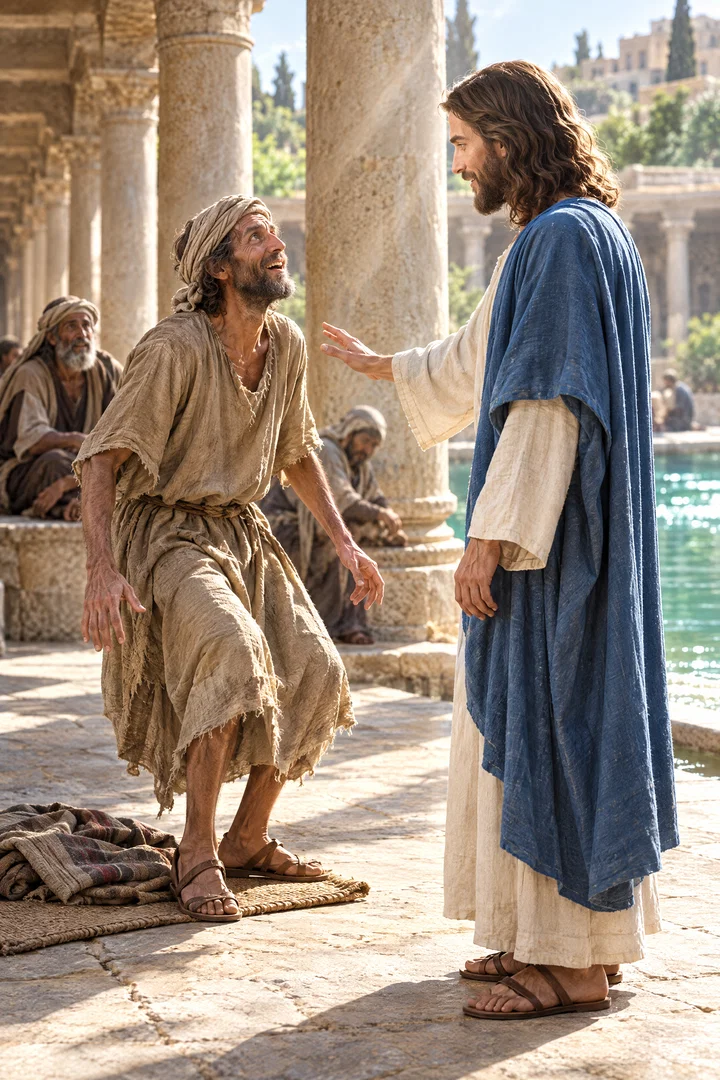
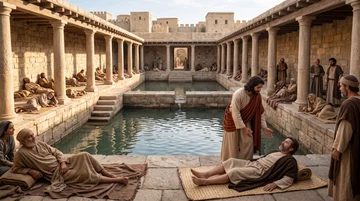
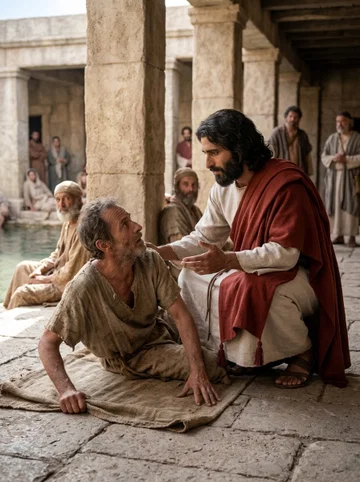
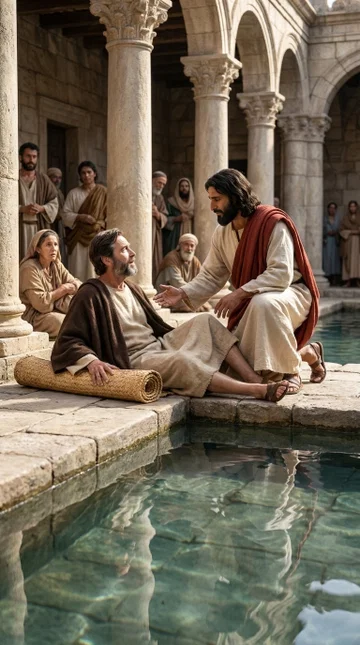
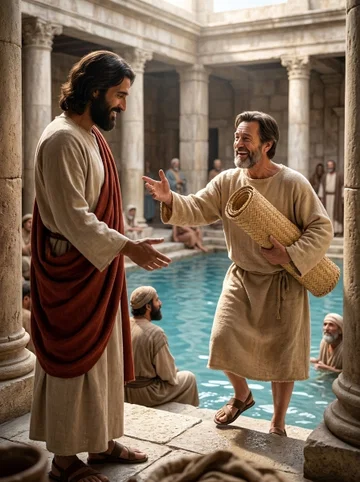
Now there is at Jerusalem by the sheep market a pool, which is called in the Hebrew tongue Bethesda, having five porches.
Translations
American King James Version, King James Version, KJV Cambridge Paragraph Bible
Now there is at Jerusalem by the sheep market a pool, which is called in the Hebrew tongue Bethesda, having five porches.
Now there is at Jerusalem by the sheep market a pool, which is called in the Hebrew tongue, Bethesda, having five porches.
Revised Version, American Standard Version
Now there is in Jerusalem by the sheep gate a pool, which is called in Hebrew Bethesda, having five porches.
and there is in Jerusalem by the sheep -[gate] a pool that is called in Hebrew Bethesda, having five porches,
Now there is in Jerusalem, at the sheepgate, a pool, which is called in Hebrew, Bethesda, having five porches.
Now there is in Jerusalem, at the Sheep-gate, a pool, which is called in Hebrew Bethzatha,—having, five porches.
Berean Standard Bible, Majority Standard Bible
Now there is in Jerusalem near the Sheep Gate a pool with five covered colonnades, which in Hebrew is called Bethesda.
Now in Jerusalem by the sheep gate, there is a pool, which is called in Hebrew, “Bethesda”, having five porches.
Now in Jerusalem near the sheep-market there is a public bath which in Hebrew is named Beth-zatha. It has five doorways.
And there is at Hierusalem by the place of the sheepe, a poole called in Ebrew Bethesda, hauing fiue porches:
Douay-Rheims (Challoner revision)
Now there is at Jerusalem a pond, called Probatica, which in Hebrew is named Bethsaida, having five porches.
Pictures
Cross-references
- John 5:8-9
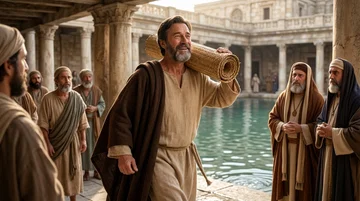
Jesus saith unto him, Rise, take up thy bed, and walk.
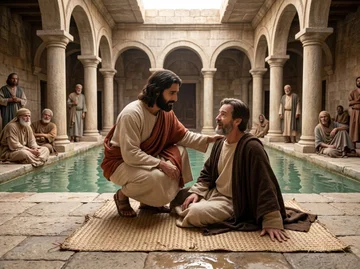
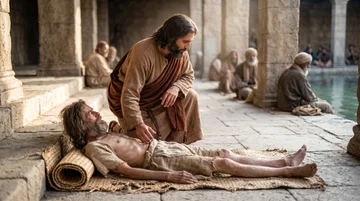
Jesus heals the man and tells him to carry his bed on the Sabbath.
- John 5:16-18
And therefore did the Jews persecute Jesus, and sought to slay him, because he had done these things on the sabbath day.
The Bethesda healing prompts Sabbath accusations and Jesus’ response about working with the Father.
- John 5:14
Afterward Jesus findeth him in the temple, and said unto him, Behold, thou art made whole: sin no more, lest a worse thing come unto thee.
Jesus tells the healed man to sin no more after finding him in the temple.
- John 7:21-23
Jesus answered and said unto them, I have done one work, and ye all marvel.
Jesus defends the Bethesda healing by comparing it with Sabbath circumcision.
- John 5:6
When Jesus saw him lie, and knew that he had been now a long time in that case, he saith unto him, Wilt thou be made whole?
Jesus asks the sick man if he wants to be made whole.
- John 5:18
Therefore the Jews sought the more to kill him, because he not only had broken the sabbath, but said also that God was his Father, making himself equal with God.
The Sabbath healing becomes a reason for hostility toward Jesus.
Commentary
Each commentary is drawn from primary sources: the writings of Ellen G. White and Adventist pioneers and periodicals. Each commentary is separate. Its own words are not a quotation; follow the references to read the source passages.
Ellen G. White
39 sources
At Jerusalem by the sheep market lay the pool called Bethesda, built with five porches that sheltered crowds of sick people from heat by day and cold by night.DA 201.1–2ST May 13, 18862SP 157.1–2 A great multitude of helpless blind, lame and withered sufferers gathered there waiting for the moving of the water, believing that at a certain season whoever first stepped in afterward was made whole.DA 201.1–2ST Mar 31, 1881MH 81.1–83.1COS 76.2–77.1 That hope left the weakest disappointed, for the stronger rushed in first while the helpless were pushed aside, and some even died beside the pool.DA 201.1–2ST Mar 31, 1881 Jesus came alone to those waiting sufferers and on the Sabbath healed the most afflicted among them directly by His word, without requiring him to reach the water.2SP 161.3–162.12SP 158.1–23RED 24.3–25.1ST Jun 8, 1882Ms 191, 1897, par. 3–4 That Sabbath cure showed relieving suffering to be lawful and proclaimed His divine Sonship, yet it led the Pharisees and leading Jews to persecute Him and seek to kill Him.2SP 161.3–162.13RED 24.3–25.13RED 28.2–29.1DA 206.1–2LC1 86.1
Pool Setting Described
The pool called Bethesda lay at Jerusalem by the sheep market and had five porches.DA 201.1–2ST May 13, 1886ST Mar 31, 1881ST Those porches sheltered the crowds of sick people who gathered there and waited by the water for its moving.DA 201.1–2ST May 13, 1886DA 201.3–4ST They gave shelter to a great multitude of helpless folk, blind, halt and withered, suffering different maladies, who visited the pool in hope of healing when its waters were thought to be troubled.DA 201.1–2ST May 13, 1886ST Mar 31, 18813RED 19.3
The porches shielded sufferers from heat by day and from cold by night.ST Jul 7, 1914 Some stayed there day and night, spending nights at the pool and returning day after day while waiting for relief.2SP 157.1–2ST Jul 7, 19142SP 157.3 One afflicted man waited in this way through long persistence amid doubt and anxiety.2SP 157.3
The sheep gate could be seen from the summit overlooking Jerusalem.2SP 390.2–391.2 For centuries the beasts for sacrificial offerings had been led through that gate.2SP 390.2–391.2 It was soon to open for Jesus himself as the great Antitype toward whose sacrifice for the sins of the world all those offerings had pointed, and it stood near the garden of Gethsemane and near Calvary.2SP 390.2–391.2
Sufferers Waiting Hoping
A great multitude of helpless sick people visited the pool and waited for the moving of the water, blind and lame and withered and suffering from different maladies.ST Mar 31, 1881MH 81.1–83.1COS 76.2–77.1 They gathered in crowds at Bethesda hoping to be healed when the water was stirred.ST Mar 31, 1881MH 81.1–83.1COS 76.2–77.1
The common belief was that at a certain season supernatural power troubled the water, and that whoever first stepped in afterward was made whole of whatever disease he had.DA 201.1–2ST Mar 31, 1881STST Jul 7, 1914 At a certain season an angel went down into the pool and troubled it, so that the first to enter after the troubling received healing.DA 201.1–2ST Mar 31, 1881 This hope is set forth as mistaken and supposed, for the sufferers watched for what they thought was their only chance of relief.Ms 191, 1897, par. 3–4
At the appointed time the crowd was so great that people rushed forward, trampling men, women and children weaker than themselves.DA 201.1–2ST Mar 31, 1881 The stronger seized the healing opportunity while the helpless were pushed aside and disappointed.ST Mar 31, 1881STMs 191, 1897, par. 1–2 Many could not reach the water first, and some died beside the pool.DA 201.1–2ST Jul 7, 1914Ms 191, 1897, par. 1–2 Hundreds came hoping for relief, but the crush and competition left the weakest unable to reach the pool.STST Jul 7, 1914Ms 191, 1897, par. 1–2
Those who pitied the helpless would carry them to the porches when the waters were expected to be troubled.ST Jul 15, 1886Ms 191, 1897, par. 3–4ST Jul 7, 1914 Yet at the favored moment the weakest had no one to help them in, and stronger ones plunged in before them and seized the coveted opportunity.ST Jul 15, 1886Ms 191, 1897, par. 3–4ST Jul 7, 1914 One crippled man with an incurable affliction had waited there for thirty-eight years, repeatedly unable to reach the water before others entered.COS 77.2–78.53RED 20.1–33RED 28.2–29.1COS 76.2–77.12SP 157.3 He repeatedly came and waited day and night, but stronger people reached the water before him.COS 77.2–78.52SP 157.3ST Jul 7, 1914 His persistent effort with its doubt and anxiety and disappointments weakened him further and left him despairing.2SP 157.3Ms 191, 1897, par. 3–4ST Jul 7, 1914
Sabbath Healing Performed
Jesus came alone, in meditation and prayer, to the pool where wretched sufferers lay waiting and watching for what they supposed was their only chance of relief.Ms 191, 1897, par. 3–4 He longed to exercise healing power for them all, to pour His healing waters into every soul and make every sufferer whole.Ms 191, 1897, par. 3–4 It was the Sabbath day when multitudes were going to the temple for worship, and He knew that an act of healing then would cut His work short because prejudice against Him was strong and His enemies greatly desired to find accusation to put Him to death.Ms 191, 1897, par. 3–4
He chose the Sabbath to heal the most afflicted, the most grievously afflicted person there.2SP 161.3–162.13RED 24.3–25.1DA 206.1–2 He told him to carry his bed through the city, so the cure would draw attention to the work and to who had done it and its circumstances would become known.2SP 161.3–162.13RED 24.3–25.1 By making the healing public He raised the question of what is lawful on the Sabbath.2SP 161.3–162.1DA 206.1–2 He healed him directly, without requiring him to reach the pool for which the man had hoped in despair.2SP 158.1–2 That direct healing is a lesson to trust and obey His command rather than allow doubt to prevent receiving His help.2SP 158.1–2ST Jun 8, 1882
The act showed that relieving suffering is lawful on that day.2SP 161.3–162.13RED 24.3–25.1DA 206.1–2 The Sabbath was meant to be a blessing and sacred rest, not a burden of added human restrictions, customs and traditions that had turned it from blessing into burden.2SP 161.3–162.1DA 206.1–2ST Jul 15, 1886 In the presence of men strict for the law's exactions yet failing its principles, He taught the sanctity of God's statutes and freed them from senseless restrictions attached to them.LC1 86.12SP 340.1–2 The healing displayed divine power and, together with His other works and teachings, proclaimed His divine identity, and after it He declared His Sonship to the Eternal before the Sanhedrin.ST Jul 15, 1886DA 231.2 That healing at Bethesda should have convinced the Jews that He was the Son of God, but they seized on the carrying of the mat as a pretext to condemn Him, blinded to the evidence of divine power and to the true purpose of the Sabbath.ST Jul 15, 1886ST Jul 15, 1886 The people justified Him while the rulers opposed Him, and many recognized Him as their friend and defended His act of mercy.3RED 28.2–29.1DA 207.4–208.1
Conflict and Withdrawal
The healing at Bethesda was done on the Sabbath, and because of that the Pharisees and leading Jews persecuted Him with a determined purpose to kill Him and watched eagerly for an opportunity to do it.LC1 86.12SP 340.1–21RED 86.1–87.1 He stood face to face with men who were strict demanders of the exactions of the law yet failed its principles in their lives, while His work taught the sanctity of God's statutes freed from the senseless restrictions men had attached to them.LC1 86.12SP 340.1–2 That Sabbath act kindled the malice of the leaders until they plotted to take His life.2SP 173.1–174.2ST Feb 22, 1877
The Jews accused Him of Sabbath-breaking for the healing, and that accusation led to His discourse afterward.7MR 278.1–3Lt 1, 1876, par. 6 Instead of being convinced by divine power that He was the Son of God, they seized on the healed man's carrying his mat on the Sabbath as a pretext to condemn Jesus.ST Jul 15, 1886 Their customs and traditions had turned the Sabbath, intended as sacred rest and a blessing, into a burden, blinding them to the evidence and to its true purpose.ST Jul 15, 1886 The healed man answered simply that the One who made him well had told him to take up his mat and walk, and his accusers questioned him to perplex him, undermine his confidence, and discredit his testimony.ST Jul 15, 1886
He defended the act as in accordance with Sabbath law, showing that if circumcising on the Sabbath is lawful it is certainly right to relieve the afflicted and make a man every whit whole on the Sabbath day, calling for righteous judgment and not judgment by appearance.1RED 86.1–87.1 The hostility provoked by that healing made it unsafe for Him to remain in the city.3RED 36.12SP 173.1–174.2ST Feb 22, 1877 After Bethesda He stopped attending the national gatherings and confined His work to Galilee, withdrawing from Jerusalem to avoid needless conflict with its leaders and making Capernaum the scene of His labors.DA 449.2–450.22SP 173.1–174.2ST Feb 22, 1877
Compassion for Sufferers
Jesus came alone in meditation and prayer to the pool at Jerusalem where wretched sufferers lay waiting and watching for what they supposed was their only chance of relief.Ms 191, 1897, par. 3–4 They did not know that One was among them who was always ready to hear the cry of the oppressed, the suffering, and the sorrowing and to give immediate relief.Ms 191, 1897, par. 3–4 He longed to exercise His healing power for them all, to pour His healing waters into every soul and make every sufferer whole.Ms 191, 1897, par. 3–4 It was the Sabbath day when multitudes were going to the temple for worship, and He knew that an act of healing then would cut His work short because prejudice against Him and His work was strong and there was great desire to find something to accuse Him of and put Him to death.Ms 191, 1897, par. 3–4 Those who pitied the helpless would carry them to the porches when the waters were expected to be troubled, yet at the favored moment the weakest had no one to help them in, and stronger ones plunged in before them and seized the coveted opportunity.Ms 191, 1897, par. 3–4
His healing of the helpless sufferer at the pool belongs to His mission to care for the suffering and hopeless.Ms 191, 1897, par. 10–11 His power reaches both body and soul.Ms 191, 1897, par. 10–11 He can free people from evil practices and passions that have bound them through long indulgence.Ms 191, 1897, par. 10–11
Sources
Pioneers and periodicals
79 sources
The pool lay in Jerusalem by the sheep market or gate and was called Bethesda, meaning a house of mercy for receiving the sick, with five porches that sheltered the gathered sufferers from heat and cold.ST May 13, 1886ST Aug 2, 1910ST Feb 8, 1905ST Feb 8, 1905 Those porches held a great multitude of blind, halt, lame and withered folk waiting for the troubling of the water, believing an angel moved it at a certain season and whoever first stepped in afterward was healed.ST Mar 31, 1881RH Jan 13, 1863ST Mar 15, 1899ST Mar 20, 1901ST Mar 15, 1899 The healing that followed took place on the Sabbath and shows a merciful work that did not break God's law, for the Sabbath forbids secular work but not works of necessity and mercy done in God's service.ST Aug 20, 1896RH Feb 11, 1862ST Dec 4, 1884RH May 5, 1874 The healing power was not in the water but in Christ's presence and word, for He Himself became like a living Bethesda who seeks the hopeless and heals at once and completely.RH Oct 24, 1912ST Feb 11, 1886RH Oct 3, 1912RH Jun 16, 1903ST Oct 25, 1910 The man had no power in himself to rise, but Christ's command carried power with it, so that when he believed and made the effort to obey he received strength to walk.ST Jun 8, 1882ST Sep 10, 1896RH Sep 28, 1905ST Nov 1, 1910ST Jul 8, 1889
Place and Wording
Now there is at Jerusalem by the sheep market, also called the sheep gate, a pool called in the Hebrew tongue Bethesda, having five porches.ST May 13, 1886STST Jul 7, 1914ST Aug 2, 1910 Jesus came to it when He went up to Jerusalem for a feast of the Jews.ST Aug 20, 1896 Bethesda means house of mercy, or place for receiving and caring for the sick.ST Feb 8, 1905ST Feb 8, 1905
The five porches sheltered the gathered sick from heat by day and cold by night, where some stayed day and night waiting for healing.ST May 13, 1886ST Jul 15, 1886ST Jul 7, 1914ST Mar 15, 1899 They sheltered a great multitude of impotent folk who waited for the moving of the water, and the crush of the crowd and competition left many unable to reach the pool.ST May 13, 1886STST Jul 7, 1914ST Aug 2, 1910
The Sheep Gate stood just inside the city, and the pool lay a short distance from the gate on the right along the street running west, with the square formerly occupied by Solomon's Temple on the left.ST Nov 10, 1898 That gate is Stephen's Gate in the eastern wall above the Kidron Valley near the center of the city north and south, looking out on the Valley of the Kidron or Jehoshaphat and the Mount of Olives.ST Nov 10, 1898 It was anciently so called because the many sheep required for the temple service entered there, as flocks are still led through in the evening.ST Nov 10, 1898 The pool pointed out as Bethesda lies north of the temple where excavation occurred and a Catholic seminary stood.RH Jul 28, 1904 It is approached through ruins of an ancient church and lies considerably beneath the present surface, so covered with ruins and changed by later buildings that its appearance in Christ's time can hardly be pictured.ST Nov 10, 1898
The remains identified as Bethesda are twin rock-cut pools lying end to end with a portico on each outer side and one on the dividing wall, one tank having twenty-four steps leading down and its sister pool being sixty feet long and of the same breadth, matching the description and verifying the account.ST Aug 24, 1888 Other measurements describe it as about 131 feet wide and 365 feet long with a further 142 feet at 45 feet wide, though the identification as the genuine pool is disputed.ST Mar 16, 1876 The verse shows Jerusalem had pools with water available where people washed.ST Apr 19, 1883 It is cited as an example that baptism performed in a pool is baptism just as truly as in a river, lake, or sea.
Crowd and Expectation
The five porches held a great multitude of impotent folk, blind, halt, lame and withered, sufferers from different maladies and long-standing illnesses gathered at the health-giving pool.ST Mar 31, 1881ST Mar 15, 1899ST Mar 20, 1901 They waited for the moving or troubling of the water, for at a certain season an angel went down into the pool and troubled it.ST Mar 31, 1881RH Jan 13, 1863ST Jun 26, 1893 The belief was that whoever first stepped in after the troubling was made whole of whatever disease he had.ST Mar 31, 1881RH Jan 13, 1863ST Mar 15, 1899
That stirring was understood as supernatural power that would heal the first entrant, the common belief of those who waited there.STST Jul 7, 1914 Those who held it as their mistaken hope still crowded in misery while the strongest failed to make room for the helpless. The waters that could cool the fevered and relieve distress were so sought that deep expectation hung on their painful upheaval.ST Jun 26, 1893
At the appointed time the crowd was so great that people rushed forward, trampling men, women and children weaker than themselves.ST Mar 31, 1881ST Mar 15, 1899 The stronger seized the healing opportunity and the helpless were pushed aside, while shelters and porches protected the waiting sick from heat by day and cold by night.ST Mar 31, 1881ST Mar 15, 1899 Many could not reach the pool, some died beside it, and sufferers sometimes stayed there day and night and waited day after day in vain hope of relief.ST Jul 7, 1914ST Mar 15, 1899
Among them was a poor impotent man helpless for thirty-eight years who repeatedly sought relief at the pool and lay on a mat beneath its porch.ST Jul 15, 1886ST Aug 28, 1898 Tortured in body and soul and schooled in misery, left unable to care for himself and relying on charity, he had no friend to help him.ST Jul 15, 1886ST Mar 20, 1901 He could move only slowly, repeatedly asked passers-by to help him reach the water, and saw others leave the pool apparently healed.ST Jul 7, 1914 A younger, stronger man reached the water before him and left him disappointed again, and his repeated efforts and disappointments weakened him further.ST Jul 7, 1914
The waters might be troubled on other days but were still and unmoved on the Sabbath.ST Mar 31, 1881 Then rest was so complete that even the lost in hell were said to have rest from torment in its sacred hours.ST Mar 31, 1881
Time and Occasion
Jesus came to the pool when He went up to Jerusalem for a feast of the Jews.ST Nov 14, 1900ST Aug 20, 1896RH Dec 5, 1907 That feast is identified as most probably the second Passover of His public ministry.ST Nov 14, 1900RH Dec 5, 1907 It was His second visit there.ST Apr 14, 1881 That Passover fell at the end of March or beginning of April, a few months before the Feast of Tabernacles, which fell at the end of September or early October.
The healing that followed at the pool took place on the Sabbath.ST Mar 8, 1899ST Jan 25, 1899 Jesus came there on the Sabbath, where many sick people were gathered, and healed the man most in need of help.ST Mar 8, 1899 The healing was one of seven miracles He performed on the Sabbath.ST Apr 14, 1881 It was the first of three miracles around which the controversy with the Jews gathered.ST Aug 20, 1896
Sabbath Meaning and Controversy
The healing at Bethesda was a merciful work done on the Sabbath that broke no law of God while it directly challenged human tradition restricting cures on that day.RH Feb 11, 1862ST Dec 4, 1884 The Sabbath commandment forbids secular work, not work done in God's service for His glory.ST Dec 4, 1884 Works of necessity and mercy outweigh all the narrow traditions about Sabbath-keeping invented by selfish men.
Performing deeds of mercy to the afflicted on the Sabbath exactly accords with the design of the sabbatic institution.ST Aug 20, 1896RH May 5, 1874ST Jun 20, 1911 It corrects the false tradition that every act of healing was unlawful on that day.RH May 5, 1874 Healing and doing good are in harmony with the Sabbath because God's work of blessing people does not cease.ST Aug 20, 1896ST Jun 20, 1911
Jesus kept God's commandments according to God's meaning, while the Pharisees condemned Him as a Sabbath-breaker according to their own rules. His answer that His Father works and He works removes nothing of the sanctity of the seventh day. He did not destroy even the smallest part of the law.
The man lay on nothing more than a blanket, rug, or sleeping-mat, not a bed as now understood, so the command to take it up and walk was no violation of Sabbath law.RH May 5, 1874ST Mar 31, 1881 Jesus deliberately chose the Sabbath to heal and to tell the man to carry his mat home.ST Aug 20, 1896ST Apr 7, 1881ST Sep 15, 1909ST Jul 15, 1897 He did so to expose how Jewish rules had turned the Sabbath, intended as a blessing, into a burden, to remove those burdens, and to restore the day's holy dignity.ST Aug 20, 1896ST Apr 7, 1881ST Jul 15, 1897 The healing was used to correct false ideas about what Sabbath observance permits.ST Sep 15, 1909
Though the man's case was not clearly urgent and waiting another day would probably not have materially changed his condition, Jesus healed him at once rather than postponing the good work because of the day or because leaders watched for grounds to accuse Him.ST Nov 11, 1897 The passage concerns the seventh day alone, the Sabbath of the Lord.ST Apr 11, 1900 Like all Sabbath commandments and all instruction about observance of the day, it has no application to the first day, Sunday, and cannot be applied to Sunday without wrestling the Scriptures.ST Apr 11, 1900
The Sabbath healing clearly defined the issue over the Sabbath's true meaning and purpose and provoked conflict.ST Nov 14, 1900ST Oct 25, 1910RH Sep 1, 1859 It became the occasion for the rulers to accuse Jesus of breaking the Sabbath and to defend His action before the people.ST Oct 25, 1910RH Sep 1, 1859 With reference to it they began persecution of Him and first entertained the thought of killing Him, an opposition culminating in the actual crucifying of Him.ST Nov 14, 1900 That Sabbath healing kindled the malice of the leading Jews against Him so that they plotted against His life, and it was no longer safe to remain in Jerusalem, so He left for Galilee and made Capernaum the scene of His labors.ST Feb 22, 1877
The healed man's carrying his mat became the charge that Christ had broken the Sabbath.ST Jul 15, 1886RH Apr 28, 1863ST Mar 31, 1881 Met in the street carrying his pallet he was reprimanded for doing so as contrary to the law, and he defended himself by the command of the one who had miraculously cured him.ST Jul 15, 1886ST Mar 31, 1881 He did not know the name of his benefactor until Jesus met him afterward in the temple, because Jesus had hurried away from the pool after curing him to avoid exciting the multitude around.ST Mar 31, 1881 The healing that should have convinced the Jews that Jesus was the Son of God and evidenced His Messiahship instead became a pretext to condemn Him.ST Jul 15, 1886ST Jul 15, 1886 Their customs and traditions had turned the Sabbath, intended as sacred rest and a blessing, into a burden, blinding them to the evidence of divine power and to the true purpose of the Sabbath, as they questioned the man to perplex him, undermine his confidence, and discredit his testimony.ST Jul 15, 1886
Christ the Healer Foreshadowed
John 5:2 sets the pool of Bethesda in Jerusalem beside the sheep market with its five porches as a place of suffering and of hope for help, where a great crowd of sick and disabled people waited for healing when the water moved.RH Oct 3, 1912ST Aug 2, 1910 It stood open freely to hopeless invalids of every kind.RH Oct 3, 1912 Its healing points to Christ and His work as the great antitype, who came to earth, took human nature, and gave Himself in sacrifice.RH Oct 3, 1912
Its healing was miraculous, accomplished through the Holy Spirit by Christ or His angel.RH Oct 3, 1912 Christ Himself became like a living Bethesda, healing every disease without distinction, turning no one away.RH Oct 3, 1912 He sought out the most hopeless among the helpless crowded in its porches and healed him at once, showing His power and willingness to save and giving the others confidence in that power.RH Oct 3, 1912ST Oct 25, 1910 The man healed there was made completely whole at once, showing Christ's power to heal fully.RH Oct 3, 1912
The healing virtue was not in its water, for Christ healed the man who had been an invalid for thirty-eight years without asking him to enter the pool, showing that healing is in Christ's presence, not in an external remedy.ST Feb 11, 1886RH Jun 16, 1903 He was unable to walk for thirty-eight years and unable even to try the remedy believed capable of helping him, a case beyond the reach of human skill, yet he was healed by the word of the Lord.ST Feb 11, 1886 Cleansing and new life come from their divine source, for Christ alone could change the man, and no friend or human substitute could answer for his sin.RH Oct 24, 1912
Bethesda cannot cure the inward leprosy of guilt and sin, but Jesus' blood washes it away.RH Jan 21, 1858 Though Bethesda was regarded as a pool whose waters were troubled and where many people had been healed, its reputation and convenience did not make it a substitute for the place Christ commanded the blind man to wash, for healing depended on obeying that command.RH Jul 20, 1876
John 5:2 places the pool in Jerusalem near the sheep market with its five porches to introduce the afflicted people gathered there and the man disabled a long time who had no one to help him reach the pool, for Jesus helps when every other help fails.ST Mar 15, 1905 He found there a man unable to walk for thirty-eight years and supplied the strength the man lacked, so that the man obeyed His command to rise, take up his bed, and walk, showing that the Saviour's power enables people to do what they cannot do by their own strength.ST Jun 21, 1905 Drawing near to Him in faith and leaving sin and sickness with Him brings healing and salvation, for Jesus is willing to heal people today.RH Jan 24, 1907 His power to heal bodily illness was present during His ministry and remains available through faith.RH Jan 24, 1907ST Feb 13, 1912
Faith and Obedience Receiving Power
The man at the pool in Jerusalem by the sheep market was powerless and helpless in himself with no power to rise and walk, but when Jesus spoke and he received those words they gave him power to obey.ST Sep 10, 1896ST Nov 1, 1910 What God commands is impossible for carnal man of himself, yet the requirement itself carries the provision for its doing.ST Sep 10, 1896 The word of God is all-potent to do in and for those who receive it with all the heart just what it commands, making the carnal man spiritual and able by grace to be obedient in all things.ST Sep 10, 1896 In the same way Jesus can give power to a sinful, tempted person today through His Word, when the person believes and takes the promise as his own.ST Nov 1, 1910
Believing Christ's word leads a person to act on it, as the man willed to walk and walked.RH Sep 28, 1905 The lesson of the healing at Bethesda with its five porches is to trust and obey Christ's command rather than allow doubt to prevent receiving His help.ST Jun 8, 1882RH Sep 28, 1905 When faith met the Saviour's command the man made the effort to obey and received power from God.ST Jul 8, 1889
That effort illustrates that people must exert themselves to do God's will as though the effort were entirely their own, while trusting God as though He alone could supply the power.ST Jul 8, 1889
Pictures and Other Scriptures
The pool with its porches is a picture of Scripture, where the helpless may walk among the porches waiting for blessing as the pool of the word is stirred. Its stirred waters cooled the fevered and relieved distress, and so show that deep peace and joy can arise through life's painful upheavals.ST Jun 26, 1893 Bethesda also figures refreshment and healing rising from within Christ, quenching the fever of anguish and restoring Him to Himself.ST Oct 18, 1899 It stands as an ancient healing fountain of pure, free, gushing water bright as morning dew, belonging with Siloam among flowing waters sought by those sick with sin and sorrow and blind with dust, whose hearts are crusted with doubt and filled with fear.ST Jun 3, 1875
The hidden wells are deep and overgrown, yet when opened they become a spring of truth within, a well of water springing up so that the drinker thirsts no more and no longer wanders sick or blind in sin.ST Jun 3, 1875 The pool with its five porches likewise images those who come near but do not enter, remaining between sin and holiness instead of living by faith in Christ and receiving a living spiritual experience.RH Oct 11, 1864 The waiting sick did not move until the waters were troubled by angels, for human stirring through impatience or passion brings no good result, since the waters must be moved by God's angels and not by human beings swayed by disaffection, prejudice, and passion.RH Jan 13, 1863
The man by the pool represents those who have no life apart from Christ, and his account belongs with the Sabbath controversy and Christ's declaration of equality with God.ST Aug 20, 1896 The troubled waters supply an image of a time of visitation and spiritual calling in which God's Spirit moves Spanish-speaking people to respond.RH Jan 2, 1913 The pool into which people could be led shows that those seeking holiness may need someone to take them by the hand and lead them into the blessing they seek.RH Jan 13, 1859
Present Call and Comfort
Jesus' question, Wilt thou be made whole, is both question and promise, meaning I will give, will you take it.ST Mar 20, 1901 Whoever rises up and walks on the promise of God is made whole in both body and soul, has sin-bred disease depart, takes up his bed and walks, confesses the Saviour, and has God's law written in the heart.ST Mar 20, 1901 That same life-and-death question is addressed now to each one on the highway to death, whether traveled for years or only begun and seeking healing today, because the life-giving Jesus is passing this way.ST Mar 20, 1901 The pool where suffering people wait disconsolate for the moving of the waters is a picture of human sorrow whose burden is lifted when Christ the Consolation comes.ST Jun 7, 1877RH Feb 25, 1875ST Mar 4, 1880 Sufferers waited there for the waters to move, hoping for relief from their afflictions.RH Feb 25, 1875ST Mar 4, 1880 The chapter supplies words of consolation spoken even at an infant's funeral.RH Apr 20, 1905
The man who had no one to help him reach the pool and whose condition appeared hopeless was a special object of Jesus' compassion.RH Dec 26, 1907ST Dec 19, 1916 He received personal attention from Jesus at the pool.RH Dec 26, 1907ST Dec 19, 1916 Jesus still seeks out and helps people in similarly desperate conditions.ST Dec 19, 1916 His situation shows that a person may be desperately ill despite accepting the truth and doing what he can to live rightly, yet still be unable to recover by his own efforts.ST Mar 15, 1899 His case is not hopeless, for Jesus remains the healer and works through ordinary means and practical faith.ST Mar 15, 1899 The scene can awaken hope in the sick in proportion to their faith in Christ as present and personal.ST Mar 15, 1899
His long wait shows why those who care for people stricken by sin should keep hoping and praying rather than become discouraged.RH Oct 24, 1912 Cleansing and new life come from their divine source, for Christ alone could change the man, and no friend or human substitute could answer for his sin.RH Oct 24, 1912 Jesus heals the sick by divine power and answers the request of the afflicted quickly. He is just as willing today to hear every call of suffering and sorrow and to answer, if for the best, I will come and heal him. True healing must come from God, whether secured through the ordinary channel of physical law as the reward of obedience to the God-ordained laws regulating being, or through the extraordinary means of miraculous working, for healing is re-creation and only divine power can create.
The healing at the pool in Jerusalem where Jesus healed the impotent man led to Barnabas being converted through it.ST Apr 15, 1897 That same healing shows Jesus Christ and His mission were doubted even while He gave life and healing.ST Sep 26, 1895 It gives an example of the unbelief that opposes Christ in His truth.ST Sep 26, 1895
Sources