John 5:3
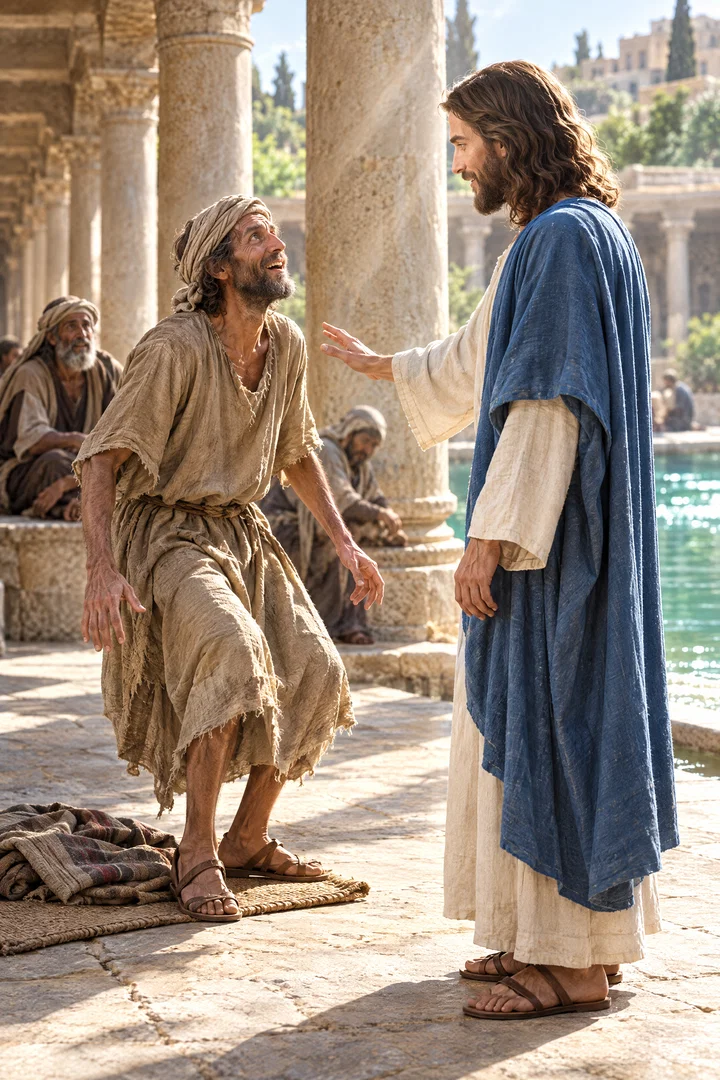
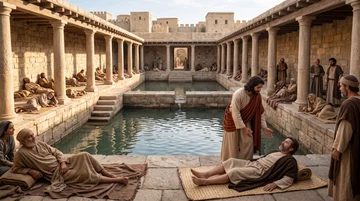
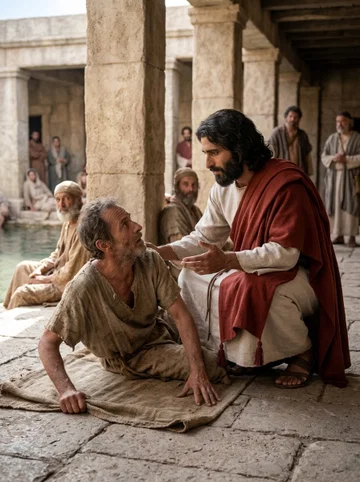
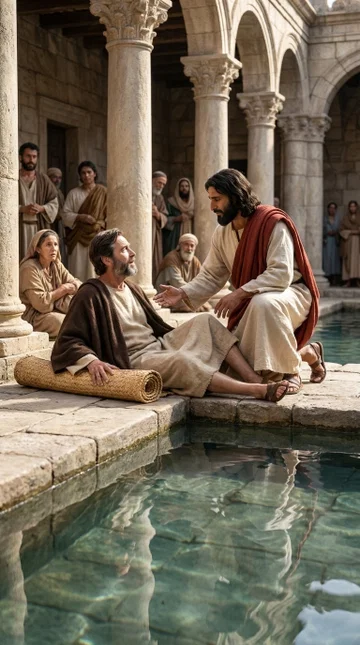
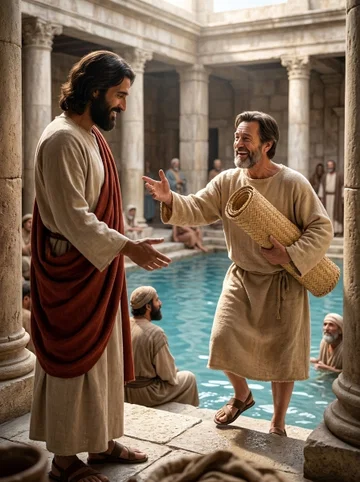
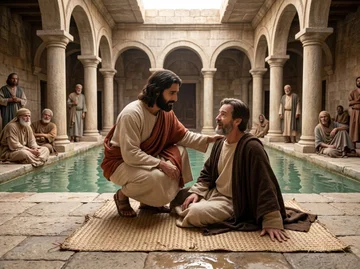
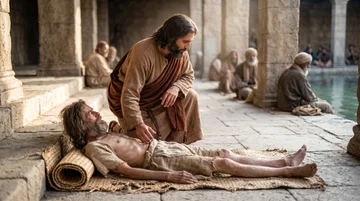
In these lay a great multitude of impotent folk, of blind, halt, withered, waiting for the moving of the water.
Translations
In these lay a great multitude of weak folk, of blind, halt, withered, waiting for the moving of the water.
King James Version, KJV Cambridge Paragraph Bible
In these lay a great multitude of impotent folk, of blind, halt, withered, waiting for the moving of the water.
In these lay a great multitude of impotent persons, of blind, halt, withered, waiting for the moving of the water.
Revised Version, American Standard Version
In these lay a multitude of them that were sick, blind, halt, withered.
in these were lying a great multitude of the ailing, blind, lame, withered, waiting for the moving of the water,
In these lay a multitude of sick, blind, lame, withered, [awaiting the moving of the water.
In these, was lying a throng of them who were sick,—blind, lame, withered.
On these walkways lay a great number of the sick, the blind, the lame, and the paralyzed.
On these walkways lay a great number of the sick, the blind, the lame, and the paralyzed, awaiting the moving of the water.
In these lay a great multitude of those who were sick, blind, lame, or paralyzed, waiting for the moving of the water;
In these doorways there were a great number of people with different diseases: some unable to see, some without the power of walking, some with wasted bodies.
In the which lay a great multitude of sicke folke, of blinde, halte, and withered, wayting for the mouing of the water.
Douay-Rheims (Challoner revision)
In these lay a great multitude of sick, of blind, of lame, of withered; waiting for the moving of the water.
Pictures
Cross-references
- John 5:9-18
And immediately the man was made whole, and took up his bed, and walked: and on the same day was the sabbath.
The healing prompts Sabbath opposition and Jesus’ claim of unity with the Father.
- John 5:8-9
Jesus saith unto him, Rise, take up thy bed, and walk.
Jesus heals the man at Bethesda, who takes up his bed and walks.
- John 5:14
Afterward Jesus findeth him in the temple, and said unto him, Behold, thou art made whole: sin no more, lest a worse thing come unto thee.
Jesus warns the healed man to sin no more, linking his illness with sin.
- John 9:7
And said unto him, Go, wash in the pool of Siloam, ( which is by interpretation, Sent.) He went his way therefore, and washed, and came seeing.
Jesus sends the blind man to wash in the pool of Siloam, and he comes seeing.
- John 7:21-23
Jesus answered and said unto them, I have done one work, and ye all marvel.
Jesus defends making a man whole on the Sabbath.
- John 5:7
The impotent man answered him, Sir, I have no man, when the water is troubled, to put me into the pool: but while I am coming, another steppeth down before me.
The sick man explains why he could not reach the pool when its water was troubled.
- Acts 3:2-8
And a certain man lame from his mother’s womb was carried, whom they laid daily at the gate of the temple which is called Beautiful, to ask alms of them that entered into the temple;
Both texts recount the healing of a lame man through a word-given-power miracle.
- John 5:10-11
The Jews therefore said unto him that was cured, It is the sabbath day: it is not lawful for thee to carry thy bed.
reprimand for carrying pallet on Sabbath
- Luke 4:18
The Spirit of the Lord is upon me, because he hath anointed me to preach the gospel to the poor; he hath sent me to heal the brokenhearted, to preach deliverance to the captives, and recovering of sight to the blind, to set at liberty them that are bruised,
Jesus’ healing of the sick fulfills his announced mission.
- John 5:13
And he that was healed wist not who it was: for Jesus had conveyed himself away, a multitude being in that place.
Jesus left pool to avoid exciting multitude
- John 7:23
If a man on the sabbath day receive circumcision, that the law of Moses should not be broken; are ye angry at me, because I have made a man every whit whole on the sabbath day?
Jesus defends making a man whole on the Sabbath as lawful.
- John 7:22
Moses therefore gave unto you circumcision; ( not because it is of Moses, but of the fathers;) and ye on the sabbath day circumcise a man.
Sabbath circumcision is contrasted with healing on the Sabbath.
- 2 Kings 5:10-14
And Elisha sent a messenger unto him, saying, Go and wash in Jordan seven times, and thy flesh shall come again to thee, and thou shalt be clean.
Naaman was healed after dipping in Jordan as commanded.
- John 4:14
But whosoever drinketh of the water that I shall give him shall never thirst; but the water that I shall give him shall be in him a well of water springing up into everlasting life.
The inward well of living water springs up into everlasting life.
- Revelation 22:17
And the Spirit and the bride say, Come. And let him that heareth say, Come. And let him that is athirst come. And whosoever will, let him take the water of life freely.
Both texts present an invitation to come for life-giving water.
Commentary
Each commentary is drawn from primary sources: the writings of Ellen G. White and Adventist pioneers and periodicals. Each commentary is separate. Its own words are not a quotation; follow the references to read the source passages.
Ellen G. White
34 sources
At the pool of Bethesda by the sheep market were five porches with shelters from heat and cold, where lay hundreds of blind, halt, lame, withered, paralyzed and otherwise sick and disabled sufferers.DA 201.3–42SP 156.3ST Jul 7, 1914ST Mar 31, 1881DA 201.1–2 At certain seasons the water was agitated, which was commonly believed to be an angel troubling it, and that whoever first stepped in afterward would be healed of whatever disease he had, so they waited in hope day and night, lying on the brink and creeping to the edge to watch for the moving.DA 201.3–43RED 19.3ST Jul 7, 1914DA 201.1–2 When the troubling came the crowd rushed in, and the stronger pushed aside and went in before the weaker men, women and children, so many never got near, were disappointed by another stepping in first, and some died beside the pool without relief.ST May 13, 1886STST Jul 7, 1914ST Mar 31, 1881 Among them Jesus singled out the most wretched and severe case, a man helpless for thirty-eight years with no friend to carry him in, to show the helplessness of trusting in the water where the weakest are passed over and worn down by vain struggle and disappointment.ST May 13, 1886ST3RED 24.3–25.12SP 161.3–162.1DA 206.1–2 He healed him purposely on the Sabbath to free the day from human burdens and show such relief of suffering lawful, which raised marvel and sharp controversy with leaders who charged Him with breaking the law and sought to kill Him, while the waiting helpless multitude itself pictures diseased souls whom He as the great Physician longs and is able to make whole.3RED 24.3–25.12SP 161.3–162.1LC1 86.12SP 340.1–2Ms 191, 1897, par. 10–11
Pool and Waiting Crowd
The pool is Bethesda at Jerusalem by the sheep market, with five porches where the sick lay waiting for the moving of the water.3RED 19.3ST Mar 31, 1881DA 201.1–2Ms 191, 1897, par. 1–2MH 81.1–83.1 Shelters were built around the place to protect those lying there from heat by day and cold by night, and some spent night after night in the porches.DA 201.1–2MH 81.1–83.1 In these porches lay a great multitude of impotent folk, a large crowd of sick and disabled sufferers gathered with different illnesses in hope of healing.DA 201.3–42SP 156.33RED 19.3ST Mar 31, 1881DA 201.1–2 They are described as blind, halt, lame, withered, paralyzed, crippled, weakened, and otherwise sick, disabled and helpless.DA 201.3–4ST Jul 7, 1914Ms 191, 1897, par. 1–2MH 81.1–83.1 Hundreds of sufferers visited the pool, creeping to the edge and lying on the brink waiting for the water to move.Ms 191, 1897, par. 1–2MH 81.1–83.1
Belief About Troubled Water
At certain seasons the water was agitated, and it was commonly believed that this troubling came from supernatural power.ST Jul 7, 1914DA 201.1–2Ms 191, 1897, par. 1–2MH 81.1–83.12SP 157.1–2 That power was explained as an angel troubling the water at certain times.3RED 19.3ST Jul 7, 1914Ms 191, 1897, par. 1–2 The great crowd in the porches waited for the moving or stirring of the pool on that understanding.3RED 19.3DA 201.1–2Ms 191, 1897, par. 1–2MH 81.1–83.12SP 157.1–2
The sufferers believed that whoever first stepped in after the troubling would be healed of whatever disease he had.3RED 19.3ST Jul 7, 1914DA 201.1–2Ms 191, 1897, par. 1–2MH 81.1–83.1 To enter then was their chance for healing, and they hoped to be healed there.DA 201.3–42SP 156.3STCOS 77.2–78.5 Only the one who entered first afterward received the cure, so the blessing went to whoever gained it before the rest.STST Jul 7, 1914DA 201.1–2Ms 191, 1897, par. 1–2
They waited in hope of that moment, lying on the brink and creeping to the edge of the pool.DA 201.3–42SP 156.3Ms 191, 1897, par. 1–2MH 81.1–83.1 Many stayed in the porches day and night and night after night, returning day after day.ST May 13, 1886DA 201.1–2MH 81.1–83.12SP 157.1–2 They did so in vain hope of relief, trusting that entering the water at that time would bring life and health.2SP 156.3ST May 13, 1886Ms 191, 1897, par. 1–2MH 81.1–83.1
Helplessness and Harsh Competition
When the water was troubled the great crowd rushed toward the pool to be first to enter, and the press of hundreds moving at once made reaching it a harsh contest.STST Jul 7, 1914ST Mar 31, 1881DA 201.1–2MH 81.1–83.1 The stronger went in before the weaker, pushing others aside and trampling weaker men, women and children underfoot, so the feeble and disabled were put at risk and often pushed aside by those able to reach the pool first.ST Jul 7, 1914ST Mar 31, 1881DA 201.1–2MH 81.1–83.13RED 21.1–2 The crowding itself left many unable to reach the water, with the weakest denied a chance to get there without help.STST Jul 7, 1914COS 77.2–78.5ST Mar 31, 1881DA 201.1–2
Many could not get near the pool at the favored moment and were disappointed when another stepped in before them.ST May 13, 1886COS 77.2–78.5DA 201.1–2MH 81.1–83.1 They waited day and night and crept to the edge day after day, yet in vain hope many never got in and received no relief.ST May 13, 1886ST Jul 7, 1914DA 201.1–2MH 81.1–83.1 Some died beside the pool and on its very edge, some without reaching it and some after reaching it, without healing.ST May 13, 1886ST Jul 7, 1914DA 201.1–2MH 81.1–83.1
The scene shows the helplessness of trusting in reaching the water, where the weakest were passed over while stronger sufferers entered first.ST May 13, 1886STST Jul 15, 18862SP 158.1–22SP 157.3 So it was with the man afterward healed, who had been helpless for thirty-eight years, had no friend to carry him in, and at the favored moment never got farther than the edge before another stepped in before him.ST May 13, 1886STST Jul 15, 18862SP 157.3Ms 191, 1897, par. 3–4 Repeated waiting, struggle, anxiety, effort and disappointment weakened him further, leaving him in supreme wretchedness among the multitude.2SP 157.3Ms 191, 1897, par. 3–4
Sabbath Healing and Conflict
Out of the great crowd lying in the porches, Jesus singled out the most afflicted and severe case for healing.3RED 24.3–25.12SP 161.3–162.1DA 206.1–2 It was one of supreme wretchedness, a man helpless for thirty-eight years.3RED 24.3–25.12SP 161.3–162.1Ms 191, 1897, par. 3–4 He had been carried to the porches when the waters were expected to be troubled, yet at the favored moment had no one to help him in.Ms 191, 1897, par. 3–4
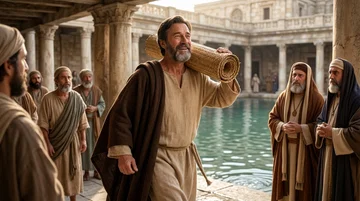
The healing of this paralytic took place on the Sabbath day, and the Sabbath was purposely chosen to free it from the burdens heaped upon it.3RED 24.3–25.12SP 161.3–162.1Ms 2, 1874, par. 23ST Apr 7, 1881 Jesus directed the man to carry his bed publicly so that the cure and its circumstances would be noticed.3RED 24.3–25.12SP 161.3–162.1 In this way the question was raised of what the Sabbath law permits.3RED 24.3–25.12SP 161.3–162.1DA 206.1–2 Afterward, in response to the Jews' accusation that He had broken the Sabbath, He gave the discourse that follows.Lt 1, 1876, par. 6
Relieving suffering in this manner is lawful and in accordance with the Sabbath law once it is freed from senseless human restrictions.2SP 161.3–162.1LC1 86.12SP 340.1–21RED 86.1–87.1 The act upheld the sanctity of God's statutes.LC1 86.12SP 340.1–2 It stood against men who insisted strictly on the exactions of the law while failing to carry out its principles in their lives.LC1 86.12SP 340.1–2
Because the miracle was done on the Sabbath it caused marvel.1RED 86.1–87.1 It caused a great uproar in the court of the temple and a sharp controversy over the true claims of the Sabbath law.ST Apr 7, 1881 The Pharisees and leading Jews charged Jesus with breaking the law as they understood it and with declaring Himself equal with God.ST Apr 7, 1881 They persecuted Him for it and formed a determined purpose to kill Him, watching eagerly for opportunity to accomplish it.LC1 86.12SP 340.1–21RED 86.1–87.13RED 36.12SP 173.1–174.2
That healing, together with His earlier miracles, teaching, and cleansing of the temple, was evidence of divine power proclaiming Him the promised Messiah.ST Jul 15, 1886DA 231.2 Before the Sanhedrin He then declared Himself to be the Son of the Eternal.DA 231.2 The sufferer was recognized as one Jesus had helped, and the people supported the healing, though some used it as an excuse to oppose Him.ST Jul 15, 1886 The malice it kindled made it no longer safe to remain in Jerusalem, so He left for Galilee and made Capernaum the scene of His labors.2SP 173.1–174.2ST Feb 22, 1877 This healing at Bethesda marked His last attendance at the national gatherings before restricting His work to Galilee to avoid needless conflict with Jerusalem's leaders.DA 449.2–450.22SP 173.1–174.2ST Feb 22, 1877
Compassion and Spiritual Meaning
Jesus came to the pool alone, as if in meditation and prayer, and saw the great company of wretched sufferers lying in the porches watching for the moving of the water as what they supposed was their only chance of relief.Ms 191, 1897, par. 3–4 They did not know that among them stood One always ready to hear the cry of the oppressed, the suffering, and the sorrowing and to give immediate relief.Ms 191, 1897, par. 3–4 He longed to exercise His healing power in their behalf, to pour His healing waters into every soul and make every sufferer whole.Ms 191, 1897, par. 3–4 Yet He refrained from a general healing because it was the Sabbath day when multitudes were going to the temple, and He knew such an act would meet strong prejudice and cut His work short.Ms 191, 1897, par. 3–4 From that multitude He then fixed upon one case of supreme wretchedness, a man helpless for thirty-eight years who had been carried to the porches when the waters were expected to be troubled yet at the favored moment had no one to help him in and never got farther than the edge before another stepped in before him.Ms 191, 1897, par. 3–4
The great multitude of helpless sufferers waiting at the pool stands within the sphere of His labor as the great Physician to care for and heal the brokenhearted.Ms 191, 1897, par. 10–11 They were friendless, suffering, and hopeless people whom He came to care for and heal.Ms 191, 1897, par. 10–11 Their bodily disease pictures also disease of soul, and with infinite wisdom to reach both He is able and longs to deliver.Ms 191, 1897, par. 10–11 Whatever evil practice or master passion binds soul and body through long indulgence, He does His utmost to set free every captive held by weakness.Ms 191, 1897, par. 10–11
The chapter to which this waiting scene belongs presents truth to enlighten people who need to be reconverted before they can become righteous.Ms 66, 1886, par. 20
Sources
Pioneers and periodicals
68 sources
In the five porches of the pool of Bethesda by the sheep gate at Jerusalem lay a great multitude of powerless, helpless folk who were blind, lame, paralyzed and withered, waiting for the moving and troubling of the water in hope of healing.ST Jul 7, 1914ST Mar 31, 1881ST Mar 15, 1905ST Aug 2, 1910ST Aug 20, 1896 They believed that at certain seasons an angel came down to stir the water and the first to step in afterward was made whole, though how the water was stirred is not explained, and the words about waiting for its moving with all of the next verse are absent from some of the earliest Greek manuscripts and are generally regarded as not written by John.RH Jan 13, 1863STST Mar 3, 1881ST Oct 1, 1896 Among them was a man helpless for thirty-eight years with no friend to carry him in, who repeatedly saw others go before him, and Jesus sought out this most needy case in the crowded porches and healed him at once.ST Jul 15, 1886ST Mar 15, 1905ST Aug 28, 1898ST Feb 8, 1905ST Oct 25, 1910 That Sabbath healing provoked the Jews to accuse Jesus of breaking their rules and to plot against his life, yet it was a lawful work of necessity and mercy deliberately done on that day to free the Sabbath from burdensome traditions and show that doing good does not cease on it.ST Nov 14, 1900RH Feb 11, 1862ST Nov 11, 1897ST Jul 15, 1897 The healing power was not in the water but in Christ's presence, for the pool is a type of Christ the Great Healer who gives power to the helpless when his word is received with all the heart and acted upon in faith and obedience.ST Mar 15, 1905RH Oct 3, 1912ST Sep 10, 1896RH Jun 16, 1903RH Sep 28, 1905
Place and Textual Wording
In these lay a great multitude of sick and disabled people in the five porches of the pool of Bethesda in Jerusalem by the sheep gate, gathered and waiting for healing when the water was troubled.ST Mar 31, 1881ST Jul 15, 1886ST Aug 20, 1896ST Mar 16, 1876 The crowd was so large and competitive that weaker sufferers were trampled or denied a chance to reach the pool.ST Mar 31, 1881 Among them was a man who had been infirm thirty-eight years, whom Jesus made whole on the Sabbath by commanding him to arise, take up his bed and walk.ST Aug 20, 1896
The pool lay inside the Sheep Gate a short distance to the right on the street running west, with the former temple square on the left.ST Nov 10, 1898 It now lies considerably beneath the present surface of the ground, reached through ruins of an ancient church, and is so covered with ruins and changed by later buildings that its appearance in the time of Christ can hardly be known.ST Nov 10, 1898 Bethesda is identified as a pool in Jerusalem associated with ill and disabled people, and is used as one example of Jerusalem's pools and their substantial size.ST Mar 16, 1876
The terms impotent, blind, halt, withered, lame, paralyzed, and sick with palsy describe powerless, helpless, and disabled people suffering the thousand afflictions to which human flesh is heir.ST Jul 7, 1914STST Sep 10, 1896 Impotent means powerless and helpless, having in himself no power to rise and walk.ST Sep 10, 1896 People lay there waiting for the water to move, and they could enter or be carried into the pool.ST Apr 19, 1883ST Mar 31, 1881
The clause about waiting for the moving of the water, along with all of John 5:4, is absent from some of the earliest Greek manuscripts and is omitted in the Revised Version.ST The words are absent from the New Revision text because the revision follows the Sinaitic, Vatican, and Alexandrine manuscripts.ST Mar 3, 1881 Bible critics generally regard the passage as not written by John, though there is no certain proof either way, so opinions about its authenticity may differ without controversy.ST Oct 1, 1896 The text itself does not explain how the water was stirred.ST
The verse belongs to the Bethesda healing account in a very late New Testament writing, where Jesus on his second visit to Jerusalem healed a man with a long-standing infirmity on the Sabbath.ST Nov 14, 1900RH Feb 11, 1862 The man is described as unable to walk for thirty-eight years and unable even to try the remedy believed to help him, yet Jesus healed him by his word with a merciful act in keeping with the Sabbath, not a violation of God's law or secular work forbidden by the fourth commandment.RH Feb 11, 1862ST Dec 4, 1884ST Feb 11, 1886 The healing became the occasion for the Jews to accuse Jesus of violating their Sabbath rules and to begin persecuting him, and Jesus united temple worship with helpful ministry on the Sabbath day.ST Nov 14, 1900 The troubling of the waters of Bethesda happened on other days, but on the Sabbath the waters were still and unmoved.ST Mar 31, 1881
Waiting for Troubled Water
A great crowd of sick and disabled people lay gathered in the porches at Bethesda, including the blind, the lame, the withered and those unable to move, waiting for the moving and stirring or troubling of the water.ST May 13, 1886ST Mar 31, 1881ST Mar 15, 1905ST Aug 2, 1910ST Mar 15, 1899 They waited there because they hoped to be healed, believing the moving water offered their chance of relief and that the first to enter would be made whole.ST May 13, 1886STST Mar 15, 1905ST Aug 2, 1910 The sick waited day and night in intense crowding, and the crowd was so large and competitive that people rushed toward the pool while weaker sufferers were trampled or put at risk and denied a chance.ST May 13, 1886STST Jul 7, 1914ST Mar 31, 1881 Many could not reach it, and some died beside the pool without relief after vain hope.ST May 13, 1886ST Jul 7, 1914ST Mar 31, 1881ST Mar 15, 1899
At certain seasons the water was agitated, and it was commonly believed that this was caused by supernatural power.STST Jul 7, 1914RH Jan 13, 1863 The moving of the water meant an angel coming down at a certain season to trouble the water, and the one who first stepped in afterward was believed to be made whole of whatever disease he had.STST Jul 7, 1914RH Jan 13, 1863 The text itself does not explain how the water was stirred.ST
They waited until the waters were troubled before they moved at all.RH Jan 13, 1863 No good would follow from stirring the water through human impatience or passion and then rushing in to seek benefit, for the waters must be moved by the angels of God, not by human beings swayed by disaffection, prejudice, and passion.RH Jan 13, 1863
Helpless Suffering Multitude
The great multitude lying in the porches gathers together the sick and disabled in all their varieties, blind and lame and withered, and embodies the many forms of human need and misery drawn by hope of healing.ST Aug 2, 1910ST Aug 2, 1910 They stand as one picture of disconsolate human sorrow, belonging with hunger and sinking and blindness, with mourning at the grave, with outcast disease and imprisonment and weeping over sin.ST Jun 7, 1877 They are sufferers waiting helplessly for relief and in need of consolation, whose burden is lifted when Christ comes to bear human sins and sorrows.ST Jun 7, 1877
They waited day and night in intense crowding, holding that the first to enter after the troubling of the water would be made whole.ST May 13, 1886STST Jul 7, 1914 The crowd was so large and competitive that there was a rush toward the pool in which weaker sufferers were trampled or put at risk and denied a chance.STST Jul 7, 1914ST Mar 31, 1881 Many could not reach the water at all, left unable to gain it through the press of others.ST May 13, 1886ST Mar 15, 1899 Some died beside the pool without relief after day after day of vain hope.ST May 13, 1886ST Jul 7, 1914ST Mar 15, 1899
Among them lay a paralyzed and impotent man helpless for thirty-eight years, long ill and without anyone to help him reach the pool in time.ST Jul 15, 1886ST Mar 15, 1905ST Aug 28, 1898 In one account he is described as seeking there for many months, having to depend on others even to reach the porches, with no friend to carry him in.ST Jul 15, 1886 He repeatedly saw others go before him while he remained for years, watching some leave apparently healed, and kept asking passers-by for help.ST Jul 15, 1886 His anxious waiting wore down what strength he had left through repeated efforts and disappointments into despair. His especially hopeless condition and lack of help explain why his case was selected from among the crowded porches.ST Feb 8, 1905 The one most in need was found there and healed at once, giving the others confidence in power to save.ST Feb 8, 1905ST Oct 25, 1910ST Mar 8, 1899
Sabbath Healing Controversy
The healing of the man long infirm at the pool became the occasion for the Jews to accuse Jesus of violating their Sabbath rules and to begin persecuting him.ST Nov 14, 1900 Among the great multitude of sick lying there was the man he cured on the Sabbath, and the cure gave the priests and rabbis an occasion to parade their hollow strictness and bring a charge against him.ST Mar 31, 1881 That Sabbath healing so kindled the malice of the leading Jews that they plotted against his life, so that it was no longer safe to remain in Jerusalem and he left for Galilee and made Capernaum the scene of his labors.ST Feb 22, 1877 Even that life-giving healing was met with doubt about his mission, with unbelief plotting to kill both the Life-giver and the one given life.ST Sep 26, 1895
The healing was a merciful act in keeping with the Sabbath, not a violation of God's law.RH Feb 11, 1862 It was a good work done in God's service, not secular work forbidden by the fourth commandment, so telling the man to carry his mat and walk did not break the Sabbath.ST Dec 4, 1884 Works of necessity and mercy take precedence over narrow human traditions about Sabbath-keeping, and this did not lessen the sanctity of the seventh day. Relieving the sick was in keeping with the Sabbath's purpose, and the Pharisees' charge of Sabbath-breaking was contrary to God's understanding of the commandment.RH May 5, 1874 Christ did not break the Sabbath commandment, against the claim that he made no distinction between days.RH Oct 21, 1851
His condition was not immediately life-threatening, and waiting another day would likely have made little difference, but Jesus healed him on the Sabbath without delay despite knowing the healing would provoke the rulers.ST Nov 11, 1897 He deliberately performed the cure on the Sabbath to challenge the burdensome traditions that had obscured the day's purpose and to show that doing good and saving life were lawful on it.ST Jul 15, 1897 He deliberately performed it on the Sabbath to show that doing good and healing are proper Sabbath observances, for God's work of caring for people does not cease on that day, and the act upheld the Sabbath's holy purpose rather than violating it.ST Aug 20, 1896 He purposely chose the Sabbath for that miracle at the pool to free the day from the burdens the Jews had heaped upon it and to correct false ideas about it.ST Apr 7, 1881 He healed knowing it would be regarded as a breach of divine law, would shock the Pharisees, and would run counter to the convictions of the great mass of the community, and he refused to meet their prejudice by doing nothing, though no application had been made because the people desired the benefit yet shrank from bringing the diseased to be cured on the holy day.ST Apr 14, 1881
It was the first of three miracles central to the controversy with the Jews.ST Aug 20, 1896 It was the first of seven recorded Sabbath miracles, some among the most conspicuous and memorable in his ministry, performed on his second visit to Jerusalem.ST Apr 14, 1881 It caused a great uproar in the court of the temple and a sharp controversy over the true claims of the Sabbath law, with charges of breaking the law as understood and of declaring himself equal with God.ST Apr 7, 1881
The mat he was told to carry home was only a blanket or rug on which he had lain, not a bed as used today.RH May 5, 1874 When the man was met in the street carrying his pallet he was reprimanded for doing what was contrary to the law, and he defended himself by the command of the one who had miraculously cured him.ST Mar 31, 1881 He did not know his benefactor's name until afterward when Jesus met him in the temple, because Jesus had hurried away from the pool after curing him to avoid exciting the surrounding multitude.ST Mar 31, 1881
The account of healing on the Sabbath and being accused of breaking it stands against the claim that Christ had abolished the Sabbath before his public ministry.RH Oct 21, 1851 It is apostolic evidence that God's law, including his sanctified rest day, has not been abolished or changed.
Christ the True Healer
The pool at Bethesda was a place of healing open to hopeless sufferers, and as such it was a type of Christ, pointing to Christ and his work as the great antitype who came to earth and brought the old types and ceremonies to their end.RH Oct 3, 1912 The waiting of the sick multitude for the stirring of the water represents multitudes waiting for Jesus the Great Healer to come among them.RH Oct 3, 1912 The healing wrought there was a miraculous work of the Holy Spirit through Christ or his angels.RH Oct 3, 1912
The healing power was not in the water itself, and healing comes not from an external remedy but from Christ's presence.RH Jun 16, 1903 Christ healed the man who had been an invalid for thirty-eight years without requiring him to enter the water at all.RH Jun 16, 1903 The impotent man lying among the helpless sick represents those who cannot give themselves life and who depend on Christ for life.ST Aug 20, 1896 Jesus beheld the afflicted there, including the long-ill man who had no one to help him reach the pool in time, and he helps when every other hope fails.ST Mar 15, 1905 He gave power to that helpless man, showing that he can bring help to the helpless and still seeks out with special compassion those in similarly desperate and seemingly hopeless circumstances.ST Nov 1, 1910ST Dec 19, 1916 He remains willing today to hear every call of suffering and sorrow and to heal when it is for the best, and people are urged to approach him in faith, entrust sin and sickness to him, and reach out by faith to receive healing from him who demonstrated in himself the power to heal bodily illness as when he walked on earth.RH Jan 24, 1907ST Feb 13, 1912
The pool could not cleanse the deeper stain of sin, for the fountain that washes away guilt and spiritual uncleanness is the blood of Jesus.RH Jan 21, 1858 The miracle at Bethesda is evidence of divine power and of Jesus as the promised Messiah, although some used it as an excuse to oppose him.ST Jul 15, 1886 The healing of the disabled man there and the healing of the disabled man at the temple's Beautiful Gate through an apostle were both works of the same Spirit of God, in the one case through Jesus and in the other through an apostle.ST Feb 21, 1906 The account shows Jesus giving direct, personal care to a person in need.RH Dec 26, 1907
Spiritual Lessons and Images
The waiting crowd shows sufferers tortured in body and soul by disease bred by sin, lying beside health-giving water yet waiting in vain and learning in misery's school, including one who had waited thirty-eight years.ST Mar 20, 1901 Christ looks upon them and is passing that way now, placing before each sufferer then and each reader now the life-and-death question of willingness to be made whole.ST Mar 20, 1901 That question is also promise, a giving met by taking, offered to make whole in both body and soul those long traveled on the highway to death and those whose journey has only begun.ST Mar 20, 1901 It is received by rising and walking upon God's promise with His law written in the heart and by confessing the Saviour.ST Mar 20, 1901
The long wait of the man who was healed illustrates keeping hope and prayer for loved ones afflicted by sin, since the Spirit may awaken them to respond.RH Oct 24, 1912 His healing points to Christ alone as able to give new life and transform the sinner, and recovery did not remove the warning to sin no more.RH Oct 24, 1912 Impotent means powerless and helpless, having in himself no power to rise and walk.ST Sep 10, 1896 When the word was spoken and received, the word itself gave power to obey.ST Sep 10, 1896ST Jun 21, 1905 Jesus supplied the strength the thirty-eight-year sufferer lacked and commanded rising, taking up the bed, and walking, which was done at once with the Saviour's strength.ST Jun 21, 1905
While God requires impossibilities of sinful, carnal man, provision lies in the requirement itself for doing what is required.ST Sep 10, 1896 The word of God received with all the heart is all-potent to do in or for man just what it commands or promises, making the carnal man spiritual and able by grace to be obedient in all things.ST Sep 10, 1896 One who believes Christ's word that he is made whole must act upon that belief.RH Sep 28, 1905 Choosing to trust God's promise and being willing to obey are met by God's power to fulfill His word.RH Sep 28, 1905ST Jul 8, 1889 The helpless man who could not walk and had no power to heal himself made effort to obey when faith met the command, and power from God enabled him, showing that effort in obeying must be put forth while depending wholly on God for power.ST Jul 8, 1889
Even when truth is accepted and every effort made to live rightly, inherited sin and past living may leave health beyond personal reach.ST Mar 15, 1899 Such a case is not hopeless, for Jesus remains the healer working through ordinary means and practical faith.ST Mar 15, 1899 The great multitude of impotent, blind, halt, withered, and palsied folk waited for healing from the thousand afflictions to which human flesh is heir, and Jesus quickly answers the afflicted and is as willing today to hear every call of suffering and sorrow, answering when for the best that He will come and heal. True healing must come from God, whether through the ordinary channel of physical law and obedience to God-ordained laws regulating being or through extraordinary miraculous working, because healing is re-creation and only divine power can create.
Reading the Scriptures is walking among the porches of Bethesda and lying helplessly beside the pool of the Word waiting for blessing. The helpless lying beside Bethesda waiting for the moving of the water pictures the reader's place. The stirring of the pool is blessing coming to the helpless reader while waiting by the Word. The troubled waters bringing healing also image how hardship stirs the soul's depths, from which peace and joy arise.ST Jun 26, 1893 They image a time of spiritual opportunity and visitation in which the call is heard and answered.RH Jan 2, 1913
The stirred water represents opportunity for spiritual healing in which those turning to God may be healed of backsliding and find shelter in the day of the Lord's anger.RH Feb 12, 1857 The pool also images the blessing of holiness, for which seekers may need one to guide them.RH Jan 13, 1859 Troubled waters image heightened interest when minds are stirred and people stand in the valley of decision, with hope of good accomplished.RH Jul 30, 1872 The sight of the invalids at Bethesda can awaken hope according to faith in a real, present, personal Christ.ST Mar 15, 1899 That helpless waiting belongs with hunger, sinking, blindness, mourning at the grave, outcast disease, imprisonment, and weeping over sin as one picture of disconsolate human sorrow, and the burden is lifted when Christ the Consolation comes to bear human sins and sorrows.ST Jun 7, 1877
The search for the healing waters of Bethesda and Siloam images seeking relief from sin, sorrow, doubt, and spiritual blindness.ST Jun 3, 1875 The hidden healing fountain becomes the spring of truth and living water giving lasting spiritual life.ST Jun 3, 1875 Bethesda also figures a healing source within Christ from which He regains strength after anguish.ST Oct 18, 1899 Those who keep speaking of distance from Jesus and unworthiness to draw near are like those who come to the pool but never plunge in, not living by faith in the Son of God and missing living experience and spiritual joy.RH Oct 11, 1864 The reputation and convenience of Bethesda as a place where healings had occurred did not make it a substitute for Siloam when the command was to wash there, for healing depended on obeying the command.RH Jul 20, 1876 The pool stands as an example of a means God may graciously use in healing.ST Oct 4, 1883
Sources