John 5:6
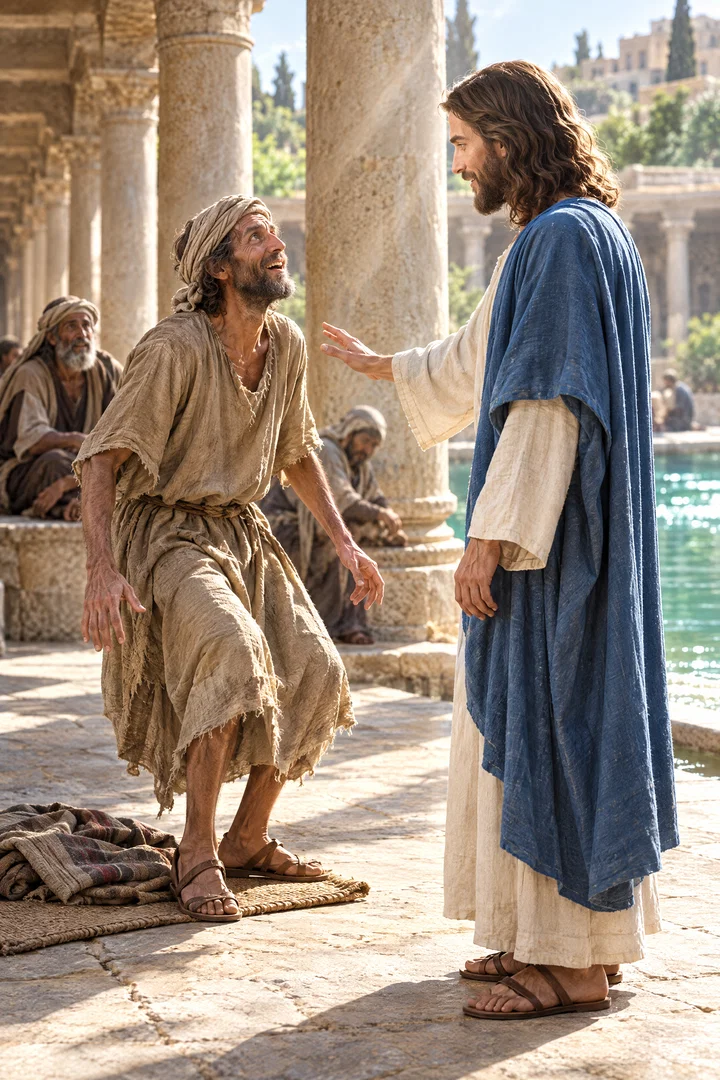
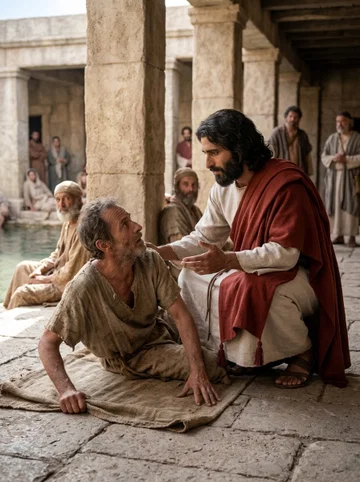
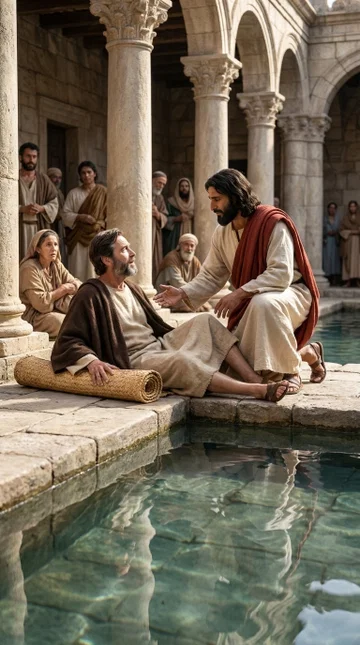
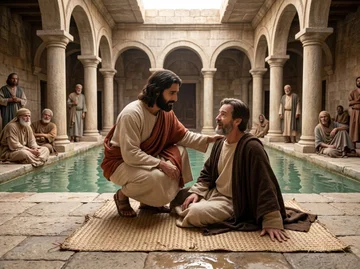
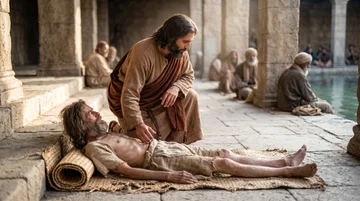
When Jesus saw him lie, and knew that he had been now a long time in that case, he saith unto him, Wilt thou be made whole?
Translations
When Jesus saw him lie, and knew that he had been now a long time in that case, he says to him, Will you be made whole?
King James Version, KJV Cambridge Paragraph Bible
When Jesus saw him lie, and knew that he had been now a long time in that case, he saith unto him, Wilt thou be made whole?
When Jesus saw him lying, and knew that he had been now a long time in that case, he saith to him, Wilt thou be healed?
Revised Version, American Standard Version
When Jesus saw him lying, and knew that he had been now a long time in that case, he saith unto him, Wouldest thou be made whole?
him Jesus having seen lying, and having known that he is already a long time, he saith to him, 'Dost thou wish to become whole?'
Jesus seeing this [ man] lying [ there], and knowing that he was [ in that state] now a great length of time, says to him, Wouldest thou become well?
Jesus, seeing, this one, lying, and taking note that now, a long time, had he continued, saith unto him—Desirest thou to be made, well?
Berean Standard Bible, Majority Standard Bible
When Jesus saw him lying there and realized that he had spent a long time in this condition, He asked him, “ Do you want to get well?”
When Jesus saw him lying there, and knew that he had been sick for a long time, he asked him, “ Do you want to be made well?”
When Jesus saw him there on the floor it was clear to him that he had been now a long time in that condition, and so he said to the man, Is it your desire to get well?
When Iesus sawe him lie, and knew that he nowe long time had bene diseased, he saide vnto him, Wilt thou be made whole?
Douay-Rheims (Challoner revision)
Him when Jesus had seen lying, and knew that he had been now a long time, he saith to him: Wilt thou be made whole?
Pictures
Cross-references
- John 5:16-18
And therefore did the Jews persecute Jesus, and sought to slay him, because he had done these things on the sabbath day.
The account continues with opposition to Jesus for healing on the Sabbath and his defense.
- John 7:23
If a man on the sabbath day receive circumcision, that the law of Moses should not be broken; are ye angry at me, because I have made a man every whit whole on the sabbath day?
defends making whole on the Sabbath
- John 5:14
Afterward Jesus findeth him in the temple, and said unto him, Behold, thou art made whole: sin no more, lest a worse thing come unto thee.
Jesus warns the healed man to stop sinning.
- John 5:17
But Jesus answered them, My Father worketh hitherto, and I work.
Jesus explains his Sabbath-day healing as work shared with the Father.
- Luke 13:11-16
And, behold, there was a woman which had a spirit of infirmity eighteen years, and was bowed together, and could in no wise lift up herself.
Jesus heals and releases an afflicted woman on the Sabbath.
- Acts 3:1-10
Now Peter and John went up together into the temple at the hour of prayer, being the ninth hour.
A second helpless man is healed through divine power.
- 1 Peter 2:24
Who his own self bare our sins in his own body on the tree, that we, being dead to sins, should live unto righteousness: by whose stripes ye were healed.
Christ bears sins, and his stripes bring healing.
- Isaiah 53:5
But he was wounded for our transgressions, he was bruised for our iniquities: the chastisement of our peace was upon him; and with his stripes we are healed.
His stripes are presented as the ground of healing.
- Numbers 21:8-9
And the LORD said unto Moses, Make thee a fiery serpent, and set it upon a pole: and it shall come to pass, that every one that is bitten, when he looketh upon it, shall live.
God used the bronze serpent as a means of healing.
- Luke 18:35-43
And it came to pass, that as he was come nigh unto Jericho, a certain blind man sat by the way side begging:
Jesus responds personally to the blind man by the roadside.
- John 5:16
And therefore did the Jews persecute Jesus, and sought to slay him, because he had done these things on the sabbath day.
The Sabbath healing leads to Jesus’ persecution.
- John 7:21
Jesus answered and said unto them, I have done one work, and ye all marvel.
The one work that caused astonishment was Jesus’ healing.
- Mark 3:4-5
And he saith unto them, Is it lawful to do good on the sabbath days, or to do evil? to save life, or to kill? But they held their peace.
Jesus heals on the Sabbath to show it is lawful to do good.
- Matthew 8:5-13
And when Jesus was entered into Capernaum, there came unto him a centurion, beseeching him,
Parallel account of the centurion’s servant being healed.
- Exodus 15:26
And said, If thou wilt diligently hearken to the voice of the LORD thy God, and wilt do that which is right in his sight, and wilt give ear to his commandments, and keep all his statutes, I will put none of these diseases upon thee, which I have brought upon the Egyptians: for I am the LORD that healeth thee.
Names the Lord as the one who heals.
- Luke 4:18
The Spirit of the Lord is upon me, because he hath anointed me to preach the gospel to the poor; he hath sent me to heal the brokenhearted, to preach deliverance to the captives, and recovering of sight to the blind, to set at liberty them that are bruised,
Jesus’ healing enacts his announced mission.
- John 7:19
Did not Moses give you the law, and yet none of you keepeth the law? Why go ye about to kill me?
Jesus’ Sabbath healing provoked a plot to kill him.
Commentary
Each commentary is drawn from primary sources: the writings of Ellen G. White and Adventist pioneers and periodicals. Each commentary is separate. Its own words are not a quotation; follow the references to read the source passages.
Ellen G. White
58 sources
Jesus saw a man who had lain helpless and paralyzed for thirty-eight years beside the pool of Bethesda, and with tender pity asked him if he wished to be made whole in order to awaken hope and draw out his desire for healing.ST Mar 31, 1881MH 84.1–2DA 201.3–4Ms 191, 1897, par. 5–6ST The man, friendless and worn down by continual disappointment, did not know Jesus could heal him and thought only of help into the water, yet Jesus required no expression of faith beforehand.COS 77.2–78.5DA 201.3–4ST Jul 15, 18862SP 158.1–2 When Jesus then commanded him to rise and walk, the man believed His word and acted at once without waiting to feel healed, and power was given so he was made whole by Christ's word and not by the pool.MH 84.1–2Ms 1, 1889, par. 26–27MH 84.3SC 50.1–51.1 The healing on the Sabbath was a merciful and lawful work that honored the day as a blessing and revealed Jesus as the divine Son, though the rulers seized on it as Sabbath-breaking and plotted to kill Him.2SP 161.3–162.13RED 24.3–25.12SP 165.2–166.1ST Jul 15, 1886LC1 86.1 His question still addresses every soul made helpless by sin, calling each to yield the will to Christ, believe His promise without waiting to feel whole, and receive cleansing, strength, and freedom unto a holy life.Ms 24, 1885, par. 13–17Ms 6, 1885, par. 10ST Jul 7, 1914MYP 119GW92 362.1–363.1
Bethesda Pool Setting
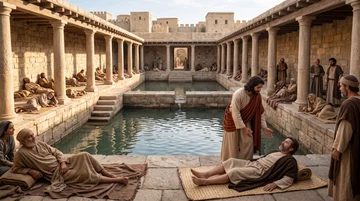
The scene is Jerusalem on the Sabbath at the pool of Bethesda by the sheep market, with its five porches.ST Jesus came there walking alone in meditation and prayer, where a great multitude of blind, halt, and withered lay waiting for the moving of the water.ST The common belief was that the water at times was troubled and whoever first stepped in after its troubling would be healed of whatever disease he had.DA 201.1–2ST
The crowded rush for that moment left weaker sufferers unable to reach the pool, for stronger ones plunged in before them and the scrambling, selfish crowd could not be contended with.ST Some died nearby in the press, shut out from the hoped-for cure.DA 201.1–2 Persistent effort toward the one object, with anxiety and continual disappointment, wore away the remnant of strength, showing the desperation surrounding hope of healing.DA 201.1–2ST
He longed to exercise His healing power and make every sufferer whole.ST Jul 7, 1914ST He knew that such healing on the Sabbath, while multitudes were going to the temple for worship, would excite prejudice and cut short His work.DA 201.3–4ST Jul 7, 1914ST He therefore singled out one case of supreme wretchedness, choosing this Sabbath healing despite knowing it would stir opposition and hinder His work.DA 201.3–4ST Jul 7, 1914ST
The question belongs to the account of healing a paralytic, impotent man at the pool of Bethesda on the Sabbath.DA 201Ms 2, 1874, par. 237MR 278.1–3Lt 1, 1876, par. 6 That account continues into Christ's discourse after the Jews accused Him of Sabbath-breaking.7MR 278.1–3Lt 1, 1876, par. 6 It extends into the account before the Sanhedrin.DA 201
Long Helpless Suffering
The man Jesus addressed at Bethesda had lain helpless, infirm, crippled and paralyzed for thirty-eight years, a long time in that condition.DA 201.3–4Lt 189, 1909, par. 5–8ST2SP 157.3 He was the most afflicted and worst case there, whose extreme misery drew particular attention.ST3RED 28.2–29.12SP 157.3 Worn down by many weary years, he was losing what little strength remained.ST2SP 157.3COS 76.2–77.1
He was alone and friendless with no one to put him into the pool, having been borne by those who pitied him only as far as the porches.DA 201.3–4ST Jul 15, 1886STDA 202.1MH 83.2–3 Unable to contend with stronger ones who plunged in before him and with the scrambling selfish crowd, he could never get farther than the edge at the favored moment when the water rippled.STDA 202.1MH 83.2–3COS 76.2–77.1 Repeated efforts ended in failure, and his appeals for help were ignored while others sought healing for their loved ones.ST Jul 15, 1886ST Jun 8, 1882DA 202.1MH 83.2–3COS 76.2–77.1
Persistent effort toward the one object with anxiety and continual disappointment was fast wearing away the remnant of his strength, leaving him nearly out of strength and nearly hopeless.ST Jul 7, 1914ST Jul 15, 1886ST2SP 157.3COS 76.2–77.1 Discouraged and doubtful that help would come in time, he had nearly given up and felt shut out from God's mercy.DA 201.3–4ST Jul 7, 1914ST Mar 31, 1881MH 83.2–3
His disease was in great degree the result of his own sin and evil habits and was looked upon by others as a judgment from God.DA 201.3–4ST Yet he carried a long-held desire for healing expressed in prayer through many weary years.ST Jul 15, 1886ST Jun 8, 1882 Despairing that his chance at the pool had passed, he first understood Jesus' question as an offer of help getting into the water and eagerly explained his disappointments and repeated failures.ST Jul 15, 18863RED 21.1–22SP 158.1–2ST May 13, 1886ST Jun 8, 1882
Compassionate Awakening Question
Jesus saw the man lying there and knew that he had been now a long time in that helpless, suffering condition, noticing his thirty-eight years of affliction before speaking to him directly.ST Mar 31, 1881MH 84.1–2Ms 191, 1897, par. 5–62SP 157.3 He recognized how long the sick man had been disabled and crippled, the worst and most afflicted case worn down by repeated failure, anxiety and continual disappointment until little strength remained.MH 84.1–22SP 157.3 He saw and knew the long, friendless condition of one who felt shut out from God's mercy, whose disease was in great degree the result of his own evil habits though others regarded it as God's judgment.DA 201.3–4
He approached with tender compassion, pity and sympathy, His heart ready to relieve suffering.COS 77.2–78.5STST Jul 7, 1914DA 202.1MH 83.2–3 He met the sufferer in despair at the point of deepest desire, a desire carried in prayer through many weary years.ST Mar 31, 1881ST Jul 15, 18862SP 157.3 He spoke tenderly to arrest the discouraged man's attention, and His compassionate question awakened hope that help was now possible.Ms 191, 1897, par. 5–6STST Jul 7, 1914DA 202.1MH 83.2–3 The man was discouraged and doubtful that help would come in time, his hope quickly fading as he recalled that he had no one to carry him into the pool and others reached it before him.STST Jul 7, 1914DA 202.1MH 83.2–3
His question whether the man wished to be made whole offered hope and help and called for an answer.ST Mar 31, 1881MH 84.1–2DA 201.3–4Ms 191, 1897, par. 5–6Ms 1, 1889, par. 26–27 It drew out desire for wholeness and met the man's deepest need as one alone, friendless and unable to reach the water before stronger ones, helpless and nearly hopeless with appeals for help ignored while others sought healing for loved ones.DA 201.3–4Ms 1, 1889, par. 26–27ST Jul 15, 1886 It turned attention from the lost chance at the pool toward the help He Himself could give, awakening hope in one who felt shut out from mercy and whose illness was largely the result of his own sin.MH 84.1–2DA 201.3–4Ms 191, 1897, par. 5–6 The man did not know that Jesus could heal him, and despairing that his chance at the pool had passed, he first took the question as an offer of help getting into the water.COS 77.2–78.52SP 158.1–2 Jesus did not require him to express faith beforehand, but the compassionate question itself introduced the healing that followed by commanding him to rise, take up his bed and walk.COS 77.2–78.52SP 158.1–2
Healing by His Word
The cure that followed came by Christ's word and power alone, not by getting the man into the pool.MH 84.1–2MH 84.3 No promise or assurance was given beforehand that he would be healed.MH 84.3 He could have doubted and so let the opportunity pass.MH 84.3
He believed the word spoken to him, set his will to obey, and at once attempted to walk.MH 84.3 He did not argue or pause to explain why he could not rise.Ms 1, 1889, par. 26–27 He acted before he could see or feel that healing had come, and in that acting God supplied the power and he was made whole.MH 84.3SC 50.1–51.1
The account stands as the pattern of faith that obeys Christ instead of waiting until every point is explained.Ms 1, 1889, par. 26–27 It is trust in His word expressed by acting on that word rather than waiting to feel whole.STSC 50.1–51.1 Forgiveness and cleansing are received in the same way, by believing God's promise, giving oneself to Him, and acting upon His word.SC 50.1–51.1
Sabbath Mercy and Opposition
Jesus deliberately chose the most afflicted man at Bethesda to display His healing power on the Sabbath, healing the worst case among the sick at the pool.2SP 161.3–162.13RED 24.3–25.1DA 206.1–2 He told him to carry his bed through the city so the cure and its circumstances would be publicly known and would raise the question of what Sabbath law permits.2SP 161.3–162.13RED 24.3–25.1DA 206.1–2 The healing and the command to carry the bed made the cure public, drawing attention to Jesus and challenging restrictive traditions about Sabbath observance.2SP 161.3–162.13RED 24.3–25.1DA 206.1–2
Relieving suffering accords with the Sabbath's purpose and restores its character as a blessing, for the merciful, sacred work honored the Sabbath and was in harmony with God's law.Lt 189, 1909, par. 5–82SP 161.3–162.13RED 24.3–25.1ST Apr 7, 1881 It freed God's statutes from senseless human restrictions and traditions that had turned the day from blessing into burden.2SP 161.3–162.1ST Jul 15, 1886LC1 86.1ST Apr 7, 1881 Such sacred work belongs on that day, and acts of mercy are in harmony with God's work.Lt 189, 1909, par. 5–83RED 24.3–25.1ST Apr 7, 1881
To make a man every whit whole on the Sabbath day is certainly right and lawful, as lawful as circumcising a man on the Sabbath.1RED 86.1–87.1LC1 87.1 The act must be judged not according to appearance but by righteous judgment, revealing the spirit of the law drawn from the work of God and the unceasing round of nature.2SP 165.2–166.11RED 86.1–87.1LC1 87.1 It upheld the sanctity of God's law by freeing it from senseless human restrictions, while exposing religious leaders who were strict for outward exactions yet failed to carry out its principles in their lives.LC1 86.12SP 340.1–2
The miracle showed divine power and should have convinced the Jews that Jesus was the promised Messiah and divine Son.ST Jul 15, 1886ST Jul 15, 1886DA 231.2 That divine Sonship He later declared before the Sanhedrin.2SP 165.2–166.1DA 231.2 The common people recognized Him as a friend who healed disease and comforted sorrow, and they justified and defended His Sabbath healing.2SP 165.2–166.1DA 207.4–208.1 The rulers, blinded by attachment to tradition and able to answer His teaching about the Sabbath only by custom and tradition, seized on the healed man's carrying his mat as a pretext for unbelief and condemned the sacred work.2SP 165.2–166.1ST Jul 15, 1886ST Jul 15, 1886 They were furious at His declaration that He was the Son of God equal with God, and persecuted Him with determined purpose to kill Him, eagerly watching for opportunity so that they had to be restrained for the time.2SP 165.2–166.1LC1 86.11RED 86.1–87.12SP 340.1–2
That Sabbath healing so kindled the malice of the leading Jews that they plotted against His life, making it no longer safe for Him to remain in Jerusalem.ST Feb 22, 18772SP 173.1–174.2 So He left for Galilee and made Capernaum the scene of His labors.ST Feb 22, 18772SP 173.1–174.2 Thereafter He avoided the national gatherings in Jerusalem and restricted His work to Galilee to prevent needless conflict with the leaders.DA 449.2–450.2
Call to Spiritual Wholeness
Christ still comes to the sick and suffering with the offer of wholeness, as Physician, Healer and Redeemer who knows what is needed, whose help is sufficient for the greatest sorrow and deepest grief, who supplies necessities and bears sorrows.Ms 43, 1902, par. 11–12Ms 191, 1897, par. 10–11 He does no half work and brings no partial relief, but saves to the uttermost all who come to Him.Ms 43, 1902, par. 11–12 He is the Author and Finisher of faith still speaking to those afflicted with physical and spiritual sickness, offering wholeness and rest even amid the fiercest conflicts of life.Ms 6, 1885, par. 10 With infinite wisdom for diseases of body and soul He fulfills His announced work to preach the gospel to the poor, heal the brokenhearted, preach deliverance to the captives, give sight to the blind, set at liberty the bruised, caring for the friendless, the suffering and the hopeless, meeting every evil practice and master passion that through long indulgence binds soul and body, able and longing to deliver and doing His utmost to set free the captive held by weakness.Ms 43, 1902, par. 11–12Ms 191, 1897, par. 10–11
His question, Wilt thou be made whole, personally addresses each sin-sick soul made spiritually helpless by sin.Ms 24, 1885, par. 13–17Ms 20, 1885, par. 14–18STMH 84.4DA 203.1 Long indulgence in evil practices and ruling passions binds soul and body, sin separates from God and leaves inability to live a holy life, and sufferers cannot make themselves holy or heal themselves but need His aid and must let Him do His work for them.Ms 20, 1885, par. 14–18STMH 84.4DA 203.1Ms 191, 1897, par. 10–11 To be made whole is to yield the will to Christ and come to Him who alone can remove defects, blot out past mistakes and transgressions, remove stains of sin and give His own righteousness.Ms 18, 1903, par. 5Ms 24, 1885, par. 13–17 It is to renounce self, come out and be separate from uncleanness, hear His voice knocking at the door of the heart and open the door to welcome Him in, looking to Him and receiving Him as personal Saviour, for He has borne iniquities and healing comes through the stripes laid upon Him, and those who take His help and yield themselves to Him are led into truth and a holy life of loving trusting obedience rather than self-righteousness.Ms 24, 1885, par. 13–17GW92 362.1–363.1Ms 46, 1899, par. 2–3
Those addressed are to believe His word and choose to serve Him without waiting until they feel healed.ST Jul 7, 1914MYP 119STMH 84.4 Faith must reach farther than sight, as the substance of things hoped for and the evidence of things unseen (Hebrews 11:1), trusting and depending on Him even amid fiercest conflicts, for He is ready to do great things for all who depend on Him.Ms 6, 1885, par. 10 By choosing to serve Him and acting on His word they receive strength, and acting brings strength.ST Jul 7, 1914MYP 119MH 84.4 He supplies power, subdues sin, delivers from long-indulged practices, ruling passions, weakness, misfortune and sin's hold, restores life to the spiritually dead, sets captives free, and gives life, peace and freedom, a great healing work in which workers can co-operate.Ms 43, 1902, par. 11–12ST Jul 7, 1914MYP 119STDA 203.1
The question presses with special urgency those in responsible places who refuse to yield their will to His will, asking them if they will be made whole by surrendering themselves to Him rather than turning from Him in the day of opportunity.Ms 18, 1903, par. 5 They have done a strange work of planning to resist the Spirit by unbelief and falsehood and cherishing opinions with no foundation in truth while marked by the deceitfulness of sin.Ms 18, 1903, par. 5 Greater evidence has already been given in demonstration of the Spirit and in power at the last General Conference, and the plea presses for decision before the coming Conference.Ms 18, 1903, par. 5 To refuse brings perishing not because of God's dealings but because of determined resistance to light and evidence.Ms 18, 1903, par. 5
Sources
Pioneers and periodicals
93 sources
Jesus saw a man who had been unable to walk for thirty-eight years lying helpless among the sick at Bethesda and knew the long misery of his condition.ST Mar 31, 1881ST Nov 11, 1897ST Aug 20, 1896ST Feb 11, 1886 From tender compassion he asked him whether he wished to be made whole, turning his despair toward hope and offering healing to whoever will receive it.ST Mar 31, 1881STST Jul 7, 1914ST Mar 20, 1901RH Dec 31, 1901 Without troubling the water he healed him completely by his own word, supplying strength to rise, take up his mat and walk at once in obedience to his command.ST Sep 10, 1896ST Feb 11, 1886RH Oct 3, 1912RH Jun 16, 1903ST Jun 21, 1905 The cure on the Sabbath was a good and merciful work, lawful and in harmony with keeping the day holy, showing that the Sabbath is for humanity's benefit and doing good.ST Nov 11, 1897RH Feb 11, 1862ST Dec 4, 1884ST Sep 15, 1909ST Jul 15, 1897 Wholeness means more than freedom from bodily pain and includes body, mind and spirit, for sin is a deadly disease no one can cure by human effort, but Christ can heal and make whole all who surrender to God, trust his word and act upon it.STST Jul 7, 1914ST Aug 20, 1896RH Jul 2, 1857ST Mar 15, 1899
Pool and Occasion
A great multitude of sick, blind, halt and withered lay at Bethesda, presenting a picture of human suffering and helplessness.ST Aug 2, 1910 At Jerusalem by the sheep market the pool of Bethesda had five porches where the disabled waited for the moving of the water commonly believed to heal whoever first stepped in after its troubling.ST At a certain season an angel troubled the waters and the one who first stepped in afterward was made whole, and the afflicted waited beside the pool until the waters were troubled before moving at all.RH Jan 13, 1863 Trying to stir the waters by human impatience and force and then rushing in for benefit brings no good result, because the moving of the waters must be done by the angels of God, not by human beings swayed by disaffection, prejudice and passion.RH Jan 13, 1863
The pool lies just inside the Sheep Gate on the right a short distance from the gate along the well-paved street running west, with the large square formerly occupied by the Temple on the left.ST Nov 10, 1898 The Sheep Gate stands at the same place as the ancient gate, and the eastern wall occupies the same place today as anciently.ST Nov 10, 1898 The pool as now pointed out is approached through ruins of an ancient church and lies considerably beneath the present surface of the ground, so covered with ruins and changed by later buildings that its appearance in the time of Christ can hardly be pictured.ST Nov 10, 1898 The healing took place on the Sabbath at the Passover in early spring, a few months before the Feast of Tabernacles. It belonged to Jesus' second visit to Jerusalem and was one of seven Sabbath miracles recorded in His ministry.ST Apr 14, 1881
People in Jesus' day entered or were carried into the pool of Bethesda, and the pool of Siloam was also used for washing, illustrating that Jerusalem had places and water suitable for immersion.ST Apr 19, 1883 Jesus was at Jerusalem on the Sabbath, walking alone in meditation and prayer to the pool, longing to exercise His healing power and make every sufferer whole.ST He knew such an act on the Sabbath while multitudes were going to the temple for worship would excite Jewish prejudice and cut short His work, so He singled out one case.ST Jul 7, 1914ST The Spirit led Him to the opportune occasion to find the man who most needed help.ST Mar 8, 1899
Jesus hurried away from the pool right after the cure to avoid exciting the multitude, so the healed man did not know the name of his benefactor until Jesus later met him in the temple.ST Mar 31, 1881 The Sabbath healing and the command to carry the pallet home caused the man to be stopped and reprimanded for doing what was contrary to the law.ST Mar 31, 1881 That gave the priests and rabbis ground to parade their strict Sabbath requirements and raise a charge against Jesus, turning the Sabbath from a blessing into a burden.ST Mar 31, 1881
Man's Long Affliction
The man had been unable to walk for thirty-eight years, a long chronic case that had left him near despair.ST Nov 11, 1897ST Aug 20, 1896ST Feb 11, 1886ST Jun 21, 1905ST Jul 21, 1909 Jesus saw him lying there and knew the long duration of his infirmity.ST Nov 11, 1897ST Aug 20, 1896 The case was beyond human means, for he could not stand or take a step by his own will and could not even attempt to use the remedy believed able to help him.ST Feb 11, 1886ST Jun 21, 1905 Yet Jesus is just as willing and able to heal today as he was then.RH Jul 4, 1907
He was helpless, alone and friendless, with no one to put him in at the favored moment.ST Jul 15, 1886STST Mar 15, 1905ST Aug 2, 1910ST Dec 19, 1916 Borne by those who pitied him only as far as the porches, he was dependent on others and his appeals for help were ignored while others sought healing for their loved ones.ST Jul 15, 1886ST At the favored moment stronger ones plunged in before him, and he could not contend with the scrambling selfish crowd.ST Persistent effort toward the one object with anxiety and continual disappointment was fast wearing away the remnant of his strength.ST Jesus helps when every other source of help fails, and he still seeks people in desperate need in order to help them.ST Mar 15, 1905ST Dec 19, 1916
He had waited at Bethesda relying on the pool as his last hope of healing, repeatedly asking passers-by to help him reach the water. His paralysis left him unable to reach the pool in time, and a younger, stronger man pushed past him and entered first, deepening his despair. Among the many sick he was noticed as especially needy, a case of supreme wretchedness whose many years of apparently hopeless illness emphasized the value of the healing that followed.STST Feb 8, 1905ST Feb 8, 1905 His lack of anyone to help him helps explain why his case was chosen.ST Feb 8, 1905ST Feb 8, 1905 He was near death when Jesus chose him and healed him completely without troubling the pool's waters.RH Oct 3, 1912
His illness was in great degree the result of his own evil habits and was looked upon as a judgment from God, illustrating sufferers bearing the consequences of wrongdoing.STST Aug 28, 1898 He felt friendless and shut out from God's mercy after long years of misery.ST He is presented as helpless from a serious affliction who had lain there a long time until Jesus made him well.ST Aug 20, 1896 He is raised as a representative of a class which the account itself does not identify, and he represents all people as sick.ST Aug 20, 1896RH Dec 31, 1901
Question Offers Hope
Jesus saw the man lying there and knew that he had been now a long time in that case, knowing the duration and misery of his condition.ST Mar 31, 1881ST Mar 15, 1899ST Feb 8, 1905ST Nov 14, 1900ST Aug 20, 1896 He saw the impotent man at Bethesda and knew he had been thirty-eight years in his infirmity, a long chronic case.ST Mar 31, 1881ST Mar 15, 1899ST Feb 8, 1905ST Mar 15, 1905ST Aug 20, 1896 He noticed the long-standing infirmity and knew how long he had suffered, including that he had no one to help him reach the pool at the right moment, and he helps when every other source of help fails.ST Jul 7, 1914ST Feb 8, 1905ST Nov 14, 1900ST Mar 15, 1905ST Aug 28, 1898
Before healing him he asked whether he wished to be made whole, turning the man's attention toward the possibility of healing and bringing the longed-for healing into focus.ST Mar 31, 1881ST Mar 15, 1899ST Mar 15, 1899ST Aug 2, 1910 The question met the sufferer in his despair and offered hope of healing.ST Mar 31, 1881STST Jul 7, 1914ST Mar 31, 1881ST Aug 28, 1898 It came from tender compassion and pity, meeting him in loneliness and deepest desire carried in prayer through weary years.ST Mar 31, 1881STST Jul 7, 1914ST Aug 28, 1898 It awakened hope in one worn down by years of suffering, discouraged and doubtful that help would come in time after repeated failures.STST Jul 7, 1914ST Mar 31, 1881ST Aug 28, 1898
The man first thought Jesus was offering to help him reach the pool, eagerly explaining his repeated efforts and disappointments.STST May 13, 1886ST Jun 8, 1882ST Aug 2, 1910 He told that he had no helper and saw no way to reach the healing water, believing his chance had passed.STST Jul 7, 1914ST May 13, 1886ST Aug 2, 1910 The question is also a promise offering to give healing to whoever will take it.ST Mar 20, 1901RH Dec 31, 1901 It is a life-and-death question for everyone whether long on the highway to death or only beginning the journey, meaning receiving health and life rather than remaining in sickness and death, for the man represents all people as sick and the great Physician addresses the same question to each person, while refusing God's will is choosing sickness and death.ST Mar 20, 1901RH Dec 31, 1901
Willingness to be made whole must be present, requiring surrender of self, appetite and ambition to God.ST Mar 15, 1899RH Jul 2, 1857 God does not save a person against the will or without understanding, but the sinner must understand the danger and helplessness, willingly come to Christ and trust him for salvation, and those who place themselves under his care are saved completely.ST Mar 15, 1899RH Jul 2, 1857 Jesus did not first ask him to exercise faith when he asked whether he desired to be made whole.ST Aug 20, 1896 He chose to relieve the affliction without delay although the man was not in immediate danger and waiting another day would not have materially changed his condition, and he did not postpone the healing because it was the Sabbath or because the rulers were watching for grounds to accuse him.ST Nov 11, 1897 He gave personal attention to the impotent man, seeking out the helpless man who most needed help, the Spirit leading him to the opportune occasion to find the one who most needed help, and he still seeks people in desperate need in order to help them.RH Dec 26, 1907ST Mar 8, 1899ST Dec 19, 1916
Sabbath Mercy Defended
Jesus healed the man who had been unable to walk for thirty-eight years on the Sabbath, asking whether he wished to be made whole and then telling him to rise, take up his mat and walk.ST Nov 11, 1897ST Nov 14, 1900ST Dec 4, 1884 The bed he was told to carry was only the blanket, rug or sleeping-mat on which he had lain, carried not for selfish purposes but for his relief and for God's glory, and the act showed the cure was real.RH May 5, 1874RH May 19, 1851RH Sep 17, 1861 Jesus hurried away from the pool right after the cure to avoid exciting the multitude, so the healed man did not know his benefactor's name until Jesus later met him in the temple.ST Mar 31, 1881 The Sabbath healing and the command to carry the pallet caused the man to be stopped and reprimanded for doing what was contrary to the law.ST Oct 25, 1910ST Mar 31, 1881 In the account as held by some, the disabled man is named Crispus, healed at Bethesda after many years of disability.ST Oct 25, 1910
The healing was a good, merciful work of necessity, lawful on the Sabbath and in harmony with keeping it holy.RH Feb 11, 1862ST Dec 4, 1884RH Apr 7, 1851 Relieving suffering and restoring health accord with the spirit of God's law, and the Sabbath commandment does not forbid work done in God's service for His glory rather than for the worker's benefit.ST Dec 4, 1884RH May 5, 1874ST Nov 17, 1881 The Sabbath is for humanity's benefit and is a time for doing good, not a burden imposed by religious rules, and proper observance allows attention to those in need.ST Nov 11, 1897ST Apr 26, 1905RH May 5, 1874 Jesus united temple worship with helpful ministry on the Sabbath, and his healing of the long-afflicted man illustrates that Sabbath ministry. The Sabbath was honored by many of his greatest miracles, of which John 5:5-9 is an example.ST Nov 17, 1909
Jesus deliberately performed the cure on the Sabbath, though he could have healed on another day.ST Sep 15, 1909ST Jul 15, 1897 He chose that day to challenge Sabbath traditions and formalism that had obscured the day's true significance and burdened people with added rules, to remove human-added restrictions, to correct false ideas about what observance allowed, and to restore the day's holy dignity as a blessing.ST Aug 20, 1896ST Apr 7, 1881ST Apr 26, 1905ST Sep 15, 1909ST Jul 15, 1897 Such sacred work of doing good and restoring the sick is in harmony with God's work, for God's work of caring for people does not cease, and Jesus' work that day was itself Sabbath-keeping.ST Aug 20, 1896ST Apr 7, 1881 The healing thus brought the question of proper Sabbath-keeping into focus.ST Aug 20, 1896ST Aug 20, 1896
Jesus kept God's commandments and observed the Sabbath according to God's meaning, not the Pharisees' rules. His statement that the Father works and He works defends the healing as like the Father's continuing providential care, and nothing in His words or deeds in this healing removes any sanctity of the seventh day, for He did not come to destroy the smallest part of the law.RH Sep 1, 1859RH Sep 17, 1861 If the Sabbath law had been abolished before he performed such healings, the accusation that he broke the Sabbath would make him a transgressor, but he did not break the commandments.RH Oct 21, 1851 The passage concerns the seventh day alone and has no application to the first day or Sunday observance, standing with all Sabbath commandments and instruction which pertain to the seventh day alone and cannot be applied to Sunday without wrestling the Scriptures.ST Apr 11, 1900 The Jews' strict and even over-particular Sabbath observance when Christ came is evidence that the Sabbath had not been lost.
The act led the Pharisees to regard Jesus as a Sabbath breaker. The priests and rabbis seized on the Sabbath healing and the carrying of the mat as ground to parade their strict Sabbath requirements and raise a charge against Jesus, turning the Sabbath from a blessing into a burden.ST Jul 15, 1886ST Mar 31, 1881 The episode raises the charge that Jesus broke the Sabbath by healing and telling the man to carry his bed, asking whether carrying the bed was a forbidden burden and what Jesus meant by saying His Father worked hitherto, and the healing was later defended as lawful and joined to Christ's public declaration of equality with God.ST Apr 7, 1881ST Aug 20, 1896RH Apr 28, 1863ST Nov 17, 1881 The miracle should have convinced the Jews that Jesus was the Son of God and the promised Messiah, showing divine power, but because it happened on the Sabbath they seized on the carrying of the mat as a pretext for unbelief.ST Jul 15, 1886ST Jul 15, 1886 Their attachment to tradition blinded them to the evidence of divine power and led them to condemn Jesus, kindling the malice of the leading Jews so that they persecuted Him, sought a way to put Him to death, and plotted against His life so that it was no longer safe to remain in Jerusalem and He left for Galilee to make Capernaum the scene of His labors, an opposition that became religious tyranny and helped bring about His death.ST Jul 15, 1886ST Nov 14, 1900ST Oct 25, 1910ST Jan 25, 1899
Christ Revealed as Healer
Bethesda was freely open to hopeless invalids, and its healing pointed to Christ and his work as the great antitype.RH Oct 3, 1912 Its setting in Jerusalem belonged to a city whose services and ceremonies pointed to Christ, and those types ceased when he came and offered himself.RH Oct 3, 1912 The verse belongs to the Gospel of John the beloved disciple, written about fifty years after Matthew.ST Sep 10, 1912 That Gospel does not deal with the beginning of the earth life of Jesus but plunges at once into doctrine, presenting him who came and lived and died for us as the eternal Word and teaching the life God offers and how that life may be received.ST Sep 10, 1912
The healing showed divine power and Jesus' identity as the promised Messiah and Son of God.ST Jul 15, 1886ST Jul 15, 1886 It should have convinced the Jews that Jesus was the Son of God, but because it happened on the Sabbath they seized on the carrying of the mat as a pretext for unbelief.ST Jul 15, 1886ST Jul 15, 1886 Their attachment to tradition had turned the Sabbath from a blessing into a burden, blinded them to the evidence of divine power, and led them to condemn Jesus.ST Jul 15, 1886 The merciful work was chosen to remove human-added restrictions and show such sacred work in harmony with God's work, bringing proper Sabbath-keeping into focus and prompting the question whether Jesus is the Messiah and his declaration of equality with God.ST Apr 7, 1881ST Aug 20, 1896
Jesus chose a pitiable man ill for thirty-eight years and near death, and healed him completely without troubling the pool's waters.RH Oct 3, 1912 The miracle was accomplished through the Holy Spirit by Christ's ministration, as the Great Healer whose power can make people whole of every disease.RH Oct 3, 1912ST Feb 21, 1906 Healing power was in Christ, not in the water, and there is healing in Christ's presence.RH Jun 16, 1903 The man could not stand or take a step by his own will and could not even attempt to use the remedy believed able to help him, for the case was beyond human means.ST Feb 11, 1886ST Jun 21, 1905 His spoken words gave power to obey when received, supplying the strength he lacked with the command to rise, take up the bed and walk.ST Sep 10, 1896ST Jun 21, 1905 The man believed, obeyed at once, and walked with the Saviour's strength filled with joy.ST Sep 10, 1896ST Jun 21, 1905
The healing illustrates that Christ's salvation brings wholeness to body as well as soul and spirit, displaying the completeness of the Gospel. He offers to make people whole, not merely to give partial or temporary relief, healing the wounded spirit, saving from death, and offering help sufficient for humanity's deepest sorrows and needs with something better than the world can give. Life is found only in Christ, and the man is raised as representative of a class which is not identified.ST Aug 20, 1896 Yet even the Life-giver's healing of the palsied man was met with doubt, with unbelief plotting to kill both the Life-giver and the one who was given life.ST Sep 26, 1895 The pool's stirring represents a time of visitation and opportunity for people responding to spiritual help and truth.RH Jan 2, 1913 The Bethesda healing scene also evokes a hidden source of healing that quenches fever, presenting Christ as restored and himself again after anguish.ST Oct 18, 1899
Wholeness Through Faith
Applied to sinners, the question offers healing from sin, which is a deadly disease that no one can cure by human effort and which, if left unchecked, ends in eternal death.RH Jul 2, 1857RH Jul 2, 1857ST Sep 8, 1898 Sin makes a man a cripple, but Christ can heal him and make him whole, and his blood cleanses from all sin.RH Jul 2, 1857ST Sep 8, 1898 The question presses for an answer because the time to be cured may soon pass; the sinner must understand the danger and helplessness, willingly come to Christ and trust him for salvation, and those who place themselves under his care are saved completely.RH Jul 2, 1857 God does not save a person against the will or without understanding.RH Jul 2, 1857
Wholeness means more than freedom from pain or physical weakness; it includes body, mind and spirit.ST Mar 15, 1899 A sound body does not make a person whole while sinful thoughts or purposes remain, and a will set on evil cannot will to be made whole.ST Mar 15, 1899 Wholeness requires surrendering self, appetite and ambition to God and becoming an instrument in his hands.ST Mar 15, 1899 Willingness to be made whole must be present in the person.ST Mar 15, 1899
People weakened and bound by sin cannot make themselves holy, atone for past sins, change their own hearts, or restore spiritual life and communion with God by human effort.ST Aug 20, 1896STRH Sep 28, 1905 Separation from God through sin leaves them powerless, but Christ can deliver them and longs to do so, and his grace gives that life.ST Aug 20, 1896ST Jesus did not first ask the long-afflicted man to exercise faith when he asked whether he desired to be made whole, yet the question is also his tender invitation to the spiritually diseased.ST Aug 20, 1896
They are to trust Christ's word, believe his promise, choose to serve him and act on that choice rather than wait until they feel healed or whole.STST Jul 7, 1914ST Aug 20, 1896STST Aug 20, 1896 By choosing to serve him and acting on his word they receive strength.ST Jul 7, 1914ST Aug 20, 1896ST Aug 20, 1896 He supplies the strength, subdues sin, and gives life, peace and freedom, delivering from long-indulged evil practices and ruling passions and freeing from weakness, misfortune and sin.ST Jul 7, 1914ST Though the man first explained that he had no helper to put him in the pool, the question awakened hope, and Christ's compassion offered help beyond failed human efforts.ST
The man believed Christ's word, believed he was healed, and immediately willed to walk, making the effort and walking.RH Sep 28, 1905 Likewise the crippled man met the Saviour's command with faith and put forth effort as though he could do it himself, and power from God enabled him.RH Sep 28, 1905ST Jul 8, 1889 In the spiritual life people are to make wholehearted effort to obey while trusting God to supply the power to do so.ST Jul 8, 1889 This illustrates that sinners may choose to serve God and believe his promise to do for them through Christ what they cannot do for themselves.RH Sep 28, 1905
Jesus' command to rise and walk is joined with the warning to sin no more.ST Mar 15, 1899 Healing means being made whole in both body and soul from sin-bred disease, with God's law written in the heart, received by rising and walking on God's promise while Jesus is passing by.ST Mar 15, 1899ST Mar 20, 1901 The man answered by taking up his bed and walking and later acknowledging Jesus.ST Mar 20, 1901 The question is a life-and-death question for everyone, whether long on the highway to death or only beginning the journey, and it is also a promise offering to give healing to whoever will take it.ST Mar 20, 1901 Through his Spirit he calls spiritually helpless, despairing people to rise from spiritual lethargy, become whole and shine as lights.ST Jul 21, 1909
The question applies to spiritual as well as bodily healing, offering to restore every part of a person's spiritual and moral nature to health.ST Aug 23, 1910ST Aug 23, 1910 It brings willing obedience to experience, reason and conscience and makes life new and sound and renewed, with rest to all who ask him.ST Aug 23, 1910ST Aug 23, 1910 The question is also applied to people distressed by disease, including those suffering the consequences of wrongdoing: the Great Physician knows their needs and offers healing, forgiveness for past sins, and strength to turn from sin through faith in Christ.ST Aug 28, 1898
Forgiveness, peace and salvation come by going to Christ just as one is and relying on his help, not on personal worth, human assistance, or waiting for better circumstances or feelings.ST Oct 25, 1910 His healing in a moment of one long helpless demonstrates his power and willingness to save even the most hopeless, giving others confidence to trust him.ST Oct 25, 1910 The same Jesus is able to speak to sinful, tempted people today through his Word so that by believing they can make his promise and power their own and turn from sin.ST Nov 1, 1910 Be thou made whole is applied to the soul receiving healing and new life, and the conviction caused by the Spirit's sharp reproof is to remain until Jesus speaks, setting the captive free and bringing healing.RH Aug 4, 1859
Healing must come from God, for healing is re-creation and only divine power can create. Jesus answers the afflicted quickly and is just as willing today to hear every call of suffering and sorrow and, if for the best, to heal as of old, whether through the ordinary channel of physical law as the reward of obedience to God-ordained laws regulating the being or through extraordinary miraculous working. Even after a person has learned and followed what he knows to be right, inherited sin and past ways of living may leave him in desperate ill health with his own efforts seemingly thwarted, but his case is not hopeless because Jesus is still a healer and works through ordinary means and practical faith.ST Mar 15, 1899 In contrast to the pool's healing, Jesus' blood cleanses the guilt and defilement of sin, and the fountain of his love is where people bring wounds and pains and remain for cleansing and life.RH Jan 21, 1858
The question also expresses Christ's tender appeal to people whose worldly plans fail, hopes are disappointed, loved ones die, or sickness and danger bring eternity near and expose earthly things as unable to satisfy the soul's deepest needs.ST Aug 23, 1910 It looks with tenderness and pity on a person longing for a better portion than earthly things can give, applying to the inward longing awakened by Christ's love and the cross and to conscience recognizing the sin of neglecting that love and power.ST Aug 23, 1910 The sight of Bethesda can awaken hope according to faith in a real, present, personal Christ.ST Mar 15, 1899 Jesus healed bodily illness at Bethesda, and the same healing power remains able to heal bodily ills in response to faith; he is just as willing and able to heal today as he was then.RH Jul 4, 1907ST Feb 13, 1912
Call to Be Whole Today
Jesus is willing to heal, and his question to the man ill for a long time whether he wanted to be made whole reaches people burdened by sickness, sin, sadness and other afflictions.RH Jan 24, 1907 It applies as an offered remedy of faith, to come to him, leave sin and sickness with him, and let him save and heal now.RH Jan 24, 1907 It is also a personal call to Jamie, who hears Jesus speaking to him as he did to the people at Bethesda.RH Jan 31, 1907 Jamie responds in faith and testifies that Jesus has healed him, so he no longer needs his crutches.RH Jan 31, 1907
The recognition that the man had suffered for a long time and the asking whether he wished to be made whole brings comfort at a funeral.RH Aug 31, 1911 The same noticing of a sufferer's long condition and asking whether he wants to be made whole shows Jesus looking with compassion on a dejected person who has no hope and calling him to wholeness.ST Mar 24, 1881
Sources