Translations
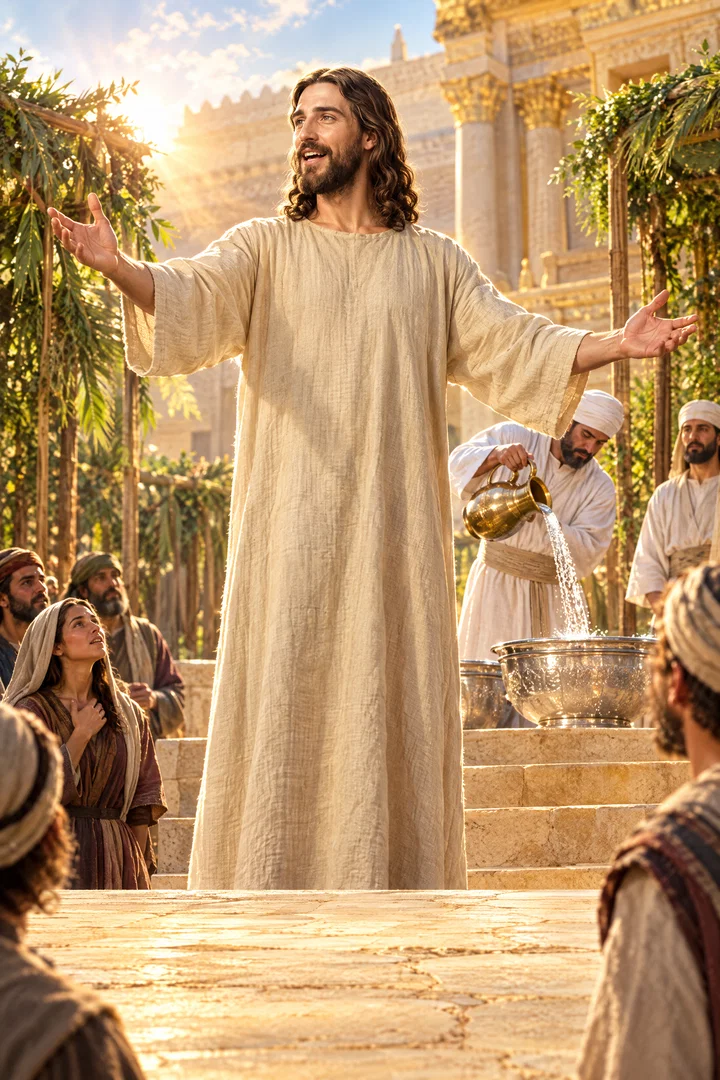
Now the Jew’s feast of tabernacles was at hand.
King James Version, KJV Cambridge Paragraph Bible, Douay-Rheims (Challoner revision)
Now the Jews’ feast of tabernacles was at hand.
Now the Jews' feast of tabernacles was at hand.
Revised Version, American Standard Version
Now the feast of the Jews, the feast of tabernacles, was at hand.
and the feast of the Jews was nigh — that of tabernacles —
Now the tabernacles, the feast of the Jews, was near.
But the feast of the Jews was near, that of the pitching of tents.
Berean Standard Bible, Majority Standard Bible
However, the Jewish Feast of Tabernacles was near.
Now the feast of the Jews, the Feast of Booths, was at hand.
But the feast of the Jews, the feast of tents, was near.
Nowe the Iewes feast of the Tabernacles was at hande.
Pictures
Cross-references
- John 7:37
In the last day, that great day of the feast, Jesus stood and cried, saying, If any man thirst, let him come unto me, and drink.
Jesus’ invitation takes place on the feast’s great day.
- Leviticus 23:42-43
Ye shall dwell in booths seven days; all that are Israelites born shall dwell in booths:
Commands Israel to dwell in booths to remember the exodus.
- John 7:10
But when his brethren were gone up, then went he also up unto the feast, not openly, but as it were in secret.
Jesus later went to the Feast of Tabernacles privately.
- Deuteronomy 16:13
Thou shalt observe the feast of tabernacles seven days, after that thou hast gathered in thy corn and thy wine:
Describes the Feast of Tabernacles as a seven-day celebration after the harvest.
- Nehemiah 8:14-18
And they found written in the law which the LORD had commanded by Moses, that the children of Israel should dwell in booths in the feast of the seventh month:
Records Israel observing the Feast of Tabernacles.
- 1 Kings 8:2
And all the men of Israel assembled themselves unto king Solomon at the feast in the month Ethanim, which is the seventh month.
Both texts record the Feast of Tabernacles in the seventh month.
- John 7:8
Go ye up unto this feast: I go not up yet unto this feast; for my time is not yet full come.
Jesus refers to going up to the Feast of Tabernacles.
- 2 Chronicles 7:8-9
Also at the same time Solomon kept the feast seven days, and all Israel with him, a very great congregation, from the entering in of Hamath unto the river of Egypt.
Both record the keeping of the Feast of Tabernacles.
- John 7:14
Now about the midst of the feast Jesus went up into the temple, and taught.
Jesus teaches at the feast.
- Ezra 3:4
They kept also the feast of tabernacles, as it is written, and offered the daily burnt offerings by number, according to the custom, as the duty of every day required;
Both texts record the keeping of the feast of tabernacles.
- 1 Kings 8:65
And at that time Solomon held a feast, and all Israel with him, a great congregation, from the entering in of Hamath unto the river of Egypt, before the LORD our God, seven days and seven days, even fourteen days.
Both describe the Feast of Tabernacles.
- 2 Chronicles 5:3
Wherefore all the men of Israel assembled themselves unto the king in the feast which was in the seventh month.
Both place an assembly at the Feast of Tabernacles.
- Leviticus 23:34
Speak unto the children of Israel, saying, The fifteenth day of this seventh month shall be the feast of tabernacles for seven days unto the LORD.
Institutes the feast that was approaching.
- Numbers 29:12-39
And on the fifteenth day of the seventh month ye shall have an holy convocation; ye shall do no servile work, and ye shall keep a feast unto the LORD seven days:
Prescribes offerings for the feast.
- Deuteronomy 16:13-15
Thou shalt observe the feast of tabernacles seven days, after that thou hast gathered in thy corn and thy wine:
The feast of tabernacles is kept after harvest with rejoicing before God.
- Zechariah 14:16
And it shall come to pass, that every one that is left of all the nations which came against Jerusalem shall even go up from year to year to worship the King, the LORD of hosts, and to keep the feast of tabernacles.
The feast of tabernacles is kept during a future gathering to worship the King.
- Exodus 13:3
And Moses said unto the people, Remember this day, in which ye came out from Egypt, out of the house of bondage; for by strength of hand the LORD brought you out from this place: there shall no leavened bread be eaten.
Recalls Israel’s deliverance from bondage in Egypt.
- Leviticus 23:2
Speak unto the children of Israel, and say unto them, Concerning the feasts of the LORD, which ye shall proclaim to be holy convocations, even these are my feasts.
Lists the yearly festivals associated with the Greek term used in Colossians 2:16.
- Acts 18:21
But bade them farewell, saying, I must by all means keep this feast that cometh in Jerusalem: but I will return again unto you, if God will. And he sailed from Ephesus.
The same Greek word is translated “feast.”
- John 6:4
And the passover, a feast of the Jews, was nigh.
Both verses mark the approach of Jewish festivals during Jesus’ ministry.
Commentary
Each commentary is drawn from primary sources: the writings of Ellen G. White and Adventist pioneers and periodicals. Each commentary is separate. Its own words are not a quotation; follow the references to read the source passages.
Ellen G. White
12 sources
The time was fixed as when the Feast of Tabernacles was approaching, setting the time for Jesus' journey to Jerusalem and the events in Judea.Ms 31, 1889, par. 41–44DA 447.3DA 447.1–2LC1 83.22SP 337.1 The feast was a seven-day gathering and the closing religious gathering of the year, one of three annual assemblies for which the Jewish people were required to assemble in Jerusalem.DA 447.3DA 447.1–22SP 337.1 It drew worshipers to Jerusalem from Palestine, other lands, and many regions, bringing people of every age and means with gifts of thanksgiving.Ms 31, 1889, par. 41–44DA 447.3 The city was decorated with greenery until it looked like a forest.DA 447.3 Its purpose was to remind the people of God's goodness, mercy, and care and to prompt thanksgiving for His goodness and the year's harvest.DA 447.3DA 447.1–2
As the feast approached, Jesus' brothers, also described as disciples, prepared to attend and urged Him to go to Jerusalem for the national gathering, to show Himself publicly and present His claims as the Messiah before the people, the rulers, and the religious leaders.LC1 83.2DA 449.2–450.22SP 337.2Ms 21, 1909, par. 7 Since His healing at Bethesda, Jesus had avoided these Jerusalem gatherings because of hostility from the Jews, had missed several of them, and had confined His work to Galilee to avoid needless conflict.2SP 337.1DA 449.2–450.2 Hostility and opposition in Judea and Jerusalem made going dangerous, so that being recognized could lead to arrest or death.Ms 31, 1889, par. 41–44Ms 191, 1907, par. 25–26
He therefore went to Jerusalem secretly, privately, and quietly rather than openly with His family or the traveling crowds, avoiding attention and withdrawing from places where an outbreak might arise.Ms 31, 1889, par. 41–44Lt 191, 1900, par. 9DA 451.3–452.1Ms 191, 1907, par. 25–26 His arrival was so quiet as not to draw attention, provoke the authorities, or let a mob hinder His work before its appointed time.Lt 191, 1900, par. 9DA 451.3–452.1 At the feast, people from many regions hoped to see Jesus, and inquiries about Him stirred widespread discussion.DA 451.3–452.1 Jesus was already making Himself known through teaching and healing, though those urging Him to appear publicly did not recognize how He was doing so.Ms 21, 1909, par. 7
At these yearly festival gatherings, where multitudes were absorbed in outward ceremony, He spoke of heavenly things and brought eternity into view.CT 261.4
Sources
Pioneers and periodicals
17 sources
The verse marks the approach of the Feast of Tabernacles, also called the Feast of Booths, one of the three times each year when all Jews were required to gather at Jerusalem.ST Nov 3, 1881ST Jun 24, 1897 It fell at the end of September or early in October, beginning on the fifteenth day of the seventh month and lasting seven days.RH Dec 10, 1861ST Nov 17, 1898 In Christ's ministry it came six months after He missed the Passover because the Jews sought to kill Him, placing it in the last six months before the crucifixion.RH Dec 5, 1907ST Feb 15, 1883ST Feb 22, 1899 Jesus had stayed away from Judea because of that enmity, and as the feast drew near the sons of Joseph urged Him to leave Galilee and present His claims and works publicly at Jerusalem.ST Nov 3, 1881RH Dec 5, 1907RH May 4, 1911 He answered that His time was not yet come while their time was always ready, and that they should go up while He would not go up yet, lest premature exposure to danger defeat His Father's will.ST Nov 3, 1881RH May 4, 1911 As one of the yearly feast-days, this feast belongs to the ceremonial system of festivals, new moons and annual Sabbaths, distinct from the weekly Sabbath of the fourth commandment and pointing forward to the death of Christ.RH Oct 31, 1854ST Jul 29, 1875ST Mar 25, 1875
Feast Time and Setting
The verse marks the approach of the Feast of Tabernacles, also called the Feast of Booths.ST Nov 3, 1881ST Jun 24, 1897 It was one of the three times each year when all Jews were required to gather at Jerusalem, and one of the annual gatherings for which they assembled there.ST Nov 3, 1881ST Oct 15, 1896 It is the setting for the events and teaching in John 7:2–39.ST Feb 22, 1905
On the yearly calendar the feast fell at the end of September or early in October. It began on the fifteenth day of the seventh month and lasted seven days.ST Nov 17, 1898 It followed the Day of Atonement by five days and was closely joined to it.RH Dec 10, 1861
In the course of Christ's ministry this feast came six months after He missed the Passover because the Jews sought to kill Him.RH Dec 5, 1907 It places John 7 in the last six months before the crucifixion.ST Feb 15, 1883 It came nearly three months before His later visit to Jerusalem for the Feast of Dedication, and after the Feast of Tabernacles He remained in the surrounding area.ST Feb 23, 1882 The feast was still in progress when He healed the man blind from birth while still in Jerusalem.ST Feb 22, 1899
The feast commemorated Israel's wilderness wanderings and living in booths.ST Nov 17, 1898ST Oct 15, 1896 It recalled deliverance from bondage in Egypt, when for seven days the Israelites lived in booths to remember that God had brought them out of Egypt.ST Oct 15, 1896ST Oct 15, 1896 During that journey a temporary shelter in the desert had been preferable to their well-provided homes there.ST Oct 15, 1896 It gave thanks to God for the earth's harvest.ST Nov 17, 1898ST Oct 15, 1896 It symbolized God's final ingathering of His people.ST Nov 17, 1898
When Christ was on earth the feast was universally observed by the Jews.ST Jun 24, 1897 By that time it had changed to a great extent from what God originally gave, with other features added to the feasts that tended to enhance the services.ST Jun 24, 1897 Instead of seeing the beautiful spiritual truths God gave as means to a great end, the people perverted the truth into false ideas.ST Jun 24, 1897 They built up barriers of tradition between themselves and God to have the preeminence instead of giving God the glory, so the service had become largely show and pomp with the real worship of God partially lost.ST Jun 24, 1897 Jesus' relatives from Nazareth came to Capernaum while traveling to the feast in Jerusalem and hoped He would join their party.
Christ's Course and Teaching
Jesus had stayed away from several of these gatherings because of the enmity of the Jews who sought to kill Him, and He came to this feast six months after missing the Passover for that same reason.ST Nov 3, 1881RH Dec 5, 1907 After He declared in the synagogue that He was the bread of life, many who had followed Him left Him and united with the Pharisees to watch and spy on His movements in hope of finding cause to condemn Him to death.ST Nov 3, 1881 As the feast drew near, the sons of Joseph, passing as His brothers and pressed by that desertion, urged Him to leave Galilee and go to Judea and Jerusalem.ST Nov 3, 1881RH May 4, 1911 Their demand was that if He was indeed the Messiah He should present His claims and works publicly before the rulers and enforce His rights.ST Nov 3, 1881RH May 4, 1911
Jesus answered with solemn dignity that His time was not yet come and not yet fully come, while His brothers' time was always ready.ST Nov 3, 1881RH May 4, 1911 The world could not hate them, but it hated Him because He testified that its works were evil.ST Nov 3, 1881 They should go up to the feast, while He would not go up yet, delaying because premature exposure to danger would not fulfill His Father's will.ST Nov 3, 1881RH May 4, 1911 The contrast between Christ and the world allowed no harmony, and His teachings and reproofs stirred hatred.ST Nov 3, 1881 He knew what awaited Him at Jerusalem and that Jewish malice would soon bring about His death, and it was not His place to hasten that event by prematurely exposing Himself to unscrupulous hatred, but to patiently await His appointed time.ST Nov 3, 1881RH May 4, 1911
He lived these last six months before the crucifixion under the shadow of the cross, with His heart resting on the prophecies and promises of the Old Testament.ST Feb 15, 1883 At this feast He used those prophecies and promises to encourage and teach His disciples and to answer His opponents.ST Feb 15, 1883 By absolute reliance upon its words He proved that all His teaching concerning the Old Testament came from His heart and deepest conviction.ST Feb 15, 1883 The approaching feast is the setting for the events and teaching in the rest of the chapter through verse 39.ST Jun 24, 1897ST Feb 22, 1905 One feast-day custom is brought out in the last part of the same chapter when Jesus stands and cries out offering rivers of living water, which is the Spirit to be received by those who believe on Him after He is glorified.ST Jun 24, 1897 That time sets forth Jesus Christ as the one in whom every longing of the soul may be satisfied and belongs to the prophecies relating to the Saviour's first advent.RH Mar 27, 1900
Ceremonial Law Distinction
The Greek word rendered feast denotes a feast day or festival day, and here it designates the Jews' Feast of Tabernacles drawing near.ST Jul 29, 1875ST Mar 25, 1875RH Nov 7, 1854 Elsewhere the same word is translated feast, and in Colossians 2:16 it is rendered holy day.RH Nov 7, 1854 That usage shows the word in Colossians 2:16 means festival and refers to the yearly ceremonial festivals and feast-days, not to the weekly Sabbath.ST Jul 29, 1875ST Mar 25, 1875
As one of the three yearly feast-days appointed by God, the Feast of Tabernacles belongs to the ceremonial system of feast-days, new moons, and annual Sabbaths, distinct from the weekly Sabbath of the fourth commandment made in Eden as a memorial of creation. As a feast-day it is part of the handwriting of ordinances and law of shadows pointing forward to the death of Christ, which expired when that death occurred, while the royal law of the ten commandments remains in full force. The account with the feast at hand through its continuation to verse 14 is one recorded instance of the seventh-month festivals being observed.RH Oct 31, 1854 The feast is one of the lesser festivals of the seventh month, following the Day of Atonement by five days and closely joined to it, whose keeping is repeatedly and particularly put on record in Scripture while not one observance of the far more important Day of Atonement is on record, which proves that silence about a holy day does not prove it was not observed.RH Oct 31, 1854RH Dec 10, 1861
Sources