John 9:6
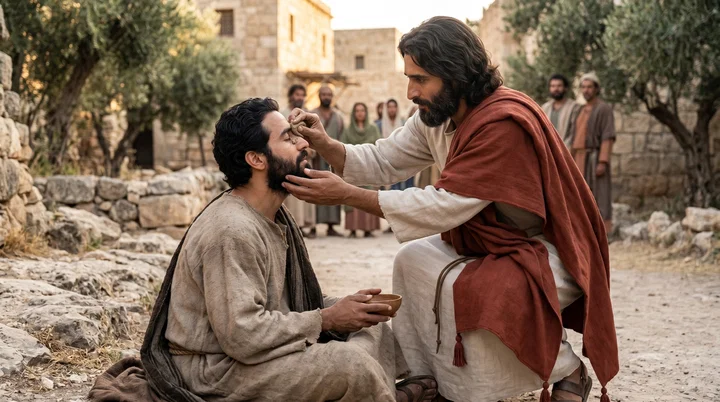
When he had thus spoken, he spat on the ground, and made clay of the spittle, and he anointed the eyes of the blind man with the clay,
Translations
American King James Version, King James Version, KJV Cambridge Paragraph Bible
When he had thus spoken, he spat on the ground, and made clay of the spittle, and he anointed the eyes of the blind man with the clay,
When he had thus spoken, he spit on the ground, and made clay of the spittle, and he anointed the eyes of the blind man with the clay,
Revised Version, American Standard Version
When he had thus spoken, he spat on the ground, and made clay of the spittle, and anointed his eyes with the clay,
These things saying, he spat on the ground, and made clay of the spittle, and rubbed the clay on the eyes of the blind man, and said to him,
Having said these things, he spat on the ground and made mud of the spittle, and put the mud, as ointment, on his eyes.
These things, having said, he spat on the ground, and made clay with the spittle, and laid the clay upon his eyes;
When Jesus had said this, He spit on the ground, made some mud, and applied it to the man’s eyes.
When Jesus had said this, He spit on the ground, made some mud, and applied it to the eyes of the blind man.
When he had said this, he spat on the ground, made mud with the saliva, anointed the blind man’s eyes with the mud,
Having said these words, he put earth, mixed with water from his mouth, on the man's eyes,
Assoone as he had thus spoken, he spat on the ground, and made clay of the spettle, and anointed the eyes of the blinde with the clay,
Douay-Rheims (Challoner revision)
When he had said these things, he spat on the ground, and made clay of the spittle, and spread the clay on his eyes,
Pictures

Cross-references
- John 9:25
He answered and said, Whether he be a sinner or no, I know not: one thing I know, that, whereas I was blind, now I see.
The lesson pairs the healing account with the healed man’s testimony.
- John 9:14
And it was the sabbath day when Jesus made the clay, and opened his eyes.
Jesus made the clay and healed the man on the Sabbath.
- John 9:35-38
Jesus heard that they had cast him out; and when he had found him, he said unto him, Dost thou believe on the Son of God?
The healed man believes in Jesus and worships him.
- Revelation 3:18
I counsel thee to buy of me gold tried in the fire, that thou mayest be rich; and white raiment, that thou mayest be clothed, and that the shame of thy nakedness do not appear; and anoint thine eyes with eyesalve, that thou mayest see.
Both call the blind to receive sight.
- John 9:32
Since the world began was it not heard that any man opened the eyes of one that was born blind.
The healed man says no one had ever opened the eyes of someone born blind.
- John 9:21
But by what means he now seeth, we know not; or who hath opened his eyes, we know not: he is of age; ask him: he shall speak for himself.
His parents avoid explaining how he received his sight because they fear being cast out.
- John 9:16
Therefore said some of the Pharisees, This man is not of God, because he keepeth not the sabbath day. Others said, How can a man that is a sinner do such miracles? And there was a division among them.
Some Pharisees condemn Jesus for making clay and healing on the Sabbath.
- John 9:17
They say unto the blind man again, What sayest thou of him, that he hath opened thine eyes? He said, He is a prophet.
The healed man calls Jesus a prophet for giving him sight.
- Mark 7:33
And he took him aside from the multitude, and put his fingers into his ears, and he spit, and touched his tongue;
Jesus uses touch and spittle in both healings.
- John 9:24
Then again called they the man that was blind, and said unto him, Give God the praise: we know that this man is a sinner.
The Pharisees challenge the healed man to condemn Jesus as a sinner despite the miracle.
- John 9:34
They answered and said unto him, Thou wast altogether born in sins, and dost thou teach us? And they cast him out.
The authorities reject the healed man’s testimony and cast him out.
- John 9:11
He answered and said, A man that is called Jesus made clay, and anointed mine eyes, and said unto me, Go to the pool of Siloam, and wash: and I went and washed, and I received sight.
blind man's report omits spittle because he could not see it
- Mark 8:23
And he took the blind man by the hand, and led him out of the town; and when he had spit on his eyes, and put his hands upon him, he asked him if he saw ought.
Both healings use spittle as Jesus meets the blind man’s weak faith.
- Isaiah 42:7
To open the blind eyes, to bring out the prisoners from the prison, and them that sit in darkness out of the prison house.
Both describe the opening of blind eyes through Jesus’ work.
- John 7:21-24
Jesus answered and said unto them, I have done one work, and ye all marvel.
Jesus defends his Sabbath healing against criticism.
- John 10:21
Others said, These are not the words of him that hath a devil. Can a devil open the eyes of the blind?
Opening the blind man’s eyes is cited as evidence that Jesus is not demon-possessed.
- Luke 4:18
The Spirit of the Lord is upon me, because he hath anointed me to preach the gospel to the poor; he hath sent me to heal the brokenhearted, to preach deliverance to the captives, and recovering of sight to the blind, to set at liberty them that are bruised,
Jesus’ work includes giving sight to the blind.
- John 9:33
If this man were not of God, he could do nothing.
miracle proves Jesus is of God
Commentary
Each commentary is drawn from primary sources: the writings of Ellen G. White and Adventist pioneers and periodicals. Each commentary is separate. Its own words are not a quotation; follow the references to read the source passages.
Ellen G. White
9 sources
The healing followed immediately upon Jesus declaring Before Abraham was, I AM in the temple, which the Pharisees called blasphemy and met with an attempt to stone Him, yet as the I AM He veiled their eyes so they could not see Him as He passed through their midst and out of the temple.14MR 22.5 As He passed through the multitude He saw the blind man and healed him.14MR 22.5Lt 119, 1895, par. 12–18
The man had been blind from birth.DA 470.1–471.3DA 471.4–6Lt 20, 1895, par. 1Lt 119, 1895, par. 12–18 One account describes him as blind from his youth.14MR 22.5
Jesus spat on the ground, made clay of the spittle, and anointed the blind man's eyes with the clay.DA 470.1–471.3DA 471.4–6Ms 18, 1898, par. 12 After anointing his eyes, Jesus sent the man to wash, and when he washed he was healed and his sight was restored.DA 470.1–471.3DA 471.4–6Ms 18, 1898, par. 12 The place where he was sent to wash was Siloam.DA 470.1–471.3
The clay itself had no healing power; the instantaneous cure came through the power of Christ, the great Healer, who chose to use a simple thing from nature.DA 470.1–471.3DA 471.4–6Ms 18, 1898, par. 12 The act was a practical answer to the disciples' question about the cause of the blindness, making God's works and Christ's power and mercy manifest instead of speculating about who sinned.DA 470.1–471.3DA 471.4–6 The miracle was convincing evidence that Jesus' mission was divine.
The blind man was despised by the self-righteous Pharisees, yet Jesus in tender compassion as the compassionate Shepherd was anxious to save him, and the man represents the lost sheep whom the Shepherd seeks to save.ST May 8, 1907ST Nov 20, 1893Lt 20, 1895, par. 1 At the time of the healing the man did not yet know who had healed him, and Jesus later revealed Himself to him as the Son of God.Lt 20, 1895, par. 1 The healing connects with Christ's work of bringing relief and redemption to people in darkness and misery.ST Jul 19, 1905
Simple remedies from nature may help inflamed eyes without the harmful effects that can follow substances that weaken and eventually destroy sight, for the eye is delicate and should be carefully treated.Ms 18, 1898, par. 12
Sources
Pioneers and periodicals
88 sources
Jesus healed a poor beggar born blind at the temple in Jerusalem at the Feast of Tabernacles on the Sabbath day by spitting on the ground, making clay of the spittle, anointing his eyes with it, and sending him to wash in Siloam.ST Jun 24, 1886ST Mar 15, 1905ST Aug 8, 1900ST May 19, 1909
The healing relieved suffering and honored God, and such merciful work is lawful on the Sabbath and reveals what true Sabbath-keeping is, though the Pharisees judged making the clay and healing to break their Sabbath rules and called Jesus a sinner for it.RH Feb 11, 1862ST Jul 8, 1897
The clay and the water had no curative power in themselves, but the virtue and power were in Christ, His word, and the Spirit of God, though those who held it saw medicinal and restorative virtue in the clay itself.ST Oct 23, 1893ST Aug 8, 1900ST Mar 31, 1898
Christ could have healed without means, yet He used this feeble, unlikely means to awaken and test the man's faith and to give him a part to do, so that healing came as he trusted Christ's word and obeyed by going to wash.ST Nov 11, 1897ST Aug 8, 1900ST May 17, 1905ST Oct 2, 1901
The lifelong blindness was not for his sin nor his parents' sins but gave occasion for God's works to be made manifest, proving by a creative act never heard of before that Jesus is the divine Light of the world who gives sight to the physically and spiritually blind.ST Oct 23, 1893ST Jun 24, 1886ST Mar 8, 1899
Setting and Details
The verse records Jesus using clay made from spittle to anoint the eyes of a man blind from birth.ST Jun 24, 1886ST Mar 15, 1905 He was a well-known poor beggar who sat begging at the temple in Jerusalem, probably near the temple entrance or on the temple mount, whom Jesus found and gave light to as He passed by.ST Jun 24, 1886ST Nov 26, 1896ST Apr 14, 1881 He is the only blind man Jesus healed who is said to have been born blind, whose condition was well attested, who had never looked on his friends nor seen the beauties of the Creator's works.ST Mar 15, 1905
The healing took place in Jerusalem at the Feast of Tabernacles on the Sabbath day.ST Jun 24, 1886ST Aug 8, 1900 It belongs to the account of Jesus healing a man who was born blind on the Sabbath.ST May 19, 1909 When He had spoken, Jesus spat on the ground and made clay or mud from spittle mixed with ground, dust, or street dirt.ST Jun 24, 1886ST Aug 8, 1900ST May 17, 1905ST Nov 29, 1910 He anointed the blind man's eyes with it as the first action in the healing, before sending him to wash in Siloam, after which the man came back able to see.ST Aug 8, 1900ST Nov 11, 1897ST May 17, 1905ST Nov 29, 1910
Saliva was commonly used for eye diseases, though not to cure blindness.ST Jun 24, 1886 Making sight-restoring clay with breath recalls the creation of life from clay by the breath of God, for sight is restored through clay made with the breath of the one who first gave life to clay, and Siloam means sent, where the clay is then washed away.ST Jun 24, 1886 The man had never seen Jesus and knew Him only by name by hearing.ST Dec 22, 1881 He felt something put on his eyes which he afterward found to be clay, but because he could not see Jesus making the clay from spittle he could not tell how it was made, so in his own account he says simply he made clay and spread it on his eyes.ST Dec 22, 1881 The simple and artless telling of many circumstances shows truth and not imposture or falsehood.ST Dec 22, 1881 The healing is recorded with striking simplicity, presenting the man's obedience and restored sight as facts which the man knows even though he cannot explain how the clay brought it about.ST Jun 24, 1886ST Mar 8, 1905
Purpose and Compassion
When asked whose fault the blindness was, Jesus did not debate the question but answered it by action, correcting the mistaken idea that severe suffering proves severe personal guilt.ST Oct 23, 1893ST Jun 24, 1886 The man's condition from birth was not inflicted because of his own wrongdoing nor because of his parents' wrongdoing, and was in no way something he could have prevented or helped.ST Jun 24, 1886RH Jan 30, 1872 His sadness under lifelong loss of sight and his temptation to complain against providence were met not with condemnation but with healing.RH Jan 30, 1872
That lifelong affliction became the occasion for God's works to be openly shown, revealing divine power, mercy and compassion in granting sight to the blind.ST Oct 23, 1893ST Jun 24, 1886ST Mar 8, 1899RH Jan 30, 1872 Christ came as the healer of disease and evil and the remover of sin's ultimate cause, and to this man He was literally the light of day.ST Jun 24, 1886 His work was to destroy sin with all its physical as well as moral effects by taking infirmities and bearing sicknesses.ST May 22, 1901
Suffering comes as a result of sin in a general sense, yet it cannot atone for sin.ST Mar 8, 1899 It may lead the sufferer to the One able to heal both body and soul, and God is honored and glorified by healing those who trust in Him from sin's consequences.ST Mar 8, 1899ST May 16, 1911
Jesus took that very calamity and, by an unprecedented display of divine power, turned lifelong sorrow into joyful recompense for all that had been endured.RH Jan 30, 1872 The healing is an explained instance of God's special providence, in which sorrows, trials and adversities are ordered by the Lord to glorify God and His Son.RH Jan 30, 1872 The day of judgment will disclose very many other dark afflictions to have been ordered in the same way.RH Jan 30, 1872
The compassionate Shepherd restored a man whom the self-righteous Pharisees despised.ST May 8, 1907ST Nov 20, 1893 That man stands for the lost sheep whom the Lord was anxious to save and whom the Shepherd seeks to save.ST May 8, 1907ST Nov 20, 1893
Sabbath Healing and Conflict
Such merciful healing on the Sabbath is lawful and worthy of the Sabbath and of its Lord.RH Feb 11, 1862RH May 5, 1874ST Mar 4, 1889ST Sep 18, 1884 It relieved suffering and honored God, and was not careless or irreverent, but an act of helpful ministry united with temple worship.RH May 5, 1874 It was no violation of God's Sabbath law, though the Jews wrongly treated it as unlawful labor, and it was a deliberate method of healing, not a rejection of the Sabbath or an announcement of a new Sabbath.ST Mar 4, 1889ST Sep 18, 1884
The law commanded abstinence only from servile work, meaning grasping after wealth by trading and worldly business, while exhorting attention to exercises of the soul, reflection and beneficial help for neighbors. It did not prohibit healing on the Sabbath, just as it did not prohibit circumcising on that day or healing dumb animals or the work of priests in the temple. The healing belongs to that lawful work of mercy, like the offices of the high priest in propitiating God, cleansing lepers, healing the sick and delivering exiled man from condemnation. Jesus did nothing contrary to the law when He healed on the Sabbath, did not violate the day, and did not make void but fulfilled the law, so that blame of Him for healing on the Sabbath is unjust, and because of this cure at Siloam and frequent other Sabbath cures many resorted to Him on Sabbath days.
Works of necessity and mercy are more important than all the narrow traditions about Sabbath-keeping invented by selfish men. The healing revealed God's idea of Sabbath observance and showed that human rules did not define the Sabbath, answering the Pharisees who sought to kill Him for disregarding their manner of Sabbath-keeping.ST Jul 8, 1897 It gave no removal of any sanctity of the seventh day, because He did not come to destroy one jot or tittle of the law. Jesus deliberately did this merciful healing on the Sabbath with design to correct false notions taught by the rabbis and to exalt true Sabbath-keeping by determining what is lawful on the Sabbath.ST Sep 15, 1909 It was done to rebuke making God's holy day a burden by superstitious exactions when it was meant to be holy, honorable and a delight, and it belongs to the miracles around which gathered the whole controversy over what constitutes proper Sabbath-keeping.ST Aug 20, 1896ST May 22, 1901 This plain teaching of simple gospel truth about the Sabbath brought bitter and relentless opposition, and was counted as a reason He should be put to death.ST Sep 15, 1909
The Pharisees judged the work to violate their Sabbath rules, though He acted according to God's commandments. They called Jesus a sinner and accused Him of not keeping the Sabbath, and some used this arduous work of opening the eyes of a man born blind to argue that Jesus was not of God.ST Jul 8, 1897ST Feb 24, 1914ST Dec 3, 1896 Making clay was considered a breach, and applying saliva to the eye was forbidden as using a remedy.ST Jun 24, 1886 The act of making the clay was charged as breaking the Sabbath, raising whether one who wilfully breaks the Sabbath can be of God.ST Dec 3, 1896 Jesus healed without waiting for the Sabbath to end though the man's condition was not urgent and he had not expected to be healed, knowing it would draw accusations and hostility from the rulers.ST Nov 11, 1897 The Sabbath healing intensified hatred and stirred persecution not only against Jesus but against any who would confess Him as Christ.ST May 22, 1901 Yet critical examination only established the miracle's reality beyond doubt, showing that efforts to hinder Christ's work only advance it, and the facts that Jesus made the clay and the man washed hold a lesson.ST Dec 3, 1896
Jewish authorities threatened exclusion from the synagogue for confessing Jesus as the Christ and ultimately cast the healed man out, and this exclusion was excommunication.RH Oct 8, 1908ST Oct 18, 1905 Fear of it kept some people of good repute from acknowledging Christ, and led his parents from fear of being disfellowshiped to admit only that he was their son born blind while refusing to say how he now sees or who opened his eyes.RH Oct 8, 1908 The poor unlearned man's whole knowledge and unshakable testimony that whereas he was blind now he sees and that Jesus must be of God or He could do nothing could not be changed or overcome, not even by the learned Sanhedrin with all its wisdom.RH Mar 30, 1876ST May 22, 1901 That persecution gave the healed man opportunity to show unusual faith and courage before the Sanhedrin, holding with certainty to what he knew, so that he defied their authority and braved excommunication as one on the side of God and truth.ST May 22, 1901
Means Faith and Obedience
The clay had no healing power for that use, and neither did the water of the pool, for the clay and the washing were not the source of the cure and possessed no curative quality in themselves.ST Oct 23, 1893ST Aug 8, 1900ST Sep 13, 1905RH Feb 23, 1905 The virtue and power that gave sight were in Christ Himself, in His word, and in the power of the Spirit of God working through the means, even when no relation between disease and remedy could be seen and the working power could not be seen.ST Oct 23, 1893ST Sep 13, 1905ST Mar 31, 1898 Those who held otherwise taught that the ointment of clay possessed medicinal value and restorative virtue, for otherwise its use would have been senseless service, and that a cure wrought through means is as truly a manifestation of divine power as a cure wrought directly without means, as the blind man himself regarded it.ST Mar 31, 1898 Christ could have healed the man born blind without either remedy, without salve or water, and at a distance as He restored one sick unto death without being present.RH Dec 7, 1916RH Jun 15, 1916ST Nov 29, 1910 His deliberate use of simple physical remedies and natural agencies of clay made from spittle and of bathing shows that God is not opposed to suitable simple remedies and is not confined to one method of healing.RH Dec 7, 1916RH Nov 30, 1916RH Aug 27, 1901RH Jun 15, 1916ST Nov 26, 1896
That use sanctions remedial agencies alongside prayer and trust, calling attention to remedies often ignored yet within the reach of all.RH Jun 15, 1916 Everything human hands can do in sickness should be done and every agency of value employed, with faith shown by works in a divine combination of faith and works, so that using them is no denial of faith.RH Jun 15, 1916 The clay and saliva served as means to build the blind man's confidence in Jesus, to let faith live and grow, to test his faith, and to give him a part to play joined to Jesus' word and healing power.ST Aug 8, 1900ST May 17, 1905ST Oct 2, 1901ST Mar 8, 1905ST Sep 13, 1905 Jesus first acted to inspire confidence already awakened and to meet the man's longing for something to be put on his eyes and his weak faith, then gave an instruction through which he could exercise that faith, for God never works in exactly the same way with different individuals but adapts His method to each person's faith.ST Aug 8, 1900ST May 17, 1905ST Mar 8, 1905ST Nov 29, 1910
The healing came as the man obeyed the specific command to go and wash in Siloam, with the washing as part of the healing, and he came back seeing.ST Nov 11, 1897ST Oct 2, 1901ST Aug 12, 1889 He depended on Jesus and His word, and the command tested his faith which he showed by obeying.ST Oct 2, 1901 Refusing the means Jesus provided while expecting a cure would be presumption rather than faith, so Christ's instructions are not meaningless and should not be replaced, neglected, or judged by human preference, as when seeking God's direct help known remedies should not be neglected nor another pool deemed better or more convenient chosen in place of Siloam.ST Feb 11, 1886ST Mar 8, 1905RH Jul 20, 1876ST Aug 12, 1889RH Feb 23, 1905 Jesus making the clay and anointing the eyes is the divine part of the work while the man's own washing is the human part.ST Mar 11, 1897 The man born blind pictures the natural human condition, proving that no one can be saved without cooperating and that it is a privilege to unite with Jesus in the great plan of salvation by voluntary cooperation with the Son of man to save what was lost.ST Mar 11, 1897
The same act is echoed when a blind woman in faith made clay, put it on her eyes, trusted Jesus to restore sight, washed, and could see.ST Apr 10, 1893ST Aug 20, 1902 Her healing led her to trust Jesus as the one who heals and forgives sins and demonstrates power to restore sight.ST Apr 10, 1893ST Aug 20, 1902 Jesus used clay made from dust, street dirt, and spittle, a feeble, unlikely, unpromising, lowly and humble means for so great an effect, to display God's power rather than the apparent effectiveness of the method.ST Oct 4, 1883RH Apr 28, 1874RH Apr 2, 1861ST Jul 29, 1886 God accomplishes great designs by weak instruments with no lack in His power and wisdom, and blesses very slender things and humble instrumentalities to conversion, spiritual understanding, and the opening of blind eyes.ST Oct 4, 1883RH Apr 28, 1874RH Apr 2, 1861ST Jul 29, 1886
Christ Power and Identity
The anointing with clay was convincing evidence that the mission was divine, for giving sight to one born blind was a creative act revealing divine power and settling the question of character.RH Dec 8, 1859 That display of power turns faith away from physical objects and toward Jehovah as the first cause, and the act of mercy belongs among the miracles that demonstrate the divine mission.RH Dec 8, 1859ST May 6, 1913 The healing was a fact the man himself could testify to, and that fact outweighed objections and theories.
On the Sabbath a prophet touched sightless eyes with clay and made a man born blind to see, and that healing became the poor unlearned man's whole knowledge and unshakable testimony before the questioning rulers, which the learned council with all its wisdom could not change or overcome.RH Mar 30, 1876 The work shows power to restore sight and to forgive sins, proving that he alone can be trusted as Saviour, even when he is not physically present to help.RH Apr 7, 1903ST Sep 28, 1904ST Aug 20, 1902 It proves power of God and that Jesus was His Son, for the blindness had not been brought on him for his own sin nor for his parents' sins and was nothing he could help, yet from birth he had never enjoyed sight and felt sad and tempted to murmur at providence until Jesus took that very calamity and by a display of divine power never heard of before turned lifelong sorrow into joyful recompense for all suffered.RH Jan 30, 1872 In this way the healing is an explained case of special providence, showing that sorrows, trials and adversities are ordered by the Lord to glorify God and His Son, and that the day of judgment will reveal very many other dark afflictions to have been ordered in the same way.RH Jan 30, 1872
Opening eyes never opened before was a work that only divine power could do, yet it was done in lowliness with attention to humble things, demonstrating mighty deeds and power to heal.RH Nov 13, 1860ST Feb 22, 1899 It demonstrated power to restore sight and to heal the sick unto death and incurable blindness, having already demonstrated power to heal before the raising of Lazarus, and it was used to challenge the claim of possession by a devil.ST Feb 22, 1899RH Nov 25, 1902RH Jun 11, 1914ST Dec 17, 1896 None of the physical action was needed for the healing, for healing could be given at a distance without being present, as with one sick unto death; the mud was used to meet the weak faith of the one healed, for God never works in exactly the same way with different individuals but adapts His method to each person's faith.ST Nov 29, 1910
The healed man's testimony presents the healing as divine and as the source of the light he received.ST Jun 14, 1905 That experienced fact outweighed objections and theories and settled character. The incident illustrates that a person can be as certain of acceptance by Christ as the man was certain that he could see after his sight was restored, offering hope and assurance to doubting souls.RH Nov 9, 1911
After men had cast him out and persecuted him, Christ returned and sought the man out as the humblest teacher might have done, found him, and taught him privately the highest secrets of His Messiahship.RH Nov 13, 1860 The healing recalls the Saviour's care for the suffering and shows mercy in giving a man born blind sight to see his mother's face after her loving care through his darkness and helplessness.RH Jan 23, 1900RH Jun 13, 1871 Those whose blindness was healed in this way are among those gathered at the cross.RH Aug 21, 1860
Spiritual Lessons for Believers
The anointing of physically blind eyes shows how Christ gives healing and sight to those spiritually blind when they come to him, touching and opening sealed eyes so they may see him and follow his way.ST Apr 16, 1896ST Aug 24, 1904 Light must be seen, yet all are blind and cannot anoint their own eyes, so they must feel after him, and he waits to recognize the touch of faith and heal them. As the great Physician he heals those blinded by sin with an anointing that enables them to perceive spiritual light.ST Apr 16, 1896
Sin keeps people from seeing the beauty of God's works, God's righteousness, and Christ's humility and self-sacrifice, while wealth, passion, fame and authority blind them to the true worth of earthly things and the greatness of God's eternal things.ST May 17, 1905ST Jan 21, 1903 By his creative power Christ can give heart and soul sight to recognize that beauty and to live in righteousness, restoring vision through the power of the Spirit of God.ST May 17, 1905ST Jan 21, 1903 The spiritually blind go by feeling, depend on others to lead them, or stumble over others' mistakes, and they need the Great Physician to anoint their eyes with spiritual eyesalve so they can see.ST Nov 11, 1913ST Jan 21, 1903
The healing belongs to a process that illustrates the growth of faith, with one step leading to another, bringing the sinner from darkness of sin and ignorance into the light of Christian faith and hope.ST Mar 8, 1905 The blind young man received both physical sight and opened spiritual eyes, so that he saw Christ and worshiped him, discerned spiritual truth, confessed Jesus despite opposition, and became a faithful follower through obedient faith even though cast out of the synagogue.ST May 16, 1911ST May 16, 1911ST Oct 2, 1901 This calls each reader to have eyes opened to God's truths, to forsake all hindrances that would keep them from the kingdom, and to know duty through Christ as the Way, the Truth and the Life and through his Word as the never-failing Guide-Book, which duty is to fear God and keep his commandments.ST May 16, 1911
Opening the eyes of one born blind means those spiritually born blind and living in blindness on the fourth commandment receive sight when the third angel's message reaches them bringing the commandments of God and the faith of Jesus.ST Apr 21, 1881 That means bold testimony on the Sabbath question, acknowledgment of present truth as acknowledgment of Christ, and going on the way rejoicing though cast out, leaving timid parents and opposing influences behind, leaning upon Christ for support and rejoicing to suffer shame for his name.ST Apr 21, 1881 Giving sight to one born blind is contrasted with conversion as the miracle of the new birth, so that amazement at physical healing can show undervaluing of the miraculous nature of conversion, while faith's power to open blind eyes represents faith overcoming ignorance.ST Jun 13, 1900
Christ's opening the eyes of a blind beggar shows his ministry to the poor and to those others regarded as hopeless cases, directing ministry toward those most in need and bringing hope to the helpless.ST Feb 21, 1906ST Jun 14, 1905RH Nov 23, 1911 By drawing near and anointing the eyes with clay he showed personal compassionate care, bringing relief and redemption to people in darkness and misery.ST Jul 19, 1905RH May 4, 1911 Seeing someone in need meant there was work to do for him, so encountering a person in need is a sacred divinely arranged opportunity to act without delay and help bring that person to Jesus.ST Aug 28, 1901ST Aug 14, 1901 If the man had been passed by he might never have met Jesus and the miracle with its lessons might never have come.ST Aug 14, 1901
The man confessed his healing at Christ's hands and was cast out of the synagogue for it, with Saul willing to see him cast out, and Saul himself passed through a similar experience receiving sight at Jesus' hands and confessing him and would be dealt with even as that man was.ST Feb 25, 1897 The anointing and washing remove uncertain steps and the bandage from the face, giving firm tread, clear sight, radiant new-born happiness and loud praise. So made a brave witness that Jesus of Nazareth is the Christ of God and the mighty Miracle-Worker, he hurries with others to testify before the priests at the same time as news of the resurrection of the dead man of Bethany, with both miracles calling for faith in him.
Sources