John 9:11
He answered and said, A man that is called Jesus made clay, and anointed mine eyes, and said unto me, Go to the pool of Siloam, and wash: and I went and washed, and I received sight.
Translations
He answered and said, A man that is called Jesus made clay, and anointed my eyes, and said to me, Go to the pool of Siloam, and wash: and I went and washed, and I received sight.
King James Version, KJV Cambridge Paragraph Bible
He answered and said, A man that is called Jesus made clay, and anointed mine eyes, and said unto me, Go to the pool of Siloam, and wash: and I went and washed, and I received sight.
He answered and said, A man that is called Jesus, made clay, and anointed my eyes, and said to me, Go to the pool of Siloam, and wash: and I went and washed, and I received sight.
Revised Version, American Standard Version
He answered, The man that is called Jesus made clay, and anointed mine eyes, and said unto me, Go to Siloam, and wash: so I went away and washed, and I received sight.
he answered and said, 'A man called Jesus made clay, and rubbed my eyes, and said to me, Go away to the pool of Siloam, and wash; and having gone away and having washed, I received sight;'
He answered [ and said], A man called Jesus made mud and anointed mine eyes, and said to me, Go to Siloam and wash: and having gone and washed, I saw.
He, answered—The man that is called Jesus, made, clay, and anointed mine eyes, and said unto me: Withdraw unto the pool of Siloam, and wash. Going away, therefore, and washing, I received sight.
He answered, “ The man they call Jesus made some mud and anointed my eyes, and He told me to go to Siloam and wash. So I went and washed and received my sight.”
He answered, “ The man they call Jesus made some mud and anointed my eyes, and He told me to go to the Pool of Siloam and wash. So I went and washed and received my sight.”
He answered, “ A man called Jesus made mud, anointed my eyes, and said to me, ‘ Go to the pool of Siloam and wash.’ So I went away and washed, and I received sight.”
His answer was: The man who is named Jesus put earth mixed with water on my eyes, and said to me, Go and make yourself clean in Siloam: so I went away and, after washing, am now able to see.
He answered, and sayd, The man that is called Iesus, made clay, and anointed mine eyes, and sayde vnto me, Goe to the poole of Siloam and wash. So I went and washed, and receiued sight.
Douay-Rheims (Challoner revision)
He answered: That man that is called Jesus made clay, and anointed my eyes, and said to me: Go to the pool of Siloe, and wash. And I went, I washed, and I see.
Pictures
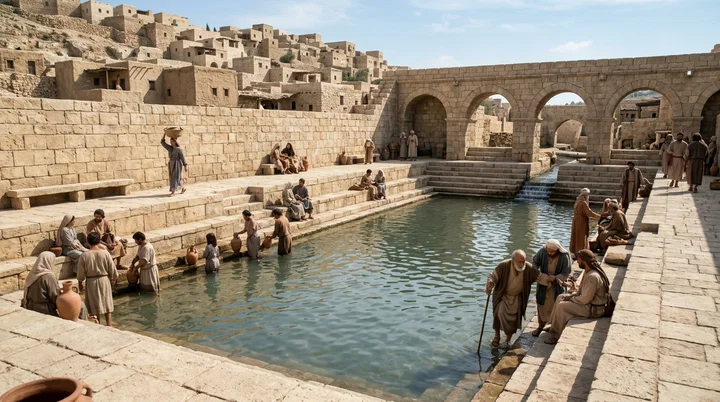
Cross-references
- John 9:6-7
When he had thus spoken, he spat on the ground, and made clay of the spittle, and he anointed the eyes of the blind man with the clay,
Jesus applies clay and sends the blind man to wash, after which he receives sight.
- John 9:25
He answered and said, Whether he be a sinner or no, I know not: one thing I know, that, whereas I was blind, now I see.
The healed man testifies that he was blind and now sees.
- John 9:38
And he said, Lord, I believe. And he worshipped him.
The healed man’s story leads him to believe in and worship Jesus.
- John 9:15
Then again the Pharisees also asked him how he had received his sight. He said unto them, He put clay upon mine eyes, and I washed, and do see.
He repeats how Jesus healed him when questioned by the Pharisees.
- John 9:5
As long as I am in the world, I am the light of the world.
Jesus’ declaration as the light of the world introduces the healing.
- John 9:34-35
They answered and said unto him, Thou wast altogether born in sins, and dost thou teach us? And they cast him out.
The healed man is cast out, and Jesus finds him.
- John 9:17
They say unto the blind man again, What sayest thou of him, that he hath opened thine eyes? He said, He is a prophet.
calls Jesus a prophet
- John 9:32-33
Since the world began was it not heard that any man opened the eyes of one that was born blind.
The healed man says no one had ever opened the eyes of someone born blind.
- John 7:23
If a man on the sabbath day receive circumcision, that the law of Moses should not be broken; are ye angry at me, because I have made a man every whit whole on the sabbath day?
Jesus defends making a man whole on the Sabbath as consistent with the law.
- John 9:16
Therefore said some of the Pharisees, This man is not of God, because he keepeth not the sabbath day. Others said, How can a man that is a sinner do such miracles? And there was a division among them.
The Pharisees are divided over Sabbath observance and Jesus’ miracles.
- John 9:28-29
Then they reviled him, and said, Thou art his disciple; but we are Moses’ disciples.
Contrasts their boast of Moses with their sneers at Jesus.
- 2 Kings 5:10-14
And Elisha sent a messenger unto him, saying, Go and wash in Jordan seven times, and thy flesh shall come again to thee, and thou shalt be clean.
Naaman, like the blind man, is healed after following a prescribed washing instruction.
- Luke 13:12-13
And when Jesus saw her, he called her to him, and said unto her, Woman, thou art loosed from thine infirmity.
Both recount Jesus healing on the Sabbath, showing mercy is lawful.
- John 9:22-23
These words spake his parents, because they feared the Jews: for the Jews had agreed already, that if any man did confess that he was Christ, he should be put out of the synagogue.
The man’s parents feared synagogue expulsion for confessing Jesus as Christ.
Commentary
Each commentary is drawn from primary sources: the writings of Ellen G. White and Adventist pioneers and periodicals. Each commentary is separate. Its own words are not a quotation; follow the references to read the source passages.
Ellen G. White
4 sources
The verse is the plain testimony of the man born blind after his healing, that a man called Jesus made clay and put it on his eyes and sent him to wash in the pool of Siloam, and that he went and washed in obedience and received sight.Ms 97, 1901, par. 9–13DA 471.4–6 He identifies Jesus simply as the one who anointed his eyes and tells that he washed and could see.Ms 97, 1901, par. 9–13DA 471.4–6
The healing was a wonderful evidence of the truth of Christ's mission, and convincing evidence that His mission was divine.Ms 97, 1901, par. 9–13 The evidence was seen in the visible transformation, which led the people to ask how his eyes had been opened.Ms 97, 1901, par. 9–13 His account then became evidence in the dispute over Jesus healing on the Sabbath.DA 471.4–6 The Pharisees treated the cure as proof against Jesus, while others asked how a sinner could perform such a miracle.DA 471.4–6
His simple witness about what Jesus had done stood against the prejudice and spiritual blindness of the Pharisees and Jewish leaders.Ms 97, 1901, par. 9–13 Those leaders were spiritually blind through envy, jealousy, and unbelief.Ms 97, 1901, par. 9–13 They made no effort to receive enlightenment and chose to remain in darkness, and they tried to smother his testimony because they hated Jesus and feared He would be honored above them.Ms 97, 1901, par. 9–13
The healed man is an example of one whom the compassionate Shepherd seeks to save.ST May 8, 1907 Though the self-righteous Pharisees despised him, Christ showed him compassion.ST May 8, 1907Lt 20, 1895, par. 1 He extended healing and compassion to him even though the man did not yet know who He was.Lt 20, 1895, par. 1 The man learned Jesus' identity only when Jesus revealed Himself as the Son of God, and then he worshiped Him.Lt 20, 1895, par. 1
Sources
Pioneers and periodicals
27 sources
The verse gives the plain report of the man born blind that a man called Jesus made clay and spread it on his eyes and told him to go wash in the pool of Siloam, which means Sent, and he went and washed and received sight.ST Jun 24, 1886ST Apr 10, 1893ST Nov 11, 1897 He had been a well-known blind beggar, and his account is simple and settled, summed up in that whereas he was blind now he sees, and he was not ashamed to own that his sight depended on Jesus.ST Oct 23, 1893ST Jun 24, 1886ST Mar 15, 1905ST Dec 22, 1881ST Sep 19, 1900 The healing was done purposely on the Sabbath, and it was a deliberate act of mercy fully worthy of the Sabbath and its Lord, involving no violation of the day.ST Jun 24, 1886ST Mar 15, 1905ST Nov 11, 1897RH Feb 11, 1862RH May 5, 1874 The Pharisees charged Jesus with breaking the Sabbath and called Him a sinner, but their charge rested on His refusal to follow their added human restrictions that forbade works of mercy.ST Oct 23, 1893ST Jul 8, 1897 He received sight by using the means Jesus provided, and the healing showed Christ's power both to restore sight and to forgive sins, leading the healed man to see Christ and worship Him.RH Apr 7, 1903ST Sep 28, 1904ST Feb 11, 1886ST Aug 20, 1902
Healing and Plain Testimony
The verse gives the healed man's own plain report that a man called Jesus made clay and anointed his eyes and told him to go wash in the pool of Siloam, and that he went and washed and received sight.ST Jun 24, 1886ST Apr 10, 1893ST Nov 11, 1897RH Apr 7, 1903ST Sep 28, 1904 Siloam means Sent.ST Jun 24, 1886ST Nov 11, 1897 The healing was by putting clay on the eyes and sending the man born blind to wash in Siloam, after which obedience brought sight.ST Apr 10, 1893RH Apr 7, 1903ST Sep 28, 1904ST Aug 20, 1902
He had been blind from birth, and his blindness was well attested.ST Mar 15, 1905ST Nov 11, 1897 He was known as a blind beggar, probably near the temple where the healing took place on the Sabbath.ST Jun 24, 1886 After his eyes were opened his face was changed and brightened, so that neighbors and friends who knew him doubted he was the same man until he ended their dispute by declaring that he was he.ST Oct 23, 1893
He had never seen Jesus but had heard His name.ST Dec 22, 1881 Because he could not see when it was done, he felt something put on his eyes which he afterward found to be clay, but he could not tell how the clay was made, so he simply says He made clay and spread it upon his eyes.ST Dec 22, 1881 The clay was moistened with spittle.RH May 5, 1874 Siloam was a pool in Jerusalem that held water.ST Mar 16, 1876
His account is simple and artless in the highest degree, plain and settled and truthful.ST Oct 23, 1893ST Dec 22, 1881 Its meaning is summed up in his testimony that whereas he was blind, now he sees.ST Sep 19, 1900 Its straightforwardness amid many circumstances proves its truth, for imposture and falsehood betray themselves when a multitude of incidents must come into review, while simple truth is never embarrassed.ST Dec 22, 1881 His simple, truthful account of what Jesus did was convincing, and he was not ashamed to acknowledge that his sight depended on Jesus.
From his own experience he knew the healing was divine, for Jesus' touch brought him sight.ST Jun 14, 1905 The light he received became a source of joy and a new sense of companionship, and he would not deny what Jesus had done or condemn His words when others challenged him.ST Jun 14, 1905 As a poor, unlearned, humbly born beggar who was blind yesterday beside the way and now sees, he stood without fear, shame, or regard for praise or blame before the scowling Sanhedrim and the learned doctors of renown.RH Mar 30, 1876 He tells the story over and over as his heart's only lore, holding his new light as sweet and clear, unmoved like a rooted rock by threats and sneers, holding to one thing: once blind, now seeing.RH Mar 30, 1876 His testimony about what Jesus had done stood against the Pharisees' prejudice and spiritual blindness as convincing evidence that Jesus' mission was divine.
Brought before the Pharisees he gave the same account, that Jesus had put clay on his eyes and he had washed and now saw, while admitting he did not know where Jesus was.ST Oct 23, 1893 The miracle was so plain it could not be hidden or denied and left them astonished.ST Oct 23, 1893 Yet they gave no credit to the clay or to the waters of Siloam and grew more hateful because the work proved Jesus was the Son of God.ST Oct 23, 1893 He was cast out of the synagogue because he believed in Christ.ST Oct 18, 1905 When men cast him out and persecuted him, Jesus as a humble teacher sought him out as a teacher would seek a student, and when He found him He taught him privately the highest truths about His Messiahship.RH Nov 13, 1860
The Gospel of John, which contains the verse, is a very late New Testament writing.
Sabbath Mercy Defended
The healing was done purposely on the Sabbath day, probably near the temple where the man had been known as a blind beggar, and Jesus was persecuted for it.ST Jun 24, 1886ST Mar 15, 1905ST Nov 11, 1897ST May 19, 1909 That Sabbath work provoked strife and division among the Jews, drew people to believe in Him, and brought conflict with the authorities that led to the man's eventual expulsion from the synagogue.ST Mar 15, 1905ST Nov 11, 1897RH Oct 8, 1908 The Pharisees regarded Him as a Sabbath breaker because He healed according to God's purpose rather than their rules, and His Sabbath work became a basis for opposition to Him.
Healing on the Sabbath by making clay, anointing the eyes, and sending the man to wash in the pool of Siloam so that he received sight is a merciful act fully worthy of the Sabbath and of its Lord, and involves no violation of the Sabbath.RH Feb 11, 1862RH May 5, 1874 It was a deliberate act of mercy that relieved suffering and honored God, not a careless or irreverent violation, the clay being moistened with spittle.RH Feb 11, 1862RH May 5, 1874 Only enemies of Christ then and opponents of the Sabbath now see any violation in it.RH Feb 11, 1862
The healing teaches that works of mercy and necessity take precedence over narrow human traditions about Sabbath-keeping, uniting temple worship with helpful ministry. It corrects false ideas about what Sabbath-keeping permits by the example of Jesus choosing the Sabbath for a merciful work.ST Sep 15, 1909 His healing did not lessen the seventh day's sanctity or change the law.
Because the healing was done on the Sabbath, some Pharisees charged Jesus was not of God for not keeping the Sabbath and called Him a sinner, while others asked how a sinner could do such miracles, so there was division among them.ST Oct 23, 1893ST Jul 8, 1897 Their charge rested on His refusal to follow their human rules, for they had burdened the Sabbath with added human restrictions and treated the healing as unlawful labor and would not allow acts of mercy.ST Jul 8, 1897ST Mar 4, 1889 He healed according to God's purpose to reveal God's purpose for the Sabbath rather than conforming to their traditions.ST Jul 8, 1897
A wise purpose underlay choosing the Sabbath, for everything He did was important in itself and in its teaching.ST Aug 20, 1896 The Sabbath had become a curse through the added requirements of the Jews, and He meant to rid it of those encumbrances and leave it standing on its own holy dignity.ST Aug 20, 1896 By healing on the Sabbath He raised the question of what is lawful to do on the Sabbath day, to denounce narrow prejudice and restrictions and declare bigotry and traditions void.ST Aug 20, 1896 God's work never ceases and is even greater on the Sabbath than on ordinary days, for on that day His people leave usual employments and spend time in prayerful meditation and worship, asking more favors and offering importunate prayers for special favors, and God does not wait for the Sabbath to pass before granting those requests but gives with judicious wisdom whatever is best.ST Aug 20, 1896 Heaven's work never ceases for a moment and men should never rest from doing good, and what the Son of man who is Lord also of the Sabbath did on that day was in itself Sabbath-keeping.ST Aug 20, 1896
Faith Worship and Application
The blind man gained his sight only after he used the means appointed for him, for clay was placed upon his eyes and he was told to wash in Siloam, and when he went and washed he received sight.ST Feb 11, 1886 Had he refused those appointed means he would have remained unhealed, so obedience to the direction given was joined to the healing itself.ST Feb 11, 1886
The same act displays power both to restore sight to the blind and to forgive sins, and it ends with the healed man seeing Christ and worshiping Him.RH Apr 7, 1903ST Sep 28, 1904ST Aug 20, 1902 To lean upon any other support instead of Him is to lean upon a broken reed.ST Aug 20, 1902 A blind woman afterward applied that same act of trust in Jesus, and she too received her sight together with assurance of forgiveness and faith in Him, and her restored sight strengthened her faith.ST Apr 10, 1893ST Sep 28, 1904
In this healing the works of God were made manifest through the man born blind.ST Mar 8, 1899 His affliction itself did not atone for sin, but suffering may lead a person to Christ, who is able to heal both body and soul.ST Mar 8, 1899 The healing was at once physical restoration and spiritual opening of the eyes, showing that men must come to Christ that they may have life and have their eyes opened to the truths of God.ST May 16, 1911 They must be willing to forsake all that would keep them from the kingdom and must learn their duty from Christ as the Way, the Truth, and the Life, with His Word as the Guide-Book that will not lead in the wrong way, which is to fear God and keep His commandments as the whole duty of man.ST May 16, 1911
The healed man stands as one whom the compassionate Shepherd seeks to save, even though the self-righteous Pharisees despised him.ST May 8, 1907RH Nov 13, 1860 The work shows lowliness and attention to humble people and humble things, for only divine power could open eyes blind from birth in so poor a man.RH Nov 13, 1860 When men cast him out and persecuted him, Jesus returned and sought him out as a humble teacher seeks a student, and when He found him He taught him privately the highest truths about His Messiahship.RH Nov 13, 1860
Sources