Joshua 22:14
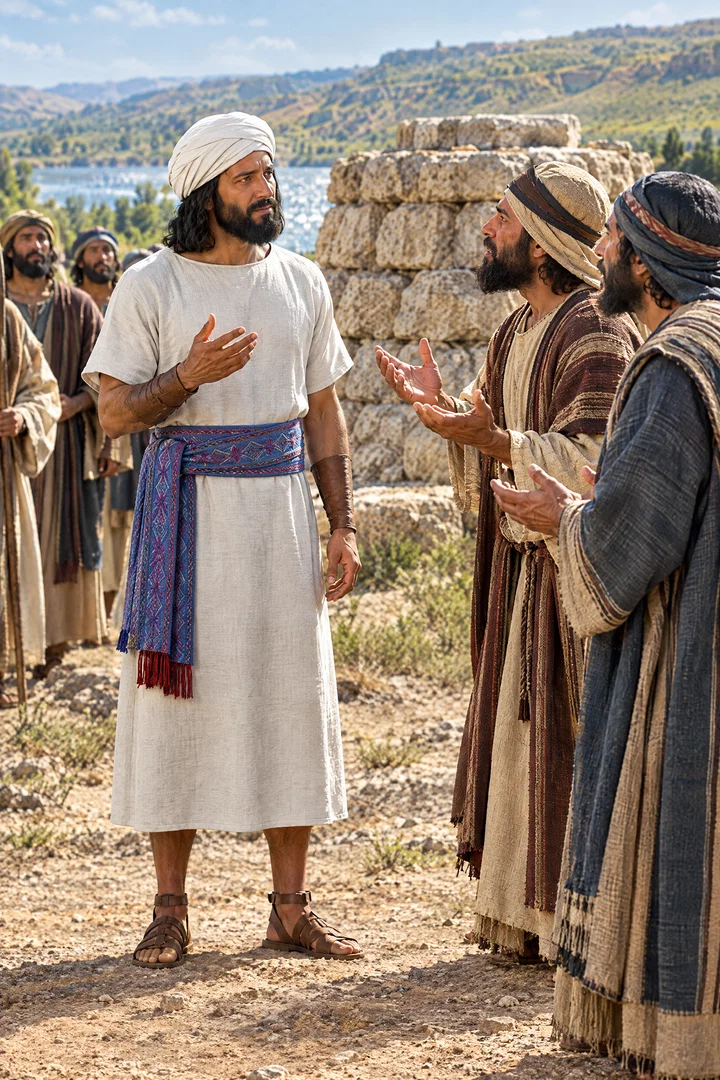
And with him ten princes, of each chief house a prince throughout all the tribes of Israel; and each one was an head of the house of their fathers among the thousands of Israel.
Translations
American King James Version, King James Version
And with him ten princes, of each chief house a prince throughout all the tribes of Israel; and each one was an head of the house of their fathers among the thousands of Israel.
and with him ten princes, of each chief house a prince throughout all the tribes of Israel; and each one was a head of the house of their fathers among the thousands of Israel.
And with him ten princes, of each chief house a prince throughout all the tribes of Israel; and each one was a head of the house of their fathers among the thousands of Israel.
Revised Version, American Standard Version
and with him ten princes, one prince of a fathers’ house for each of the tribes of Israel; and they were every one of them head of their fathers’ houses among the thousands of Israel.
and ten princes with him, one prince, one prince, for a house of a father, for all the tribes of Israel, and each of them a head of a house of their fathers, for the thousands of Israel.
and with him ten princes, of each father's house a prince, out of all the tribes of Israel; and each of them was head of a father's house, of the thousands of Israel.
and ten princes with him, one prince of an ancestral house for each of the tribes of Israel,—they being, severally heads of their ancestral houses, among the thousands of Israel.
Berean Standard Bible, Majority Standard Bible
With him they sent ten chiefs— one family leader from each tribe of Israel, each the head of a family among the clans of Israel.
With him were ten princes, one prince of a fathers’ house for each of the tribes of Israel; and they were each head of their fathers’ houses among the thousands of Israel.
And with him they sent ten chiefs, one for every tribe of the children of Israel, every one of them the head of his house among the families of Israel.
And with him ten princes, of euery chiefe house a prince, according to all the tribes of Israel: for euery one was chiefe of their fathers housholde among the thousands of Israel.
Douay-Rheims (Challoner revision)
And ten princes with him, one of every tribe.
Pictures
Cross-references
- Joshua 22:27-28
But that it may be a witness between us, and you, and our generations after us, that we might do the service of the LORD before him with our burnt offerings, and with our sacrifices, and with our peace offerings; that your children may not say to our children in time to come, Ye have no part in the LORD.
The altar was built as a witness, not for worship.
- Leviticus 17:8-9
And thou shalt say unto them, Whatsoever man there be of the house of Israel, or of the strangers which sojourn among you, that offereth a burnt offering or sacrifice,
The law requires sacrifices to be offered at the tabernacle, not other altars.
Commentary
Each commentary is drawn from primary sources: the writings of Ellen G. White and Adventist pioneers and periodicals. Each commentary is separate. Its own words are not a quotation; follow the references to read the source passages.
Ellen G. White
4 sources
The tribes of Gad and Reuben with half Manasseh had received their inheritance before crossing the Jordan in the grazing lands of Gilead and Bashan, pledging armed men to fight with their brethren, and they faithfully sent forty thousand prepared for war over before the Lord unto battle to the plains of Jericho.PP 517.4–518.1 They fought for years beside the ten tribes in Canaan and shared the spoils, then were dismissed to the land of their possession with much riches, very much cattle, silver, gold, brass, iron and very much raiment to share with those who had remained with families and flocks.PP 517.4–518.1 There they were to dwell at a distance from the sanctuary where there was anxious fear their isolated life would tempt them to heathen customs.PP 517.4–518.1
When the eastern tribes erected the large witness altar near the Jordan, Phinehas the high priest was sent with ten princes, one from each tribe, each one a head of a chief house of his fathers among the thousands of Israel, as representatives to require an explanation of the motive for erecting it.ST May 12, 1881ST May 12, 1881 Sending this delegation instead of at once making war showed a cautious course, restraining the excitement and indignation over what was supposed to be a rival altar to take the place of the tabernacle at Shiloh.ST May 12, 1881 The delegation came convinced the guilt of their brethren was already proved and met them with sharp rebuke and suspicion, going too far by not first asking courteously for the facts.ST May 12, 1881ST May 12, 1881
They accused their brethren of rebelling against the Lord, reminded them how the wrath of God visited Israel for joining to Baal-Peor, and feared that surrounded by worshipers of that idol they would again partake of that iniquity.ST May 12, 1881 They declared God's positive command that no sacrifice be offered except at the door of the tabernacle.ST May 12, 1881 They offered in behalf of all Israel that if the eastern tribes were unwilling to abide east of Jordan without an altar for sacrifice and worship they would be welcomed to a share in the possessions and privileges on the west side.ST May 12, 1881
Their zeal to guard Israel against sin was prompted by the earlier failure to deal vigilantly with Achan's sin, and they warned from the case of Achan, whose transgression with his whole family brought suffering on all the congregation, to show what dire result would follow if so large a company disobeyed and departed from God.ST May 12, 1881ST May 12, 1881 The serious inquiry by Israel's representatives shows the seriousness of their concern about preserving Israel's unity in worship and guarding Israel against sin.ST May 12, 1881ST May 12, 1881 The peaceful resolution teaches that suspected wrongdoing should be addressed with restraint and that those who are misjudged should respond with meekness and forbearance rather than anger or retaliation.ST May 12, 1881
Sources
Pioneers and periodicals
7 sources
The verse stands in the closing part of Joshua dealing with the conquering of the Canaanites and the division of the land, just before Joshua's solemn charge in the last two chapters to serve God and Him alone.ST Mar 17, 1909
Rather than at once making war in excitement and indignation, the congregation took a cautious course and sent Phinehas the high priest with ten princes, one from each tribe, as representatives to require an explanation.ST May 12, 1881 Each one was a head of his father's chief house among the thousands of Israel, one leader of his ancestral house from each of the other tribes to speak with the two and one-half tribes.ST May 12, 1881 The inquiry concerned the large altar built by the two and one-half tribes, the tribes of Reuben and Gad, near the Jordan east of the river.ST May 12, 1881ST May 25, 1904 It was patterned after the Lord's altar but intended as a witness, not for sacrifice and worship, yet it was suspected of being a rival altar to take the place of the tabernacle at Shiloh and a signal of apostasy and rebellion against the Lord.ST May 12, 1881ST May 18, 1904ST May 25, 1904
The delegation came convinced the guilt of their brethren was already proved and met them with sharp rebuke, accusing them of rebelling against the Lord.ST May 12, 1881 They reminded them how God's wrath visited Israel for joining to Baal-Peor and feared that surrounded by worshipers of that idol they would again partake of that iniquity.ST May 12, 1881 They declared God's positive command that no sacrifice be offered except at the door of the tabernacle, and offered in behalf of all Israel that if they were unwilling to abide east of Jordan without an altar for sacrifice and worship they would be welcomed to a share in the possessions and privileges on the west side.ST May 12, 1881 They warned them from the case of Achan, whose transgression with his whole family brought suffering on all the congregation, what dire result would follow if so large a company disobeyed.ST May 12, 1881
Their zeal to guard Israel against sin was prompted by the earlier failure to deal vigilantly with Achan's sin, but they went too far by approaching their fellow Israelites with suspicion instead of first asking courteously for the facts.ST May 12, 1881 The other Israelites accepted the eastern tribes' explanation, and the peaceful resolution shows the seriousness of their concern about preserving Israel's unity in worship.ST May 12, 1881ST May 18, 1904 Suspected wrongdoing should be addressed with restraint, and those who are misjudged should respond with meekness and forbearance rather than anger or retaliation.ST May 12, 1881 Making a likeness is not itself a violation of the Second Commandment; its purpose and use determine whether it becomes idolatry, as illustrated by an altar patterned after the Lord's altar but intended as a witness and not an object of worship.ST May 18, 1904
The chapter is used as a chronological marker for the period from Joshua's death to Saul's coronation, which Usher's chronology places at about 331 years, though Acts 13:20 gives about 450 years, making a difference of 119 years.RH Nov 26, 1872
Sources