Joshua 24:27
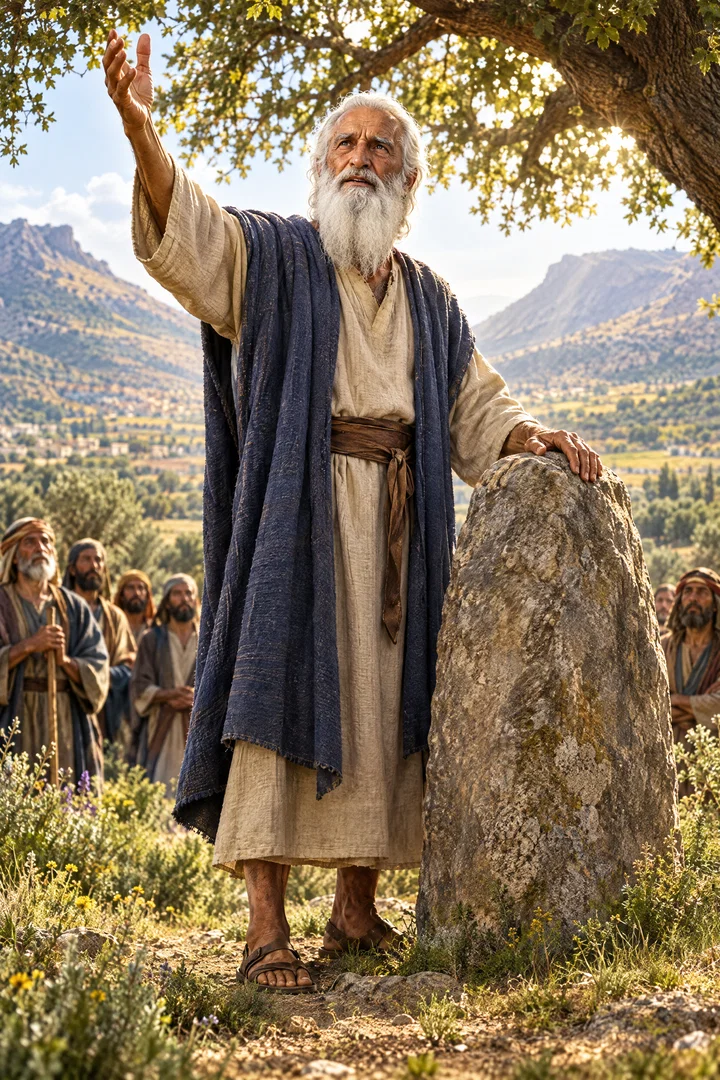
And Joshua said unto all the people, Behold, this stone shall be a witness unto us; for it hath heard all the words of the LORD which he spake unto us: it shall be therefore a witness unto you, lest ye deny your God.
Translations
And Joshua said to all the people, Behold, this stone shall be a witness to us; for it has heard all the words of the LORD which he spoke to us: it shall be therefore a witness to you, lest you deny your God.
And Joshua said unto all the people, Behold, this stone shall be a witness unto us; for it hath heard all the words of the LORD which he spake unto us: it shall be therefore a witness unto you, lest ye deny your God.
And Joshua said unto all the people, Behold, this stone shall be a witness unto us; for it hath heard all the words of the Lord which he spake unto us: it shall be therefore a witness unto you, lest ye deny your God.
And Joshua said to all the people, Behold, this stone shall be a witness to us; for it hath heard all the words of the LORD which he spoke to us, it shall be therefore a witness to you, lest ye deny your God.
And Joshua said unto all the people, Behold, this stone shall be a witness against us; for it hath heard all the words of the LORD which he spake unto us: it shall be therefore a witness against you, lest ye deny your God.
And Joshua said unto all the people, Behold, this stone shall be a witness against us; for it hath heard all the words of Jehovah which he spake unto us: it shall be therefore a witness against you, lest ye deny your God.
And Joshua saith unto all the people, 'Lo, this stone is against us for a witness, for it hath heard all the sayings of Jehovah which He hath spoken with us, and it hath been against you for a witness, lest ye lie against your God.'
And Joshua said unto all the people, Behold, this stone shall be a witness unto us, for it hath heard all the words of Jehovah which he spoke unto us; and it shall be a witness against you, lest ye deny your God.
And Joshua said unto all the people—Lo! this stone, shall serve against us as a witness, for, it, hath heard all the sayings of Yahweh, which he hath spoken with us,—so shall it serve against you as a witness, lest ye should act deceptively against your God.
Berean Standard Bible, Majority Standard Bible
And Joshua said to all the people, “ You see this stone. It will be a witness against us, for it has heard all the words the LORD has spoken to us, and it will be a witness against you if you ever deny your God.”
Joshua said to all the people, “ Behold, this stone shall be a witness against us, for it has heard all the LORD’s words which he spoke to us. It shall be therefore a witness against you, lest you deny your God.”
And Joshua said to all the people, See now, this stone is to be a witness against us; for all the words of the Lord have been said to us in its hearing: so it will be a witness against you if you are false to the Lord your God.
And Ioshua saide vnto all the people, Beholde, this stone shall be a witnesse vnto vs: for it hath heard all the wordes of the Lord which he spake with vs: it shall be therefore a witnesse against you, lest yee denie your God.
Douay-Rheims (Challoner revision)
And he said to all the people: Behold this stone shall be a testimony unto you, that it hath heard all the words of the Lord, which he hath spoken to you: lest perhaps hereafter you will deny it, and lie to the Lord your God.
Pictures
Cross-references
- Joshua 24:20-23
If ye forsake the LORD, and serve strange gods, then he will turn and do you hurt, and consume you, after that he hath done you good.
The people pledge to serve the LORD, and the stone seals the covenant promise.
- Deuteronomy 27:4
Therefore it shall be when ye be gone over Jordan, that ye shall set up these stones, which I command you this day, in mount Ebal, and thou shalt plaister them with plaister.
Stones were set up in the land as a witness and memorial.
- 1 Samuel 7:12
Then Samuel took a stone, and set it between Mizpeh and Shen, and called the name of it Eben-ezer, saying, Hitherto hath the LORD helped us.
Samuel’s stone memorialized the Lord’s help.
- Joshua 24:15
And if it seem evil unto you to serve the LORD, choose you this day whom ye will serve; whether the gods which your fathers served that were on the other side of the flood, or the gods of the Amorites, in whose land ye dwell: but as for me and my house, we will serve the LORD.
Joshua urges the people to choose whom they will serve and declares his own choice.
- Exodus 19:4-8
Ye have seen what I did unto the Egyptians, and how I bare you on eagles’ wings, and brought you unto myself.
gives original covenant terms renewed at Shechem
- Exodus 24:8
And Moses took the blood, and sprinkled it on the people, and said, Behold the blood of the covenant, which the LORD hath made with you concerning all these words.
records blood sealing the covenant words
- Luke 19:40
And he answered and said unto them, I tell you that, if these should hold their peace, the stones would immediately cry out.
The note connects the stone’s witness with the saying that stones would cry out.
- Joshua 24:14
Now therefore fear the LORD, and serve him in sincerity and in truth: and put away the gods which your fathers served on the other side of the flood, and in Egypt; and serve ye the LORD.
Joshua’s final testimony calls Israel to serve the LORD faithfully.
- Joshua 24:31
And Israel served the LORD all the days of Joshua, and all the days of the elders that overlived Joshua, and which had known all the works of the LORD, that he had done for Israel.
It notes that the generation kept the covenant made at this gathering.
Commentary
Each commentary is drawn from primary sources: the writings of Ellen G. White and Adventist pioneers and periodicals. Each commentary is separate. Its own words are not a quotation; follow the references to read the source passages.
Ellen G. White
7 sources
The verse belongs to Joshua's closing address to all Israel, called together after the Lord had given them rest from their enemies, when his faithful life of steadfast integrity and service as the visible leader was ending.Ms 35, 1899, par. 5Lt 112, 1895, par. 11–12PP 521.1 In that gathering near the end of his life he reviewed Israel's history to lead the people to gratitude for God's care and humility over their failures to follow His will.4MR 218.3–220.2 He led them in revival and renewal of their covenant with their Maker, and wrote what he had said in the book of the law.13MR 336.3Ms 35, 1899, par. 5Lt 112, 1895, par. 7
He then set up a great stone under an oak by the sanctuary of the Lord at Shechem as a memorial of God's dealings with His people.13MR 336.3PP 524.2–3Ms 35, 1899, par. 5 The stone was to stand as a witness that had heard all the words the Lord had spoken, against their denying their God.13MR 336.3Ms 35, 1899, par. 5 It memorialized the people's covenant pledge and solemn choice of Jehovah to serve Him and obey His voice.13MR 336.3PP 524.2–3Lt 112, 1895, par. 11–12 That choice included putting away the strange gods among them and inclining their hearts to the Lord God of Israel, so that having heard God's words they became witnesses against themselves and could not deny their God.PP 524.2–3Lt 112, 1895, par. 11–12
The surrounding appeal warned against idolatry and corrupting ties with idolaters, including intermarriage, urging them to shun even the appearance of evil.4MR 218.3–220.2 Such ties would corrupt them, departure from God would bring desolation, and God would fulfill both His promises and His warnings.4MR 218.3–220.2 Joshua's loyal, faithful, ringing testimony closed his life to be a light to Israel.Lt 112, 1895, par. 11–12 But after he and the old faithful sentinels who had crossed Jordan died one by one, a new generation unaccustomed to the bread from heaven forgot its experience, departed from God, and corrupted worship with erroneous principles, haughty pride, and love of display.Lt 112, 1895, par. 11–12
The chapter records a revival to be read carefully and with an understanding heart by all who name the name of Christ while searching their own hearts whether they are in the faith.Lt 112, 1895, par. 7 Its warning against departure from God is to be applied personally.4MR 218.3–220.2
Sources
Pioneers and periodicals
15 sources
At his final assembly of Israel at Shechem Joshua renewed their commitment to serve God alone and set up a great stone as a monument under an oak by the Lord's sanctuary.RH Mar 20, 1900ST Sep 5, 1895ST Mar 17, 1909ST Mar 15, 1910ST Sep 8, 1898 This was a renewal of the covenant made at Mount Sinai after Israel had entered the promised land, in which the people repeatedly promised to keep God's law and God promised to make them His peculiar treasure if they obeyed His voice.ST Nov 16, 1888 The stone was set to have heard all the words of the Lord and the people's pledge to serve Him, standing as a lasting, silent witness and reminder against denying God and testifying to later generations whether they remained faithful or turned to idolatry.ST Mar 28, 1911RH Apr 7, 1868ST Sep 5, 1895 Its hearing and witnessing is personification, for the inanimate stone did not literally hear, a figure common in Scripture where lifeless things are described as speaking and acting like rational beings.ST Jun 30, 1881ST Mar 15, 1877ST Mar 27, 1879RH May 12, 1874 By fulfilling its purpose even creation rebukes human insensibility and ingratitude, and in the same way speech ascribed to the dead in hades is personification and does not mean they are conscious.RH Apr 7, 1868RH Mar 28, 1865RH May 12, 1874
Covenant Setting and Witness
The verse stands at the conclusion of the book, in Joshua's final gathering of Israel at Shechem where he delivered his parting admonitions, renewed their commitment to God, and solemnly charged them to serve God alone.ST Mar 17, 1909ST Mar 15, 1910ST Sep 8, 1898 That gathering was a renewal of the Sinai covenant, made in B.C. 1426, sixty-five years after the making of the covenant and the giving of the law at Mount Sinai and after Israel had entered into possession of the promised land.ST Nov 16, 1888 The covenant so renewed was the agreement between the Lord and the people concerning the law of God, in which the people repeatedly promised to keep the law of God and God promised that if they obeyed His voice and kept His covenant He would make them a peculiar treasure unto Himself above all people.ST Nov 16, 1888
The witness appointed there was a great stone erected by Joshua as a monument under an oak at Shechem by the sanctuary of the Lord.RH Mar 20, 1900ST Sep 5, 1895RH Feb 24, 1910ST Oct 1, 1902 It had heard all the words of the Lord spoken to the people, including their covenant words and promise to serve God.ST Mar 28, 1911RH Apr 7, 1868 It was therefore set to stand as a witness to those words and as a reminder warning the people not to deny their God.ST Mar 28, 1911RH Mar 20, 1900ST Sep 5, 1895RH Feb 24, 1910
It was to be a silent and constant witness, abiding after the assembly was ended.ST Sep 5, 1895 It would remind later generations of Israel's pledge to serve God. It would stand as a lasting testimony whether the people remained faithful or turned to apostasy and idolatry, and would stand against them if they returned to idolatry and denied Him.
Figurative Language and Lessons
The stone's hearing and witnessing is personification, in which an inanimate stone is set forth as hearing and bearing witness and acting like a person.ST Jun 30, 1881ST Mar 15, 1877ST Mar 27, 1879 It did not literally hear, but is personified as hearing and witnessing and is given the hearing and language of a rational being.ST Jun 30, 1881ST Mar 15, 1877RH Mar 28, 1865RH May 12, 1874 This kind of personification is common in Scripture, where inanimate things are described as speaking or acting.ST Mar 27, 1879RH May 12, 1874 The blood of Abel, the depth and the sea, destruction and death, trees, thistles, hired wages, stones, and beams are made to speak and are given the hearing and language of a rational being.RH May 12, 1874
Its having heard is a forceful charge of human insensibility to the Maker.RH Apr 7, 1868 Even inanimate creation, by fulfilling its purpose, seems to testify against human ingratitude and rebellion.RH Apr 7, 1868 Because lifeless things are often spoken of as living, speaking, and acting with reference to the facts of their cases as though alive, speech ascribed to the dead in hades does not mean they are conscious.RH Mar 28, 1865RH May 12, 1874 It shows the dead are personified and made to speak and act as though alive.RH Mar 28, 1865RH May 12, 1874
Sources