Joshua 24:26
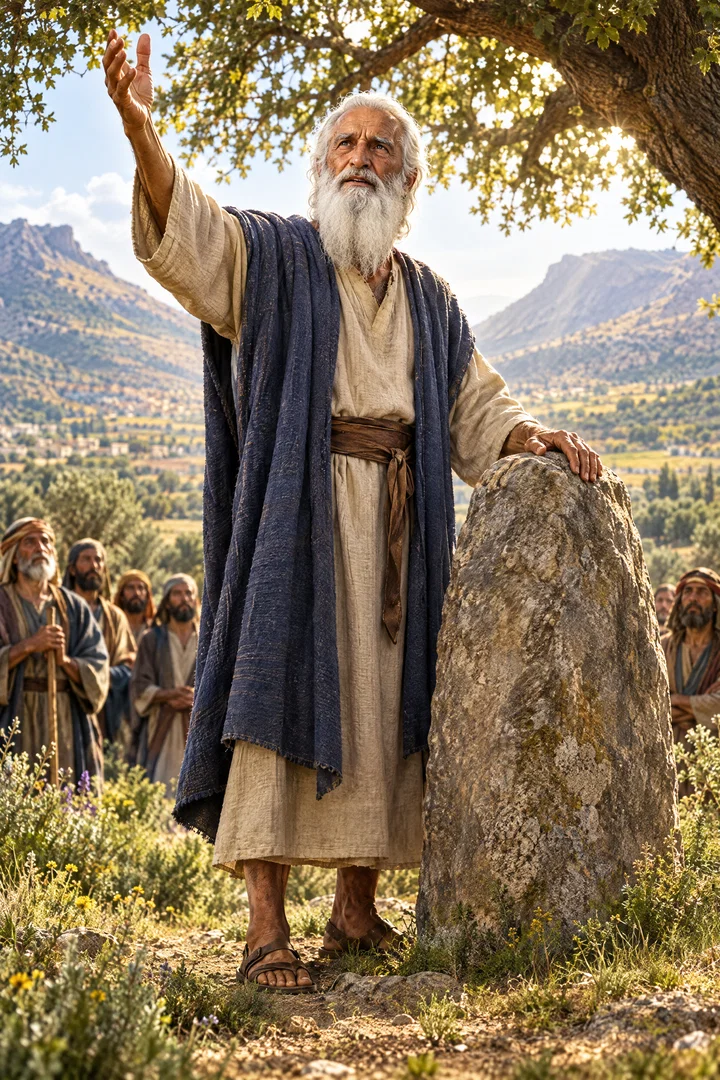
And Joshua wrote these words in the book of the law of God, and took a great stone, and set it up there under an oak, that was by the sanctuary of the LORD.
Translations
American King James Version, King James Version
And Joshua wrote these words in the book of the law of God, and took a great stone, and set it up there under an oak, that was by the sanctuary of the LORD.
And Joshua wrote these words in the book of the law of God, and took a great stone, and set it up there under an oak, that was by the sanctuary of the Lord.
And Joshua wrote these words in the book of the law of God, and took a great stone, and set it up there under an oak that was by the sanctuary of the LORD.
And Joshua wrote these words in the book of the law of God; and he took a great stone, and set it up there under the oak that was by the sanctuary of the LORD.
And Joshua wrote these words in the book of the law of God; and he took a great stone, and set it up there under the oak that was by the sanctuary of Jehovah.
And Joshua writeth these words in the Book of the Law of God, and taketh a great stone, and raiseth it up there under the oak which [is] in the sanctuary of Jehovah.
And Joshua wrote these words in the book of the law of God, and took a great stone, and set it up there under the oak that was by the sanctuary of Jehovah.
And Joshua wrote these words in the scroll of the law of God,—and took a great stone, and set it up there, under the oak that was by the sanctuary of Yahweh.
Berean Standard Bible, Majority Standard Bible
Joshua recorded these things in the Book of the Law of God. Then he took a large stone and set it up there under the oak that was near the sanctuary of the LORD.
Joshua wrote these words in the book of the law of God; and he took a great stone, and set it up there under the oak that was by the sanctuary of the LORD.
And Joshua put these words on record, writing them in the book of the law of God; and he took a great stone, and put it up there under the oak-tree which was in the holy place of the Lord.
And Ioshua wrote these woordes in the booke of the Lawe of God, and tooke a great stone, and pitched it there vnder an oke that was in the Sanctuarie of the Lord.
Douay-Rheims (Challoner revision)
And he wrote all these things in the volume of the law of the Lord: and he took a great stone, and set it under the oak that was in the sanctuary of the Lord.
Pictures
Cross-references
- Joshua 18:1
And the whole congregation of the children of Israel assembled together at Shiloh, and set up the tabernacle of the congregation there. And the land was subdued before them.
Identifies the tabernacle set up at Shiloh as the sanctuary.
- Joshua 24:15
And if it seem evil unto you to serve the LORD, choose you this day whom ye will serve; whether the gods which your fathers served that were on the other side of the flood, or the gods of the Amorites, in whose land ye dwell: but as for me and my house, we will serve the LORD.
Joshua’s call to choose whom to serve is answered by a written covenant.
- Joshua 24:1
And Joshua gathered all the tribes of Israel to Shechem, and called for the elders of Israel, and for their heads, and for their judges, and for their officers; and they presented themselves before God.
Joshua gathered Israel at Shechem for the covenant gathering.
- Joshua 24:16-18
And the people answered and said, God forbid that we should forsake the LORD, to serve other gods;
The people recall God’s deliverance and pledge loyalty, a promise Joshua writes down.
- Exodus 19:4-8
Ye have seen what I did unto the Egyptians, and how I bare you on eagles’ wings, and brought you unto myself.
The people’s original covenant agreement is renewed by Joshua.
- Joshua 24:22
And Joshua said unto the people, Ye are witnesses against yourselves that ye have chosen you the LORD, to serve him. And they said, We are witnesses.
Israel affirmed its promise to serve the LORD.
- Deuteronomy 31:26
Take this book of the law, and put it in the side of the ark of the covenant of the LORD your God, that it may be there for a witness against thee.
The written account is placed beside the book of the law.
- Jeremiah 7:12
But go ye now unto my place which was in Shiloh, where I set my name at the first, and see what I did to it for the wickedness of my people Israel.
Both texts associate a sanctuary with Shiloh.
- 1 Samuel 7:12
Then Samuel took a stone, and set it between Mizpeh and Shen, and called the name of it Eben-ezer, saying, Hitherto hath the LORD helped us.
Samuel set up a stone to commemorate the Lord’s help.
- Exodus 24:8
And Moses took the blood, and sprinkled it on the people, and said, Behold the blood of the covenant, which the LORD hath made with you concerning all these words.
words ratifying Sinai covenant
- Deuteronomy 27:4-6
Therefore it shall be when ye be gone over Jordan, that ye shall set up these stones, which I command you this day, in mount Ebal, and thou shalt plaister them with plaister.
Stones were set up and used to build an altar to the Lord.
- Exodus 24:7
And he took the book of the covenant, and read in the audience of the people: and they said, All that the LORD hath said will we do, and be obedient.
people promised again after book was read
- Psalms 20:2
Send thee help from the sanctuary, and strengthen thee out of Zion;
both call the tabernacle building the Sanctuary
- Joshua 24:31
And Israel served the LORD all the days of Joshua, and all the days of the elders that overlived Joshua, and which had known all the works of the LORD, that he had done for Israel.
Israel’s generation remained faithful to the covenant.
- Joshua 19:51
These are the inheritances, which Eleazar the priest, and Joshua the son of Nun, and the heads of the fathers of the tribes of the children of Israel, divided for an inheritance by lot in Shiloh before the LORD, at the door of the tabernacle of the congregation. So they made an end of dividing the country.
Both texts identify the sanctuary at Shiloh.
- Judges 2:1-2
And an angel of the LORD came up from Gilgal to Bochim, and said, I made you to go up out of Egypt, and have brought you unto the land which I sware unto your fathers; and I said, I will never break my covenant with you.
Both texts recall Israel’s covenant with God and address their obedience.
- Joshua 23:1
And it came to pass a long time after that the LORD had given rest unto Israel from all their enemies round about, that Joshua waxed old and stricken in age.
Describes Israel’s rest and sets the scene for Joshua’s address.
- Psalms 28:2
Hear the voice of my supplications, when I cry unto thee, when I lift up my hands toward thy holy oracle.
both call the tabernacle building the Sanctuary
Commentary
Each commentary is drawn from primary sources: the writings of Ellen G. White and Adventist pioneers and periodicals. Each commentary is separate. Its own words are not a quotation; follow the references to read the source passages.
Ellen G. White
10 sources
The verse belongs to Joshua's final address to Israel, given after the wars of conquest had ended and Israel had enjoyed a long period of rest from its enemies.PP 521.1 At the close of his service as Israel's visible leader, before his death, he assembled the chosen Hebrew host with faithful testimony, after which the people would lose the guidance of the older, faithful generation.Ms 35, 1899, par. 513MR 336.3Lt 112, 1895, par. 11–121SP 351.3–352.1 Following the example of Moses, he recapitulated their wilderness travels and God's merciful dealings and providential care in order to foster gratitude and humility.1SP 351.3–352.14MR 218.3–220.2 He led Israel to renew their covenant to serve the Lord and obey His voice, pledging to serve Him and put away foreign gods, while warning them against idolatry and corrupting connections; turning from God brings desolation, and God is faithful both to His promises and to His threatenings, a lesson that applies to each person.Ms 35, 1899, par. 5Lt 112, 1895, par. 11–121SP 351.3–352.14MR 218.3–220.2
Joshua wrote down the covenant transaction and promise of what he had spoken in the book of the law of God containing the laws and statutes given to Moses, placing the account with the book beside the ark.PP 524.2–3Ms 35, 1899, par. 513MR 336.3SG4 64.3–65.11SP 351.3–352.1 He set up a great stone or pillar under an oak by the sanctuary of the Lord as a memorial of God's dealings with His people.PP 524.2–3Ms 35, 1899, par. 513MR 336.3 The stone was to stand as a witness that had heard all the words of the Lord and to witness against them lest they deny their God, so they could not deny their commitment to serve and obey.PP 524.2–3Ms 35, 1899, par. 513MR 336.3
The stone and oak stood in Palestine by the sanctuary of the Lord, not inside it, showing that the sanctuary is distinct from the surrounding land and proving that Palestine and the earth are not the sanctuary.4SP 498.2–3GC88 683.4–684.5
Sources
Pioneers and periodicals
18 sources
At his final assembly at Shechem Joshua renewed the covenant between the Lord and Israel, wrote its solemn words in the book of the law of God, and set up a great stone under an oak by the sanctuary of the Lord as a lasting witness to it.ST Mar 28, 1911RH Mar 20, 1900ST Sep 5, 1895ST Oct 1, 1902 The sanctuary there was the definite holy place made by Moses, the curtained tabernacle building pitched at Shiloh where God dwelt among His people, not the whole earth or land.RH Sep 4, 1856RH Jan 6, 1853RH Mar 1, 1870RH Mar 28, 1854 The stone stood as a monument to the people's repeated promise to obey His voice and keep His law, to remind them of their pledge and to testify against them to later generations if they denied Him and returned to idolatry.RH Mar 20, 1900ST Sep 5, 1895 Its hearing of all their words was not literal hearing but Scripture giving an inanimate thing the senses and speech of a living being, as it also makes the dead speak and act as though alive.ST Jun 30, 1881ST Mar 15, 1877ST Mar 27, 1879
Covenant Setting and Record
Joshua 24:26 falls within Joshua's final address to the people before his death, in which he recalled God's dealings with Israel, gave parting admonitions, and urged them to choose whom they will serve.ST Mar 28, 1911ST Sep 8, 1898 It belongs to his final assembly of Israel at Shechem to renew the covenant with God.ST Sep 8, 1898 That renewal belongs to B.C. 1426, sixty-five years after the making of the covenant and the giving of the law at Mount Sinai.ST Nov 16, 1888 Shechem had also been the central setting for the covenant blessings and curses after the conquest of Canaan.ST Sep 8, 1898
The covenant was an agreement between the Lord and the people relative to the law of God, in which the people repeatedly promised to keep the law and God promised that if they obeyed His voice and kept His covenant He would make them a peculiar treasure unto Himself above all people.ST Nov 16, 1888 The people first promised obedience before they had fully heard the law.ST Nov 16, 1888 They promised again after the Lord spoke His law to all the people, and promised again after Moses wrote all the words of the Lord and the promise of the people in a book and read it to the congregation.ST Nov 16, 1888 The covenant was then ratified when Moses sprinkled both the book and all the people with the blood of calves and of goats and said, Behold the blood of the covenant which the Lord hath made with you concerning all these words.ST Nov 16, 1888
Shechem was marked as a sacred place by the oak associated with Abraham and Jacob, which gave the city standing in Israel's eyes.RH Feb 24, 1910 It was a central place in Israel's history, also associated with Joseph's burial and with Joshua's home and burial.RH Feb 24, 1910ST Sep 8, 1898 The verse records that Joshua wrote and preserved the solemn covenant words in the book of the law of God, also called the book of the law of Moses.ST Sep 5, 1895ST Oct 1, 1902RH Dec 27, 1864 This shows that the books called the books of Moses were written by Moses down to the time of his death, including the account of his death, and were not written wholly by him.RH Dec 27, 1864
Sanctuary Identified
The sanctuary of the Lord by the oak where the stone was set up was a definite holy place, the curtained tabernacle building itself made by Moses, also called the house of God and the house of the Lord.RH Jan 6, 1853RH Mar 28, 1854RH Sep 2, 1852 That name Sanctuary belongs to that building, not to the whole earth nor to Palestine nor to the land of Canaan.RH Sep 4, 1856RH Mar 1, 1870ST Nov 1, 1877 The stone was set up near the sanctuary in the land, which shows the land itself was not the sanctuary, and the verse places the stone by the sanctuary of the Lord in a way that keeps the sanctuary distinct from Canaan.ST Nov 1, 1877 The place where the great stone was set up is thus identified as the location of the Lord's sanctuary, the tabernacle carried into the promised land, not the land itself.RH Mar 1, 1870
After Israel carried the tabernacle into the promised land it was pitched and set up at Shiloh at the time the land was divided, and therefore called the tabernacle of Shiloh.RH Sep 2, 1852 The stone Joshua set up stood by that sanctuary there, with the tabernacle also called the house of God set up at Shiloh after Israel entered the promised land.RH Jan 6, 1853RH Mar 1, 1870 That built tabernacle made by Moses is God's habitation where He dwells among His people.RH Mar 28, 1854
The verse is one of nineteen times between Israel's entrance into the land and the housing of that building in the temple where the Bible expressly calls it the Sanctuary.RH Sep 4, 1856 The name Sanctuary remained for the sacred place after Israel entered the land, before it was incorporated into the temple.RH Sep 4, 1856 The sanctuary was set up at Shechem at the covenant renewal where Israel assembled to renew its covenant with God, and it remained revered centuries later, even after Jerusalem became the nation's sacred capital.
Stone as Witness
Joshua took a great stone and set it up beneath an oak beside the sanctuary of the Lord as a monument and lasting witness to the renewal of the covenant and to the people's promise to obey God.RH Mar 20, 1900ST Sep 5, 1895ST Oct 1, 1902 The solemn covenant words were written and preserved in the book of the law of God, and the stone was raised to commemorate the pledge to serve and obey the Lord.ST Sep 5, 1895ST Oct 1, 1902 It was set to remind Israel of their commitment and to warn them not to deny Him, testifying to later generations and against them if they returned to idolatry.RH Mar 20, 1900 In this way it stood as a silent witness to whether the people remained faithful or turned to apostasy, confirming that Joshua's warnings and instructions were God's words.
The stone is represented as having heard all the words of Israel, yet it did not literally hear.ST Jun 30, 1881ST Mar 15, 1877ST Mar 27, 1879RH May 12, 1874 It is given the animation, sentiments, actions, senses, speech, and language of a rational being, being spoken of as a witness though it is an inanimate object.ST Mar 15, 1877RH May 12, 1874 This illustrates how Scripture can give inanimate things the speech or actions of living beings without implying that they are conscious.ST Jun 30, 1881ST Mar 27, 1879RH May 12, 1874 It is the same figure by which the dead are made to speak and act as though alive.RH May 12, 1874
Sources