Exodus 24:8
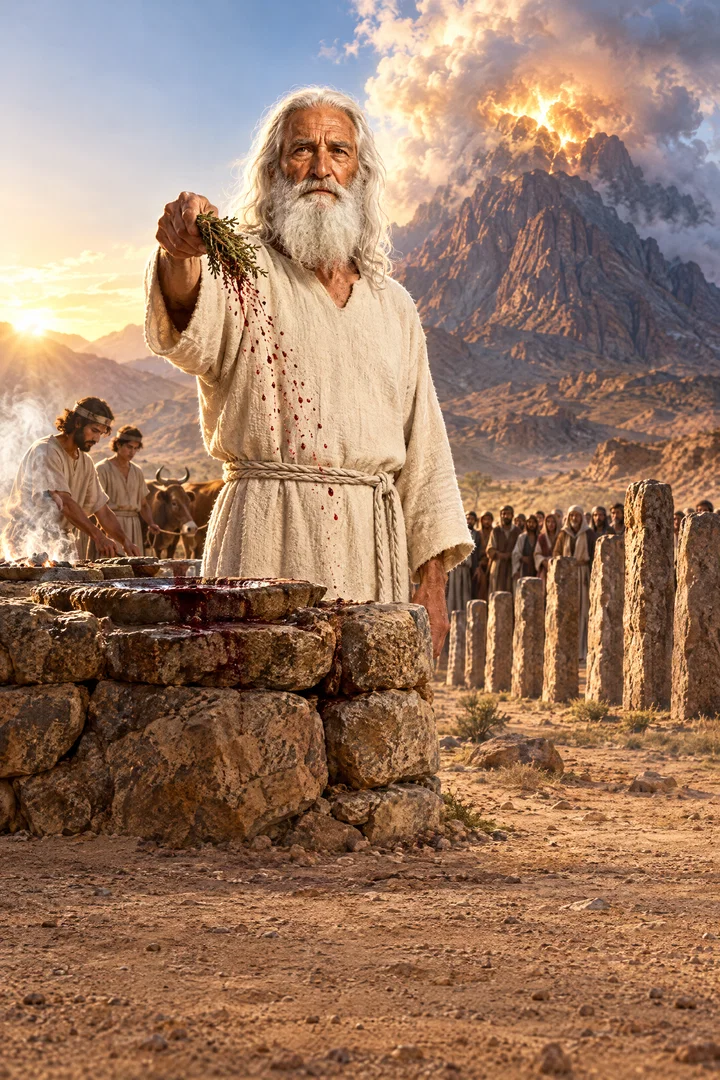
And Moses took the blood, and sprinkled it on the people, and said, Behold the blood of the covenant, which the LORD hath made with you concerning all these words.
Translations
And Moses took the blood, and sprinkled it on the people, and said, Behold the blood of the covenant, which the LORD has made with you concerning all these words.
King James Version, Revised Version
And Moses took the blood, and sprinkled it on the people, and said, Behold the blood of the covenant, which the LORD hath made with you concerning all these words.
And Moses took the blood, and sprinkled it on the people, and said, Behold the blood of the covenant, which the Lord hath made with you concerning all these words.
And Moses took the blood, and sprinkled it on the people, and said, Behold, the blood of the covenant, which the LORD hath made with you concerning all these words.
And Moses took the blood, and sprinkled it on the people, and said, Behold the blood of the covenant, which Jehovah hath made with you concerning all these words.
And Moses taketh the blood, and sprinkleth on the people, and saith, 'Lo, the blood of the covenant which Jehovah hath made with you, concerning all these things.'
And Moses took the blood, and sprinkled [ it] on the people, and said, Behold the blood of the covenant that Jehovah has made with you concerning all these words.
Then Moses took the blood, and dashed over the people, and said, Lo! the blood of the covenant which Yahweh hath solemnised with you, over all these words.
So Moses took the blood, sprinkled it on the people, and said, “ This is the blood of the covenant that the LORD has made with you in accordance with all these words.”
So Moses took the blood, splattered it on the people, and said, “ This is the blood of the covenant that the LORD has made with you in accordance with all these words.”
Moses took the blood, and sprinkled it on the people, and said, “ Look, this is the blood of the covenant, which the LORD has made with you concerning all these words.”
Then Moses took the blood and let it come on the people, and said, This blood is the sign of the agreement which the Lord has made with you in these words.
Then Moses tooke the blood, and sprinkled it on the people, and said, Behold, the blood of the couenant, which the Lord hath made with you concerning all these things.
Douay-Rheims (Challoner revision)
And he took the blood and sprinkled it upon the people, and he said: This is the blood of the covenant which the Lord hath made with you concerning all these words.
Pictures
Cross-references 20 of 80
- Exodus 19:5-8
Now therefore, if ye will obey my voice indeed, and keep my covenant, then ye shall be a peculiar treasure unto me above all people: for all the earth is mine:
covenant promised there and ratified here
- Hebrews 9:18-20
Whereupon neither the first testament was dedicated without blood.
Moses sprinkles the people with blood to dedicate the first covenant.
- Deuteronomy 4:13
And he declared unto you his covenant, which he commanded you to perform, even ten commandments; and he wrote them upon two tables of stone.
The Lord identifies the commandments written on stone as his covenant.
- Exodus 20:1-17
And God spake all these words, saying,
The commandments proclaimed at Sinai formed the law Israel pledged to obey in the covenant.
- Jeremiah 31:31-32
Behold, the days come, saith the LORD, that I will make a new covenant with the house of Israel, and with the house of Judah:
Contrasts the new covenant with the covenant made when God brought Israel from Egypt, which they broke.
- Hebrews 8:8-9
For finding fault with them, he saith, Behold, the days come, saith the Lord, when I will make a new covenant with the house of Israel and with the house of Judah:
Contrasts the Sinai covenant with the promised new covenant.
- Exodus 24:3
And Moses came and told the people all the words of the LORD, and all the judgments: and all the people answered with one voice, and said, All the words which the LORD hath said will we do.
The people pledge to obey God’s words before the blood seals the covenant.
- Galatians 4:24
Which things are an allegory: for these are the two covenants; the one from the mount Sinai, which gendereth to bondage, which is Agar.
Identifies the Sinai covenant as one of the two covenants that gendereth to bondage.
- Exodus 24:12
And the LORD said unto Moses, Come up to me into the mount, and be there: and I will give thee tables of stone, and a law, and commandments which I have written; that thou mayest teach them.
After the covenant is ratified, God calls Moses to receive the written law.
- Deuteronomy 5:2-3
The LORD our God made a covenant with us in Horeb.
Moses identifies the Horeb covenant as made with Israel, the people present.
- Exodus 21:1-23
Now these are the judgments which thou shalt set before them.
These judgments form part of the covenant terms given to the people.
- Matthew 26:28
For this is my blood of the new testament, which is shed for many for the remission of sins.
Jesus identifies his shed blood as covenant blood poured out for forgiveness.
- Hebrews 8:6
But now hath he obtained a more excellent ministry, by how much also he is the mediator of a better covenant, which was established upon better promises.
Christ mediates a better covenant than the one made through Moses.
- Exodus 34:28
And he was there with the LORD forty days and forty nights; he did neither eat bread, nor drink water. And he wrote upon the tables the words of the covenant, the ten commandments.
The Ten Commandments are identified as the words of the covenant.
- 2 Kings 23:3
And the king stood by a pillar, and made a covenant before the LORD, to walk after the LORD, and to keep his commandments and his testimonies and his statutes with all their heart and all their soul, to perform the words of this covenant that were written in this book. And all the people stood to the covenant.
The people covenant to keep the commandments and statutes written in the book.
- Hebrews 9:15
And for this cause he is the mediator of the new testament, that by means of death, for the redemption of the transgressions that were under the first testament, they which are called might receive the promise of eternal inheritance.
Christ mediates the new covenant through death, bringing redemption and the promise of eternal inheritance.
- Exodus 19:8
And all the people answered together, and said, All that the LORD hath spoken we will do. And Moses returned the words of the people unto the LORD.
The people agree to obey God.
- Hebrews 9:1
Then verily the first covenant had also ordinances of divine service, and a worldly sanctuary.
The first covenant is associated with ordinances of divine service and a worldly sanctuary.
- Hebrews 9:18
Whereupon neither the first testament was dedicated without blood.
Both texts describe the covenant’s dedication with blood.
- Hebrews 8:13
In that he saith, A new covenant, he hath made the first old. Now that which decayeth and waxeth old is ready to vanish away.
Explains that calling it new made the first covenant old.
Commentary
Each commentary is drawn from primary sources: the writings of Ellen G. White and Adventist pioneers and periodicals. Each commentary is separate. Its own words are not a quotation; follow the references to read the source passages.
Ellen G. White
21 sources
Moses sprinkled the blood on the people as the final step of the solemn ratification at Sinai, after telling them all the words and judgments, writing them down, building an altar with twelve pillars, offering burnt and peace offerings, putting half the blood on the altar, and reading the book of the covenant to their repeated promise to obey.Ms 126, 1901, par. 52–56Ms 65, 1906, par. 17–18ST May 6, 1880 The covenant was made concerning all those heard words, and specifically concerning the Ten Commandments in all their details, which were already God's covenant and became its basis as what He commanded them to perform.1MR 114.1PP 311.5–312.2PP 761.4 By that sprinkling the covenant God had made with Israel and the people's pledge to do all He had said were solemnly confirmed, sealed, and ratified, binding them to the words they had promised to keep.1MR 114.1PP 311.5–312.2ST May 6, 1880 The sprinkled blood signified the shedding of the blood of Jesus by which human beings are cleansed from sin, with that on the altar signifying their consecration of body, mind, and soul to God and that on the people signifying His gracious acceptance of them as His special treasure.Ms 119, 1903, par. 11–12Ms 126, 1901, par. 52–56Lt 188, 1903, par. 21–26Ms 65, 1906, par. 17–181MR 115.1 That sprinkling set Israel apart anew as a peculiar people sealed to God, typifying the covenant made between God and every believer in Jesus Christ.Ms 119, 1903, par. 11–12Ms 126, 1901, par. 52–56Lt 188, 1903, par. 21–261MR 114.2
Ratification at Sinai
The sprinkling of blood was the final step of a solemn ratification in which Moses first told the people all the words of the Lord and the judgments, wrote them down, and then built an altar under the hill with twelve pillars for the twelve tribes of Israel.Ms 126, 1901, par. 52–56Ms 65, 1906, par. 17–18ST May 6, 1880RH Aug 16, 1906 Young men of Israel offered burnt offerings and peace offerings of oxen, Moses put half the blood in basins and sprinkled half on the altar, and then he took the book of the covenant and read it in the hearing of the people.Ms 126, 1901, par. 52–56Ms 65, 1906, par. 17–18RH Aug 16, 1906 The people had already answered with one voice that they would do all the words the Lord had said, and after the reading they repeated the promise to do all He had said and be obedient, with their solemn pledge written in the book.Ms 58, 1900, par. 23–25Ms 65, 1906, par. 17–18ST May 6, 1880RH Aug 16, 1906 Then Moses sprinkled the blood on the people and declared it the blood of the covenant which the Lord had made with them concerning all these words, thereby sealing their pledge to do all He had said and to be obedient.Ms 126, 1901, par. 52–56Ms 65, 1906, par. 17–18ST May 6, 1880RH Aug 16, 1906
The laws and ordinances Moses wrote and read had been given in the mount just as spoken and dictated by the Son of God, Christ, the same Teacher who later spoke in human flesh.Ms 126, 1901, par. 52–56Lt 160, 1906, par. 3–9 At Sinai Israel formally covenanted to accept God as their sovereign, and God acknowledged them as His chosen and treasured people.Ms 126, 1901, par. 52–56PP 376.3 This followed His wonders in bringing them from Egypt and gave reason to expect further blessing in speedily entering the good land.PP 376.3
After the sprinkling Moses went up with Aaron, Nadab, Abihu, and seventy of the elders and saw the God of Israel, with under His feet as it were a paved work of sapphire stone as heaven in clearness.Ms 58, 1900, par. 23–25 Upon the nobles God laid not His hand, but they saw God and ate and drank.Ms 58, 1900, par. 23–25 Then the Lord called Moses higher into the mount, with Joshua as his minister, to receive tables of stone with law and commandments written for teaching the people.Ms 58, 1900, par. 23–25 There followed directions for building a sanctuary and the pattern of the ark, while the delay of Moses revealed unbelief that broke out in the golden calf.Ms 58, 1900, par. 23–25
Terms of the Covenant
The covenant was made concerning all the words the people had heard, and specifically concerning the Ten Commandments in all their details.1MR 114.1PP 311.5–312.2PP 761.4 Those commandments had already been termed God's covenant before this covenant with Israel was made, and they became its basis.PP 761.4 They were not an agreement negotiated between parties but what God commanded Israel to perform.PP 761.4 The blood sprinkled on the people confirmed that covenant and bound them to the words they had promised to keep after hearing its terms and freely renewing their pledge to obey them.1MR 114.1PP 311.5–312.2
The book Moses read contained the judgments and conditional promises, not the Ten Commandments.SG3 270.1–21SP 239.2–240.1 Its promises depended on obedience.SG3 270.1–21SP 239.2–240.1 The conditions were plainly laid before the people with the principles of the law particularized so they would know how much obedience involved.Ms 126, 1901, par. 52–561MR 114.2 They unanimously consented and accepted those defined obligations, saying they would do all the Lord said and be obedient.Ms 126, 1901, par. 52–561MR 114.2
Those covenant words include laws written in a book that guard against injustice, guide dealings with one another, put an end to contention, and call people to love as brethren with softened and subdued hearts.Lt 160, 1906, par. 3–9 The law on stone and the specific precepts given through Christ to Moses expressed the enduring principles of love for God and for others and guarded them from being forgotten in an apostate world.Lt 160, 1906, par. 3–9ST Apr 15, 1875 The instruction God gave to Moses in the mount belonging to this verse must be studied and presented before the people now just as verily as by Israel in the days of Moses.Lt 160, 1906, par. 3–9
Obedience to those requirements would have made Israel practical Christians, happy in keeping God's ways instead of following their own natural hearts.Ms 126, 1901, par. 52–56 The pledge to obey God's words is connected with God's blessing for obedience and with the law given at Sinai whose commands were later repeated and explained for the people.Lt 100, 1907, par. 9 Worshiping the calf, the work of man, in place of sincere devotion to the living God broke the covenant Israel had so recently made with God.1SP 248.2–249.1 The broken tables of stone represented that they had thus broken the covenant.1SP 248.2–249.1
Meaning of Sprinkled Blood
By the sprinkling Moses solemnly confirmed, sealed and ratified the covenant God had made with Israel concerning all the words they had heard.1MR 114.1PP 311.5–312.2ST May 6, 1880 The sprinkled blood ratified the people's solemn pledge to do all He had said and be obedient, binding them to the words they had promised to keep after they had freely heard its terms and renewed that pledge.1MR 114.1PP 311.5–312.2ST May 6, 1880Lt 100, 1907, par. 9 That pledge to obey God's words, confirmed in a covenant sealed with blood, stands connected with God's blessing for obedience.Lt 100, 1907, par. 9
The sprinkling set Israel apart once more as a peculiar and special people and sealed them to God in solemn covenant.Ms 119, 1903, par. 11–12Ms 126, 1901, par. 52–56Lt 188, 1903, par. 21–26Ms 65, 1906, par. 17–18FE 506.8–507.1 The service was the final act by which Israel was set apart in covenant at Sinai after they had twice agreed to do and be obedient to all the Lord had said.Ms 65, 1906, par. 17–18RH Aug 16, 1906 The sprinkled blood signified the shedding of the blood of Jesus, by which human beings are cleansed from sin.Ms 119, 1903, par. 11–12Lt 188, 1903, par. 21–26Ms 65, 1906, par. 17–18FE 506.8–507.1
The portion sprinkled on the altar signified that the people consecrated themselves body, mind, and soul to God.Ms 126, 1901, par. 52–561MR 115.1 The portion sprinkled on the people signified that through the sprinkled blood of Christ God graciously accepted them as His special treasure.Ms 126, 1901, par. 52–561MR 115.1 Their covenant with God typified the covenant made between God and every believer in Jesus Christ.Ms 126, 1901, par. 52–561MR 114.2
The old covenant formed with Israel at Sinai was ratified by the blood of a sacrifice.RH Oct 17, 1907 That blood was shed before the blood of Christ that ratified the Abrahamic covenant, which is why the Sinai compact is called the first or old covenant and the Abrahamic covenant is called the second or new covenant.RH Oct 17, 1907
Sources
Pioneers and periodicals
105 sources
Moses scattered half the sacrificial blood upon the people and proclaimed it the blood of the covenant made concerning all the words, after half had been placed upon the altar and after the people had repeatedly promised to obey.ST Feb 6, 1879ST Mar 8, 1883 That covenant was the solemn mutual agreement between God and Israel to keep His words, not the Ten Commandments themselves, which with the judgments were its subject, terms and conditions.ST Feb 13, 1879ST Sep 20, 1899ST Feb 13, 1879 The rite dedicated, sealed and finished the first or old covenant, which rested on Israel's promise in human strength and was quickly broken when the people turned to idolatry in less than forty days.ST Feb 13, 1879ST Dec 16, 1897ST Jan 29, 1908ST Sep 23, 1913 As the blood of bulls and goats then ratified the first covenant, so the blood and death of Christ ratifies the second and everlasting covenant, in which the same law once written on stone is written upon the heart.ST Nov 10, 1881ST Jul 27, 1882RH Jul 7, 1874ST Oct 23, 1884 Israel's breaking of its promise a thousand times did not change or cancel the law, which remains obligatory and binding, while the people's vow offered no forgiveness and no power to keep it apart from faith in Christ.ST Dec 10, 1896STST Jun 3, 1886ST Mar 9, 1915
Rite Words and Setting
Moses used the blood that remained after half had been placed on the altar, sprinkling the people and the written covenant to dedicate and solemnly ratify the agreement between God and Israel.ST Feb 6, 1879ST Mar 8, 1883 His declaration identified that blood as the blood of the covenant made concerning all the words recorded in it, showing a contract whose condition was obedience to God's law.ST Feb 6, 1879ST Mar 8, 1883RH May 13, 1862 The sprinkling fell on both the book and all the people, and the rite made the covenant of force as a mutual agreement between two parties brought together by a mediator, containing one condition and one promise.RH May 13, 1862ST May 28, 1896 Peace offerings confirmed vows and contracts, being made in token of thanksgiving and as voluntary offerings, and the unblemished animal from herd or flock fitly represented the Prince of Peace.RH Jun 6, 1912
The blood came from oxen offered as burnt offerings and peace offerings by young men of Israel and kept in basins for sprinkling.ST May 6, 1880RH May 13, 1862 Moses had risen early, built an altar under the hill with twelve pillars according to the twelve tribes of Israel, and sent the young men to offer the burnt offerings and sacrifice the peace offerings of oxen.RH Aug 16, 1906RH Mar 17, 1863 He took half of the blood and put it in basins and sprinkled half on the altar before reading the book and sprinkling the people.RH Aug 16, 1906RH Mar 17, 1863 That sequence of telling, writing, reading aloud, and sacrifice prepared the way for a signal honor to be conferred upon the law.RH Mar 17, 1863
Both the book of the covenant and the people were sprinkled with blood to dedicate the agreement concerning His words.ST Feb 13, 1879ST Mar 8, 1883ST Oct 25, 1883 The stone tables are not mentioned in the sprinkling and had no blood sprinkled on them, and Israel had no written copy of the Ten Commandments in any form that could be sprinkled at that time.RH Jun 26, 1900RH May 13, 1862 The work was afterward placed at the side of the ark, outside it, while the tables remained inside, showing the two to be separate and different.ST Dec 23, 1897 The book contained laws to regulate the government of Israel, while the tables contained commandments that are the standard of righteousness in all ages and for all people.ST Dec 23, 1897
The sprinkling followed the people's hearing of the terms, their assent, and the writing and public reading of the covenant, marking their solemn entry into it.ST Mar 8, 1883ST Oct 1, 1885ST Oct 10, 1895 After Moses wrote all the words of the Lord and read the book of the covenant in the hearing of the people, they promised for the second and third time to do all the Lord had said and be obedient.ST Oct 1, 1885ST Dec 10, 1896 The covenant joined the people's promise to keep the law with God's promise to make them His special treasure if they obeyed.ST Dec 10, 1896ST Nov 16, 1888 It took place before Moses went up into the mount for forty days to receive the tables, which were afterward broken and renewed after a second forty days, so that Israel had no written copy until at least eighty days after the ratification.RH Jun 26, 1900
The Hebrew word for sprinkle means to scatter, hence to sprinkle, and does not mean to dip, plunge, or immerse.ST Oct 24, 1895ST May 6, 1880 The word for the rite means to dedicate, set apart, or initiate, not to cleanse or purify.ST Oct 25, 1883 The dedicating was done once for all, not in the sanctuary and not repeated yearly, and it bears no resemblance in form or object to the cleansing of the sanctuary by the high priest with the blood of the sin offering for the uncleanness of Israel.ST Oct 25, 1883
The word is covenant, not testament, and translating it as testament obscures the link to Hebrews 9:20, which refers to the same covenant.RH Apr 23, 1861RH May 27, 1873 Hebrews renders the making as enjoined rather than made, showing conditions imposed and not negotiated between the parties.ST Feb 17, 1890RH Dec 31, 1861 The last clause can be read as on all these words rather than concerning all these words, with on joining blood or sprinkled understood, showing both the book and all the people were sprinkled.RH Mar 25, 1873RH May 6, 1873 The italicized concerning marks the words themselves as distinct from the covenant, while those who held the whole body of the ten commandments together with their amplification in the three following chapters to be the old covenant itself taught that with its abolition its conditions ceased.RH Mar 25, 1873RH May 6, 1873
The event belongs at Sinai or Horeb after the exodus, in the chiefly legislative second division of Exodus in chapters 19-40.RH Jan 27, 1916 It marks the ratification over the book of the covenant of the law solemnly proclaimed at Sinai together with other statutes, after the people accepted the condition, to preserve them as a peculiar treasure, a kingdom of priests, and a holy nation following the Lord coming down upon the mount in thunder and lightning. It stands amid first instructions respecting the sanctuary, coming just before the statement of the express purpose for which the sanctuary was erected, and gives preliminary instruction for its building.RH Oct 20, 1863RH Feb 1851ST Feb 11, 1913 It belongs to the account of God calling Moses, Aaron, Nadab, Abihu, and seventy elders up the mountain, while Moses is called into closer relationship with God and receives the Ten Words on stone, with the pattern shown in the cloud.ST Jan 31, 1911
Covenant Distinct From Law
The blood dedicated a solemn mutual agreement, contract and pledge between God and Israel concerning obedience to his words, not the Ten Commandments themselves.ST Feb 13, 1879ST Feb 13, 1879ST Mar 8, 1883ST Dec 16, 1897ST Feb 6, 1879 The law was the condition of that contract, with obedience as its requirement, and the agreement was sealed when the people were sprinkled with sacrificial blood after again promising to obey the Lord's words.ST Feb 13, 1879ST Sep 20, 1899ST Mar 8, 1883ST Dec 16, 1897ST Feb 6, 1879 The blood used was what remained after half had been offered on the altar, and with it both the written covenant and the people were sprinkled to dedicate and solemnly ratify the covenant.ST Sep 20, 1899ST Feb 13, 1879ST Dec 16, 1897ST Feb 6, 1879ST Mar 8, 1883 The written laws regulated the Jewish theocracy but were not themselves the covenant, which was Israel's agreement to obey them, and this ratified agreement was the first or old covenant identified in Hebrews, the foundation of the Jewish theocracy and Levitical priesthood.ST Feb 13, 1879ST Feb 13, 1879ST Mar 8, 1883ST Dec 16, 1897ST Feb 6, 1879
The Ten Commandments together with the other words, judgments and law were the subject, basis, terms and conditions of that agreement, which the people promised to keep after hearing and accepting them.ST Feb 13, 1879ST Feb 13, 1879ST Mar 8, 1883ST Mar 8, 1883 Israel undertook to obey before hearing God's words and then ratified that undertaking after hearing them, when the agreement was written in a book and the book and the people were sprinkled with blood to dedicate it.ST Feb 13, 1879ST Mar 8, 1883ST Dec 16, 1897ST Mar 8, 1883 Those words are called a covenant elsewhere only because they state its terms, setting forth what was to be obeyed.ST Feb 13, 1879ST Feb 13, 1879ST Mar 8, 1883ST Mar 8, 1883
The covenant required the people's cooperation and assent, with Moses serving as mediator to convey the promised blessings for obedience and receive their agreement, and it was ratified only after they had heard the Ten Commandments.ST Aug 13, 1885ST Jan 17, 1884RH Jan 7, 1862ST May 23, 1878 It was a voluntary contract between two parties with mutual promises on mutual conditions, namely God's promise to make Israel a favored people above all nations on condition they would obey his voice and keep his commandments.ST Aug 13, 1885ST Jan 17, 1884RH Jan 7, 1862ST May 23, 1878 This is unlike the moral law, which God proclaimed directly and which depended on no human consent or action.ST Aug 13, 1885ST Jan 17, 1884RH Jan 7, 1862ST May 23, 1878 That law already existed from the beginning and already bound people before the exodus and before it was publicly proclaimed on Sinai, so obedience to the holy law including the Sabbath could be made the covenant's condition beforehand, and the people's pledge at Horeb joining God's commands with their promise embodied its precepts without bringing them into existence, nor were the commandments themselves dedicated with blood.ST Aug 13, 1885ST Jan 17, 1884RH Jan 7, 1862ST May 23, 1878
The commandments are also called God's covenant because they set out the conditions he offered and required people to obey.ST Mar 8, 1883RH Dec 19, 1871ST Apr 15, 1886RH Mar 18, 1875RH Nov 10, 1874 The book of the covenant included the Lord's words, with the Ten Commandments distinguished as the words of the Lord and the further precepts delivered through Moses called the judgments.ST Mar 8, 1883RH Dec 19, 1871ST Apr 15, 1886RH Mar 18, 1875RH Nov 10, 1874 The declaration concerning all these words means the covenant was made concerning certain words, not that the covenant was those words themselves, namely the words God spoke with his voice and called his covenant, even the Ten Commandments.ST Mar 8, 1883RH Dec 19, 1871ST Apr 15, 1886RH Mar 18, 1875RH Nov 10, 1874 There the people repeated the promise to obey made in Exodus 19:8, so the ten-commandment law was the condition they covenanted to keep, with keeping it to make them a holy people and the Lord's peculiar treasure.ST Mar 8, 1883RH Dec 19, 1871ST Apr 15, 1886RH Mar 18, 1875RH Nov 10, 1874 That agreement depending on their promise became a nullity because they did not perform it, which is distinct from the Ten Commandments themselves that remain a rule of right even when people break them.ST Mar 8, 1883RH Dec 19, 1871ST Apr 15, 1886RH Mar 18, 1875RH Nov 10, 1874
Those who held the other view taught that the whole body of the Ten Commandments together with their amplification in the three following chapters is itself the old covenant, so that with the abolition of the covenant its conditions ceased.RH Mar 25, 1873RH May 6, 1873 On that reading the last clause means on all these words rather than concerning all these words, with on joining blood or sprinkled understood, showing both the book and all the people were sprinkled.RH Mar 25, 1873RH May 6, 1873 This giving and ratification at Sinai, with the standing between the Lord and the people by reason of fear of the fire, is distinct from the preliminary interview in Exodus 19 to see whether a covenant would be kept if made.RH Mar 25, 1873RH May 6, 1873 The Ten Commandments were in force before this covenant but not as given on Sinai, and only as then given were abolished.RH Mar 25, 1873RH May 6, 1873
The ending of that covenant made at Sinai with the recently liberated Hebrews does not remove the Sabbath commandment's obligation under the gospel, a point at issue in dispute over whether the covenant was the Ten Commandments.ST Aug 13, 1885ST Jan 17, 1884ST May 23, 1878ST Aug 13, 1885
Terms Promises and Records
The covenant was a mutual agreement, contract and solemn pledge between God and the people concerning all the words of the Lord and all the judgments, dedicated with blood after the people had heard His voice from Sinai which they had promised to obey.ST Oct 1, 1885ST Aug 13, 1885ST Sep 17, 1885ST Nov 16, 1888 Its terms were God's promise to make Israel His special treasure above all nations, a kingdom of priests, a holy nation, a great nation, to accept them as His people, to be their God and to care for them, on the condition that they would obey His voice and keep His covenant and commandments, and the people's repeated promise with one voice to do all the Lord had said and be obedient.ST Oct 1, 1885ST Sep 17, 1885ST Nov 16, 1888ST Mar 15, 1883 The agreement had already been made when the Lord promised blessings if the people obeyed and they promised to obey, and Exodus 24:8 records its ratification when Moses wrote, read and sprinkled and declared the blood of the covenant the Lord had made concerning all these words.ST Oct 1, 1885ST Aug 13, 1885ST Sep 17, 1885ST Nov 16, 1888ST Mar 15, 1883 The Ten Commandments were the conditions, basis, terms and subject of that agreement, associated with it as its written terms when it was put in writing and dedicated, not themselves the covenant agreement, and the people remained obligated to obey God whether or not they had promised, but by disobedience they broke their promise and forfeited claim to the conditioned blessings.ST Aug 13, 1885ST Sep 17, 1885ST Mar 15, 1883 This established the relation in which God was Israel's husband.ST Oct 1, 1885
The book of the covenant that Moses wrote, read in the hearing of the people, and sprinkled contained the agreement between God and Israel, namely the ten words spoken by God together with the judgments of Exodus 21-23 that formed the basis of the national law.ST Dec 10, 1896ST Dec 23, 1897ST Apr 15, 1886 It contained the Lord's instructions, laws, rites, services, ceremonies, sacrifices and national life, including moral, civil, health and ceremonial laws, statutes and judgments that explained the Sinai law, taught Israel how to avoid transgression and what to do when violated, guided rulers, priests and people, and set forth the principles of that law in national life, with the Ten Commandments as the foundation of public and individual life and distinguished as the words of the Lord while the further precepts delivered through Moses are called the judgments.ST Dec 10, 1896ST Jun 13, 1906ST Apr 15, 1886ST May 6, 1875 The covenant was not sealed until God spoke His law and gave further instruction through Moses, Moses wrote it all in a book and read it, and they promised a second time to obey, and then the blood ratified that mutual agreement concerning His law.ST Dec 10, 1896ST Jun 13, 1906 Israel's later failure to keep the promise did not change the law, which remains obligatory, perpetual, just and good.ST Dec 10, 1896
The book written by the hand of Moses in a book called the book of the covenant is distinct from the covenant of the tables written by the finger of God on stone, the book itself being sprinkled with blood at the dedication while the tables had no blood sprinkled on them.ST Dec 23, 1897RH Mar 29, 1864RH Jun 25, 1861 The book was afterward placed at the side of the ark, outside it, while the tables remained inside the ark, showing the two are separate and different, the book containing laws to regulate the government of Israel while the tables contain commandments that are the standard of righteousness in all ages and for all people.ST Dec 23, 1897RH Jun 25, 1861 The Ten Commandments are the only law God ever spoke directly to His people and the only law He ever wrote with His own hand, in plain distinction from all other laws given through Moses to speak to them, and are called a law by the Lord Himself.ST Dec 23, 1897RH Mar 29, 1864RH Mar 29, 1864 On this distinction it is taught that the Decalogue is no part of the first covenant that vanished away, the blood-sprinkled mutual agreement recorded by Moses being distinct from God's ten commandments written on stone, with the tables of the law not yet given and Israel as a party distinct from the covenant God commanded.ST Dec 23, 1897RH Apr 30, 1872RH Jun 25, 1861ST Dec 18, 1893
The covenant was made with Israel as a nation, the Hebrews, the Jewish people, Israel according to the flesh, recently liberated and ransomed, the people as a whole being formally included when they promised to keep God's law.ST Dec 16, 1897ST Apr 17, 1907ST Nov 4, 1897RH Jan 20, 1916ST Sep 9, 1889 The sprinkling set Israel apart for a holy commission as a kingdom of priests and a holy nation to carry God's message to the world, and the ratified agreement was the first or old covenant, the foundation of the Jewish theocracy and Levitical priesthood at the beginning of the Levitical dispensation, marking the making of Israel into a nation under covenant with God.ST Dec 16, 1897ST Apr 17, 1907ST Mar 4, 1889RH Jan 20, 1916 The law on which it was based, the Ten Commandments, is distinguished from the ritual and ceremonial system, and promises fulfilled under the Horeb covenant were subject to its conditions and that covenant is no longer in force.ST Mar 4, 1889ST Sep 9, 1889 The sprinkling of half the blood of oxen offered as burnt offerings, kept in basins, partly on the altar representing God and partly on the people, sealed the covenant and made it of force, completing a mutual agreement between two parties brought together by Moses as mediator, containing one condition and one promise and ratifying a perpetual alliance concerning the publicly proclaimed law written on stone.ST Oct 23, 1884ST May 28, 1896 Exodus 24:3-8 is identified as part of the ritual and judicial law that Moses was to write in a book after transgression to accord with the form of the law written on stone.RH Feb 7, 1854
Old Covenant Failure and End
The sprinkling of blood dedicated, sealed, confirmed, established and finished the first or old covenant, the solemn agreement God made with Israel concerning the words of His law.ST Feb 13, 1879ST Dec 16, 1897ST May 16, 1878ST May 16, 1878RH May 13, 1862 That covenant was the contract to obey the Ten Commandments, not the commandments themselves, which stood as its condition, basis and terms; the written regulations for the Jewish theocracy were not themselves the covenant, and Hebrews identifies this blood-dedicated agreement as the first covenant, the foundation of the Jewish theocracy and Levitical priesthood.ST Feb 13, 1879ST Dec 16, 1897RH Jun 26, 1900ST May 16, 1878ST May 16, 1878 It was made in Exodus 19:5-8 when the people promised obedience to God's voice before they had yet heard His voice in the speaking of the decalogue in Exodus 20:2-17, so the law itself cannot be that covenant, and it was ratified in Exodus 24:3-8 when Moses read the book of the covenant, the people again said all that the Lord hath said will be done with obedience, and Moses sprinkled the altar and sprinkled both the book and the people with the blood of calves and goats, of oxen offered as burnt offerings and peace offerings by young men with half put on the altar and half kept in basins, with water and scarlet wool and hyssop, saying behold the blood of the covenant.ST Dec 16, 1897RH Jun 26, 1900RH May 13, 1862RH Oct 31, 1907 The tables of stone are not mentioned at all in that sprinkling, proving the Ten Commandments were not thus dedicated and are no part of the first covenant except as that to which it related, and the covenant was finished at that sprinkling before Moses went into the mount for forty days and forty nights to receive tables of stone written by God, which were broken and then renewed after a second forty days, so Israel had no written copy of the Ten Commandments until at least eighty days after the covenant was ratified.RH Jun 26, 1900ST May 16, 1878ST May 16, 1878RH May 13, 1862 The sprinkling of animal blood made the covenant of force, completing a mutual agreement between two parties brought together by a mediator, containing one condition and one promise, for it was not in force until the sacrifice had been killed; Exodus 19 was only preliminary interview to see whether a covenant would be kept if made, while Exodus 24 shows its sealing after it was finished and recorded and promised for the third time.RH Oct 31, 1907ST Nov 10, 1881ST Sep 23, 1889RH Dec 31, 1861
The people broke the covenant quickly, in less than forty days turning after professing faith and obedience to the golden calf and to the Egyptian sun-god Apis, repeatedly breaking their part and violating the law, as the shattered stone tablets made plain.ST Sep 23, 1913ST Sep 24, 1896RH Jan 7, 1862ST Apr 17, 1907 By disobedience they broke their promise and forfeited claim to the conditioned blessings, including continued possession of the land, which depended on obedience to God's law and judgments; the agreement became null and passed away by their default.ST Sep 17, 1885RH Jun 25, 1872RH Jun 25, 1872RH Oct 22, 1861 The old covenant that was abolished was this Sinai or Horeb agreement concerning the voice of God and the ten commandments, made with the Jews and with Israel brought out of Egypt, superseded by the new covenant because of Israel's default and no longer in force; it cannot be identical with the moral law because it was made concerning that law, and Israel's breach nullified its claim to the promises conditioned on obedience but did not abolish God's law or His claim to obedience, for the righteous law that set its conditions remained.ST Sep 17, 1885STRH Jun 25, 1872RH Jun 25, 1872RH Aug 13, 1872
The covenant was faulty through the people and no stronger than its weakest link, because it rested on Israel's promise in human strength and effort without faith and without power to do God's will; Israel promised to do what God alone could accomplish in them.ST Sep 23, 1913ST Jan 29, 1908ST Mar 9, 1915ST Aug 6, 1896ST Jul 29, 1913 Trying to do God's will in human strength places people in bondage and cannot save the soul, just as Abraham's attempt to carry out God's promise through Hagar produced a bondman who could not be heir, and a covenant made with a whole people or nation cannot save individuals; built on human effort and expediency rather than faith, it leads to bondage under sin and the law's condemnation, and transgression made it a bond against them.ST Sep 23, 1913ST Mar 9, 1915ST Aug 6, 1896ST Jul 29, 1913ST Oct 21, 1897 The covenant nevertheless served to preserve Israel as a nation, with its promises concerning Christ, the law and truth, until Christ came, and its blessings were conditional on obedience.ST Sep 23, 1913ST Feb 17, 1890RH Oct 22, 1861 It was Israel's agreement with God concerning obedience to the law, with perfect obedience required and death as the penalty for transgression, distinct from the Ten Commandments themselves which were the basis of the agreement; the blood marked the covenant's seal of death for transgressors and also typified life through Christ's death, though Israel was not yet prepared to understand that meaning.ST Jun 16, 1914
Christ and New Covenant
As the blood of bulls and goats shed and sprinkled then ratified the first covenant, so the blood and death of Christ ratified the second, both brought into force by death and both ordained in the hands of a mediator.ST Nov 10, 1881RH Jul 7, 1874RH Feb 19, 1861 The old covenant was dedicated and established with animal blood sprinkled on the people, while the new covenant was ratified by Christ's death and is now in force, already made because every step and provision for the first was met in the second.ST Nov 10, 1881RH Jul 7, 1874ST May 12, 1898 That animal blood was corruptible, unlike Christ's blood which ratifies the everlasting new covenant, and the blood at Sinai sealed the covenant before Christ's blood was shed at Calvary to seal the new.ST May 12, 1898RH Jan 12, 1911RH Feb 19, 1861 The Sinai compact is called the first or old covenant because its sacrificial blood was shed before the blood of Christ that ratified the Abrahamic covenant, which is therefore called the second or new covenant, in contrast to Moses ratifying with sprinkled blood and Christ ratifying the covenant of grace by shedding his own blood.RH Oct 17, 1907RH Jan 12, 1911RH Feb 19, 1861
The blood also typified life through Christ's death, though Israel was not yet prepared to understand that meaning, marking the covenant's seal of death for transgressors under required perfect obedience.ST Jun 16, 1914 Sprinkled blood as the sign of God's covenant illustrates forgiveness of sin and points to the atoning work of Christ accepted by those who are saved and obedient.ST Jun 28, 1905 The same law written on stone under the first covenant is promised in the new covenant as law written on fleshly tables of the heart, and its transgression made the people sinners needing forgiveness.ST Jul 27, 1882ST Oct 23, 1884ST Jun 12, 1879 The old covenant concerning His law ceased because the people failed its condition of keeping the commandments, yet the new covenant does not abrogate that law but secures obedience by putting it into the heart of every Christian, leaving the moral law with the Sabbath still binding apart from the abrogated typical and ceremonial system.ST Jul 27, 1882ST Oct 23, 1884ST Dec 25, 1893 The blood of the sin-offering sprinkled over the ark holding that law showed Israel were sinners in regard to it and pointed to the need for sins to be taken away, while believers in past ages received the blessings of the one covenant of salvation by faith in the coming Christ and God's sacrifice, and now receive forgiveness and a willing heart to obey with the law in heart and mind.ST Oct 23, 1884ST Jun 12, 1879ST Apr 22, 1913 The old covenant offered no salvation and a national covenant could not save individuals, since human promise gave no power to do God's will, but the new covenant confirmed by Christ's death preserves the same law by writing it on the hearts of God's people.ST Apr 22, 1913ST Dec 25, 1893
The ordinances of divine service belonged to that first covenant made through God's words and the people's agreement, and the blood ceremony accompanying it formed no part of its terms.ST Jan 27, 1890ST Jan 27, 1890 Those ordinances acknowledged that the people deserved death for breaking the law they had promised to keep, and expressed their faith in the Mediator of the new covenant.ST Jan 27, 1890 The sacrifices offered under them did not themselves secure forgiveness but showed faith in Christ, whose promised sacrifice alone made pardon possible under the new covenant.ST Jan 27, 1890
Hebrews identifies this blood-dedicated agreement as the first covenant or testament, the solemn contract to obey the Ten Commandments rather than the commandments themselves, with the law as its condition.ST Feb 13, 1879RH Apr 23, 1861RH May 27, 1873 The word is covenant, not testament, and rendering it testament obscures the link to Hebrews 9:20 which refers to the same covenant, also cited in Hebrews 9:18-20 for this first covenant.RH Apr 23, 1861RH May 27, 1873 The verse gives the relation that makes 2 Corinthians 3:7 clear, showing the old covenant and its ministration of death were concerning all the words the Lord spoke and wrote on two tables of stone, and were not themselves written and engraved in the stones.RH May 1, 1913 That mediated glory on Moses' face when the blood was sprinkled is done away, while the law itself was not veiled and is not done away but was put into the ark, with the same law whose transgression needs forgiveness now written in the heart.ST Oct 23, 1884ST Jun 12, 1879 Beyond the earlier sacrifices, additional light in Exodus 24 reveals God's plan for the final disposition of sin through the sanctuary of two apartments, the holy place and the most holy place or holy of holies, as an object-lesson and miniature type of heavenly things.RH Aug 31, 1911 In its yearly round repentant sinners brought victims daily and sins were conveyed in figure by blood into the sanctuary until the tenth day of the seventh month, the great day of atonement regarded as the day of judgment, when the high priest cleansed the sanctuary and removed those collected sins to the scapegoat led by a fit man into the wilderness.RH Aug 31, 1911
Law Endures and Human Need
Israel's later failure to keep its promise, breaking the agreement a thousand times, did not change, abolish, confirm, weaken, or cancel the law, which remains obligatory, perpetual, just, good, and binding whether kept or not.ST Dec 10, 1896STRH Jun 25, 1872ST Mar 15, 1883RH Jun 25, 1872 The blood ratified the mutual agreement concerning His law after the people promised a second time to obey, the book containing the ten words spoken by God together with the judgments of Exodus 21-23 that formed the basis of the national law and the principles of that law in national life.ST Dec 10, 1896RH Jun 25, 1872RH Jun 25, 1872 That covenant was a solemn contract distinct from the Ten Commandments themselves, in which the people pledged obedience and God undertook to make them His special treasure and accept them as His people and be their God, so Israel could nullify the contract by violating its conditions and forfeit claim to its conditioned blessings yet could not thereby weaken or cancel the authority of God's law or His claim to obedience.STRH Jun 25, 1872ST Mar 15, 1883RH Jun 25, 1872ST Jul 27, 1882 The old covenant ceased because the people failed its condition of keeping the commandments, while the new covenant does not abrogate that law but secures obedience by putting it into the heart, leaving the moral law with the Sabbath still binding apart from the abrogated typical and ceremonial system.RH Jun 25, 1872ST Mar 15, 1883ST Jul 27, 1882
By publicly entering the formal covenant when the blood was sprinkled on the people concerning God's words, Israel acknowledged His law and Sabbath, but their connection with God and His law did not make either the Sabbath or the law Jewish.RH Dec 17, 1861 Their promise was an agreement to obey perfectly in their own strength, offering no forgiveness for past or future sin and no power to keep the law, and because they were already sinful and weak they could not fulfill their vows and were left condemned under violated law and in bondage.ST Jun 3, 1886ST Mar 9, 1915ST Sep 22, 1914ST Aug 6, 1896ST Jul 29, 1913 The covenant rested on Israel's promise and was no stronger than that weakest link, since Israel had no power of themselves to do God's will, and trying to do God's will in human strength and by human power and effort and expediency rather than faith places people in bondage and cannot save the soul.ST Jun 3, 1886ST Mar 9, 1915ST Aug 6, 1896ST Jul 29, 1913ST Sep 28, 1915 Built on human promises and effort, this covenant leads to bondage and failure like Abraham's attempt through Hagar, whose child Ishmael was a bondman and slave who could not be heir and bore children to bondage, representing those who trust in their own works and follow human scheming instead of God's order.ST Mar 9, 1915ST Aug 6, 1896ST Jul 29, 1913ST Sep 28, 1915
It was their privilege to accept Jesus Christ there and so give themselves to God that the Lord's power would come in and help and save them just as it did Moses, Joshua, and Caleb, becoming children of freedom saved through the new covenant by faith and the promises of God.ST Sep 28, 1915ST Apr 22, 1913 A covenant made with a whole people or nation cannot save individuals, for the covenant of salvation is the same through all ages and was ratified by Christ's death, so believers in the past received its blessings by faith in the coming Christ and in God's sacrifice, while those who trusted God received forgiveness and a willing heart to obey with God's law written in heart and mind.ST Sep 28, 1915ST Apr 22, 1913 Relying on human scheming they could not look beyond the glory and were consequently condemned by it, since their own promises led to bondage rather than liberty.ST Sep 28, 1915ST Apr 22, 1913
God gave Israel His holy law and other laws through Moses at Sinai in love, intending not to drive the people from Him but to write the law on their hearts and draw them into close fellowship with Him.ST Apr 15, 1875ST Jan 27, 1909 The covenant law expressed the enduring principles of love for God and for other people, clarified by the stone writing and the specific precepts given through Christ to Moses to guard them from being forgotten in an apostate world.ST Apr 15, 1875ST Jan 27, 1909 God's practical truth in the Sinai covenant made with the people then present is present truth for those then present.ST Nov 10, 1898
Sources