Joshua 4:20
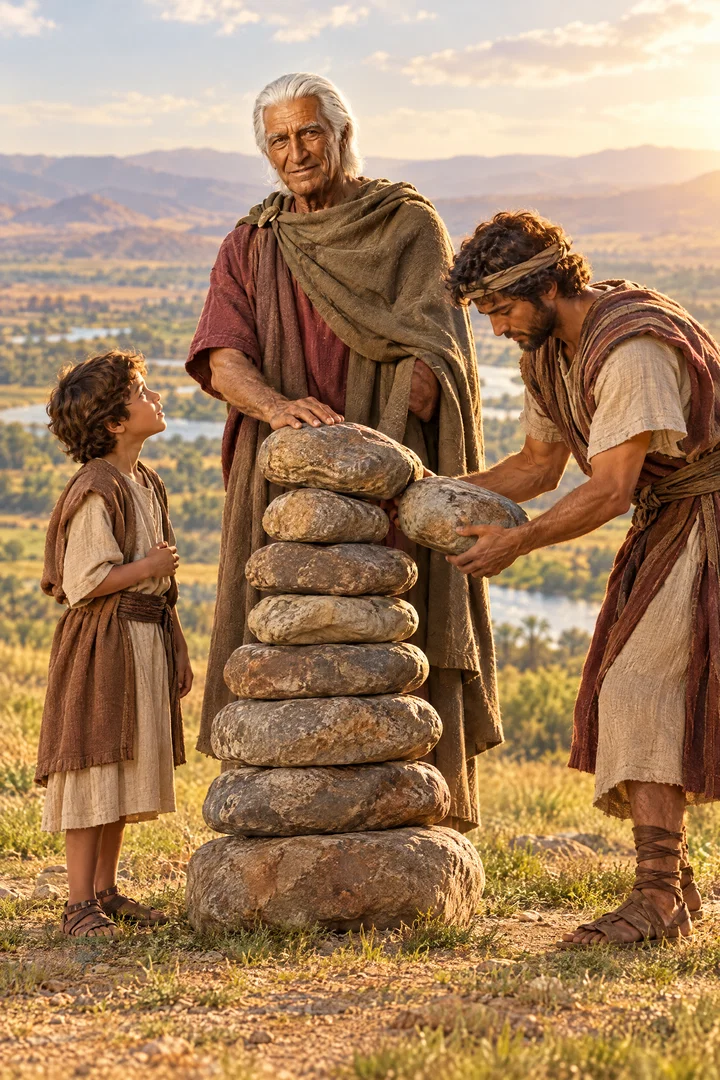
And those twelve stones, which they took out of Jordan, did Joshua pitch in Gilgal.
Translations
American King James Version, King James Version, KJV Cambridge Paragraph Bible
And those twelve stones, which they took out of Jordan, did Joshua pitch in Gilgal.
And those twelve stones which they took out of Jordan, did Joshua set up in Gilgal.
And those twelve stones, which they took out of Jordan, did Joshua set up in Gilgal.
And those twelve stones, which they took out of the Jordan, did Joshua set up in Gilgal.
and these twelve stones, which they have taken out of the Jordan, hath Joshua raised up in Gilgal.
And those twelve stones which they had taken out of the Jordan did Joshua set up in Gilgal.
And, these twelve stones which they took out of the Jordan, did Joshua set up, in Gilgal.
Berean Standard Bible, Majority Standard Bible
And there at Gilgal Joshua set up the twelve stones they had taken from the Jordan.
Joshua set up those twelve stones, which they took out of the Jordan, in Gilgal.
And the twelve stones which they took out of Jordan, Joshua put up in Gilgal.
Also the twelue stones, which they tooke out of Iorden, did Ioshua pitch in Gilgal.
Douay-Rheims (Challoner revision)
And the twelve stones which they had taken out of the channel of the Jordan, Josue pitched in Galgal,
Pictures
Cross-references
- Joshua 4:6-7
That this may be a sign among you, that when your children ask their fathers in time to come, saying, What mean ye by these stones?
The stones prompt questions and memorialize the Jordan crossing.
- Joshua 4:24
That all the people of the earth might know the hand of the LORD, that it is mighty: that ye might fear the LORD your God for ever.
The stones made the Lord’s might known and inspired reverence.
- Psalms 114:3
The sea saw it, and fled: Jordan was driven back.
Both describe the Jordan turning back as Israel crossed.
Commentary
Each commentary is drawn from primary sources: the writings of Ellen G. White and Adventist pioneers and periodicals. Each commentary is separate. Its own words are not a quotation; follow the references to read the source passages.
Ellen G. White
3 sources
The twelve stones taken out of the Jordan's riverbed as Israel crossed into Canaan were pitched by Joshua at Gilgal.Lt 292, 1908, par. 18PP 484.34T 158.2 They were erected there as a lasting monument and reminder of God bringing Israel across the river on dry land.Lt 292, 1908, par. 18PP 484.34T 158.2 The monument preserved the memory of His miraculous deliverance and of the lessons He taught Israel in the crossing.Lt 292, 1908, par. 18PP 484.34T 158.2
It was meant to cause children in later generations to ask about the meaning of the stones.Lt 292, 1908, par. 18PP 484.34T 158.2 When they asked, parents were to recount the miracle, so that God's dealings would remain memorable and instructive to future generations.Lt 292, 1908, par. 18PP 484.34T 158.2 Through that retelling children would learn that the Lord's power is mighty.PP 484.3 In this way all people might come to know Him, and Israel might fear Him forever.PP 484.3
Sources
Pioneers and periodicals
8 sources
The verse belongs to the account in Joshua 1-4 of the preparation for passing over the Jordan and the impressive crossing of the river at full flood, followed by the people's reconsecration to God.ST Mar 25, 1913 The book containing it was written at the close of Joshua's life in 1427 B.C., with its story beginning in about 1451 B.C., the same year Moses died.ST Mar 25, 1913 It shows Joshua at about eighty years old leading Israel through the Jordan at the start of his greatest work, dividing the land for them and setting them in a fair way to conquer their foes and find the promised rest, with the Captain of Jehovah's hosts with him in victory, including his meeting with Christ the Prince of God's host.ST Mar 21, 1911ST Mar 25, 1913
The twelve stones were taken from the midst of the Jordan where the priests' feet stood firm, carried out one stone by each of twelve men chosen one from every tribe, and pitched at Gilgal where Israel encamped the night after the Lord parted the Jordan to bring Israel over into the promised land after forty years of wandering in the wilderness.RH Aug 1, 1907 The pitching of the stones was a memorial of the miraculous crossing on dry land into the promised land, recalling that the Jordan's waters were cut off before the Ark of the Covenant and displaying the deliverance, power, providence, and care of the living God on the day Israel passed through the angry waters.RH Apr 21, 1851RH Jul 28, 1904RH Nov 18, 1909RH Feb 18, 1904RH Dec 9, 1902 The stones were set up as a memorial to the Lord and not as a monument to the men who were instrumental in the work, and the same purpose belongs to a building erected for God to glorify His name and make known His mighty hand rather than its builders who were only instruments under God.RH Aug 1, 1907
The meaning appointed for the stones was that when children in time to come ask what the stones mean, fathers should let them know that Israel came over Jordan on dry land, for the Lord dried up the waters of Jordan until they were passed over as He dried up the Red Sea, that all the people of the earth might know the hand of the Lord that it is mighty and that they might fear the Lord forever.RH Apr 21, 1851RH Aug 1, 1907 Joshua, whose name signifies the same as Jesus in Greek, Saviour, was in his leading of Israel a type of the Lord.ST Mar 25, 1913 The record was given for learning from God's acts and not merely for wonder or curiosity, so the people would keep His past leading fresh in mind, with the significance of the stones to be carefully and continually explained to children in the home circle as part of teaching God's fear, truth, and providence, since He remains our God and acts in human life.RH Jul 28, 1904RH Feb 18, 1904RH Dec 9, 1902
Sources