Joshua 4:6
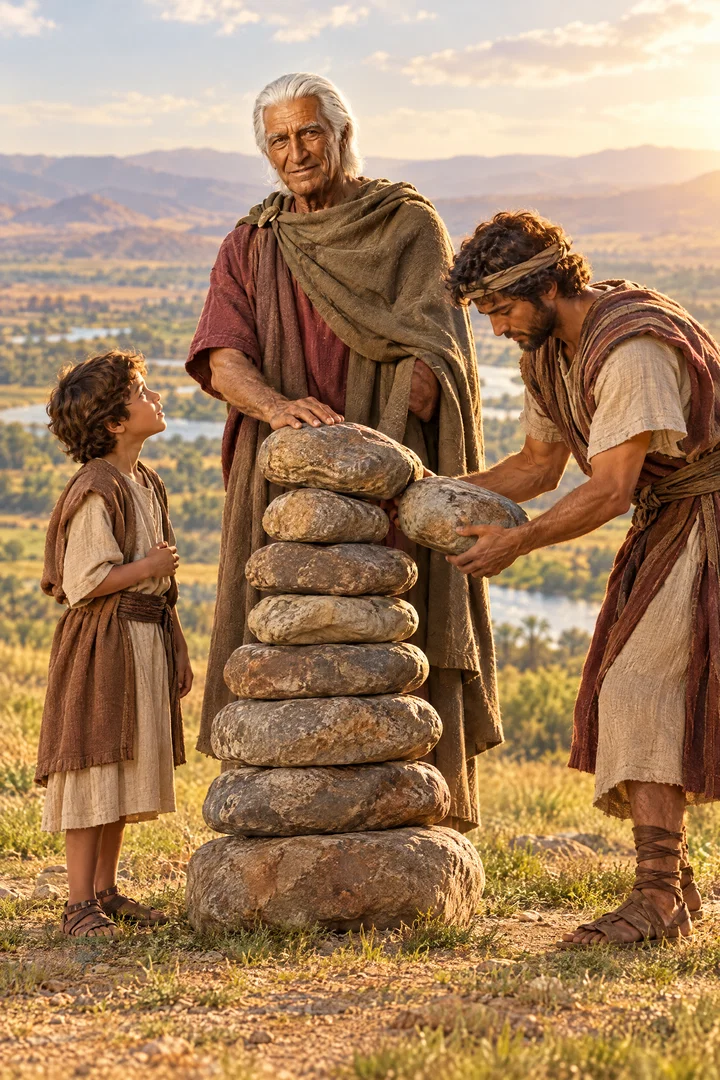
That this may be a sign among you, that when your children ask their fathers in time to come, saying, What mean ye by these stones?
Translations
That this may be a sign among you, that when your children ask their fathers in time to come, saying, What mean you by these stones?
King James Version, Webster Bible
That this may be a sign among you, that when your children ask their fathers in time to come, saying, What mean ye by these stones?
that this may be a sign among you, that when your children ask their fathers in time to come, saying, What mean you by these stones?
that this may be a sign among you, that when your children ask in time to come, saying, What mean ye by these stones?
that this may be a sign among you, that, when your children ask in time to come, saying, What mean ye by these stones?
so that this is a sign in your midst, when your children ask hereafter, saying, What [are] these stones to you?
that this may be a sign in your midst. When your children ask hereafter, saying, What mean ye by these stones?
that this may be a sign in your midst,—for your sons will ask in time to come, saying, What mean these stones to you?
Berean Standard Bible, Majority Standard Bible
to serve as a sign among you. In the future, when your children ask, ‘ What do these stones mean to you?’
that this may be a sign among you, that when your children ask in the future, saying, ‘ What do you mean by these stones?’
So that this may be a sign among you; when your children say to you in time to come, What is the reason for these stones?
That this may bee a signe among you, that whe your children shall aske their fathers in time to come, saying, What meane you by these stones?
Douay-Rheims (Challoner revision)
That it may be a sign among you and when your children shall ask you tomorrow, saying: What mean these stones?
Pictures
Cross-references
- Joshua 4:21-24
And he spake unto the children of Israel, saying, When your children shall ask their fathers in time to come, saying, What mean these stones?
The stones prompt children to ask and hear how God brought Israel through the Jordan.
- Joshua 3:17
And the priests that bare the ark of the covenant of the LORD stood firm on dry ground in the midst of Jordan, and all the Israelites passed over on dry ground, until all the people were passed clean over Jordan.
Israel crossed the Jordan on dry ground, which the stones commemorated.
- Exodus 14:21-22
And Moses stretched out his hand over the sea; and the LORD caused the sea to go back by a strong east wind all that night, and made the sea dry land, and the waters were divided.
The Jordan crossing recalls God opening the Red Sea for Israel.
- Deuteronomy 6:20-23
And when thy son asketh thee in time to come, saying, What mean the testimonies, and the statutes, and the judgments, which the LORD our God hath commanded you?
Children ask what the signs mean, prompting parents to recount God’s deliverance.
- Exodus 12:26
And it shall come to pass, when your children shall say unto you, What mean ye by this service?
The Passover service prompts children to ask its meaning.
- Joshua 3:13
And it shall come to pass, as soon as the soles of the feet of the priests that bear the ark of the LORD, the Lord of all the earth, shall rest in the waters of Jordan, that the waters of Jordan shall be cut off from the waters that come down from above; and they shall stand upon an heap.
God stopped the Jordan so Israel could cross.
- Psalms 78:4-7
We will not hide them from their children, shewing to the generation to come the praises of the LORD, and his strength, and his wonderful works that he hath done.
God’s works are to be told to the next generation.
- Psalms 114:3
The sea saw it, and fled: Jordan was driven back.
The Jordan’s parting is linked with Israel’s departure from Egypt and the sea’s parting.
- 1 Kings 18:31
And Elijah took twelve stones, according to the number of the tribes of the sons of Jacob, unto whom the word of the LORD came, saying, Israel shall be thy name:
Elijah uses twelve stones to represent Israel’s tribes.
- Joshua 3:3
And they commanded the people, saying, When ye see the ark of the covenant of the LORD your God, and the priests the Levites bearing it, then ye shall remove from your place, and go after it.
The Ark leads Israel toward the Jordan crossing.
- Joshua 3:5
And Joshua said unto the people, Sanctify yourselves: for to morrow the LORD will do wonders among you.
Joshua announces that the Lord will do wonders before the crossing.
- Deuteronomy 6:7
And thou shalt teach them diligently unto thy children, and shalt talk of them when thou sittest in thine house, and when thou walkest by the way, and when thou liest down, and when thou risest up.
Commands God’s people to teach his words diligently to their children.
- Exodus 31:13
Speak thou also unto the children of Israel, saying, Verily my sabbaths ye shall keep: for it is a sign between me and you throughout your generations; that ye may know that I am the LORD that doth sanctify you.
Both identify a sign for Israel across generations.
Commentary
Each commentary is drawn from primary sources: the writings of Ellen G. White and Adventist pioneers and periodicals. Each commentary is separate. Its own words are not a quotation; follow the references to read the source passages.
Ellen G. White
13 sources
The twelve stones taken from the Jordan and set up at Gilgal by divine direction were to commemorate Israel's miraculous passage through the river on dry ground at its first encampment in the promised land.RH Sep 25, 1913ST Jul 27, 1882PP 613.3–614.2 They were to stand as a lasting sign and memorial, so that when children in time to come asked what the stones meant, their fathers could explain how God cut off the waters before the ark and brought His people across by His power.Lt 292, 1908, par. 184T 158.2PP 484.3 The question was to open the way for instruction that impressed mind and heart, as parents recounted God's providence, goodness, mercy, power and care in leading and delivering His people.ED 41.29MR 134.3–135.2Lt 33, 1890, par. 7–96T 364.3–4 Teaching and retelling that history from one generation to the next kept His wonderful works in view, strengthened faith, and led each generation to remember and praise Him.9MR 134.3–135.2Lt 33, 1890, par. 7–96T 364.3–4 So believers are to set up their own stones of witness by recording what God has wrought for them, for grateful remembrance strengthens faith to receive more, and testimony joined to a Christlike life reveals Christ with power for the salvation of souls.DA 347.2–348.1
The Stones as Sign
The twelve stones taken from the Jordan were set up at Gilgal by divine direction to commemorate the miraculous passage across the river.RH Sep 25, 1913ST Jul 27, 1882PP 613.3–614.2 That setting up is recorded in Joshua 4:1-9.ST Jul 27, 1882 Gilgal was Israel's first encampment in the promised land, and the stones erected there made the place a reminder of God's deliverance.ST Jul 27, 1882
The stones were to serve as a lasting sign and memorial for future generations and descendants.Lt 292, 1908, par. 184T 158.2PP 484.31SP 345.2–3ST Apr 7, 1881 The monument was meant to keep the miraculous crossing in remembrance and to preserve God's dealings with Israel in memory.Lt 292, 1908, par. 181SP 345.2–3Lt 33, 1890, par. 7–9 It kept His providential care, goodness, mercy, power, and deliverance in view as a history to be taught from one generation to the next.Lt 33, 1890, par. 7–9 It was a lasting sign of His miracle, intended to pass the story of His mighty act from one generation to the next.4T 158.2PP 484.3
When children in time to come asked what the stones meant, their fathers could explain the events and lessons connected with the passage into the promised land.Lt 292, 1908, par. 18PP 484.3 They could tell how God had delivered Israel by opening the river for them to cross.4T 158.2PP 484.3 They could tell that Israel had crossed the Jordan on dry ground by God's power, brought across on dry land.4T 158.21SP 345.2–3 They could tell that the waters of the Jordan had been cut off before the ark of the Lord as Israel crossed.ST Apr 7, 1881
The twelve stones would also prompt remembrance of Israel's covenant with the Lord on entering the promised land.RH Sep 25, 1913 That covenant involved the twelve tribes, and it was later recalled when Elijah rebuilt the altar with twelve stones.RH Sep 25, 1913
Teaching Future Generations
The stones were set up as a sign and memorial so that when children in later time asked what they meant, the question itself would open the way for instruction.ED 41.2 That instruction was to impress both mind and heart and to keep the memory of God's wonderful works alive.ED 41.2 In answering, parents were to tell the story of God's dealings with Israel, recounting how He had led and delivered His people and setting forth His providence, goodness, mercy, power, and care.9MR 134.3–135.2Lt 33, 1890, par. 7–96T 364.3–4 Those visible memorials were to be preserved and that history taught and retold from one generation to the next, so that God's power and care were kept in view and in remembrance.9MR 134.3–135.2Lt 33, 1890, par. 7–96T 364.3–4 By this continual retelling faith was strengthened across the generations, and each generation was led to remember Him and to praise Him.9MR 134.3–135.2Lt 33, 1890, par. 7–96T 364.3–4
Personal Stones of Witness
As Israel stood by the Jordan, so believers in their own pilgrimage are to raise up stones of witness to keep every gift of God fresh in memory.DA 347.2–348.1 Upon those memorials is to be inscribed the precious story of what God has wrought for them along the way.DA 347.2–348.1 Such remembrance is for their own benefit, strengthening faith to claim and to receive still more from His hand.DA 347.2–348.1
Gratitude melted into praise that bears the mark of personal experience declares thanksgiving and pays vows to the Lord openly before His people.DA 347.2–348.1 When that testimony is supported by a Christlike life it reveals Christ to the world with irresistible power for the salvation of souls.DA 347.2–348.1
Sources
Pioneers and periodicals
24 sources
The twelve stones taken from the dry bed of the Jordan and set up at Gilgal were to stand as a lasting sign and memorial that its waters were cut off before the ark as Israel crossed over on dry ground.RH Apr 21, 1851ST Dec 17, 1874RH Dec 15, 1874 They were placed among the people so that when children in coming time asked what the stones meant, their fathers would tell how God divided the waters and delivered His people by mighty power and love.RH Mar 13, 1913RH Apr 12, 1906 That answering of a child's own question by a visible sign was to keep the miracle fresh in memory, teach God's power and dealings, lead children to reverence Him, and guard them from forgetting Him and turning to idolatry.ST Dec 17, 1874RH Dec 15, 1874ST Sep 17, 1885 As those stones served as a sign and memorial, so the seventh-day Sabbath is the divinely appointed sign and memorial of His making heaven and earth in six days and resting the seventh.RH Jul 1, 1873RH Dec 15, 1874RH Aug 10, 1869 Joshua's leading Israel through the Jordan from wilderness wanderings into the promised land is a type of Jesus bringing His people from sin's wilderness through judgment into the heavenly Canaan.ST Mar 15, 1910
Stones at the Jordan
Twelve stones were lifted from the dry bottom of the Jordan and heaped on the bank at Gilgal, Israel's first encampment in the promised land, to stand as a lasting sign and memorial that the waters of the Jordan were cut off before the ark of the covenant of the Lord when Israel crossed over on dry ground.ST Apr 7, 1881ST Jul 27, 1882RH Apr 21, 1851RH Dec 15, 1874ST Sep 17, 1885 The stones were set up so that when children in time to come asked what they meant, fathers could tell how God stopped the river and brought His people across by mighty power and love in leading and providing for them.ST Dec 17, 1874ST Sep 17, 1885ST Feb 3, 1904 Whenever men in all coming generations looked upon that pile it would remind them of that wonderful miracle and keep it fresh in memory.ST Dec 17, 1874RH Dec 15, 1874
The crossing belongs to Joshua leading the children of Israel through the Jordan at full flood in preparation to conquer their foes and find the promised rest.ST Mar 21, 1911ST Mar 25, 1913 It stands at the beginning of the conquest in about 1451 B.C., the same year Moses died, following Joshua's meeting with Christ the Prince of God's host.ST Mar 25, 1913 This was part of his greatest work, begun when he was about eighty years old, after he had been one of the two of his generation who wholly followed the Lord during the forty years of temptation in the wilderness, and in this work the Captain of Jehovah's hosts was with him.ST Mar 21, 1911 The crossing marks Israel's impressive passage from wilderness wanderings into the promised land and the people's reconsecration to God.ST Mar 15, 1910
"Sign" in the verse and "memorial" in the following verse are the same thing, used interchangeably for the stones with the same purpose of keeping God's work fresh in memory.ST Dec 17, 1874RH Jul 1, 1873RH Dec 15, 1874RH Aug 10, 1869 A memorial looks back to a past event, unlike a shadow which points forward to a future event.RH Oct 14, 1915 A memorial is set up coeval with the event it commemorates, as the stones were set up when the crossing occurred and not long afterward.RH Oct 14, 1915ST Mar 11, 1880
The twelve stones set up by faith in the middle of the bed of the Jordan were kept in their position amid the rushing, whirling waters by the power of God alone and were to be a constant witness to that power from generation to generation.ST Mar 2, 1915 Israel placed in Canaan in the highway of nations was to be kept in its possession by that same power alone while armies swept back and forth from south to north and east to west, in order to be the same witness to all the conquering nations in each generation to come.ST Mar 2, 1915 The number twelve recalled Israel's covenant with the Lord on entering the land and the twelve tribes, later recalled by Elijah's rebuilding the altar with twelve stones.RH Sep 25, 1913
Teaching Future Generations
The stones were to stand as a sign among the people, so that when children in time to come asked their fathers what the stones meant, the fathers would answer and explain the meaning.RH Mar 13, 1913ST Feb 3, 1904RH Apr 12, 1906RH Aug 1, 1907 The answer was to tell how God divided the waters of the Jordan and cut them off before the ark of the covenant, and brought Israel across on dry land.ST Dec 17, 1874RH Dec 15, 1874ST Sep 17, 1885RH Apr 12, 1906RH Aug 1, 1907 In that telling the coming generations would be taught of Israel's deliverance, of God's dealings with His people, and of His mighty power and love in leading and providing for them.RH Mar 13, 1913ST Feb 3, 1904RH Apr 12, 1906RH Aug 1, 1907
The retelling when the question was asked would keep the miracle fresh in memory and preserve the memory of that momentous event for all coming generations.ST Dec 17, 1874RH Dec 15, 1874ST Sep 17, 1885ST Jul 21, 1909 Whenever men looked upon that pile of twelve stones taken from the bottom of the Jordan and heaped on the bank, they would be reminded of the wonderful miracle God wrought in stopping the river's waters as Israel crossed.ST Dec 17, 1874RH Dec 15, 1874ST Sep 17, 1885 So taught, the children would learn God's power and deeds for His people, would be led to reverence Him, and would have His mighty works impressed on their minds.ST Sep 17, 1885RH Apr 12, 1906RH Aug 1, 1907 Remembering and speaking of God's special acts in daily life, and diligently teaching His commands and deeds to children, keeps His people from forgetting Him even in prosperity, guards them from idolatry, and calls attention to His mighty hand.RH Apr 12, 1906RH Aug 1, 1907
The twelve stones beside the Jordan were set up to prompt children themselves to ask what they meant, so that parents could teach them that God had opened the Jordan's waters before Israel.RH Sep 19, 1912 A visible sign joined to a child's own question makes the lesson more strongly remembered.RH Sep 19, 1912 In the same way the conspicuous ashes at the altar prompted questions and taught that sin would finally be burned away and the earth made clean.RH Sep 19, 1912
Sabbath, Christ and Memorials
A sign is a memorial, and the stones taken from the Jordan were set up to keep God's work in memory.RH Jul 1, 1873RH Dec 15, 1874RH Aug 10, 1869 Twelve stones were taken out of the bottom of the Jordan after its waters were cut off and dried up for Israel to cross over, and heaped on the bank to be a sign among the people.RH Dec 15, 1874 When children in time to come asked their fathers what the stones meant, the fathers would answer that the waters of Jordan were cut off before the ark of the covenant of the Lord when it passed over Jordan, and these stones would be for a memorial to the children of Israel forever.RH Jul 1, 1873RH Dec 15, 1874 Whenever men in all coming generations looked upon that pile it would remind them of that wonderful miracle God wrought for His people and keep it fresh in memory.RH Dec 15, 1874 In the same way the seventh-day Sabbath is a divinely appointed sign and memorial of God's work of making heaven and earth in six days and resting the seventh day, His creation and rest.RH Jul 1, 1873RH Dec 15, 1874RH Aug 10, 1869
Joshua's leading Israel through the Jordan marks the passage from wilderness wanderings into the promised land, and it is a type of Jesus bringing His people from sin's wilderness through judgment into the heavenly Canaan.ST Mar 15, 1910 A visible memorial prompts later generations to ask what it means, and a completed building can stand in the same way as a reminder of prayers, struggles, work, sacrifices, hardship and divine help through which it was built.RH Apr 12, 1906RH Apr 12, 1906RH Dec 7, 1916 These experiences give a building its deeper consecration rather than a dedication ceremony, while its timbers and stones can remind future workers how God helped and guided His servants and testify to His mighty power so as to lead the people to reverence Him and call attention to His mighty hand.RH Apr 12, 1906RH Apr 12, 1906 Recounting a stone's history and carrying it back can make a deep impression and inspire giving, as in beginning a fund for that purpose.RH Dec 7, 1916 The account of Israel crossing the Jordan on dry land was given for learning about God's acts, showing His power as the work of the living God that remains relevant to daily life rather than belonging only to an unrepeatable past.RH Apr 12, 1906RH Dec 9, 1902
Sources