Exodus 12:26
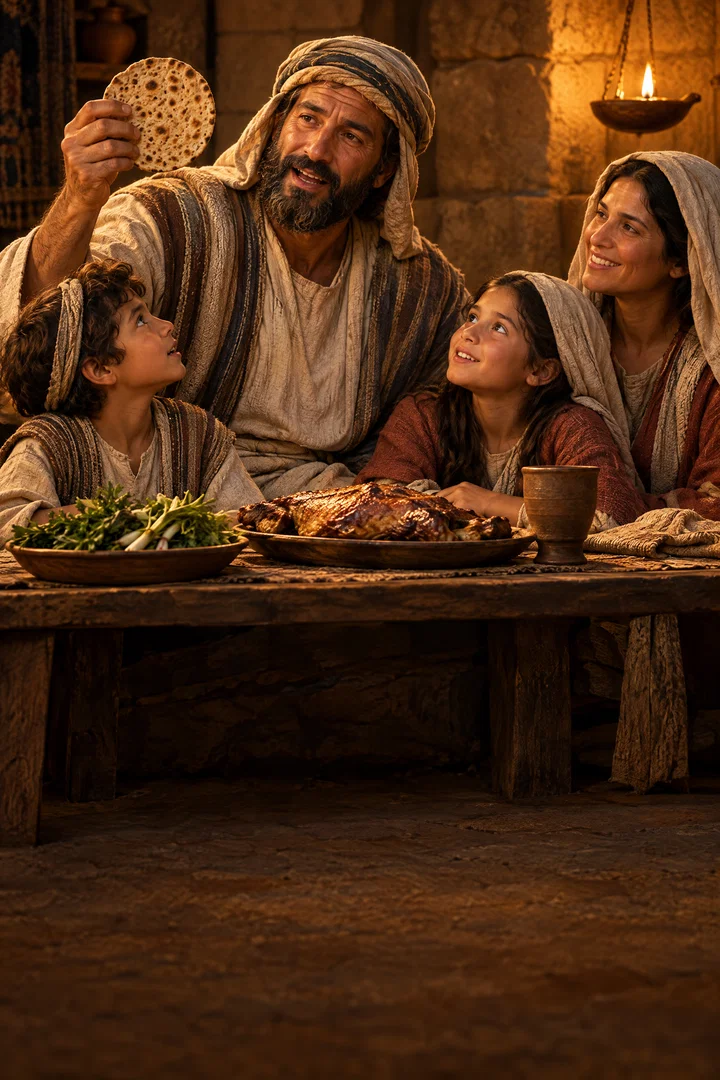
And it shall come to pass, when your children shall say unto you, What mean ye by this service?
Translations
American King James Version, Webster Bible
And it shall come to pass, when your children shall say to you, What mean you by this service?
King James Version, Revised Version, American Standard Version
And it shall come to pass, when your children shall say unto you, What mean ye by this service?
And it shall come to pass, when your children shall say unto you, What mean you by this service?
and it hath come to pass when your sons say unto you, What [is] this service ye have?
And it shall come to pass, when your children shall say to you, What mean ye by this service?
and it shall come to pass that your sons shall say unto you,—What is this your service?
Berean Standard Bible, Majority Standard Bible
When your children ask you, ‘ What does this service mean to you?’
It will happen, when your children ask you, ‘ What do you mean by this service?’
And when your children say to you, What is the reason of this act of worship?
And when your children aske you, What seruice is this ye keepe?
Douay-Rheims (Challoner revision)
And when your children shall say to you: What is the meaning of this service?
Pictures
Cross-references 20 of 30
- 1 Corinthians 5:7
Purge out therefore the old leaven, that ye may be a new lump, as ye are unleavened. For even Christ our passover is sacrificed for us:
Christ is identified as the Passover sacrifice foreshadowed by the feast.
- Exodus 12:13
And the blood shall be to you for a token upon the houses where ye are: and when I see the blood, I will pass over you, and the plague shall not be upon you to destroy you, when I smite the land of Egypt.
The blood marked Israel’s houses, which the Lord spared from the plague.
- Exodus 12:14
And this day shall be unto you for a memorial; and ye shall keep it a feast to the LORD throughout your generations; ye shall keep it a feast by an ordinance for ever.
The feast is ordained as a memorial of deliverance from Egypt.
- Deuteronomy 16:4
And there shall be no leavened bread seen with thee in all thy coast seven days; neither shall there any thing of the flesh, which thou sacrificedst the first day at even, remain all night until the morning.
It prohibits leaven during the Passover observance.
- Exodus 13:8
And thou shalt shew thy son in that day, saying, This is done because of that which the LORD did unto me when I came forth out of Egypt.
Israel’s answer explains the observance by recalling God’s deliverance from Egypt.
- Exodus 12:11
And thus shall ye eat it; with your loins girded, your shoes on your feet, and your staff in your hand; and ye shall eat it in haste: it is the LORD’s passover.
Gives the hasty manner of eating the first Passover, which the children ask about.
- Exodus 12:42
It is a night to be much observed unto the LORD for bringing them out from the land of Egypt: this is that night of the LORD to be observed of all the children of Israel in their generations.
It identifies the Passover night as a remembrance of Israel’s deliverance.
- John 1:29
The next day John seeth Jesus coming unto him, and saith, Behold the Lamb of God, which taketh away the sin of the world.
The Passover lamb points to Jesus, the Lamb who takes away the world’s sin.
- Deuteronomy 6:7
And thou shalt teach them diligently unto thy children, and shalt talk of them when thou sittest in thine house, and when thou walkest by the way, and when thou liest down, and when thou risest up.
Parents are commanded to teach God’s instructions diligently to their children.
- Exodus 13:14
And it shall be when thy son asketh thee in time to come, saying, What is this? that thou shalt say unto him, By strength of hand the LORD brought us out from Egypt, from the house of bondage:
Children ask about the service, and parents explain the LORD’s deliverance from Egypt.
- John 19:32-37
Then came the soldiers, and brake the legs of the first, and of the other which was crucified with him.
Christ’s unbroken bones fulfill the Passover lamb pattern.
- Exodus 12:8
And they shall eat the flesh in that night, roast with fire, and unleavened bread; and with bitter herbs they shall eat it.
lamb, unleavened bread, bitter herbs shown
- Luke 22:19
And he took bread, and gave thanks, and brake it, and gave unto them, saying, This is my body which is given for you: this do in remembrance of me.
The Lord’s Supper commemorates Christ’s death in place of the Passover feast.
- Exodus 12:7
And they shall take of the blood, and strike it on the two side posts and on the upper door post of the houses, wherein they shall eat it.
The service recalled the blood placed on the houses.
- Exodus 12:1-6
And the LORD spake unto Moses and Aaron in the land of Egypt, saying,
gives time to take and slay lamb
- Joshua 4:6
That this may be a sign among you, that when your children ask their fathers in time to come, saying, What mean ye by these stones?
Children ask what the memorial stones mean.
- Deuteronomy 16:3
Thou shalt eat no leavened bread with it; seven days shalt thou eat unleavened bread therewith, even the bread of affliction; for thou camest forth out of the land of Egypt in haste: that thou mayest remember the day when thou camest forth out of the land of Egypt all the days of thy life.
Unleavened bread commemorates Israel’s departure from Egypt.
- Luke 22:15
And he said unto them, With desire I have desired to eat this passover with you before I suffer:
Jesus says He desired to eat the Passover with His disciples before He suffered.
- Hebrews 11:28
Through faith he kept the passover, and the sprinkling of blood, lest he that destroyed the firstborn should touch them.
Moses kept the Passover by faith.
- Exodus 12:15
Seven days shall ye eat unleavened bread; even the first day ye shall put away leaven out of your houses: for whosoever eateth leavened bread from the first day until the seventh day, that soul shall be cut off from Israel.
It requires leaven to be removed during the feast.
Commentary
Each commentary is drawn from primary sources: the writings of Ellen G. White and Adventist pioneers and periodicals. Each commentary is separate. Its own words are not a quotation; follow the references to read the source passages.
Ellen G. White
17 sources
God appointed that in every later generation when children ask what the Passover service means, parents shall answer that it is the sacrifice of the Lord's passover who passed over the blood-marked houses when He smote the Egyptians and brought Israel out as an independent nation.SG3 223.1DA 76.11SP 199.1–200.1 It was given on the night of the last and most severe judgment on Egypt, when each household was to slay an unblemished lamb, put its blood on the doorposts, and eat it in haste with unleavened bread and bitter herbs while the firstborn were slain.PP 274.1–2SG3 244.2PP 275 The blood was the token that those inside belonged to God, and only those who in faith separated from the Egyptians, gathered their children within, and abode under its protection were spared.17MR 350.2–351.1SG3 223.1 Its yearly ceremonies and solemn rehearsal of the sprinkled blood, the death-dealing angel, and the march from bondage were to make deliverance vivid to children, turn hearts from worldly concerns, and foster love, reverence, and trust in God.ED 42.2ST Nov 2, 1915 The slain lamb signified the death and blood of Christ which cleanses the believing sinner and shelters from coming wrath, so that after He died no lamb need be slain and the Lord's Supper continues the same memorial until His second coming, while the gathering of children into marked homes urges parents today to keep them under the bond of the covenant within sacred influences made possible through His redeeming blood.MH 403.3COS 106.6–7RH Nov 4, 1902
Passover Night and Ordinance
The verse belongs to directions given through Moses to the children of Israel before the final judgment on Egypt, concerning their departure from Egypt and especially their preservation from the coming judgment.PP 274.1–2 Each family, alone or joined with others, was to slay a lamb or a kid without blemish and with hyssop sprinkle its blood on the two side-posts and the upper door-post of the house, so that the destroying angel coming at midnight would not enter that dwelling.PP 274.1–2 They were to eat the flesh roasted, with unleavened bread and bitter herbs, at night with loins girded, shoes on feet and staff in hand, eating in haste, because it is the Lord's passover.PP 274.1–2 That night the Lord would pass through the land of Egypt and smite all the first-born of man and beast and execute judgment against all the gods of Egypt, but the blood would be a token on the houses where they were, so that when it was seen He would pass over them and the plague would not destroy them when He smote the land of Egypt.PP 274.1–2 The whole service is thus centered on the blood marked on the doorway, the Passover supper, and the first-born being slain.PP 274.1–2PP 275
The solemn ordinance of the Passover was instituted on the night of the last and most severe plague.SG3 244.21SP 217.2 Its nature and effect were told beforehand to Pharaoh and the people of Egypt and also to the Israelites.SG3 244.21SP 217.2 That night was terrible to the Egyptians and glorious to the people of God.SG3 244.21SP 217.2 It came after the dreadful plague of locusts was met with stubborn refusal to submit to God, and after darkness in which Egypt was deprived of light and suffered an oppressive atmosphere difficult to breathe, while the Hebrews had a pure atmosphere and light in their dwellings.SG3 244.2
The blood on the doorposts was a sign that those inside belonged to God, and those who obeyed were spared while those who failed to obey suffered with the Egyptians.17MR 350.2–351.1SG3 223.1 It required faith shown by works, for the blood had to be seen upon their houses to escape God's judgment.SG3 223.1 Families had to separate and gather themselves and their children from the Egyptians into their own houses and abide within under its protection for safety.SG3 223.1 When the destroying angel went forth in the night to slay the first-born of man and the first-born of beast, he passed over their houses, and not one Hebrew with the token of blood upon the door-posts was slain.SG3 223.1 The ordinance was therefore a memorial to preserve to children the remembrance of God's care and wonderful preservation in Egypt, answered when children asked what the service meant.17MR 350.2–351.1SG3 223.1
Memorial Teaching for Children
God commanded the Passover to be kept yearly beginning with the birth of the Hebrew nation on the last night of bondage, when families gathered within their dwellings with the blood of the slain lamb sprinkled on the doorposts and ate the roasted flesh with unleavened bread and bitter herbs in haste, after which at midnight all the Egyptian firstborn of man and beast were slain by the destroying angel and Israel went out an independent nation.SG3 223.1DA 76.1 It was ordained as a commemoration of deliverance from Egyptian bondage and as an ordinance and memorial, so that in every later generation when children ask what this service means parents shall answer that it is the sacrifice of the Lord's passover, who passed over the houses marked with blood when He smote the Egyptians, and not one Hebrew with the token upon the doorposts was slain.SG3 223.1DA 76.11SP 199.1–200.1 The history of that wonderful deliverance and of God's care for His people was to be repeated to them so that it would be kept fresh in the minds of all, requiring faith shown by works, the blood seen upon their houses to escape judgment, and the separating and gathering of themselves and their children from the Egyptians into their own houses for safety.SG3 223.1RH Nov 4, 1902DA 652.3 The same memorial purpose continues in the ordinance of the Lord's Supper, given to commemorate the great deliverance wrought by Christ's death and sacrifice and to be celebrated till He shall come the second time in power and great glory as the means by which His great work is kept fresh in mind.RH Nov 4, 1902DA 652.3
Its ceremonies recalled deliverance from bondage and made the story vivid to impress the heart: the lamb, the unleavened bread, the bitter herbs, and the solemn rehearsal of the sprinkled blood, the death-dealing angel, and the march from Egypt.ED 42.2 The children's question was answered by what they saw and heard on the journey to Jerusalem and at the feast itself.ST Nov 2, 1915 On the way parents recounted the experiences of the past to the children, sang the songs of the wilderness wandering, and chanted God's commandments, fixing them forever in the memory of many a child and youth through the blessed influences of nature and kindly human association.ST Nov 2, 1915 At Jerusalem the children witnessed the paschal night assembly, the men with girded loins, shoes on feet and staff in hand, the hasty meal of lamb, unleavened bread and bitter herbs, and heard in solemn silence the rehearsal of the sprinkled blood, the death-dealing angel, and the grand march from the land of bondage, all stirring the imagination and impressing the heart.ST Nov 2, 1915
The service was to turn people from worldly concerns and remind them of God's works, mercy, and loving-kindness, fostering love, reverence, and trust in Him. God's acts of deliverance and provision were to be kept in memory, retold to children, and His commandments repeated often, so that the people would serve Him and keep His Sabbaths.Lt 8a, 1896, par. 8–9 Remembering and retelling that deliverance taught them that God would fulfill what He had undertaken.13MR 186.2
Christ and Covenant Life
The slain lamb of the Passover service taught about the death of Christ, and its blood stood for the blood of Christ which cleanses the believing sinner from sin and shelters from coming wrath, a provision received only as it is acted upon in faith.COS 106.6–7 Once Christ the Lamb of God had died for the sins of the world, no lamb any longer needed to be slain to represent that death.COS 106.6–7 After rejection of Christ, continued keeping of the feast became a worthless form.COS 106.6–7
The same memorial purpose belongs to the ordinance of the Lord's Supper, which commemorates the great deliverance wrought by the death and sacrifice of Christ.RH Nov 4, 1902DA 652.3 It was given to be celebrated till He shall come the second time in power and great glory, as the means by which His great work is kept fresh in mind.RH Nov 4, 1902DA 652.3
Given at the birth of Israel as a nation, the Passover was made an object-lesson to deeply impress all hearts and to teach children.MH 403.3 Before the last terrible judgment in the death of the firstborn, the people were commanded to gather their children into their own homes, with the doorpost of every house marked with blood, and to abide within under the protection assured by that token.MH 403.3 This urged upon Israel the importance of guarding the associations of children, with all arrangements of civil, religious, and social life made to preserve them from harmful companionship and to make them familiar from earliest years with the precepts and principles of the law.MH 403.3 So today parents who love and fear God are to keep their children under the bond of the covenant, within the protection of those sacred influences made possible through the redeeming blood of Christ.MH 403.3
The question about the service points to deliverance of the people from Egypt by mighty power notwithstanding the opposition of Pharaoh, done that they might keep the law which had been given in Eden.8T 197.4–198.1 He brought them to Sinai to hear the ten commandments proclaimed with His own voice, thereby demonstrating their importance.8T 197.4–198.1 In awful grandeur He made known His majesty and authority as Ruler of the world, to impress the sacredness of His law and the importance of obeying it.8T 197.4–198.1 The power and glory with which the law was given reveal its importance as the faith once delivered to the saints by the Redeemer speaking from Sinai.8T 197.4–198.1
Sources
Pioneers and periodicals
81 sources
When children asked what the service meant, parents were to explain that it commemorated the Lord passing over Israelite homes when He struck the Egyptians, sparing the firstborn in houses marked by lamb's blood on the doorposts.ST May 22, 1907RH Apr 7, 1851RH Mar 5, 1872ST Sep 13, 1877RH Jan 7, 1862 The observance was suited to call it to mind and to prompt children themselves to ask for its meaning, so the lesson would impress the mind more forcibly.RH Jan 20, 1916RH Sep 19, 1912ST May 31, 1905RH May 27, 1875 The paschal lamb slain on the fourteenth day of the first month was a type meeting its antitype in the death of Jesus as the Lamb of God on that same day.ST Aug 13, 1874RH Mar 31, 1874 Its sprinkled blood pointed to Jesus' blood, through faith in which sins are forgiven and transgressions are passed over so people are protected from the destroyer.RH Sep 8, 1904ST Apr 13, 1904RH Oct 16, 1900ST Oct 25, 1905 The Passover is the true appointed memorial of deliverance from Egypt to be kept through generations, not the Sabbath, which memorializes God's rest at creation.RH Dec 17, 1857RH Apr 30, 1872ST Dec 2, 1880
Setting in Exodus Story
The verse belongs to the account of God's miracles in Egypt, where divine power confronted Egypt's religious system, which was itself supported by supposed miracles.RH Mar 11, 1915 In that confrontation the power was not in Moses himself but in the Word God spoke through him, turning the rivers of Egypt into blood and smiting the land with plague.ST Apr 4, 1911
The ordinance stands in the mainly historical first division of Exodus covering chapters 1-18, given in close connection with the tenth plague, the death of the firstborn, and the hurried departure of Israel from Egypt, when the firstborn were claimed as the Lord's. Israel left Egypt 1491 years before Christ.ST Jan 28, 1886 That departure came one month before the march from Elim to the wilderness of Sin with the fall of manna.ST Apr 24, 1879
Its setting is God's call three and one-half millenniums ago, when Egypt ruled the world as the greatest of all kingdoms in might and power and skill and wisdom in statecraft.ST Nov 14, 1906 It was a land made abundant by the yearly overflow of its river which it deified as a god, and by the sun which it worshiped and from whom its kings took their title as representatives of the sun-god on the throne of men.ST Nov 14, 1906 The question comes from the few descendants of the nomadic patriarch Abraham who had sought supplies from Egypt's granaries, whose kinsman Joseph as a captive slave had taught Pharaoh to store grain in plenteous years to become rich in famine, had instituted a just land-law with easy rental and taxes, and as prime minister had brought prosperity and freedom from oppression while his memory was honored and his laws governed.ST Nov 14, 1906
It stands at the close of the narrative of Exodus 5-12, in which the oppression of Israel was not merely physical bondage but involved the right to worship the true God as Creator and to keep His commandments, which became a direct issue and crisis.RH Mar 25, 1909 Pharaoh's power was broken and the people delivered only through the terrible plagues and the direct intervention and miraculous power of God.RH Mar 25, 1909 Through that deliverance God showed His wisdom, love, power, and right to rule, and Israel's deliverance made clear their obligation to obey Him.ST Mar 7, 1906 The service the children ask about is serving God, and God's request was reasonable, Let My people go that they may serve Me; He would have left Israel in Egypt if they had been given the privilege of serving Him there, but Pharaoh would not grant it.ST Jan 20, 1909
Its setting follows the brick-making bondage and building work described in Exodus 1, matched by the explored store cities with bricks made with and without straw and by the unfinished tomb attributed to the son of Meneptah II.ST Dec 14, 1915 The exodus supervised by Moses is historical narrative, stated with no less certainty than the account of creation.ST Jul 28, 1881 The first day of unleavened bread in Egypt at the exodus marks the end of the period counted from the Creator's rest-day in Eden in Genesis 1.ST Jun 12, 1879
It belongs to the original instructions for the Passover instituted for Israel in Egypt, observed in the wilderness on the journey from Egypt to Palestine and for some time later.ST Feb 22, 1899 That first form was materially changed after the building of the temple, when injunctions were added that were not in the former instructions and could hardly have been carried out in the wilderness.ST Feb 22, 1899 Wine used in later observances was not enjoined in those original instructions, and the Hallel song closing the meal was not required by them.ST Feb 22, 1899 The Passover was observed only once during the wilderness years.RH Jan 7, 1862 It belongs to the further instruction in Exodus 12:7-27 on how the Passover festival should be observed, for which the people were commanded to make proper preparation at a definite arranged time; while the first paschal lamb was killed and eaten before the people departed from Egypt and before they were delivered, the children's question belongs to later observances remembering that deliverance.ST Oct 7, 1930
It belongs to a commanded institution giving its observance, timing, participants, and purpose.RH Mar 9, 1905 Exodus 12 gives the time for observing the Passover and presents it as a memorial of deliverance from Egyptian bondage.ST Apr 23, 1896 It is part of the directions for the Passover service that Jesus and His disciples prepared for and ate before His suffering.ST Sep 20, 1910 Eating the Passover refers specifically to eating the paschal lamb with bitter herbs, not merely to the feast in general, eaten on the night following the fourteenth day, so that the reference also supports identifying the day of preparation with preparations for that meal.RH Jun 24, 1873 The Passover and its feast were called perpetual, but that designation does not by itself mean they must continue forever, since their prescribed period may have ended.RH Apr 15, 1873
Its setting is Israel's deliverance from servitude in Egypt, which God demanded and brought about.RH Oct 1, 1861
Passover Memorial Explained
The observance was arranged to make children ask what the service meant, so that the very sight of it would prompt inquiry about its meaning.RH Jan 20, 1916ST May 31, 1905RH May 27, 1875 It was suited to call the deliverance from Egypt to mind, and the answer was to identify it as remembrance of that deliverance.ST May 31, 1905RH May 27, 1875
When children asked, parents were to explain that the service commemorated the night in Egypt when the Lord struck the Egyptians yet passed over Israelite homes.ST May 22, 1907RH Apr 7, 1851RH Mar 5, 1872RH May 27, 1858 The blood of the slain lamb placed on the doorposts was the token, and when the angel saw it the house was passed over and its firstborn spared.ST May 22, 1907RH Apr 7, 1851RH Dec 10, 1867 That yearly feast was kept just before Israel left Egypt to begin the journey from bondage toward Canaan.ST May 22, 1907RH Dec 10, 1867
It commemorated deliverance from Egyptian bondage and the hurried departure, when Israel carried dough that was later baked and eaten unleavened.RH Jan 7, 1862RH Nov 15, 1853RH Apr 18, 1854 It was celebrated in the night because Israel fled in the night, showing that God's memorials are fitting and appropriate.ST Sep 13, 1877 Its meaning as a memorial was plainly declared, with its office described in the account itself.RH Dec 17, 1857ST May 12, 1898 The Passover remembered how the destroying angel passed over Israel's dwellings when Egypt's firstborn were doomed to die, and the Feast of Unleavened Bread remembered how the Egyptians hurried Israel away.ST Sep 13, 1877RH Jan 7, 1862 Together they marked the anniversary of the departure from Egypt.RH Jan 7, 1862ST May 12, 1898
The service meant slaying the paschal lamb, roasting the flesh, preparing unleavened bread and bitter herbs, sprinkling the blood on the doorposts, and watching and praying in awe through the night.RH Dec 10, 1867ST Dec 7, 1904 The lamb was eaten on its first night and unleavened bread was eaten for seven days.RH Dec 10, 1867 The directions give no mention of wine, for drink was optional, but if drink was served it could not be fermented, since nothing leavened was to be used in the sacred memorial feast.ST Oct 8, 1894ST Nov 22, 1883
Israel was required to keep it as an ordinance proving faith in the deliverance God was bringing about, relating to children their wonderful preservation when the destroying angel went forth in the night to slay the firstborn of man and beast.ST Mar 25, 1880RH Sep 8, 1904 Not one Hebrew sheltered under the blood sign was slain as the angel passed the houses bearing the token.ST Mar 25, 1880RH Sep 8, 1904 The deliverance came through faith, not through the visible blood itself.RH Sep 8, 1904 That service belonged to an entire yearly system of religious forms instituted to bring the people nearer to God and make them a mighty people, requiring exact obedience in every particular.ST Aug 18, 1881
The service was instituted with a definite object to be read and studied carefully.ST Jan 30, 1912 That object is triumph over earthly foes in the song of Moses, which the redeemed will at last sing together with the song of the Lamb, meaning redemption from earthly foes as well as redemption from all sin.ST Jan 30, 1912
Christ Foreshadowed in Passover
The sprinkled blood pointed to the blood of Jesus, through faith in which sins are forgiven and transgressions are passed over and blotted out so that people are not cut off but are protected from the destroyer.RH Sep 8, 1904ST Apr 13, 1904 The deliverance came through faith, not through the visible blood itself.RH Sep 8, 1904 The remnant living at the close of probation will have a special experience of this passing over and blotting out.ST Apr 13, 1904
The blood applied by faith was a sign of safety and a type of saving blood, teaching children who asked what the service meant that safety from judgment came through the Passover Lamb.RH Oct 16, 1900ST Oct 25, 1905 It belonged to the symbolism of sacrifice for sin and peace with God, where type meets Antitype.ST Oct 25, 1905 The paschal lamb slain on the fourteenth day of the first month was a type meeting its antitype in the death of Jesus as the Lamb of God on that same day.ST Aug 13, 1874RH Mar 31, 1874 The annual lamb was a type of Christ the true Passover.ST May 12, 1898
The service commemorated deliverance from Egyptian bondage yet pointed forward to Christ's death and sacrifice.RH Feb 19, 1901ST Aug 13, 1885RH Feb 2, 1911 It was a shadow of good to come for the human race, representing Christ who delivers from sin.ST Aug 13, 1885ST Jun 3, 1897 That deliverance from Egypt was a type of deliverance from the bondage of sin and this world to the heavenly Canaan.ST Mar 18, 1889 It therefore calls each person to consider whether sins are washed away before death and God's decision.ST
The slain lamb symbolized Christ's death, and its blood symbolized Christ's blood cleansing the believing sinner from sin and sheltering from coming wrath. Receiving that provision required acting in faith. The institution with the destroying angel pictures Christ crucified as our Passover and centers the living truths of the Saviour's resurrection.ST Apr 5, 1899
The same memorial purpose continues in the Lord's Supper, given to keep the great deliverance wrought by Christ's sacrifice fresh until He comes the second time with power and great glory.RH Nov 4, 1902 As Moses instituted the Passover, Christ in superior degree instituted the Supper.RH Feb 19, 1861 The old feast is entered into and transfigured by Easter, making one of the old and the new and showing the unity of God's purposes.ST Dec 9, 1897
Sabbath Distinct from Passover
The Passover is the appointed memorial of the deliverance from Egypt to be kept through the generations, not the Sabbath.RH Dec 17, 1857RH Apr 30, 1872 When children would ask what the service meant, the answer was that with a mighty hand the Lord brought Israel up from Egypt, sparing the homes marked for Him when He struck the Egyptians.ST Sep 13, 1877RH Nov 15, 1853RH Nov 15, 1853 The Passover remembered how the destroying angel passed over Israelite dwellings when Egypt's firstborn were doomed to die, and the Feast of Unleavened Bread remembered how the Egyptians hurried Israel away with dough later baked unleavened.ST Sep 13, 1877RH Nov 15, 1853 It was celebrated in the night because Israel fled in the night, showing that God's memorials are always fitting and appropriate. The Sabbath was not commanded as a memorial of that deliverance, for that office already belongs to the Passover, and there is no fitness in wresting the Sabbath from commemorating creation and typifying future rest to connect it with a deliverance that came but once a year.RH Dec 17, 1857ST Sep 13, 1877RH Nov 15, 1853
The convocation days in Exodus 12 were appointed for particular days of the month with no reference to the weekly Sabbath.RH Apr 9, 1861 The holy days connected with that feast in that one year were not necessarily upon the weekly Sabbath. The weeks were all full, with different weekdays falling on different dates of the month, and the year did not close with a defective week nor did the week begin with the year or month. The service about which children would ask therefore belongs to the yearly feast sabbaths, which are quite another thing from the weekly seventh-day Sabbath holy unto the Lord.
Exodus 12 describes the origin of a new institution, in contrast with Exodus 16 which refers familiarly to an already existing Sabbath.RH Mar 14, 1865 The Passover stood in the first month of the sacred year, which was the seventh month of the civil year reckoned from creation.RH Nov 7, 1871 That distinction rejects the claim that the exodus made the fifteenth of Abib a new regular Sabbath.RH Nov 7, 1871
In Egypt Israel still worshiped God and kept His ordinances, being ready to eat the Passover for which circumcision was necessary.RH Sep 24, 1872 That readiness shows they had not forgotten the Lord's past dealings, so the Sabbath made known at Sinai was first given, not recalled as a forgotten ordinance brought back to remembrance.RH Sep 24, 1872 The institution of the Passover is explicitly and plainly recorded, as plainly as the Sabbath at creation and in the law and as plainly as the annual feast-day sabbaths and their abolition by Christ's death on the cross.ST Apr 13, 1915 Any revision or repeal of the weekly Sabbath would therefore have to be given just as plainly.ST Apr 13, 1915
As the Passover service recalled the reason for its institution when the Lord passed over the houses in striking Egypt, so the Sabbath memorializes God's rest at creation.ST Dec 2, 1880
Prophecy of Final Deliverance
The account of the plagues in Exodus 7-12 shadows forth the seven last plagues, which will be as real and literal as those plagues were.RH Dec 23, 1851RH Mar 23, 1852ST Oct 28, 1930 Those plagues came just before the deliverance of Israel, as the seven last plagues will come just before the final deliverance of the saints.RH Dec 23, 1851ST Oct 28, 1930 The going out of Egypt into Canaan shows the deliverance of God's people from the dark Egypt of earth, and the setting among the plagues visited upon Egypt shows the last plagues recorded in Revelation 16, which were literal.ST
The deceptive power of Satan shown by the magicians who withstood Moses just before and in connection with the plagues of Egypt will be repeated by the wonders and miracles of the two-horned beast just before and in connection with the seven last plagues.RH Dec 23, 1851 As Israel's experience during the plagues upon Egypt shows, God's people will remain on earth through the final fearful events, yet be protected while calamities fall around them.ST Jul 18, 1878
The houses of the Israelites marked with the blood of the paschal lamb were spared as the destroying angel passed over to slay the firstborn of the Egyptians.ST May 8, 1879 That marking is a distinguishing religious characteristic that exempts God's servants from the judgments falling on the wicked around them.ST May 8, 1879 It foreshadows the seal of God placed on His servants to save them from coming war and trouble.ST May 8, 1879
Teaching Children Through Worship
Exodus 12:26 ordains that the meaning of the Passover service was to be explained carefully to children in the home, with fathers holding the feast in their own houses and answering when children asked what it meant.RH Feb 18, 1904RH Jan 14, 1862ST Mar 28, 1906 Household religious feasts and their rites were part of the appointed way for parents to teach sacred history, to teach reverence for God's law, and to pass on its words and meaning.ST Feb 9, 1882 That home teaching knit Israel together as one great homogeneous people, and the same duty belongs to Christian fathers to explain often what is meant by the great services and sacraments of faith, so that more will follow Jesus Christ as the Lamb of God who takes away the sin of the world.ST Mar 28, 1906
God planned much of the typical service to arouse a spirit of inquiry in the minds of the young, so that children themselves would ask for information and then be taught.RH Sep 19, 1912 When the curiosity of the child is aroused so that he makes the inquiry, the lesson is more forcibly impressed upon his mind.RH Sep 19, 1912 The same purpose is seen in the twelve stones piled on the banks of Jordan to cause children to ask what they mean, and in placing the ashes from the altar conspicuously on the east side of the altar where every child entering the court could not fail to see and ask what the ashes mean.RH Sep 19, 1912 Placing ashes in a perfectly clean place without the camp was likewise to cause children to ask what they mean, so parents would teach that all sin will finally be burned to ashes in the fires of the last day and that a new earth free from sin will come forth from the fires that destroy the last trace of sin.RH Sep 19, 1912
The children's question was answered by what they saw and heard on the journey to Jerusalem and at the feast itself.ST Nov 2, 1915 On the way parents recounted the experiences of the past to the children, sang the songs of the wilderness wandering, and chanted God's commandments, fixing them forever in the memory of many a child and youth through the blessed influences of nature and kindly human association.ST Nov 2, 1915 At Jerusalem the children witnessed the paschal night assembly, the men with girded loins, shoes on feet and staff in hand, the hasty meal, the lamb, the unleavened bread and the bitter herbs, and heard in solemn silence the rehearsal of the sprinkled blood, the death-dealing angel, and the grand march from the land of bondage, all stirring the imagination and impressing the heart.ST Nov 2, 1915
When others ask what a service of worship means, God's people are to answer by telling what that service means, what the building of their church means, and what faith makes them the people they are.ST Israel's deliverance and worship were taught through meaningful rites that helped the people understand God's plan of salvation. The deliverance of Israel's firstborn made God's power and mercy personally known to those who trusted Him, and the service recalled that experience.ST Nov 27, 1901
God ordained the Passover as a commemoration of the deliverance of Israel from Egyptian bondage and commanded that when children asked what the service meant the history of that wonderful deliverance was to be repeated to them so it would be kept fresh in the minds of all.RH Nov 4, 1902 The Passover was to turn people from worldly concerns and remind them of God's works, mercy, and loving-kindness, fostering love, reverence, and trust in Him. The same memorial purpose continues in the ordinance of the Lord's Supper, given to be celebrated till Christ should come the second time with power and great glory as the means by which the great deliverance wrought by His sacrifice is kept fresh in mind.RH Nov 4, 1902 Receiving that provision required people to act in faith, for the slain lamb symbolized Christ's death and its blood symbolized Christ's blood, which cleanses the believing sinner from sin and shelters from God's coming wrath.
The law given to Israel around this service was for every person of whatever race or nationality, not for Israel alone.ST Jun 13, 1906 Israel was the chosen people through whom the knowledge of God was to extend through the earth, to be as a light to surrounding nations, with their course revealing what it means to be a member of God's government and God's people.ST Jun 13, 1906 The Ten Commandments are the constitution of God's government and the basis of national and individual life, and the rites, services, and ceremonies around this verse are by-laws given to make plain the greatness and depth of that organic law, to explain its real meaning, how to be kept from transgressing it, and what to do when it is violated.ST Jun 13, 1906
That deliverance and that institution of sacrifices and rites of worship about which children would ask are realities from God on which the whole Bible stands.ST May 8, 1879 All the later books of the Old Testament proceed on them as verities, presenting Israel's relation to God and the priesthood, sacrifices, covenants, promises, and whole system of laws as instituted by God.ST May 8, 1879 The New Testament ratifies them in the fullest manner as realities, and the work of redemption it reveals is founded on them, so if they are not from God the New Testament cannot be true.ST May 8, 1879 The exodus must therefore be understood in order to understand Jesus Christ, for the true Christ is the Christ of the prophets, the fulfilment of Moses and the prophets, and the Word made flesh as the embodiment of the written Word, so Jesus cannot be satisfactorily understood apart from the Old Testament including the exodus.RH Nov 8, 1906
Sources