Joshua 6:3
And ye shall compass the city, all ye men of war, and go round about the city once. Thus shalt thou do six days.
Translations
And you shall compass the city, all you men of war, and go round about the city once. Thus shall you do six days.
King James Version, KJV Cambridge Paragraph Bible
And ye shall compass the city, all ye men of war, and go round about the city once. Thus shalt thou do six days.
And ye shall compass the city, all ye men of war, and go round the city once: thus shalt thou do six days.
Revised Version, American Standard Version
And ye shall compass the city, all the men of war, going about the city once. Thus shalt thou do six days.
and ye have compassed the city — all the men of battle — going round the city once; thus thou dost six days;
And ye shall go round the city, all the men of war, encompassing the city once. Thus shalt thou do six days.
So then ye shall compass the city all ye men of war, going round the city, once,—thus, shall thou do six days.
Berean Standard Bible, Majority Standard Bible
March around the city with all the men of war, circling the city one time. Do this for six days.
All of your men of war shall march around the city, going around the city once. You shall do this six days.
Now let all your fighting-men make a circle round the town, going all round it once. Do this for six days.
All ye therefore that be men of warre, shall compasse the citie, in going round about the citie once: thus shall you doe sixe dayes:
Douay-Rheims (Challoner revision)
Go round about the city, all ye fighting men, once a day: so shall ye do for six days.
Pictures
Cross-references
- Joshua 6:20
So the people shouted when the priests blew with the trumpets: and it came to pass, when the people heard the sound of the trumpet, and the people shouted with a great shout, that the wall fell down flat, so that the people went up into the city, every man straight before him, and they took the city.
Jericho’s walls fell after Israel completed the commanded march and shouted.
- Hebrews 11:30
By faith the walls of Jericho fell down, after they were compassed about seven days.
Jericho’s walls fell after Israel marched around them in faith.
- Joshua 5:13-15
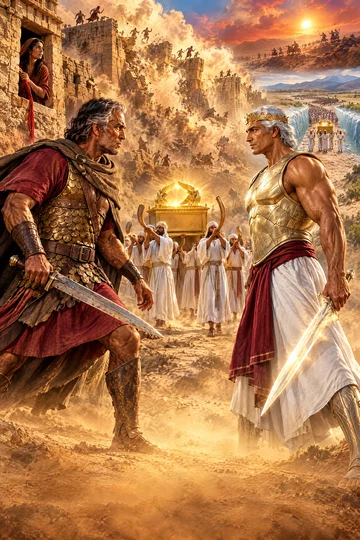
And it came to pass, when Joshua was by Jericho, that he lifted up his eyes and looked, and, behold, there stood a man over against him with his sword drawn in his hand: and Joshua went unto him, and said unto him, Art thou for us, or for our adversaries?
Joshua meets the commander of the Lord’s army before Jericho.
- Joshua 3:14-17
And it came to pass, when the people removed from their tents, to pass over Jordan, and the priests bearing the ark of the covenant before the people;
Israel crossed the Jordan by God’s command before circling Jericho.
- Joshua 6:15-16
And it came to pass on the seventh day, that they rose early about the dawning of the day, and compassed the city after the same manner seven times: only on that day they compassed the city seven times.
They describe the seventh-day march around Jericho and the command to shout.
- 1 Kings 16:34
In his days did Hiel the Beth-elite build Jericho: he laid the foundation thereof in Abiram his firstborn, and set up the gates thereof in his youngest son Segub, according to the word of the LORD, which he spake by Joshua the son of Nun.
Hiel’s rebuilding of Jericho fulfilled the curse spoken through Joshua.
- Joshua 2:1
And Joshua the son of Nun sent out of Shittim two men to spy secretly, saying, Go view the land, even Jericho. And they went, and came into an harlot’s house, named Rahab, and lodged there.
Spies first visit Jericho before Israel’s conquest.
- Joshua 6:26
And Joshua adjured them at that time, saying, Cursed be the man before the LORD, that riseth up and buildeth this city Jericho: he shall lay the foundation thereof in his firstborn, and in his youngest son shall he set up the gates of it.
curse followed the capture
- Joshua 4:19
And the people came up out of Jordan on the tenth day of the first month, and encamped in Gilgal, in the east border of Jericho.
Israel encamped at Gilgal before taking Jericho.
- Joshua 5:10
And the children of Israel encamped in Gilgal, and kept the passover on the fourteenth day of the month at even in the plains of Jericho.
Both events happened at Gilgal.
- Judges 7:17-18
And he said unto them, Look on me, and do likewise: and, behold, when I come to the outside of the camp, it shall be that, as I do, so shall ye do.
Both give battle plans to be obeyed.
Commentary
Each commentary is drawn from primary sources: the writings of Ellen G. White and Adventist pioneers and periodicals. Each commentary is separate. Its own words are not a quotation; follow the references to read the source passages.
Ellen G. White
33 sources
God through the Captain of the host instructed Joshua, withdrawn in prayer for guidance on taking Jericho as the first step in conquering Canaan, that all the men of war should circle the city once each day for six days with no assault, in simple obedience to His directions.PP 487.3PP 488.3–491.1PP 488.11SP 348.4–349.1Ms 36, 1885, par. 23–24 Israel carried it out in solemn order with an armed vanguard, seven priests with rams' horns, the ark bearing God's law as the sign of His presence and leadership, and the host tribe by tribe in silence, returning to camp until the seventh day of seven circuits and shouting.ST Apr 14, 1881PP 488.1SG4 63.14T 153.3–154.2ST Sep 2, 1880 The plan was foolishness by human military judgment against high and strong walls, yet no human hand threw them down, for Christ with His angels and the armies of heaven overthrew the city so that God alone would be glorified and no one could boast in human strength or wisdom.Lt 54, 1894, par. 18–19SG4 64.1–21SP 351.1–2ST Apr 14, 1881ST Jul 21, 1881 The long ceremony before the fall was purposed to increase faith, to teach Israel to put self out of the question and rely wholly on their divine Leader, and to prove that obedience, not ceremony or human methods, was the condition of victory.4T 162.4–163.1ST Apr 14, 18816T 140.1Lt 58, 1895, par. 22–25Ms 143, 1899, par. 22–23 The same test of implicit faith and obedience comes to Christians in spiritual warfare and to professed keepers of God's commandments now, who must obey simply under their great Captain rather than follow human reason and plans, lest like unbelieving Israel they fail to enter the heavenly Canaan.4T 162.4–163.1ST Apr 14, 1881ST Jul 21, 1881Lt 8a, 1896, par. 8–9Ms 32, 1897, par. 7–10
Command and Daily March
The instruction to circle the city was given to Joshua by the Captain of the host of the Lord, who was Christ Himself, after Joshua had withdrawn from the camp to meditate and pray for divine guidance because the reduction of Jericho was the first step in the conquest of Canaan.PP 487.31SP 348.4–349.1Ms 36, 1885, par. 23–24 It came together with the assurance that Jericho with its king and mighty men of valor had been given into his hand, and the work that followed was accomplished by Christ rather than by Joshua.PP 487.3Ms 36, 1885, par. 23–24 The course Christ Himself instructed was for all the men of war to compass the city once each day for six days, and on the seventh day to go around seven times.PP 487.31SP 348.4–349.1
The order was that all the men of war should march once around the city each day for six days, with no assault, as an act of obedience to God's directions rather than an attack by force or by their own skill.PP 488.3–491.1PP 488.1SG4 62.2–3Lt 24, 1888, par. 2 Israel carried out this first step while the walls remained standing, circling solemnly in preparation for the seventh day when they would circle seven times, the trumpets would sound, and the walls would fall.PP 488.3–491.1PP 488.1 The people were to follow God's simple instructions while God would bring down the walls and receive the glory, for the conquest depended not on Israel's military strength but on God's promise and power.PP 488.3–491.1Lt 24, 1888, par. 2
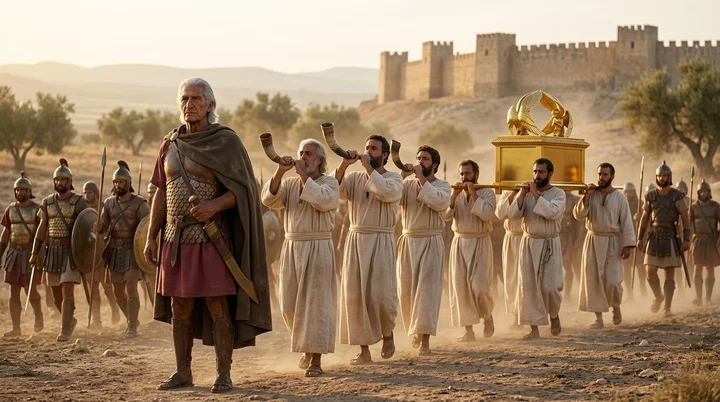
The circling was performed in solemn order as Israel marched out from Gilgal, its first encampment in the promised land to begin the conquest.ST Apr 14, 1881ST Jul 27, 1882PP 613.3–614.2 A chosen armed body went first, not to use skill in warfare but to believe and obey, followed by seven priests with trumpets of rams' horns, then the ark of God borne by priests in sacred dress and surrounded by a halo of divine glory, then the vast army following in perfect order tribe by tribe each under its standard.ST Apr 14, 1881SG4 63.1 There was no sound but the tread of the host and the solemn peal of the trumpets echoing among the hills and through the streets, in pomp and majesty, and after completing the circuit the army returned silently to camp.ST Apr 14, 1881PP 488.1SG4 63.1 For six days the circuit was performed this way to prepare for the seventh day of seven circuits, trumpet sounding and shouting when the walls fell.ST Apr 14, 1881PP 488.3–491.1
The daily circuit in its mysterious majesty struck the watchmen, priests, rulers and people of Jericho with wonder, alarm, terror and awe as they marked every move and could not understand its purpose.ST Apr 14, 18814T 160.2SG4 63.1 Many ridiculed the manner of attack and any harm from it, while others were awed by the ark and the solemn procession and trusted their high, strong, firm walls to resist, keeping the gates tightly shut and carefully guarded by mighty warriors at each gate.ST Apr 14, 1881SG4 64.1–2ST Oct 19, 18881SP 351.1–2SG4 63.1 Some remembered the Red Sea parted forty years before and the passage just prepared through the Jordan.SG4 63.1 When the walls suddenly tottered and fell flat with a crash like loudest thunder, terror left the people paralyzed and unable to fight or resist.SG4 64.1–2ST Oct 19, 18881SP 351.1–2
One account describes the priests bearing the ark about the city in solemn silence going round once each day for seven days, then the trumpets pealing and the people giving a great shout, after which the massive walls fell flat upon the earth.ST Dec 22, 1881 It was a wonder wrought by God when the ark went before the people and a glorious triumph that Israel afterward remembered as proof of victory through the ark.ST Dec 22, 1881 The ark containing God's law and borne around the city was the symbol of God Himself, of His own presence, promise and appointed leadership going with Israel under His watchful direction and care, so that no harm could come to them.4T 153.3–154.2ST Sep 2, 18801SP 402.3–403.1 The easy victory did not come from merely having the ark present but from obedience to the law contained in it, a point Israel later forgot when it remembered bearing the ark at Jericho and at the passage over Jordan and wrongly supposed that bringing the ark into battle alone would give triumph over the Philistines.ST Sep 2, 18801SP 402.3–403.1
Victory Through Divine Power
To human military judgment the order to circle the city once a day for six days was unscientific and inconsistent, with no scientific method or skill in warfare in it.Lt 54, 1894, par. 18–19ST Apr 14, 1881PP 492.3–493.1 Its simple agency and long-continued ceremony looked like unmeaning, meaningless and ridiculous movements, humanly powerless against strong and towering fortifications.Lt 54, 1894, par. 18–19ST Apr 14, 1881ST Jul 21, 1881PP 492.3–493.1 The principles and modes of working it embodied were widely different from the maxims and customs of the world, so that no heathen general ever waged war this way and the proud and worldly-wise would despise it.Lt 54, 1894, par. 18–19ST Apr 14, 1881ST Jul 21, 1881
The conquest did not depend on Israel's military strength, wisdom or might but on God's promise, power and battle plan.SG4 64.1–21SP 351.1–2Lt 8a, 1896, par. 8–9Lt 63, 1895, par. 34–38 Christ, the Captain of the Lord's host, with His angels and the armies of heaven threw down the walls and prepared an entrance for Israel, so that not a human hand touched the city or its walls.SG4 64.1–21SP 351.1–2Lt 58, 1895, par. 22–25Lt 8a, 1896, par. 8–9Lt 63, 1895, par. 34–38 God directed the battle and led both heavenly and human agents while human agents carried out only their assigned part.Lt 58, 1895, par. 22–25Lt 63, 1895, par. 34–38Ms 32, 1897, par. 7–10 Those same heavenly armies will do many things now if men move in accordance with His will, obey their great Captain, and give God a chance to work.Ms 32, 1897, par. 7–10
God made the order so plain and simple and united human and heavenly agencies in such a way that no person could take credit, boast of overcoming the city by human power, strength or talent, or take the victory to himself.Lt 58, 1895, par. 22–25Ms 143, 1899, par. 22–233MR 21.1–22.3Ms 40a, 1890, par. 65–67 No human being is to take glory for the work accomplished but God alone was to be glorified and magnified, to keep men from lifting themselves up in pride of intellect.Lt 54, 1894, par. 18–19Lt 58, 1895, par. 22–25Ms 143, 1899, par. 22–23Lt 63, 1895, par. 34–38Ms 40a, 1890, par. 65–67 God Himself, the mighty General of armies and great I AM, planned how Jericho would be taken and how His work should be done, and lest man take the victory to himself no human hand was to bring down the walls.Ms 143, 1899, par. 22–23Lt 8a, 1896, par. 8–9 He can accomplish great things through simple means when men follow His directions and trust Him to do what they cannot.3MR 21.1–22.3Ms 40a, 1890, par. 65–67
Every human being must understand that capabilities and endowments are from the Lord, who plans how His work shall be done, instructs His servants, and works through whom He will without consulting human preferences about who shall bring His message.Lt 54, 1894, par. 18–19Ms 143, 1899, par. 22–23 He will use men of highest intelligence if they let Him mold them as well as men high or low, learned or ignorant, if willing to be used.Lt 54, 1894, par. 18–19 Human beings desire too much power and control and feel qualified for the highest place, but the managing work belongs in God's hands, and man's work is to obey His voice and let Him manage and guard His own work.Lt 54, 1894, par. 18–19Ms 143, 1899, par. 22–23
Continuing the ceremony so long before the overthrow was purposed to give time and opportunity for increase and development of faith.4T 162.4–163.1ST Apr 14, 1881PP 492.3–493.1 It was meant to impress thoroughly that the land was not to be gained by warfare in their own might and will but only by the God of salvation, whose strength rather than human wisdom or might gives success.ST Apr 14, 18814T 148.3PP 492.3–493.1ST Sep 2, 1880 It was meant to accustom Israel to put self out of the question and rely wholly on their divine Leader in submission and unqualified obedience, in contrast to going up without God's command, without the ark containing His law as the symbol of His presence, promise and appointed leadership, and without Moses and Aaron conducting the expedition under His watchful direction.ST Apr 14, 1881PP 492.3–493.1ST Sep 2, 1880 Obedience, not ceremony or human methods, was the condition of victory, and the miracle strengthened faith in God's power to subdue enemies and rebuked former unbelief.SG4 64.1–24T 162.4–163.11SP 351.1–26T 140.1
Faithful Obedience for Today
The circling of the city once a day for six days was a test of faith and obedience delivered through Joshua alone.4T 162.4–163.1ST Apr 14, 1881PP 492.3–493.1 The Captain of the Lord's host revealed Himself only to Joshua, so the congregation had to believe Joshua's report of what had been revealed to him and follow commands given in the Captain's name.ST Apr 14, 1881PP 492.3–493.1 They could not see the host of angels marshaled under the Son of God leading their van, yet they had to choose whether to trust and obey or to doubt, rebel and deny his authority.4T 162.4–163.1ST Apr 14, 1881PP 492.3–493.1 The long continuance of the ceremony before the overthrow was purposed to afford opportunity for increase of faith.4T 162.4–163.1ST Apr 14, 1881PP 492.3–493.1 It was meant to impress thoroughly that strength is not in the wisdom of man nor in his might but only in the God of salvation, and to accustom Israel to put self out of the question and rely wholly upon their divine Leader.4T 162.4–163.1ST Apr 14, 1881PP 492.3–493.1
God's commands must be implicitly obeyed irrespective of the world's opinion.ST Jul 21, 1881 His principles and modes of working are widely different from the maxims and customs of the world, and no heathen general ever conducted warfare this way.ST Jul 21, 1881 The order to have all the men of war go around Jericho once a day for six days was a simple agency that the proud and worldly-wise would despise.ST Apr 14, 1881ST Jul 21, 1881PP 492.3–493.1 Yet humble trust in God and faithful obedience are as essential to the Christian in waging spiritual warfare as they were at Jericho.ST Jul 21, 1881 The only sure ground of success is the help of God working with human effort, and such a victory glorifies God's name, strengthens faith, and brings enemies to shame and confusion.ST Jul 21, 1881
The same lack of faith is tested in professed keepers of God's commandments upon whom the ends of the world are come.ST Apr 14, 1881 They must let supreme duty wield authority over human reason and obey simply instead of following their own plans.ST Apr 14, 1881 They are not to seek ways that reflect glory on self, nor to question how a mighty city could be conquered thus or how the work can be done thus.ST Apr 14, 1881 Lest like unbelieving Israel they lose heavenly Canaan, as rebellious Israel failed to enter earthly Canaan.ST Apr 14, 1881
The capture of Jericho as the key to Canaan was to be kept fresh in memory and retold to children as an exhibition of God's power.Lt 8a, 1896, par. 8–9 The victory was not devised by a human general or achieved by human strength, for the Captain of the Lord's host gave the orders and not a human hand touched the city or its walls.Lt 8a, 1896, par. 8–9Ms 32, 1897, par. 7–10 The city was compassed in obedience to God, and the victory was wrought by the armies of the Lord's host under their heavenly General.Ms 32, 1897, par. 7–10 God works in His own way when men move in accordance with His will and obey their great Captain, and those same heavenly armies will do many things now if men obey and give God a chance to work.Ms 32, 1897, par. 7–10
Sources
Pioneers and periodicals
74 sources
God commanded all the men of war to circle Jericho once each day for six days as the first part of a seven-day sequence ending with seven circuits, trumpet blowing, and shouting on the seventh day.RH Jan 21, 1862RH Apr 21, 1851ST Jul 6, 1915 The circuit was made in solemn order with the ark of God at the center, armed men going first, then seven priests with rams'-horn trumpets, then the ark borne by priests, with the army following tribe by tribe in perfect order to the sound of the trumpets.ST Apr 14, 1881ST Dec 22, 1881RH Nov 5, 1903 It was no military assault, for Israel struck no blow and the massive walls were thrown down by God and His invisible angels, showing the land was given by His power and not won by Israel's prowess.ST Mar 21, 1911ST Mar 20, 1901 The strength of the march lay not in the ark as wood overlaid with gold but in what it housed, the law of God, and victory came while Israel cherished His law and obeyed by faith before any sign of the walls falling.RH Nov 22, 1906ST Jun 30, 1898ST Jun 10, 1875RH Aug 28, 1856 The six days of circling belong to seven successive days of marching, so one day must have been the Sabbath, yet marching with the ark under God's express command did not break the Sabbath law kept in the ark, because the commandment forbids one's own work and not worship and obedience God appoints, though those who held the opposite position taught the seven days are the days of the compassing itself and not days of the week, with no proof Jericho was taken on the weekly Sabbath.RH Jan 21, 1862RH Jul 27, 1876RH Oct 15, 1872ST Dec 21, 1888RH Oct 15, 1872
Narrative Context and March
The command belongs to the continuing conversation between the Captain of the Lord's host and Joshua begun in chapter five, with chapter 6 verse 1 standing as a parenthesis that does not interrupt it.RH Jan 8, 1861 It is God's direct command given through Joshua, revealed to Joshua alone, so that the congregation had to believe his words and follow commands given in the Captain's name or rebel and deny his authority.ST Apr 14, 1881RH Sep 21, 1916
All the men of war were commanded to compass the city and go round about it once each day for six days.RH Jan 21, 1862RH Apr 21, 1851RH Apr 28, 1853 This was the first part of a seven-day sequence ordered directly by God, ending on the seventh day with seven circuits, trumpet blowing, and shouting, thirteen circuits in all.ST Jul 6, 1915RH Apr 28, 1853 The whole army took part in the procession, not only the men of war, with the people obeying despite the plan seeming foolish by human reasoning and trusting God's word for the promised victory.RH Sep 8, 1904 The order met Israel at its first obstacle on entering the promised land of rest, a mighty walled city that had discouraged the spies forty years before, after God had declared He had given them Jericho with its king and mighty men of valor.
The circuit was carried out in solemn order with the ark of God taking the central place.ST Apr 14, 1881ST Dec 22, 1881RH Nov 5, 1903 A chosen body of armed men went first, not to use skill in warfare but to believe and obey, followed by seven priests with rams'-horn trumpets, then the ark borne by priests in sacred dress and surrounded by a halo of divine glory, with the vast army following in perfect order tribe by tribe each under its standard.ST Apr 14, 1881 They compassed the city with the ark once each day in pomp and majesty, with no sound but the tread of the host and the solemn peal of the trumpets echoing among the hills and through the streets.ST Apr 14, 1881 Appointed leaders directed the people under divine supervision, with the ark containing God's law going before the army as the pledge that He would go with them.RH Nov 5, 1903 The priests as chief campaigners stayed with the people through the campaign, and Joshua with the priests lodged among them and went with them into the work.RH Nov 16, 1905
Jericho was the first city in Canaan taken by Israel, about forty years after the exodus from Egypt, after crossing the Jordan and marching out from Gilgal, the first encampment in the promised land.ST Jul 27, 1882RH Aug 24, 1905RH Aug 28, 1856 This was before the tabernacle was set up at Shiloh while Israel and the sanctuary still had no permanent abiding place, and before Achan's sin and the defeat at Ai.RH Aug 28, 1856 It was a leading city second only to Jerusalem, a city of Benjamin about twenty miles northeast of Jerusalem and about six miles from the Jordan amid its fertile plain, appointed to utter destruction which overtook it at Joshua's hands after a most remarkable siege ending in the overthrow of its walls by faith.RH Aug 24, 1905 Its walled cities could not prevent God from giving Israel the land, for Israel already had ample evidence of His power in the overthrow of Pharaoh and the crossing of the Red Sea.ST May 13, 1889 The taking belongs to the Hebrew invasion of Canaan in the fifteenth century before Christ, when Babylonian was the language of diplomacy and Canaanite kings kept up written correspondence with Egypt.RH Aug 31, 1905 The Habiri described in the Tel el-Amarna letters as making inroads into the country, against whom Abdi-Hiba of Jerusalem and other rulers begged Egypt to send troops lest the king's land be lost, are the Hebrews carrying out this conquest, who could take Canaan while the land was disturbed and its peoples weakened by conflict.RH Aug 4, 1910RH Aug 31, 1905
For six days the daily march and trumpet blasts continued while Jericho's gates stayed shut, carefully closed and guarded by mighty warriors.ST Apr 14, 1881ST Mar 20, 1901 Its mysterious majesty struck wonder, alarm, terror, and awe into its watchmen, priests, and people as they watched.ST Apr 14, 1881 Many ridiculed any harm from it and others trusted their strong defenses and felt secure because of their strong walls.ST Apr 14, 1881ST Oct 19, 1888 Those six days were the closing time in which its people could still open the gates and receive God's people.ST Mar 20, 1901 When the walls suddenly fell their defenses could not protect them, leaving them terrified and unable to resist.ST Oct 19, 1888
Divine Power and Ark
The march around Jericho was no military assault, for Israel struck no blow and won nothing by fighting but only marched as directed while God brought down the walls and conquered the people.ST Mar 20, 1901ST Oct 20, 1914RH May 29, 1913 The city fell to a weaponless obedience, its massive walls leveled by God's invisible and invincible army, with angels tearing them down after the shout.ST Mar 21, 1911ST Mar 10, 1909 This showed that Canaan was given to Israel by God rather than won by their own prowess, and its fall at the beginning pledged that continued obedience, zeal, service and consecration would prepare the way for God to give deliverance and victory throughout the conquest.ST Mar 20, 1901ST Mar 10, 1909RH May 29, 1913 It might have been saved had it opened its gates to God's hosts, but the walls fell when the opportunity had passed.
The ark of the covenant accompanied the procession and held the central and conspicuous place in the capture as the visible sign of God's presence and strength.RH Apr 21, 1851RH Feb 24, 1910 The priests bore it about the city in solemn silence once each day, and on the seventh day the men of war circled seven times until at the final circuit the ram-horn trumpets blew and the people shouted and the wall fell.ST Dec 22, 1881RH Apr 21, 1851RH Feb 24, 1910 Israel triumphed because it had the ark with it, and afterward remembered the wonder wrought when the ark went before the people as proof of victory through the ark.ST Dec 22, 1881 He had promised to go with them to take the city, the ark containing His law went before the army, and appointed leaders directed the people under divine supervision.RH Nov 5, 1903
The strength of that marching did not lie in the ark as a chest of wood to be treated as a charm, but in what was inside it, the law of God.ST Jun 30, 1898ST Jun 10, 1875ST Jun 30, 1898 That law, including the fourth commandment, was spoken at Sinai amid smoke, lightning and thunder, engraved by God's finger on tables of stone, housed in an ark overlaid with pure gold and set in the Most Holy Place as the center of Israel's religious system and glory.RH Dec 20, 1853RH Aug 11, 1853 The same presence that divided the waters of the Jordan gave victory at Jericho while Israel cherished His law and mercy and shouted victory by faith, so that towering walls fell flat amid a mighty shout and crumbled in its presence.ST Jun 10, 1875ST Jun 30, 1898 Yet its presence could not ensure success when people and priests were unrighteous and continued in sin while wrongly relying on it, as when Israel was defeated by the Philistines and the ark was taken and Hophni and Phinehas were killed.ST Jun 30, 1898RH Aug 28, 1856 Keeping that same law gives certain triumph to the remnant in the latter days who refuse the mark of the beast, and God's power attended Israel when they went forward with it across Jordan, around Jericho, and out to battle.ST Jun 10, 1875RH Aug 11, 1853
Jericho was the first-fruits of the land, devoted wholly to God, and Christ the Captain of the Lord's host with His angels gave Joshua victory and possession of the city as part of Israel's gradual possession of the promised land.ST Mar 20, 1901ST Jan 23, 1907 Its fall was one step in God's leading from bondage in Egypt, through defense in leaving Egypt, overthrow of Pharaoh, passage of the Red Sea, guidance through the wilderness, manna, water from the rock, defeat of Amalek, and stopping of the Jordan, until He threw down the ramparts of Jericho.ST May 13, 1889RH Nov 21, 1854 That overthrow put the heathen rulers to flight and drove the nations asunder, opening the way to possess the vine-clad hills, vales, water-brooks, springs, and milk and honey of Canaan.RH Nov 21, 1854 Its walled cities could not prevent God's people from doing what He wanted, for He led them with a strong arm, and He drives out enemies when they believe and follow Him, as He would have done for Judah against the inhabitants of the valleys had they trusted Him.RH Oct 8, 1908ST May 13, 1889ST May 27, 1913
Sabbath Observance Dispute
The order to compass the city once a day for six days belongs to seven successive days of marching ending with seven circuits on the seventh day, so one of those days must have been the Sabbath and Israel encompassed the city on every day of the week.RH Jan 21, 1862RH Feb 3, 1852ST Dec 21, 1888RH Jun 19, 1856ST Nov 10, 1914 The full seven-day procession with the ark and priests bearing rams'-horn trumpets was ordered directly by God, and the fighting men marched as commanded through the week including on the Sabbath.RH Jan 21, 1862RH Jul 27, 1876RH May 12, 1868RH Nov 15, 1864RH Dec 20, 1864 The command came forty years after the Sabbath law was given at Sinai, so its occurrence during the march does not prove that no day had been assigned as holy.RH Apr 28, 1853RH May 12, 1868RH Nov 15, 1864
Marching around Jericho on the Sabbath under God's express command did not violate the Sabbath law kept in the ark, because the fourth commandment forbids doing one's own work, not doing work God appoints.RH Jul 27, 1876ST Dec 21, 1888RH May 12, 1868RH Dec 20, 1864RH Jun 19, 1856 The march was worship and obedience in following the ark of the Lord rather than fighting or breaking down the walls, for angels brought the walls down after the shout.RH Jan 21, 1862ST Dec 21, 1888ST Nov 10, 1914 As with ordinances God gave that could involve labor on the Sabbath without transgression, work He directly commands for that day is not a violation of the Sabbath.RH Jan 21, 1862RH Jul 27, 1876RH Jun 19, 1856
Marching on the seventh day by divine command does not mean the Sabbath was abolished at Jericho less than forty years after the Decalogue was written on tables of stone.RH Apr 28, 1853RH May 12, 1868RH Nov 15, 1864 Traveling by the Lord's command before the manna was given does not prove the Sabbath was not then binding, and the same logic would wrongly abolish it at Jericho.RH Apr 28, 1853RH Nov 15, 1864 Joshua's action after entering Canaan does not mean Christ would abolish the Sabbath before believers enter the heavenly Canaan, for that entry is still future.RH Jan 21, 1862RH May 12, 1868
The Sabbath occurred during the week of marching but the capture need not have happened on that day.RH Jan 21, 1862ST Dec 21, 1888ST Nov 10, 1914 The destruction probably began only after sundown on the seventh day, and the account does not establish whether the final day of marching was the Sabbath.RH Jan 21, 1862ST Dec 21, 1888ST Nov 10, 1914 Those who held that God set aside an older law by a later conflicting command used the account as an example of His commanding compassing and spoiling on the Sabbath.RH Oct 15, 1872 The opposite teaching holds that the seven days are the days of the compassing itself, not days of the week, like the first and seventh days of the feasts, with no evidence or reasonable inference that Jericho was taken on the weekly Sabbath and therefore no contrast between Sabbath and circumcision and no example of Sabbath-breaking, while the record of marching for six days bears on proving what day of true time the Jews observed as Sabbath.RH Oct 15, 1872RH Oct 15, 1872RH Oct 29, 1872
Faith Obedience and Grace
The marching around Jericho illustrates faith and the victory that faith brings.RH Nov 22, 1906RH Sep 8, 1904 The order to have all the men of war circle the city once a day for six days belonged to the ordered march with trumpets leading to the great shout on the seventh day when the wall would fall flat, meeting Israel at the first obstacle on entering the promised land of rest, a mighty walled city that had discouraged the spies forty years before after God had declared He had given Jericho with its king and mighty men of valor. Their obedience and shout were active faith in the promised victory before any visible sign that the walls would fall, daring to claim victory on God's word alone while no sign appeared, laughing at prudence that would wait to shout until the walls fell, and God acted according to that faith to bring the victory to pass.ST Jul 6, 1915RH Sep 8, 1904ST Nov 17, 1898ST Nov 17, 1898 Their marching was active obedience and the work of faith, trusting God's word rather than weapons to break the wall, with the whole procession including the people and not only the men of war.RH Sep 8, 1904ST Nov 17, 1898ST Nov 17, 1898
God gave a precise plan to be followed exactly, together, and on the days and times He appointed.RH Feb 6, 1879RH Aug 12, 1902 The men of war were to circle once each day for six days and then follow the further instruction for the seventh day, with the whole community and all its strength in prompt, unquestioning obedience rather than substituting human ideas.RH Feb 6, 1879RH Aug 12, 1902 Marching at the commanded time called for courage and faith, for acting on their own schedule would have meant marching without the angels' cooperation. Failure to obey such a plan would be Israel's own fault and not a defect in God's design, while the taking of Jericho shows that a great undertaking can be carried out in God's strength and that biblical events instruct later work.RH Feb 6, 1879RH Dec 18, 1900
The order looked like unmeaning movements and a ridiculous performance with no effect upon strong and towering fortifications.ST Apr 14, 1881RH Oct 17, 1907 By ordinary military standards and human reasoning it seemed foolish and absurd, an apparently weak instrumentality and simple agency that the proud and worldly-wise would despise.ST Jul 21, 1881RH Sep 8, 1904RH Oct 17, 1907ST May 6, 1875 Yet God accomplished a mighty result through this feeble human means, as with the weapons of the siege and the press in many languages.RH Sep 8, 1904ST May 6, 1875 Joshua followed the instructions despite no outward sign that the city would fall, with obedience resting on God's promise to give Jericho into his hand, and the outcome showed that trusting and following God's instructions was sound.RH Oct 17, 1907
Continuing the ceremony so long before the final overthrow was purposed to afford opportunity for increase of faith.ST Apr 14, 1881 It was to impress thoroughly that strength is not in the wisdom of man nor in his might but only in the God of salvation, and to accustom Israel to put self out of the question and rely wholly upon their divine Leader.ST Apr 14, 1881 The command tests professed keepers of God's commandments upon whom the ends of the world are come, who must let supreme duty wield authority over human reason and obey simply instead of following their own plans, seeking ways that reflect glory on self, or questioning how a mighty city could be conquered thus, lest like unbelieving Israel they lose heavenly Canaan as rebellious Israel failed to enter earthly Canaan.ST Apr 14, 1881 God's principles and modes of working are widely different from the maxims and customs of the world, and no heathen general ever conducted warfare this way, so His commands must be implicitly obeyed irrespective of the world's opinion.ST Apr 14, 1881ST Jul 21, 1881
Miracle-working power and blessing come from God while responsibility for having it done rests on the human agent, for God does nothing without human cooperation. Obedience showed faith while God supplied the power and blessing, with the people circling thirteen times in all through marching, blowing trumpets, and shouting.ST Jul 6, 1915 Although grace brought down the walls, they would never have fallen if Israel had neglected the commanded action, since grace did not do for them what God had told them to do.ST Apr 19, 1883ST Nov 15, 1883
Israel's course was marked by faith, persistence, order, and earnestness, with preparation made and going out early on the decisive morning.RH Mar 21, 1912 They did not win by fighting but by following God's directions.RH May 29, 1913 Their continued obedience, zeal, service, and consecration prepared the way for God to accomplish the victory.RH Mar 21, 1912RH May 29, 1913
Mercy Probation and Judgment
The daily circling of Jericho once a day for six days with priests and the invisible army of God accompanying Israel was a weaponless appeal to turn from disobedience and accept Him.ST Mar 20, 1901ST Oct 8, 1902 Those six days of march and trumpet blasts while the gates stayed shut were the closing time in which the inhabitants could still open the gates and welcome and receive God's people and yield to His mercy.ST Mar 20, 1901ST Oct 8, 1902 The destruction came only after that opportunity had passed.ST Oct 8, 1902
Jericho was the first-fruits of the land, devoted wholly to God and appointed to utter destruction, and that judgment overtook it at the hands of Joshua.ST Mar 20, 1901RH Aug 24, 1905 Each march offered opportunity, but hearts grew harder until the walls fell. Only Rahab and her household were saved.
The overthrow of its walls by faith through God's invincible army pledged that the same power would give deliverance and victory throughout the conquest of the land if Israel obeyed God.ST Mar 10, 1909ST Jan 22, 1894ST Mar 10, 1909 Wholly obeyed with no Achan allowed in the camp, the victory at Jericho could have become victory throughout the land, the seven nations destroyed, God's power made known to the world, the disobedient finally destroyed, and Satan's kingdom brought to an end.ST Jan 22, 1894 Instead Achan's covetousness and disobedience after Jericho fell brought defeat and shame on Israel at Ai, and once he was punished and the camp purged victory returned and the people continued their conquest through the valley.ST Feb 14, 1906 Complicity with evil brings weakness and defeat, so the call to gather converts for entry into the heavenly Canaan must include only those truly converted, since unfaithful members would bring defeat as Achan did.ST Feb 14, 1906RH Apr 3, 1913 The Valley of Achor means trouble and recalls that defeat and judgment, yet trouble can become a door of hope when God's people learn from it and remove the evil.ST Feb 14, 1906
Applications and Parallels
The circling of Jericho once a day for six days was the ordered march that met Israel at its first obstacle on entering the promised land of rest, a mighty walled city that had discouraged the spies forty years before after God had declared He had given Israel Jericho with its king and mighty men of valor, with trumpets of testimony leading to the great shout on the seventh day when the wall would fall flat and each man would go straight in.RH Jan 28, 1902 That marching reveals in type the secret of Christian warfare that turns warfare into triumphal progress, the shout of a faith that dares to claim a promised victory on the authority of God's word alone while no sign of victory appears, laughing at prudence that would wait to shout until the walls fall, and God acts according to that faith to bring the victory to pass. God's principles and modes of working are widely different from the maxims and customs of the world, and no heathen general ever conducted warfare by such simple agency, which the proud and worldly-wise would despise, yet the only sure ground of success is the help of God working with human effort, so that the victory glorified God's name, strengthened Israel's faith, and brought enemies to shame and confusion.ST Jul 21, 1881 Humble trust in God and faithful obedience are therefore as essential to the Christian in waging spiritual warfare as they were at Jericho, for obstacles entrenched like a walled city can be overcome as Jericho fell, with God's grace enabling people to drive out sins and overcome temptation, unbelief, and iniquity by pressing on in faith and trusting the victory already gained in Jesus rather than waiting for every difficulty to be removed.ST Jul 21, 1881RH Jan 28, 1902ST Feb 11, 1889
Christ gives that same complete victory over wrong such as the tobacco habit when conviction is met right there and then with full purpose of heart and whole-soul dependence on the grace of Christ.ST Nov 29, 1910 Temporizing with the wrong and yielding to it again and again keeps the appetite alive, holds victory only for a while and then brings defeat, and God lets the appetite remain to trouble until all compromise and temporizing is utterly abandoned and the whole soul is cast upon God.ST Nov 29, 1910 Walking around the walls of Jericho is obeying whatever God commands without fear, showing implicit faith in God's promises and confidence in His word to do anything He asks without being disheartened or afraid even when it seems difficult or unlikely. Though naturally the weakest people that have ever lived, those who now form the habit of obedience by doing successfully the things God calls for today will as the one hundred and forty-four thousand stand calmly trusting in God through scorching heat, earthquakes, darkened nature, and hail while others hide in fear, as Israel of old crossed the Red Sea, passed over the Jordan, and circled Jericho if God so commanded. Marching around Jericho with the ark once a day for six days, after which the towering walls fell flat amid a mighty shout, shows Israel triumphed because it had the ark, whose strength lay not in a chest of wood but in what was inside it, the law of God, and the same presence that divided the waters of Jordan gave victory at Jericho, while keeping that same law gives certain triumph to the remnant in the latter days who refuse the mark of the beast.ST Jun 10, 1875
Taking Jericho is applied to entering the great cities of the world to warn their people and gather the honest before the end, for God sends messengers even for one person seeking light.RH Sep 21, 1916 The closing gospel work will be finished speedily and brought to its glorious consummation by an aggressive missionary campaign such as never has been seen, embracing every believer from the oldest pioneer to little children giving out papers and tracts in whole-hearted consecration and complete surrender for service, when Joshua took all the people with him and organized them from least to greatest for the finishing of the conflict.RH Oct 29, 1914 Joining the humble, despised canvassing work is like taking a place in that advancing army against Jericho, a humble means through which God will awaken His people and proclaim the last message despite the obstacles faced by God's advancing work. Breaking down prejudice by medical missionary work is as the march brought down walls, spreading truth in Europe by the press goes forward despite severe toil in many languages, and the march continued until the walls fell on the final day as an image of persistent prayer for New England.RH Aug 3, 1876RH Oct 29, 1914 Reformers in Scotland going around Jericho while sounding trumpets could not resist their enemies by their own strength, so they went forward trusting God to give them strength and victory by His power, and faithful people awaiting God's direction and judgment might likewise march around treason, going forward trusting God's power rather than their own strength while sounding trumpets.RH Sep 23, 1862
After Moses was permitted to lead Israel only to the border of Canaan, God found in Joshua a man to meet the crisis to lead Israel across Jordan with the walls of Jericho falling before him, proving that in every crisis in history the Lord has a willing people to meet the issue.RH May 13, 1915 He promised to go with Israel with His presence, promise, and appointed leadership, with the ark containing His law as the symbol of Himself and with Moses and Aaron conducting the expedition under His watchful direction, so that no harm could come to them.ST Sep 2, 1880 The land was not to be gained by warfare in their own might and will but through submission and unqualified obedience to His commands, in contrast to going up without God's command, without the ark, and without Moses.ST Sep 2, 1880 The priests were the chief campaigners in taking Jericho, with Joshua and the priests remaining with the people through the campaign around the city, lodging among them and going with them into the work, giving church officers an example of leadership that stays with the flock and takes its place in front.RH Nov 16, 1905 The capture belongs to the connected story from the building of the tabernacle through Samuel, coming after the death of Moses and the crossing of the Jordan and before the sin of Achan and the defeat at Ai, told to children with wars and intricate narrations needed only for adults left out and practical moral lessons woven in where a child could not draw them alone, to teach children about fighting battles against evil and winning the battle of faith.RH Nov 17, 1910RH Apr 28, 1904
Sources